


 Скачать презентацию Rushing Through the Implementation Pipeline Hypertension Self-Management Hayden
93424c676467eed880d1ce7f0418f264.ppt
- Количество слайдов: 31
 Rushing Through the Implementation Pipeline: Hypertension Self-Management Hayden B. Bosworth, Ph. D. George L. Jackson, Ph. D. , MHA Ben J. Powers, MD, MHS Center for Health Services Research in Primary Care Durham VA Medical Center VA Quality Enhancement Research Initiative (QUERI) 2008 Annual Meeting
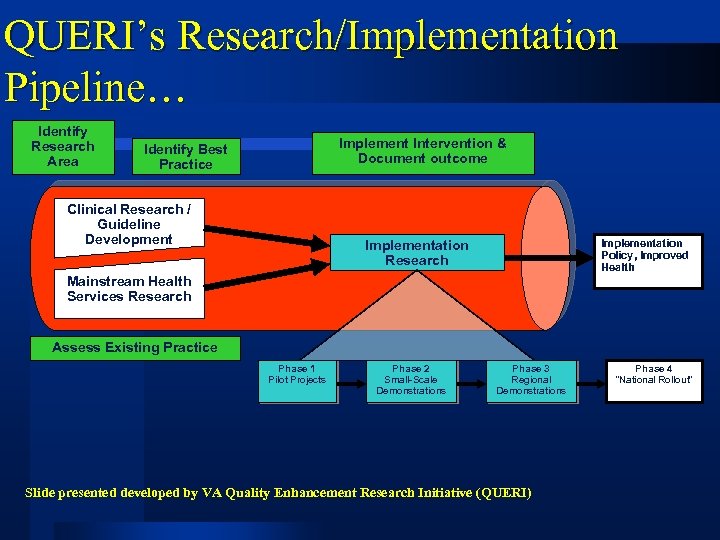 QUERI’s Research/Implementation Pipeline… Identify Research Area Implement Intervention & Document outcome Identify Best Practice Clinical Research / Guideline Development Implementation Research Implementation Policy, Improved Health Mainstream Health Services Research Assess Existing Practice Phase 1 Pilot Projects Phase 2 Small-Scale Demonstrations Phase 3 Regional Demonstrations Slide presented developed by VA Quality Enhancement Research Initiative (QUERI) Phase 4 “National Rollout”
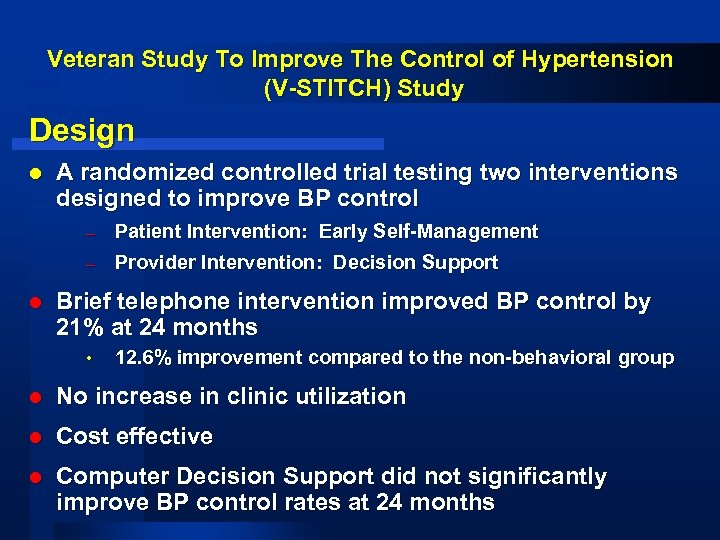 Veteran Study To Improve The Control of Hypertension (V-STITCH) Study Design l A randomized controlled trial testing two interventions designed to improve BP control – – l Patient Intervention: Early Self-Management Provider Intervention: Decision Support Brief telephone intervention improved BP control by 21% at 24 months • 12. 6% improvement compared to the non-behavioral group l No increase in clinic utilization l Cost effective l Computer Decision Support did not significantly improve BP control rates at 24 months
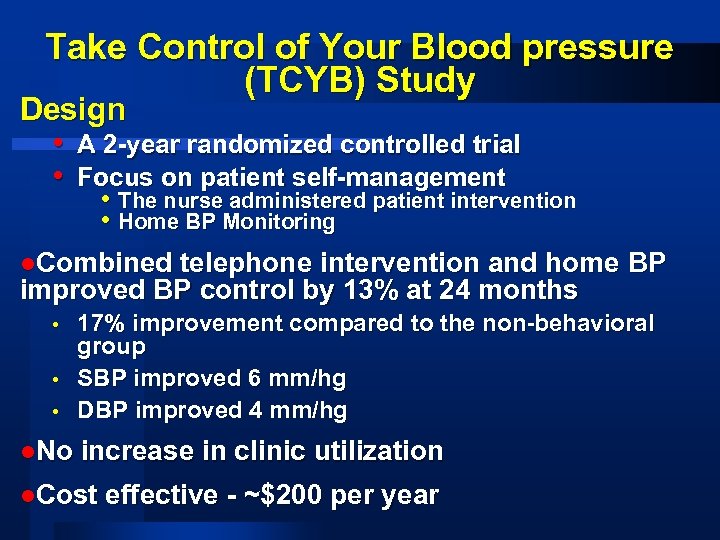 Take Control of Your Blood pressure (TCYB) Study Design • A 2 -year randomized controlled trial • Focus on patient self-management • The nurse administered patient intervention • Home BP Monitoring l. Combined telephone intervention and home BP improved BP control by 13% at 24 months • • • l. No 17% improvement compared to the non-behavioral group SBP improved 6 mm/hg DBP improved 4 mm/hg increase in clinic utilization l. Cost effective - ~$200 per year
 Hypertension Intervention Nurse Telemedicine Study (HINTS) Design • A 18 month randomized controlled trial • Focus on patient self-management • The nurse administered patient intervention • Home BP Monitoring • Medication management by MDs l. Completed recruitment • 600 patients • 50% recruitment rate • > 90% 12 -motnth retention • 50% African American • 45% have diabetes
 Telephone Intervention l Behavioral interventions to enhance hypertension control l Intervention implemented in nontraditional setting - outside of the clinic, easily administered via the telephone l Delivered by nurses or other clinicians l Tailoring the intervention to patients’ needs - this ensures a more cost efficient method of implementing the intervention l Multiple hypertension-related behaviors addressed l Software allows the integration of patient, medical records, and provider information l Emphasis on cultural issues related to hypertension
 HTN IMPROVE: Quality Improvement Project Hypertension Telemedicine Nurse Implementation Project for Veterans
 In the Pipeline – Summary of HTN-IMPROVE l The study is addressing four specific aims: – 1) Assess the implementation of an evidencebased behavioral intervention to improve BP levels. – 2) Evaluate the clinical impact of the intervention to promote and improve BP levels as it is implemented. – 3) Assess the organizational factors associated with the sustainability of the intervention to improve BP levels. – 4) Assess the cost of the intervention to improve BP levels as it is implemented by VA facilities.
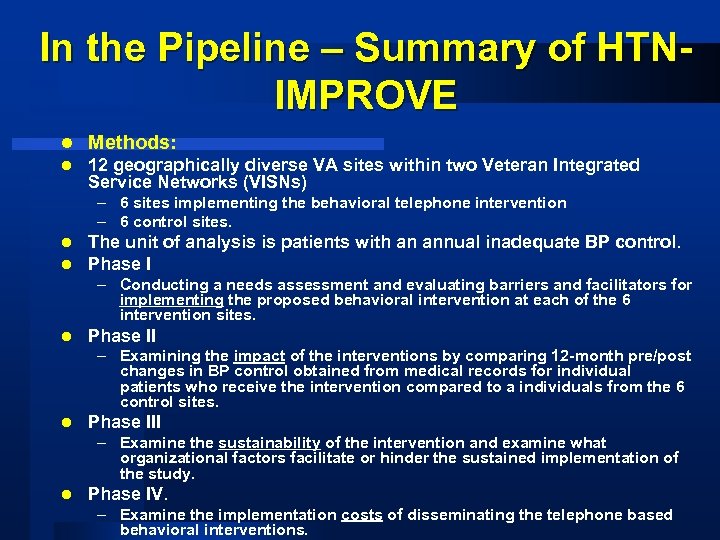 In the Pipeline – Summary of HTNIMPROVE l Methods: l 12 geographically diverse VA sites within two Veteran Integrated Service Networks (VISNs) – 6 sites implementing the behavioral telephone intervention – 6 control sites. l l The unit of analysis is patients with an annual inadequate BP control. Phase I – Conducting a needs assessment and evaluating barriers and facilitators for implementing the proposed behavioral intervention at each of the 6 intervention sites. l Phase II – Examining the impact of the interventions by comparing 12 -month pre/post changes in BP control obtained from medical records for individual patients who receive the intervention compared to a individuals from the 6 control sites. l Phase III – Examine the sustainability of the intervention and examine what organizational factors facilitate or hinder the sustained implementation of the study. l Phase IV. – Examine the implementation costs of disseminating the telephone based behavioral interventions.
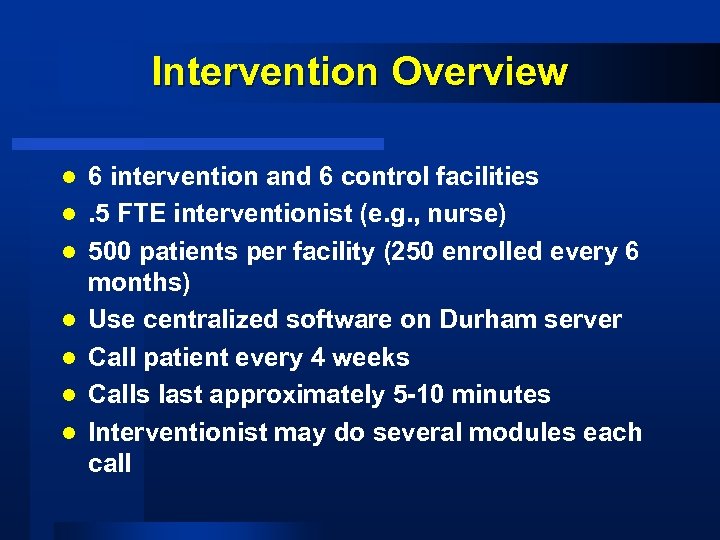 Intervention Overview l l l l 6 intervention and 6 control facilities. 5 FTE interventionist (e. g. , nurse) 500 patients per facility (250 enrolled every 6 months) Use centralized software on Durham server Call patient every 4 weeks Calls last approximately 5 -10 minutes Interventionist may do several modules each call
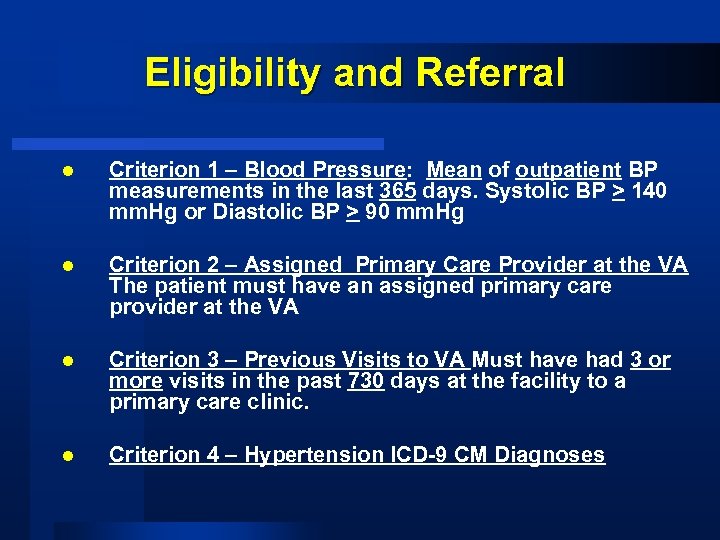 Eligibility and Referral l Criterion 1 – Blood Pressure: Mean of outpatient BP measurements in the last 365 days. Systolic BP > 140 mm. Hg or Diastolic BP > 90 mm. Hg l Criterion 2 – Assigned Primary Care Provider at the VA The patient must have an assigned primary care provider at the VA l Criterion 3 – Previous Visits to VA Must have had 3 or more visits in the past 730 days at the facility to a primary care clinic. l Criterion 4 – Hypertension ICD-9 CM Diagnoses
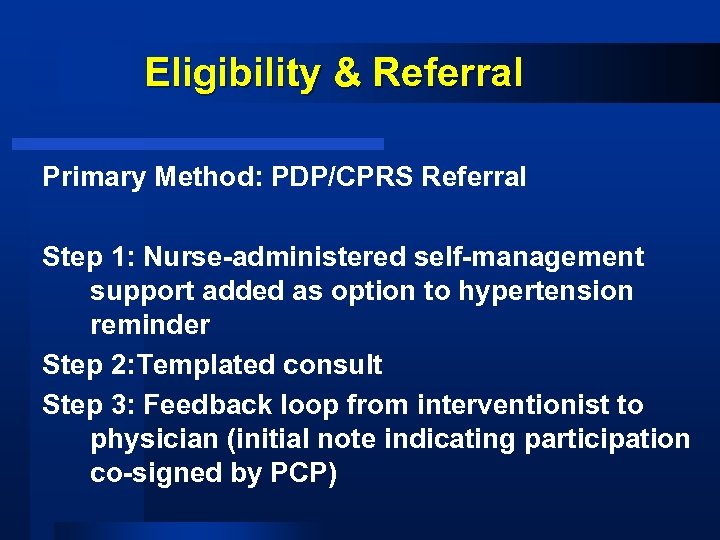 Eligibility & Referral Primary Method: PDP/CPRS Referral Step 1: Nurse-administered self-management support added as option to hypertension reminder Step 2: Templated consult Step 3: Feedback loop from interventionist to physician (initial note indicating participation co-signed by PCP)
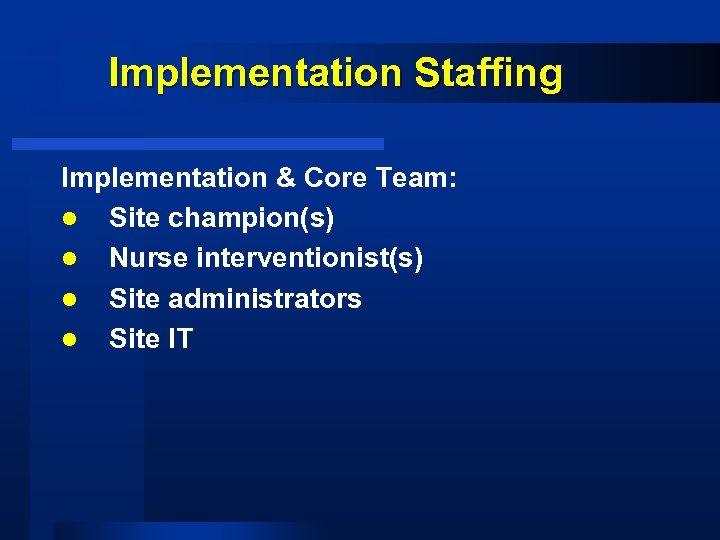 Implementation Staffing Implementation & Core Team: l Site champion(s) l Nurse interventionist(s) l Site administrators l Site IT
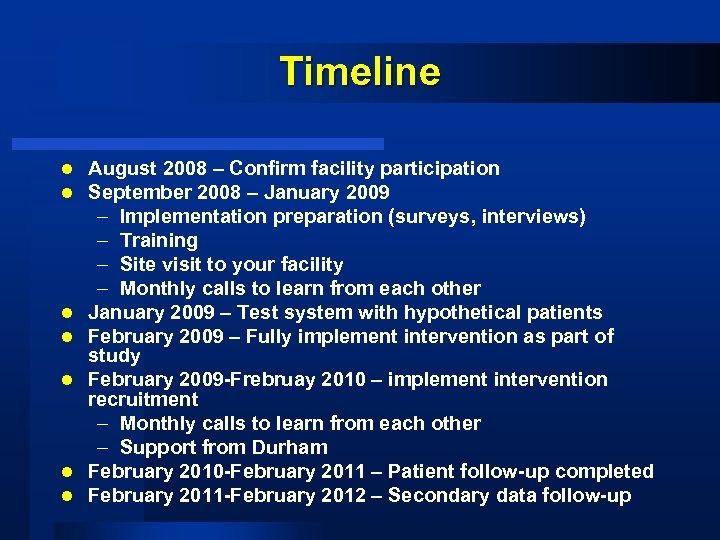 Timeline l l l l August 2008 – Confirm facility participation September 2008 – January 2009 – Implementation preparation (surveys, interviews) – Training – Site visit to your facility – Monthly calls to learn from each other January 2009 – Test system with hypothetical patients February 2009 – Fully implement intervention as part of study February 2009 -Frebruay 2010 – implement intervention recruitment – Monthly calls to learn from each other – Support from Durham February 2010 -February 2011 – Patient follow-up completed February 2011 -February 2012 – Secondary data follow-up
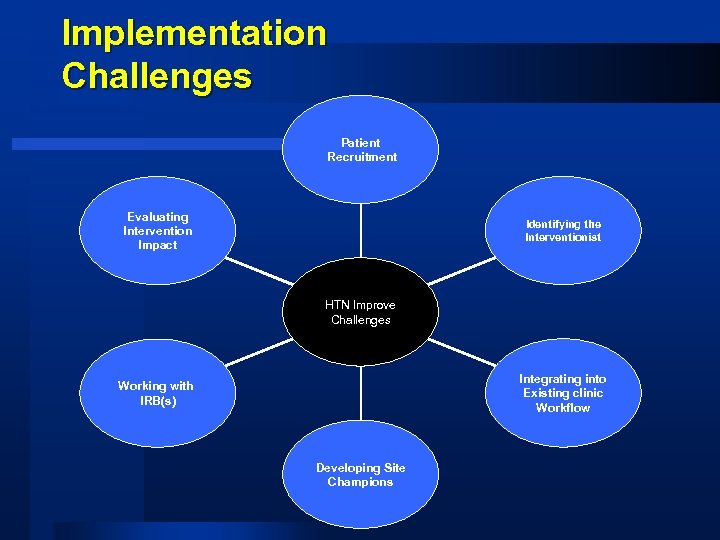 Implementation Challenges Patient Recruitment Evaluating Intervention Impact Identifying the Interventionist HTN Improve Challenges Integrating into Existing clinic Workflow Working with IRB(s) Developing Site Champions
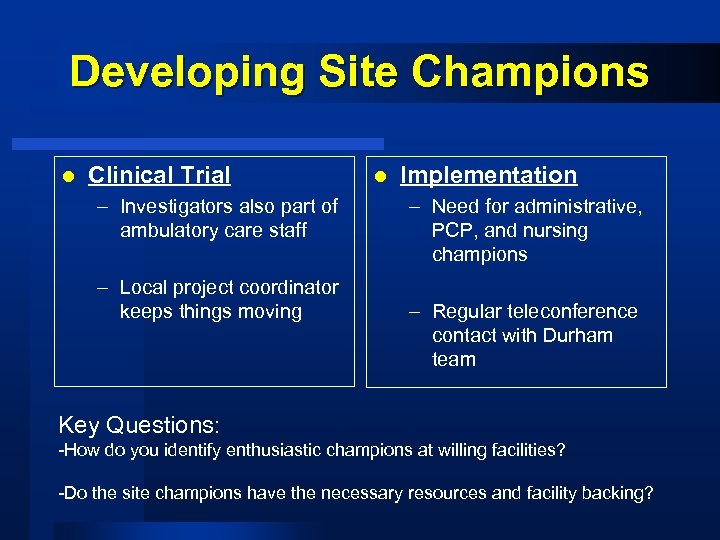 Developing Site Champions l Clinical Trial – Investigators also part of ambulatory care staff – Local project coordinator keeps things moving l Implementation – Need for administrative, PCP, and nursing champions – Regular teleconference contact with Durham team Key Questions: -How do you identify enthusiastic champions at willing facilities? -Do the site champions have the necessary resources and facility backing?
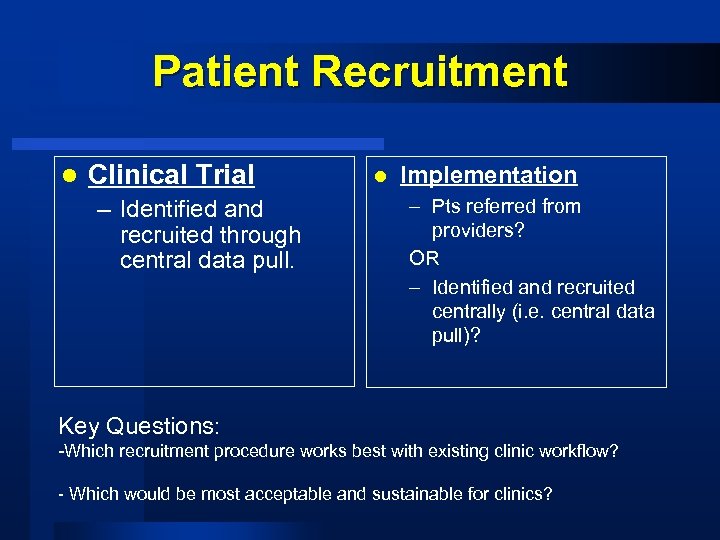 Patient Recruitment l Clinical Trial – Identified and recruited through central data pull. l Implementation – Pts referred from providers? OR – Identified and recruited centrally (i. e. central data pull)? Key Questions: -Which recruitment procedure works best with existing clinic workflow? - Which would be most acceptable and sustainable for clinics?
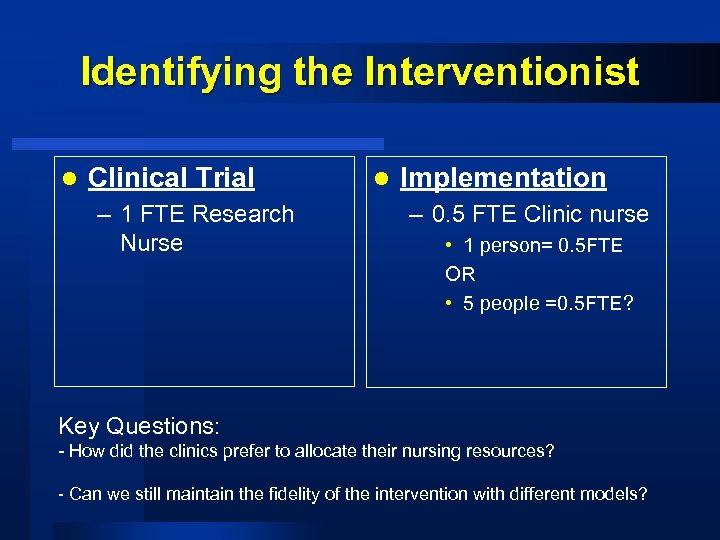 Identifying the Interventionist l Clinical Trial – 1 FTE Research Nurse l Implementation – 0. 5 FTE Clinic nurse • 1 person= 0. 5 FTE OR • 5 people =0. 5 FTE? Key Questions: - How did the clinics prefer to allocate their nursing resources? - Can we still maintain the fidelity of the intervention with different models?
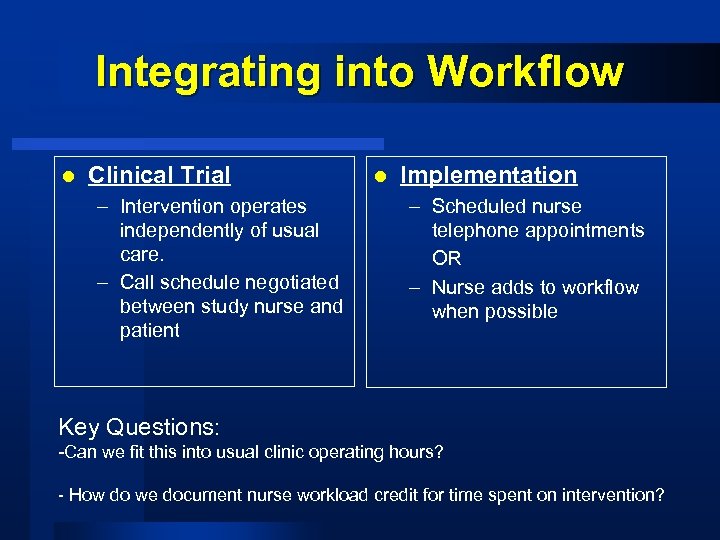 Integrating into Workflow l Clinical Trial – Intervention operates independently of usual care. – Call schedule negotiated between study nurse and patient l Implementation – Scheduled nurse telephone appointments OR – Nurse adds to workflow when possible Key Questions: -Can we fit this into usual clinic operating hours? - How do we document nurse workload credit for time spent on intervention?
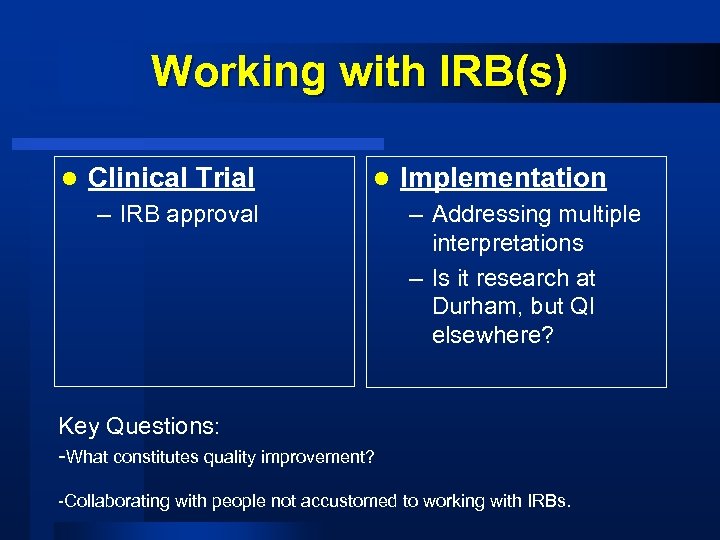 Working with IRB(s) l Clinical Trial l – IRB approval Implementation – Addressing multiple interpretations – Is it research at Durham, but QI elsewhere? Key Questions: -What constitutes quality improvement? -Collaborating with people not accustomed to working with IRBs.
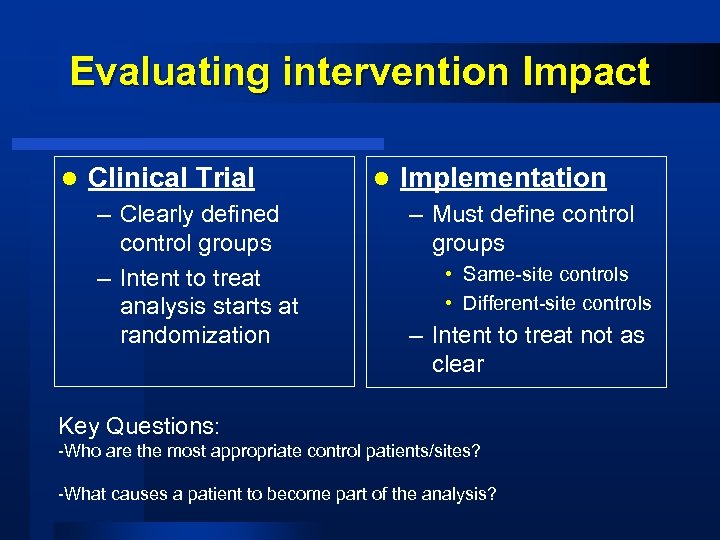 Evaluating intervention Impact l Clinical Trial – Clearly defined control groups – Intent to treat analysis starts at randomization l Implementation – Must define control groups • Same-site controls • Different-site controls – Intent to treat not as clear Key Questions: -Who are the most appropriate control patients/sites? -What causes a patient to become part of the analysis?
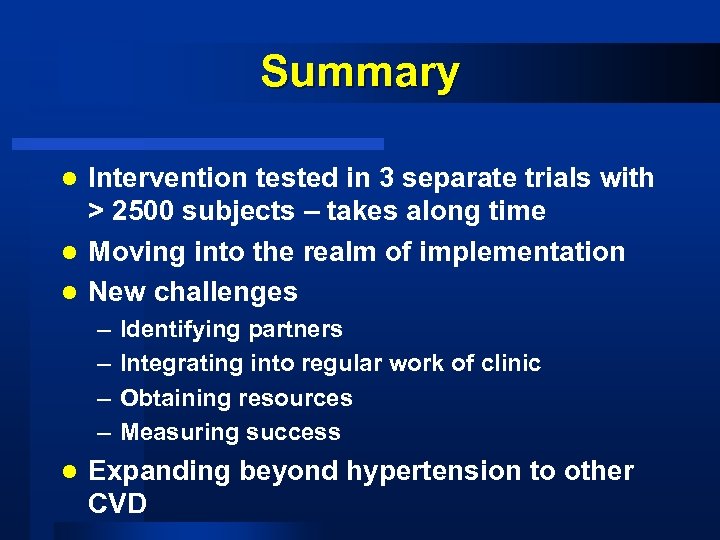 Summary Intervention tested in 3 separate trials with > 2500 subjects – takes along time l Moving into the realm of implementation l New challenges l – – l Identifying partners Integrating into regular work of clinic Obtaining resources Measuring success Expanding beyond hypertension to other CVD
 Acknowledgements • VA Health Services Research Investigator Initiated Award, 2001 -06 • NHLBI Grant R 01 HL 070713 (2003 -2009) • Pfizer Health Communication Initiative Award (20042006) • Established Investigator Award, American Heart Association (2006 -2011) Danny Almirall Mike Newell Pam Gentry Bryan Weiner Teresa Damush Daniel Lee Eugene Oddone Amy Kaufman
 Contact Information • Hayden Bosworth – hayden. bosworth@duke. edu • George L. Jackson – george. l. jackson@duke. edu • Ben Powers – power 017@mc. duke. edu
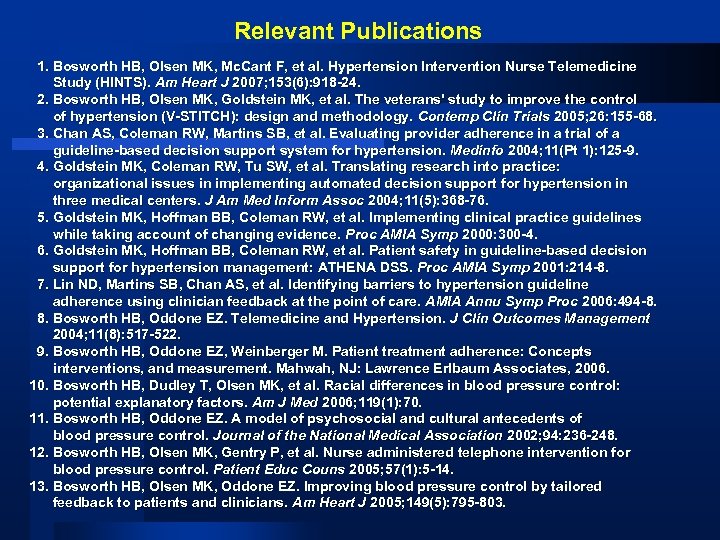 Relevant Publications 1. Bosworth HB, Olsen MK, Mc. Cant F, et al. Hypertension Intervention Nurse Telemedicine Study (HINTS). Am Heart J 2007; 153(6): 918 -24. 2. Bosworth HB, Olsen MK, Goldstein MK, et al. The veterans' study to improve the control of hypertension (V-STITCH): design and methodology. Contemp Clin Trials 2005; 26: 155 -68. 3. Chan AS, Coleman RW, Martins SB, et al. Evaluating provider adherence in a trial of a guideline-based decision support system for hypertension. Medinfo 2004; 11(Pt 1): 125 -9. 4. Goldstein MK, Coleman RW, Tu SW, et al. Translating research into practice: organizational issues in implementing automated decision support for hypertension in three medical centers. J Am Med Inform Assoc 2004; 11(5): 368 -76. 5. Goldstein MK, Hoffman BB, Coleman RW, et al. Implementing clinical practice guidelines while taking account of changing evidence. Proc AMIA Symp 2000: 300 -4. 6. Goldstein MK, Hoffman BB, Coleman RW, et al. Patient safety in guideline-based decision support for hypertension management: ATHENA DSS. Proc AMIA Symp 2001: 214 -8. 7. Lin ND, Martins SB, Chan AS, et al. Identifying barriers to hypertension guideline adherence using clinician feedback at the point of care. AMIA Annu Symp Proc 2006: 494 -8. 8. Bosworth HB, Oddone EZ. Telemedicine and Hypertension. J Clin Outcomes Management 2004; 11(8): 517 -522. 9. Bosworth HB, Oddone EZ, Weinberger M. Patient treatment adherence: Concepts interventions, and measurement. Mahwah, NJ: Lawrence Erlbaum Associates, 2006. 10. Bosworth HB, Dudley T, Olsen MK, et al. Racial differences in blood pressure control: potential explanatory factors. Am J Med 2006; 119(1): 70. 11. Bosworth HB, Oddone EZ. A model of psychosocial and cultural antecedents of blood pressure control. Journal of the National Medical Association 2002; 94: 236 -248. 12. Bosworth HB, Olsen MK, Gentry P, et al. Nurse administered telephone intervention for blood pressure control. Patient Educ Couns 2005; 57(1): 5 -14. 13. Bosworth HB, Olsen MK, Oddone EZ. Improving blood pressure control by tailored feedback to patients and clinicians. Am Heart J 2005; 149(5): 795 -803.
 Single disease vs. multimorbidity self-mgmt? l Two key questions 1. ) Is there a “spillover” effect from disease-focused self-mgmt onto other conditions? 2. ) Is it possible to address multiple conditions simultaneously in a selfmanagement intervention?
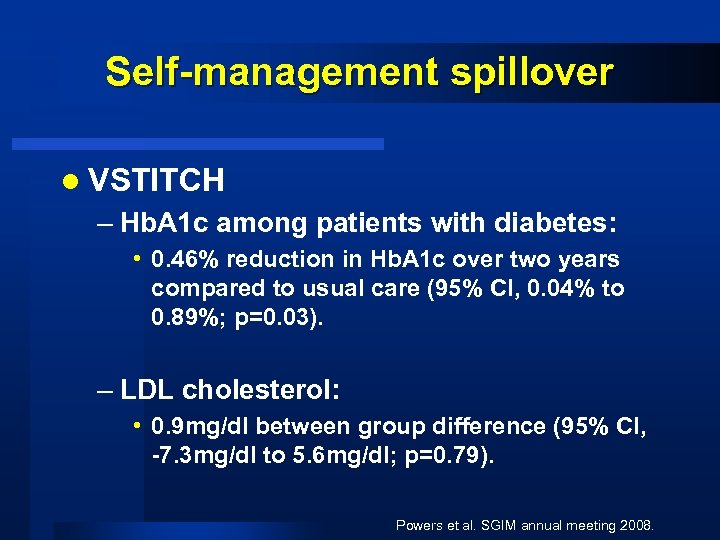 Self-management spillover l VSTITCH – Hb. A 1 c among patients with diabetes: • 0. 46% reduction in Hb. A 1 c over two years compared to usual care (95% CI, 0. 04% to 0. 89%; p=0. 03). – LDL cholesterol: • 0. 9 mg/dl between group difference (95% CI, -7. 3 mg/dl to 5. 6 mg/dl; p=0. 79). Powers et al. SGIM annual meeting 2008.
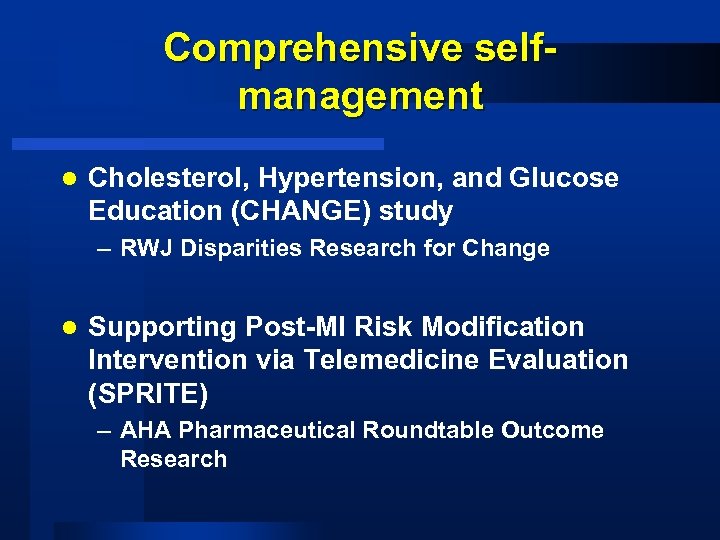 Comprehensive selfmanagement l Cholesterol, Hypertension, and Glucose Education (CHANGE) study – RWJ Disparities Research for Change l Supporting Post-MI Risk Modification Intervention via Telemedicine Evaluation (SPRITE) – AHA Pharmaceutical Roundtable Outcome Research
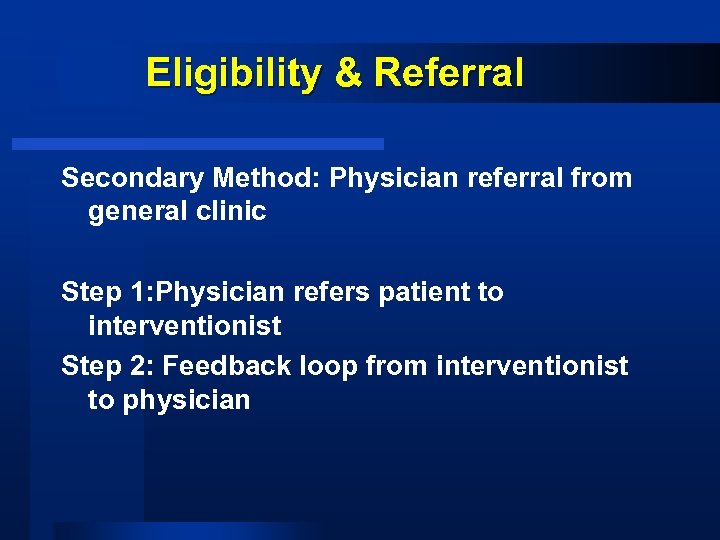 Eligibility & Referral Secondary Method: Physician referral from general clinic Step 1: Physician refers patient to interventionist Step 2: Feedback loop from interventionist to physician
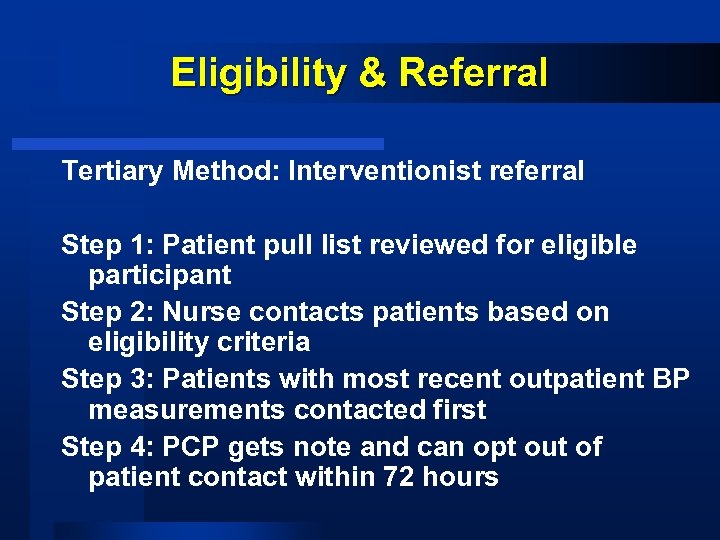 Eligibility & Referral Tertiary Method: Interventionist referral Step 1: Patient pull list reviewed for eligible participant Step 2: Nurse contacts patients based on eligibility criteria Step 3: Patients with most recent outpatient BP measurements contacted first Step 4: PCP gets note and can opt out of patient contact within 72 hours
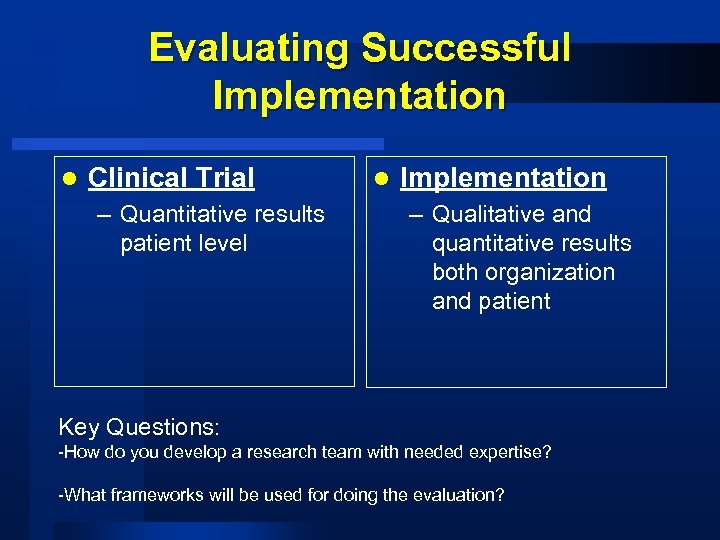 Evaluating Successful Implementation l Clinical Trial – Quantitative results patient level l Implementation – Qualitative and quantitative results both organization and patient Key Questions: -How do you develop a research team with needed expertise? -What frameworks will be used for doing the evaluation?