


 Скачать презентацию Rural Finance Prof Dr Manfred Zeller Prof Dr
717db66f8bc15fa7e51e18fa429c26b5.ppt
- Количество слайдов: 71
 Rural Finance Prof. Dr. Manfred Zeller Prof. Dr. Franz Heidhues Thomas Dufhues Universität Hohenheim, Institut 490 a 1
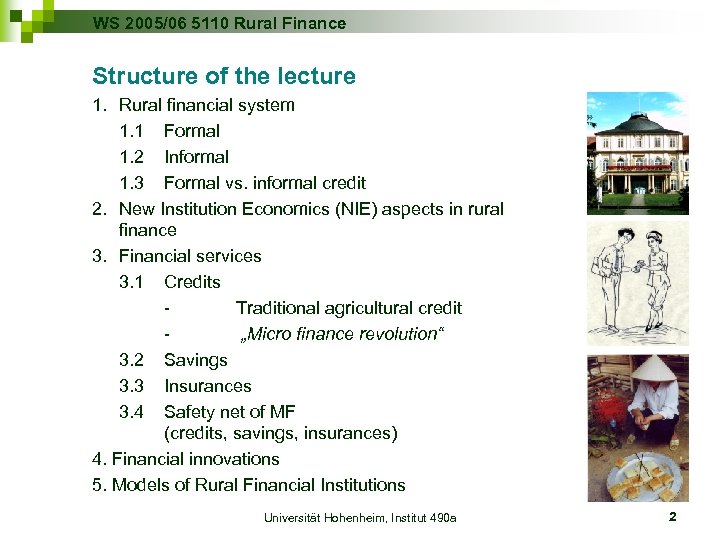 WS 2005/06 5110 Rural Finance Structure of the lecture 1. Rural financial system 1. 1 Formal 1. 2 Informal 1. 3 Formal vs. informal credit 2. New Institution Economics (NIE) aspects in rural finance 3. Financial services 3. 1 Credits Traditional agricultural credit „Micro finance revolution“ 3. 2 Savings 3. 3 Insurances 3. 4 Safety net of MF (credits, savings, insurances) 4. Financial innovations 5. Models of Rural Financial Institutions Universität Hohenheim, Institut 490 a 2
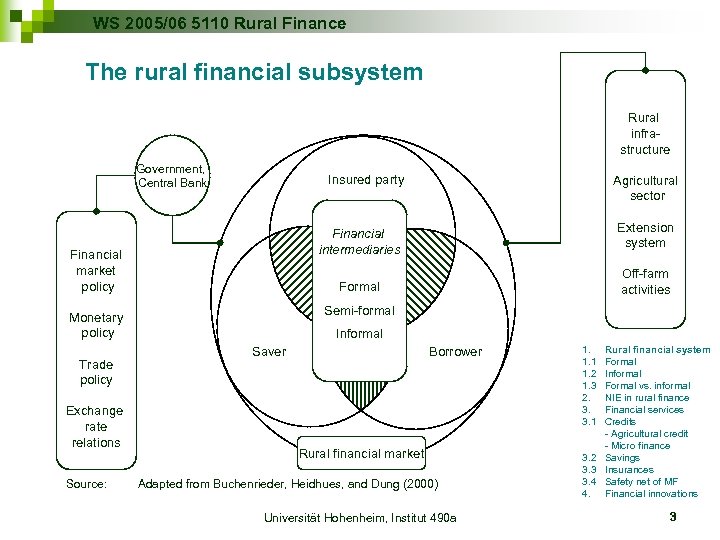 WS 2005/06 5110 Rural Finance The rural financial subsystem Rural infrastructure Government, Central Bank Insured party Financial intermediaries Source: Off-farm activities Semi-formal Monetary policy Exchange rate relations Extension system Formal Financial market policy Trade policy Agricultural sector Informal Saver Borrower Rural financial market Adapted from Buchenrieder, Heidhues, and Dung (2000) Universität Hohenheim, Institut 490 a 1. 1. 1 1. 2 1. 3 2. 3. 3. 1 Rural financial system Formal Informal Formal vs. informal NIE in rural finance Financial services Credits - Agricultural credit - Micro finance 3. 2 Savings 3. 3 Insurances 3. 4 Safety net of MF 4. Financial innovations 3
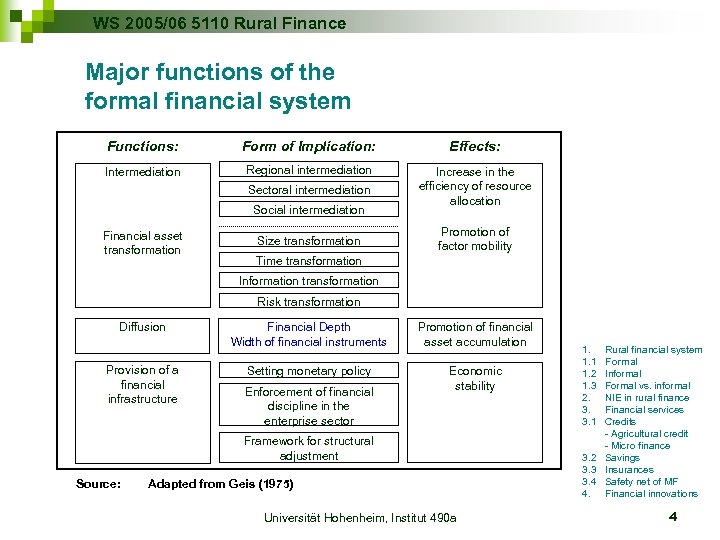 WS 2005/06 5110 Rural Finance Major functions of the formal financial system Functions: Form of Implication: Effects: Intermediation Regional intermediation Increase in the efficiency of resource allocation Sectoral intermediation Social intermediation Financial asset transformation Size transformation Time transformation Promotion of factor mobility Information transformation Risk transformation Diffusion Provision of a financial infrastructure Financial Depth Width of financial instruments Promotion of financial asset accumulation Setting monetary policy Economic stability Enforcement of financial discipline in the enterprise sector Framework for structural adjustment Source: Adapted from Geis (1975) Universität Hohenheim, Institut 490 a 1. 1. 1 1. 2 1. 3 2. 3. 3. 1 Rural financial system Formal Informal Formal vs. informal NIE in rural finance Financial services Credits - Agricultural credit - Micro finance 3. 2 Savings 3. 3 Insurances 3. 4 Safety net of MF 4. Financial innovations 4
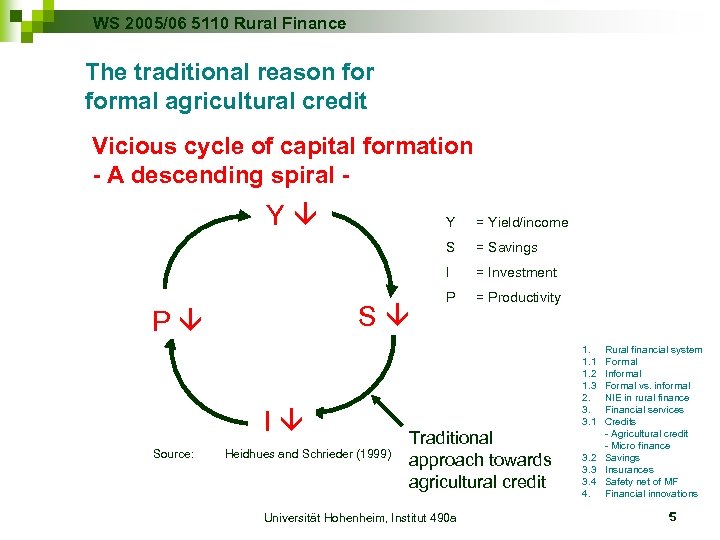 WS 2005/06 5110 Rural Finance The traditional reason formal agricultural credit Vicious cycle of capital formation - A descending spiral - Y Y S S I Source: Heidhues and Schrieder (1999) = Savings I P = Yield/income = Investment P = Productivity 1. 1. 1 1. 2 1. 3 2. 3. 3. 1 Traditional approach towards agricultural credit Universität Hohenheim, Institut 490 a Rural financial system Formal Informal Formal vs. informal NIE in rural finance Financial services Credits - Agricultural credit - Micro finance 3. 2 Savings 3. 3 Insurances 3. 4 Safety net of MF 4. Financial innovations 5
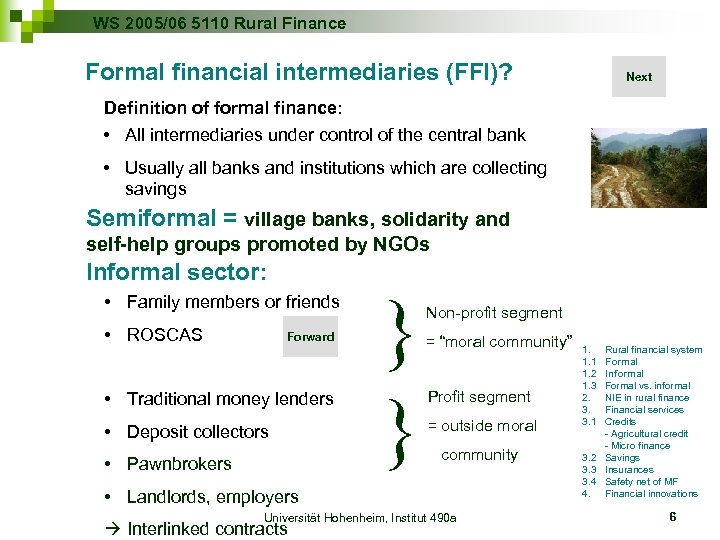 WS 2005/06 5110 Rural Finance Formal financial intermediaries (FFI)? Next Definition of formal finance: • All intermediaries under control of the central bank • Usually all banks and institutions which are collecting savings Semiformal = village banks, solidarity and self-help groups promoted by NGOs Informal sector: • Family members or friends • ROSCAS Forward • Traditional money lenders • Deposit collectors • Pawnbrokers } } Non-profit segment = “moral community” Profit segment = outside moral community • Landlords, employers Universität Hohenheim, Institut 490 a Interlinked contracts 1. 1. 1 1. 2 1. 3 2. 3. 3. 1 Rural financial system Formal Informal Formal vs. informal NIE in rural finance Financial services Credits - Agricultural credit - Micro finance 3. 2 Savings 3. 3 Insurances 3. 4 Safety net of MF 4. Financial innovations 6
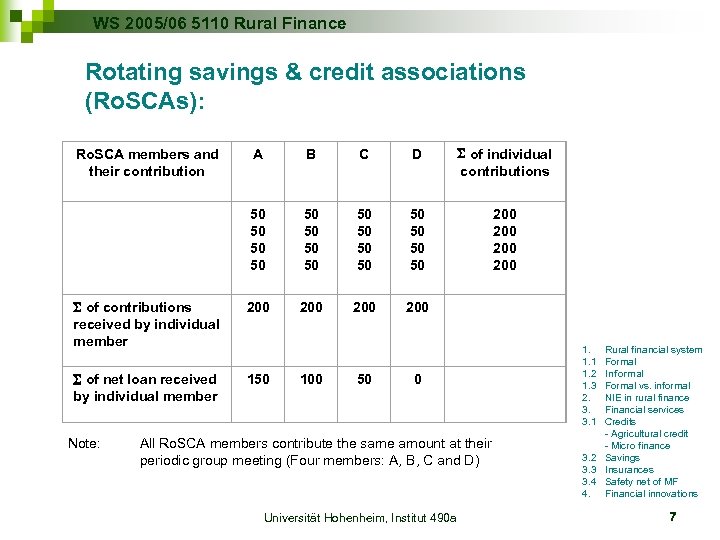 WS 2005/06 5110 Rural Finance Rotating savings & credit associations (Ro. SCAs): Ro. SCA members and their contribution A B C D of individual contributions 50 50 50 50 200 200 of contributions received by individual member 200 200 of net loan received by individual member 150 Note: 100 50 0 All Ro. SCA members contribute the same amount at their periodic group meeting (Four members: A, B, C and D) Universität Hohenheim, Institut 490 a 1. 1. 1 1. 2 1. 3 2. 3. 3. 1 Rural financial system Formal Informal Formal vs. informal NIE in rural finance Financial services Credits - Agricultural credit - Micro finance 3. 2 Savings 3. 3 Insurances 3. 4 Safety net of MF 4. Financial innovations 7
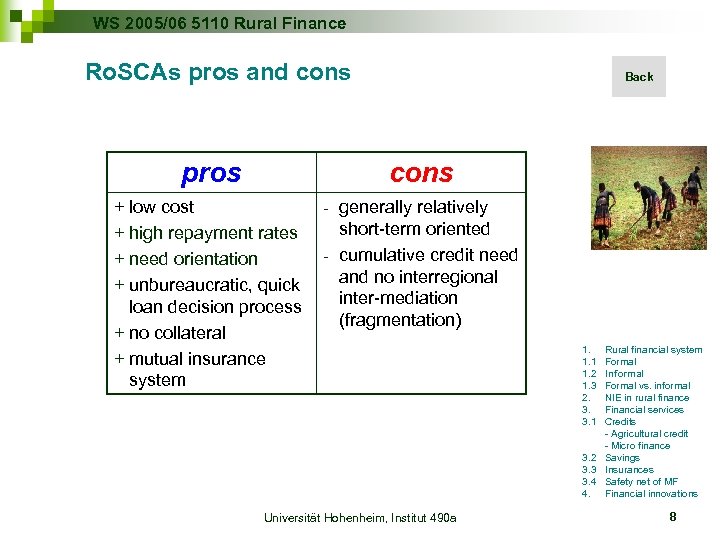 WS 2005/06 5110 Rural Finance Ro. SCAs pros and cons pros Back cons + low cost + high repayment rates + need orientation + unbureaucratic, quick loan decision process + no collateral + mutual insurance system - generally relatively short-term oriented cumulative credit need and no interregional inter-mediation (fragmentation) Universität Hohenheim, Institut 490 a 1. 1. 1 1. 2 1. 3 2. 3. 3. 1 Rural financial system Formal Informal Formal vs. informal NIE in rural finance Financial services Credits - Agricultural credit - Micro finance 3. 2 Savings 3. 3 Insurances 3. 4 Safety net of MF 4. Financial innovations 8
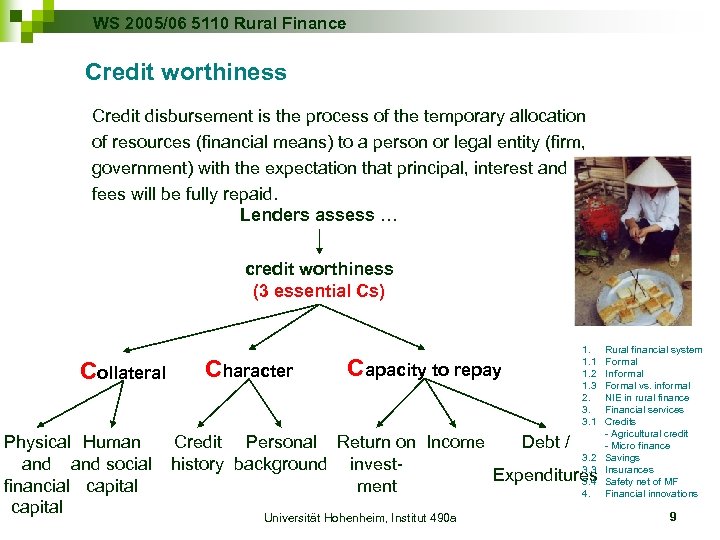 WS 2005/06 5110 Rural Finance Credit worthiness Credit disbursement is the process of the temporary allocation of resources (financial means) to a person or legal entity (firm, government) with the expectation that principal, interest and fees will be fully repaid. Lenders assess … credit worthiness (3 essential Cs) Collateral Character Capacity to repay 1. 1. 1 1. 2 1. 3 2. 3. 3. 1 Rural financial system Formal Informal Formal vs. informal NIE in rural finance Financial services Credits - Agricultural credit - Micro finance 3. 2 Savings 3. 3 Insurances 3. 4 Safety net of MF 4. Financial innovations Physical Human Credit Personal Return on Income Debt / and social history background invest. Expenditures financial capital ment capital Universität Hohenheim, Institut 490 a 9
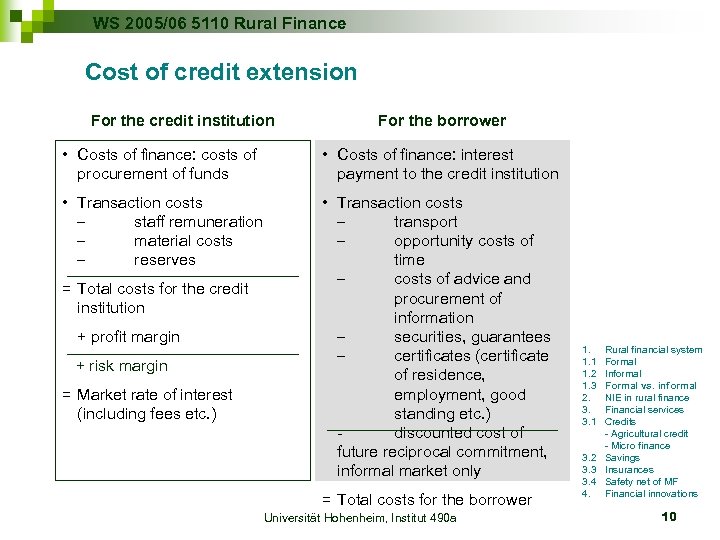 WS 2005/06 5110 Rural Finance Cost of credit extension For the credit institution For the borrower • Costs of finance: costs of procurement of funds • Costs of finance: interest payment to the credit institution • Transaction costs staff remuneration material costs reserves • Transaction costs transport opportunity costs of time costs of advice and procurement of information securities, guarantees certificates (certificate of residence, employment, good standing etc. ) discounted cost of future reciprocal commitment, informal market only = Total costs for the credit institution + profit margin + risk margin = Market rate of interest (including fees etc. ) = Total costs for the borrower Universität Hohenheim, Institut 490 a 1. 1. 1 1. 2 1. 3 2. 3. 3. 1 Rural financial system Formal Informal Formal vs. informal NIE in rural finance Financial services Credits - Agricultural credit - Micro finance 3. 2 Savings 3. 3 Insurances 3. 4 Safety net of MF 4. Financial innovations 10
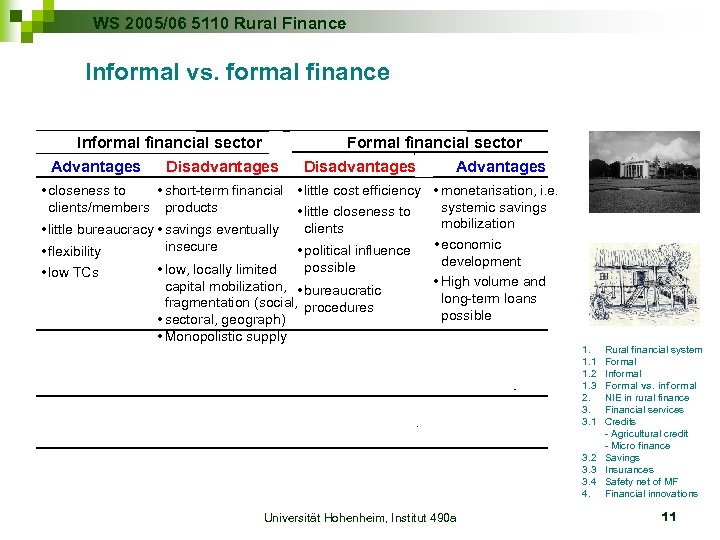 WS 2005/06 5110 Rural Finance Informal vs. formal finance Informal financial sector Advantages Disadvantages Formal financial sector Disadvantages Advantages • closeness to • short-term financial • little cost efficiency • monetarisation, i. e. clients/members products systemic savings • little closeness to mobilization clients • little bureaucracy • savings eventually • economic insecure • political influence • flexibility development possible • low, locally limited • low TCs • High volume and capital mobilization, • bureaucratic long-term loans fragmentation (social, procedures possible • sectoral, geograph) • Monopolistic supply Universität Hohenheim, Institut 490 a 1. 1. 1 1. 2 1. 3 2. 3. 3. 1 Rural financial system Formal Informal Formal vs. informal NIE in rural finance Financial services Credits - Agricultural credit - Micro finance 3. 2 Savings 3. 3 Insurances 3. 4 Safety net of MF 4. Financial innovations 11
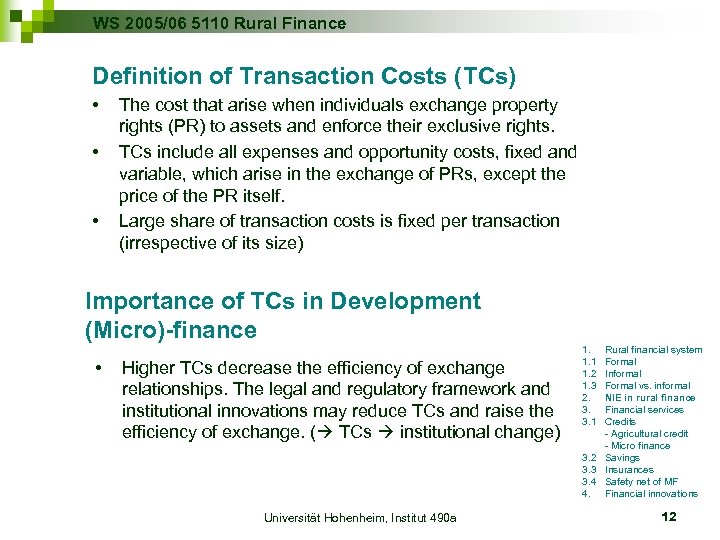 WS 2005/06 5110 Rural Finance Definition of Transaction Costs (TCs) • • • The cost that arise when individuals exchange property rights (PR) to assets and enforce their exclusive rights. TCs include all expenses and opportunity costs, fixed and variable, which arise in the exchange of PRs, except the price of the PR itself. Large share of transaction costs is fixed per transaction (irrespective of its size) Importance of TCs in Development (Micro)-finance • Higher TCs decrease the efficiency of exchange relationships. The legal and regulatory framework and institutional innovations may reduce TCs and raise the efficiency of exchange. ( TCs institutional change) Universität Hohenheim, Institut 490 a 1. 1. 1 1. 2 1. 3 2. 3. 3. 1 Rural financial system Formal Informal Formal vs. informal NIE in rural finance Financial services Credits - Agricultural credit - Micro finance 3. 2 Savings 3. 3 Insurances 3. 4 Safety net of MF 4. Financial innovations 12
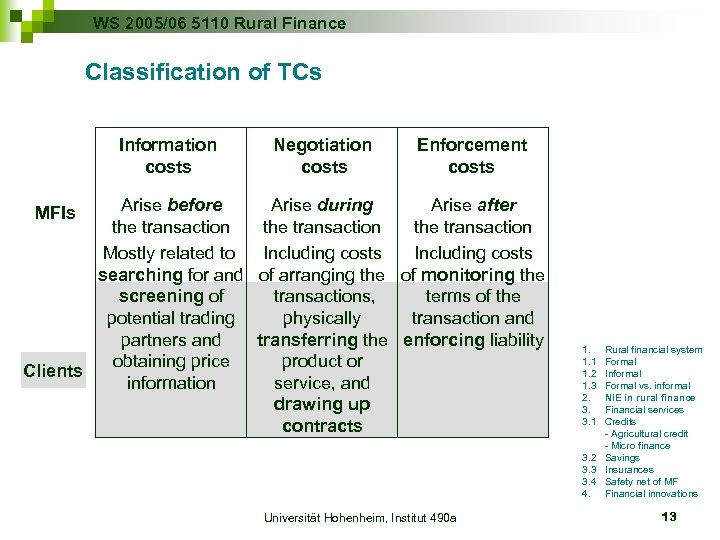 WS 2005/06 5110 Rural Finance Classification of TCs Information costs Negotiation costs Enforcement costs Arise before Arise during Arise after the transaction Mostly related to Including costs searching for and of arranging the of monitoring the transactions, terms of the screening of physically potential trading transaction and transferring the enforcing liability partners and product or obtaining price Clients service, and information drawing up contracts MFIs Universität Hohenheim, Institut 490 a 1. 1. 1 1. 2 1. 3 2. 3. 3. 1 Rural financial system Formal Informal Formal vs. informal NIE in rural finance Financial services Credits - Agricultural credit - Micro finance 3. 2 Savings 3. 3 Insurances 3. 4 Safety net of MF 4. Financial innovations 13
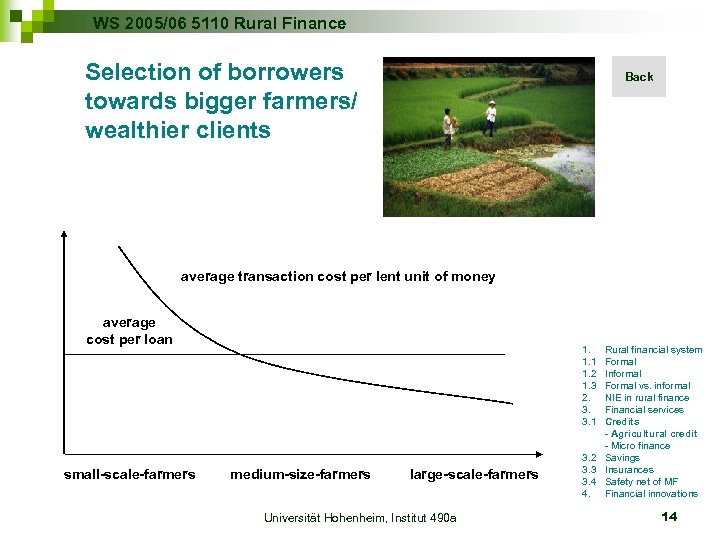 WS 2005/06 5110 Rural Finance Selection of borrowers towards bigger farmers/ wealthier clients Back average transaction cost per lent unit of money average cost per loan 1. 1. 1 1. 2 1. 3 2. 3. 3. 1 small-scale-farmers medium-size-farmers large-scale-farmers Universität Hohenheim, Institut 490 a Rural financial system Formal Informal Formal vs. informal NIE in rural finance Financial services Credits - Agricultural credit - Micro finance 3. 2 Savings 3. 3 Insurances 3. 4 Safety net of MF 4. Financial innovations 14
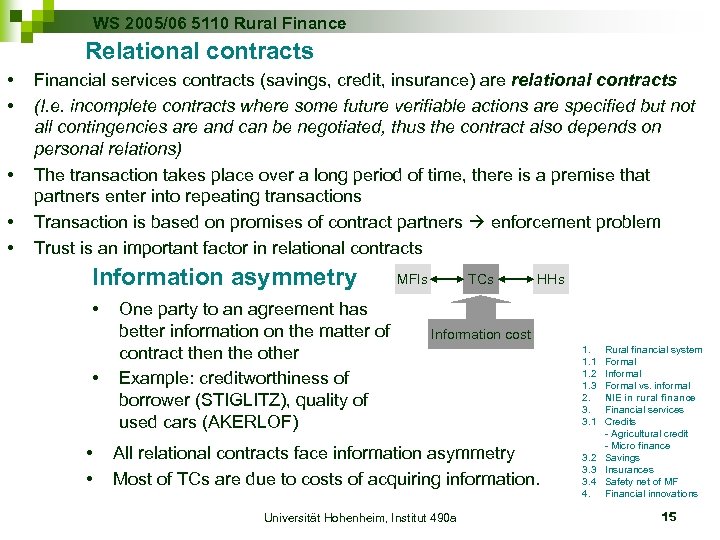 WS 2005/06 5110 Rural Finance Relational contracts • • • Financial services contracts (savings, credit, insurance) are relational contracts (I. e. incomplete contracts where some future verifiable actions are specified but not all contingencies are and can be negotiated, thus the contract also depends on personal relations) The transaction takes place over a long period of time, there is a premise that partners enter into repeating transactions Transaction is based on promises of contract partners enforcement problem Trust is an important factor in relational contracts Information asymmetry • • One party to an agreement has better information on the matter of contract then the other Example: creditworthiness of borrower (STIGLITZ), quality of used cars (AKERLOF) MFIs TCs HHs Information cost All relational contracts face information asymmetry Most of TCs are due to costs of acquiring information. Universität Hohenheim, Institut 490 a 1. 1. 1 1. 2 1. 3 2. 3. 3. 1 Rural financial system Formal Informal Formal vs. informal NIE in rural finance Financial services Credits - Agricultural credit - Micro finance 3. 2 Savings 3. 3 Insurances 3. 4 Safety net of MF 4. Financial innovations 15
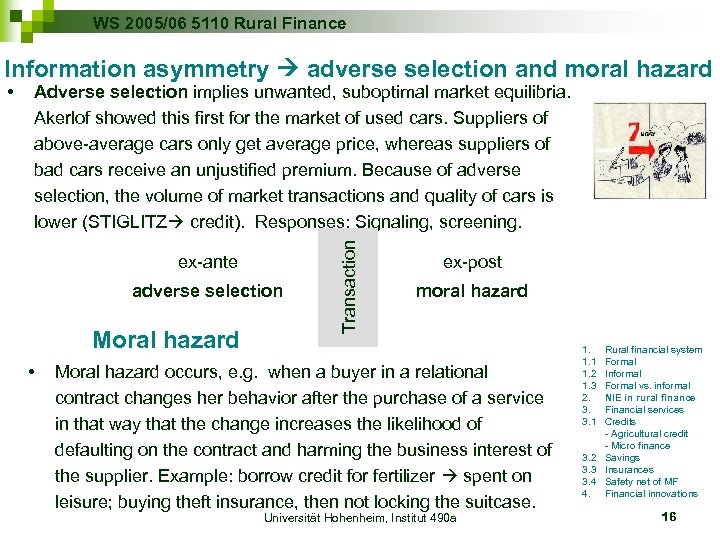 WS 2005/06 5110 Rural Finance Information asymmetry adverse selection and moral hazard • ex-ante adverse selection Moral hazard • Transaction Adverse selection implies unwanted, suboptimal market equilibria. Akerlof showed this first for the market of used cars. Suppliers of above-average cars only get average price, whereas suppliers of bad cars receive an unjustified premium. Because of adverse selection, the volume of market transactions and quality of cars is lower (STIGLITZ credit). Responses: Signaling, screening. ex-post moral hazard Moral hazard occurs, e. g. when a buyer in a relational contract changes her behavior after the purchase of a service in that way that the change increases the likelihood of defaulting on the contract and harming the business interest of the supplier. Example: borrow credit for fertilizer spent on leisure; buying theft insurance, then not locking the suitcase. Universität Hohenheim, Institut 490 a 1. 1. 1 1. 2 1. 3 2. 3. 3. 1 Rural financial system Formal Informal Formal vs. informal NIE in rural finance Financial services Credits - Agricultural credit - Micro finance 3. 2 Savings 3. 3 Insurances 3. 4 Safety net of MF 4. Financial innovations 16
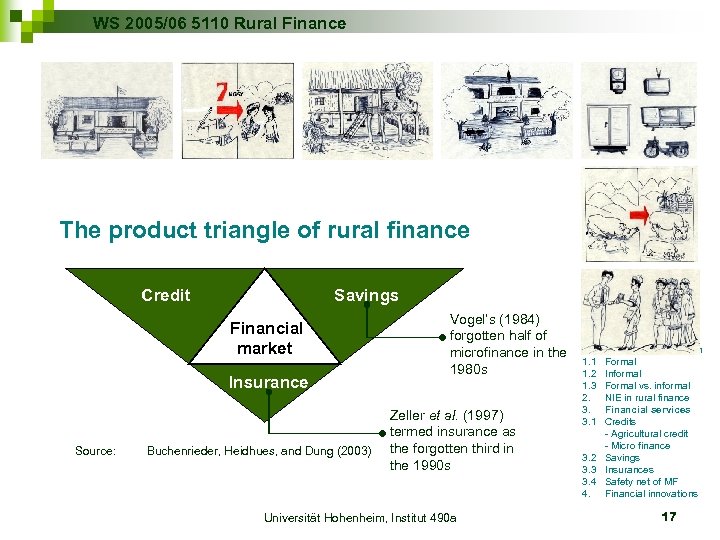 WS 2005/06 5110 Rural Finance The product triangle of rural finance Credit Savings Financial market Insurance Source: Buchenrieder, Heidhues, and Dung (2003) Vogel‘s (1984) forgotten half of microfinance in the 1980 s Zeller et al. (1997) termed insurance as the forgotten third in the 1990 s Universität Hohenheim, Institut 490 a 1. 1. 1 1. 2 1. 3 2. 3. 3. 1 Rural financial system Formal Informal Formal vs. informal NIE in rural finance Financial services Credits - Agricultural credit - Micro finance 3. 2 Savings 3. 3 Insurances 3. 4 Safety net of MF 4. Financial innovations 17
 WS 2005/06 5110 Rural Finance The efficiency of informal finance 1. Are the services provided by informal lenders "valuable" for their clientele? The answer is a strong “yes“. 2. Are the services provided by informal lenders "sufficient, " from the perspective of their clientele? Under many circumstances, the answer in this case is possibly “no“. 3. Are informal financial services "efficient" from an economic perspective? 1. The answer here is a strong “no“ (in a first-best sense), but yes in 1. 1 a second-best sense. 4. Can informal financial transactions be replaced and/or complemented with formal financial intermediation? The answer is “potentially yes“, but the task is not easy at all. Universität Hohenheim, Institut 490 a 1. 2 1. 3 2. 3. 3. 1 3. 2 3. 3 3. 4 4. Rural financial system Formal Informal Formal vs. informal NIE in rural finance Financial services Credits - Agricultural credit - Micro finance Savings Insurances Safety net of MF Financial innovations 18
 WS 2005/06 5110 Rural Finance Key features of the traditional agricultural credit supply 1. External (to the rural sector) financing by government and external donors 2. (Short-term) production credit (supervised credit, credit targeted to certain crops/animal husbandry activities) 3. Strong focus on (production) credit; no savings mobilization, no insurance or insurance substitutes 4. Subsidized credit (low interest rate) providing opportunities for seeking rents that tend to be captured by the wealthy/powerful 5. Collateral to overcome information asymmetry (systematically screening out the poor) 6. Policy of “Give and forgive” (Zeller et al. , 1997) Universität Hohenheim, Institut 490 a 1. 1. 1 1. 2 1. 3 2. 3. 3. 1 Rural financial system Formal Informal Formal vs. informal NIE in rural finance Financial services Credits - Agricultural credit - Micro finance 3. 2 Savings 3. 3 Insurances 3. 4 Safety net of MF 4. Financial innovations 19
 WS 2005/06 5110 Rural Finance Why was the traditional agricultural credit approach not successful? Ø No capital mobilization (savings) lack of independence Gov. influence undermines institutional independence Ø Uncertainties of external funding (government, donors) Ø Linkage between government funding and repayment performance Ø Did not reach the target group Ø Market distortions caused by subsidized credit Ø Did not respond to the full demand for financial services by rural households (poor and non-poor) Universität Hohenheim, Institut 490 a 1. 1. 1 1. 2 1. 3 2. 3. 3. 1 Rural financial system Formal Informal Formal vs. informal NIE in rural finance Financial services Credits - Agricultural credit - Micro finance 3. 2 Savings 3. 3 Insurances 3. 4 Safety net of MF 4. Financial innovations 20
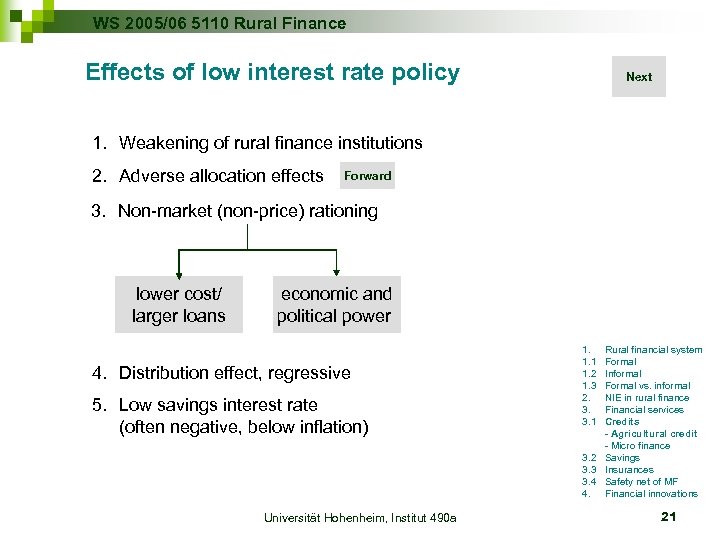 WS 2005/06 5110 Rural Finance Effects of low interest rate policy Next 1. Weakening of rural finance institutions 2. Adverse allocation effects Forward 3. Non-market (non-price) rationing lower cost/ larger loans economic and political power 4. Distribution effect, regressive 5. Low savings interest rate (often negative, below inflation) Universität Hohenheim, Institut 490 a 1. 1. 1 1. 2 1. 3 2. 3. 3. 1 Rural financial system Formal Informal Formal vs. informal NIE in rural finance Financial services Credits - Agricultural credit - Micro finance 3. 2 Savings 3. 3 Insurances 3. 4 Safety net of MF 4. Financial innovations 21
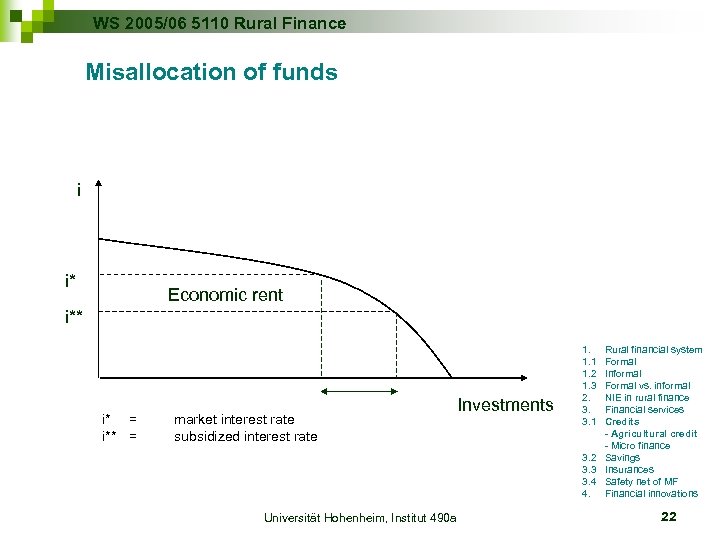 WS 2005/06 5110 Rural Finance Misallocation of funds i i* Economic rent i** i* = i** = market interest rate subsidized interest rate Universität Hohenheim, Institut 490 a Investments 1. 1. 1 1. 2 1. 3 2. 3. 3. 1 Rural financial system Formal Informal Formal vs. informal NIE in rural finance Financial services Credits - Agricultural credit - Micro finance 3. 2 Savings 3. 3 Insurances 3. 4 Safety net of MF 4. Financial innovations 22
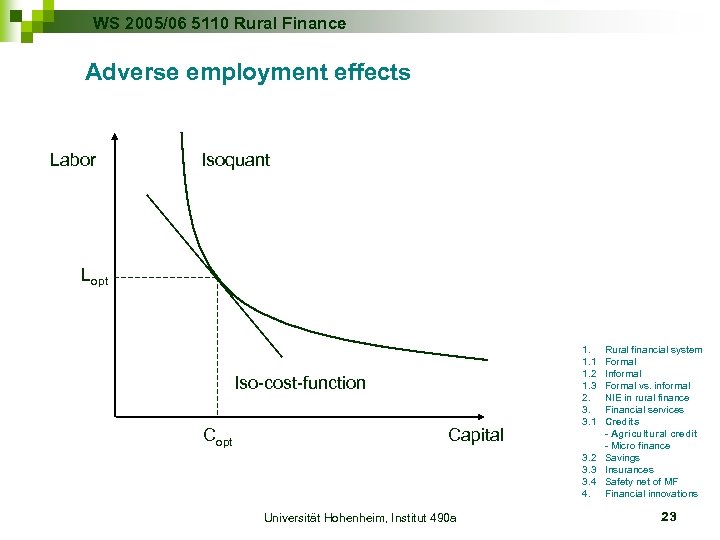 WS 2005/06 5110 Rural Finance Adverse employment effects Labor Isoquant Lopt Iso-cost-function Copt Capital Universität Hohenheim, Institut 490 a 1. 1. 1 1. 2 1. 3 2. 3. 3. 1 Rural financial system Formal Informal Formal vs. informal NIE in rural finance Financial services Credits - Agricultural credit - Micro finance 3. 2 Savings 3. 3 Insurances 3. 4 Safety net of MF 4. Financial innovations 23
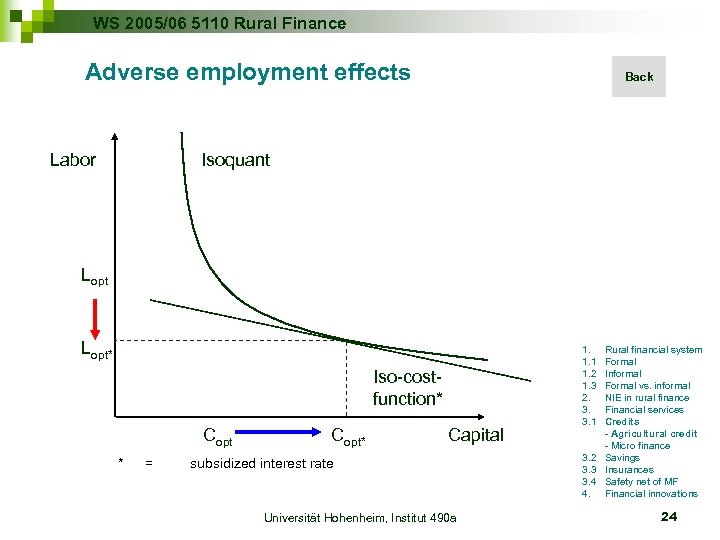 WS 2005/06 5110 Rural Finance Adverse employment effects Labor Back Isoquant Lopt* Iso-costfunction* Copt * = Copt* Capital subsidized interest rate Universität Hohenheim, Institut 490 a 1. 1. 1 1. 2 1. 3 2. 3. 3. 1 Rural financial system Formal Informal Formal vs. informal NIE in rural finance Financial services Credits - Agricultural credit - Micro finance 3. 2 Savings 3. 3 Insurances 3. 4 Safety net of MF 4. Financial innovations 24
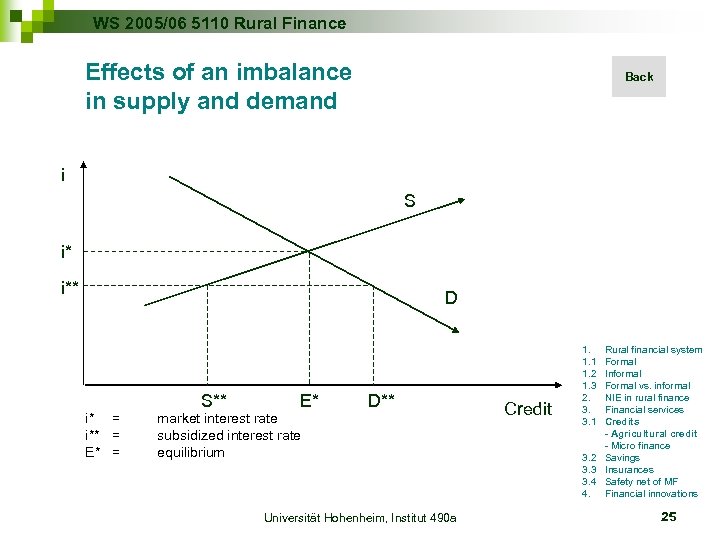 WS 2005/06 5110 Rural Finance Effects of an imbalance in supply and demand Back i S i* i** D i* = i** = E* = S** E* market interest rate subsidized interest rate equilibrium D** Universität Hohenheim, Institut 490 a Credit 1. 1. 1 1. 2 1. 3 2. 3. 3. 1 Rural financial system Formal Informal Formal vs. informal NIE in rural finance Financial services Credits - Agricultural credit - Micro finance 3. 2 Savings 3. 3 Insurances 3. 4 Safety net of MF 4. Financial innovations 25
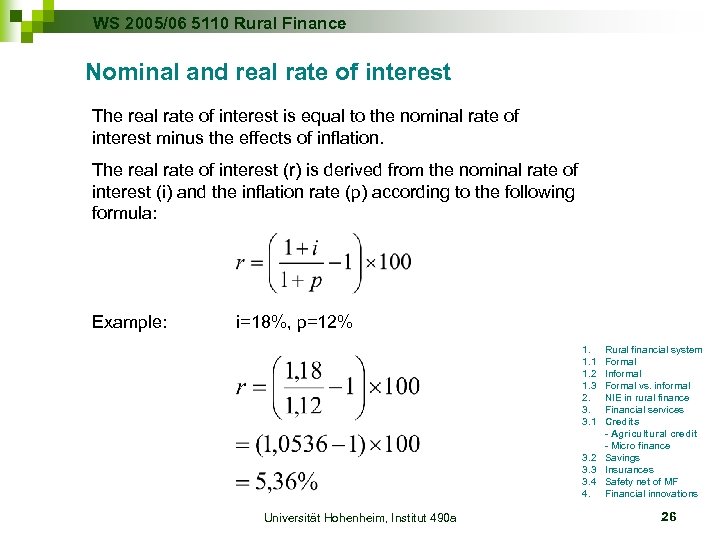 WS 2005/06 5110 Rural Finance Nominal and real rate of interest The real rate of interest is equal to the nominal rate of interest minus the effects of inflation. The real rate of interest (r) is derived from the nominal rate of interest (i) and the inflation rate (p) according to the following formula: Example: i=18%, p=12% 1. 1. 1 1. 2 1. 3 2. 3. 3. 1 Rural financial system Formal Informal Formal vs. informal NIE in rural finance Financial services Credits - Agricultural credit - Micro finance 3. 2 Savings 3. 3 Insurances 3. 4 Safety net of MF 4. Financial innovations Universität Hohenheim, Institut 490 a 26
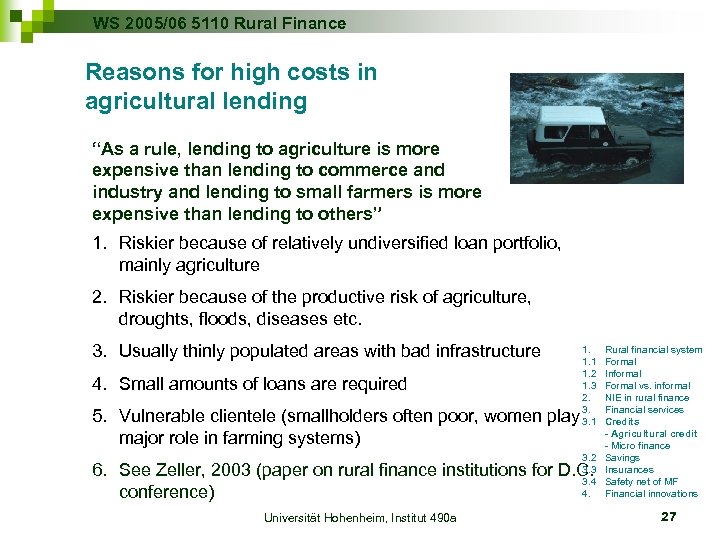 WS 2005/06 5110 Rural Finance Reasons for high costs in agricultural lending “As a rule, lending to agriculture is more expensive than lending to commerce and industry and lending to small farmers is more expensive than lending to others” 1. Riskier because of relatively undiversified loan portfolio, mainly agriculture 2. Riskier because of the productive risk of agriculture, droughts, floods, diseases etc. 3. Usually thinly populated areas with bad infrastructure 4. Small amounts of loans are required 1. 1. 1 1. 2 1. 3 2. 3. 3. 1 Rural financial system Formal Informal Formal vs. informal NIE in rural finance Financial services Credits - Agricultural credit - Micro finance 3. 2 Savings 3. 3 Insurances 3. 4 Safety net of MF 4. Financial innovations 5. Vulnerable clientele (smallholders often poor, women play major role in farming systems) 6. See Zeller, 2003 (paper on rural finance institutions for D. C. conference) Universität Hohenheim, Institut 490 a 27
 WS 2005/06 5110 Rural Finance The new approach to rural finance - The microfinance revolution - Next 1. Financially sustainable and independent financial organizations Forward 2. Ensure outreach to the whole spectrum of the rural population Forward 3. Implementation of client adapted financial services (see last chapter) 4. Implementation of savings instruments Forward 5. New forms of collateral, e. g. group credit, savings, leasing. . . Forward Universität Hohenheim, Institut 490 a 1. 1. 1 1. 2 1. 3 2. 3. 3. 1 Rural financial system Formal Informal Formal vs. informal NIE in rural finance Financial services Credits - Agricultural credit - Micro finance 3. 2 Savings 3. 3 Insurances 3. 4 Safety net of MF 4. Financial innovations 28
 WS 2005/06 5110 Rural Finance 1. Sustainability Back Why sustainability? • The poor value secure but more expensive access to credit higher then cheap but uncertain access • Unsustainable FFI are a drain of public resources • Non-performing loans leaving behind a burnt soil for any viable rural financial intermediation How to achieve sustainability? • Savings collection for being independent from external funds which tend to end at some point of time (also lower costs of capital than commercial borrowing) • Full recovery of costs of lending is essential: 1. Rural financial system 1. 1 Formal a) cost covering interest rate greater than opp costs 1. 2 Informal 1. 3 Formal vs. informal of capital plus admin costs plus risk premium 2. NIE in rural finance 3. Financial services b) achieve high repayment rate (> 95%), and 3. 1 Credits c) organizational efficiency (low hierarchies, de - Agricultural credit - Micro finance 3. 2 Savings central decision making lower administrative costs) 3. 3 Insurances BUT: For the few sustainable MFIs, see Microbanking Bulletin 3. 4 Safety net of MF 4. Financial innovations Universität Hohenheim, Institut 490 a 29
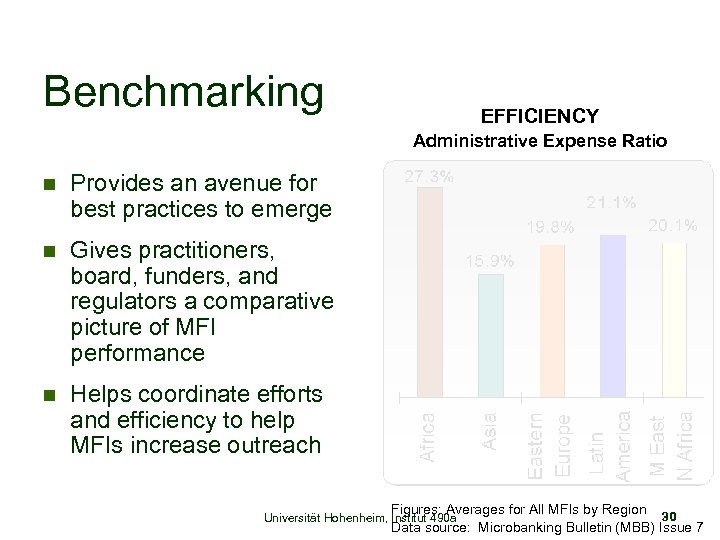 Benchmarking EFFICIENCY Administrative Expense Ratio n Provides an avenue for best practices to emerge n Gives practitioners, board, funders, and regulators a comparative picture of MFI performance n Helps coordinate efforts and efficiency to help MFIs increase outreach Figures: Averages for All MFIs by Region 30 Data source: Microbanking Bulletin (MBB) Issue 7 Universität Hohenheim, Institut 490 a
 WS 2005/06 5110 Rural Finance 2. Outreach While outreach is used from the perspective of the financial program and access is used from the point of view of the potential client, they both refer to the same thing: who is getting the credit (Vaessen 2001). • supports rural growth and food security • it improves an equitable income distribution • it enhances portfolio diversification of the rural finance institution and reduces risk • Depth of outreach: high share of women, poorest, etc. • Breadth of outreach: reaching huge numbers of target group people Universität Hohenheim, Institut 490 a 1. 1. 1 1. 2 1. 3 2. 3. 3. 1 Rural financial system Formal Informal Formal vs. informal NIE in rural finance Financial services Credits - Agricultural credit - Micro finance 3. 2 Savings 3. 3 Insurances 3. 4 Safety net of MF 4. Financial innovations 31
 WS 2005/06 5110 Rural Finance 2. Outreach - How to reach the target group? Targeting – Ex ante • Potential clients are assessed ex ante by short-cut poverty indicators, e. g. wealth, assets, farm size, type of house, occupation etc. Problem Usually quite expensive and time consuming, as every new customer has to be assessed (But Geo-targeting, Housing index, PWR, poverty assessment tools) Potentially open to corruption Product design • Designing of financial services exactly tailored to the needs of the target group and thus, are not demanded by other groups of the population • This requires extensive market research before the product design Problem Critics say, that with product targeting alone the very poor can not be reached Universität Hohenheim, Institut 490 a 1. 1. 1 1. 2 1. 3 2. 3. 3. 1 Rural financial system Formal Informal Formal vs. informal NIE in rural finance Financial services Credits - Agricultural credit - Micro finance 3. 2 Savings 3. 3 Insurances 3. 4 Safety net of MF 4. Financial innovations 32
 WS 2005/06 5110 Rural Finance 2. Outreach vs. Sustainability • • • Some argue there is a trade-off between sustainability and outreach (see e. g. Zeller and Meyer, 2002) the costly information collection on the credibility of potential clients and long distances in sparsely populated regions Counter example: e. g. BRI (Bank Rakyat Indonesia) has an enormous breadth of outreach and is covering its operational costs (however: depth of outreach not clear) Sustainability enables rural MFIs to serve significant/more numbers of low-income clients over time MFIs try to operate in a so called ‘win-win pro-position’: The poor benefit from the financial services provided, willingly to pay high interest rates/fees to obtain them, which permits the MFIs to provide the services on a sustainable basis. Sustainability is based on the reasoning that sustainability today will mean more outreach and impact tomorrow Universität Hohenheim, Institut 490 a Back 1. 1. 1 1. 2 1. 3 2. 3. 3. 1 Rural financial system Formal Informal Formal vs. informal NIE in rural finance Financial services Credits - Agricultural credit - Micro finance 3. 2 Savings 3. 3 Insurances 3. 4 Safety net of MF 4. Financial innovations 33
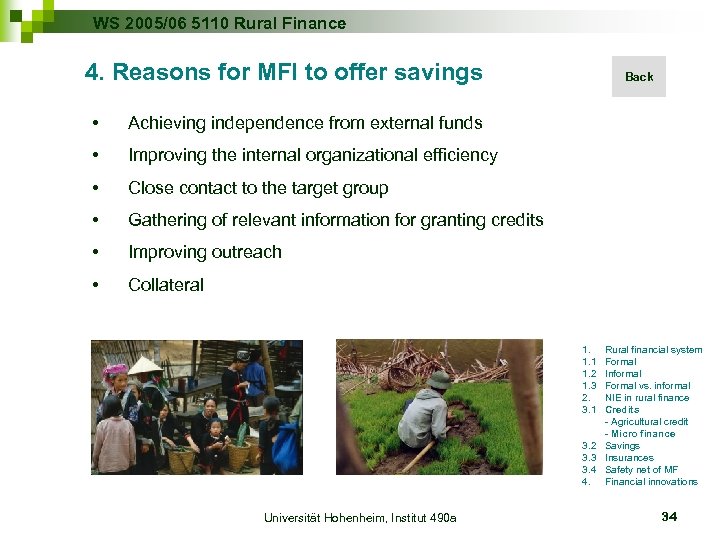 WS 2005/06 5110 Rural Finance 4. Reasons for MFI to offer savings • Achieving independence from external funds • Improving the internal organizational efficiency • Close contact to the target group • Gathering of relevant information for granting credits • Improving outreach • Back Collateral 1. 1. 1 1. 2 1. 3 2. 3. 1 Rural financial system Formal Informal Formal vs. informal NIE in rural finance Credits - Agricultural credit - Micro finance 3. 2 Savings 3. 3 Insurances 3. 4 Safety net of MF 4. Financial innovations Universität Hohenheim, Institut 490 a 34
 WS 2005/06 5110 Rural Finance 5. Collateral Why are banks asking for collateral? • Relational contracts, information asymmetry, moral hazard problem • Collateral insures the lenders’ loan portfolio in case of borrowers’ default. It represents an incentive of the borrowers’ willingness to repay. Traditional collateral • Land titles, wages, capital assets (car with title) • FFIs typically resort to legal options, such as seizing property or wages directly from the employer. • MFIs lend to low-income clients who usually have very few assets. Consequently, traditional collateral is often not available, and collateral substitutes (similar to the informal market) are used. Universität Hohenheim, Institut 490 a 1. 1. 1 1. 2 1. 3 2. 3. 3. 1 Rural financial system Formal Informal Formal vs. informal NIE in rural finance Financial services Credits - Agricultural credit - Micro finance 3. 2 Savings 3. 3 Insurances 3. 4 Safety net of MF 4. Financial innovations 35
 WS 2005/06 5110 Rural Finance 5. Collateral Back Substitutes of traditional collateral • Joint liability groups • Compulsory savings • Social collateral or character-based lending • Credit history • Any kind of valuable property, e. g. animals, furniture The mechanism of collateral • Often, simply the risk of legal repression is enough to encourage repayment. • Regardless of the actually value of the asset, the act of pledging assets and the consequent realization that they can be lost causes the client to repay the loan. • Even if the collateral is almost never collected, this does not signal its lack of importance. Few instances when collateral is actually collected are sufficient. Universität Hohenheim, Institut 490 a 1. 1. 1 1. 2 1. 3 2. 3. 3. 1 Rural financial system Formal Informal Formal vs. informal NIE in rural finance Financial services Credits - Agricultural credit - Micro finance 3. 2 Savings 3. 3 Insurances 3. 4 Safety net of MF 4. Financial innovations 36
 WS 2005/06 5110 Rural Finance Reasons for households to save Next 1. Income smoothing Safeguards against uneven income streams due to seasonal variations Forward 2. Insurance Provisions against disability, disease, retirement, sudden income losses and other contingencies 3. Wealth accumulation Financing household’s long-term goals (social and religious purposes, heritage, consumer durable) 4. Future investments 5. Financial reciprocity or social reciprocity The possibility of using savings to gain access to credit or other services Universität Hohenheim, Institut 490 a 1. 1. 1 1. 2 1. 3 2. 3. 3. 1 Rural financial system Formal Informal Formal vs. informal NIE in rural finance Financial services Credits - Agricultural credit - Micro finance 3. 2 Savings 3. 3 Insurances 3. 4 Safety net of MF 4. Financial innovations 37
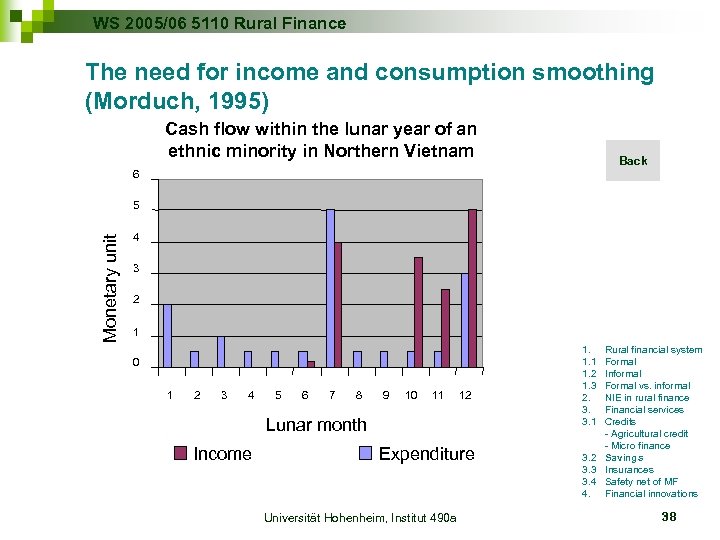 WS 2005/06 5110 Rural Finance The need for income and consumption smoothing (Morduch, 1995) Cash flow within the lunar year of an ethnic minority in Northern Vietnam Back 6 Monetary unit 5 4 3 2 1 0 1 2 3 4 5 6 7 8 9 10 11 12 Lunar month Income Expenditure Universität Hohenheim, Institut 490 a 1. 1. 1 1. 2 1. 3 2. 3. 3. 1 Rural financial system Formal Informal Formal vs. informal NIE in rural finance Financial services Credits - Agricultural credit - Micro finance 3. 2 Savings 3. 3 Insurances 3. 4 Safety net of MF 4. Financial innovations 38
 WS 2005/06 5110 Rural Finance Formal and informal savings Formal savings • • • Bank accounts Certain insurances Stocks Informal savings In kind: • • Animals (cows, goats, pigs, chickens etc. ) Grain (maize, rice etc. ) and commodities (beans, coffee etc. ) • Construction materials (bricks, wood, etc. ) • Jewelry or gold In cash: • Money collectors • Reciprocal lending (e. g. Ro. SCAs) • Under the pillow Universität Hohenheim, Institut 490 a 1. 1. 1 1. 2 1. 3 2. 3. 3. 1 Rural financial system Formal Informal Formal vs. informal NIE in rural finance Financial services Credits - Agricultural credit - Micro finance 3. 2 Savings 3. 3 Insurances 3. 4 Safety net of MF 4. Financial innovations 39
 WS 2005/06 5110 Rural Finance Decision parameters for choosing a saving option 1. Transaction costs TCs incurred on transforming available surplus into a specific savings option or on liquidating it 2. Liquidity Time of liquidating the saving option in case of need 3. Real interest rates Remunerations of the saving option 4. Divisibility Possibility of parting of the savings in different sizes 5. Safety How secure are the savings stored? 6. Trustworthiness and confidence 7. Piggy bank Locking money away from relatives and friends Universität Hohenheim, Institut 490 a 1. 1. 1 1. 2 1. 3 2. 3. 3. 1 Rural financial system Formal Informal Formal vs. informal NIE in rural finance Financial services Credits - Agricultural credit - Micro finance 3. 2 Savings 3. 3 Insurances 3. 4 Safety net of MF 4. Financial innovations 40
 WS 2005/06 5110 Rural Finance Importance of savings “For the poor, access to saving products may be more important than credit (Zeller 2001). ” “In institutions which offer unbiased savings and credit services, the number of savers exceeds the number of borrowers by a wide margin (Seibel 1999). ” The most successful saving product: - voluntary - close proximity to the clients - positive real interest rates - (quickly accessible in case of need) BUT: Locking away of savings in formal deposits may decrease the depositor’s access to financial support from the social environment in times of scarce resources. Social cohesion as well as individuals’ safety nets may be disrupted Universität Hohenheim, Institut 490 a 1. 1. 1 1. 2 1. 3 2. 3. 3. 1 Rural financial system Formal Informal Formal vs. informal NIE in rural finance Financial services Credits - Agricultural credit - Micro finance 3. 2 Savings 3. 3 Insurances 3. 4 Safety net of MF 4. Financial innovations 41
 WS 2005/06 5110 Rural Finance Micro-Insurance “Many households borrow, more save, and all insure (Zeller 2000). ” • • Formal insurance schemes in most developing countries not available, particularly not for the rural population Particularly poor households enter into various forms of informal self-insurance or co-insurance arrangements • Informal insurance arrangement are important but at the end not sufficient Insurance in rural finance: • Relatively new product in rural finance • During the 80 s many experiments in developing countries 1. Rural financial system 1. 1 Formal with crop insurance schemes 1. 2 Informal BUT: All failed and immense public resources were wasted 1. 3 Formal vs. informal 2. NIE in rural finance 3. Financial services • Today many MFIs also offer micro-insurances, e. g. life 3. 1 Credits - Agricultural credit insurances, disability insurance, health insurances - Micro finance 3. 2 Savings • MFIs sometimes offering a compulsory investment 3. 3 Insurances 3. 4 Safety net of MF insurance to secure their portfolio 4. Financial innovations Universität Hohenheim, Institut 490 a 42
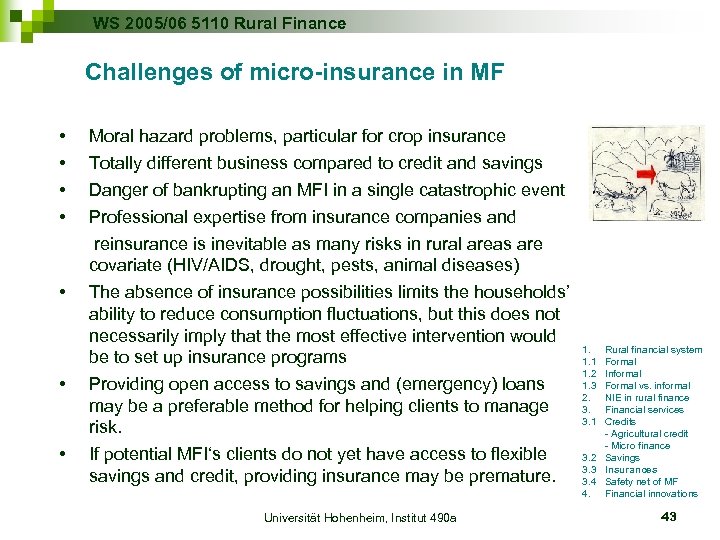 WS 2005/06 5110 Rural Finance Challenges of micro-insurance in MF • Moral hazard problems, particular for crop insurance • Totally different business compared to credit and savings • Danger of bankrupting an MFI in a single catastrophic event • Professional expertise from insurance companies and reinsurance is inevitable as many risks in rural areas are covariate (HIV/AIDS, drought, pests, animal diseases) • The absence of insurance possibilities limits the households’ ability to reduce consumption fluctuations, but this does not necessarily imply that the most effective intervention would be to set up insurance programs • Providing open access to savings and (emergency) loans may be a preferable method for helping clients to manage risk. • If potential MFI‘s clients do not yet have access to flexible savings and credit, providing insurance may be premature. Universität Hohenheim, Institut 490 a 1. 1. 1 1. 2 1. 3 2. 3. 3. 1 Rural financial system Formal Informal Formal vs. informal NIE in rural finance Financial services Credits - Agricultural credit - Micro finance 3. 2 Savings 3. 3 Insurances 3. 4 Safety net of MF 4. Financial innovations 43
 WS 2005/06 5110 Rural Finance The safety net role of microfinance? • Open access savings and emergency loans act as a form of insurance (people may choose not to borrow to Forward their full credit limit, see Diagne and Zeller, 2002, Malawi research report of IFPRI) • Credit and savings products cannot provide complete protection against risks resulting in a loss greater than what a household can save or repay at this point, insurance becomes a more effective method of risk management • Some risks cannot be economically insured and there are some risks where insurance is technically possible but may not be the most appropriate tool • Different risks require different financial services with specific features: There is no „one fits all“ solution!!! Next Universität Hohenheim, Institut 490 a 1. 1. 1 1. 2 1. 3 2. 3. 3. 1 Rural financial system Formal Informal Formal vs. informal NIE in rural finance Financial services Credits - Agricultural credit - Micro finance 3. 2 Savings 3. 3 Insurances 3. 4 Safety net of MF 4. Financial innovations 44
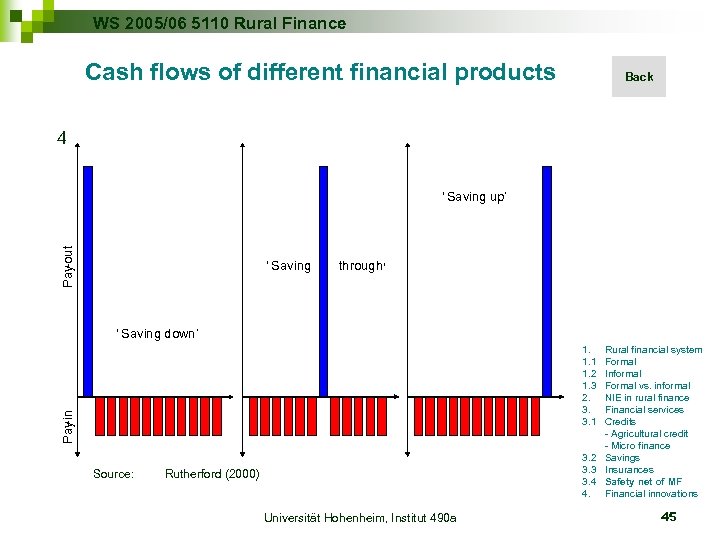 WS 2005/06 5110 Rural Finance Cash flows of different financial products Back 4 Pay -out ‘ Saving up’ ‘ Saving through‘ ‘ Saving down’ Rural financial system Formal Informal Formal vs. informal NIE in rural finance Financial services Credits - Agricultural credit - Micro finance 3. 2 Savings 3. 3 Insurances 3. 4 Safety net of MF 4. Financial innovations Pay -in 1. 1. 1 1. 2 1. 3 2. 3. 3. 1 Source: Rutherford (2000) Universität Hohenheim, Institut 490 a 45
 WS 2005/06 5110 Rural Finance Categories of financial innovations „The Schumpeterian qualification, that innovation must be cost reducing, separates change from innovation (Von Pischke 1995 p. 121). “ 1. Innovations in the macro-financial system 2. Innovations at the level of the financial intermediary 3. Innovations in organizing financial intermediation 4. Financial product innovations Universität Hohenheim, Institut 490 a 1. 1. 1 1. 2 1. 3 2. 3. 3. 1 Rural financial system Formal Informal Formal vs. informal NIE in rural finance Financial services Credits - Agricultural credit - Micro finance 3. 2 Savings 3. 3 Insurances 3. 4 Safety net of MF 4. Financial innovations 46
 WS 2005/06 5110 Rural Finance (1) • • Innovations in the macro-financial system Innovations at this level change the system as a whole. They may contribute to the outreach of financial intermediation and are generally applied at the policy level. Examples: Changes in the legal and regulatory framework Establishment and acceptance of new organizational forms of financial intermediaries Innovations in the macro-financial system allowed NGOs to take up financial intermediation activities in many countries which was illegal before Universität Hohenheim, Institut 490 a 1. 1. 1 1. 2 1. 3 2. 3. 3. 1 Rural financial system Formal Informal Formal vs. informal NIE in rural finance Financial services Credits - Agricultural credit - Micro finance 3. 2 Savings 3. 3 Insurances 3. 4 Safety net of MF 4. Financial innovations 47
 WS 2005/06 5110 Rural Finance (2) • • Innovations at the level of the financial organization refer to changes in their legal form or organizational form. These innovations may increase access to financial services through economies of scale and specialization; mistrust may be reduced through a better organizational compatibility with existing organizational forms. Examples: Transformation of an informal into a registered (NGO) or formal financial institution (bank) Changes in the hierarchical structure, decentralization, two- tier models Market differentiation through the creation of specialized outlets which, e. g. cater particularly to SMEs Universität Hohenheim, Institut 490 a 1. 1. 1 1. 2 1. 3 2. 3. 3. 1 Rural financial system Formal Informal Formal vs. informal NIE in rural finance Financial services Credits - Agricultural credit - Micro finance 3. 2 Savings 3. 3 Insurances 3. 4 Safety net of MF 4. Financial innovations 48
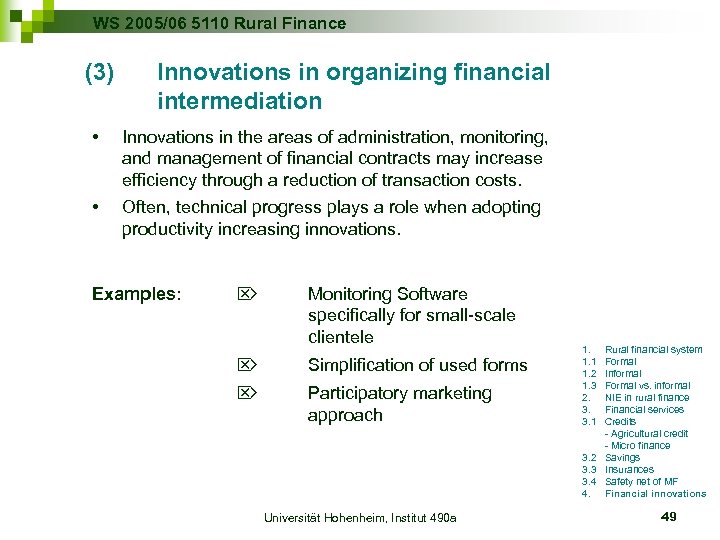 WS 2005/06 5110 Rural Finance (3) Innovations in organizing financial intermediation • Innovations in the areas of administration, monitoring, and management of financial contracts may increase efficiency through a reduction of transaction costs. • Often, technical progress plays a role when adopting productivity increasing innovations. Examples: Monitoring Software specifically for small-scale clientele Simplification of used forms Participatory marketing approach Universität Hohenheim, Institut 490 a 1. 1. 1 1. 2 1. 3 2. 3. 3. 1 Rural financial system Formal Informal Formal vs. informal NIE in rural finance Financial services Credits - Agricultural credit - Micro finance 3. 2 Savings 3. 3 Insurances 3. 4 Safety net of MF 4. Financial innovations 49
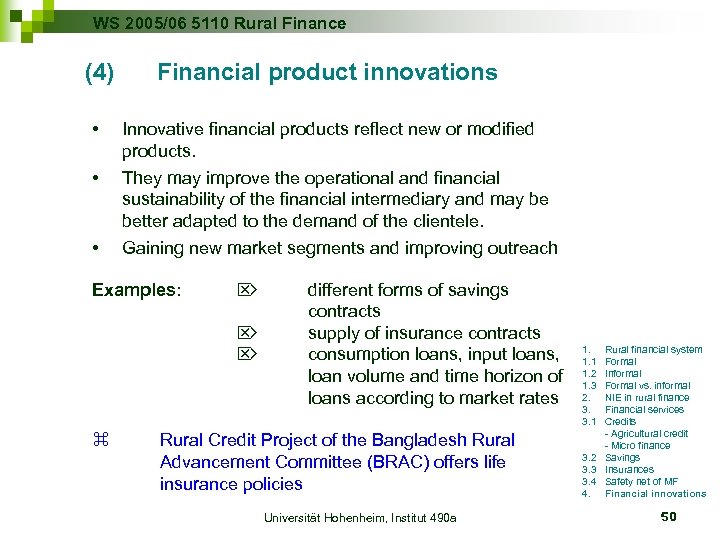 WS 2005/06 5110 Rural Finance (4) • Financial product innovations • Innovative financial products reflect new or modified products. They may improve the operational and financial sustainability of the financial intermediary and may be better adapted to the demand of the clientele. • Gaining new market segments and improving outreach Examples: different forms of savings contracts supply of insurance contracts consumption loans, input loans, loan volume and time horizon of loans according to market rates Rural Credit Project of the Bangladesh Rural Advancement Committee (BRAC) offers life insurance policies Universität Hohenheim, Institut 490 a 1. 1. 1 1. 2 1. 3 2. 3. 3. 1 Rural financial system Formal Informal Formal vs. informal NIE in rural finance Financial services Credits - Agricultural credit - Micro finance 3. 2 Savings 3. 3 Insurances 3. 4 Safety net of MF 4. Financial innovations 50
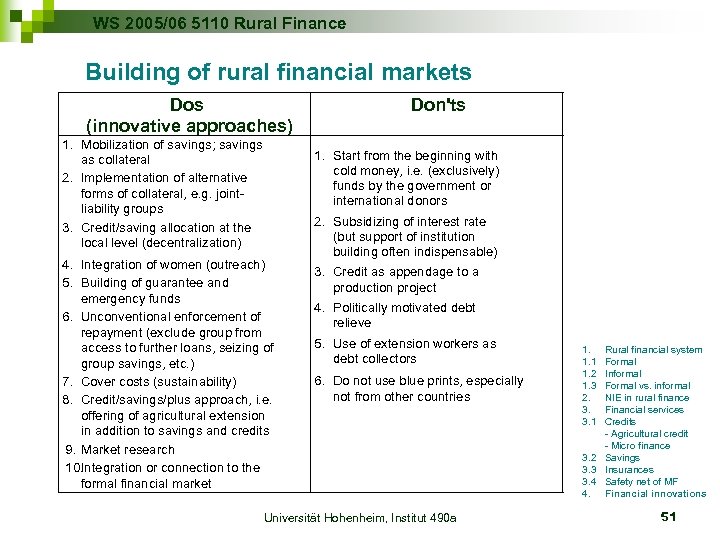 WS 2005/06 5110 Rural Finance Building of rural financial markets Dos (innovative approaches) 1. Mobilization of savings; savings as collateral 2. Implementation of alternative forms of collateral, e. g. jointliability groups 3. Credit/saving allocation at the local level (decentralization) 4. Integration of women (outreach) 5. Building of guarantee and emergency funds 6. Unconventional enforcement of repayment (exclude group from access to further loans, seizing of group savings, etc. ) 7. Cover costs (sustainability) 8. Credit/savings/plus approach, i. e. offering of agricultural extension in addition to savings and credits 9. Market research 10. Integration or connection to the formal financial market Don'ts 1. Start from the beginning with cold money, i. e. (exclusively) funds by the government or international donors 2. Subsidizing of interest rate (but support of institution building often indispensable) 3. Credit as appendage to a production project 4. Politically motivated debt relieve 5. Use of extension workers as debt collectors 6. Do not use blue prints, especially not from other countries Universität Hohenheim, Institut 490 a 1. 1. 1 1. 2 1. 3 2. 3. 3. 1 Rural financial system Formal Informal Formal vs. informal NIE in rural finance Financial services Credits - Agricultural credit - Micro finance 3. 2 Savings 3. 3 Insurances 3. 4 Safety net of MF 4. Financial innovations 51
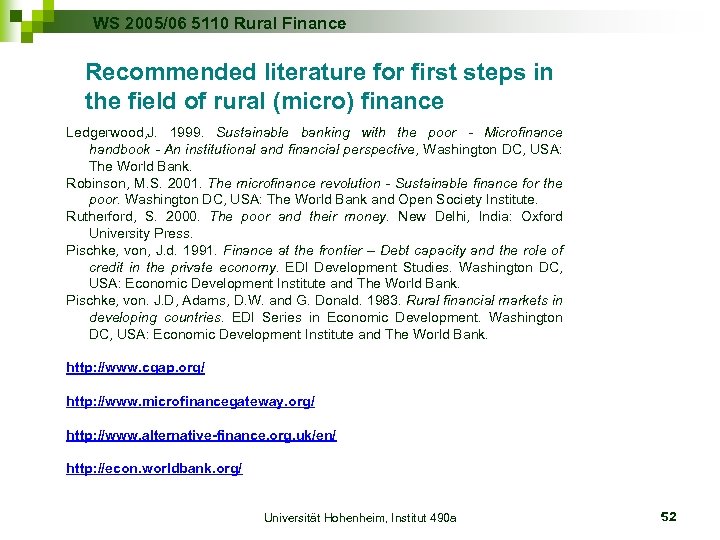 WS 2005/06 5110 Rural Finance Recommended literature for first steps in the field of rural (micro) finance Ledgerwood, J. 1999. Sustainable banking with the poor - Microfinance handbook - An institutional and financial perspective, Washington DC, USA: The World Bank. Robinson, M. S. 2001. The microfinance revolution - Sustainable finance for the poor. Washington DC, USA: The World Bank and Open Society Institute. Rutherford, S. 2000. The poor and their money. New Delhi, India: Oxford University Press. Pischke, von, J. d. 1991. Finance at the frontier – Debt capacity and the role of credit in the private economy. EDI Development Studies. Washington DC, USA: Economic Development Institute and The World Bank. Pischke, von. J. D, Adams, D. W. and G. Donald. 1983. Rural financial markets in developing countries. EDI Series in Economic Development. Washington DC, USA: Economic Development Institute and The World Bank. http: //www. cgap. org/ http: //www. microfinancegateway. org/ http: //www. alternative-finance. org. uk/en/ http: //econ. worldbank. org/ Universität Hohenheim, Institut 490 a 52
 Models of Rural Finance Institutions Manfred Zeller Presentation made at the International Conference on Paving the Road Forward for Rural Finance, June 2 -4, 2003, Washington, D. C. Download papers at http: //www. basis. wisc. edu/rfc/ Universität Hohenheim, Institut 490 a 53
 WS 2005/06 5110 Rural Finance Outline of presentation 1. 2. 3. 4. 5. 6. Renewed interest in rural and ag finance: Why? Changing paradigms and policy objectives in development finance. What is specific about rural and ag finance: environments, ag production, clientele. Types (or models) of rural finance institutions. Micro-finance best practices: Transfer? Policy recommendations: Towards sustainable rural financial systems. Universität Hohenheim, Institut 490 a 54
 WS 2005/06 5110 Rural Finance Renewed interest in rural and ag finance: Why? 1. 2. 3. Decline in formal rural and agric credit after justified collapse of subsidized ag credit systems. Role of rural finance for agric and economic growth, food security and poverty reduction. Hope of doing better this time because of our enhanced knowledge on: - market and government failure improved macroeconomic, financial and ag sector policy frameworks - demand for financial services by rural population - best practices in (urban-based) micro-finance and financial systems building Universität Hohenheim, Institut 490 a 55
 WS 2005/06 5110 Rural Finance Old versus new paradigm Old paradigm of sector-directed, supply-led and subsidized credit: n n faulty assumptions about demand (i. e. “need”) focus not on financial sustainability of institution, but on (depth) of outreach. Impact was assumed. New paradigm: n n n focus on institution and systems building liberalization of financial markets as necessary but not sufficient condition for deepening financial systems need institutional and technological innovations to reduce transaction costs Demand orientation, three objectives Universität Hohenheim, Institut 490 a 56
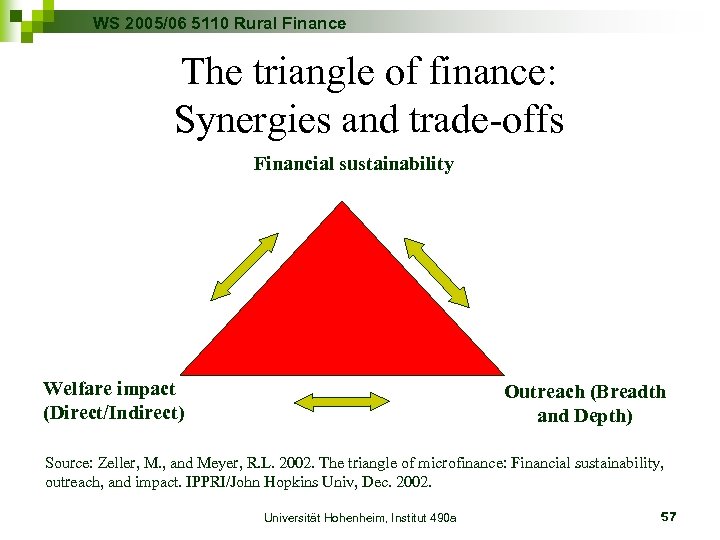 WS 2005/06 5110 Rural Finance The triangle of finance: Synergies and trade-offs Financial sustainability Welfare impact (Direct/Indirect) Outreach (Breadth and Depth) Source: Zeller, M. , and Meyer, R. L. 2002. The triangle of microfinance: Financial sustainability, outreach, and impact. IPPRI/John Hopkins Univ, Dec. 2002. Universität Hohenheim, Institut 490 a 57
 WS 2005/06 5110 Rural Finance The Urban-Rural Dichotomy higher transaction costs for FIs and their clients (irrespective of the institutional model) n higher systemic risks, more volatile cash flows, and complex, heterogeneous legal frameworks n lower risk bearing ability and higher vulnerability of rural households n lower policy commitment to rural areas Rural finance is more difficult n Universität Hohenheim, Institut 490 a 58
 WS 2005/06 5110 Rural Finance Specific characteristics of agriculture 1. 2. 3. Location-specificity (ag is production in space). Unfavorable terms of trade for agriculture. Production depends on natural conditions (covariant risks!), gestation periods of several years e. g. tree crops, dairy. 4. 5. Seasonality (production, food and factor prices). Significant role of women in ag, especially food crops. 6. High incidence and depth of poverty among population dependent on agriculture. 7. High volatility of prices in ag commodities. Serving ag clients is EVEN more difficult. Universität Hohenheim, Institut 490 a 59
 WS 2005/06 5110 Rural Finance Creating inst. innovations 1. 2. 3. Institutional innovations in rural and microfinance are rarely the PURE product of market forces seeking to maximize profit. Successful innovations were done conform with market principles. Yet, they were fostered by public investments (example BRI) or by private altruistic action (1. coop movement in Germany started by Raiffeissen and Schultze von Delitzsch, 2. Grameen Bank: Yunus 3. Many other leaders in the industry supported by donors. State has a role to invest in innovations and related learning and multiplication of best practices (freerider problem)– Much of investment (and learning) can and needs to be done together with other stakeholders (private firms, NGOs, clients). 60 Universität Hohenheim, Institut 490 a
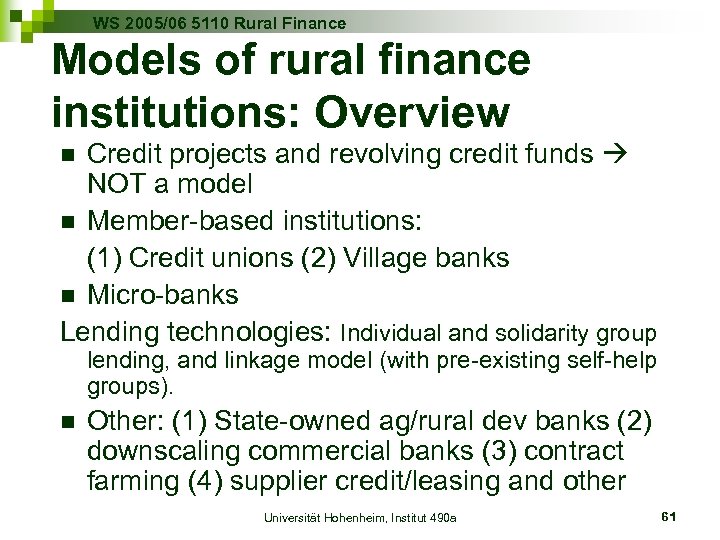 WS 2005/06 5110 Rural Finance Models of rural finance institutions: Overview Credit projects and revolving credit funds NOT a model n Member-based institutions: (1) Credit unions (2) Village banks n Micro-banks Lending technologies: Individual and solidarity group n lending, and linkage model (with pre-existing self-help groups). n Other: (1) State-owned ag/rural dev banks (2) downscaling commercial banks (3) contract farming (4) supplier credit/leasing and other Universität Hohenheim, Institut 490 a 61
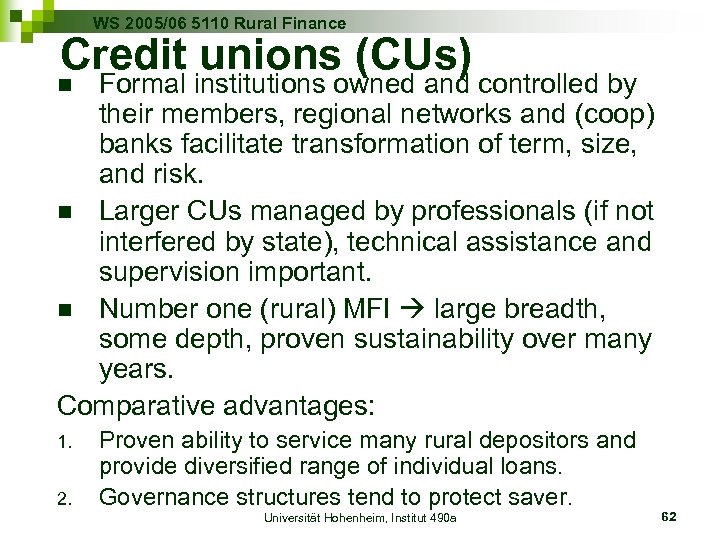 WS 2005/06 5110 Rural Finance Credit unions (CUs) Formal institutions owned and controlled by their members, regional networks and (coop) banks facilitate transformation of term, size, and risk. n Larger CUs managed by professionals (if not interfered by state), technical assistance and supervision important. n Number one (rural) MFI large breadth, some depth, proven sustainability over many years. Comparative advantages: n 1. 2. Proven ability to service many rural depositors and provide diversified range of individual loans. Governance structures tend to protect saver. Universität Hohenheim, Institut 490 a 62
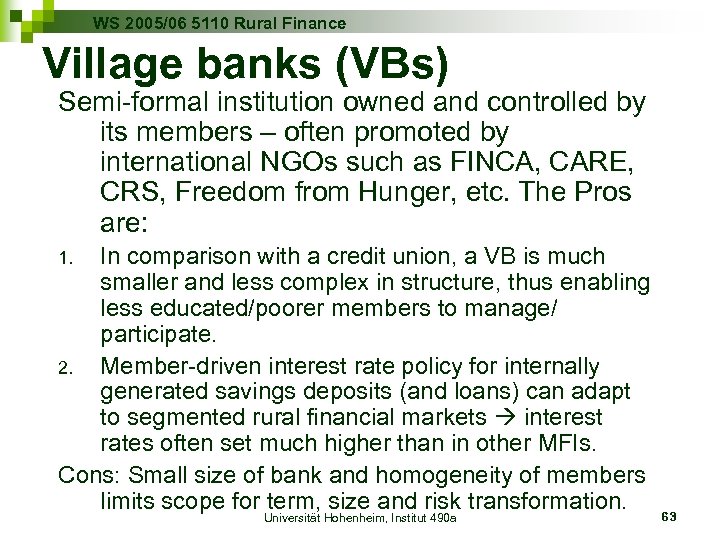 WS 2005/06 5110 Rural Finance Village banks (VBs) Semi-formal institution owned and controlled by its members – often promoted by international NGOs such as FINCA, CARE, CRS, Freedom from Hunger, etc. The Pros are: In comparison with a credit union, a VB is much smaller and less complex in structure, thus enabling less educated/poorer members to manage/ participate. 2. Member-driven interest rate policy for internally generated savings deposits (and loans) can adapt to segmented rural financial markets interest rates often set much higher than in other MFIs. Cons: Small size of bank and homogeneity of members limits scope for term, size and risk transformation. 1. Universität Hohenheim, Institut 490 a 63
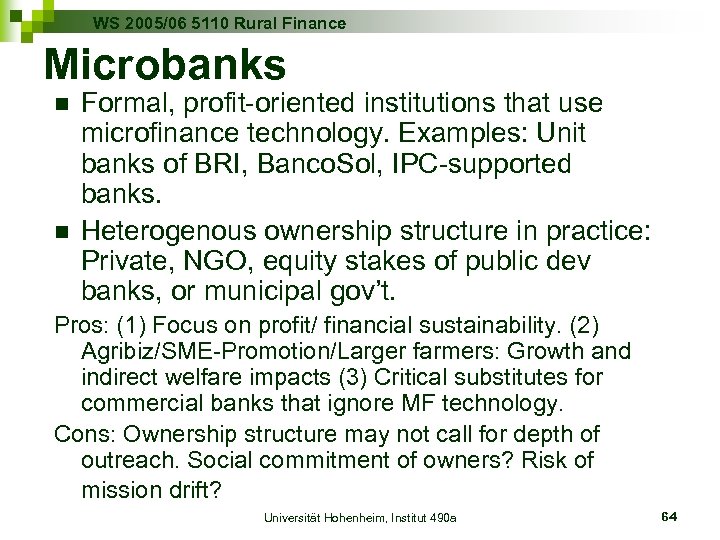 WS 2005/06 5110 Rural Finance Microbanks n n Formal, profit-oriented institutions that use microfinance technology. Examples: Unit banks of BRI, Banco. Sol, IPC-supported banks. Heterogenous ownership structure in practice: Private, NGO, equity stakes of public dev banks, or municipal gov’t. Pros: (1) Focus on profit/ financial sustainability. (2) Agribiz/SME-Promotion/Larger farmers: Growth and indirect welfare impacts (3) Critical substitutes for commercial banks that ignore MF technology. Cons: Ownership structure may not call for depth of outreach. Social commitment of owners? Risk of mission drift? Universität Hohenheim, Institut 490 a 64
 WS 2005/06 5110 Rural Finance State-owned rural/ag dev banks Need to be transformed (based on business principles), or, if not possible, liquidated. Successful transformation is possible even if STATE OWNERSHIP is retained (BRI, BAAC) depends on political will, suitable macroeconomic and ag sectoral framework, and on mgt that is independent and has incentives to perform A number of donors are involved in reform of state-owned banks (IFAD/GTZ/IDB/USAID): No reason to write them off. Liquidation (even if possible) is often not the best option. Universität Hohenheim, Institut 490 a 65
 WS 2005/06 5110 Rural Finance Micro-finance best practices Knowledge on best practices in micro-finance are relevant, but not sufficient because of specific characteristics of agric finance Agricultural lending: See FAO, Table 3 in paper Savings: CGAP working papers. Insurance against idiosyncratic risks such as sickness, accident: Innovations by SEWA and others, see ILO and other publications. Adaptation to rural and farm households is needed. But this is nothing new: Best practice means to develop demand-oriented products and delivery technologies. Universität Hohenheim, Institut 490 a 66
 WS 2005/06 5110 Rural Finance Conclusions/recommendations 1. 2. Learn from past failures of rural/ag finance. It is too costly to repeat them. No (model) blueprint but promote institutional diversity/innovation. Each institutional model has its comparative advantages, and diversity enhances competition, outreach, and impact. 3. Promote rural finance institutions within a financial systems perspective. Stand-alone retail rural financial institutions are doomed to vanish need horizontal/vertical integration. Universität Hohenheim, Institut 490 a 67
 WS 2005/06 5110 Rural Finance Conclusions/recommendations 4. Do the relatively “easy” things first, while gradually experimenting with the more difficult ones. Rural and ag finance is more difficult than urban finance, and many environments are too hostile without preceding improvements in other sectors (infrastructure, ag tech, ag policy…). Rural finance follows rather than precedes… 5. Be patient. Building of rural financial institutions and systems is a labor-, knowledge-, and timeconsuming process. It is technical, not financial assistance that matters. More of capital can do more harm than good. Universität Hohenheim, Institut 490 a 68
 WS 2005/06 5110 Rural Finance Literature used for this lecture Buchenrieder, G. , Heidhues, F. , and P. T. M. Dung. 2000. Rural finance and sustainable rural development in Northern Vietnam - Research proposal submitted to Deutsche Forschungsgemeinschaft (DFG). Stuttgart, Germany: University of Hohenheim, The Uplands Program. Buchenrieder, G. , Heidhues, F. , and P. T. M. Dung. 2003. Risk management of farm households in Northern Vietnam. Research proposal submitted to Deutsche Forschungsgemeinschaft (DFG). Stuttgart, Germany: University of Hohenheim, The Uplands Program. Geis, H. G. 1975. Die Rolle der finanziellen Infrastruktur bei der Kapitalbildung. In: Priebe, H. (ed. ): Eigenfinanzierung und Entwicklung. Berlin, Germany: Duncker und Humboldt. Heidhues, F. and G. Schrieder. 1999. Rural financial market development. Research in Development Economics and Policy Discussion Paper No 1. Stuttgart, Germany: Grauer Verlag. Pischke, von, J. D. Analytical and public policy issues in promoting innovation in rural financial markets. In Special issue: Innovative approaches to rural financial market development. (ed Heidhues, F). Quarterly Journal of International Agriculture 34 (2): 121 -131 Rutherford, S. 2000. Raising the curtain on the 'microfinancial services era'. Small Enterprise Development 11 (1): 13 -25. Seibel, D. 1999. Outreach and sustainability of rural microfinance in Asia: Observations and recommendations. Rural Finance Working Paper No A 5. Rome, Italy: International Fund for Agriculture Development (IFAD). Vaessen, J. 2001. Accessibility of rural credit in Northern Nicaragua: The importance of networks of information and recommendation. Savings and Development 25 (1): 5 -32. Vogel, R. , 1984. Savings mobilization, the forgotten half of rural finance. In: Adams, D. W. , Graham, D. , Von Pischke, J. D. (Eds. ): 248 -265. Undermining rural development with cheap credit. Boulder, USA: Westview Press. Zeller, M. 2001. Promoting institutional innovation in microfinance - Replicating best practices is not enough. Development and Cooperation (1): 8 -11. Zeller, M. and M. Sharma. 2000. Many borrow, more save, and all insure: Implications for food and microfinance policy. Food Policy 25 (2): 143 -167. Zeller, M. , Schrieder, G. , Braun von, . J. , and F. Heidhues. 1997. Rural finance for food security of the poor: Concept, review, and implications for research and policy. Food Policy Review No 4. Washington DC, USA: International Food Policy Research Institute (IFPRI). Universität Hohenheim, Institut 490 a 69
 WS 2005/06 5110 Rural Finance Literature used for this lecture Lapenu, Cécile, and Manfred Zeller, 2002. Distribution, growth, and performance of the microfinance institutions in Africa, Asia and Latin America: A Recent Inventory. Savings and Development, Vol. 26 (1), pp 87 -111. (a longer version of this paper can be downloaded at www. ifpri. org under discussion papers) 1. Zeller, Manfred. 1998. Determinants of repayment performance in credit groups in Madagascar: The role of program design, intra-group risk pooling and social cohesion. Economic Development and Cultural Change, Vol. 46 (1), pp. 599 -620, January 1998, University of Chicago Press. Sharma, Manohar, and Manfred Zeller. 1997. Repayment performance in group-based credit programs in Bangladesh: an empirical analysis. World Development, Vol. 25 (10), pp. 1731 -1742. October 1997. Adams, D. W. 1988. The conundrum of successful credit projects in floundering rural financial markets. Economic Development and Cultural Change 36 (2): 355 -367. Feder, G. , R. E. Just, and D. Zilberman. 1985. Adoption of agricultural innovations in developing countries. Economic Development and Cultural Change 22(2): 255 -296. Hulme, D. , and P. Mosley. 1996. Finance against poverty. Routledge: London and New York. Universität Hohenheim, Institut 490 a 70
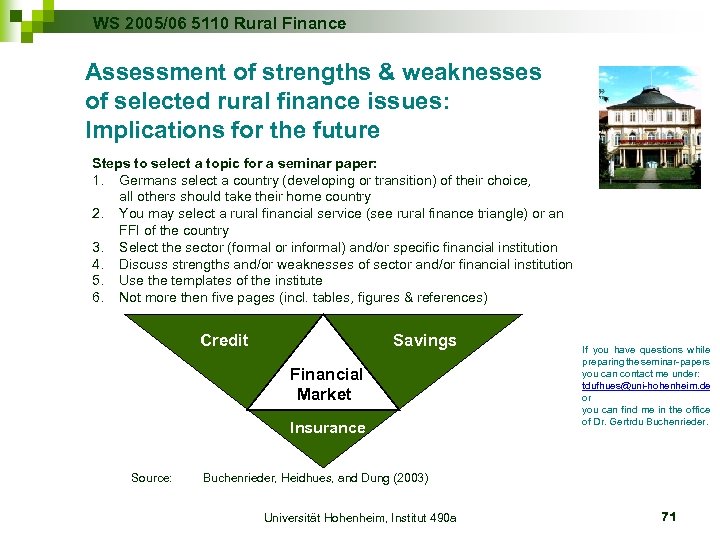 WS 2005/06 5110 Rural Finance Assessment of strengths & weaknesses of selected rural finance issues: Implications for the future Steps to select a topic for a seminar paper: 1. Germans select a country (developing or transition) of their choice, all others should take their home country 2. You may select a rural financial service (see rural finance triangle) or an FFI of the country 3. Select the sector (formal or informal) and/or specific financial institution 4. Discuss strengths and/or weaknesses of sector and/or financial institution 5. Use the templates of the institute 6. Not more then five pages (incl. tables, figures & references) Credit Savings Financial Market Insurance Source: If you have questions while preparing the seminar-papers you can contact me under: tdufhues@uni-hohenheim. de or you can find me in the office of Dr. Gertrdu Buchenrieder, Heidhues, and Dung (2003) Universität Hohenheim, Institut 490 a 71