 Скачать презентацию RURAL ELECTRIFICATION IN Islamic Republic of Iran RURAL
e0b8435cee47c0f741ee4286e9055b7d.ppt
- Количество слайдов: 29



RURAL ELECTRIFICATION IN Islamic Republic of Iran RURAL ELECTRICITY • DEPARTMENT OF Renewable Energy Organization • of IRAN(SUNA) By: S. MANESHIPOUR 7 th of November 2012
OUTLINE v. The Importance of Energy v. The Aims of Rural Development v. Photovoltaics & Rural Electrification Deparmant v. Rural Electrification situation in IRAN v. Photovoltaic experience in IRAN v Photovoltaic in Rural Area v Design system v Feasibility study and How to apply v Advantage and capability v Gains and Successes v Future Planes v Conclusions
IMPORTANCE OF ENERGY Ø ENERGY IS A BASIC NEED FOR HUMAN DEVELOPMENT Ø IT IS A MAJOR INPUT FOR SUCCESSFUL FAMILY AND FOR IMPLEMENTATION OF IRAN’S, POLICIES AND PROGRAMMES
The aims of rural development Definition of rural development: Ø To improve life level of rural populations like improvement of income and occupation. Ø To reduce inequality of distribution of rural income and facilities. Ø To expand of abilities in rural section by training. The aims: q Creation of occupation in economical sections in order to improve develops of industry sections and sections of services. q creation of motivation of rural to remain in rural areas.
The aims of rural development q Creation of balance between areas in economical, social, cultural aspects. This inequality has created on basis of historical, natural, infrastructure and economical factors. Therefore, the responsibility of the Government is to decrease these inequalities. q Changing of rural society from a purely natural environment to a technical environment due to development of economical sections. This subject will create increased incomes for rural population. ( Ministry of Jahad Agriculture, 2001)
Rural Electrification Objectives ü Improving the quality of energy used by rural residents for daily life. ü Promoting farmers income growth. ü Reducing poverty. ü Improving local ecological environment. ü improving the standard of living and increase quality of life. ü Reducing in the number of people migrating to urban areas. ü improving local health and safety issues.
Photovoltaics & Rural Electrification Deparmant • Developed and Promote RE Resources in Rurals in line with the objectives of renewable energy objects in the country. • Participation in design strategy, the long-term, medium-term and short-term programs , guidelines and standards for the use of photovoltaic systems to increase the share of the country's total energy production. • Use of new technologies and definition of new projects. • Evaluation studies , supply project’s specifications and in the implementation of projects, installe and analyze project performance
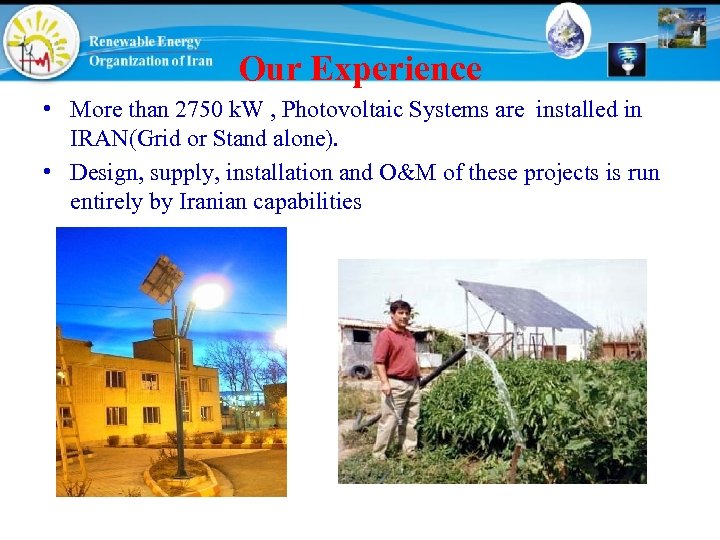
Our Experience • More than 2750 k. W , Photovoltaic Systems are installed in IRAN(Grid or Stand alone). • Design, supply, installation and O&M of these projects is run entirely by Iranian capabilities
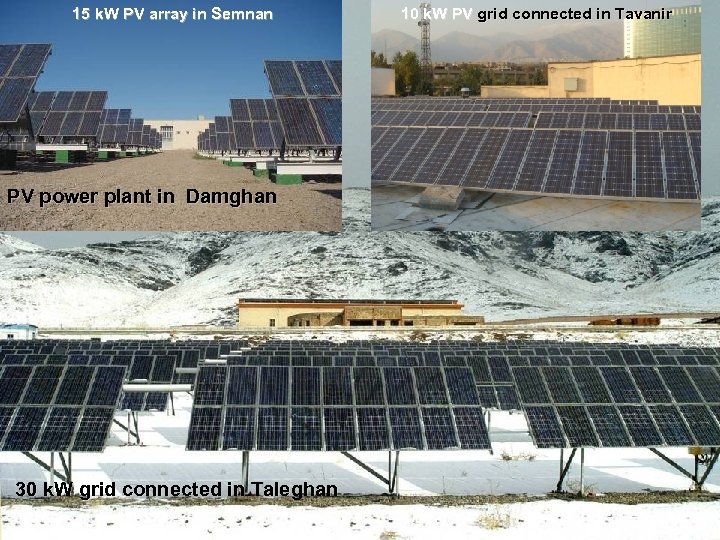
15 k. W PV array in Semnan PV power plant in Damghan 30 k. W grid connected in Taleghan 10 k. W PV grid connected in Tavanir
Rural Energy situation in Iran • Almost, %30 of our population live in rural areas • In end of 2009, Power supplied to the villages with more than 20 residents. • Power supply to some villages remain with less than 20 residents and households. • These people live in remote and mountainous areas • Because of limited infrastructure in these areas, grid extension and the provision of diesel supplies is difficult. rural areas of country with population.
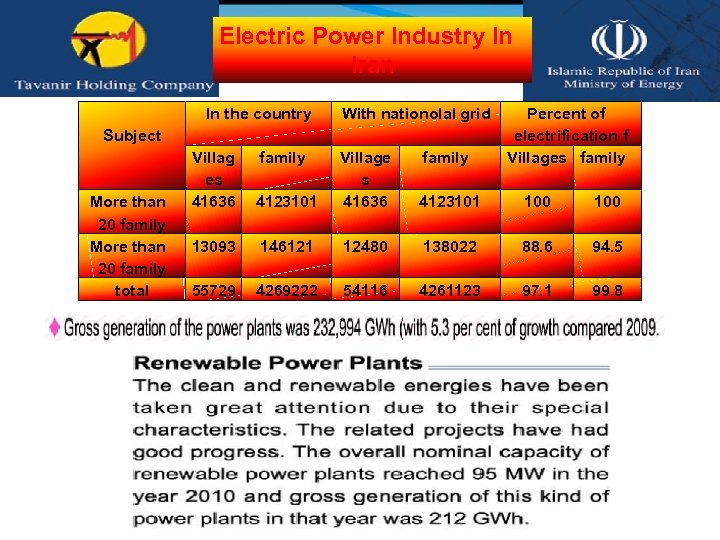
Electric Power Industry In Iran In the country With nationolal grid Subject More than 20 family total Villag es 41636 family Percent of electrification f Villages family 4123101 Village s 41636 4123101 100 13093 146121 12480 138022 88. 6 94. 5 55729 4269222 54116 4261123 97. 1 99. 8
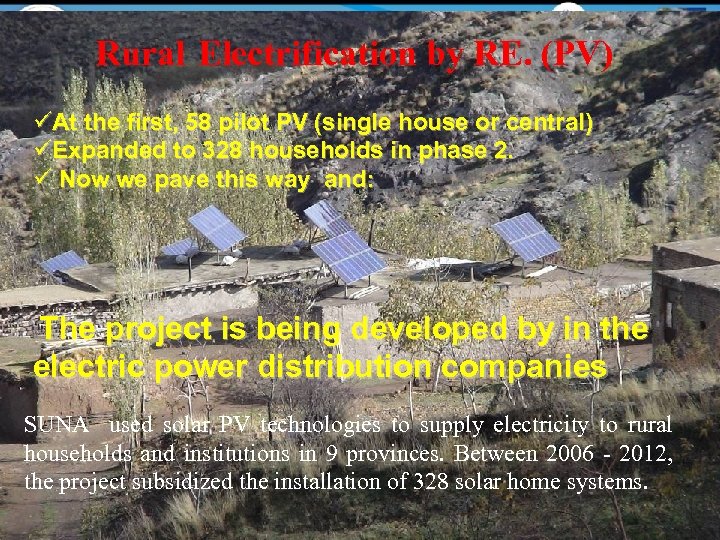
Rural Electrification by RE. (PV) üAt the first, 58 pilot PV (single house or central) üExpanded to 328 households in phase 2. ü Now we pave this way and: The project is being developed by in the electric power distribution companies SUNA used solar PV technologies to supply electricity to rural households and institutions in 9 provinces. Between 2006 - 2012, the project subsidized the installation of 328 solar home systems.
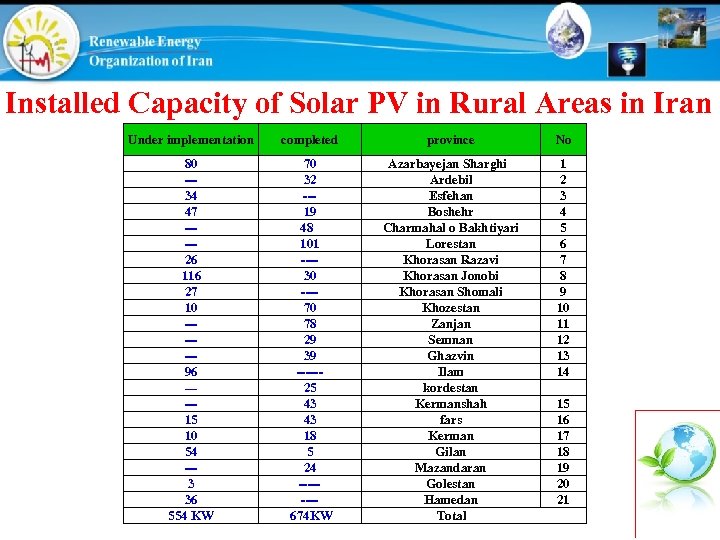
Installed Capacity of Solar PV in Rural Areas in Iran Under implementation completed province No 80 --34 47 ----26 116 27 10 ------96 ----15 10 54 --3 36 554 KW 70 32 --19 48 101 ---30 ---70 78 29 39 -----25 43 43 18 5 24 -------674 KW Azarbayejan Sharghi Ardebil Esfehan Boshehr Charmahal o Bakhtiyari Lorestan Khorasan Razavi Khorasan Jonobi Khorasan Shomali Khozestan Zanjan Semnan Ghazvin Ilam kordestan Kermanshah fars Kerman Gilan Mazandaran Golestan Hamedan Total 1 2 3 4 5 6 7 8 9 10 11 12 13 14 15 16 17 18 19 20 21
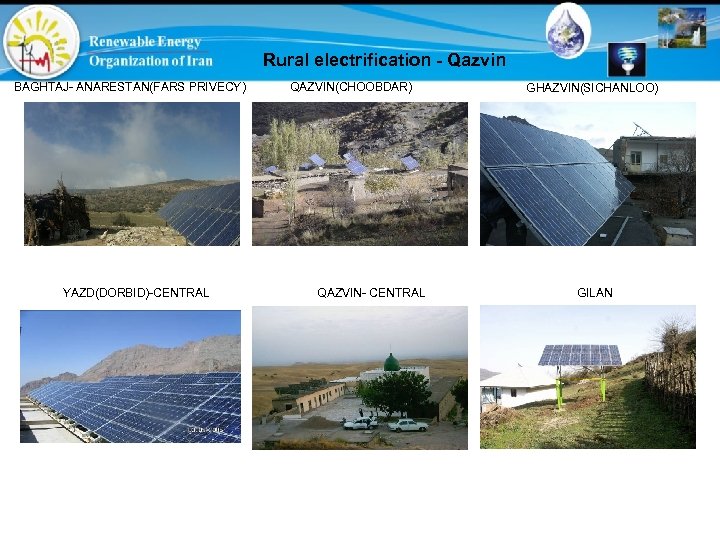
Rural electrification - Qazvin BAGHTAJ- ANARESTAN(FARS PRIVECY) YAZD(DORBID)-CENTRAL QAZVIN(CHOOBDAR) QAZVIN- CENTRAL GHAZVIN(SICHANLOO) GILAN
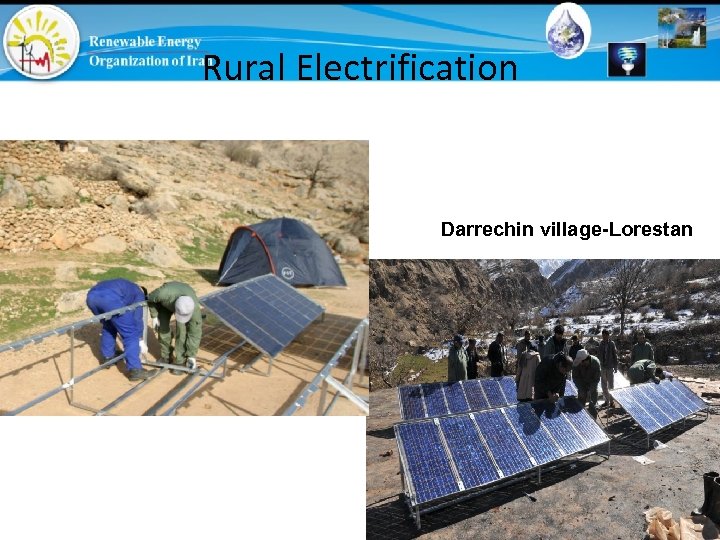
Rural Electrification Darrechin village-Lorestan Izeh village-Khoozestan
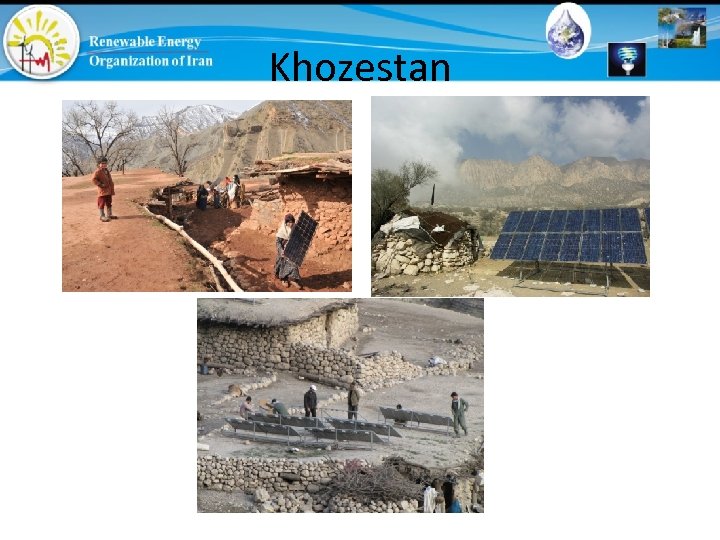
Khozestan
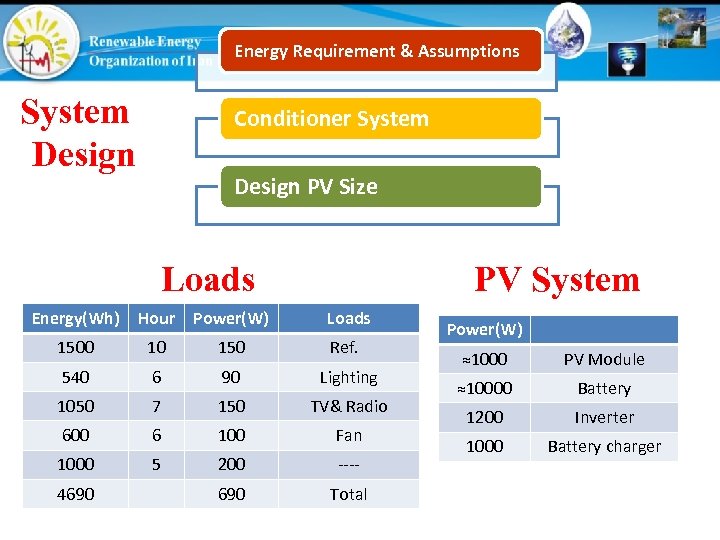
Energy Requirement & Assumptions System Design Conditioner System Design PV Size Loads PV System Energy(Wh) Hour Power(W) Loads 1500 10 150 Ref. 540 6 90 Lighting 1050 7 150 TV& Radio 600 6 100 Fan 1000 5 200 ---- 690 Total 4690 Power(W) ≈1000 PV Module ≈10000 Battery 1200 Inverter 1000 Battery charger
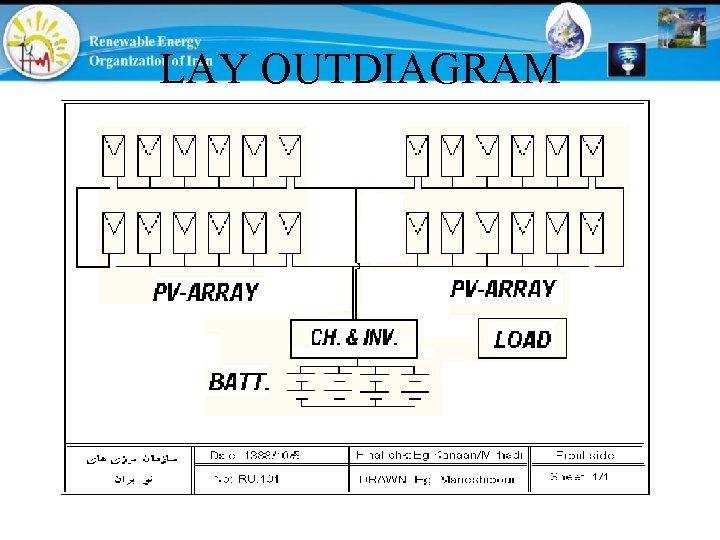
LAY OUTDIAGRAM
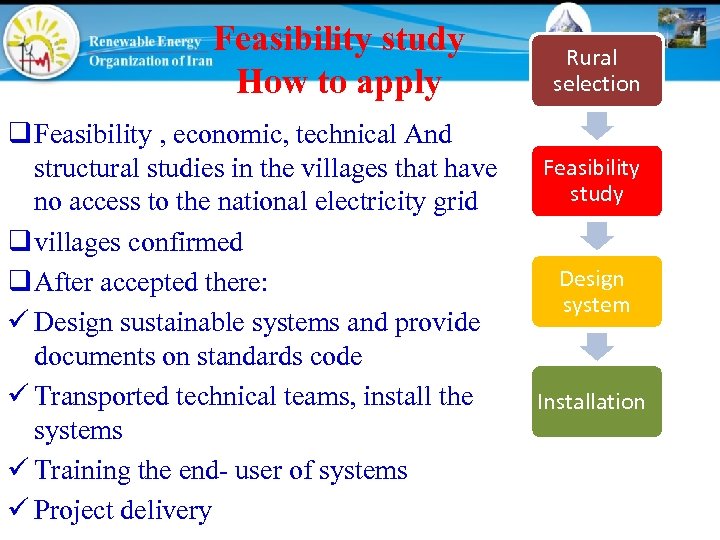
Feasibility study How to apply q Feasibility , economic, technical And structural studies in the villages that have no access to the national electricity grid q villages confirmed q After accepted there: ü Design sustainable systems and provide documents on standards code ü Transported technical teams, install the systems ü Training the end- user of systems ü Project delivery Rural selection Feasibility study Design system Installation
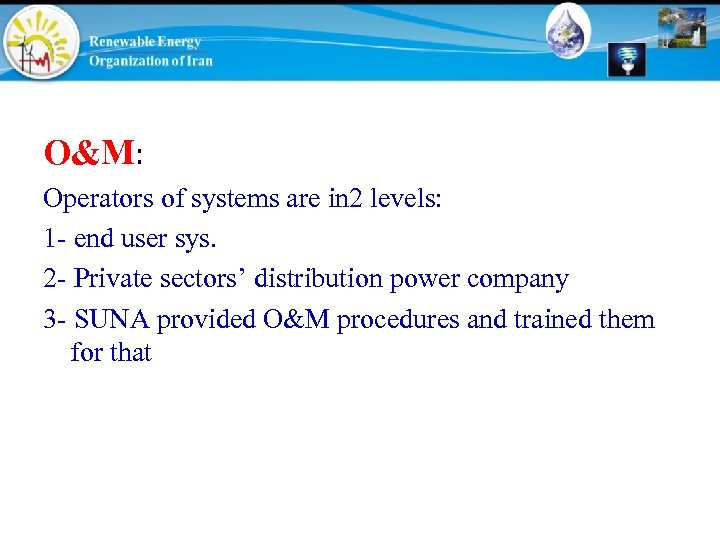
O&M: Operators of systems are in 2 levels: 1 - end user sys. 2 - Private sectors’ distribution power company 3 - SUNA provided O&M procedures and trained them for that
IRAN’S advantages & Capabilities v Producing PV modules by 3 Private sectors’ manufactures & companies v Producing electrical instruments as Inverter, Battery and Charge Controller in Private sectors’ companies. v Engineering and technically service by Iranian Experts & Private sectors’ companies.
Gains and Successes v Supporting manufacturers for transferring and localization of RE technologies which are expected to become competitive in medium terms, e. g. PV systems. v Supporting the research centers to expand their research programs for PV technologies that are becoming competitive in longer than 10 years period. v Providing sustainable and accessible energy to the remote and isolated areas. v Building capacity and development provides business opportunities
Gains and Successes v Training, supporting research centers, encouraging manufacturers to produce required PV equipments. v Raising public awareness. v Promote application of alternative energy sources other than fuelwood, in order to reduce deforestation, indoor health hazards and time spent by rural women in search of fuelwood; v to clear the ground for the private sector to come forward.
FUTURE PLAN v Promote and Developed RE, in the other rural areas (less than 20 residential)- at least 3500 family in country by Photovoltaic Systems in next 5 year (our programs to develop). v Promote and Developed PV sys. For nomads people. v Promote and Developed PV system in grid connected to 4 MW in our programs to develop.
CONCLUSIONS v We Produce PV equipments and technical service, completely in Iran v Knowledge, technical and engineering service transfer to other countries v We could share our experience to other countries v The success depends on two factors largely beyond government control: - Economic growth - The corresponding increase in personal incomes
CONCLUSIONS q Given the importance and weight attached by the Government to rural energy, a specific policy on rural energy is in the making q Promote entrepreneurship and private initiative in the production and marketing of products and services for rural and renewable energy; 26 3/17/2018
CONCLUSIONS q Facilitate increased availability of energy services, including grid and off- grid electrification to rural areas. q Establish norms, codes of practice, standards and guidelines for cost effective rural energy supplies. q Private sectors’ participation is always the most important option for energy to access to rural people
CONCLUSIONS q Support research and development in renewable energy technologies q Promote entrepreneurship and private initiatives in the production and marketing of products and services for rural and renewable energy.
THANK YOU FOR YOUR ATTENTIONS
Скачать презентацию RURAL ELECTRIFICATION IN Islamic Republic of Iran RURAL
e0b8435cee47c0f741ee4286e9055b7d.ppt