


 Скачать презентацию Rural Areas Definition for Monitoring Income Policies The
5b42bf59965753eb3c87e4cee2f93982.ppt
- Количество слайдов: 18
 Rural Areas Definition for Monitoring Income Policies: The Mediterranean Case Study WYE CITY GROUP On statistical on rural development and agriculture household income Giancarlo Lutero, Paola Pianura and Edoardo Pizzoli Rome, 11 -12 june 2009 – FAO Head-Quarters
 WYE CITY GROUP Outlines • The Mediterranean region: political subdivisions and data available • Rural-Urban classifications • The Panel model • Results • Concluding remarks and future developments Rome, 11 -12 june 2009 – FAO Head-Quarters
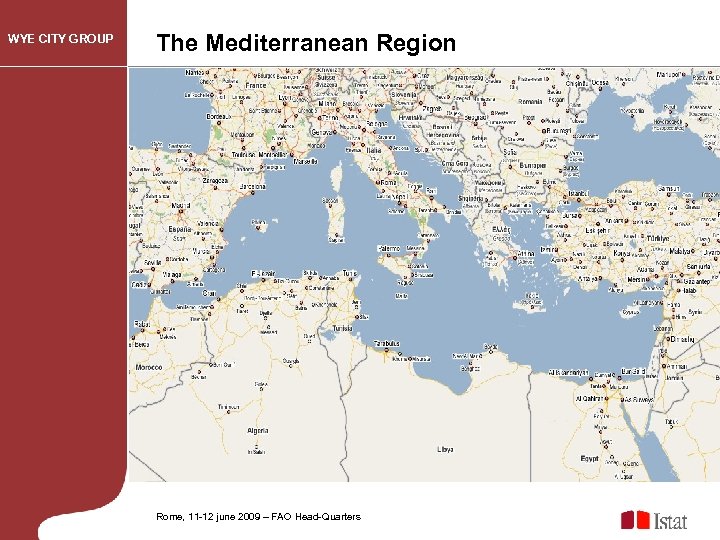 WYE CITY GROUP The Mediterranean Region Rome, 11 -12 june 2009 – FAO Head-Quarters
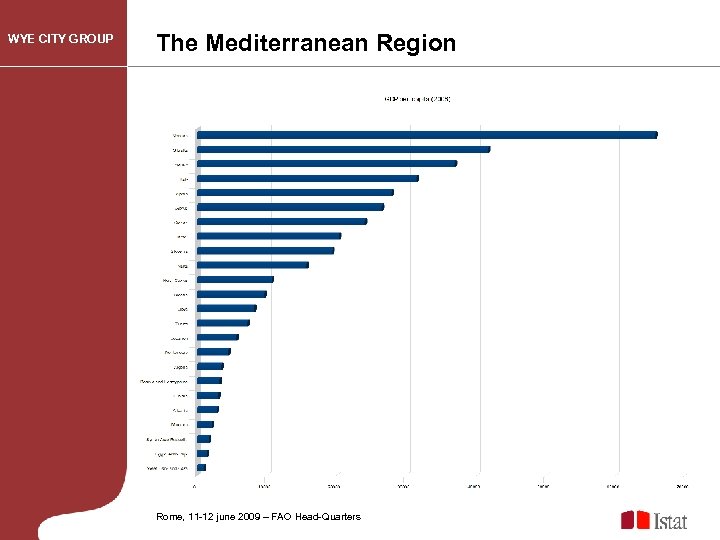
 WYE CITY GROUP The Mediterranean Region • Political subdivisions: • 24 countries; 8 members of European Union (EU), 2 city-states (Gibraltar, Monaco) and 3 countries with a limited political status: Gibraltar under the sovereignty of the United Kingdom, North Cyprus recognised only from Turkey and Palestinian Territory occupied by Israel • Economic differences among countries: Rome, 11 -12 june 2009 – FAO Head-Quarters
 WYE CITY GROUP The Mediterranean Region Rome, 11 -12 june 2009 – FAO Head-Quarters
 WYE CITY GROUP The Mediterranean Region • Data available: • Dishomogeneous in different countries (different variables and frequency) • Sources (United Nations, World Bank, FAO, EUROSTAT, CIA and national statistical offices) • Missing data for southern Mediterranean countries, Balkan countries and city states • Annual Frequency • Sample 2000 -2007 Rome, 11 -12 june 2009 – FAO Head-Quarters
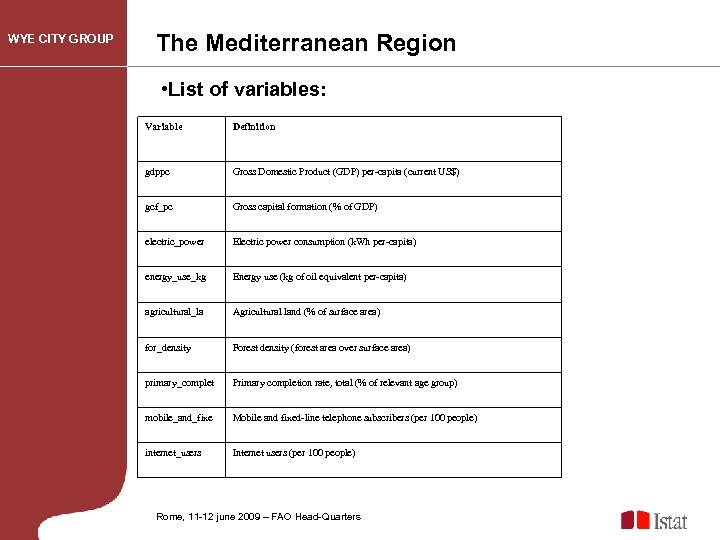 WYE CITY GROUP The Mediterranean Region • List of variables: Variable Definition gdppc Gross Domestic Product (GDP) per-capita (current US$) gcf_pc Gross capital formation (% of GDP) electric_power Electric power consumption (k. Wh per-capita) energy_use_kg Energy use (kg of oil equivalent per-capita) agricultural_la Agricultural land (% of surface area) for_density Forest density (forest area over surface area) primary_complet Primary completion rate, total (% of relevant age group) mobile_and_fixe Mobile and fixed-line telephone subscribers (per 100 people) internet_users Internet users (per 100 people) Rome, 11 -12 june 2009 – FAO Head-Quarters
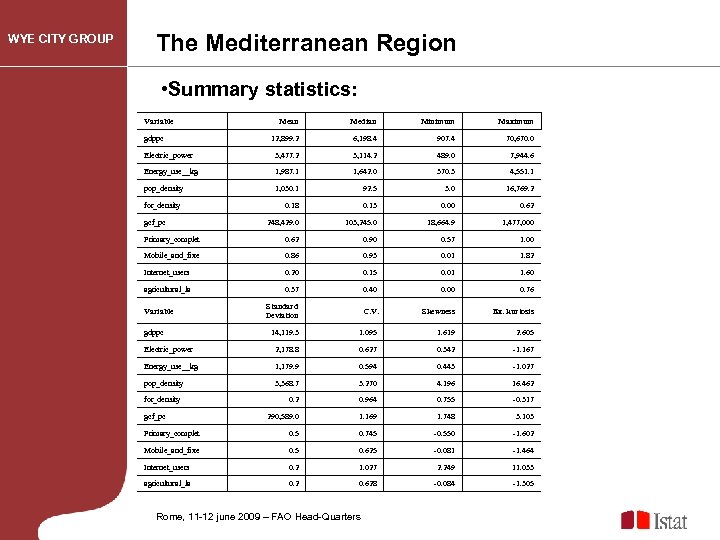 WYE CITY GROUP The Mediterranean Region • Summary statistics: Variable Mean Median Minimum Maximum 12, 899. 2 6, 198. 4 907. 4 70, 670. 0 Electric_power 3, 477. 2 3, 114. 2 489. 0 7, 944. 6 Energy_use__kg 1, 987. 1 1, 642. 0 370. 3 4, 551. 1 pop_density 1, 030. 1 92. 5 3. 0 16, 769. 2 0. 18 0. 13 0. 00 0. 62 248, 429. 0 103, 245. 0 18, 664. 9 1, 477, 000 Primary_complet 0. 62 0. 90 0. 57 1. 00 Mobile_and_fixe 0. 86 0. 93 0. 01 1. 82 Internet_users 0. 20 0. 15 0. 01 1. 60 agricultural_la 0. 37 0. 40 0. 00 0. 76 Standard Deviation C. V. Skewness Ex. kurtosis 14, 119. 3 1. 095 1. 619 2. 605 Electric_power 2, 178. 8 0. 627 0. 342 -1. 167 Energy_use__kg 1, 179. 9 0. 594 0. 443 -1. 027 pop_density 3, 368. 7 3. 270 4. 196 16. 462 0. 964 0. 755 -0. 317 290, 589. 0 1. 169 1. 748 3. 103 Primary_complet 0. 5 0. 745 -0. 550 -1. 602 Mobile_and_fixe 0. 5 0. 625 -0. 081 -1. 464 Internet_users 0. 2 1. 027 2. 249 11. 033 agricultural_la 0. 2 0. 628 -0. 084 -1. 305 gdppc for_density gcf_pc Variable gdppc for_density gcf_pc Rome, 11 -12 june 2009 – FAO Head-Quarters
 WYE CITY GROUP Rural-Urban Classifications • Several territorial classification variables calculated on available data • Criteria: 1. Single indicator (population density is the default indicator) 2. Two combined indicators (population and agricultural density) 3. Multivariate clustering (two or three clusters) • Warning: no political or administrative area subdivision is purely urban or rural (i. e. distance of probability) Rome, 11 -12 june 2009 – FAO Head-Quarters
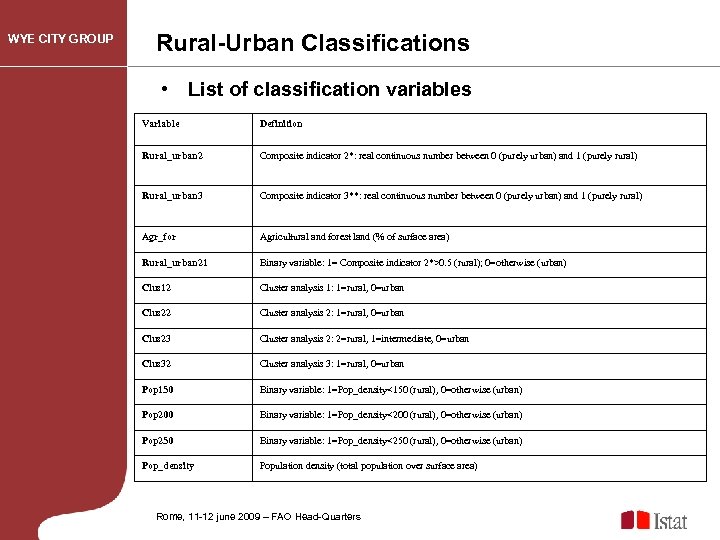 WYE CITY GROUP Rural-Urban Classifications • List of classification variables Variable Definition Rural_urban 2 Composite indicator 2*: real continuous number between 0 (purely urban) and 1 (purely rural) Rural_urban 3 Composite indicator 3**: real continuous number between 0 (purely urban) and 1 (purely rural) Agr_for Agricultural and forest land (% of surface area) Rural_urban 21 Binary variable: 1= Composite indicator 2*>0. 5 (rural); 0=otherwise (urban) Clus 12 Cluster analysis 1: 1=rural, 0=urban Clus 22 Cluster analysis 2: 1=rural, 0=urban Clus 23 Cluster analysis 2: 2=rural, 1=intermediate, 0=urban Clus 32 Cluster analysis 3: 1=rural, 0=urban Pop 150 Binary variable: 1=Pop_density<150 (rural), 0=otherwise (urban) Pop 200 Binary variable: 1=Pop_density<200 (rural), 0=otherwise (urban) Pop 250 Binary variable: 1=Pop_density<250 (rural), 0=otherwise (urban) Pop_density Population density (total population over surface area) Rome, 11 -12 june 2009 – FAO Head-Quarters
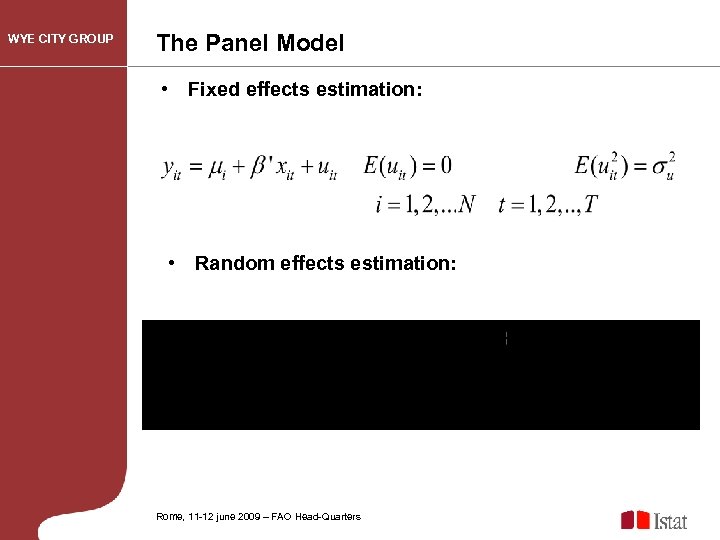 WYE CITY GROUP The Panel Model • Fixed effects estimation: • Random effects estimation: Rome, 11 -12 june 2009 – FAO Head-Quarters
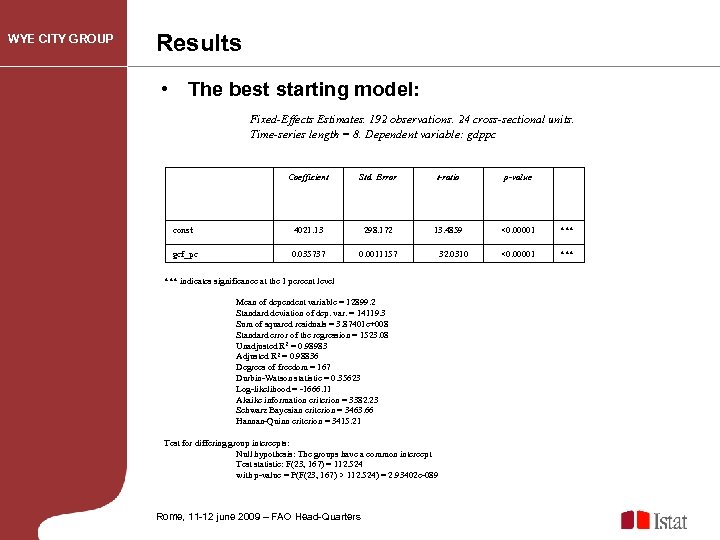 WYE CITY GROUP Results • The best starting model: Fixed-Effects Estimates. 192 observations. 24 cross-sectional units. Time-series length = 8. Dependent variable: gdppc Coefficient Std. Error t-ratio p-value const 4021. 13 298. 172 13. 4859 <0. 00001 *** gcf_pc 0. 035737 0. 0011157 <0. 00001 *** indicates significance at the 1 percent level Mean of dependent variable = 12899. 2 Standard deviation of dep. var. = 14119. 3 Sum of squared residuals = 3. 87401 e+008 Standard error of the regression = 1523. 08 Unadjusted R 2 = 0. 98983 Adjusted R 2 = 0. 98836 Degrees of freedom = 167 Durbin-Watson statistic = 0. 35623 Log-likelihood = -1666. 11 Akaike information criterion = 3382. 23 Schwarz Bayesian criterion = 3463. 66 Hannan-Quinn criterion = 3415. 21 Test for differing group intercepts: Null hypothesis: The groups have a common intercept Test statistic: F(23, 167) = 112. 524 with p-value = P(F(23, 167) > 112. 524) = 2. 93402 e-089 Rome, 11 -12 june 2009 – FAO Head-Quarters 32. 0310
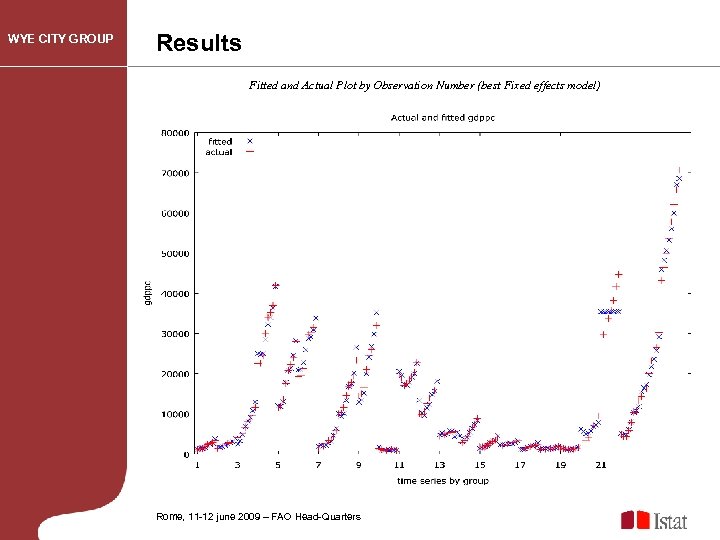 WYE CITY GROUP Results Fitted and Actual Plot by Observation Number (best Fixed effects model) Rome, 11 -12 june 2009 – FAO Head-Quarters
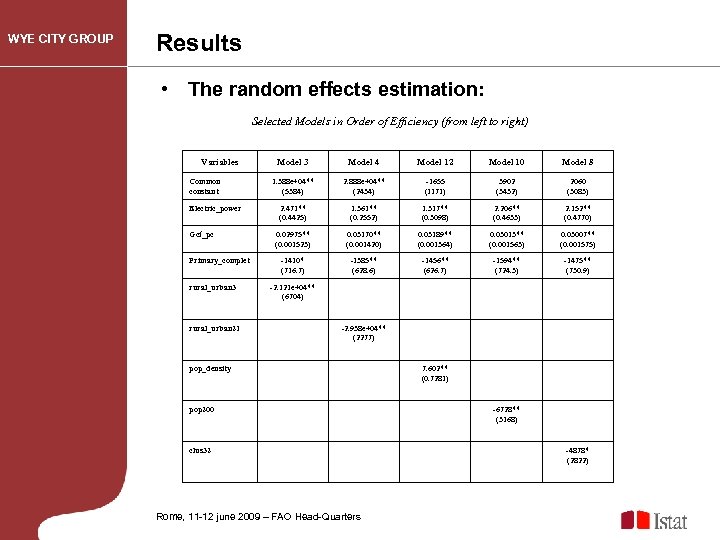 WYE CITY GROUP Results • The random effects estimation: Selected Models in Order of Efficiency (from left to right) Variables Common constant Electric_power Gcf_pc Primary_complet rural_urban 3 rural_urban 21 Model 3 Model 4 Model 12 Model 10 Model 8 1. 388 e+04** (5384) 2. 888 e+04** (2434) -1655 (1171) 3902 (3432) 2060 (3083) 2. 471** (0. 4425) 1. 361** (0. 2552) 1. 317** (0. 3098) 2. 206** (0. 4633) 2. 152** (0. 4770) 0. 02975** (0. 001523) 0. 03170** (0. 001420) 0. 03189** (0. 001364) 0. 03013** (0. 001563) 0. 03007** (0. 001575) -1410* (716. 7) -1385** (628. 6) -1456** (626. 7) -1594** (724. 3) -1475** (730. 9) -2. 121 e+04** (6704) -2. 938 e+04** (2277) pop_density pop 200 clus 32 Rome, 11 -12 june 2009 – FAO Head-Quarters 7. 602** (0. 7281) -6728** (3168) -4878* (2822)
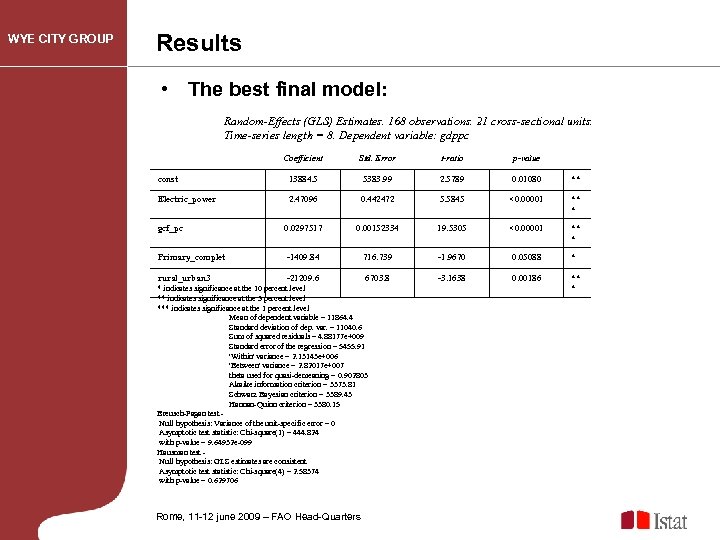 WYE CITY GROUP Results • The best final model: Random-Effects (GLS) Estimates. 168 observations. 21 cross-sectional units. Time-series length = 8. Dependent variable: gdppc Coefficient Std. Error t-ratio p-value const 13884. 5 5383. 99 2. 5789 0. 01080 ** Electric_power 2. 47096 0. 442472 5. 5845 <0. 00001 ** * 0. 0297517 0. 00152334 19. 5305 <0. 00001 ** * Primary_complet -1409. 84 716. 739 -1. 9670 0. 05088 * rural_urban 3 -21209. 6 6703. 8 -3. 1638 0. 00186 ** * gcf_pc * indicates significance at the 10 percent level ** indicates significance at the 5 percent level *** indicates significance at the 1 percent level Mean of dependent variable = 11864. 4 Standard deviation of dep. var. = 11040. 6 Sum of squared residuals = 4. 88177 e+009 Standard error of the regression = 5455. 91 'Within' variance = 2. 13143 e+006 'Between' variance = 2. 82017 e+007 theta used for quasi-demeaning = 0. 902803 Akaike information criterion = 3373. 81 Schwarz Bayesian criterion = 3389. 43 Hannan-Quinn criterion = 3380. 15 Breusch-Pagan test Null hypothesis: Variance of the unit-specific error = 0 Asymptotic test statistic: Chi-square(1) = 444. 824 with p-value = 9. 64932 e-099 Hausman test Null hypothesis: GLS estimates are consistent Asymptotic test statistic: Chi-square(4) = 2. 58374 with p-value = 0. 629706 Rome, 11 -12 june 2009 – FAO Head-Quarters
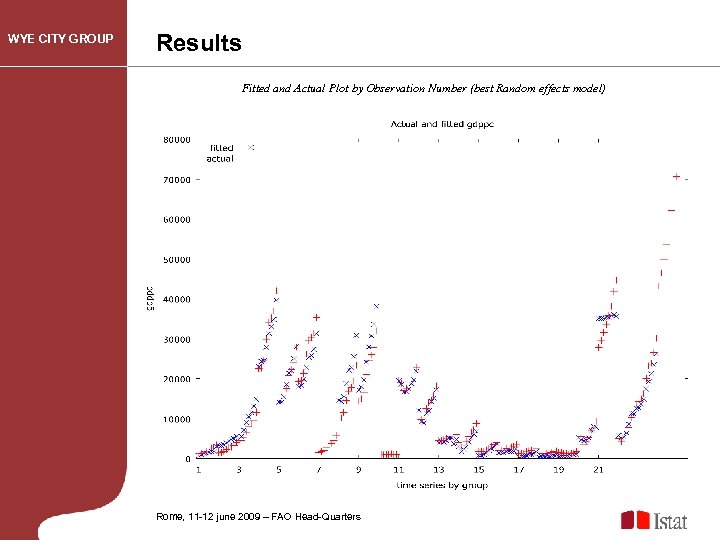 WYE CITY GROUP Results Fitted and Actual Plot by Observation Number (best Random effects model) Rome, 11 -12 june 2009 – FAO Head-Quarters
 WYE CITY GROUP Concluding remarks and future developments • Results highlight a cross-sectional heterogeneity among the Mediterranean countries but the diagnostic analysis and fitting show that a common model for the available data is a satisfactory solution • Several rural-urban classification variables are significant in this panel data approach • A composite indicator, such as a combination of population density with agricultural density (i. e. rural_urban 3 in this paper), undoubtedly improve percapita income explanation Roma, 23 giugno 2009
 References • Agresti, A. (2002) Categorical Data Analysis, John Wiley & Sons, 2 nd edition • Baltagi B. (2008) Econometric Analysis of Panel Data, John Wiley & Sons, 4 th edition • FAO (2007) Rural Development and Poverty Reduction: is Agriculture still the key? , ESA Working Paper No. 07 -02, Rome • Pizzoli E. and Xiaoning G. (2007 a) How to Best Classify Rural and Urban? , Fourth International Conference on Agriculture Statistics (ICAS-4), Beijing, www. stats. gov. cn/english/icas • UNECE, FAO, OECD and World Bank (2005) Rural Household’s Livelihood and Well-Being: Statistics on Rural Development and Agriculture Household Income, Handbook, UN, New York, www. fao. org/statistics/rural Roma, 23 giugno 2009