


 Скачать презентацию Rule extraction in neural networks A survey Krzysztof
fd3ae2e62802c61f2795ee4e37eb4c87.ppt
- Количество слайдов: 45
 Rule extraction in neural networks. A survey. Krzysztof Mossakowski Faculty of Mathematics and Information Science Warsaw University of Technology
 o o o Black boxes Rule extraction Neural networks for rule extraction Sample problems Bibliography Krzysztof Mossakowski – Computational Intelligence Seminar – 8. 02. 2006
 BLACK BOXES Krzysztof Mossakowski – Computational Intelligence Seminar – 8. 02. 2006
 Black-Box Models o Aims of many data analysis’s methods (pattern recognition, neural networks, evolutionary computation and related): n n n building predictive data models adapting internal parameters of the data models to account for the known (training) data samples allowing for predictions to be made on the unknown (test) data samples Krzysztof Mossakowski – Computational Intelligence Seminar – 8. 02. 2006
 Dangers o Using a large number of numerical parameters to achieve high accuracy n n overfitting the data many irrelevant attributes may contribute to the final solution Krzysztof Mossakowski – Computational Intelligence Seminar – 8. 02. 2006
 Drawbacks o o o Combining predictive models with a priori knowledge about the problem is difficult No systematic reasoning No explanations of recommendations No way to control and test the model in the areas of the future Unacceptable risk in safety-critical domains (medical, industrial) Krzysztof Mossakowski – Computational Intelligence Seminar – 8. 02. 2006
 Reasoning with Logical Rules o o More acceptable to human users Comprehensible, provides explanations May be validated by human inspection Increases confidence in the system Krzysztof Mossakowski – Computational Intelligence Seminar – 8. 02. 2006
 Machine Learning o Explicit goal: the formulation of symbolic inductive methods n o methods that learn from examples Discovering rules that could be expressed in natural language n rules similar to those a human expert might create Krzysztof Mossakowski – Computational Intelligence Seminar – 8. 02. 2006
 Neural Networks as Black Boxes o Perform mysterious functions Represent data in an incomprehensible way o Two issues: o 1. 2. understanding what neural networks really do using neural networks to extract logical rules describing the data. Krzysztof Mossakowski – Computational Intelligence Seminar – 8. 02. 2006
 Techniques for Feretting Out Information from Trained ANN o o o Sensitivity analysis Neural Network Visualization Rule Extraction Krzysztof Mossakowski – Computational Intelligence Seminar – 8. 02. 2006
 Sensitivity Analysis o o Probe ANN with test inputs, and record the outputs Determining the impact or effect of an input variable on the output n hold the other inputs to some fixed value (e. g. mean or median value), vary only the input while monitoring the change in outputs Krzysztof Mossakowski – Computational Intelligence Seminar – 8. 02. 2006
 Automated Sensitivity Analysis o For backpropagation ANN: n n keep track of the error terms computed during the back propagation step measure of the degree to which each input contributes to the output error o n the largest error the largest impact the relative contribution of each input to the output errors can be computed by acumulating errors over time and normalizing them Krzysztof Mossakowski – Computational Intelligence Seminar – 8. 02. 2006
 Neural Network Visualization o Using power of human brain to see and recognize patterns in two- and three-dimensional data Krzysztof Mossakowski – Computational Intelligence Seminar – 8. 02. 2006
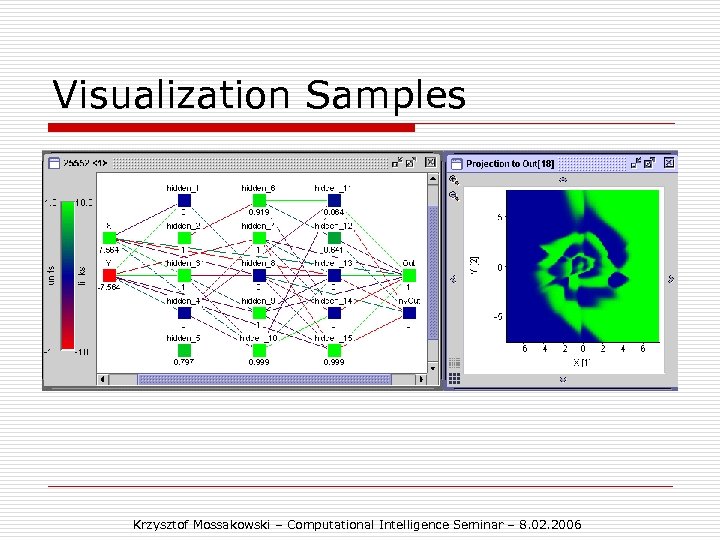 Visualization Samples Krzysztof Mossakowski – Computational Intelligence Seminar – 8. 02. 2006
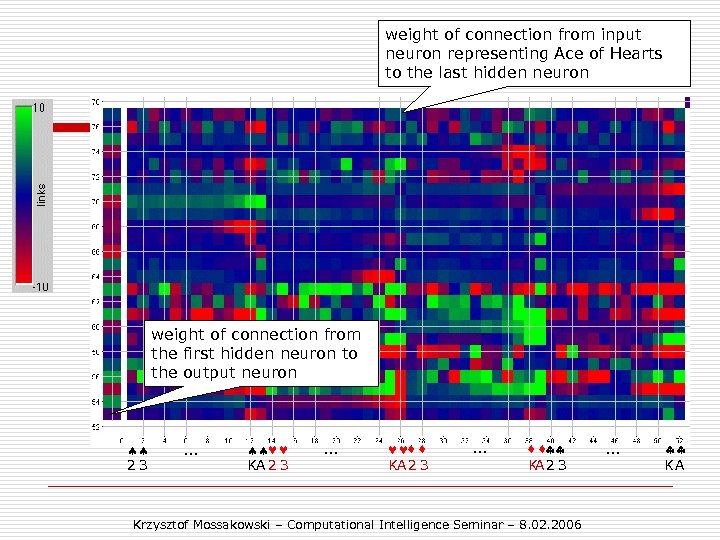 weight of connection from input neuron representing Ace of Hearts to the last hidden neuron weight of connection from the first hidden neuron to the output neuron 23 . . . KA 2 3 Krzysztof Mossakowski – Computational Intelligence Seminar – 8. 02. 2006 . . . KA
 RULE EXTRACTION Krzysztof Mossakowski – Computational Intelligence Seminar – 8. 02. 2006
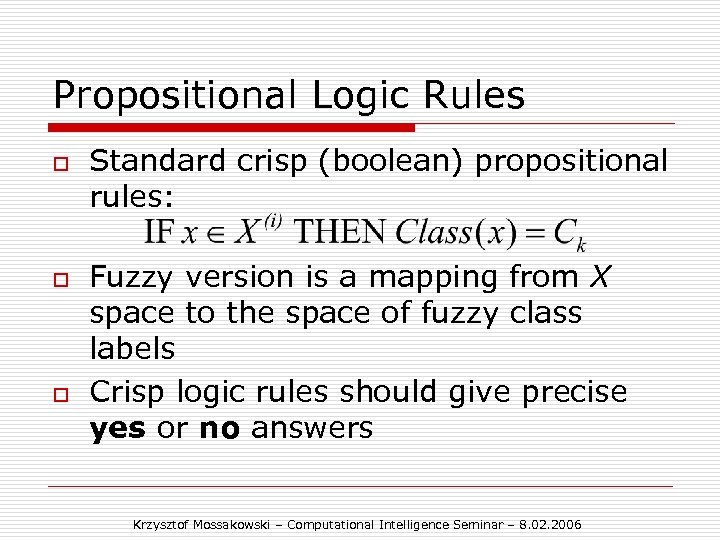 Propositional Logic Rules o o o Standard crisp (boolean) propositional rules: Fuzzy version is a mapping from X space to the space of fuzzy class labels Crisp logic rules should give precise yes or no answers Krzysztof Mossakowski – Computational Intelligence Seminar – 8. 02. 2006
 Condition Part of Logic Rule o o Defined by a conjuction of logical predicate functions Usually predicate functions are tests on a single attribute n if feature k has values that belong to a subset (for discrete features) or to an interval or (fuzzy) subsets for attribute K Krzysztof Mossakowski – Computational Intelligence Seminar – 8. 02. 2006
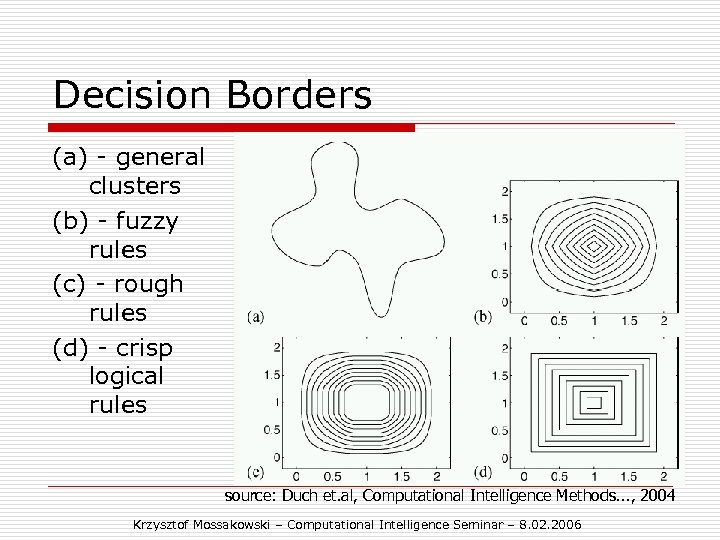 Decision Borders (a) - general clusters (b) - fuzzy rules (c) - rough rules (d) - crisp logical rules source: Duch et. al, Computational Intelligence Methods. . . , 2004 Krzysztof Mossakowski – Computational Intelligence Seminar – 8. 02. 2006
 Linguistic Variables o o Attempts to verbalize knowledge require symbolic inputs (called linguistic variables) Two types of linguistic variables: n n context-independent - identical in all regions of the feature space context-dependent - may be different in each rule Krzysztof Mossakowski – Computational Intelligence Seminar – 8. 02. 2006
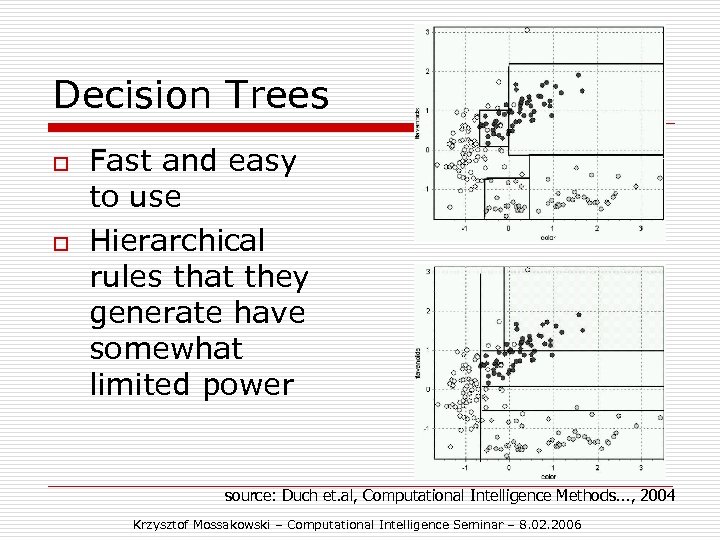 Decision Trees o o Fast and easy to use Hierarchical rules that they generate have somewhat limited power source: Duch et. al, Computational Intelligence Methods. . . , 2004 Krzysztof Mossakowski – Computational Intelligence Seminar – 8. 02. 2006
 NEURAL NETWORKS FOR RULE EXTRACTION Krzysztof Mossakowski – Computational Intelligence Seminar – 8. 02. 2006
 Neural Rule Extraction Methods o o Neural networks are regarded commonly as black boxes but can be used to provide simple and accurate sets of logical rules Many neural algorithms extract logical rules directly from data have been devised Krzysztof Mossakowski – Computational Intelligence Seminar – 8. 02. 2006
 Categorizing Rule-Extraction Techniques o o o Expressive power of extracted rules Translucency of the technique Specialized network training schemes Quality of extracted rules Algorithmic complexity The treatment of linguistic variables Krzysztof Mossakowski – Computational Intelligence Seminar – 8. 02. 2006
 Expressive Power of Extracted Rules o Types of extracted rules: n n n crisp logic rules fuzzy logic rules first-order logic form of rules - rules with quantifiers and variables Krzysztof Mossakowski – Computational Intelligence Seminar – 8. 02. 2006
 Translucency o o The relationship between the extracted rules and the internal architecture of the trained ANN Categories: n n n decompositional (local methods) pedagogical (global methods) eclectic Krzysztof Mossakowski – Computational Intelligence Seminar – 8. 02. 2006
 Translucency Decompositional Approach o To extract rules at the level of each individual hidden and output unit within the trained ANN n n n some form of analysis of the weight vector and associated bias of each unit rules with antecedents and consequents expressed in terms which are local to the unit a process of aggregation is required Krzysztof Mossakowski – Computational Intelligence Seminar – 8. 02. 2006
 Translucency Pedagogical Approach o o o The trained ANN viewed as a black box Finding rules that map inputs directly into outputs Such techniques typically are used in conjunction with a symbolic learning algorithm n use the trained ANN to generate examples for the training algorithm Krzysztof Mossakowski – Computational Intelligence Seminar – 8. 02. 2006
 Specialized network training schemes o o o If specialized ANN training regime is required It provides some measure of the "portability" of the rule extraction technique across various ANN architectures Underlaying ANN can be modifief or left intact by the rule extraction process Krzysztof Mossakowski – Computational Intelligence Seminar – 8. 02. 2006
 Quality of extracted rules o Criteria: n n accuracy - if can correctly classify a set of previously unseen examples fidelity - if extracted rules can mimic the behaviour of the ANN consistency - if generated rules will produce the same classification of unseen examples comprehensibility - size of the rules set and number of antecendents per rule Krzysztof Mossakowski – Computational Intelligence Seminar – 8. 02. 2006
 Algorithmic complexity o Important especially for decompositional approaches to rule extraction n usually the basic process of searching for subsets of rules at the level of each (hidden and output) unit in the trained ANN is exponential in the number of inputs to the node Krzysztof Mossakowski – Computational Intelligence Seminar – 8. 02. 2006
 The Treatment of Linguistic Variables o Types of variables which limit usage of techniques: n n n binary variables discretized inputs continuous variables that are converted to linguistic variables automatically Krzysztof Mossakowski – Computational Intelligence Seminar – 8. 02. 2006
 Techniques Reviews o o o Andrews et. al, A survey and critique. . . , 1995 - 7 techniques described in detail Tickle et. al, The truth will come to light. . . , 1998 - 3 more techiques added Jacobsson, Rule extraction from recurrent. . . , 2005, techniques for recurrent neural networks Krzysztof Mossakowski – Computational Intelligence Seminar – 8. 02. 2006
 SAMPLE PROBLEMS Krzysztof Mossakowski – Computational Intelligence Seminar – 8. 02. 2006
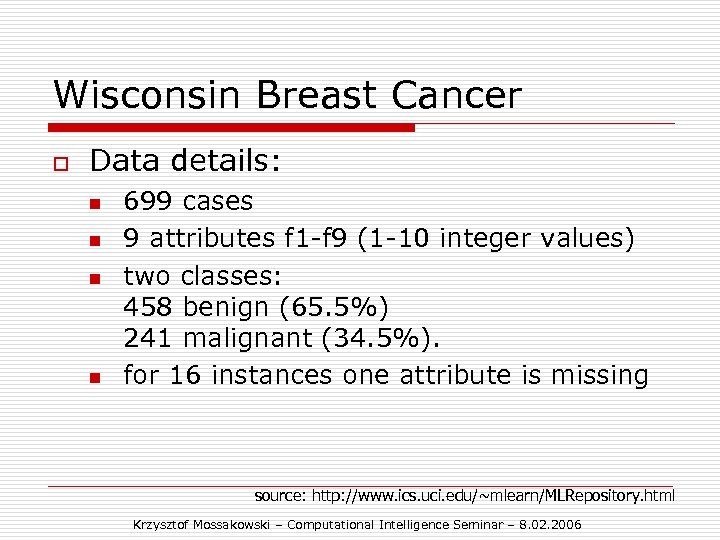 Wisconsin Breast Cancer o Data details: n n 699 cases 9 attributes f 1 -f 9 (1 -10 integer values) two classes: 458 benign (65. 5%) 241 malignant (34. 5%). for 16 instances one attribute is missing source: http: //www. ics. uci. edu/~mlearn/MLRepository. html Krzysztof Mossakowski – Computational Intelligence Seminar – 8. 02. 2006
![Wisconsin Breast Cancer - results o Single rule: IF f 2 = [1, 2]](https://present5.com/presentation/fd3ae2e62802c61f2795ee4e37eb4c87/image-36.jpg "Wisconsin Breast Cancer - results o Single rule: IF f 2 = [1, 2]") Wisconsin Breast Cancer - results o Single rule: IF f 2 = [1, 2] then benign else malignant n o 646 correct (92. 42%), 53 errors 5 rules for malignant: R 1: f 1<9 & f 4<4 & f 6<2 & f 7<5 R 2: f 1<10 & f 3<4 & f 4<4 & f 6<3 R 3: f 1<7 & f 3<9 & f 4<3 & f 6=[4, 9] & f 7<4 R 4: f 1=[3, 4] & f 3<9 & f 4<10 & f 6<6 & f 7<8 R 5: f 1<6 & f 3<3 & f 7<8 ELSE: benign n 692 correct (99%), 7 errors source: http: //www. phys. uni. torun. pl/kmk/projects/rules. html#Wisconsin Krzysztof Mossakowski – Computational Intelligence Seminar – 8. 02. 2006
Wisconsin Breast Cancer - results o Single rule: IF f 2 = [1, 2] then benign else malignant n o 646 correct (92. 42%), 53 errors 5 rules for malignant: R 1: f 1<9 & f 4<4 & f 6<2 & f 7<5 R 2: f 1<10 & f 3<4 & f 4<4 & f 6<3 R 3: f 1<7 & f 3<9 & f 4<3 & f 6=[4, 9] & f 7<4 R 4: f 1=[3, 4] & f 3<9 & f 4<10 & f 6<6 & f 7<8 R 5: f 1<6 & f 3<3 & f 7<8 ELSE: benign n 692 correct (99%), 7 errors source: http: //www. phys. uni. torun. pl/kmk/projects/rules. html#Wisconsin Krzysztof Mossakowski – Computational Intelligence Seminar – 8. 02. 2006
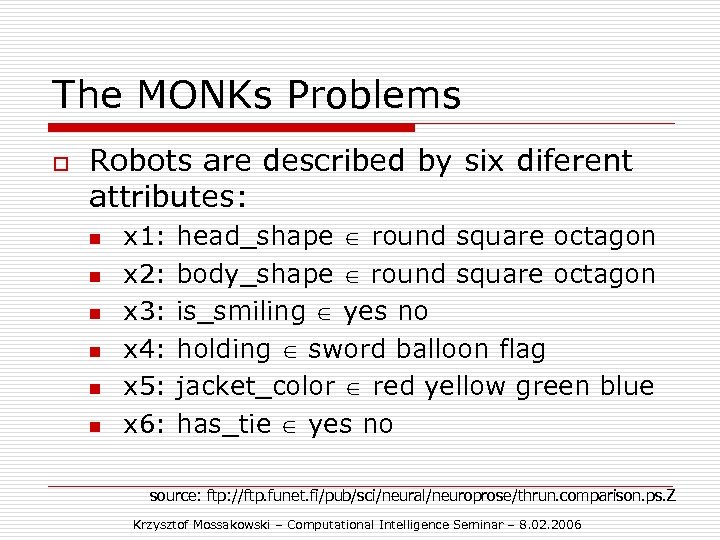 The MONKs Problems o Robots are described by six diferent attributes: n n n x 1: x 2: x 3: x 4: x 5: x 6: head_shape round square octagon body_shape round square octagon is_smiling yes no holding sword balloon flag jacket_color red yellow green blue has_tie yes no source: ftp: //ftp. funet. fi/pub/sci/neural/neuroprose/thrun. comparison. ps. Z Krzysztof Mossakowski – Computational Intelligence Seminar – 8. 02. 2006
 The MONKs Problems o o o cont. Binary classification task Each problem is given by a logical description of a class Only a subset of all 432 possible robots with its classification is given source: ftp: //ftp. funet. fi/pub/sci/neural/neuroprose/thrun. comparison. ps. Z Krzysztof Mossakowski – Computational Intelligence Seminar – 8. 02. 2006
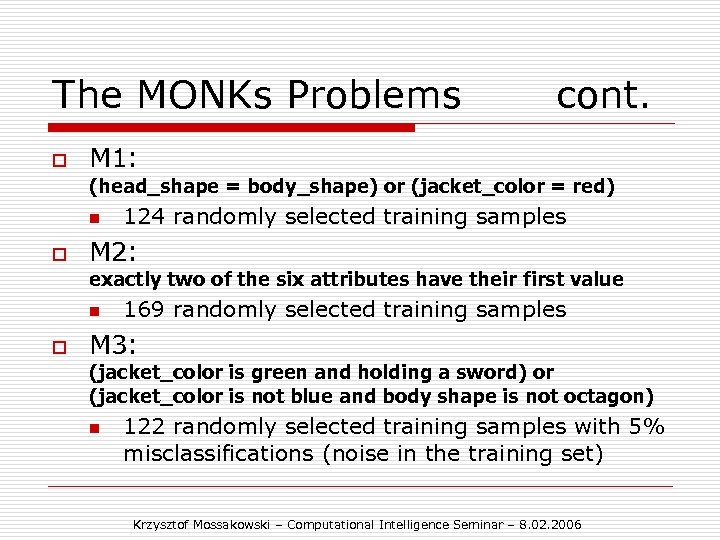 The MONKs Problems o cont. M 1: (head_shape = body_shape) or (jacket_color = red) n o 124 randomly selected training samples M 2: exactly two of the six attributes have their first value n o 169 randomly selected training samples M 3: (jacket_color is green and holding a sword) or (jacket_color is not blue and body shape is not octagon) n 122 randomly selected training samples with 5% misclassifications (noise in the training set) Krzysztof Mossakowski – Computational Intelligence Seminar – 8. 02. 2006
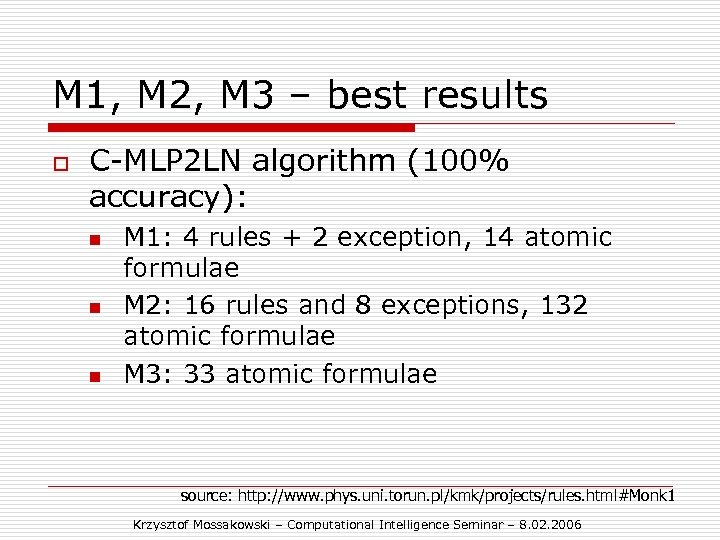 M 1, M 2, M 3 – best results o C-MLP 2 LN algorithm (100% accuracy): n n n M 1: 4 rules + 2 exception, 14 atomic formulae M 2: 16 rules and 8 exceptions, 132 atomic formulae M 3: 33 atomic formulae source: http: //www. phys. uni. torun. pl/kmk/projects/rules. html#Monk 1 Krzysztof Mossakowski – Computational Intelligence Seminar – 8. 02. 2006
 BIBLIOGRAPHY Krzysztof Mossakowski – Computational Intelligence Seminar – 8. 02. 2006
 References o Duch, W. , Setiono, R. , Zurada, J. M. , Computational Intelligence Methods for Rule-Based Data Understanding, Proceedings of the IEEE, 2004, vol. 92, Issue 5, pp. 771 -805 Krzysztof Mossakowski – Computational Intelligence Seminar – 8. 02. 2006
 Surveys o o R. Andrews, J. Diederich, and A. B. Tickle, A survey and critique of techniques for extracting rules from trained artificial neural networks, Knowl. Based Syst. , vol. 8, pp. 373– 389, 1995 A. B. Tickle, R. Andrews, M. Golea, and J. Diederich, The truth will come to light: Directions and challenges in extracting the knowledge embedded within trained artificial neural networks, IEEE Trans. Neural Networks, vol. 9, pp. 1057– 1068, Nov. 1998. Krzysztof Mossakowski – Computational Intelligence Seminar – 8. 02. 2006
 Surveys o o cont. I. Taha, J. Ghosh, Symbolic interpretation of artifcial neural networks, Knowledge and Data Engineering vol. 11, pp. 448 -463, 1999 H. Jacobsson, Rule extraction from recurrent neural networks: A Taxonomy and Review, 2005 [citeseer] Krzysztof Mossakowski – Computational Intelligence Seminar – 8. 02. 2006
 Problems o o S. B. Thrun et al. , The MONK’s problems: a performance comparison of different learning algorithms, Carnegie Mellon University, CMU-CS-91197 (December 1991) http: //www. phys. uni. torun. pl/kmk/projects/rules. html (prof. Włodzisław Duch) Krzysztof Mossakowski – Computational Intelligence Seminar – 8. 02. 2006