 Скачать презентацию RTV 151 Video Remember to check www tonydemars
63b2a5fe63b6a5bf5b43ba388be9f334.ppt
- Количество слайдов: 87



RTV 151 Video Remember to check www. tonydemars. com for course outline and reading every week (see online audio and video reading) 3/15/2018 1
What about you? n Life is Great n Life is a Challenge n 3/15/2018 Something you want to share with the class. 2
Audio Review n n Textbook… Should you jot down reminders about every one of these so you’ll know them on the test? u n Will I go slow enough so you can write down each item on page word for word? u 3/15/2018 ABSOLUTELY No 3
What examples are discussed in the chapter that fit into the category of 'digital radio'? Sirius XM radio HD radio Internet radio n Why is FM not ‘digital audio’?
How long did it take FM radio to earn 50% of the radio audience in the U. S. ? 35 years
Most digital audio formats use some kind of _______ technique, which reduces the size of files. compression
How did the Telecommunications Act of 1996 have the biggest impact on radio? Eliminated ownership limits
Nearly three-fourths of radio listening takes place where? In the car n New owner of HD Radio plans to exploit that
______ is the technology in the ______ is the U. S. to transmit digital radio by way of traditional radio stations. IBOC
What kind of service is that type technology (IBOC)? HD Radio
Although original radio broadcasting is commonly attributed to Marconi, in 1943 the U. S. patent office confirmed (restored credit) for original radio patents from the late 1800 s to whom? Nicola Tesla

What is it that has been added to most smart phones by this point but not yet activated by carriers? FM receiver
The 'HD' of HD Radio originally stood for -----. Hybrid Digital
Online audio reading… dolly
_______ on an audio mixer allows an audio source to pass through an auxiliary VU meter to high quality speakers (the monitor) so levels can be set and audio quality evaluated, while… _______ sends the audio through the master gain control (heard through the monitor) to be recorded or broadcast. Audition / program
______ inputs handle the extremely low voltages associated with microphones, while _____ inputs are associated with the outputs of amplified sources of audio, such as CD players Mic level / line level
Studio mics use cables with threeprong _______ connectors, the standard analog professional audio connector, that provides a balanced connection. XLR / Cannon
________ (volume controls) on an audio board can be either linear or rotary in design, and may be also called ______. Faders / pots
sound loudness is commonly measured in _______; when that’s a measure of acoustic loudness the term is _____ Decibels / d. B-SPL
_______ relates to the basic pitch of a sound -- how high or low it is, the number of cycles of the sound wave that occur er second. frequency
A ______ allows specific bands of A ______ frequencies to be individually adjusted for loudness. Graphic equalizer
The objective study of the physical behavior of receved sound. acoustics
Early reflections of indirect sound in an acoustical space are _____ and later reflections are ______ Echo / reverberation
The three major polar, or pick up patterns of professional mics Unidirectional (cardioid), bidirectional, omnidirectional
The three types of transducing elements in professional mics Moving coil, ribbon, capacitor (condensor)
Film vs. Video n Film u n Video u 3/15/2018 a thin flexible strip of plastic or other material coated with lightsensitive emulsion for exposure in a camera, used to produce photographs or motion pictures magnetic tape for recording and reproducing visual images and sound. 26
Film vs. Video n n n 3/15/2018 Film stock is the imaging device for motion picture film CCD or CMOS is the imaging device for video Future for film? 27
Film n n n 8 mm, 16 mm, 35 mm, 70 mm Super 16 and 35 mm Film stock--costs and processing u n n n 3/15/2018 Film stock types: b/w or color, negative or reversal, fast or slow, tungsten or daylight 1. 85: 1 aspect ratio 24 fps Sprocket holes, audio recording 28
Magnetic Videotape n n n Analog vs. Digital Interlaced or Progressive Standard or High Def 4: 3 or 16: 9 Digital Compression Codecs u n n 3/15/2018 WMA, Quick. Time, Real. Player Not ‘filming’ Future -- not tape 29
New storage options n n 3/15/2018 HDD DVD / Blu Ray / Optical discs Flash memory (built in vs. removable, like SD card) Cloud storage 30
Digital Recording n n n n 3/15/2018 480 vs. 720 vs. 1080 Now UHD / 4 K Contrast ratio Megapixels I vs. P Lossy or Lossless codecs Color sampling: relationship of chroma to luminance / luma Bit depth: the number of individual 0 s and 1 s sampled 31
Video Scanning Process n n Pixels Persistence of vision -- Demonstrated in online reading Phi Phenomenon -- our brain connects and fills in the blank moments through a sequence of static images thus creating the illusion of movement. NTSC 525 scan lines (480 used) x 640 rows u 4: 3 aspect ratio u 30 fps interlaced -- 60 fields u
Time Code n n 3/15/2018 Vital to videotape Also important in syncing digital files Important for timing / syncing SMPTE 33
Lenses n n n Camera body vs. lens Zoom or fixed (prime) -- critical focus Optical vs. Digital zoom Diaphragm / aperture -- f-stops / t-stops / number means what? Manual vs. autofocus u n 3/15/2018 Sharp focus, Selective focus, follow focus, rack focus, soft focus, swimming focus Depth of field is affected by focal length, aperture, and the distance of objects from the camera. 34
Camera mounts n Tripod and pedestal u n n n Crane vs. jib Dolly / track Steadi. Cam vs. Handheld u n 3/15/2018 Friction head / Fluid Head Image stabilization Robotics, follow me, Segue, ‘copter, cable mount, etc. (see online reading) 35
Technical vs. aesthetics n n n 3/15/2018 What kind of camera? What kind of lighting? What kind of lens? Consumer vs. Prosumer vs. professional cameras How the story is told? ‘Language’ of visual storytelling -- Hollywood style, home movies style, new media style, NPPA / news style 36
Chapter 6 – Digital TV n OTT Elsewhere: ‘connected’ u Vs. ‘linear’ u Sling TV: ‘live TV channels’ u n n n 3/15/2018 OTA MVPDs Proposed idea: merge into Internet Delivered Television, I-DTV 37
Improving the image… n n n 4 K / UHD 3 D-TV ? ? HDR Imaging High Dynamic Range u Audio? This: range between dark and light areas in image u n n 3/15/2018 Japan: 8 K: SHV (Super High Vision) Programming produced in what format? 38
Digital Transition n n 2009, end of OTA full-power analog broadcasting NTSC to ATSC 3. 0 soon u COFDM vs 8 -VSB u n n n 3/15/2018 Smart TVs Evolution of displays Evolution of cameras 39
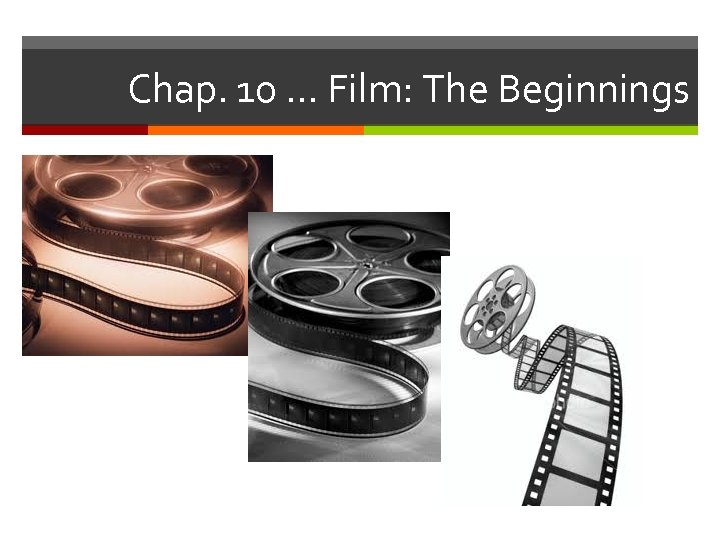
Chap. 10 … Film: The Beginnings
To set up film, we go back to earlier… Before there was film, there was photography
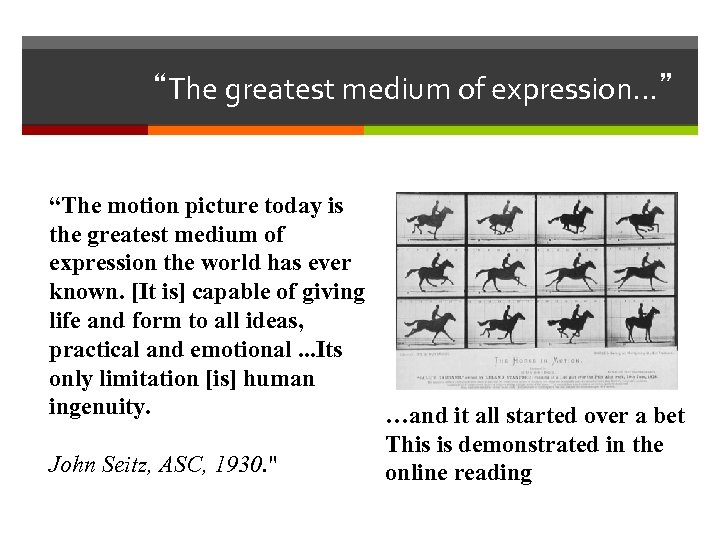
“The greatest medium of expression. . . ” “The motion picture today is the greatest medium of expression the world has ever known. [It is] capable of giving life and form to all ideas, practical and emotional. . . Its only limitation [is] human ingenuity. …and it all started over a bet This is demonstrated in the John Seitz, ASC, 1930. " online reading
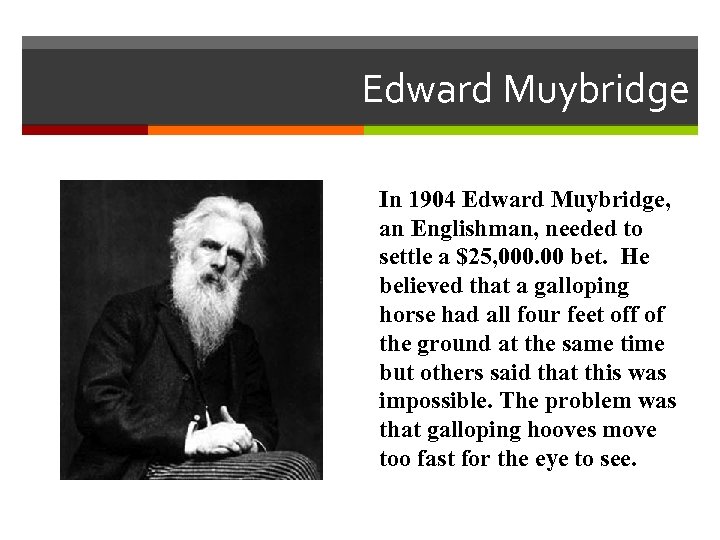
Edward Muybridge In 1904 Edward Muybridge, an Englishman, needed to settle a $25, 000. 00 bet. He believed that a galloping horse had all four feet off of the ground at the same time but others said that this was impossible. The problem was that galloping hooves move too fast for the eye to see.
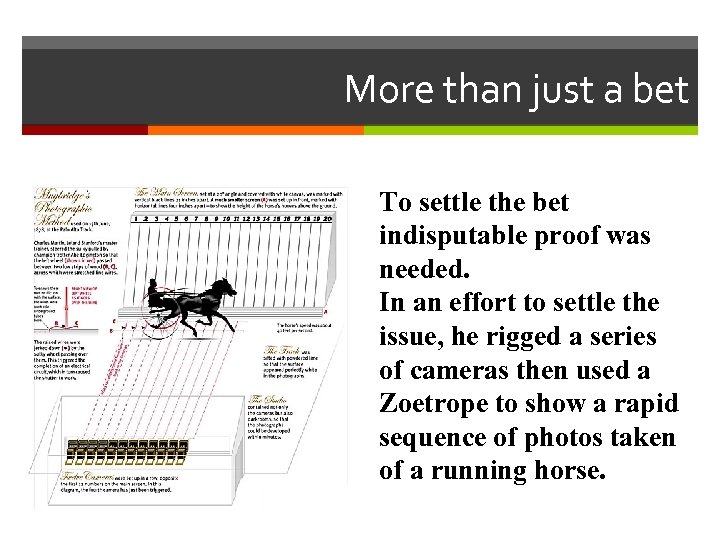
More than just a bet To settle the bet indisputable proof was needed. In an effort to settle the issue, he rigged a series of cameras then used a Zoetrope to show a rapid sequence of photos taken of a running horse.
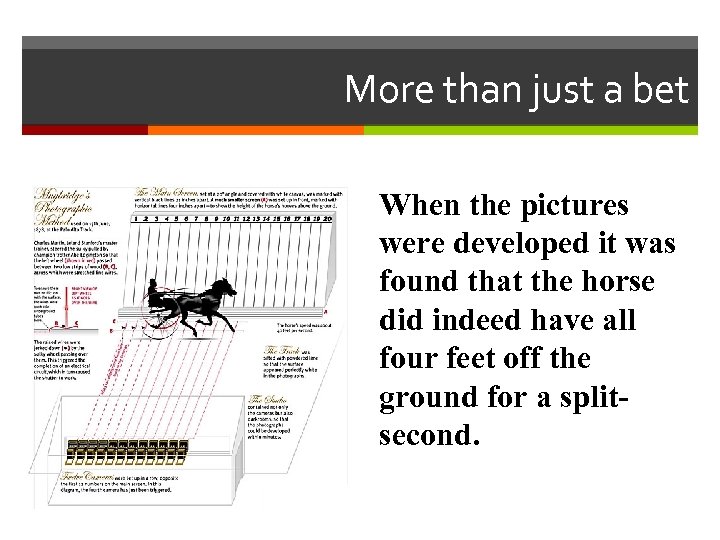
More than just a bet When the pictures were developed it was found that the horse did indeed have all four feet off the ground for a splitsecond.
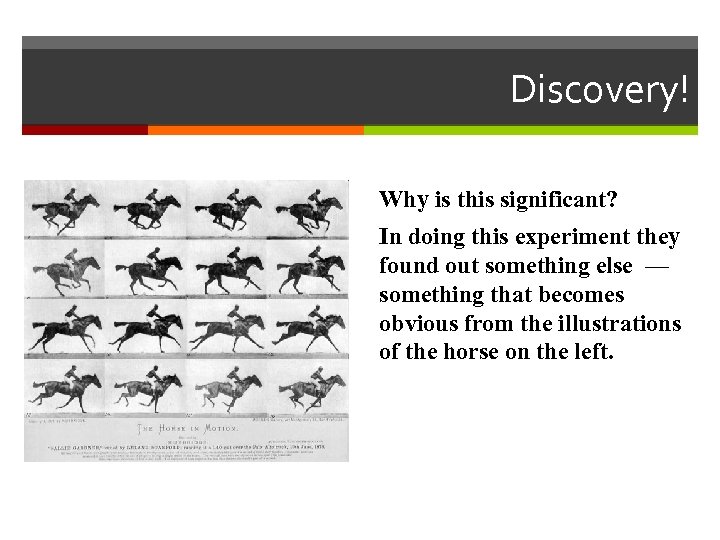
Discovery! Why is this significant? In doing this experiment they found out something else — something that becomes obvious from the illustrations of the horse on the left.
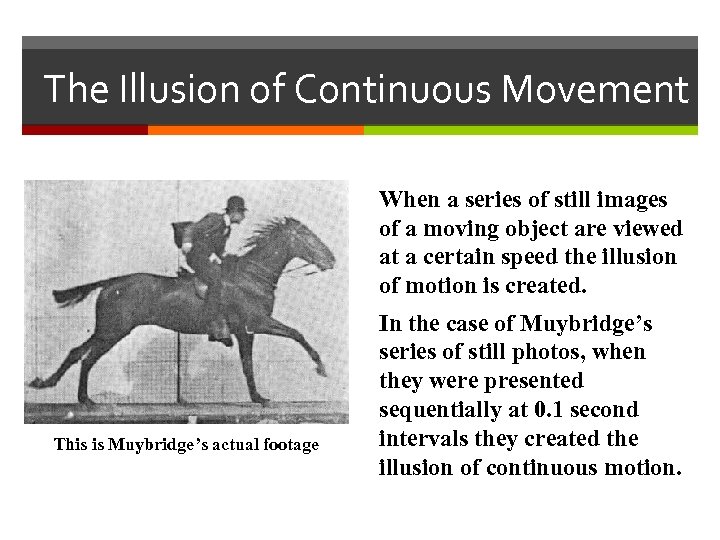
The Illusion of Continuous Movement When a series of still images of a moving object are viewed at a certain speed the illusion of motion is created. This is Muybridge’s actual footage In the case of Muybridge’s series of still photos, when they were presented sequentially at 0. 1 second intervals they created the illusion of continuous motion.
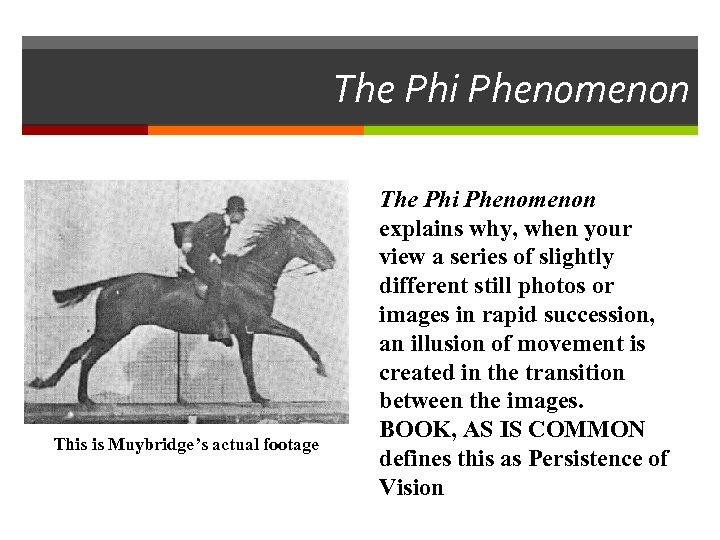
The Phi Phenomenon This is Muybridge’s actual footage The Phi Phenomenon explains why, when your view a series of slightly different still photos or images in rapid succession, an illusion of movement is created in the transition between the images. BOOK, AS IS COMMON defines this as Persistence of Vision
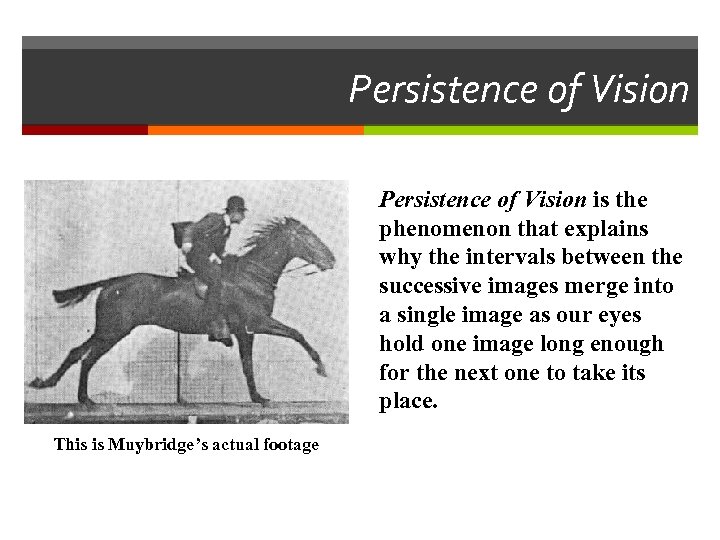
Persistence of Vision is the phenomenon that explains why the intervals between the successive images merge into a single image as our eyes hold one image long enough for the next one to take its place. This is Muybridge’s actual footage
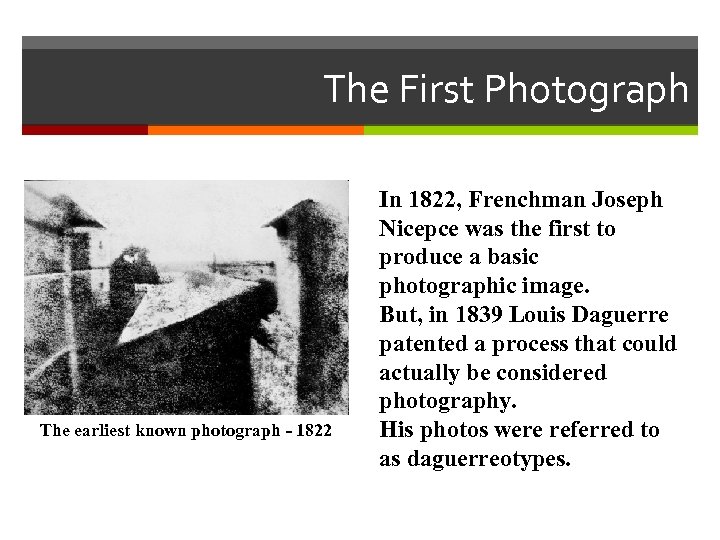
The First Photograph The earliest known photograph - 1822 In 1822, Frenchman Joseph Nicepce was the first to produce a basic photographic image. But, in 1839 Louis Daguerre patented a process that could actually be considered photography. His photos were referred to as daguerreotypes.
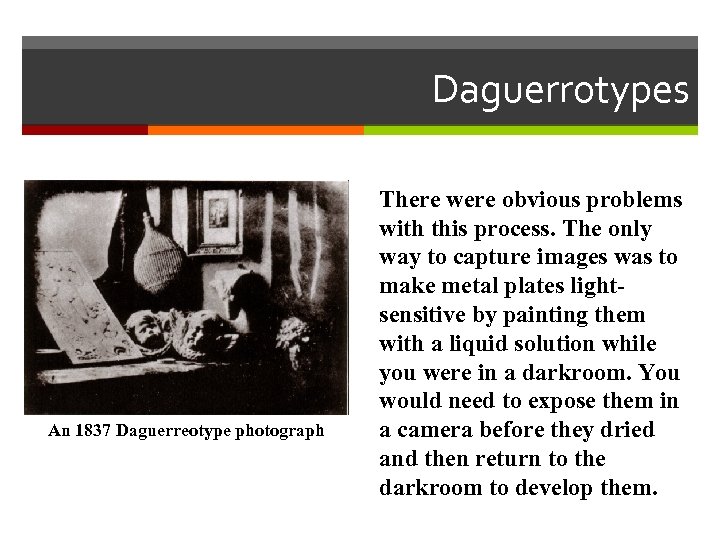
Daguerrotypes An 1837 Daguerreotype photograph There were obvious problems with this process. The only way to capture images was to make metal plates lightsensitive by painting them with a liquid solution while you were in a darkroom. You would need to expose them in a camera before they dried and then return to the darkroom to develop them.
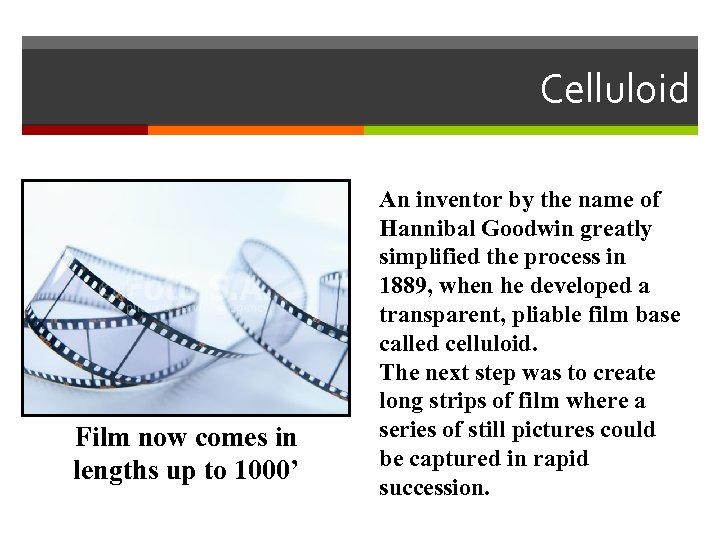
Celluloid Film now comes in lengths up to 1000’ An inventor by the name of Hannibal Goodwin greatly simplified the process in 1889, when he developed a transparent, pliable film base called celluloid. The next step was to create long strips of film where a series of still pictures could be captured in rapid succession.
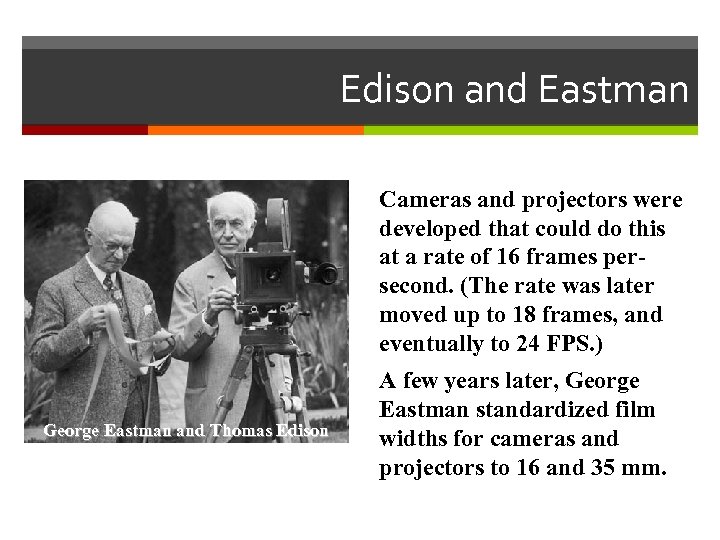
Edison and Eastman Cameras and projectors were developed that could do this at a rate of 16 frames persecond. (The rate was later moved up to 18 frames, and eventually to 24 FPS. ) George Eastman and Thomas Edison A few years later, George Eastman standardized film widths for cameras and projectors to 16 and 35 mm.
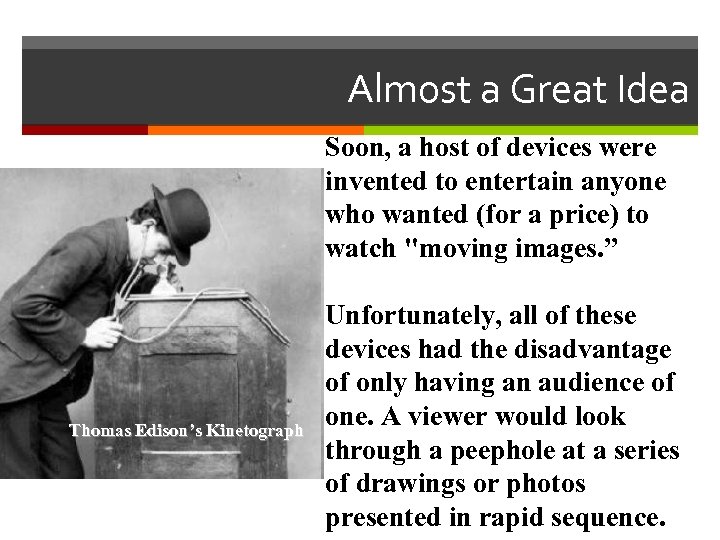
Almost a Great Idea Soon, a host of devices were invented to entertain anyone who wanted (for a price) to watch "moving images. ” Thomas Edison’s Kinetograph Unfortunately, all of these devices had the disadvantage of only having an audience of one. A viewer would look through a peephole at a series of drawings or photos presented in rapid sequence.
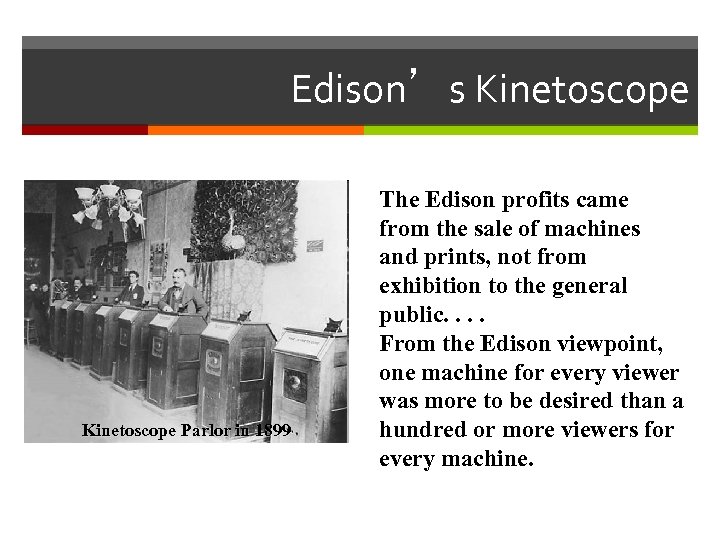
Edison’s Kinetoscope Parlor in 1899 The Edison profits came from the sale of machines and prints, not from exhibition to the general public. . From the Edison viewpoint, one machine for every viewer was more to be desired than a hundred or more viewers for every machine.
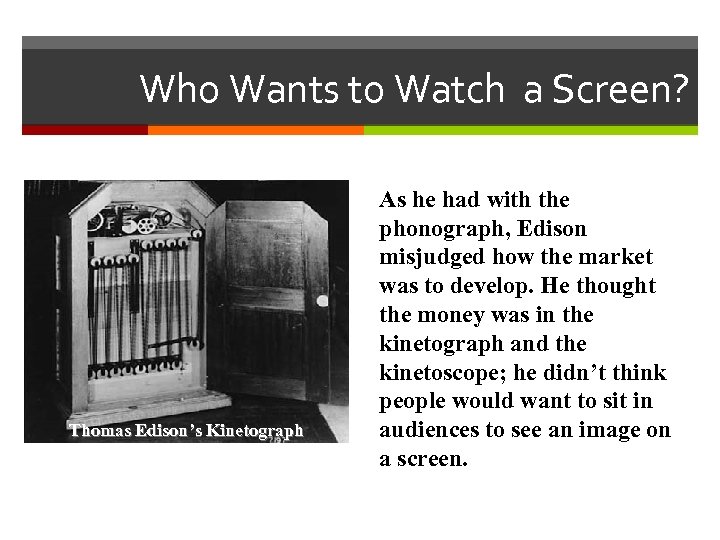
Who Wants to Watch a Screen? Thomas Edison’s Kinetograph As he had with the phonograph, Edison misjudged how the market was to develop. He thought the money was in the kinetograph and the kinetoscope; he didn’t think people would want to sit in audiences to see an image on a screen.
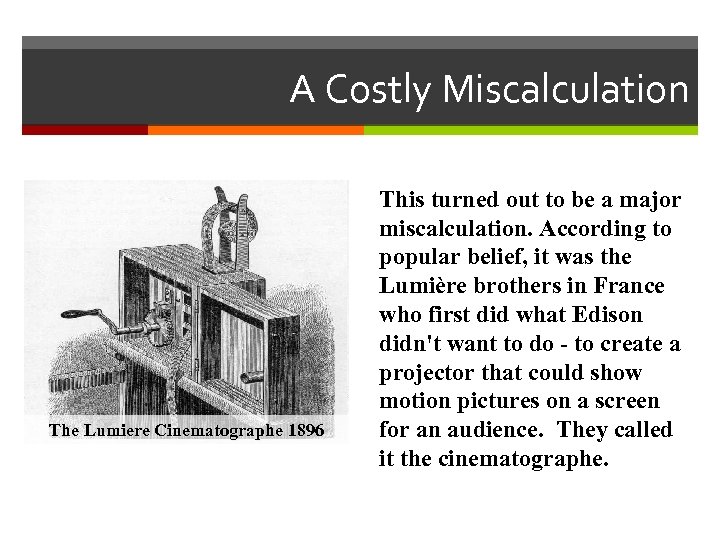
A Costly Miscalculation The Lumiere Cinematographe 1896 This turned out to be a major miscalculation. According to popular belief, it was the Lumière brothers in France who first did what Edison didn't want to do - to create a projector that could show motion pictures on a screen for an audience. They called it the cinematographe.
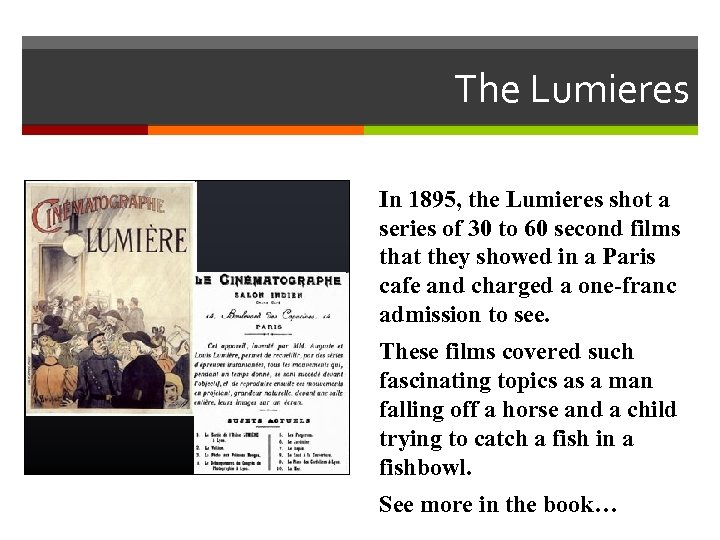
The Lumieres In 1895, the Lumieres shot a series of 30 to 60 second films that they showed in a Paris cafe and charged a one-franc admission to see. These films covered such fascinating topics as a man falling off a horse and a child trying to catch a fish in a fishbowl. See more in the book…
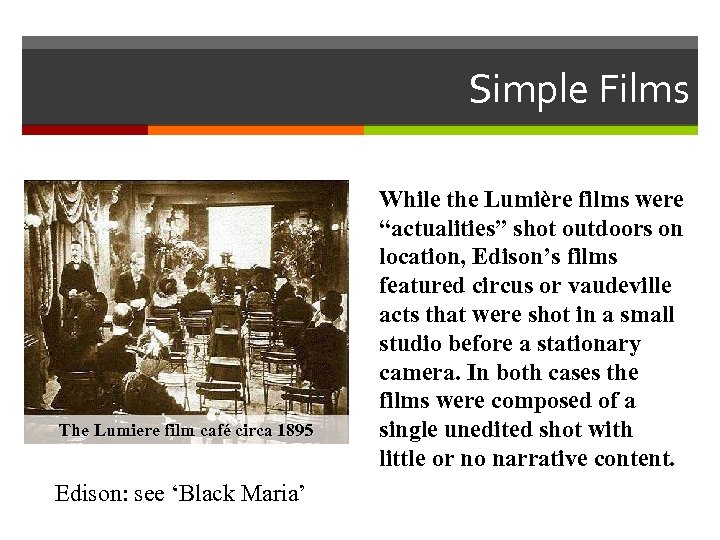
Simple Films The Lumiere film café circa 1895 Edison: see ‘Black Maria’ While the Lumière films were “actualities” shot outdoors on location, Edison’s films featured circus or vaudeville acts that were shot in a small studio before a stationary camera. In both cases the films were composed of a single unedited shot with little or no narrative content.
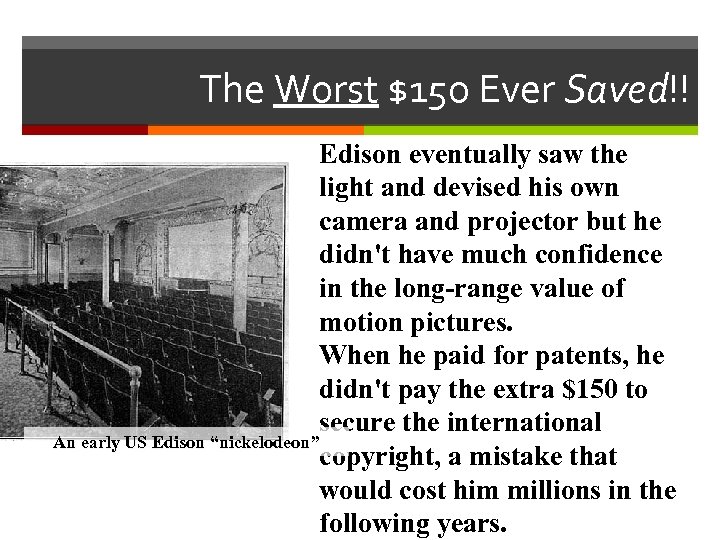
The Worst $150 Ever Saved!! Edison eventually saw the light and devised his own camera and projector but he didn't have much confidence in the long-range value of motion pictures. When he paid for patents, he didn't pay the extra $150 to secure the international An early US Edison “nickelodeon” copyright, a mistake that would cost him millions in the following years.
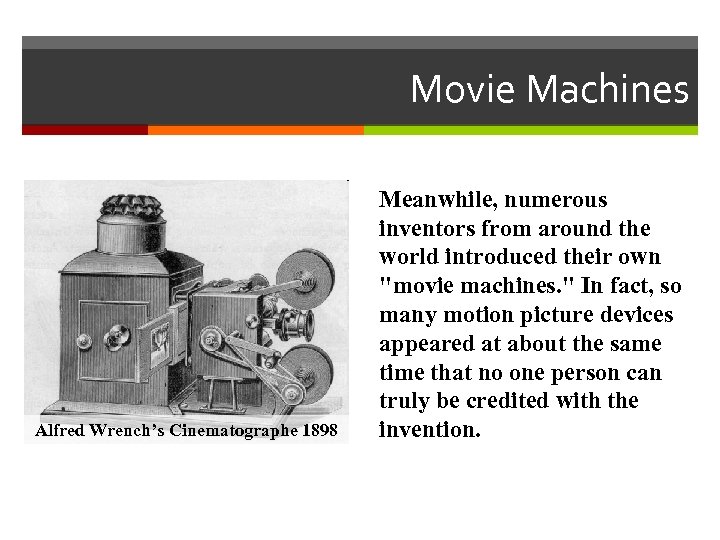
Movie Machines Alfred Wrench’s Cinematographe 1898 Meanwhile, numerous inventors from around the world introduced their own "movie machines. " In fact, so many motion picture devices appeared at about the same time that no one person can truly be credited with the invention.
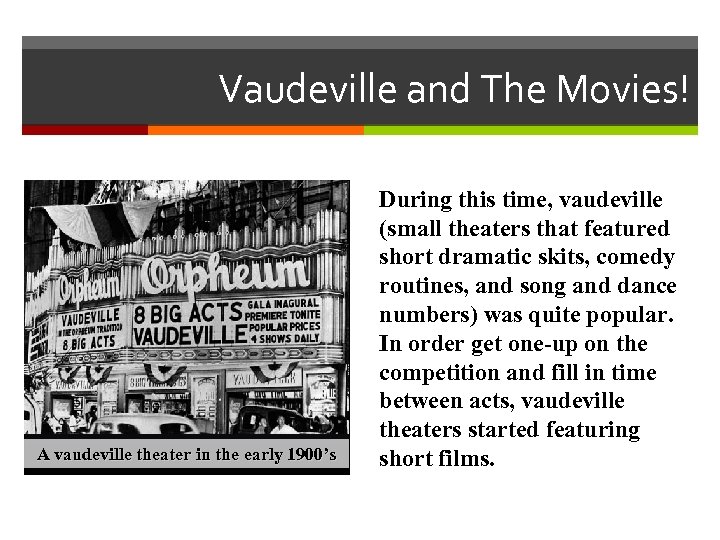
Vaudeville and The Movies! A vaudeville theater in the early 1900’s During this time, vaudeville (small theaters that featured short dramatic skits, comedy routines, and song and dance numbers) was quite popular. In order get one-up on the competition and fill in time between acts, vaudeville theaters started featuring short films.
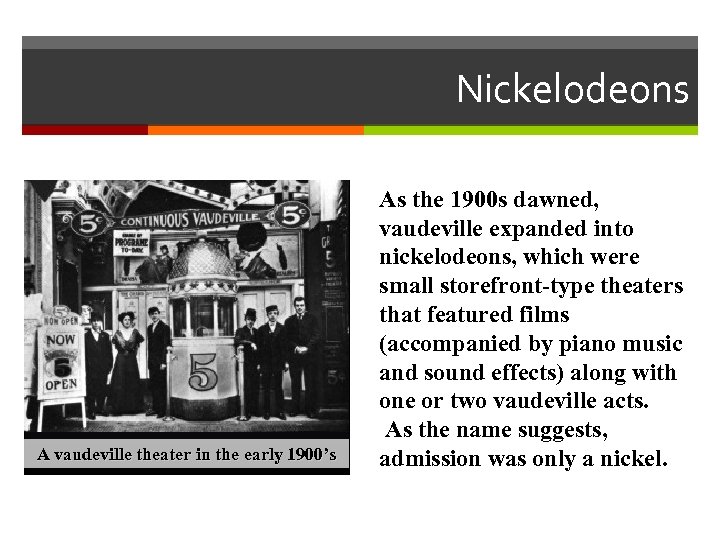
Nickelodeons A vaudeville theater in the early 1900’s As the 1900 s dawned, vaudeville expanded into nickelodeons, which were small storefront-type theaters that featured films (accompanied by piano music and sound effects) along with one or two vaudeville acts. As the name suggests, admission was only a nickel.
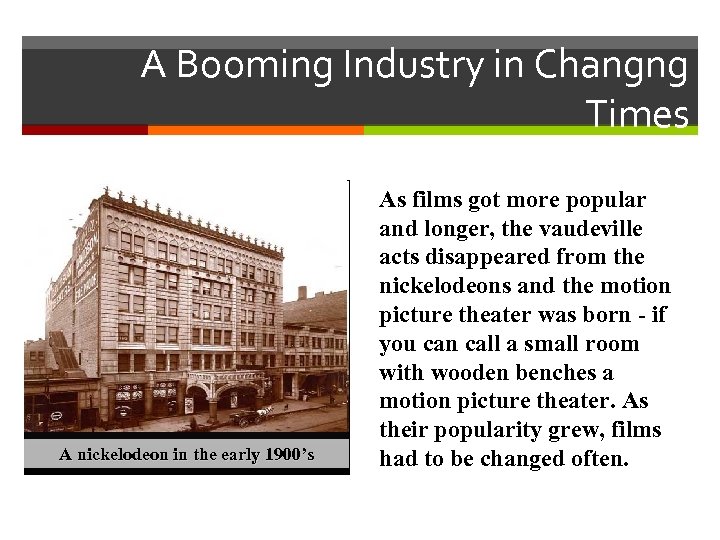
A Booming Industry in Changng Times A nickelodeon in the early 1900’s As films got more popular and longer, the vaudeville acts disappeared from the nickelodeons and the motion picture theater was born - if you can call a small room with wooden benches a motion picture theater. As their popularity grew, films had to be changed often.
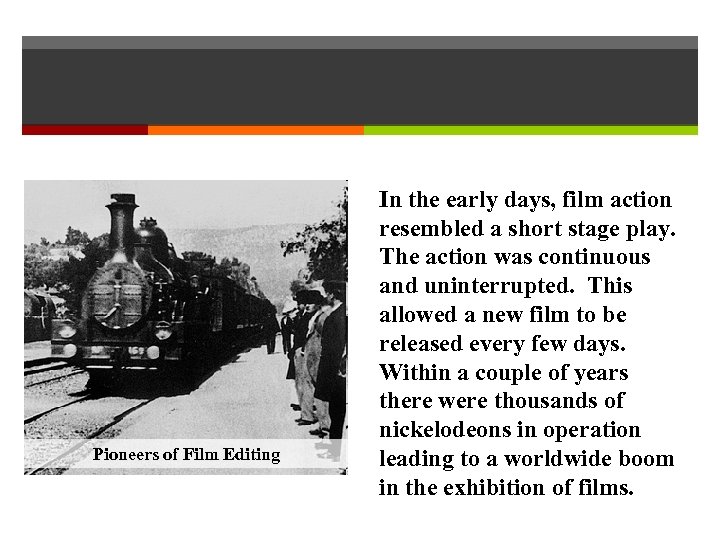
Pioneers of Film Editing In the early days, film action resembled a short stage play. The action was continuous and uninterrupted. This allowed a new film to be released every few days. Within a couple of years there were thousands of nickelodeons in operation leading to a worldwide boom in the exhibition of films.
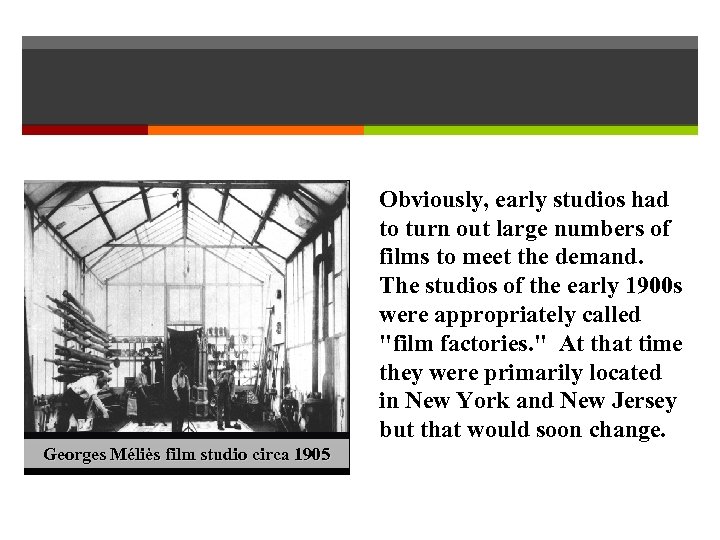
Obviously, early studios had to turn out large numbers of films to meet the demand. The studios of the early 1900 s were appropriately called "film factories. " At that time they were primarily located in New York and New Jersey but that would soon change. Georges Méliès film studio circa 1905
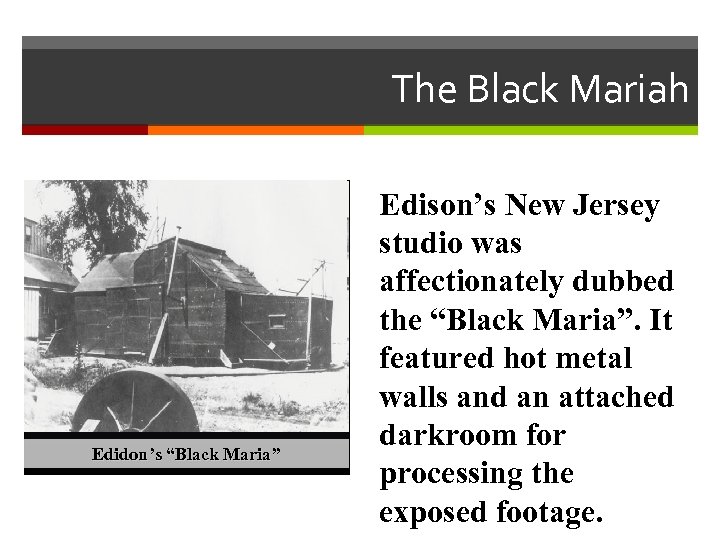
The Black Mariah Edidon’s “Black Maria” Edison’s New Jersey studio was affectionately dubbed the “Black Maria”. It featured hot metal walls and an attached darkroom for processing the exposed footage.
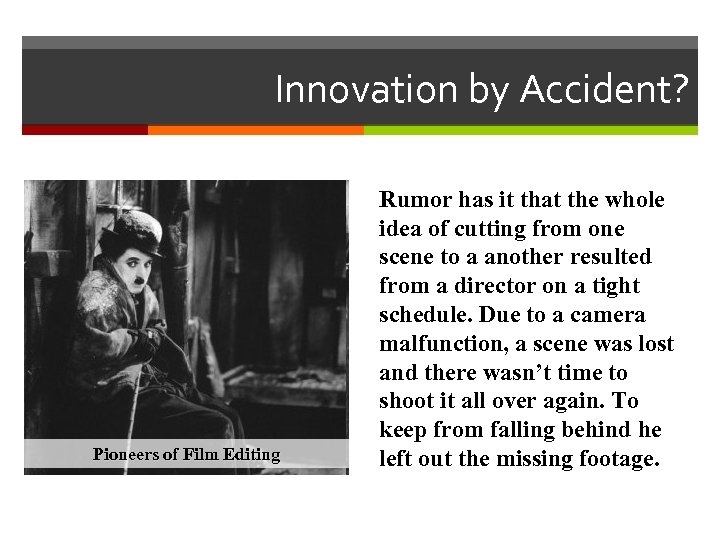
Innovation by Accident? Pioneers of Film Editing Rumor has it that the whole idea of cutting from one scene to a another resulted from a director on a tight schedule. Due to a camera malfunction, a scene was lost and there wasn’t time to shoot it all over again. To keep from falling behind he left out the missing footage.
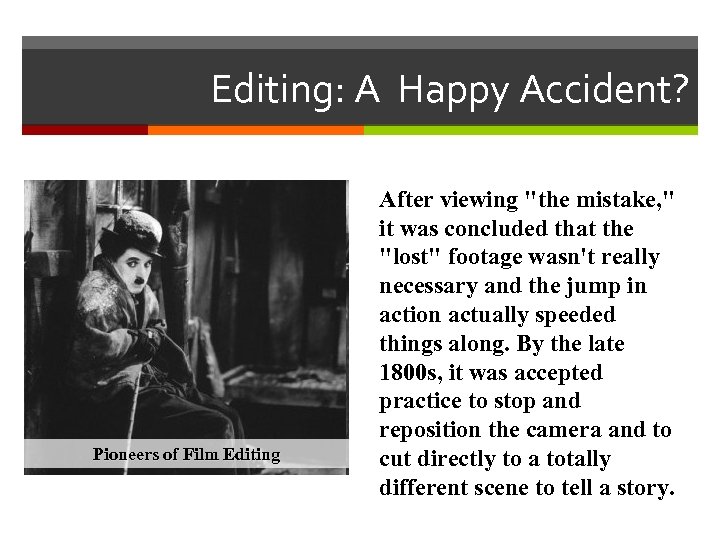
Editing: A Happy Accident? Pioneers of Film Editing After viewing "the mistake, " it was concluded that the "lost" footage wasn't really necessary and the jump in action actually speeded things along. By the late 1800 s, it was accepted practice to stop and reposition the camera and to cut directly to a totally different scene to tell a story.
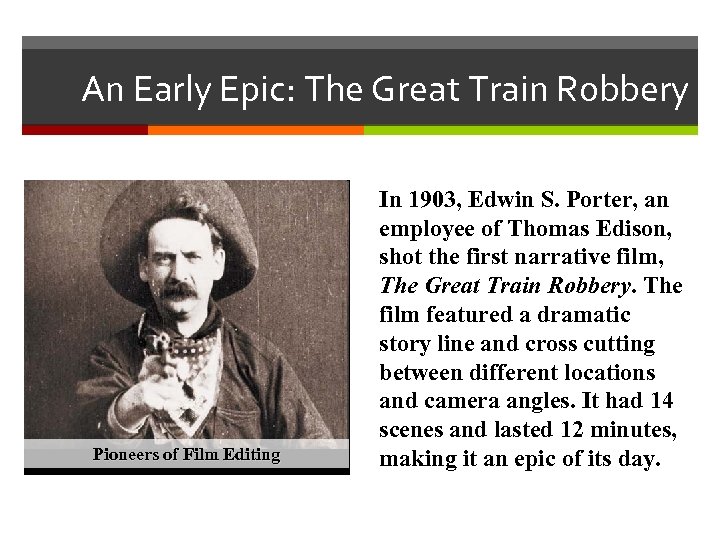
An Early Epic: The Great Train Robbery Pioneers of Film Editing In 1903, Edwin S. Porter, an employee of Thomas Edison, shot the first narrative film, The Great Train Robbery. The film featured a dramatic story line and cross cutting between different locations and camera angles. It had 14 scenes and lasted 12 minutes, making it an epic of its day.
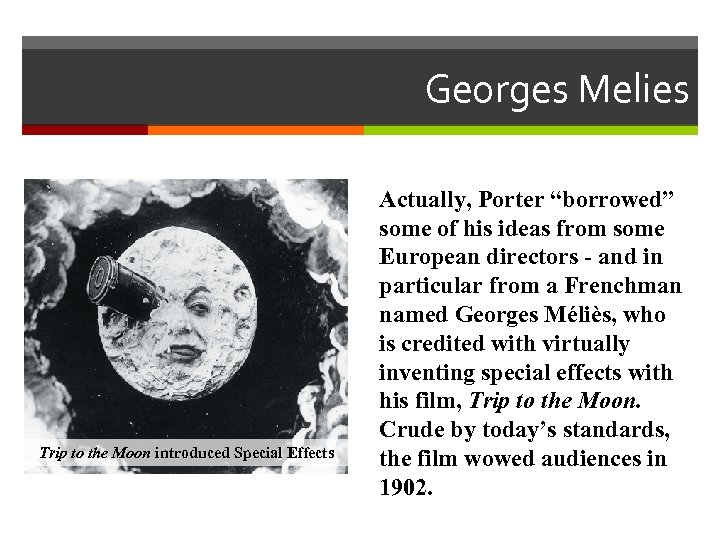
Georges Melies Trip to the Moon introduced Special Effects Actually, Porter “borrowed” some of his ideas from some European directors - and in particular from a Frenchman named Georges Méliès, who is credited with virtually inventing special effects with his film, Trip to the Moon. Crude by today’s standards, the film wowed audiences in 1902.
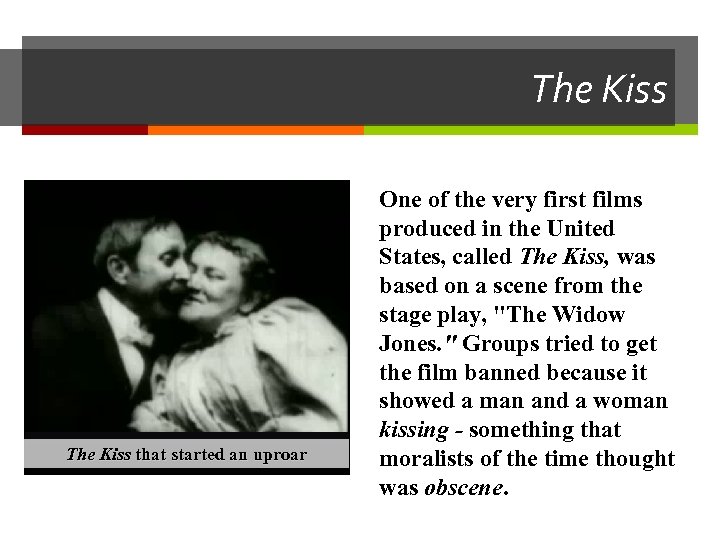
The Kiss that started an uproar One of the very first films produced in the United States, called The Kiss, was based on a scene from the stage play, "The Widow Jones. " Groups tried to get the film banned because it showed a man and a woman kissing - something that moralists of the time thought was obscene.
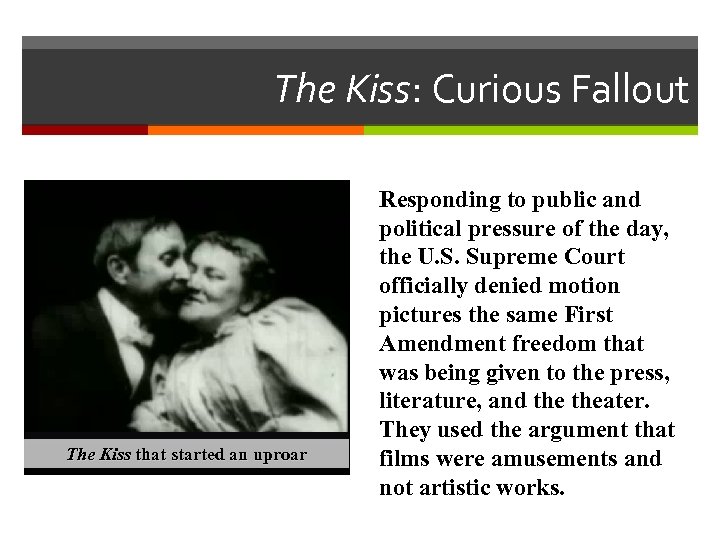
The Kiss: Curious Fallout The Kiss that started an uproar Responding to public and political pressure of the day, the U. S. Supreme Court officially denied motion pictures the same First Amendment freedom that was being given to the press, literature, and theater. They used the argument that films were amusements and not artistic works.
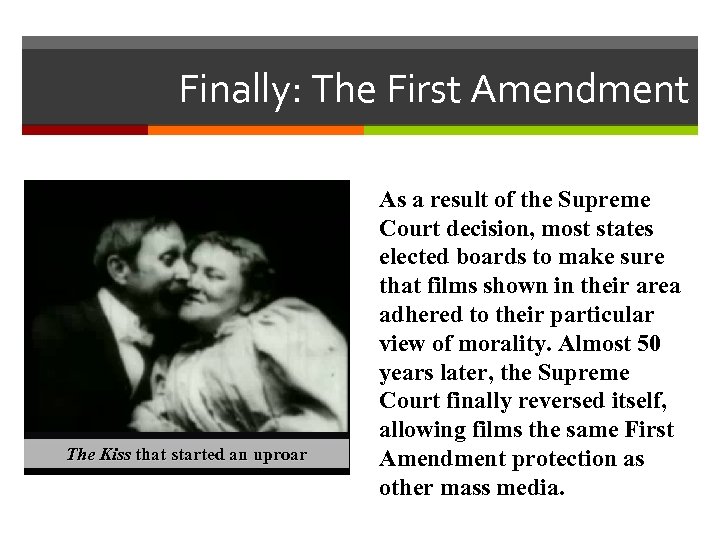
Finally: The First Amendment The Kiss that started an uproar As a result of the Supreme Court decision, most states elected boards to make sure that films shown in their area adhered to their particular view of morality. Almost 50 years later, the Supreme Court finally reversed itself, allowing films the same First Amendment protection as other mass media.
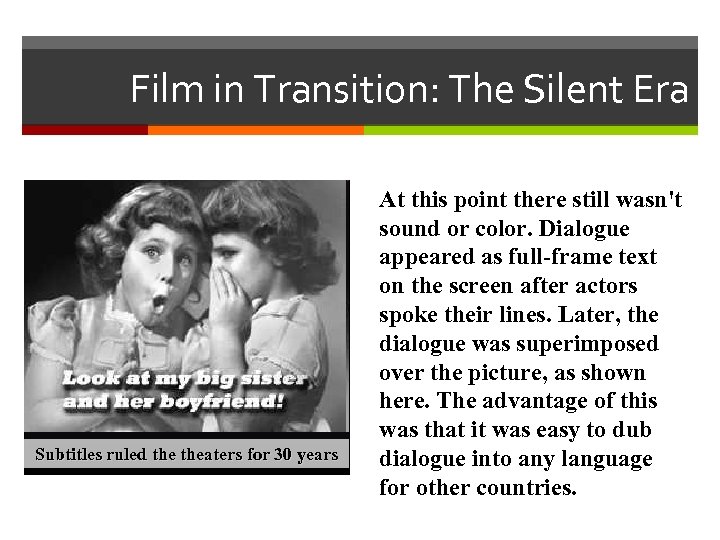
Film in Transition: The Silent Era Subtitles ruled theaters for 30 years At this point there still wasn't sound or color. Dialogue appeared as full-frame text on the screen after actors spoke their lines. Later, the dialogue was superimposed over the picture, as shown here. The advantage of this was that it was easy to dub dialogue into any language for other countries.
That’s early film The book covers the remaining history is a summative way Here are some modern technology main ideas…
Standard film and video aspect ratios are. . . 4: 3 original Academy standard and NTSC TV standard, 16: 9 HD video, 1. 85: 1 Hollywood standard since 1960 s, 2. 39: 1 current anamorphic theatrical standard
After a Supreme Court ruling, in the 1960 s the Hayes Production Code was replaced by the -----. MPAA Ratings System
What architectural innovation in the 1960 s changed the way most people see movies? Multi-screen cineplexes
VFX stands for ------ and CGI stands for ------- Visual Effects, Computer Generated Imagery
Among then various landmark films for VFX and CGI, --- was the first live-action movie to use CGI for a length of time; ----- was the first all CGI animated feature film. Tron; Toy Story
A modern theater sound system ------ is named after George Lucas’ debut feature film, and is not a cinema sound format but system that strives to reproduce the acoustics and ambience of the movie studio, allowing the audience to enjoy the sound effects, score, dialogue, and visual presentation with the clarity and detail of the final mastering session THX
------ is one of the leading audio delivery technologies in the cinema industry, and ----- is their newest cinema audio format. Dolby Digital 5. 1 / Dolby Surround 7. 1
Is film dead? What doe s evidence from movimakers suggest? p. 128 evidence of use, including at least 100 movies using film in 2015
RED Scarlet, RED Epic, Arri Alexa, Sony Cine. Alta F 65 and Canon EOS C 500 are all examples of what? Digital video cameras now commonly used for moviemaking
More than 80% of movie theaters in the U. S. no longer do what for showing movies? Show them by projecting film; instead are using digital projectors and playback systems
Next… MVPDs Mobile media Digital signage Mid Term next Thursday 10/20
Скачать презентацию RTV 151 Video Remember to check www tonydemars
63b2a5fe63b6a5bf5b43ba388be9f334.ppt