


 Скачать презентацию Royal College of Surgeons in Ireland Coláiste Ríoga
839fcc1440fde7a6b8b890cca6f4ca07.ppt
- Количество слайдов: 13
 Royal College of Surgeons in Ireland Coláiste Ríoga na Máinleá in Éirinn Computer-Based Clinical Decision Support Systems (CDSSs) Borislav D Dimitrov Division of Population Health Sciences 1
 Contents 1) Clinical & Research Evidence: Implementation in Practice 2) Levels of Functionality in Health Informatics 3) Decision Support Systems (DSSs) 4) Clinical DSSs (computer-based / e. CDSSs) 5) CPRs EHR/EPR e. CDSSs: Better Decision-Making Division of Population Health Sciences 2
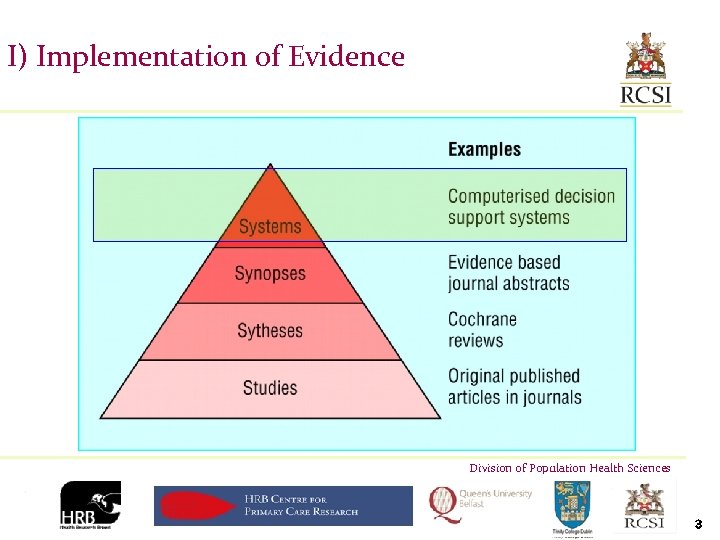 I) Implementation of Evidence Division of Population Health Sciences 3
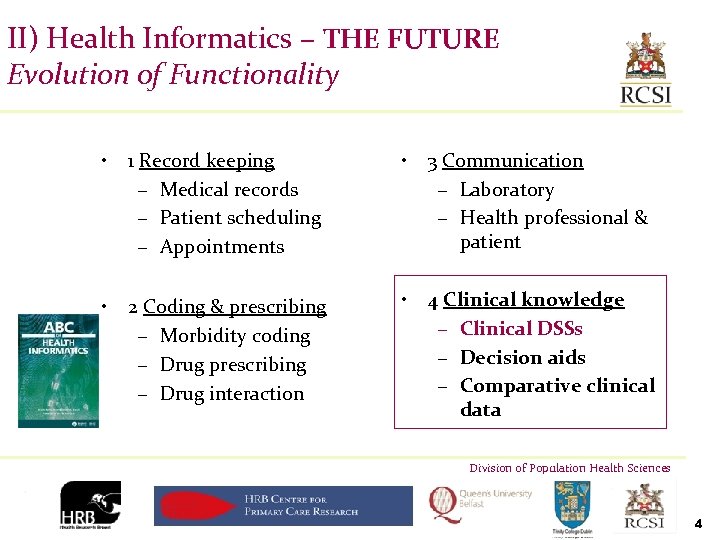 II) Health Informatics – THE FUTURE Evolution of Functionality • 1 Record keeping – Medical records – Patient scheduling – Appointments • 3 Communication – Laboratory – Health professional & patient • 2 Coding & prescribing – Morbidity coding – Drug prescribing – Drug interaction • 4 Clinical knowledge – Clinical DSSs – Decision aids – Comparative clinical data Division of Population Health Sciences 4
 III) DSSs: definition and aspects - 1 Decision Support Systems (DSSs) - a class of computer-based information systems including knowledge-based systems that support decision-making activities: - parts/blocks: database/KB, model, user interface - components: inputs, user knowledge/expertise, outputs decisions - classifications: scope, relationships to user, mode of assistance, evolution, orientation Division of Population Health Sciences 5
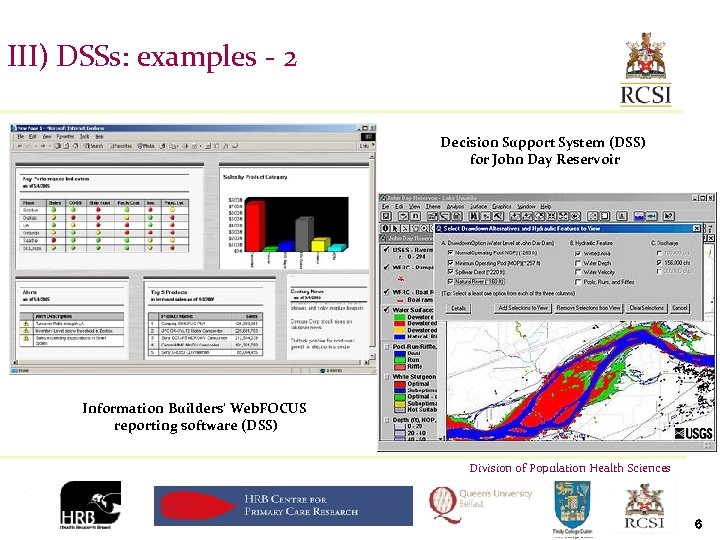 III) DSSs: examples - 2 Decision Support System (DSS) for John Day Reservoir Information Builders' Web. FOCUS reporting software (DSS) Division of Population Health Sciences 6
 IV) Clinical DSSs: definition and aspects - 1 Clinical Decision Support Systems (CDSSs) – a direct aid to clinical decision-making in which the characteristics of an individual patient are matched to a computerized clinical knowledge base, and patientspecific assessments or recommendations are then presented to the clinician and/or the patient for a decision (Sim at al 2001): - scope: designed ot improve clinical decision-making - key elements: integration with HER/EPR, computerised-knowledge base, algorithm, patient-specific info - classifications: context, knowledge & data source, decision support, information delivery, workflow Division of Population Health Sciences 7
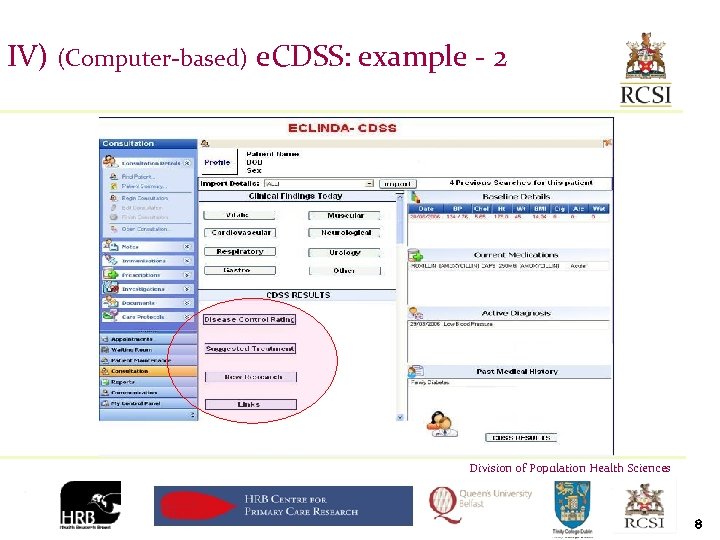 IV) (Computer-based) e. CDSS: example - 2 Division of Population Health Sciences 8
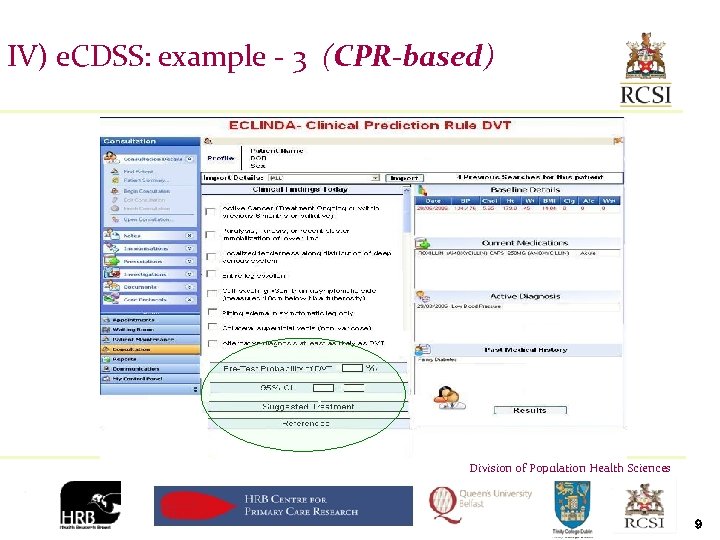 IV) e. CDSS: example - 3 (CPR-based) Division of Population Health Sciences 9
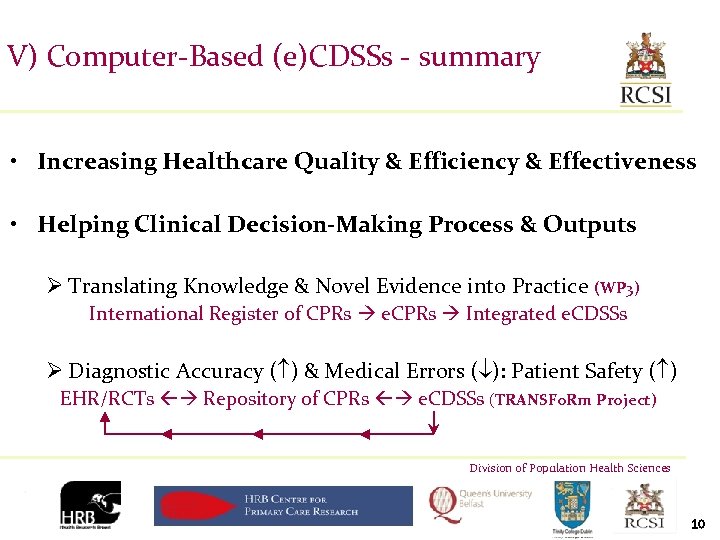 V) Computer-Based (e)CDSSs - summary • Increasing Healthcare Quality & Efficiency & Effectiveness • Helping Clinical Decision-Making Process & Outputs Ø Translating Knowledge & Novel Evidence into Practice (WP 3) International Register of CPRs e. CPRs Integrated e. CDSSs Ø Diagnostic Accuracy ( ) & Medical Errors ( ): Patient Safety ( ) EHR/RCTs Repository of CPRs e. CDSSs (TRANSFo. Rm Project) Division of Population Health Sciences 10
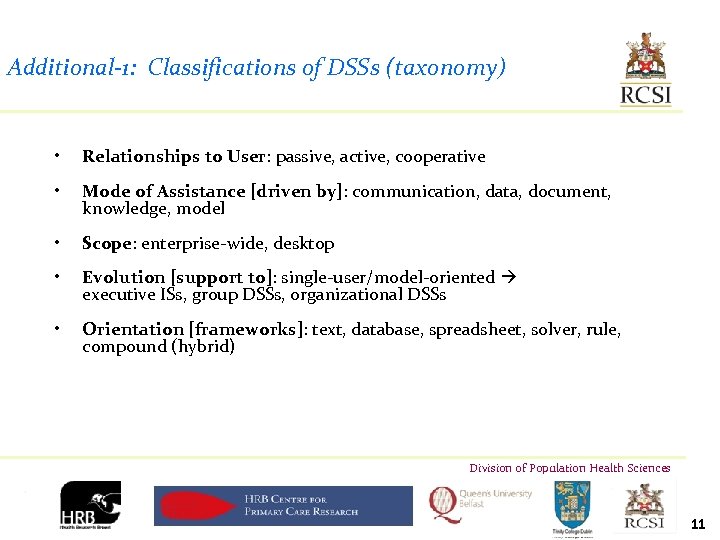 Additional-1: Classifications of DSSs (taxonomy) • Relationships to User: passive, active, cooperative • Mode of Assistance [driven by]: communication, data, document, knowledge, model • Scope: enterprise-wide, desktop • Evolution [support to]: single-user/model-oriented executive ISs, group DSSs, organizational DSSs • Orientation [frameworks]: text, database, spreadsheet, solver, rule, compound (hybrid) Division of Population Health Sciences 11
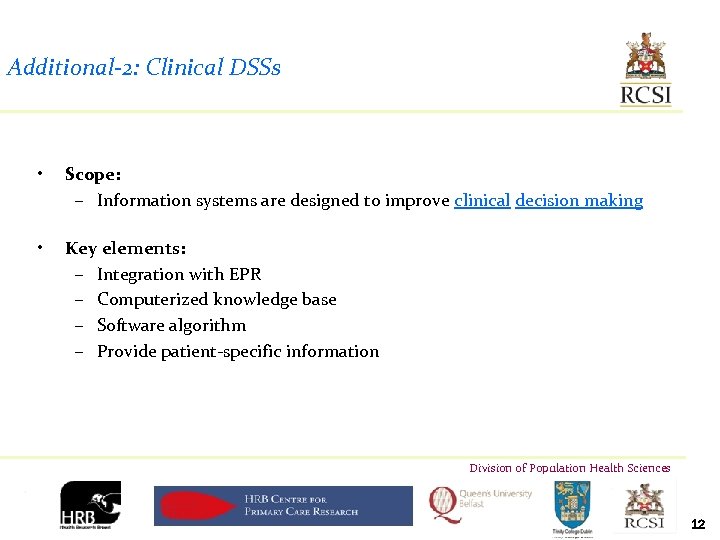 Additional-2: Clinical DSSs • Scope: – Information systems are designed to improve clinical decision making • Key elements: – Integration with EPR – Computerized knowledge base – Software algorithm – Provide patient-specific information Division of Population Health Sciences 12
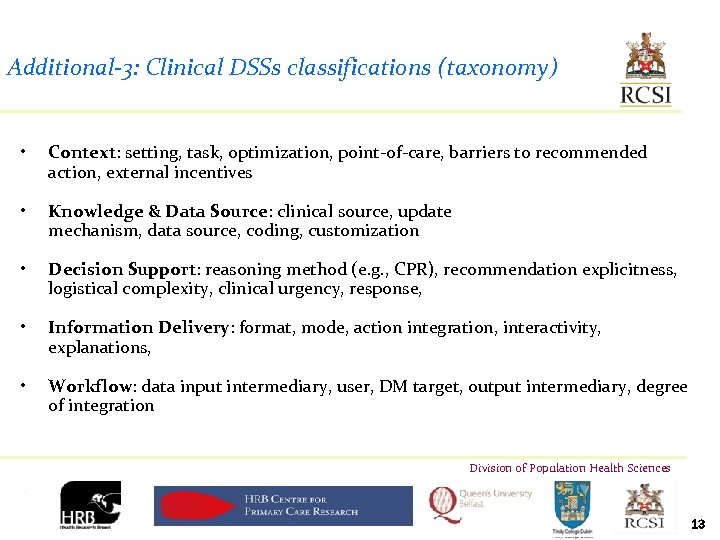 Additional-3: Clinical DSSs classifications (taxonomy) • Context: setting, task, optimization, point-of-care, barriers to recommended action, external incentives • Knowledge & Data Source: clinical source, update mechanism, data source, coding, customization • Decision Support: reasoning method (e. g. , CPR), recommendation explicitness, logistical complexity, clinical urgency, response, • Information Delivery: format, mode, action integration, interactivity, explanations, • Workflow: data input intermediary, user, DM target, output intermediary, degree of integration Division of Population Health Sciences 13