 Скачать презентацию Roy Brown Ph D All slides
dc5583ea1cd6142c006726dda50f0a39.ppt
- Количество слайдов: 59



Roy Brown Ph. D. , (All slides copyright 2009)
Individual and Family Quality of Life: Issues of Ageing and Intellectual Disability Roy I. Brown Ph. D, FIASSID. Ageing Seminar 2009 Hong Kong Joint Council for People with Disabilities / Hong Kong Council of Social Service
AGEING - THE PROCESS AND THE CHALLENGE. Two types of People -Two Issues: ØThose who are aged now ØThose who are young and will age
Similar conditions do not mean the same psychological or social behaviours are shown or that needs or requirements are identical.
Ageing and disability represent a final life frontier. Decisions will at times need to be made without experimental or other scientific evidence. (note: Science is not just experiment but observation). Practice is knowledge based on science, experience & common sense).
Diseases and restrictions of ageing are interactive with a person’s personal characteristics and environmental experience, causing an infinite range of responses.
QUALITY OF LIFE What does quality of life approach mean? a) For the individual. b) For the family. c) For the community d) For services. e) For policy. IT MAY BE USEFUL TO NOTE DOWN YOUR VIEWS
If we use a quality of life approach v How do we define quality? v What are we prepared to do socially and psychologically v How will we sensitize our services v What are we prepared to do economically? v How can we help to shape policy
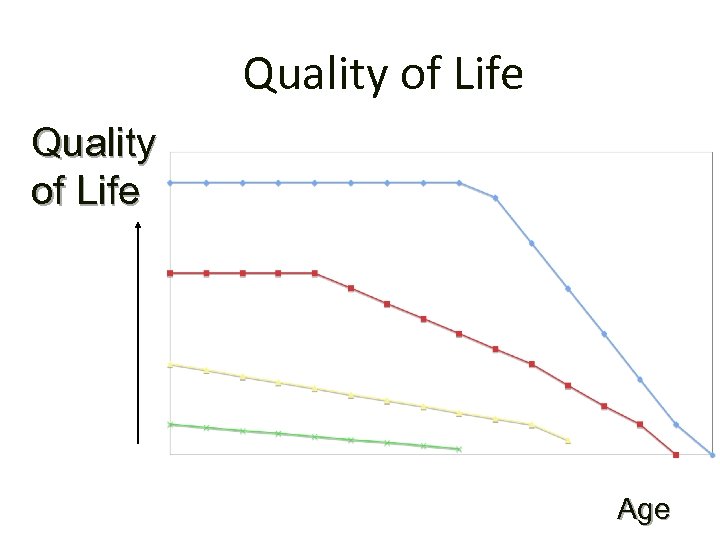
Quality of Life Age
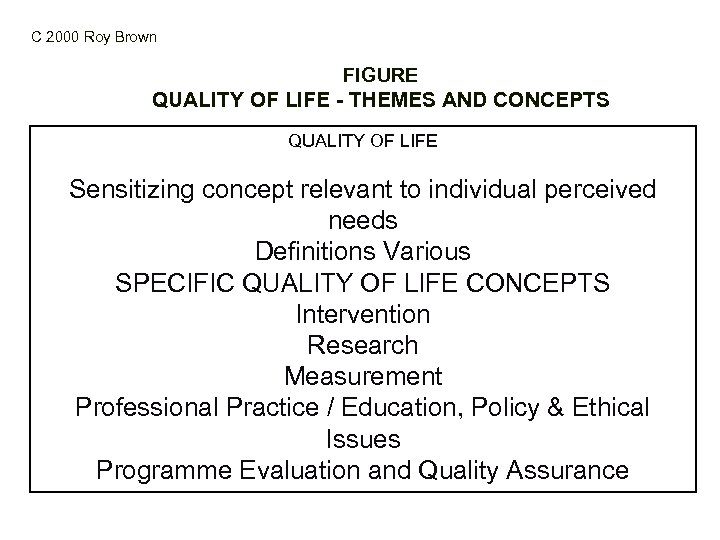
C 2000 Roy Brown FIGURE QUALITY OF LIFE - THEMES AND CONCEPTS QUALITY OF LIFE Sensitizing concept relevant to individual perceived needs Definitions Various SPECIFIC QUALITY OF LIFE CONCEPTS Intervention Research Measurement Professional Practice / Education, Policy & Ethical Issues Programme Evaluation and Quality Assurance
Quality of life is: A Sensitizing concept relevant to individual perceived needs Policy making, health-education, social promotion, advocacy etc. e. g. Taylor 1994
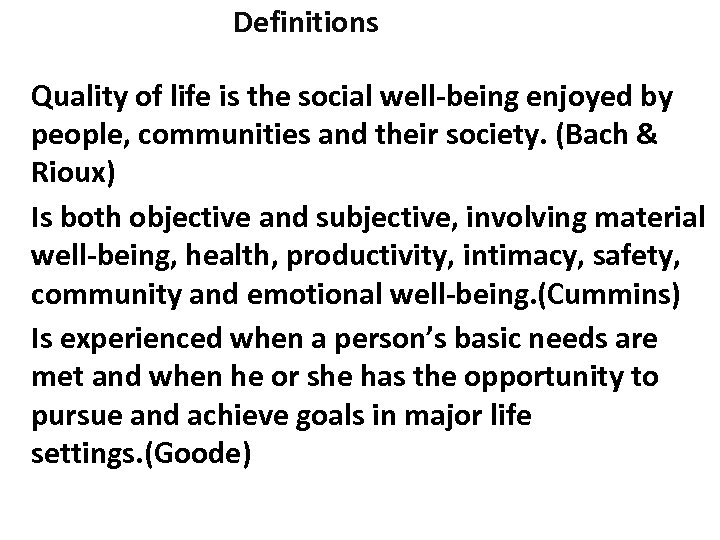
Definitions Quality of life is the social well-being enjoyed by people, communities and their society. (Bach & Rioux) Is both objective and subjective, involving material well-being, health, productivity, intimacy, safety, community and emotional well-being. (Cummins) Is experienced when a person’s basic needs are met and when he or she has the opportunity to pursue and achieve goals in major life settings. (Goode)
Def Contin The discrepancy between a person’s unmet needs and desires. Referring to the subjective or perceived as well as objective assessment. Relates to all life domains. Recognises interaction between individual and environment (Brown, Bayer & Macfarlane)
Being Belonging Becoming Ivan Brown et al
Some key descriptors of quality of life • A multidimensional concept involving well-being across life domains • Relates to the objective and subjective experiences of well-being • Satisfaction of the individual • Individual well-being across the lifespan
SPECIFIC QUALITY OF LIFE CONCEPTS Domains of well being Holism Lifespan Choices Personal Control Perception Self Image Empowerment Inter & Intra Personal Variability Values e. g. Goode 1994, Renwick , Brown, I. , & Nagler 1996, Felce & Perry, 1996, Brown 1997, Schalock 1997
Exclusion & Inclusion CAN BE: - PHYSICAL SOCIAL PSYCHOLOGICAL EDUCATIONAL
Exclusion & Inclusion can be: - 1. Short or long term 2. Individual or Group (e. g. Gender or Intercultural) 3. Inter Generational 4. Institutional 5. Within the Community 6. Within the Home Exclusion has rules and values which are exclusive & hierarchical See Brown & Brown (2003)
MEASUREMENT INDIVIDUAL & FAMILY QUALITY OF LIFE Individual and Social Indicators Perceptual and Objective Personal not Proxy Quantitative and Qualitative Aims Assessment Practical application and intervention Evaluation Research
Measurement QOL (Instruments) • The Resident (Burnett, 1989) Satisfaction Inventory • Rehabilitation Questionnaire. A Personal Guide to the Individual’s Quality of Life (Brown & Bayer 1992) • The Comprehensive Quality of Life Scale (Cummins, 1993)
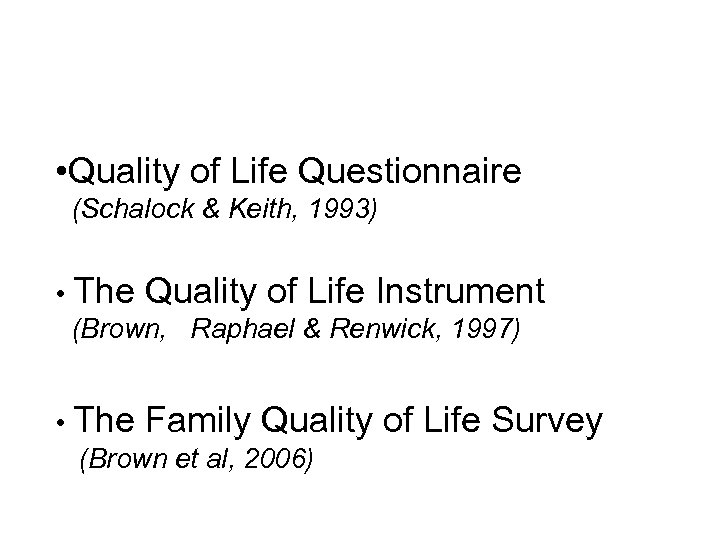
• Quality of Life Questionnaire (Schalock & Keith, 1993) • The Quality of Life Instrument (Brown, Raphael & Renwick, 1997) • The Family Quality (Brown et al, 2006) of Life Survey
The professional behaviour of all personnel is guided by a well thought out value system. What are your value systems a) professionally and b) personally? Do these 2 systems differ in your professional and private behaviour?
Quality of Life and the Family All the above concepts can be applied to the family with a member who is ageing
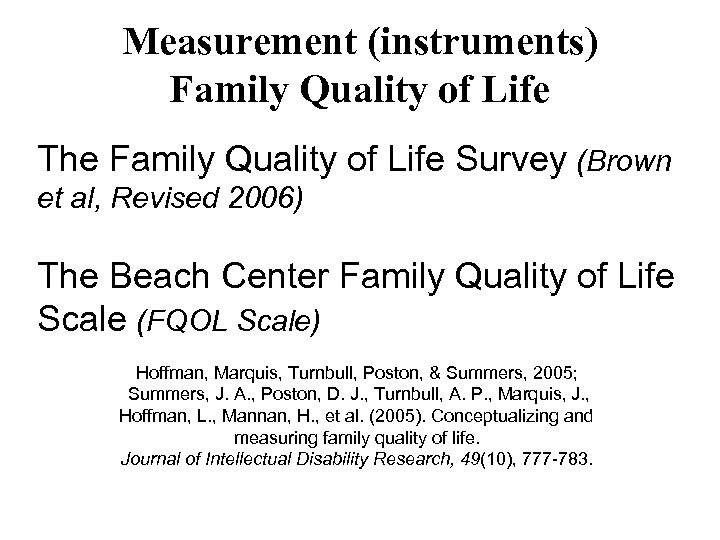
Measurement (instruments) Family Quality of Life The Family Quality of Life Survey (Brown et al, Revised 2006) The Beach Center Family Quality of Life Scale (FQOL Scale) Hoffman, Marquis, Turnbull, Poston, & Summers, 2005; Summers, J. A. , Poston, D. J. , Turnbull, A. P. , Marquis, J. , Hoffman, L. , Mannan, H. , et al. (2005). Conceptualizing and measuring family quality of life. Journal of Intellectual Disability Research, 49(10), 777 -783.
Measurement (instruments) Family Quality of Life The Family Quality of Life Survey (Brown et al, Revised 2006) The Beach Center Family Quality of Life Scale (FQOL Scale) (Hoffman, Marquis, Turnbull, Poston, & Summers, 2005; Summers, J. A. , Poston, D. J. , Turnbull, A. P. , Marquis, J. , Hoffman, L. , Mannan, H. , et al. (2005). Conceptualizing and measuring family quality of life. Journal of Intellectual Disability Research, 49(10), 777 -783.
Family Quality of Life Survey • www. surreyplace. on. ca • Once you have accessed the website click on research and evaluation on the left column and you will see the link to family quality
International Family Quality of Life Project Family Quality of Life Survey (FQo. L) The International Family Quality of Life Project examines the quality of life of families who have one or more members with an intellectual or developmental disability. The project was initiated in 1997 by researchers from Australia, Canada, and Israel. The organization of the project is led by researchers in Canada at Surrey Place Centre, Muki. Baum Treatment Centres, and faculty from the University of Toronto and the University of Victoria. Many other countries are now involved.
Countries involved • • Australia Austria Bosnia Belgium Canada India Iran Ireland Israel Italy Japan Malaysia Mexico Netherlands Poland Slovenia Taiwan USA
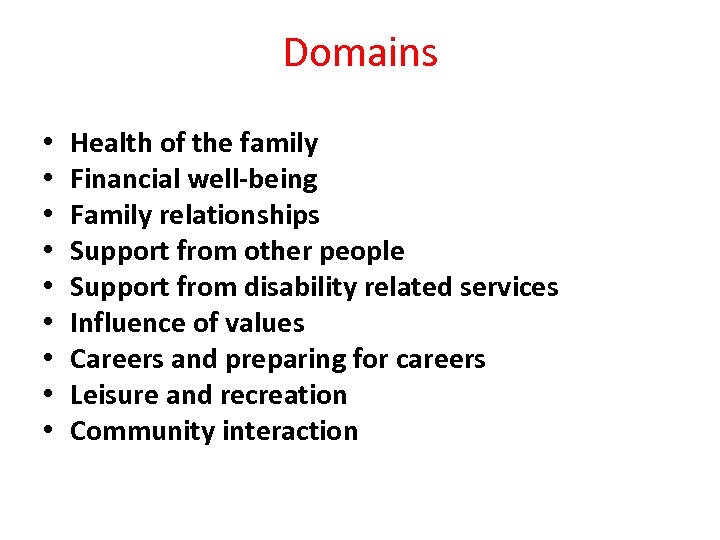
Domains • • • Health of the family Financial well-being Family relationships Support from other people Support from disability related services Influence of values Careers and preparing for careers Leisure and recreation Community interaction
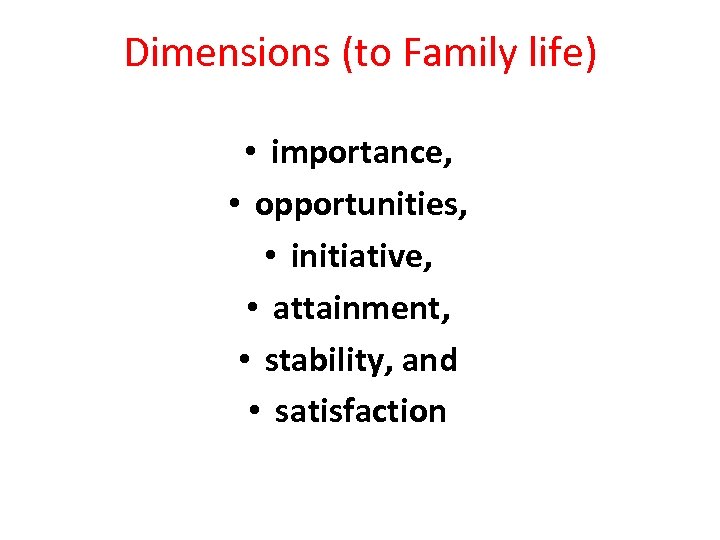
Dimensions (to Family life) • importance, • opportunities, • initiative, • attainment, • stability, and • satisfaction
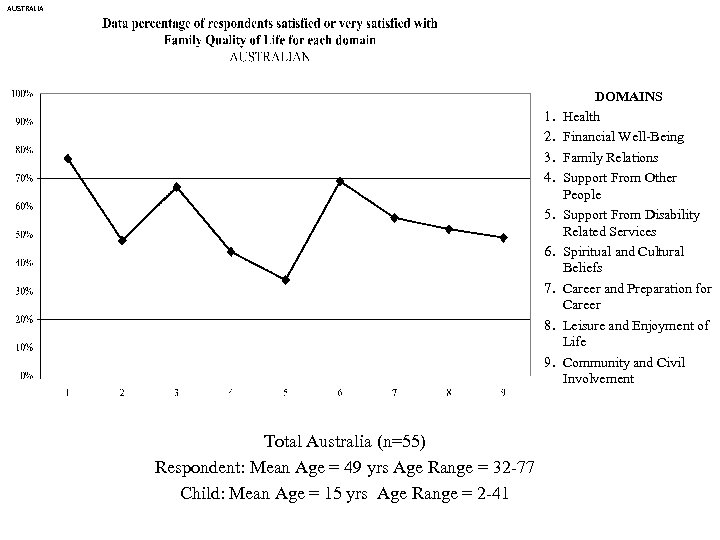
AUSTRALIA 1. 2. 3. 4. 5. 6. 7. 8. 9. Total Australia (n=55) Respondent: Mean Age = 49 yrs Age Range = 32 -77 Child: Mean Age = 15 yrs Age Range = 2 -41 DOMAINS Health Financial Well-Being Family Relations Support From Other People Support From Disability Related Services Spiritual and Cultural Beliefs Career and Preparation for Career Leisure and Enjoyment of Life Community and Civil Involvement
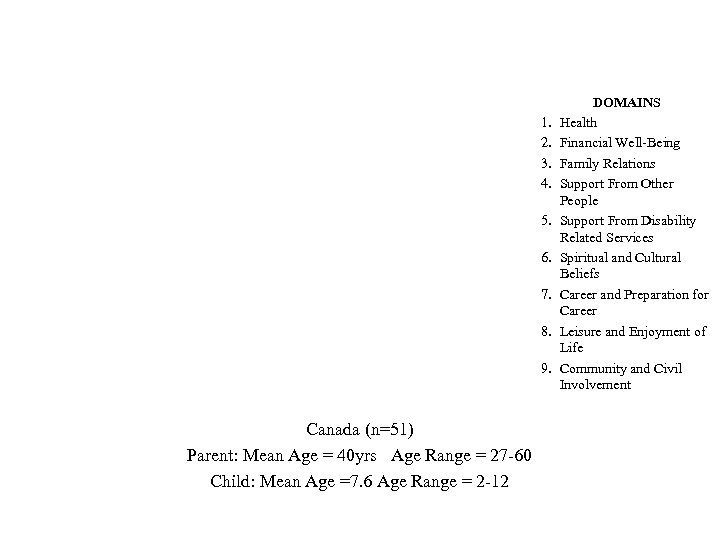
CANADA 1. 2. 3. 4. 5. 6. 7. 8. 9. Canada (n=51) Parent: Mean Age = 40 yrs Age Range = 27 -60 Child: Mean Age =7. 6 Age Range = 2 -12 DOMAINS Health Financial Well-Being Family Relations Support From Other People Support From Disability Related Services Spiritual and Cultural Beliefs Career and Preparation for Career Leisure and Enjoyment of Life Community and Civil Involvement
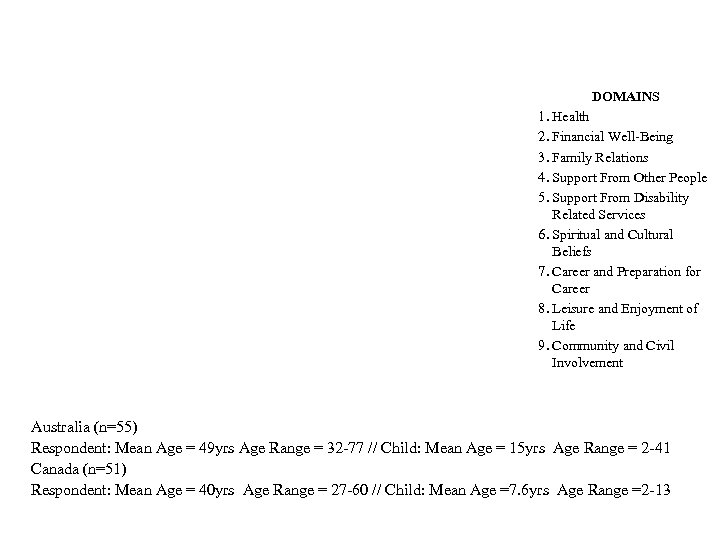
AUSTRALIA & CANADA DOMAINS 1. Health 2. Financial Well-Being 3. Family Relations 4. Support From Other People 5. Support From Disability Related Services 6. Spiritual and Cultural Beliefs 7. Career and Preparation for Career 8. Leisure and Enjoyment of Life 9. Community and Civil Involvement Australia (n=55) Respondent: Mean Age = 49 yrs Age Range = 32 -77 // Child: Mean Age = 15 yrs Age Range = 2 -41 Canada (n=51) Respondent: Mean Age = 40 yrs Age Range = 27 -60 // Child: Mean Age =7. 6 yrs Age Range =2 -13
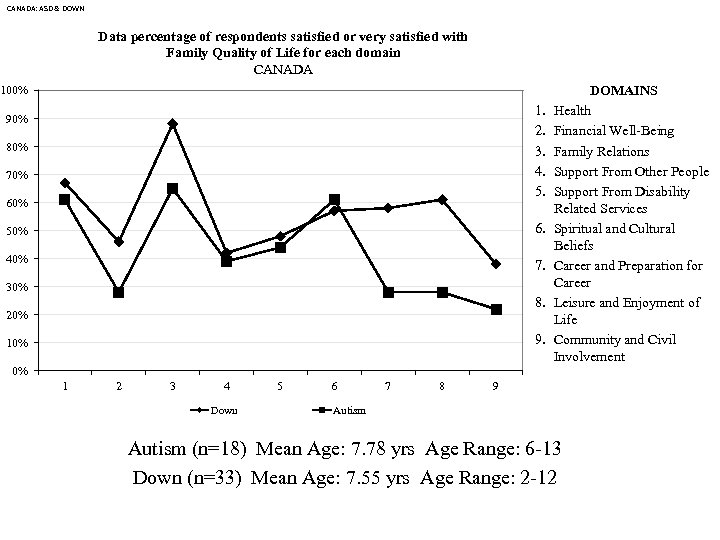
CANADA: ASD & DOWN Data percentage of respondents satisfied or very satisfied with Family Quality of Life for each domain CANADA 100% 1. 2. 3. 4. 5. 90% 80% 70% 60% 50% 6. 40% 7. 30% 8. 20% 9. 10% DOMAINS Health Financial Well-Being Family Relations Support From Other People Support From Disability Related Services Spiritual and Cultural Beliefs Career and Preparation for Career Leisure and Enjoyment of Life Community and Civil Involvement 0% 1 2 3 4 Down 5 6 7 8 9 Autism (n=18) Mean Age: 7. 78 yrs Age Range: 6 -13 Down (n=33) Mean Age: 7. 55 yrs Age Range: 2 -12
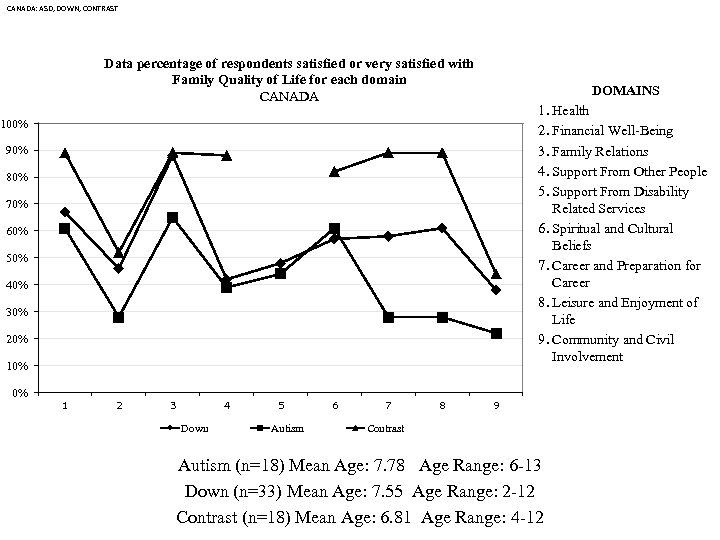
CANADA: ASD, DOWN, CONTRAST Data percentage of respondents satisfied or very satisfied with Family Quality of Life for each domain CANADA DOMAINS 1. Health 2. Financial Well-Being 3. Family Relations 4. Support From Other People 5. Support From Disability Related Services 6. Spiritual and Cultural Beliefs 7. Career and Preparation for Career 8. Leisure and Enjoyment of Life 9. Community and Civil Involvement 100% 90% 80% 70% 60% 50% 40% 30% 20% 10% 0% 1 2 3 4 Down 5 Autism 6 7 8 9 Contrast Autism (n=18) Mean Age: 7. 78 Age Range: 6 -13 Down (n=33) Mean Age: 7. 55 Age Range: 2 -12 Contrast (n=18) Mean Age: 6. 81 Age Range: 4 -12
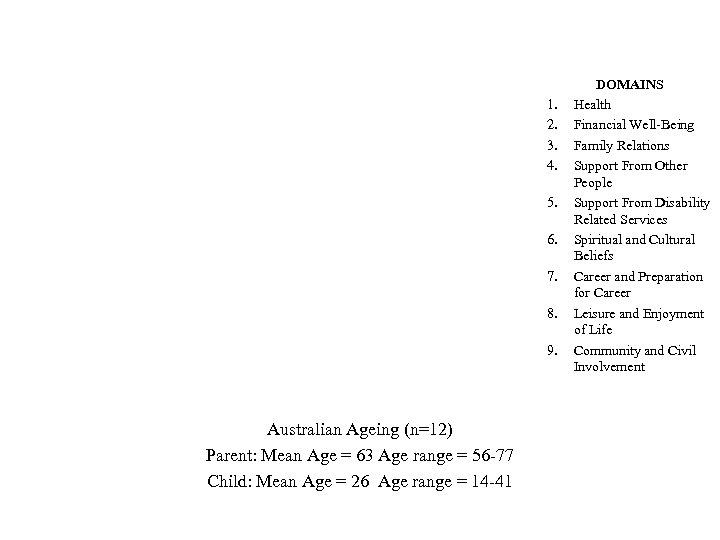
AUSTRALIA AGEING 1. 2. 3. 4. 5. 6. 7. 8. 9. Australian Ageing (n=12) Parent: Mean Age = 63 Age range = 56 -77 Child: Mean Age = 26 Age range = 14 -41 DOMAINS Health Financial Well-Being Family Relations Support From Other People Support From Disability Related Services Spiritual and Cultural Beliefs Career and Preparation for Career Leisure and Enjoyment of Life Community and Civil Involvement
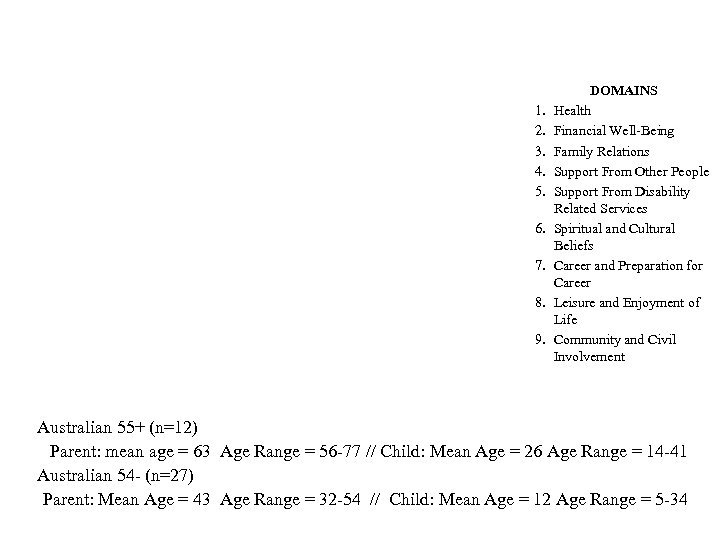
AUSTRALIA 55+ 54 - 1. 2. 3. 4. 5. 6. 7. 8. 9. DOMAINS Health Financial Well-Being Family Relations Support From Other People Support From Disability Related Services Spiritual and Cultural Beliefs Career and Preparation for Career Leisure and Enjoyment of Life Community and Civil Involvement Australian 55+ (n=12) Parent: mean age = 63 Age Range = 56 -77 // Child: Mean Age = 26 Age Range = 14 -41 Australian 54 - (n=27) Parent: Mean Age = 43 Age Range = 32 -54 // Child: Mean Age = 12 Age Range = 5 -34
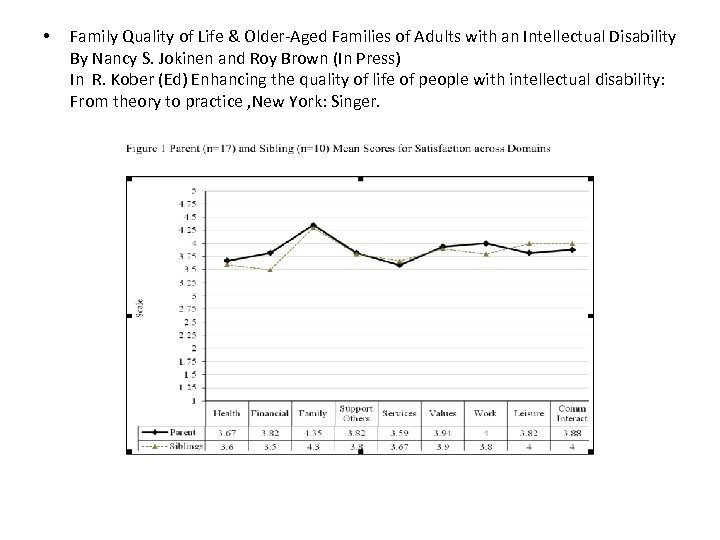
• Family Quality of Life & Older-Aged Families of Adults with an Intellectual Disability By Nancy S. Jokinen and Roy Brown (In Press) In R. Kober (Ed) Enhancing the quality of life of people with intellectual disability: From theory to practice , New York: Singer.
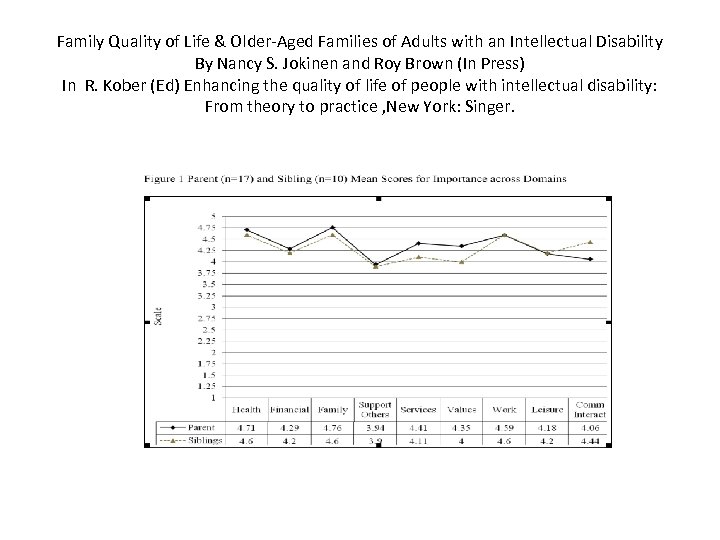
Family Quality of Life & Older-Aged Families of Adults with an Intellectual Disability By Nancy S. Jokinen and Roy Brown (In Press) In R. Kober (Ed) Enhancing the quality of life of people with intellectual disability: From theory to practice , New York: Singer.
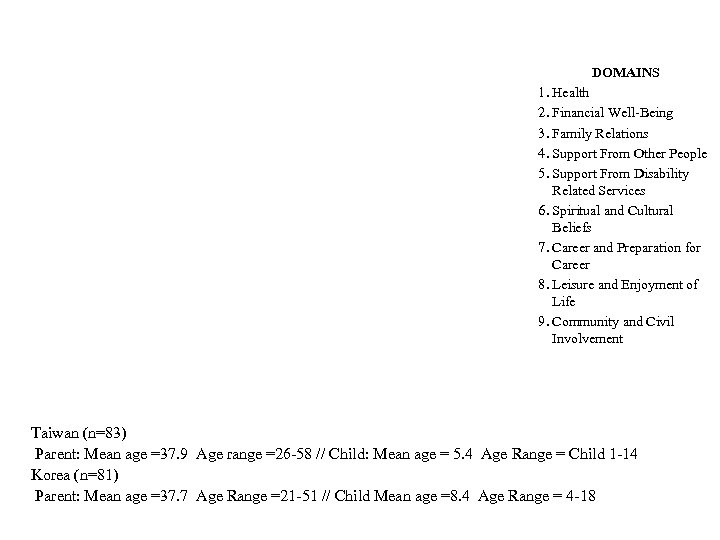
DOMAINS 1. Health 2. Financial Well-Being 3. Family Relations 4. Support From Other People 5. Support From Disability Related Services 6. Spiritual and Cultural Beliefs 7. Career and Preparation for Career 8. Leisure and Enjoyment of Life 9. Community and Civil Involvement Taiwan (n=83) Parent: Mean age =37. 9 Age range =26 -58 // Child: Mean age = 5. 4 Age Range = Child 1 -14 Korea (n=81) Parent: Mean age =37. 7 Age Range =21 -51 // Child Mean age =8. 4 Age Range = 4 -18
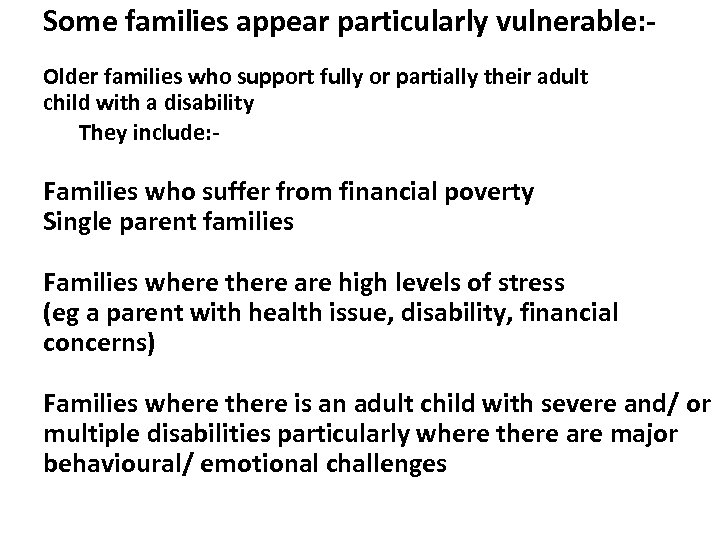
Some families appear particularly vulnerable: Older families who support fully or partially their adult child with a disability They include: - Families who suffer from financial poverty Single parent families Families where there are high levels of stress (eg a parent with health issue, disability, financial concerns) Families where there is an adult child with severe and/ or multiple disabilities particularly where there are major behavioural/ emotional challenges
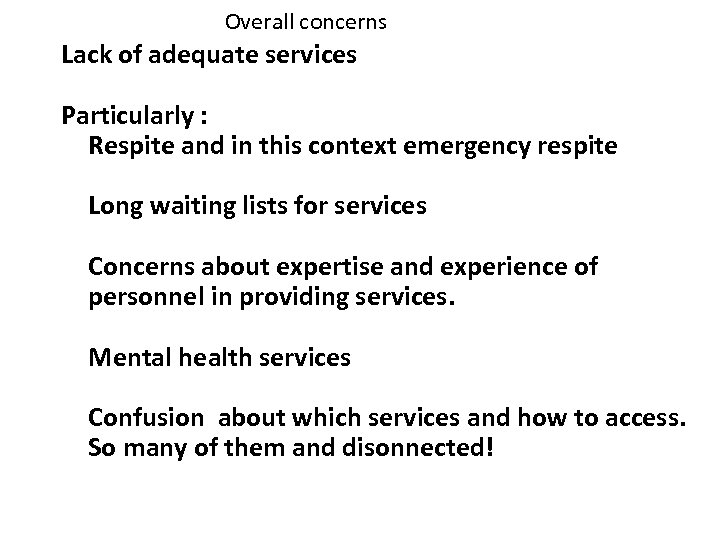
Overall concerns Lack of adequate services Particularly : Respite and in this context emergency respite Long waiting lists for services Concerns about expertise and experience of personnel in providing services. Mental health services Confusion about which services and how to access. So many of them and disonnected!
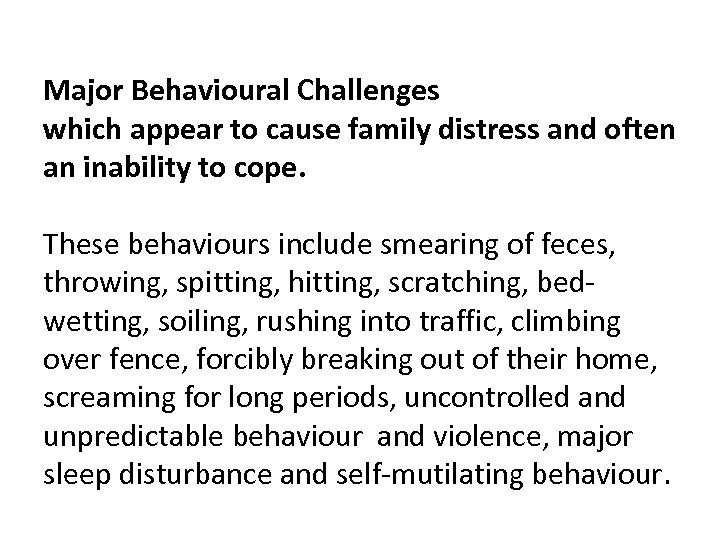
Major Behavioural Challenges which appear to cause family distress and often an inability to cope. These behaviours include smearing of feces, throwing, spitting, hitting, scratching, bedwetting, soiling, rushing into traffic, climbing over fence, forcibly breaking out of their home, screaming for long periods, uncontrolled and unpredictable behaviour and violence, major sleep disturbance and self-mutilating behaviour.
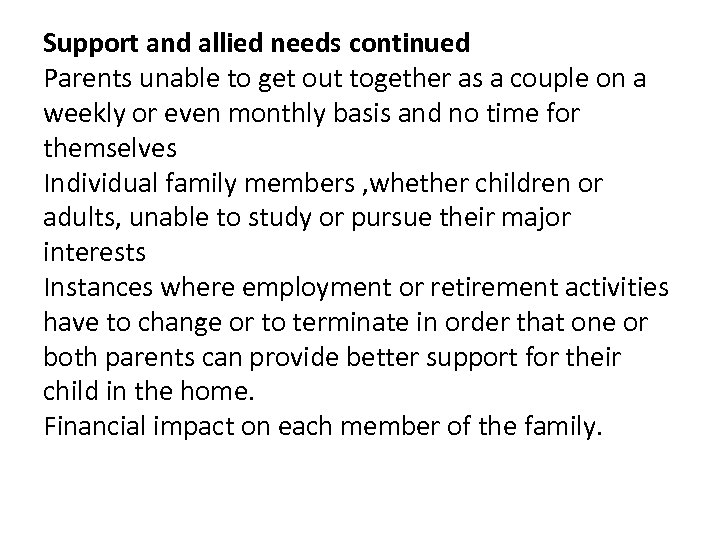
Support and allied needs continued Parents unable to get out together as a couple on a weekly or even monthly basis and no time for themselves Individual family members , whether children or adults, unable to study or pursue their major interests Instances where employment or retirement activities have to change or to terminate in order that one or both parents can provide better support for their child in the home. Financial impact on each member of the family.
Other Issues 2 A need to talk to a professional about family issues and concerns as well as disability Experience suggests that most individuals (families) want to function effectively. They do not wish to be dependant “on the system” They want to solve their own problems but need support for the family for key items and for stressful periods. They wish to avert major stress and therefore services need be forward looking with forward planning.
Other Issues 3 Lack of support from relatives Lack of help from friends and neighbours Lack of support from religious communities to which individual families are affiliated Challenges for siblings
Internal and external aspects of family and individual quality of life 1) Those who have positive and satisfactory internal family dimensions, but lack adequate support for aspects of external family life, and 2) Those families who have low levels of satisfaction in both internal and external aspects of family life.
• Internal family quality life relates to how families see themselves functioning in terms of: - • a) health, • b) family relations • c) spiritual and cultural beliefs These reached at least 60 per cent levels of satisfaction, and the highest domain percentages recorded in most of our research. These domains are intrinsically about internal aspects of family life, which to a large degree relate to family values and internal relationships.
External domains of family quality life relate to how families see themselves functioning in terms of outside events, and these impact the family and individual somewhat differently. They include domains such as: • a) Financial Well- Being (i. e. essentially what the family earned from outside employment including disability allowances & pensions) • b) Support from other People in the Community • c) Support from Disability Related Services The above 3 were the lowest 3 domains in terms of satisfaction in our studies.
Areas to look for if overall FQo. L is low Internal FQo. L • a) health, • b) family relations • c) spiritual and cultural beliefs External FQo. L • a) Financial Well- Being (i. e. essentially what the family earned from outside employment including disability allowances & pensions) • b) Support from other People in the Community • c) Support from Disability Related Services
Some of the positives for older parents (Note such parents often have children who are mildy or moderately disabled) • Companionship particularly if a single parent • Help with household matters (e. g. making beds) • Help in the community (E. g. help with shopping)
Where to from now? The challenge is how we work with families, older persons with intellectual disabilities, policy makers, agencies and frontline personnel to move concerns to supportive action.
What do the following aspects imply for those who work with and support them?
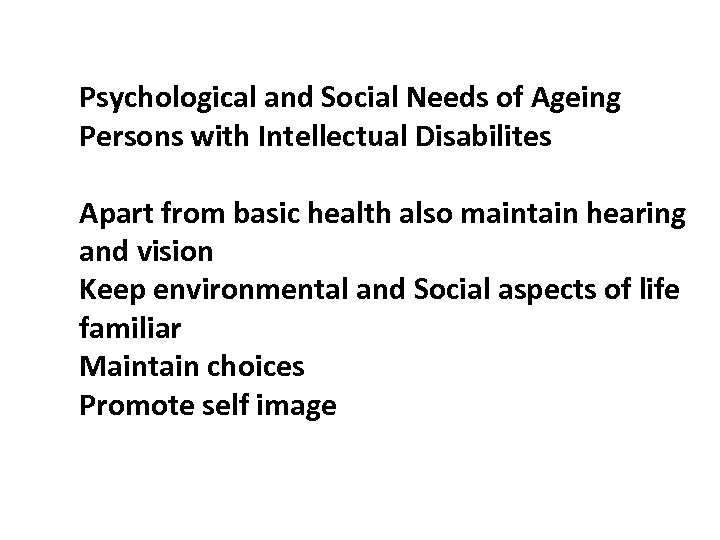
Psychological and Social Needs of Ageing Persons with Intellectual Disabilites Apart from basic health also maintain hearing and vision Keep environmental and Social aspects of life familiar Maintain choices Promote self image
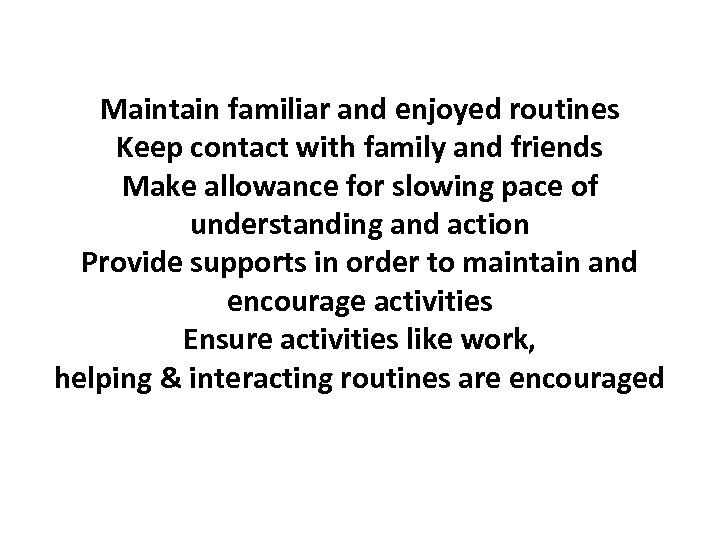
Maintain familiar and enjoyed routines Keep contact with family and friends Make allowance for slowing pace of understanding and action Provide supports in order to maintain and encourage activities Ensure activities like work, helping & interacting routines are encouraged
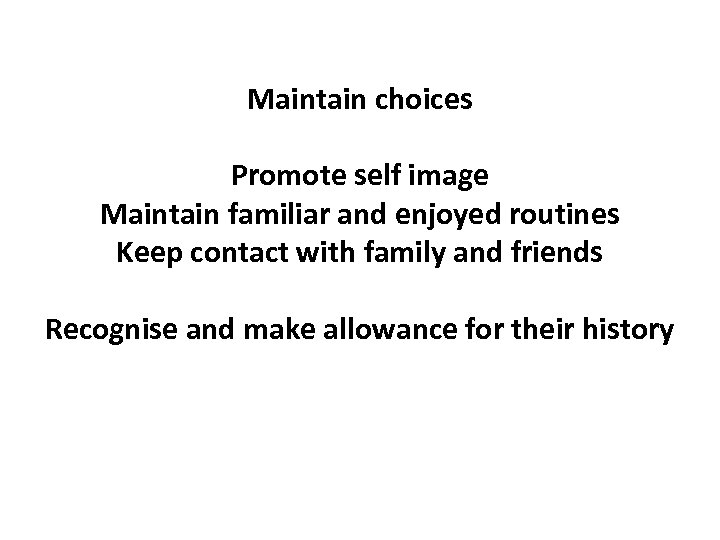
Maintain choices Promote self image Maintain familiar and enjoyed routines Keep contact with family and friends Recognise and make allowance for their history
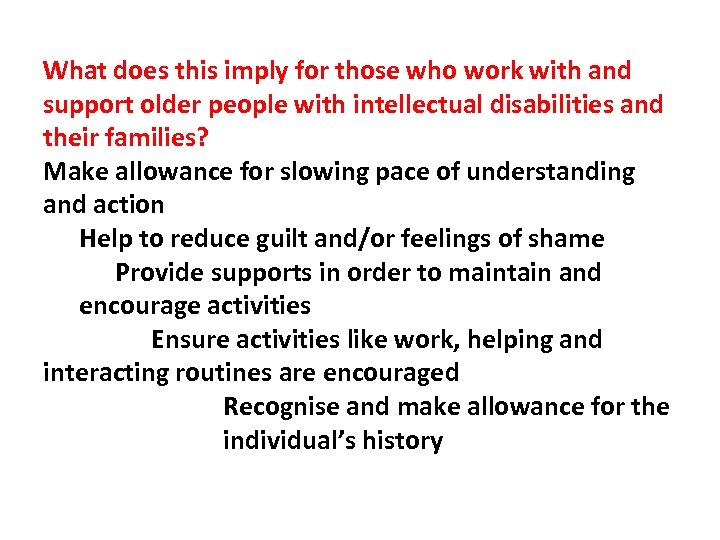
What does this imply for those who work with and support older people with intellectual disabilities and their families? Make allowance for slowing pace of understanding and action Help to reduce guilt and/or feelings of shame Provide supports in order to maintain and encourage activities Ensure activities like work, helping and interacting routines are encouraged Recognise and make allowance for the individual’s history
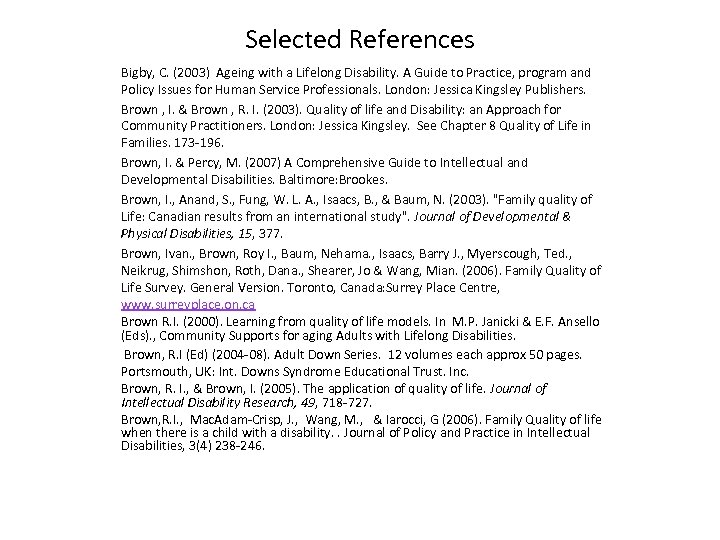
Selected References Bigby, C. (2003) Ageing with a Lifelong Disability. A Guide to Practice, program and Policy Issues for Human Service Professionals. London: Jessica Kingsley Publishers. Brown , I. & Brown , R. I. (2003). Quality of life and Disability: an Approach for Community Practitioners. London: Jessica Kingsley. See Chapter 8 Quality of Life in Families. 173 -196. Brown, I. & Percy, M. (2007) A Comprehensive Guide to Intellectual and Developmental Disabilities. Baltimore: Brookes. Brown, I. , Anand, S. , Fung, W. L. A. , Isaacs, B. , & Baum, N. (2003). "Family quality of Life: Canadian results from an international study". Journal of Developmental & Physical Disabilities, 15, 377. Brown, Ivan. , Brown, Roy I. , Baum, Nehama. , Isaacs, Barry J. , Myerscough, Ted. , Neikrug, Shimshon, Roth, Dana. , Shearer, Jo & Wang, Mian. (2006). Family Quality of Life Survey. General Version. Toronto, Canada: Surrey Place Centre, www. surreyplace. on. ca Brown R. I. (2000). Learning from quality of life models. In M. P. Janicki & E. F. Ansello (Eds). , Community Supports for aging Adults with Lifelong Disabilities. Brown, R. I (Ed) (2004 -08). Adult Down Series. 12 volumes each approx 50 pages. Portsmouth, UK: Int. Downs Syndrome Educational Trust. Inc. Brown, R. I. , & Brown, I. (2005). The application of quality of life. Journal of Intellectual Disability Research, 49, 718 -727. Brown, R. I. , Mac. Adam-Crisp, J. , Wang, M. , & Iarocci, G (2006). Family Quality of life when there is a child with a disability. . Journal of Policy and Practice in Intellectual Disabilities, 3(4) 238 -246.
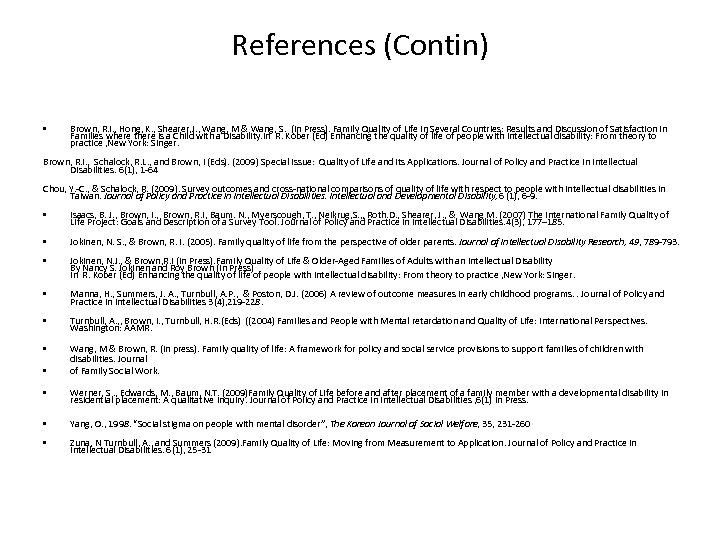
References (Contin) • Brown, R. I. , Hong, K. , Shearer, J. , Wang, M & Wang, S. (In Press). Family Quality of Life in Several Countries: Results and Discussion of Satisfaction in Families where there is a Child with a Disability. In R. Kober (Ed) Enhancing the quality of life of people with intellectual disability: From theory to practice , New York: Singer. Brown, R. I. , Schalock, R. L. , and Brown, I (Eds). (2009) Special issue: Quality of Life and its Applications. Journal of Policy and Practice in Intellectual Disabilities. 6(1), 1 -64 Chou, Y. -C. , & Schalock, R. (2009). Survey outcomes and cross-national comparisons of quality of life with respect to people with intellectual disabilities in Taiwan. Journal of Policy and Practice in Intellectual Disabilities. Intellectual and Developmental Disability, 6 (1), 6 -9. • Isaacs, B. J. , Brown, I. , Brown, R. I, Baum. N. , Myerscough, T. , Neikrug, S. , , Roth. D. , Shearer, J. , & Wang M. (2007) The International Family Quality of Life Project: Goals and Description of a Survey Tool. Journal of Policy and Practice in Intellectual Disabilities. 4(3), 177– 185. • Jokinen, N. S. , & Brown, R. I. (2005). Family quality of life from the perspective of older parents. Journal of Intellectual Disability Research, 49, 789 -793. • Jokinen, N. J. , & Brown, R. I (In Press). Family Quality of Life & Older-Aged Families of Adults with an Intellectual Disability By Nancy S. Jokinen and Roy Brown (In Press) In R. Kober (Ed) Enhancing the quality of life of people with intellectual disability: From theory to practice , New York: Singer. • Manna, H. , Summers, J. A. , Turnbull, A. P. , & Poston, D. J. (2006) A review of outcome measures in early childhood programs. . Journal of Policy and Practice in Intellectual Disabilities 3(4), 219 -228. • Turnbull, A. , , Brown, I. , Turnbull, H. R. (Eds) ((2004) Families and People with Mental retardation and Quality of Life: International Perspectives. Washington: AAMR. • Wang, M & Brown, R. (in press). Family quality of life: A framework for policy and social service provisions to support families of children with disabilities. Journal of Family Social Work. • • Werner, S. , Edwards, M. , Baum, N. T. (2009)Family Quality of Life before and after placement of a family member with a developmental disability in residential placement: A qualitative inquiry. Journal of Policy and Practice in Intellectual Disabilities , 6(1) In Press. • Yang, O. , 1998. “Social stigma on people with mental disorder”, The Korean Journal of Social Welfare, 35, 231 -260 • Zuna, N Turnbull, A. , and Summers (2009). Family Quality of Life: Moving from Measurement to Application. Journal of Policy and Practice in Intellectual Disabilities. 6(1), 25 -31
Скачать презентацию Roy Brown Ph D All slides
dc5583ea1cd6142c006726dda50f0a39.ppt