 Скачать презентацию Routing Issues in Mobile IP Sudarshan Vasudevan Chun
340476fd2aedc8148a0064b2887b896a.ppt
- Количество слайдов: 47



Routing Issues in Mobile IP Sudarshan Vasudevan Chun Zhang
PART 1 Unicast Routing using Mobile IP
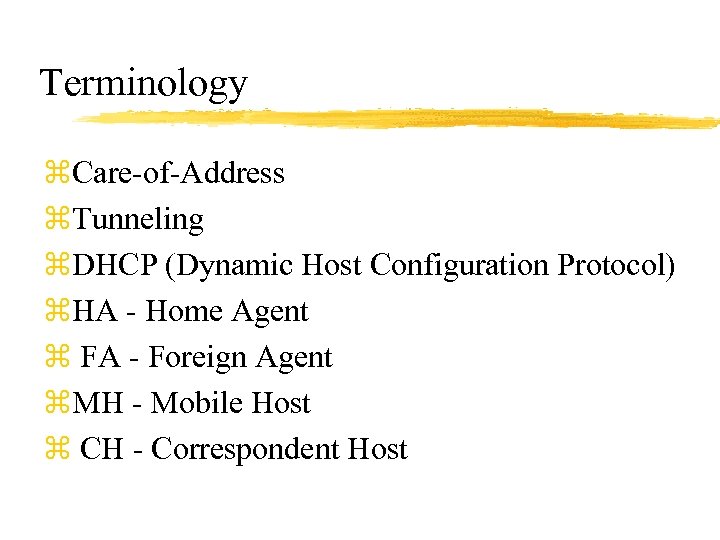
Terminology z. Care-of-Address z. Tunneling z. DHCP (Dynamic Host Configuration Protocol) z. HA - Home Agent z FA - Foreign Agent z. MH - Mobile Host z CH - Correspondent Host
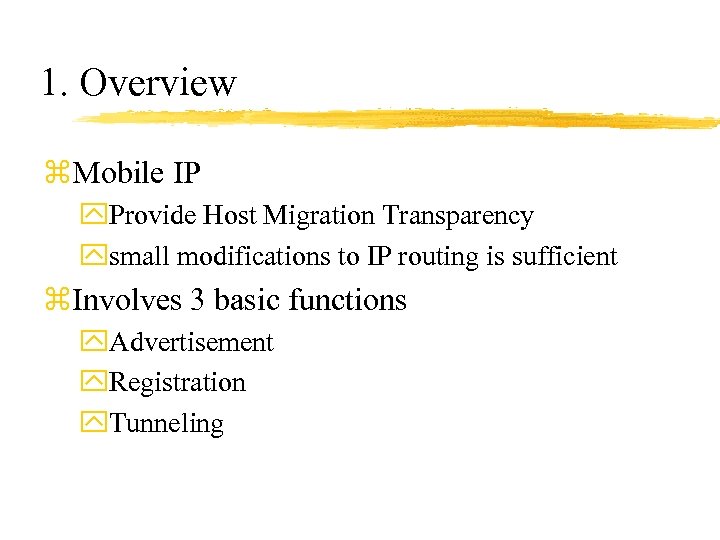
1. Overview z. Mobile IP y. Provide Host Migration Transparency ysmall modifications to IP routing is sufficient z. Involves 3 basic functions y. Advertisement y. Registration y. Tunneling
Protocol z. When MH is in its home network y. Normal IP Routing z. When MH is away from it home network y. HA keeps track of MH’s care-of-address xeither FA’s IP address or one obtained using DHCP y. Care-of-Address represents the MH’s current location y. When the MH migrates into another foreign network, MH notifies its new care-of-address to the HA
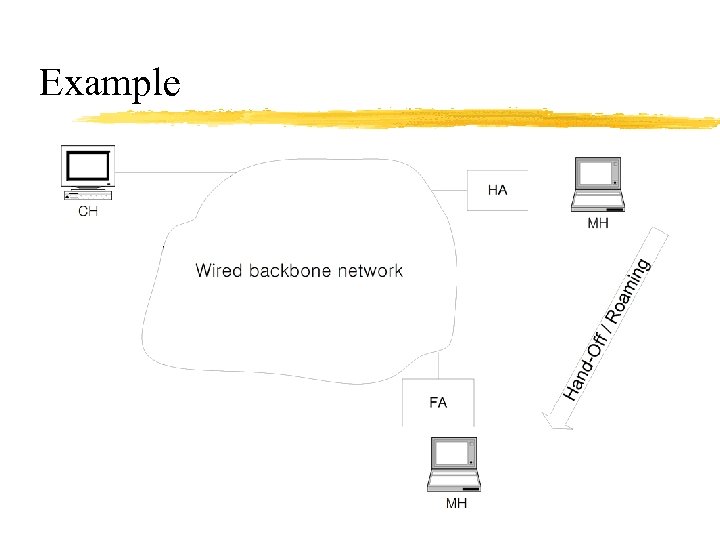
Example
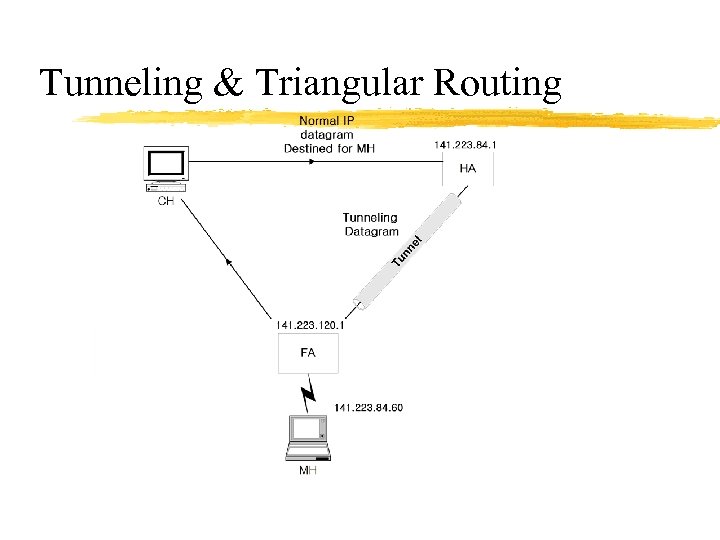
Tunneling & Triangular Routing
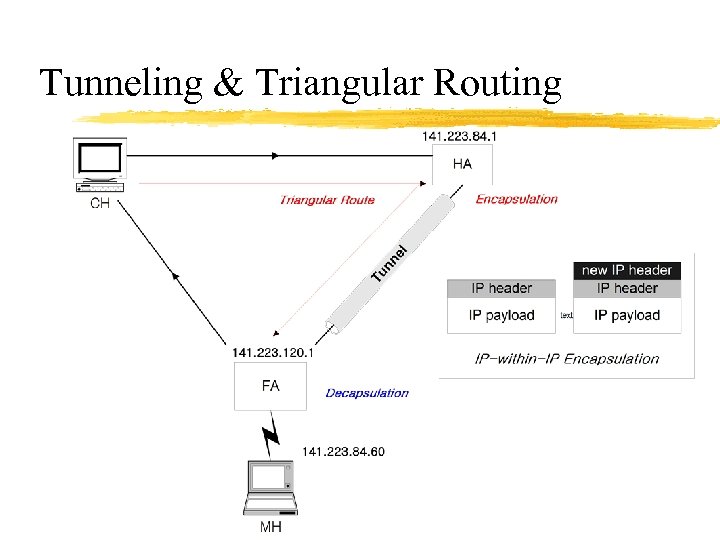
Tunneling & Triangular Routing
Route Optimization z. Triangular path is not optimal route z. Route Optimization y. Supply binding update to CHs yauthentication and replay protection for binding updates yregistration key between MH and FA for smooth handoff
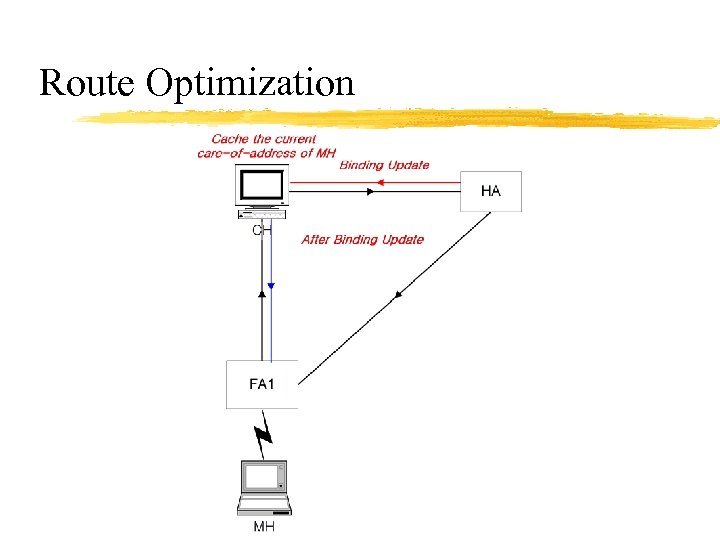
Route Optimization
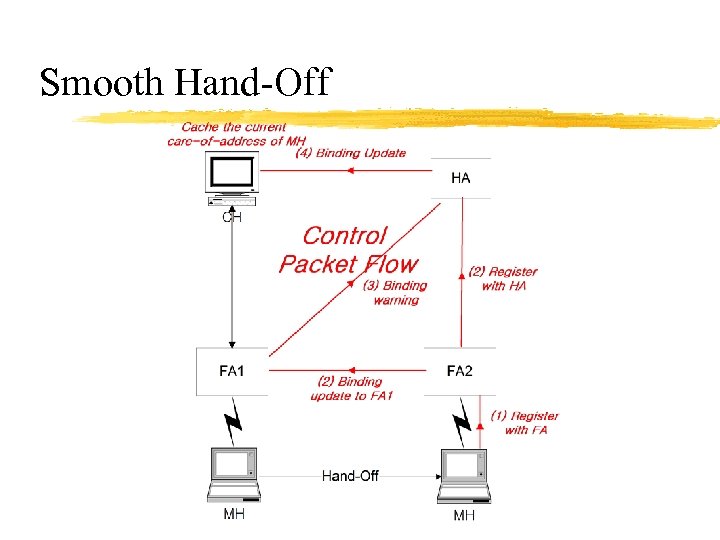
Smooth Hand-Off
Conclusion z. Triangular Routing can be eliminated ysending binding updates to CHs z. Smooth handoffs very valuable ycounteract unwanted effects of dropped packets yspecial tunnels can further reduce this effect z. Main difficulty yestablishment of security associations between FA and MH
Future Work z. Mobility Security Association Management yauthentication of all messages that affect routing ycurrently manual establishment of MSAs ydifficult to manage, no scalability y efficient Key Distribution Protocols needed z. Certification of Foreign Agents yprevent malicious nodes pretending as FAs z. Security issues introduced by Tunneling
References z z z z z Perkins, Charles E. , ed. “Ipv 4 Mobility Support” RFC 2002. October 1996 b. Perkins, Charles E. “Minimal Encapsulation within IP”. RFC 2004. October 1996 c. Perkins, Charles E. “IP Encapsulation within IP”. RFC 2003. October 1996 a. Perkins, Charles E and Johnson, David B. “Mobility Support in IPv 6. ” In ACM Mobicomm 96. November 1996. Johnson, David B. “Scalable and Robust Internetwork Routing for Mobile Hosts” In Proceedings of the 14 th International Conference on Distributed Computing Systems. June 1994. Hanks Stan, Tony Li, Dino Farinacci, and Paul Traina, Generic Routing Encapsulation over IPv 4 networks. RFC 1702. October 1994 b. Deering, Stephen E. , ed. , “ICMP Router Discovery Messages. ” RFC 1256. September 1991. Hellman, M. E. , W. Diffie, and R. C. Merkle. “Cryptographic Apparatus and Method. ” US Patent 4, 200, 770. April 1980. Rivest, Ronald L. “The MD 5 Message-Digest Algorithm”. RFC 1321. April 1992. Maughan, Douglass, Mark Schetler, Mark Schneider, and Jeff Turner. Internet Security Association and Key Management Protocol (ISAKMP). (Internet-draft) draft-ietf-ipsecisakmp 08. txt, . ps. July 1997.
PART 2 Multicast Routing using Mobile IP
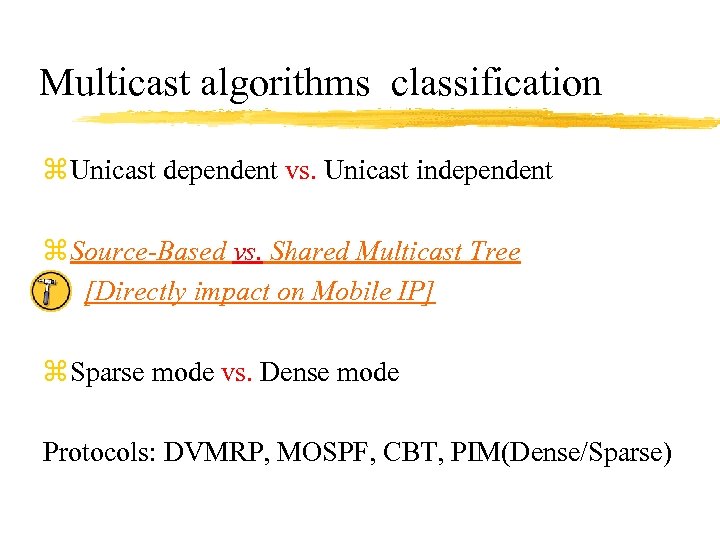
Multicast algorithms classification z Unicast dependent vs. Unicast independent z Source-Based vs. Shared Multicast Tree [Directly impact on Mobile IP] z Sparse mode vs. Dense mode Protocols: DVMRP, MOSPF, CBT, PIM(Dense/Sparse)
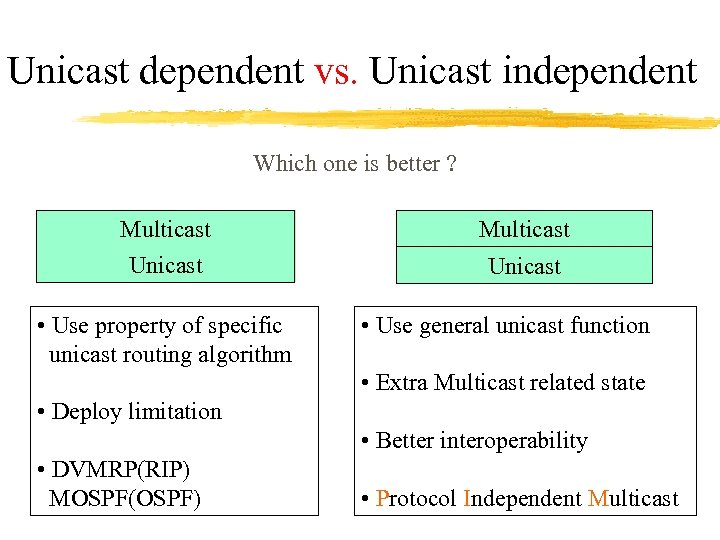
Unicast dependent vs. Unicast independent Which one is better ? Multicast Unicast • Use property of specific unicast routing algorithm Multicast Unicast • Use general unicast function • Extra Multicast related state • Deploy limitation • Better interoperability • DVMRP(RIP) MOSPF(OSPF) • Protocol Independent Multicast
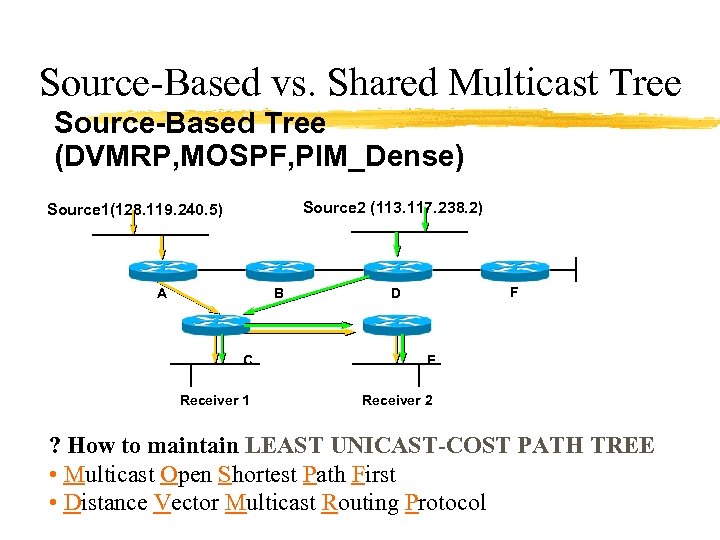
Source-Based vs. Shared Multicast Tree Source-Based Tree (DVMRP, MOSPF, PIM_Dense) Source 2 (113. 117. 238. 2) Source 1(128. 119. 240. 5) A B C Receiver 1 F D E Receiver 2 ? How to maintain LEAST UNICAST-COST PATH TREE • Multicast Open Shortest Path First • Distance Vector Multicast Routing Protocol
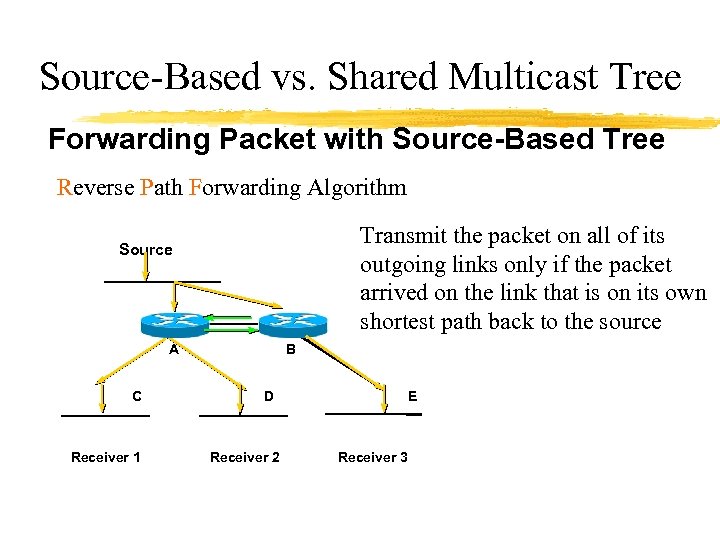
Source-Based vs. Shared Multicast Tree Forwarding Packet with Source-Based Tree Reverse Path Forwarding Algorithm Transmit the packet on all of its outgoing links only if the packet arrived on the link that is on its own shortest path back to the source Source A C Receiver 1 B D Receiver 2 E Receiver 3
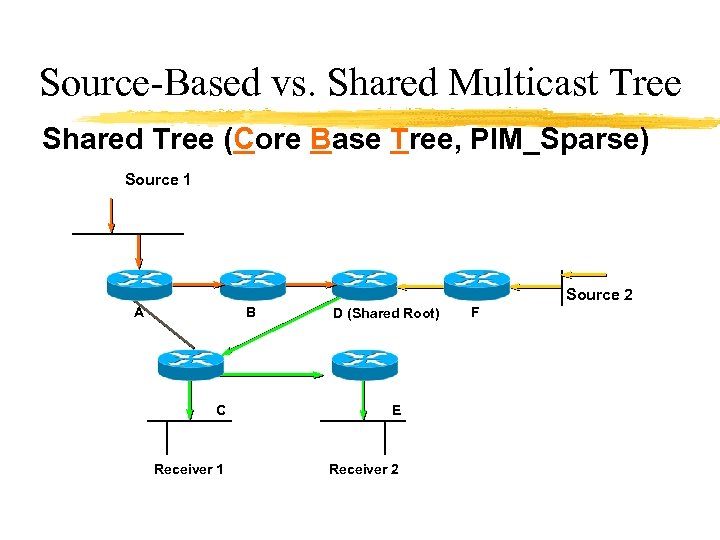
Source-Based vs. Shared Multicast Tree Shared Tree (Core Base Tree, PIM_Sparse) Source 1 Source 2 A B D (Shared Root) C E Receiver 1 Receiver 2 F
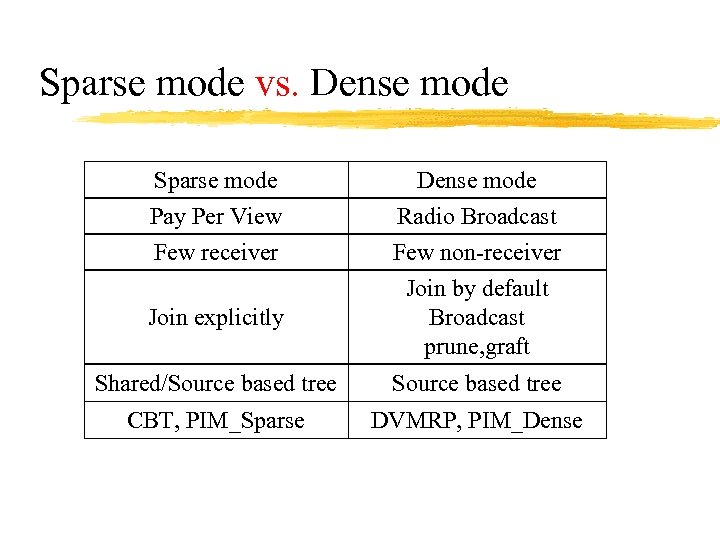
Sparse mode vs. Dense mode Sparse mode Pay Per View Dense mode Radio Broadcast Few receiver Few non-receiver Join by default Broadcast prune, graft Join explicitly Shared/Source based tree CBT, PIM_Sparse DVMRP, PIM_Dense
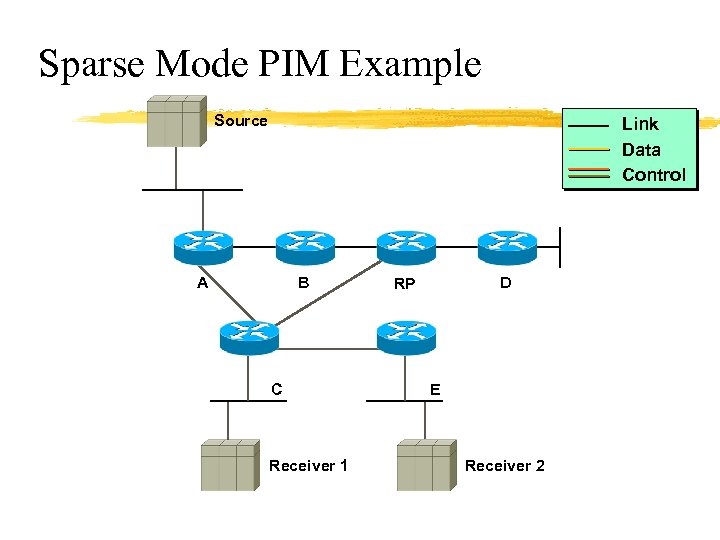
Sparse Mode PIM Example Source Link Data Control A B C Receiver 1 D RP E Receiver 2
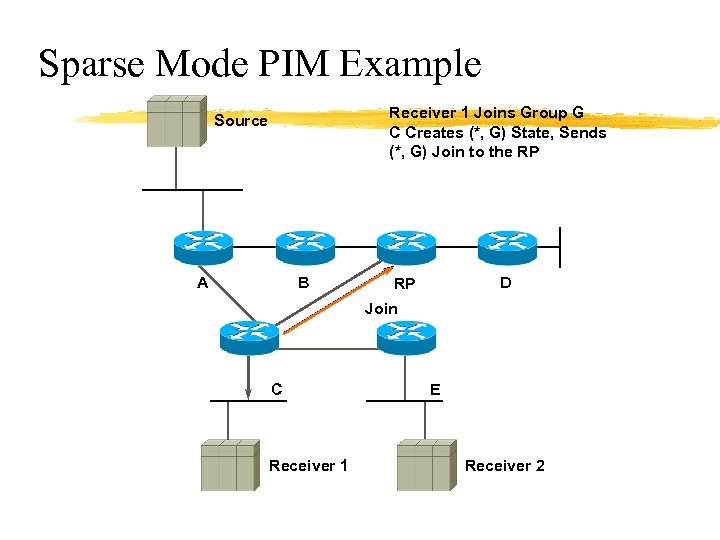
Sparse Mode PIM Example Receiver 1 Joins Group G C Creates (*, G) State, Sends (*, G) Join to the RP Source A B D RP Join C Receiver 1 E Receiver 2
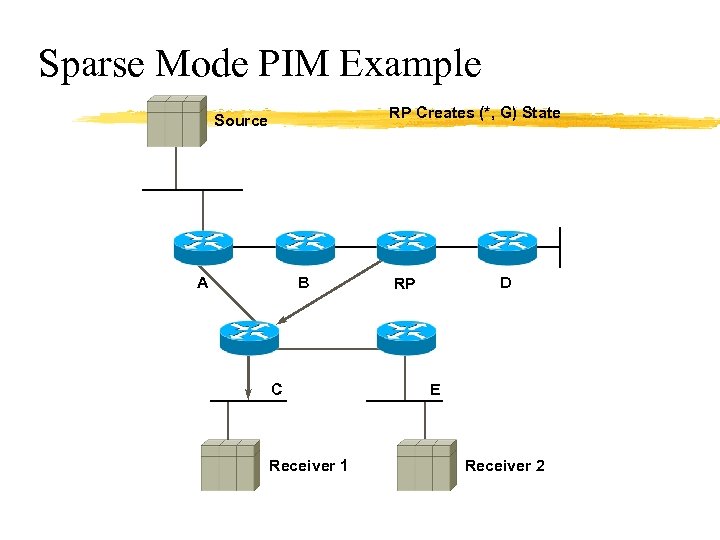
Sparse Mode PIM Example RP Creates (*, G) State Source A B C Receiver 1 D RP E Receiver 2
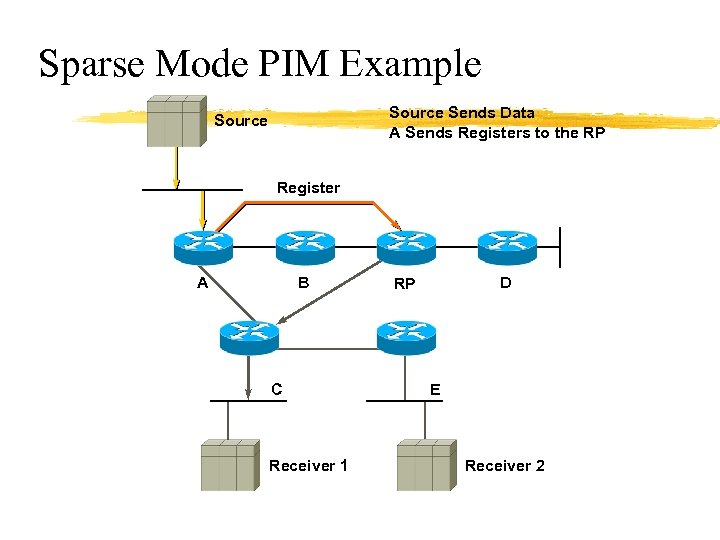
Sparse Mode PIM Example Source Sends Data A Sends Registers to the RP Source Register A B C Receiver 1 D RP E Receiver 2
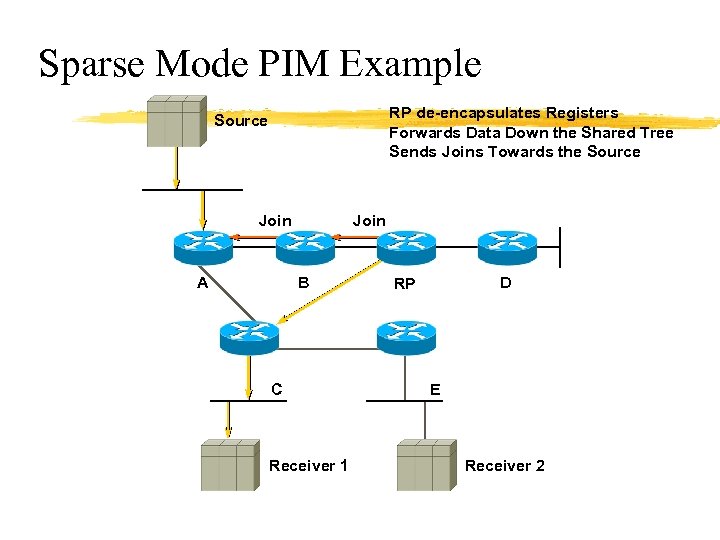
Sparse Mode PIM Example RP de-encapsulates Registers Forwards Data Down the Shared Tree Sends Joins Towards the Source Join A Join B C Receiver 1 D RP E Receiver 2
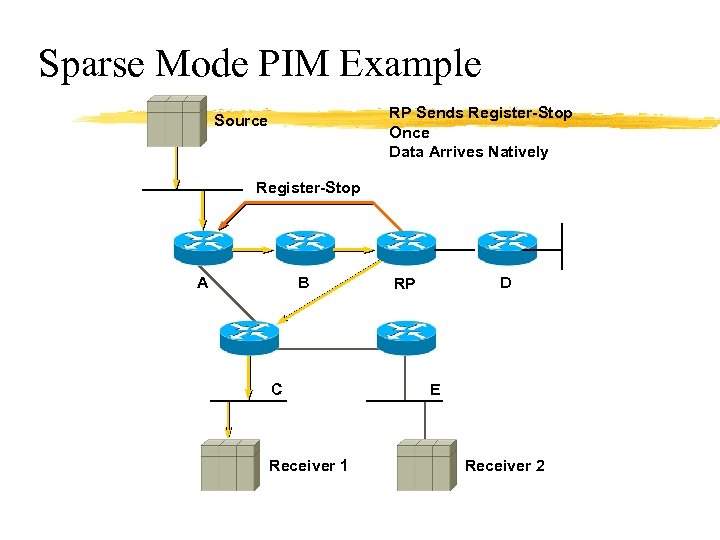
Sparse Mode PIM Example RP Sends Register-Stop Once Data Arrives Natively Source Register-Stop A B C Receiver 1 D RP E Receiver 2
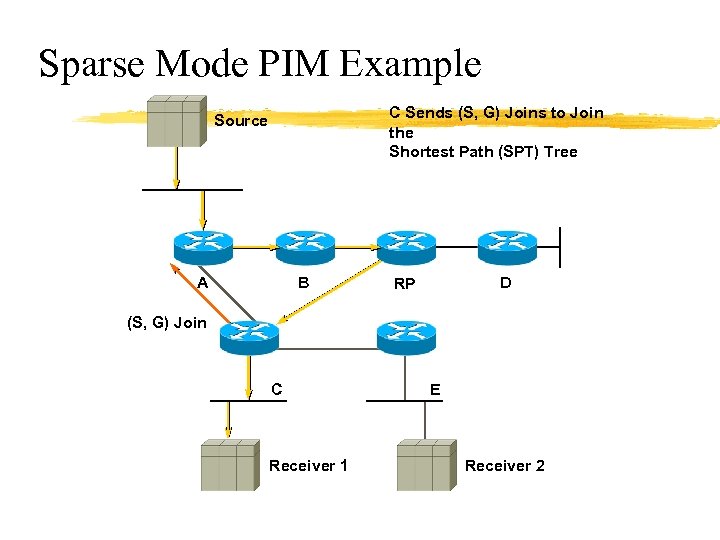
Sparse Mode PIM Example C Sends (S, G) Joins to Join the Shortest Path (SPT) Tree Source A B D RP (S, G) Join C Receiver 1 E Receiver 2
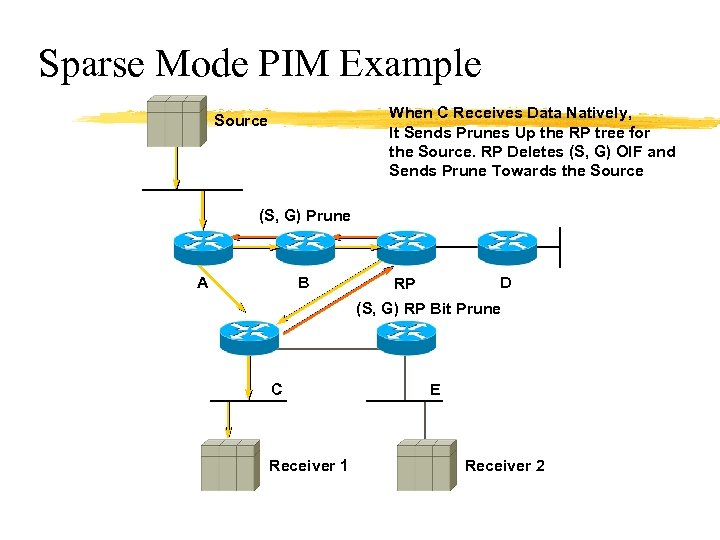
Sparse Mode PIM Example When C Receives Data Natively, It Sends Prunes Up the RP tree for the Source. RP Deletes (S, G) OIF and Sends Prune Towards the Source (S, G) Prune A B D RP (S, G) RP Bit Prune C Receiver 1 E Receiver 2
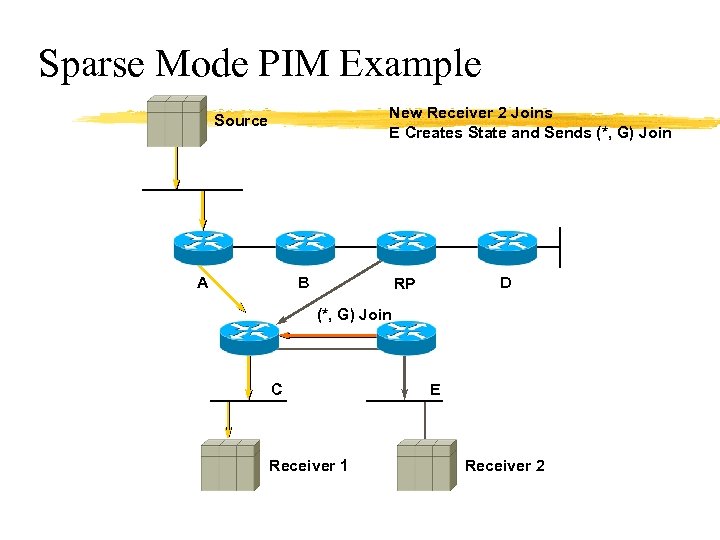
Sparse Mode PIM Example New Receiver 2 Joins E Creates State and Sends (*, G) Join Source A B D RP (*, G) Join C Receiver 1 E Receiver 2
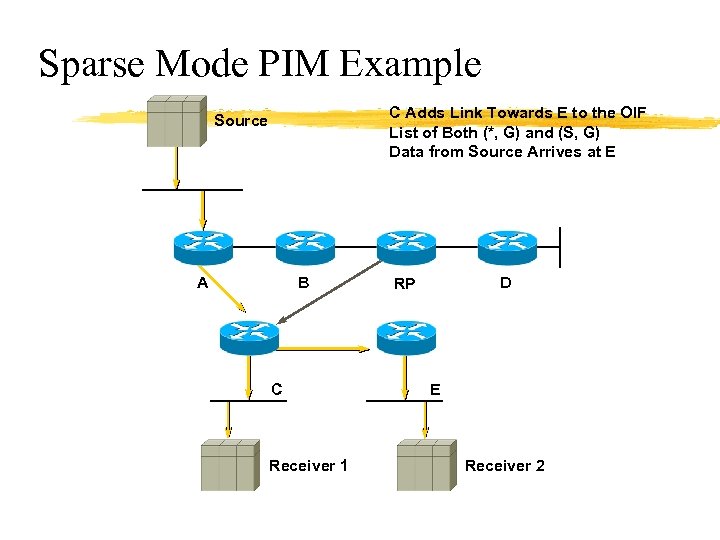
Sparse Mode PIM Example C Adds Link Towards E to the OIF List of Both (*, G) and (S, G) Data from Source Arrives at E Source A B C Receiver 1 D RP E Receiver 2
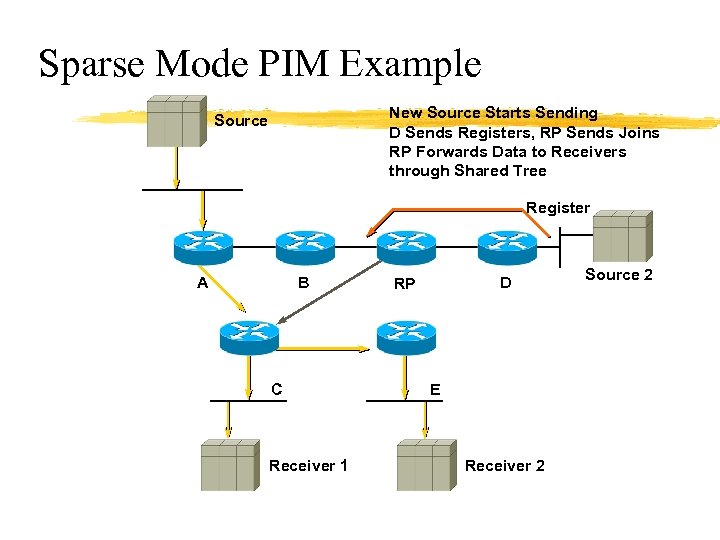
Sparse Mode PIM Example New Source Starts Sending D Sends Registers, RP Sends Joins RP Forwards Data to Receivers through Shared Tree Source Register A B C Receiver 1 D RP E Receiver 2 Source 2
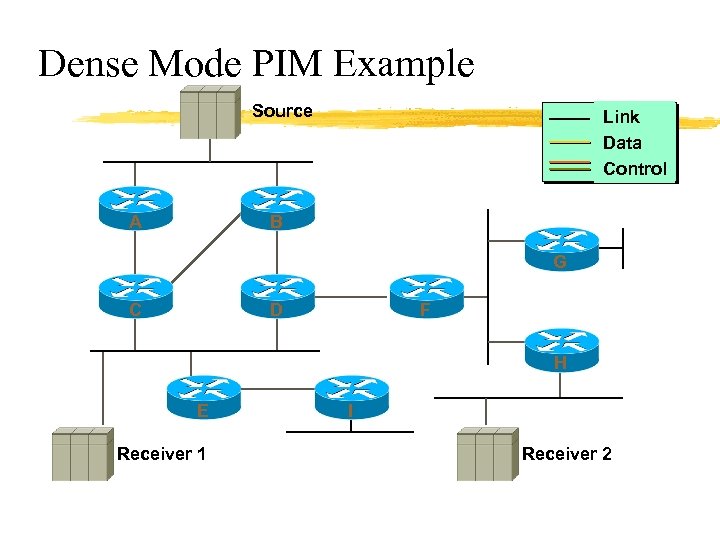
Dense Mode PIM Example Source A Link Data Control B G C D F H E Receiver 1 I Receiver 2
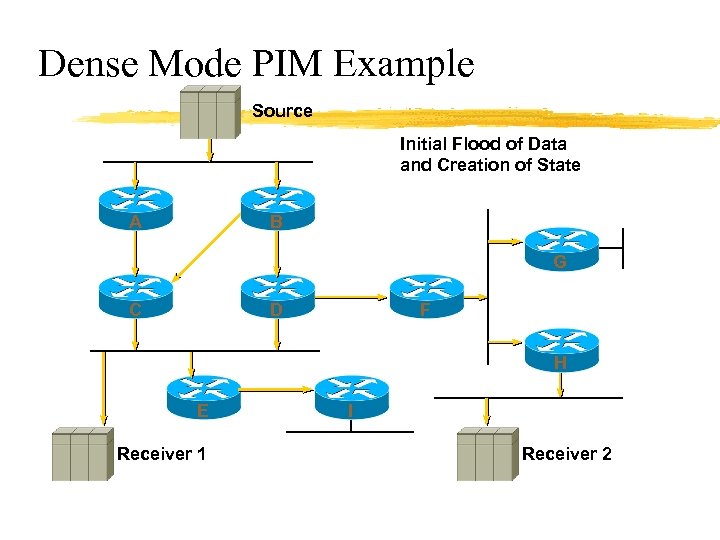
Dense Mode PIM Example Source Initial Flood of Data and Creation of State A B G C D F H E Receiver 1 I Receiver 2
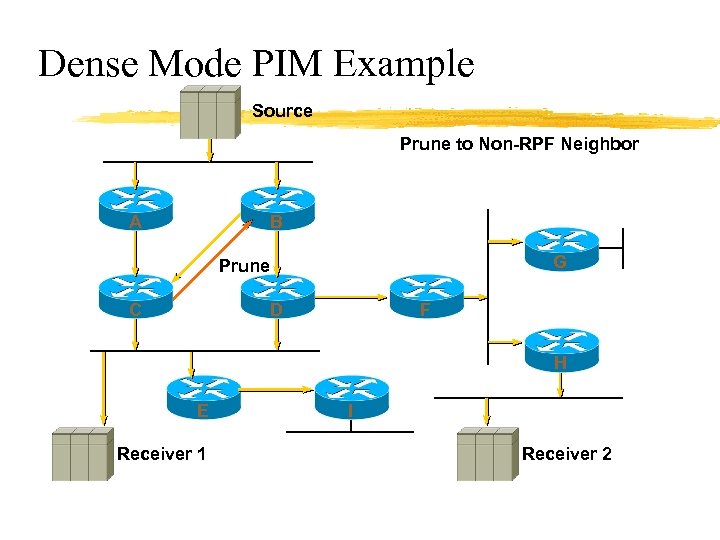
Dense Mode PIM Example Source Prune to Non-RPF Neighbor A B G Prune C D F H E Receiver 1 I Receiver 2
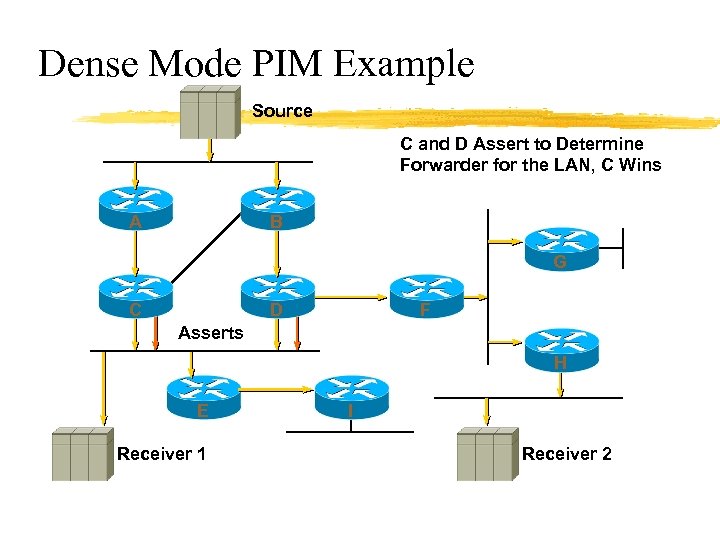
Dense Mode PIM Example Source C and D Assert to Determine Forwarder for the LAN, C Wins A B G C D F Asserts H E Receiver 1 I Receiver 2
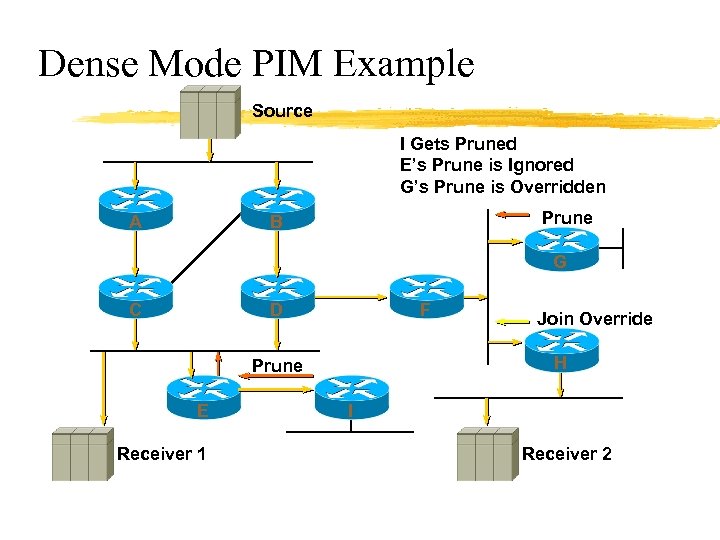
Dense Mode PIM Example Source I Gets Pruned E’s Prune is Ignored G’s Prune is Overridden A Prune B G C D F H Prune E Receiver 1 Join Override I Receiver 2
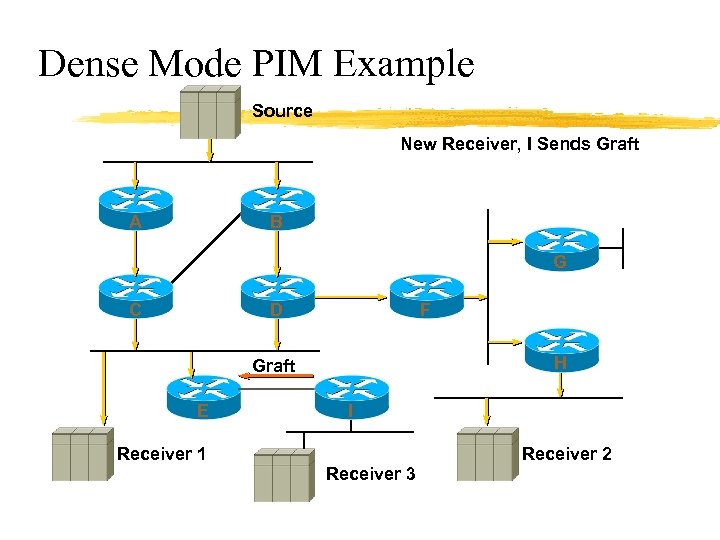
Dense Mode PIM Example Source New Receiver, I Sends Graft A B G C D F H Graft E I Receiver 1 Receiver 2 Receiver 3
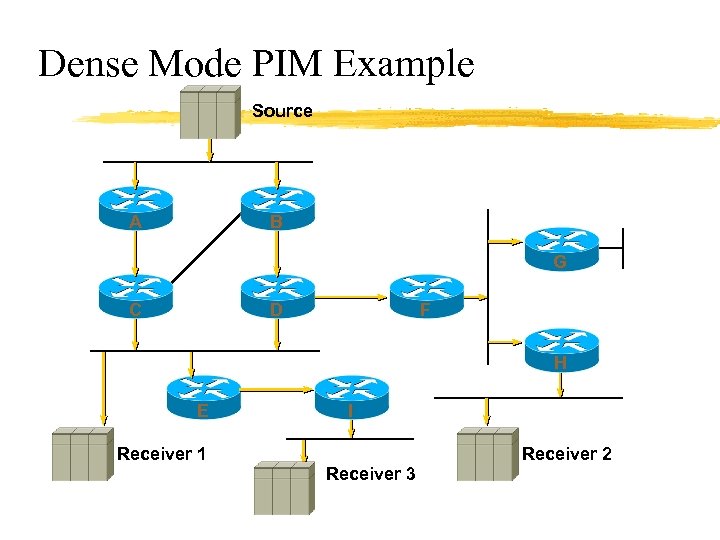
Dense Mode PIM Example Source A B G C D F H E I Receiver 1 Receiver 2 Receiver 3
Multicast + Mobile IP z Mobile Host as Sender y Using Home Address as packet source address y Using Care-of Address as packet source address z. Mobile Host as Receiver y Home Subscription Join multicast group using Home Address y Remote Subscription Join multicast group using Care-of Address
Home Address as packet source address z Option 1: Packet directly sent out from foreign network y. For Source-Based Tree (routing related to packet source address) Packet might not be delivered y. For Central Based Tree (routing uncorrelated to packet source address) Packet will be delivered correctly z Option 2: Packet tunneled to Home Agent, then sent out Packet will be delivered correctly
Care-of Address as packet source address z Packet directly sent out from foreign network Packet will be delivered correctly z Problem: How the misdelivered response reach the roaming sender ?
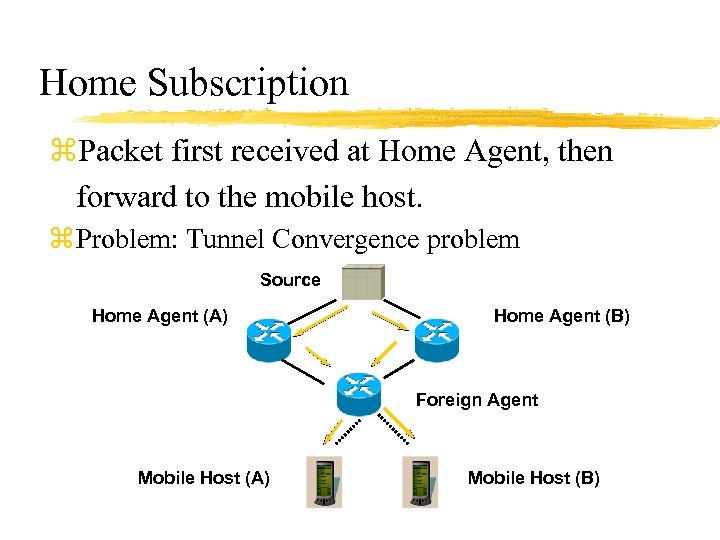
Home Subscription z. Packet first received at Home Agent, then forward to the mobile host. z Problem: Tunnel Convergence problem Source Home Agent (A) Home Agent (B) Foreign Agent Mobile Host (A) Mobile Host (B)
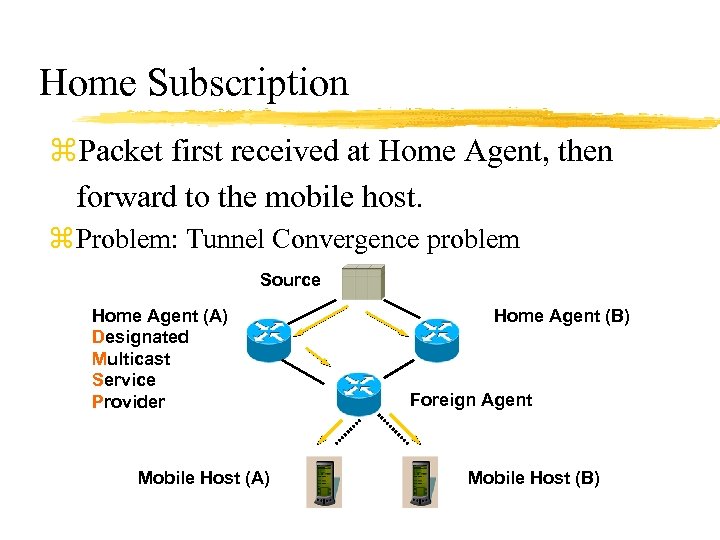
Home Subscription z. Packet first received at Home Agent, then forward to the mobile host. z Problem: Tunnel Convergence problem Source Home Agent (A) Designated Multicast Service Provider Mobile Host (A) Home Agent (B) Foreign Agent Mobile Host (B)
Remote Subscription z It works fine since multicast packet is delivered based on multicast group address z Foreign network router should support multicast
Conclusion z Mobile Host as Sender y Using Home Address as packet source address x. Core Based Tree/ Tunneled packet sent out from Home Agent y Using Care-of Address as packet source address x. Hardly to use z Mobile Host as Receiver y Home Subscription x. Tunnel convergence problem y Remote Subscription x. Foreign network support multicast
References z Mobile Multicast(Mo. M) Protocol: Multicast Support for Mobile Hosts. Tim G. Harrison, Carey L. Williason, Wayne L. Mackrell, Richard B. Bunt. U. of Saskatchewan, Saskatoon, Canadan. Proceedings of the third annual ACM/IEEE international conference on Mobile computing and networking. September 26 - 30, 1997, Budapest Hungary z Rel. M: Reliable Multicast for Mobile Networks. Journal of Computer Communications, 1997. Kevin Brown, Suresh Singh z Supporting IP Multicast for Mobile Hosts, for review. Yu Wang, Weidong Chen. Southern Methodist University z Flexible Network Support for Mobile Hosts. X. Zhao, C. Castelluccia, M. Baker. Proc. MOBICOM '98, Dallas, Texas, 1998, pp. 145 --156 z IP Multicast Extensions for Mobile Internetworking. In Proceedings of IEEE Infocom'96, March 1996 z IP Multicasting for wireless mobile hosts. George Xylomenos and George C. Polyzos. Proceedings of the IEEE MILCOM, 10 1996
Скачать презентацию Routing Issues in Mobile IP Sudarshan Vasudevan Chun
340476fd2aedc8148a0064b2887b896a.ppt