 Скачать презентацию ROUTINE HEALTH INFORMATION SYSTEMS A Curriculum on Basic
706d2f952d0fb904f6fa3e3b86eff3e5.ppt
- Количество слайдов: 17



ROUTINE HEALTH INFORMATION SYSTEMS A Curriculum on Basic Concepts and Practice MODULE 8: Information and Communication Technology for RHIS SESSION 3: Patient-Centered Information Systems The complete RHIS curriculum is available here: https: //www. measureevaluation. org/our-work/ routine-health-information-systems/rhis-curriculum 1
Learning Objectives and Topics Covered Objectives • Define what patient-centered information systems are Topics Covered • Electronic medical records (EMRs) and aggregate-information systems • Types of EMRs • Benefits of EMRs • Patient unique identifiers (PUIDs) 2
Electronic Medical Records • Contain data related to a single patient, such as diagnosis, name, age, and earlier medical history • Data typically based on a single patient/healthcare worker interaction • Systems used largely by clinicians for diagnosis and treatment, but also by administrative staff for accounting and file management • EMR is not just one system; it may include interfaces with many other systems and applications 3
Aggregate Information Systems • Contain consolidated data relating to multiple patients, and therefore cannot be traced back to a specific patient. They are merely counts, such as incidences of malaria, TB, or other diseases. • Aggregated data are used for the generation of routine reports and indicators, and for strategic planning and guidance within the health system. 4
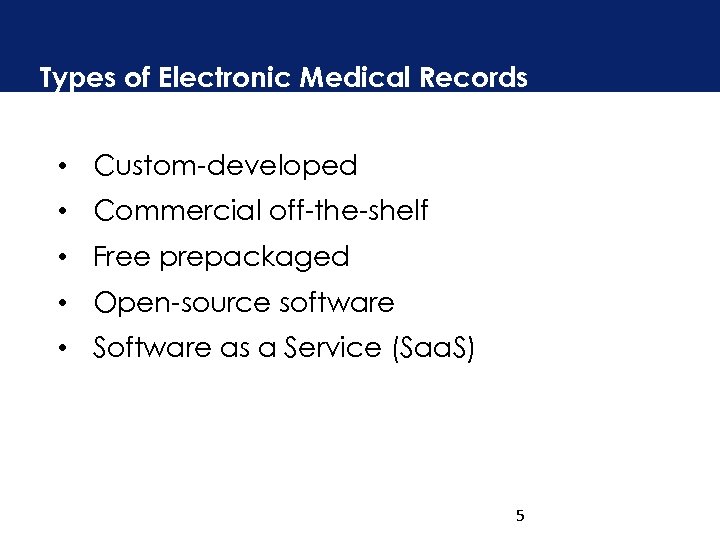
Types of Electronic Medical Records • Custom-developed • Commercial off-the-shelf • Free prepackaged • Open-source software • Software as a Service (Saa. S) 5
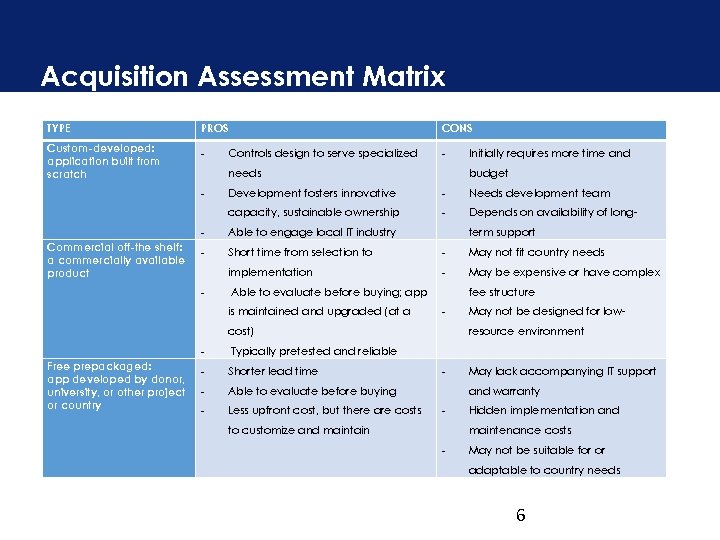
Acquisition Assessment Matrix TYPE PROS CONS Custom-developed: application built from scratch - - Controls design to serve specialized needs - Initially requires more time and budget Development fosters innovative - Needs development team capacity, sustainable ownership - Depends on availability of long- Commercial off-the shelf: a commercially available product Able to engage local IT industry - Short time from selection to - May not fit country needs implementation - May be expensive or have complex - term support Able to evaluate before buying; app is maintained and upgraded (at a fee structure - cost) Free prepackaged: app developed by donor, university, or other project or country Shorter lead time - Able to evaluate before buying - Less upfront cost, but there are costs resource environment Typically pretested and reliable - May not be designed for low- - May lack accompanying IT support and warranty - to customize and maintain Hidden implementation and maintenance costs - May not be suitable for or adaptable to country needs 6
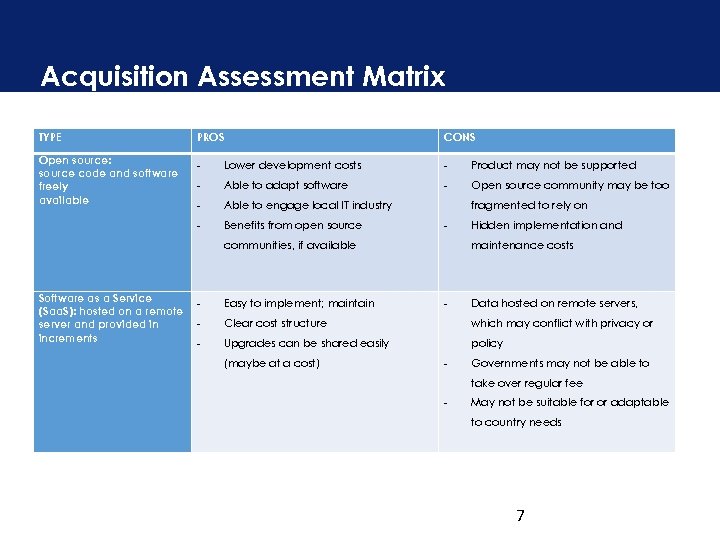
Acquisition Assessment Matrix TYPE PROS CONS Open source: source code and software freely available - Lower development costs - Product may not be supported - Able to adapt software - Open source community may be too - Able to engage local IT industry - Benefits from open source fragmented to rely on - communities, if available Software as a Service (Saa. S): hosted on a remote server and provided in increments Hidden implementation and maintenance costs - Easy to implement; maintain - Clear cost structure which may conflict with privacy or - Upgrades can be shared easily policy (maybe at a cost) - - Data hosted on remote servers, Governments may not be able to take over regular fee - May not be suitable for or adaptable to country needs 7
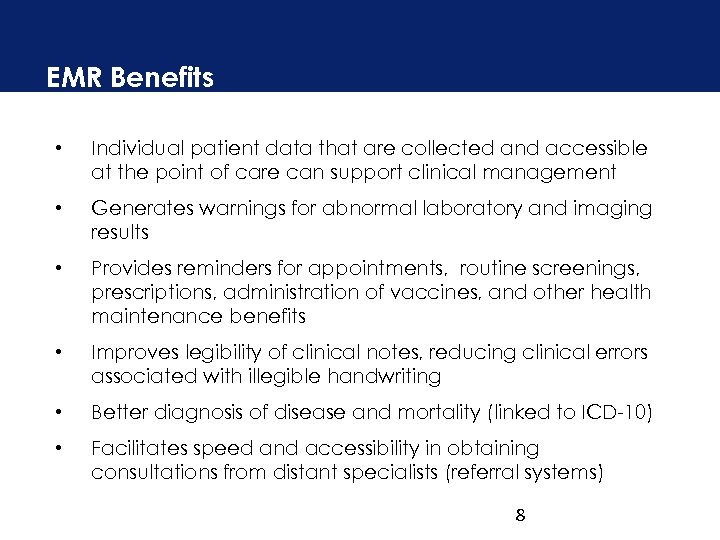
EMR Benefits • Individual patient data that are collected and accessible at the point of care can support clinical management • Generates warnings for abnormal laboratory and imaging results • Provides reminders for appointments, routine screenings, prescriptions, administration of vaccines, and other health maintenance benefits • Improves legibility of clinical notes, reducing clinical errors associated with illegible handwriting • Better diagnosis of disease and mortality (linked to ICD-10) • Facilitates speed and accessibility in obtaining consultations from distant specialists (referral systems) 8
EMR Benefits • Supports service monitoring (reporting outcomes, budgets, and supplies) • Data back-up and archiving • Easy information transfer and sharing with other databases • Supports clinical research 9
EMR Implementation Considerations • Poor IT infrastructure (power outages; limited network connectivity and bandwidth) increases the cost to set up and maintain the systems • Limited healthcare staff with heavy workload • Insufficient investment in research to develop patient-centered information systems that would meet the needs of a particular healthcare system • Security, confidentiality, and reliability 10
EMR Implementation Considerations • Technology, access, and interoperability • Staff buy-in and political will/buy-in (IT culture: behavioral aspects) • Licensing and contracting • Timelines • User fit: Does system fit well within existing culture, language, and user workflows? • Sustainability and adaptability • Scalability 11
Patient Unique Identifier (PUID) • Numeric or alphanumeric string that is associated with a single patient within a given health register or a health-records system • PUIDs should be portable across different systems 12
PUID Components • An identifier (numeric; alphanumeric) scheme • Identification mechanism • Index links the PUID and the identification information of the patient • Mechanism to hide or encrypt the identifier • Technology infrastructure to search, identify, match, encrypt, etc. • Administrative infrastructure including the central governing authority 13
PUID: Functions and Objectives • Support the protection of privacy and confidentiality through accurate identification (explicit identification of patient information) and dis-identification (mask/encrypt/hide patient information) • Help prevent, detect, or mitigate problems caused by duplicate records and patient mixups or mistaken identity 14
PUID: Functions and Objectives • Help retrieve a complete history of patient’s medical history regardless of where patient received services • Provide positive identification of patient for delivery of care and administrative functions • Track patients across multiple facilities (locations), systems, programs, or services; hence supporting the continuum of care 15
Discussion • Do EMRs contribute important benefits to healthcare projects? • Do EMRs have a beneficial impact on patient care? • What EMR implementation challenges have you faced? 16
ROUTINE HEALTH INFORMATION SYSTEMS A Curriculum on Basic Concepts and Practice This presentation was produced with the support of the United States Agency for International Development (USAID) under the terms of MEASURE Evaluation cooperative agreement AID-OAA-L-14 -00004. MEASURE Evaluation is implemented by the Carolina Population Center, University of North Carolina at Chapel Hill in partnership with ICF International; John Snow, Inc. ; Management Sciences for Health; Palladium; and Tulane University. The views expressed in this presentation do not necessarily reflect the views of USAID or the United States government. 17
Скачать презентацию ROUTINE HEALTH INFORMATION SYSTEMS A Curriculum on Basic
706d2f952d0fb904f6fa3e3b86eff3e5.ppt