 Скачать презентацию Round-table Forum on Trade of Legal and Sustainable
29d1fbf165a188c4956edab1ff3fdb17.ppt
- Количество слайдов: 18



Round-table Forum on Trade of Legal and Sustainable Wood in China Beijing, 26 April 2007 Japan’s Public Timber Procurement Policy Dr. Federico Lopez-Casero Forest Conservation Project Institute for Global Environmental Strategies (IGES) 1
Overview 1. Japan’s role in timber trade 2. Japan’s response to illegal wood imports 3. Framework of timber procurement policy 4. Legal and policy context of PPP reform 5. Reform of timber procurement policy 6. Definitions and verification modalities 7. Policy implementation: a) Domestic; b) Imported timber 8. Preliminary observations: a) Certification / legality verification schemes and b) Actors 9. What does this mean for China? 2
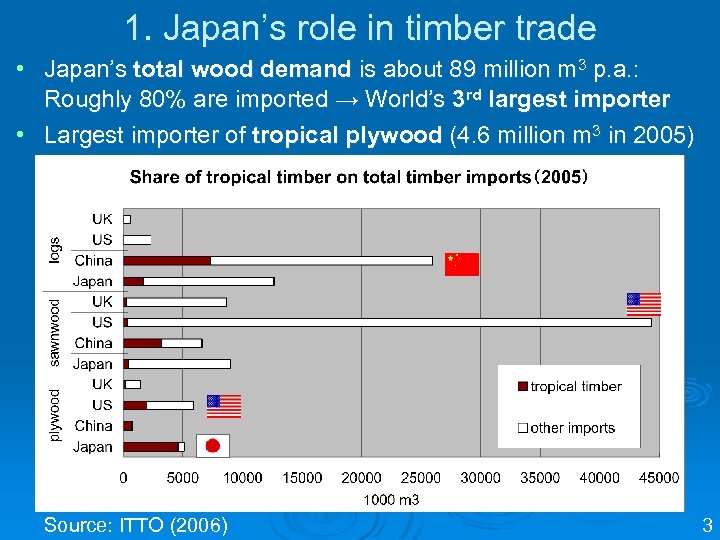
1. Japan’s role in timber trade • Japan’s total wood demand is about 89 million m 3 p. a. : Roughly 80% are imported → World’s 3 rd largest importer • Largest importer of tropical plywood (4. 6 million m 3 in 2005) Source: ITTO (2006) 3
2. Japan’s response to illegal wood imports • Since the G 8 Summit in 2002, Japan has repeatedly expressed its commitment to tackle illegal logging • “We will not use timber that has been produced illegally” (Forestry Agency 31. 03. 2005) • Government stresses financial/administrative support to international organisations and producer countries • Low engagement of private sector prior to PPP reform: – Only 12% of 115 firms claimed to make any effort to assess the legality of the procured timber (survey by JFWIA) • Potential of PPP to represent “hard” policy option: – Public sector: 3% of total wood procurement (estimated) – May prompt a response from the private sector 4
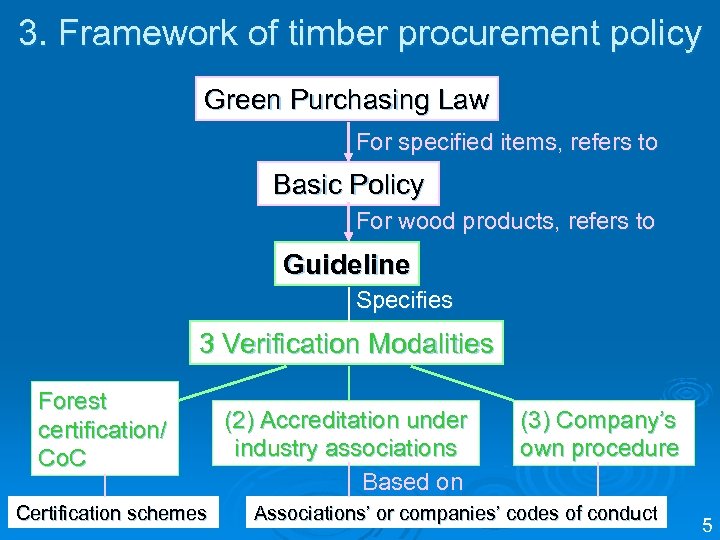
3. Framework of timber procurement policy Green Purchasing Law For specified items, refers to Basic Policy For wood products, refers to Guideline Specifies 3 Verification Modalities Forest certification/ Co. C Certification schemes (2) Accreditation under industry associations Based on (3) Company’s own procedure Associations’ or companies’ codes of conduct 5
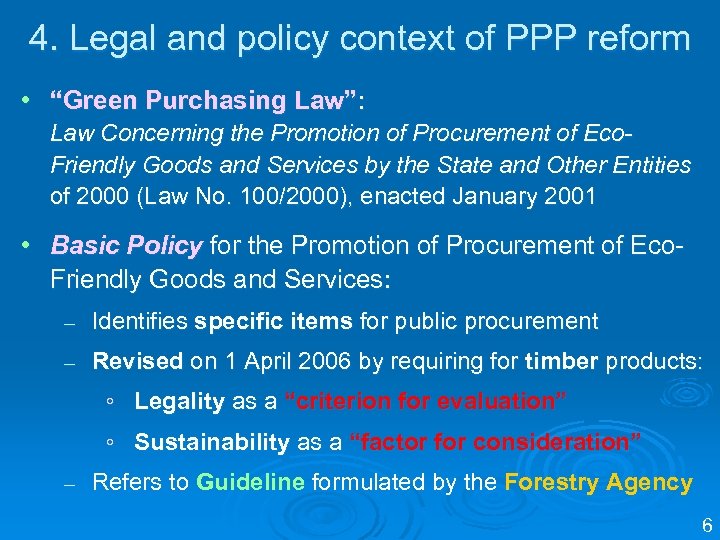
4. Legal and policy context of PPP reform • “Green Purchasing Law”: Law Concerning the Promotion of Procurement of Eco. Friendly Goods and Services by the State and Other Entities of 2000 (Law No. 100/2000), enacted January 2001 • Basic Policy for the Promotion of Procurement of Eco. Friendly Goods and Services: – Identifies specific items for public procurement – Revised on 1 April 2006 by requiring for timber products: ◦ Legality as a “criterion for evaluation” ◦ Sustainability as a “factor for consideration” – Refers to Guideline formulated by the Forestry Agency 6
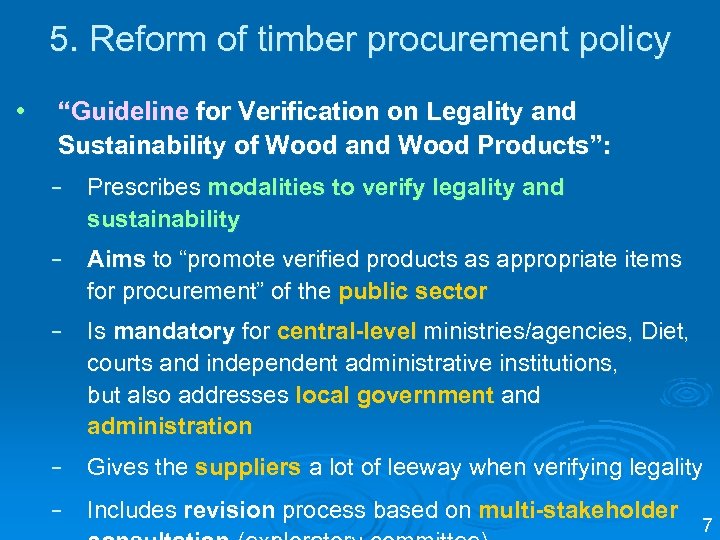
5. Reform of timber procurement policy • “Guideline for Verification on Legality and Sustainability of Wood and Wood Products”: − Prescribes modalities to verify legality and sustainability − Aims to “promote verified products as appropriate items for procurement” of the public sector − Is mandatory for central-level ministries/agencies, Diet, courts and independent administrative institutions, but also addresses local government and administration − Gives the suppliers a lot of leeway when verifying legality − Includes revision process based on multi-stakeholder 7
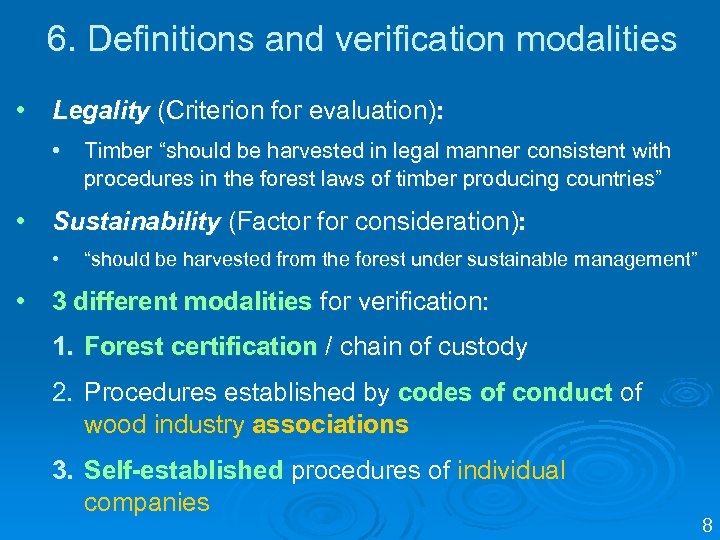
6. Definitions and verification modalities • Legality (Criterion for evaluation): • Timber “should be harvested in legal manner consistent with procedures in the forest laws of timber producing countries” • Sustainability (Factor for consideration): • “should be harvested from the forest under sustainable management” • 3 different modalities for verification: 1. Forest certification / chain of custody 2. Procedures established by codes of conduct of wood industry associations 3. Self-established procedures of individual companies 8
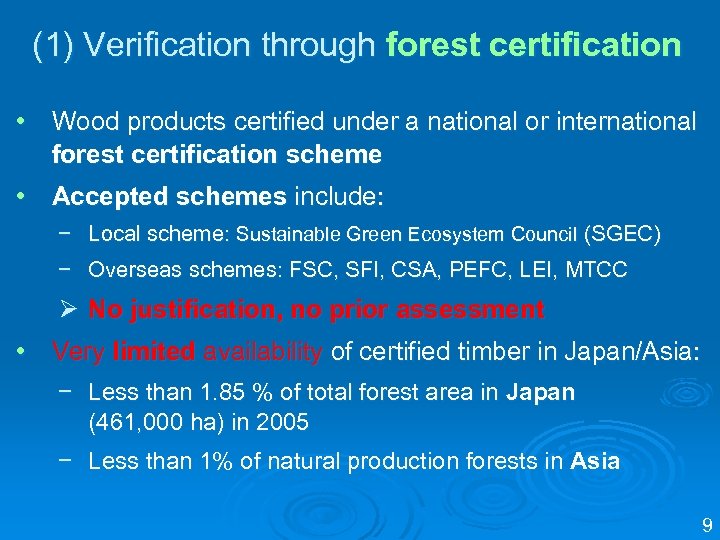
(1) Verification through forest certification • Wood products certified under a national or international forest certification scheme • Accepted schemes include: − Local scheme: Sustainable Green Ecosystem Council (SGEC) − Overseas schemes: FSC, SFI, CSA, PEFC, LEI, MTCC Ø No justification, no prior assessment • Very limited availability of certified timber in Japan/Asia: − Less than 1. 85 % of total forest area in Japan (461, 000 ha) in 2005 − Less than 1% of natural production forests in Asia 9
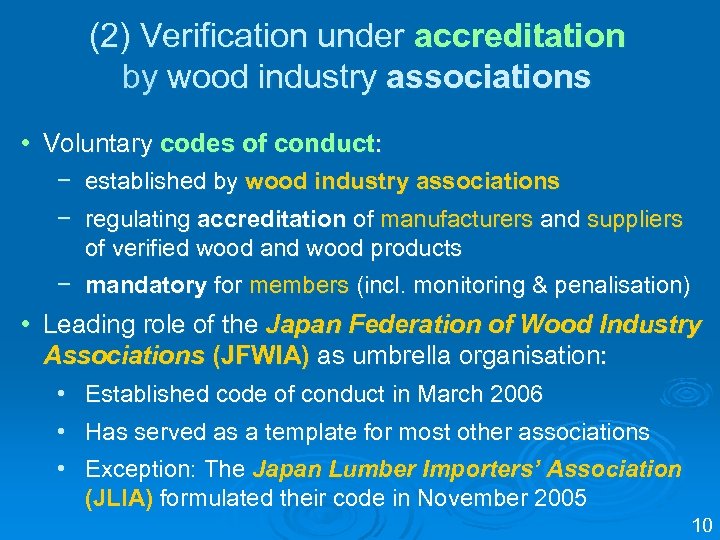
(2) Verification under accreditation by wood industry associations • Voluntary codes of conduct: − established by wood industry associations − regulating accreditation of manufacturers and suppliers of verified wood and wood products − mandatory for members (incl. monitoring & penalisation) • Leading role of the Japan Federation of Wood Industry Associations (JFWIA) as umbrella organisation: • Established code of conduct in March 2006 • Has served as a template for most other associations • Exception: The Japan Lumber Importers’ Association (JLIA) formulated their code in November 2005 10
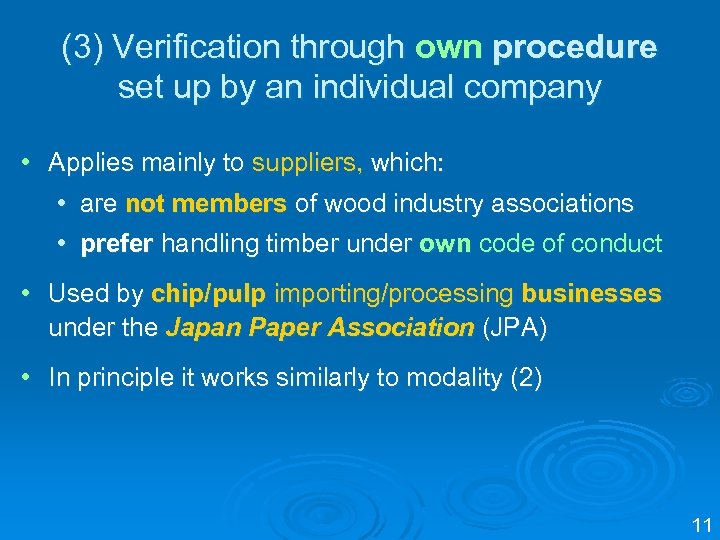
(3) Verification through own procedure set up by an individual company • Applies mainly to suppliers, which: • are not members of wood industry associations • prefer handling timber under own code of conduct • Used by chip/pulp importing/processing businesses under the Japan Paper Association (JPA) • In principle it works similarly to modality (2) 11
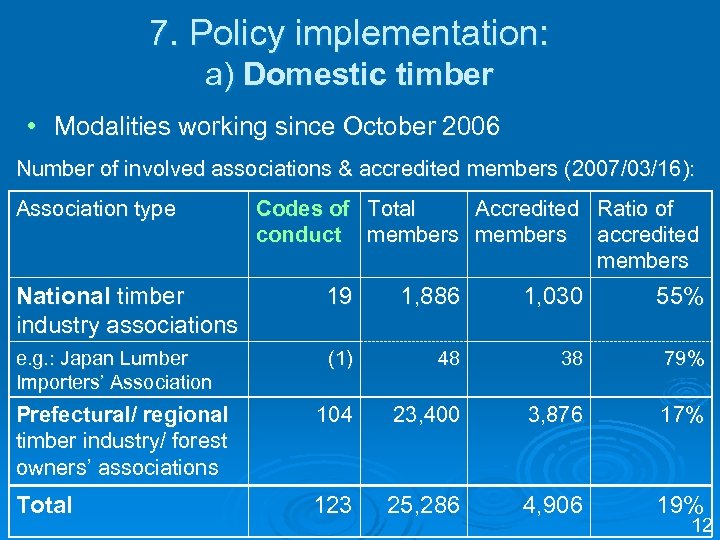
7. Policy implementation: a) Domestic timber • Modalities working since October 2006 Number of involved associations & accredited members (2007/03/16): Association type Codes of Total Accredited Ratio of conduct members accredited members National timber industry associations 19 1, 886 1, 030 55% e. g. : Japan Lumber Importers’ Association (1) 48 38 79% Prefectural/ regional timber industry/ forest owners’ associations 104 23, 400 3, 876 17% Total 123 25, 286 4, 906 19% 12
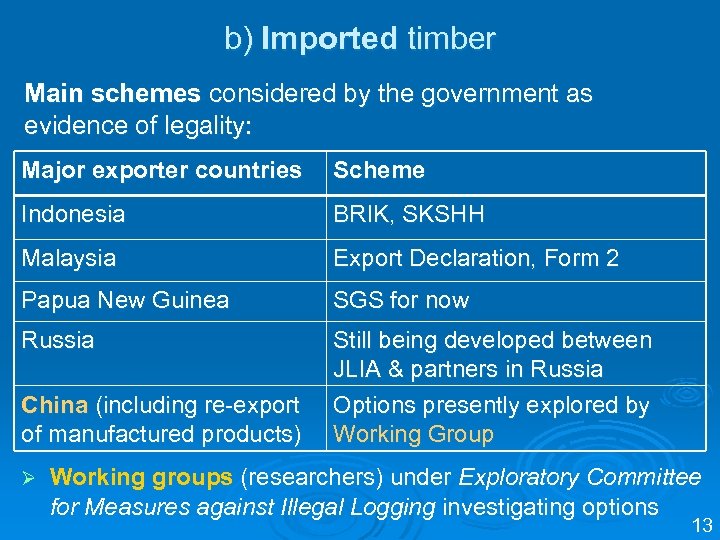
b) Imported timber Main schemes considered by the government as evidence of legality: Major exporter countries Scheme Indonesia BRIK, SKSHH Malaysia Export Declaration, Form 2 Papua New Guinea SGS for now Russia Still being developed between JLIA & partners in Russia Options presently explored by Working Group China (including re-export of manufactured products) Ø Working groups (researchers) under Exploratory Committee for Measures against Illegal Logging investigating options 13
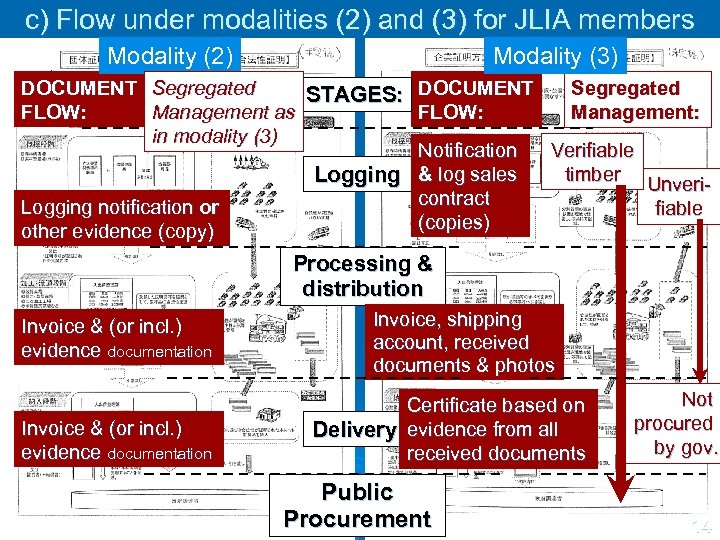
c) Flow under modalities (2) and (3) for JLIA members Modality (2) Modality (3) DOCUMENT Segregated STAGES: DOCUMENT FLOW: Management as FLOW: Management: in modality (3) Notification Verifiable timber Logging & log sales Unvericontract Logging notification or fiable (copies) other evidence (copy) Processing & distribution Invoice & (or incl. ) evidence documentation Invoice, shipping account, received documents & photos Certificate based on Delivery evidence from all received documents Public Procurement Not procured by gov. 14
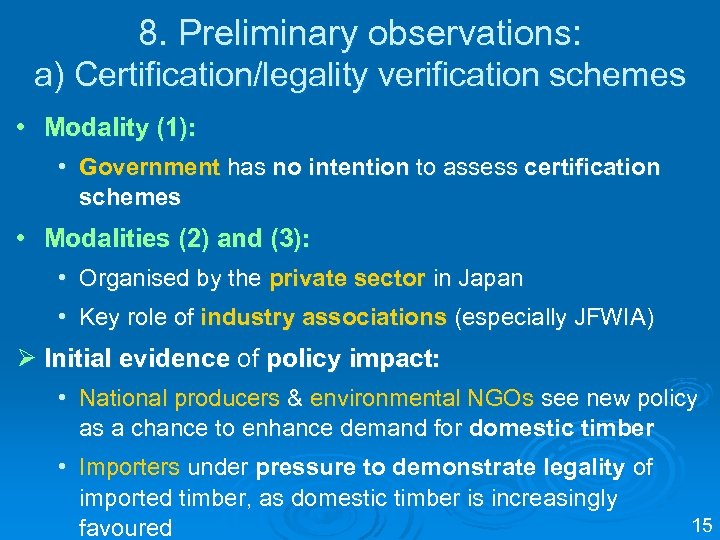
8. Preliminary observations: a) Certification/legality verification schemes • Modality (1): • Government has no intention to assess certification schemes • Modalities (2) and (3): • Organised by the private sector in Japan • Key role of industry associations (especially JFWIA) Ø Initial evidence of policy impact: • National producers & environmental NGOs see new policy as a chance to enhance demand for domestic timber • Importers under pressure to demonstrate legality of imported timber, as domestic timber is increasingly favoured 15
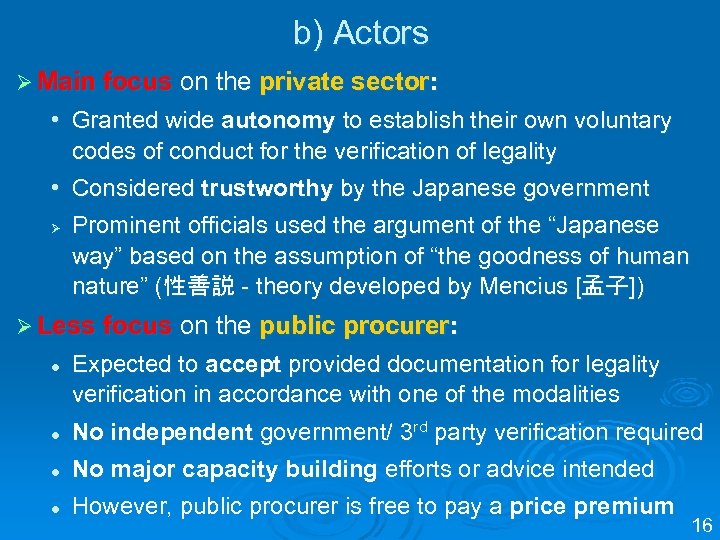
b) Actors Ø Main focus on the private sector: • Granted wide autonomy to establish their own voluntary codes of conduct for the verification of legality • Considered trustworthy by the Japanese government Ø Prominent officials used the argument of the “Japanese way” based on the assumption of “the goodness of human nature” (性善説 - theory developed by Mencius [孟子]) Ø Less focus on the public procurer: l Expected to accept provided documentation for legality verification in accordance with one of the modalities l No independent government/ 3 rd party verification required l No major capacity building efforts or advice intended l However, public procurer is free to pay a price premium 16
9. What does this mean for China? • China and Japan are important timber trade partners • However, presently China has no complete timber tracing and monitoring management system in place Ø Impossible to identify or verify the origin of timber Ø Only two ways China’s timber industry can presently supply public entities in Japan: − Certified wood products − Enterprise able to provide legality evidence throughout supply chain • Need for a timber monitoring system in China: Presently, in close consultation with its Chinese partners, the JFWIA is exploring options to set up a legality verification system for wood products (re)exported from China and procured by public entities in Japan 17
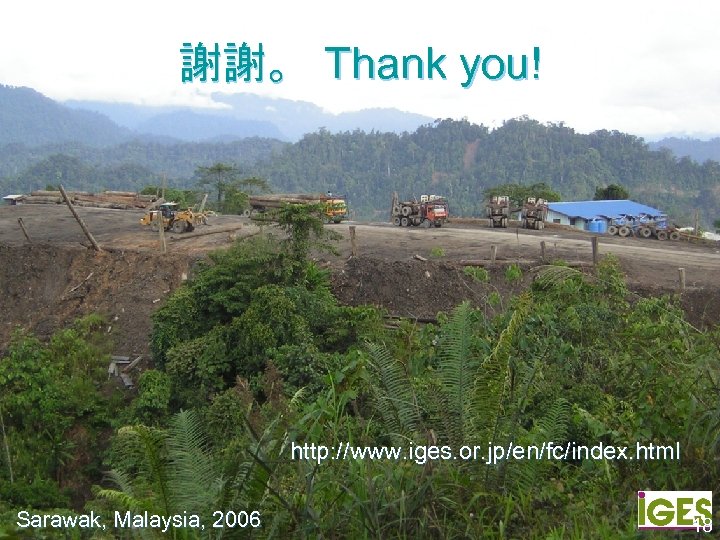
謝謝。 Thank you! http: //www. iges. or. jp/en/fc/index. html Sarawak, Malaysia, 2006 18
Скачать презентацию Round-table Forum on Trade of Legal and Sustainable
29d1fbf165a188c4956edab1ff3fdb17.ppt