


 Скачать презентацию Rotem Neeman Yonat Milstein under the supervision
8a622d8c5107d3f567513a20a3941555.ppt
- Количество слайдов: 1
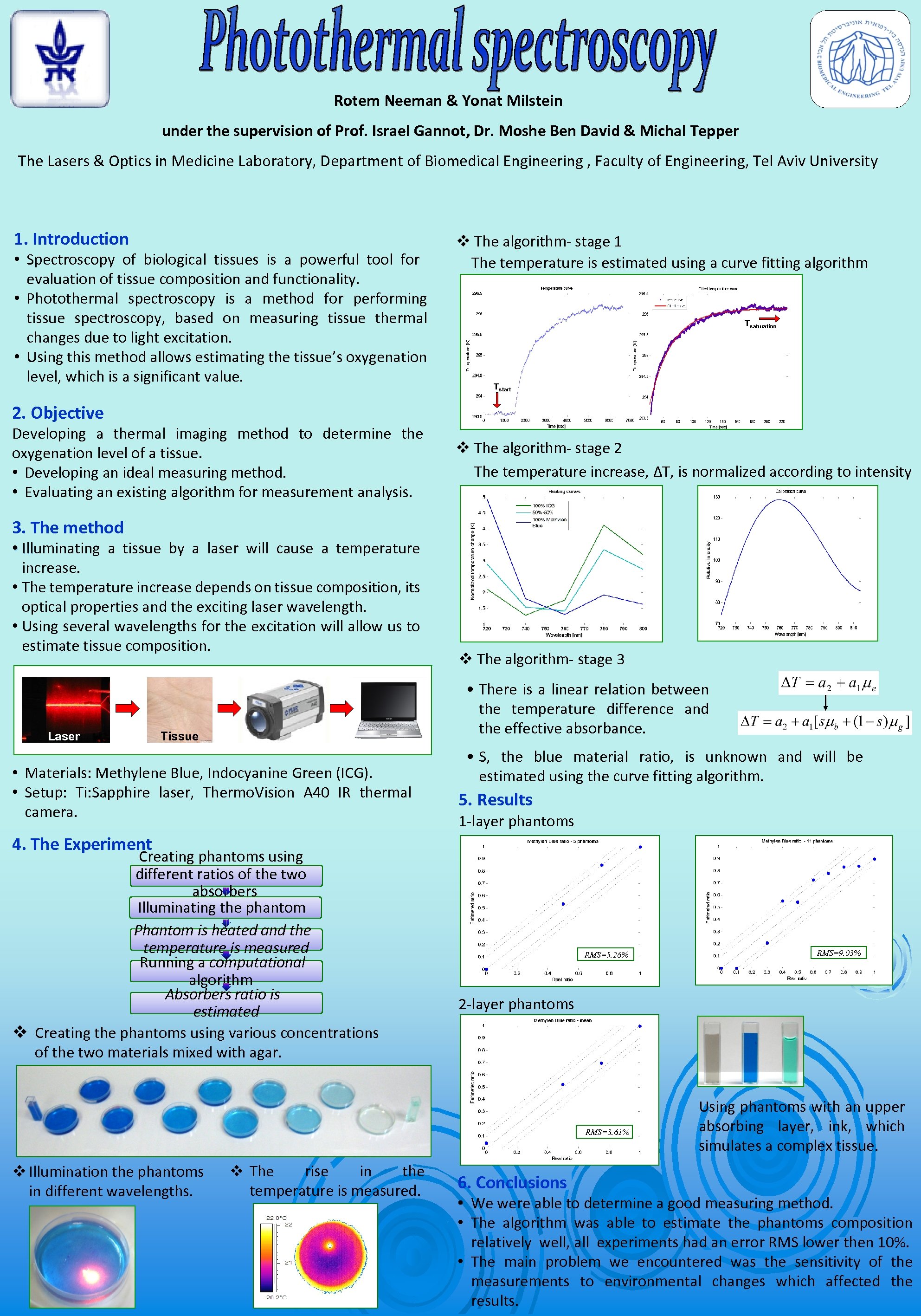 Rotem Neeman & Yonat Milstein under the supervision of Prof. Israel Gannot, Dr. Moshe Ben David & Michal Tepper The Lasers & Optics in Medicine Laboratory, Department of Biomedical Engineering , Faculty of Engineering, Tel Aviv University 1. Introduction • Spectroscopy of biological tissues is a powerful tool for evaluation of tissue composition and functionality. • Photothermal spectroscopy is a method for performing tissue spectroscopy, based on measuring tissue thermal changes due to light excitation. • Using this method allows estimating the tissue’s oxygenation level, which is a significant value. v The algorithm- stage 1 The temperature is estimated using a curve fitting algorithm Tsaturation Tstart 2. Objective Developing a thermal imaging method to determine the oxygenation level of a tissue. • Developing an ideal measuring method. • Evaluating an existing algorithm for measurement analysis. v The algorithm- stage 2 The temperature increase, ΔT, is normalized according to intensity 3. The method • Illuminating a tissue by a laser will cause a temperature Ill increase. • The temperature increase depends on tissue composition, its optical properties and the exciting laser wavelength. • Using several wavelengths for the excitation will allow us to estimate tissue composition. Laser v The algorithm- stage 3 • There is a linear relation between the temperature difference and the effective absorbance. Tissue • Materials: Methylene Blue, Indocyanine Green (ICG). • Setup: Ti: Sapphire laser, Thermo. Vision A 40 IR thermal camera. • S, the blue material ratio, is unknown and will be estimated using the curve fitting algorithm. 5. Results 1 -layer phantoms 4. The Experiment Creating phantoms using different ratios of the two absorbers Illuminating the phantom Phantom is heated and the temperature is measured Running a computational algorithm Absorbers ratio is estimated v Creating the phantoms using various concentrations of the two materials mixed with agar. RMS=5. 26% 2 -layer phantoms RMS=3. 61% v Illumination the phantoms in different wavelengths. v The rise in the temperature is measured. RMS=9. 03% Using phantoms with an upper absorbing layer, ink, which simulates a complex tissue. 6. Conclusions • We were able to determine a good measuring method. • The algorithm was able to estimate the phantoms composition relatively well, all experiments had an error RMS lower then 10%. • The main problem we encountered was the sensitivity of the measurements to environmental changes which affected the results.