


 Скачать презентацию Rostov the Great Rostov the Great is
Rostov the Great.pptx
- Количество слайдов: 11
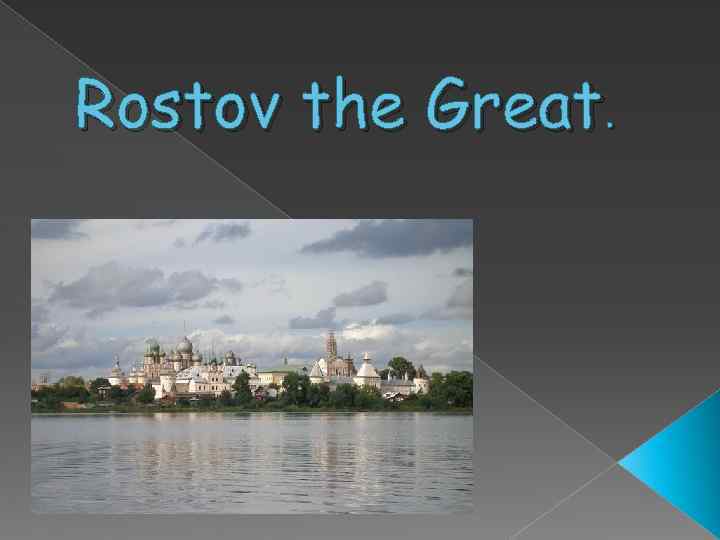 Rostov the Great.
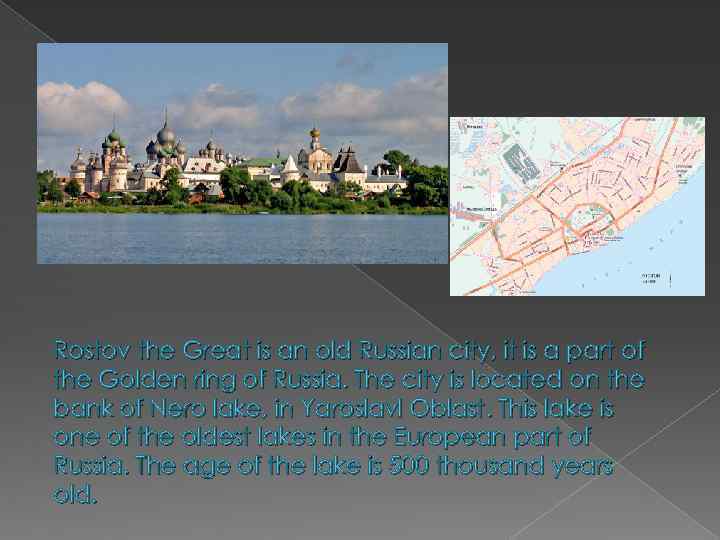 Rostov the Great is an old Russian city, it is a part of the Golden ring of Russia. The city is located on the bank of Nero lake, in Yaroslavl Oblast. This lake is one of the oldest lakes in the European part of Russia. The age of the lake is 500 thousand years old.
 For the first time Rostov is mentioned in chronicles in 862 (it was the reign of Rurik). At that time it was an important ancient Russian city like Novgorod and Kiev. Pretty soon Rostov got the name «the Great» , it became the center of the Rostov Principality.
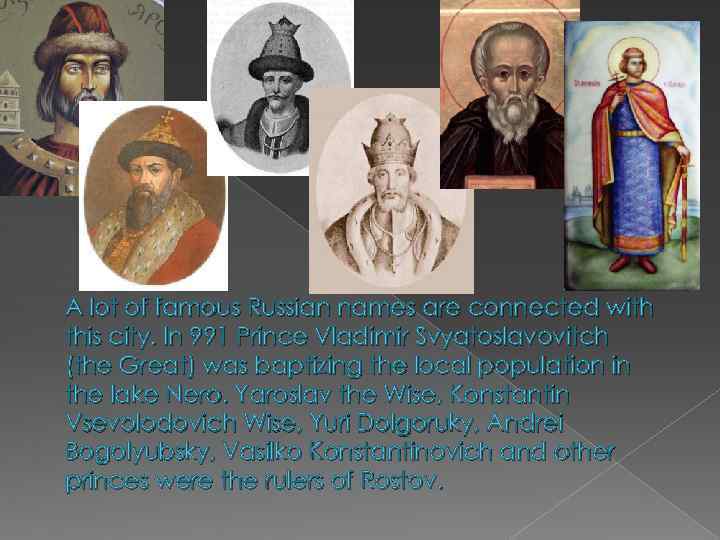 A lot of famous Russian names are connected with this city. In 991 Prince Vladimir Svyatoslavovitch (the Great) was baptizing the local population in the lake Nero. Yaroslav the Wise, Konstantin Vsevolodovich Wise, Yuri Dolgoruky, Andrei Bogolyubsky, Vasilko Konstantinovich and other princes were the rulers of Rostov.
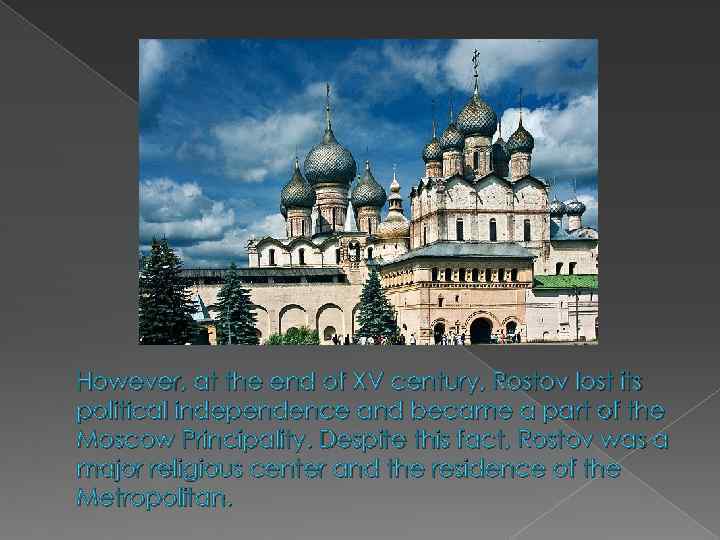 However, at the end of XV century, Rostov lost its political independence and became a part of the Moscow Principality. Despite this fact, Rostov was a major religious center and the residence of the Metropolitan.
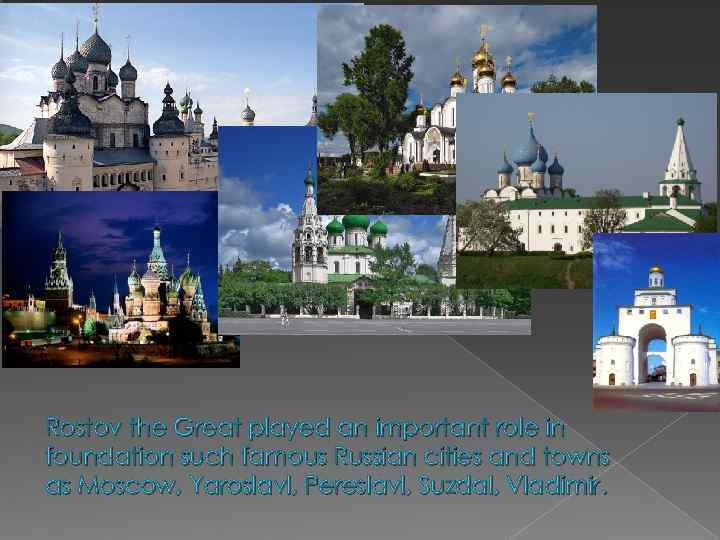 Rostov the Great played an important role in foundation such famous Russian cities and towns as Moscow, Yaroslavl, Pereslavl, Suzdal, Vladimir.
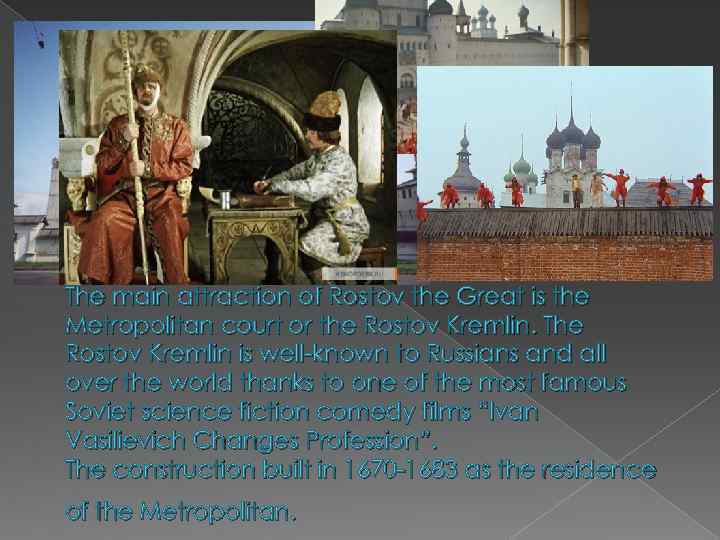 The main attraction of Rostov the Great is the Metropolitan court or the Rostov Kremlin. The Rostov Kremlin is well-known to Russians and all over the world thanks to one of the most famous Soviet science fiction comedy films “Ivan Vasilievich Changes Profession”. The construction built in 1670 -1683 as the residence of the Metropolitan.
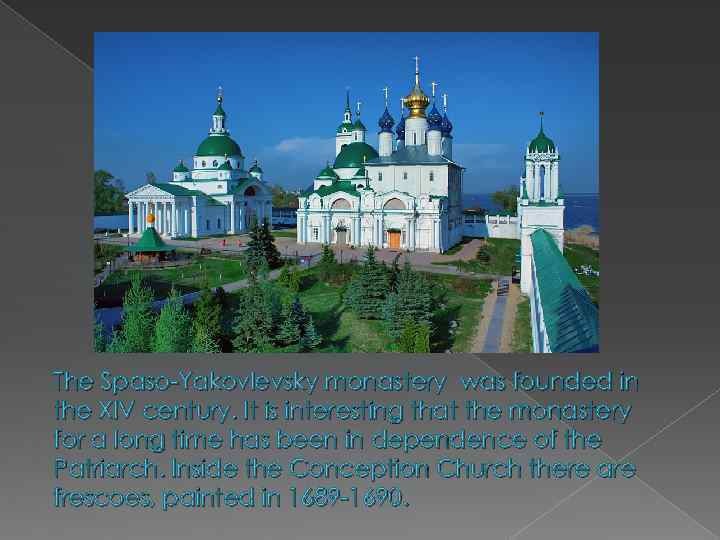 The Spaso-Yakovlevsky monastery was founded in the XIV century. It is interesting that the monastery for a long time has been in dependence of the Patriarch. Inside the Conception Church there are frescoes, painted in 1689 -1690.
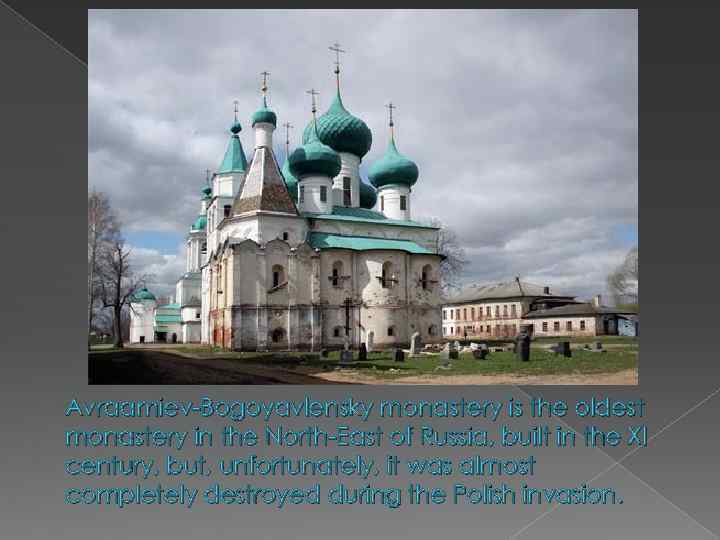 Avraamiev-Bogoyavlensky monastery is the oldest monastery in the North-East of Russia, built in the XI century, but, unfortunately, it was almost completely destroyed during the Polish invasion.
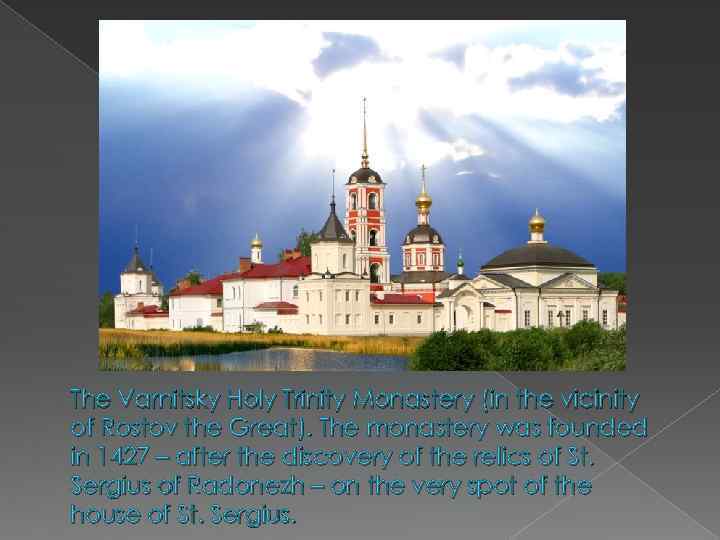 The Varnitsky Holy Trinity Monastery (in the vicinity of Rostov the Great). The monastery was founded in 1427 – after the discovery of the relics of St. Sergius of Radonezh – on the very spot of the house of St. Sergius.
 The presentation is done by Anastasia Smirnova and Olga Belkovets (10 A)