


 Скачать презентацию Roots of Government in Georgia
745903cef636c8f0d61670979d2d2e90.ppt
- Количество слайдов: 56
 Roots of Government in Georgia
 • Colonial Ga • Constitutions of GA • Popular Sovereignty • GA Constitution • Constitution of 1983 • Federal vs. State • Grant-in-Aids • Article IV • State Constitutions • General Assembly • State Senators • State Ho. R Members • Speaker of the House • Lieutenant Governor • • • • • How the General Assembly Works Types of Bills Recall Governor Roles of the Gov. Budget Powers denied to the Gov. Lieutenant Gov. Attorney General Ex. Depts. GA Courts Lower Courts Appellate Courts Supreme Court Counties Board of Commissioners Cities • • Infrastructure Priorities Resources Public Education
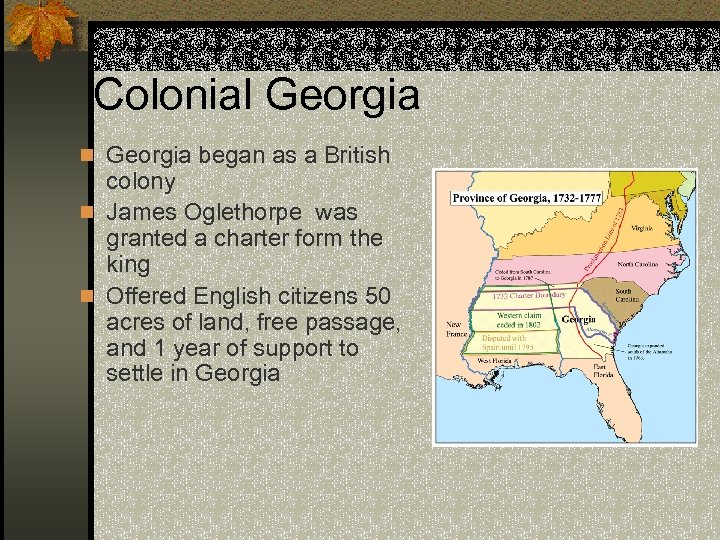 Colonial Georgia n Georgia began as a British colony n James Oglethorpe was granted a charter form the king n Offered English citizens 50 acres of land, free passage, and 1 year of support to settle in Georgia
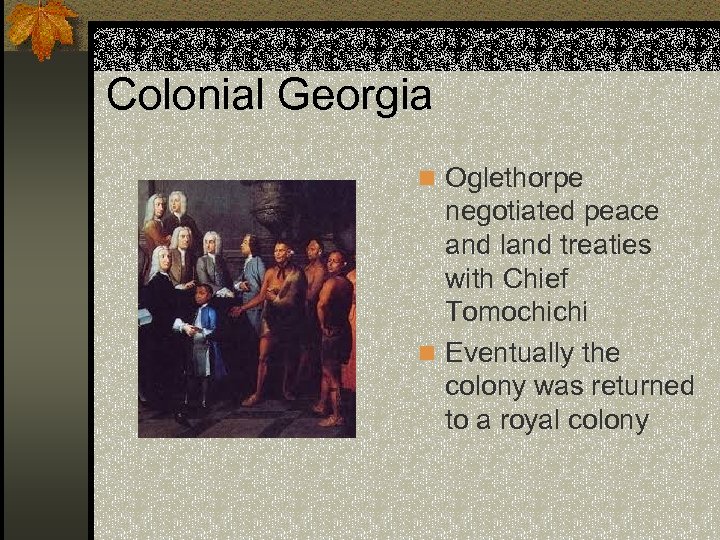 Colonial Georgia n Oglethorpe negotiated peace and land treaties with Chief Tomochichi n Eventually the colony was returned to a royal colony
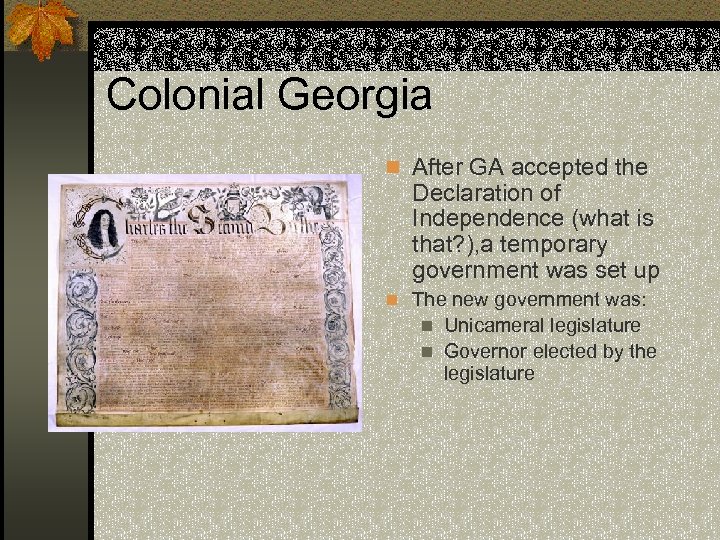 Colonial Georgia n After GA accepted the Declaration of Independence (what is that? ), a temporary government was set up n The new government was: Unicameral legislature n Governor elected by the legislature n
 The Constitutions of Georgia
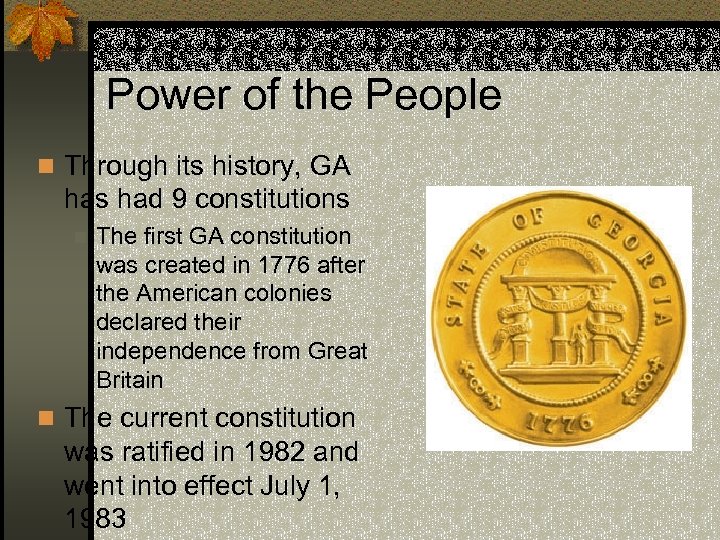 Power of the People n Through its history, GA has had 9 constitutions n The first GA constitution was created in 1776 after the American colonies declared their independence from Great Britain n The current constitution was ratified in 1982 and went into effect July 1, 1983
 Power of the People n The Constitution of GA is similar to the US Constitution n In its 11 Articles, it includes the following n n n A bill of rights An outline of the framework of government A listing of state powers and responsibilities A provision for local government An amending clause that details the methods of formal constitutional change
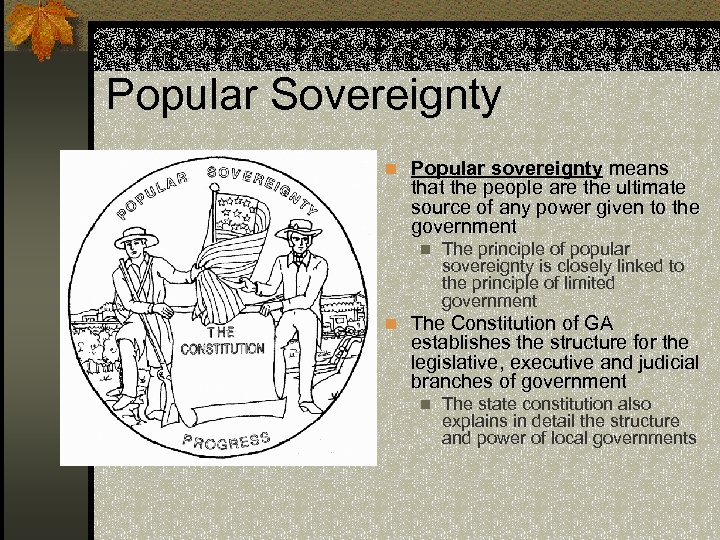 Popular Sovereignty n Popular sovereignty means that the people are the ultimate source of any power given to the government n The principle of popular sovereignty is closely linked to the principle of limited government n The Constitution of GA establishes the structure for the legislative, executive and judicial branches of government n The state constitution also explains in detail the structure and power of local governments
 The Constitution Over Time: Constitution of 1983 n GA’s present constitution went into effect in 1983 n Set up 3 branches of government n Bicameral legislature n Executive Branch n Judicial Branch
 State and Local Government
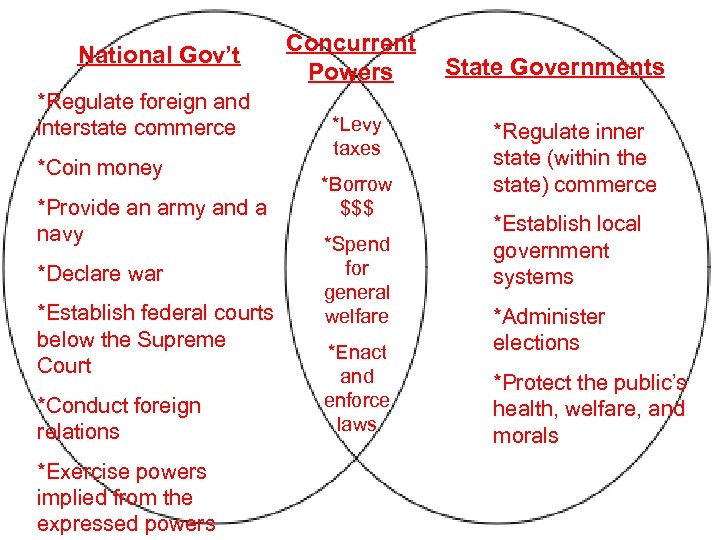 National Gov’t *Regulate foreign and interstate commerce *Coin money *Provide an army and a navy *Declare war *Establish federal courts below the Supreme Court *Conduct foreign relations *Exercise powers implied from the expressed powers Concurrent Powers *Levy taxes *Borrow $$$ *Spend for general welfare *Enact and enforce laws State Governments *Regulate inner state (within the state) commerce *Establish local government systems *Administer elections *Protect the public’s health, welfare, and morals
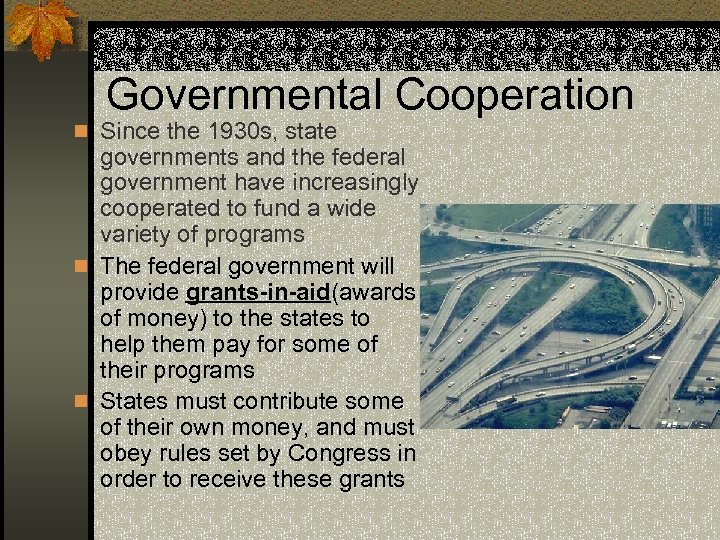 Governmental Cooperation n Since the 1930 s, state governments and the federal government have increasingly cooperated to fund a wide variety of programs n The federal government will provide grants-in-aid(awards of money) to the states to help them pay for some of their programs n States must contribute some of their own money, and must obey rules set by Congress in order to receive these grants
 Governmental Cooperation n The federal government gives some grants-in- aid directly to cities and counties n Article IV of the US Constitution encourages interstate cooperation by requiring states to give “full faith and credit” to the public laws and court decisions of other states n Article IV also requires all state governments to be a “republican form of government” n The federal government will protect each state against invasion and domestic violence
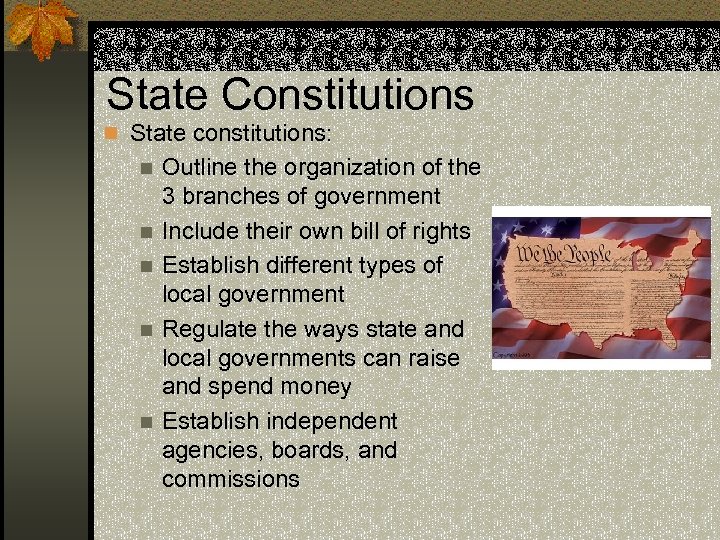 State Constitutions n State constitutions: n n n Outline the organization of the 3 branches of government Include their own bill of rights Establish different types of local government Regulate the ways state and local governments can raise and spend money Establish independent agencies, boards, and commissions
 State Legislative Branch Primary Goal: Pass Laws & Collect $$$$
 Makeup of Legislatures n State lawmaking bodies vary in name and size n Different names for state legislatures: n General assembly (GA) n Legislative assembly n Legislature
 Powers of the General Assembly n The General Assembly makes two kinds of laws: n n Statutes-laws that apply statewide Local or special laws that apply only to specific counties or cities n In addition to making laws, the General Assembly frequently examines government operations n These reviews—called legislative oversights— allow legislators to learn how well current laws are working and whether the laws need to be changed
 North Carolina State Legislature n Senate: n 56 members n 56 Senatorial Districts n Representatives: n 180 members n 180 House Districts n Must be 21 n Must be 25 n Live in GA for 2 yrs n Lived in district for 1 yr n Live in District for 1 yr n US Citizen • Both members elected for 2 year terms • Legislative session: Atlanta, 40 days long
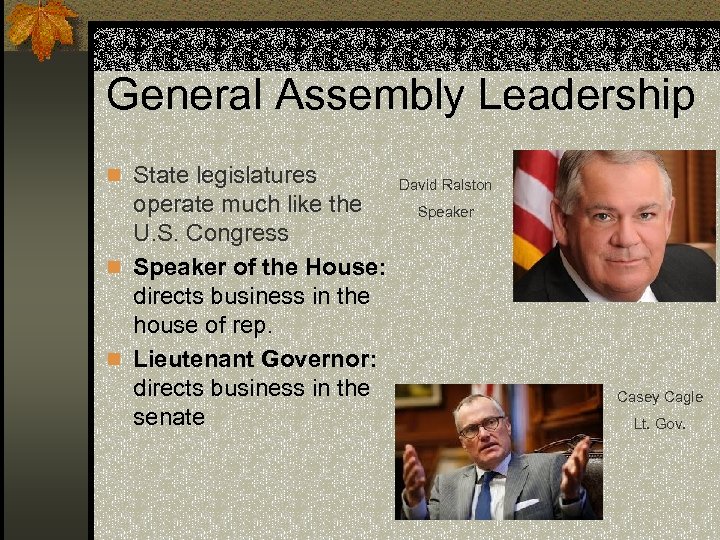 General Assembly Leadership n State legislatures operate much like the U. S. Congress n Speaker of the House: directs business in the house of rep. n Lieutenant Governor: directs business in the senate David Ralston Speaker Casey Cagle Lt. Gov.
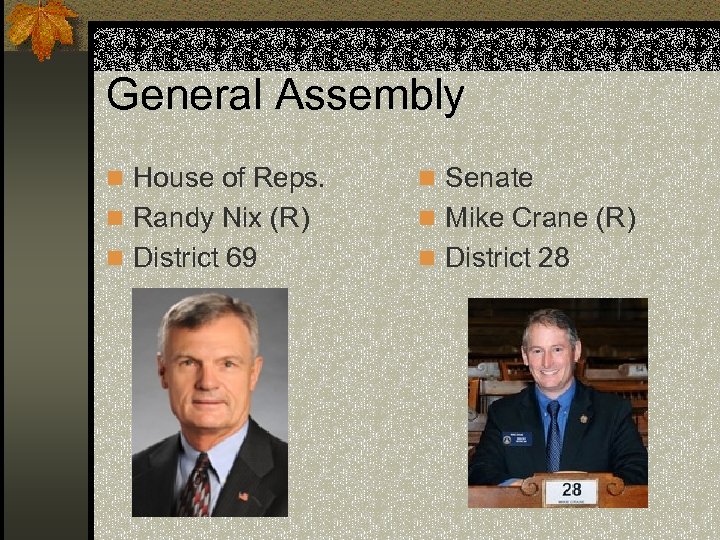 General Assembly n House of Reps. n Senate n Randy Nix (R) n Mike Crane (R) n District 69 n District 28
 How State Legislatures Function n The majority party in the house selects the speaker, and in states where the lieutenant governor does not preside, the majority party picks the senate president
 How State Legislatures Work n State legislatures have various committees, the chairperson is appointed by the majority party n When a bill is introduced into state legislatures it goes to the appropriate committee n Example: Education or Agricultural Committees
 Types of Bills n Proposition-bill proposals made by elected members of the General Assembly n Initiative-bill written by citizens presented to their elected member who introduces the bill into the General Assembly n Referendum-”Refer” to the people to vote n Elected officials do not want to vote because possibility of negative public response
 Recall n Process that allows citizens to remove elected officials before the end of their terms n Election would be held
 State Executive Branch
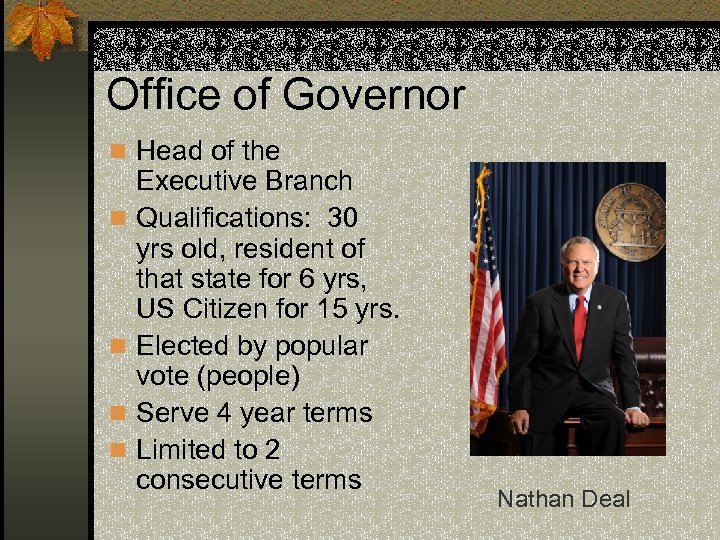 Office of Governor n Head of the n n Executive Branch Qualifications: 30 yrs old, resident of that state for 6 yrs, US Citizen for 15 yrs. Elected by popular vote (people) Serve 4 year terms Limited to 2 consecutive terms Nathan Deal
 Office of the Governor n Most basic thing is to execute, carry out, the laws of the state n Enforce laws
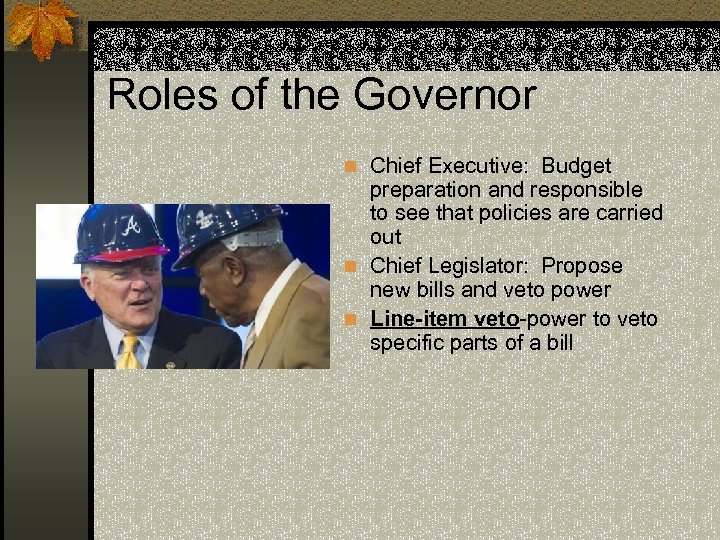 Roles of the Governor n Chief Executive: Budget preparation and responsible to see that policies are carried out n Chief Legislator: Propose new bills and veto power n Line-item veto-power to veto specific parts of a bill
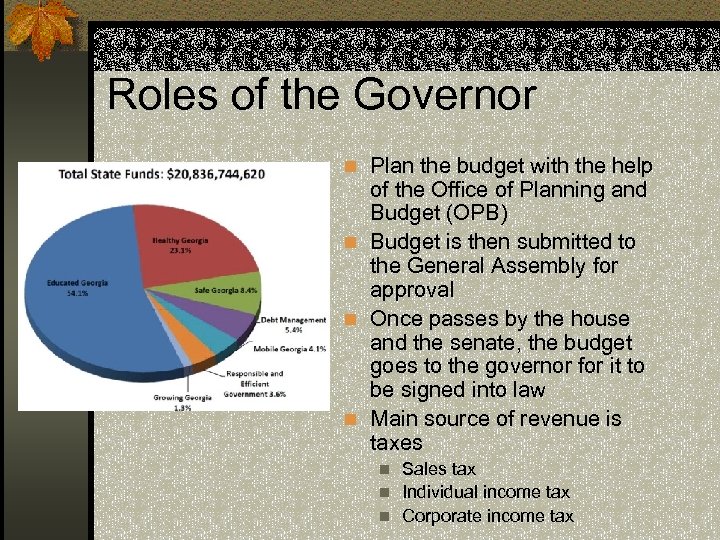 Roles of the Governor n Plan the budget with the help of the Office of Planning and Budget (OPB) n Budget is then submitted to the General Assembly for approval n Once passes by the house and the senate, the budget goes to the governor for it to be signed into law n Main source of revenue is taxes Sales tax n Individual income tax n Corporate income tax n
 Power denied to GA governor n Executive clemency- the power to grant pardons and commutations n This power is given to the State Board of Pardon and Paroles n 5 board members appointed by the governor
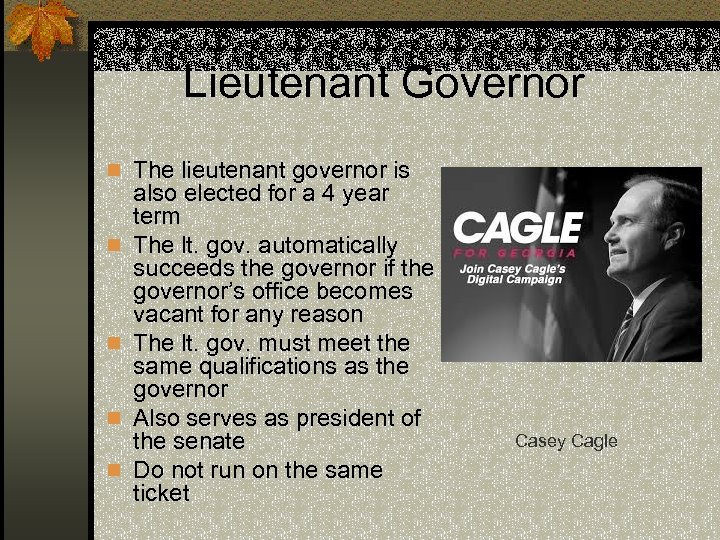 Lieutenant Governor n The lieutenant governor is n n also elected for a 4 year term The lt. gov. automatically succeeds the governor if the governor’s office becomes vacant for any reason The lt. gov. must meet the same qualifications as the governor Also serves as president of the senate Do not run on the same ticket Casey Cagle
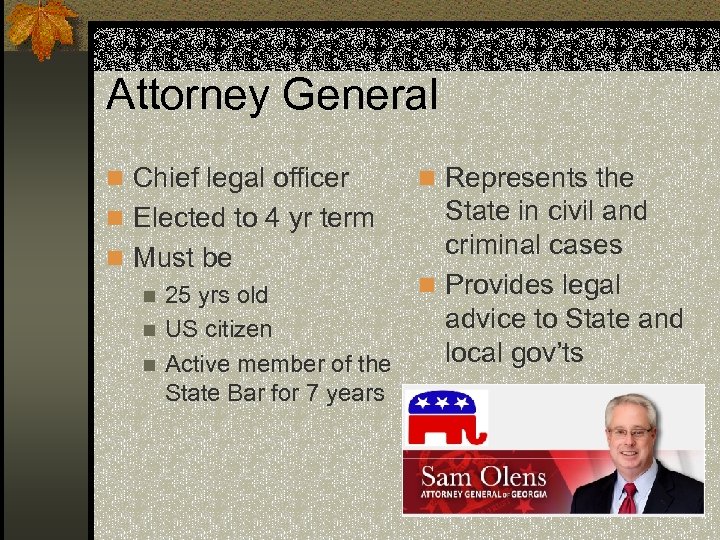 Attorney General n Chief legal officer n Represents the State in civil and criminal cases n Must be n Provides legal n 25 yrs old advice to State and n US citizen local gov’ts n Active member of the n Elected to 4 yr term State Bar for 7 years
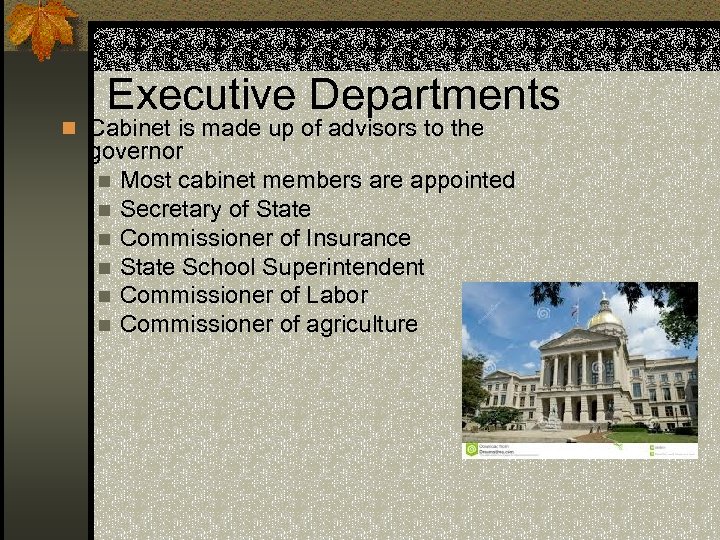 Executive Departments n Cabinet is made up of advisors to the governor n Most cabinet members are appointed n Secretary of State n Commissioner of Insurance n State School Superintendent n Commissioner of Labor n Commissioner of agriculture
 State Judicial Branch
 Georgia’s Court System n Georgia has three types of courts n Circuit and lesser Court n Court of Appeals n Supreme Court
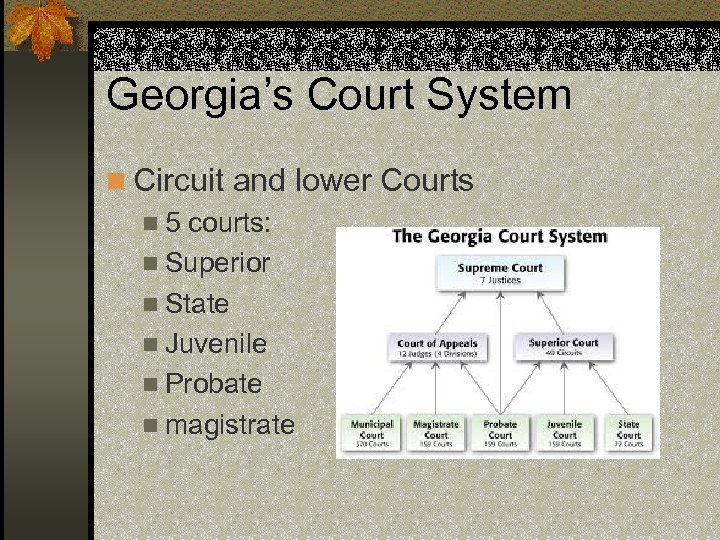 Georgia’s Court System n Circuit and lower Courts n 5 courts: n Superior n State n Juvenile n Probate n magistrate
 Georgia’s Court System Superior Court judges n Exclusive jurisdiction n Elected to 4 yr terms over felony cases, except when they involve juveniles n Land, equity, and divorce cases n Must be: n 30 yrs old n GA citizen for 3 yrs n Practiced law of 7 yrs
 Georgia’s Court System State Courts n Handle all misdemeanor violations Traffic n Civil actions n Search and arrest warrants n Preliminary hearings n Juvenile Court n Deals with cases involving individuals under 18 n Serious crimes, such as murder, may be tried in adult Superior Court
 Georgia’s Court System Probate Court Magistrate Court n Administer oaths of n Oversees civil claims of n n office Issue marriage and gun permits Handles wills Administer estates Appoint guardians $15, 000 or less
 Georgia’s Appellate Courts n Court of Appeals n Hears cases not involving the death penalty n Panel of 3 judges from 12 justices hears the case n Appellate jurisdiction
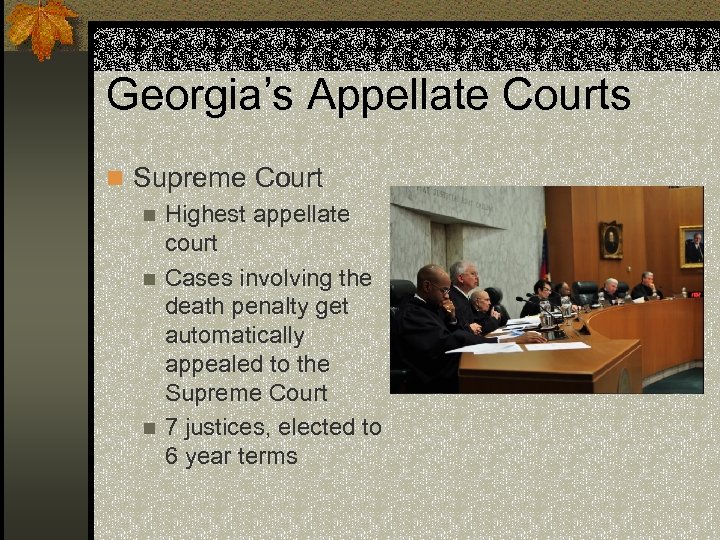 Georgia’s Appellate Courts n Supreme Court n Highest appellate court n Cases involving the death penalty get automatically appealed to the Supreme Court n 7 justices, elected to 6 year terms
 Local Governments City, Counties, special districts
 Counties n Has 159 counties (more than any state except TX) n Carry out elections, licensing, road building n Administer state programs
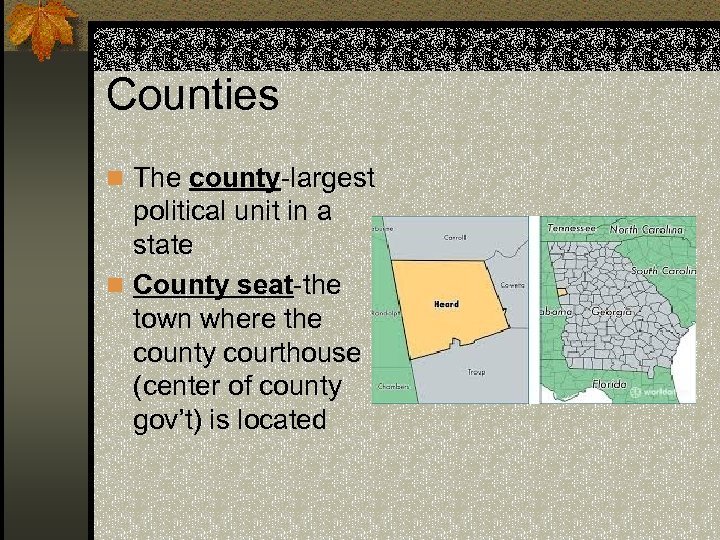 Counties n The county-largest political unit in a state n County seat-the town where the county courthouse (center of county gov’t) is located
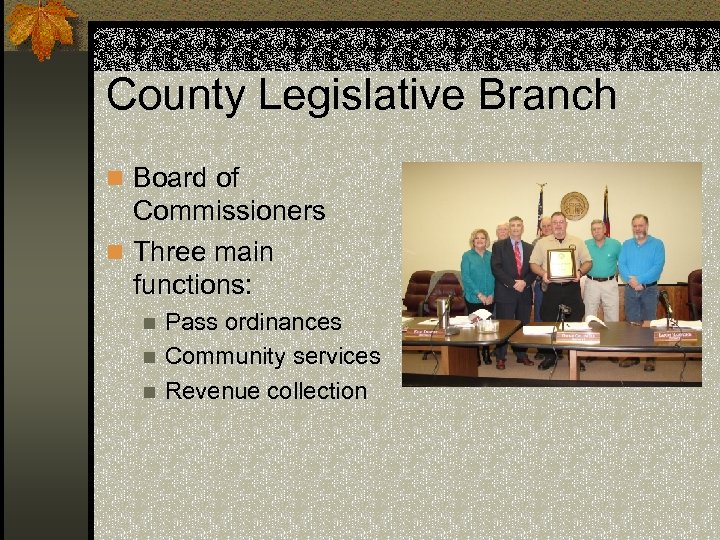 County Legislative Branch n Board of Commissioners n Three main functions: Pass ordinances n Community services n Revenue collection n
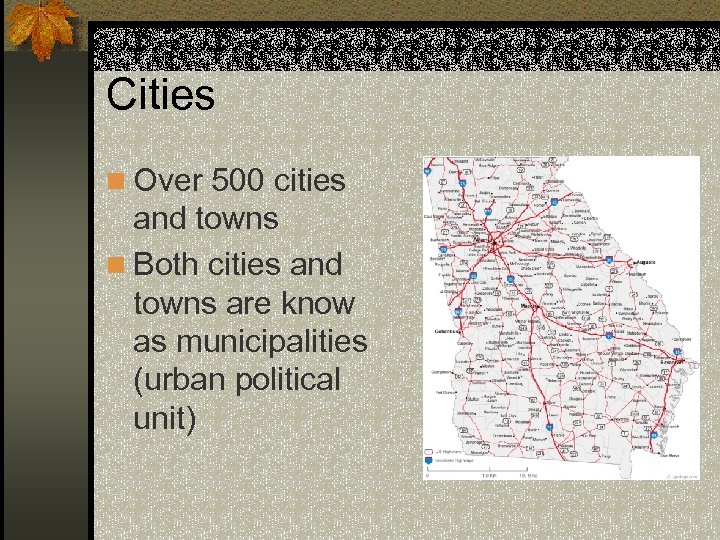 Cities n Over 500 cities and towns n Both cities and towns are know as municipalities (urban political unit)
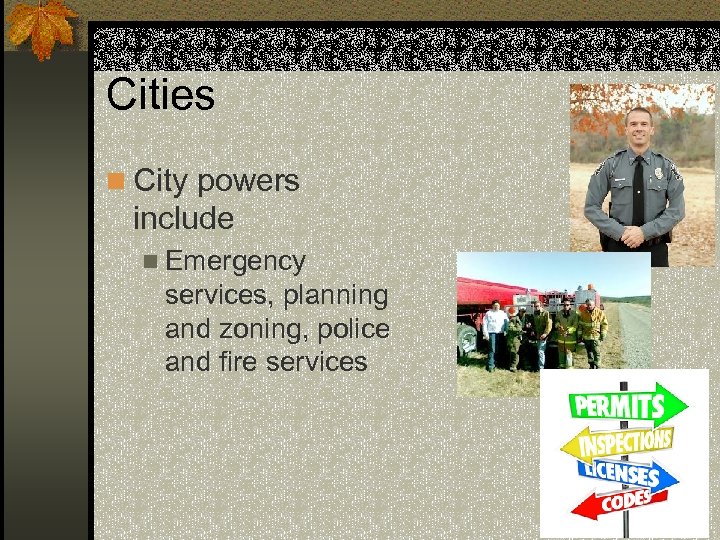 Cities n City powers include n Emergency services, planning and zoning, police and fire services
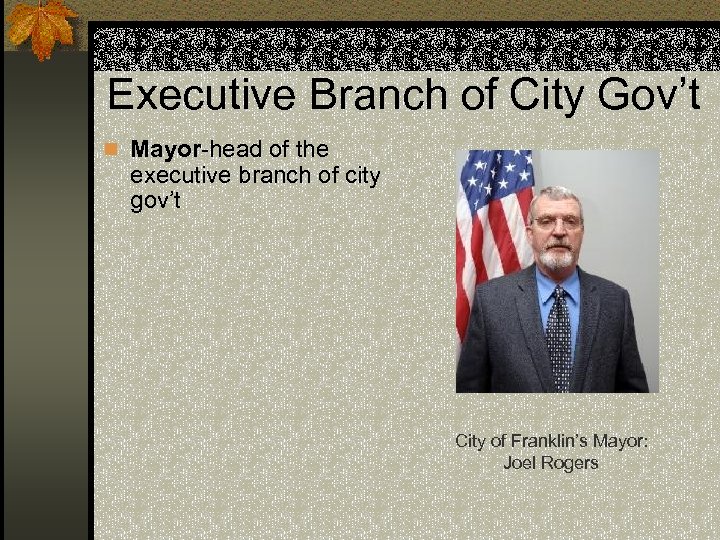 Executive Branch of City Gov’t n Mayor-head of the executive branch of city gov’t City of Franklin’s Mayor: Joel Rogers
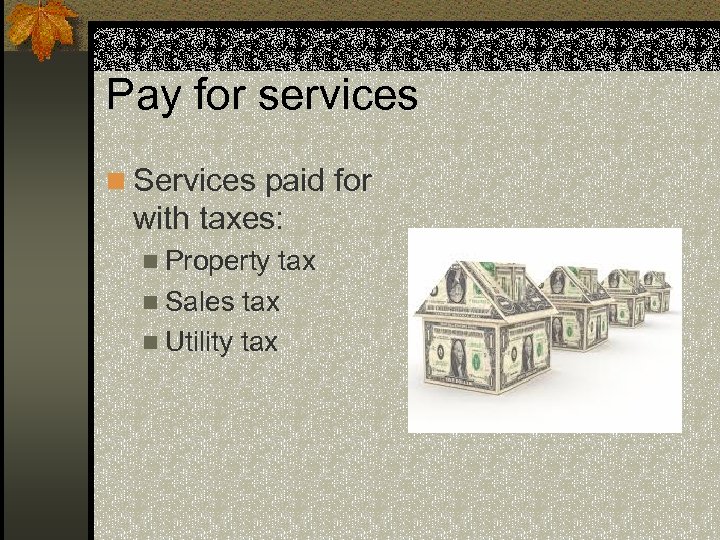 Pay for services n Services paid for with taxes: n Property tax n Sales tax n Utility tax
 Dealing With Community Issues
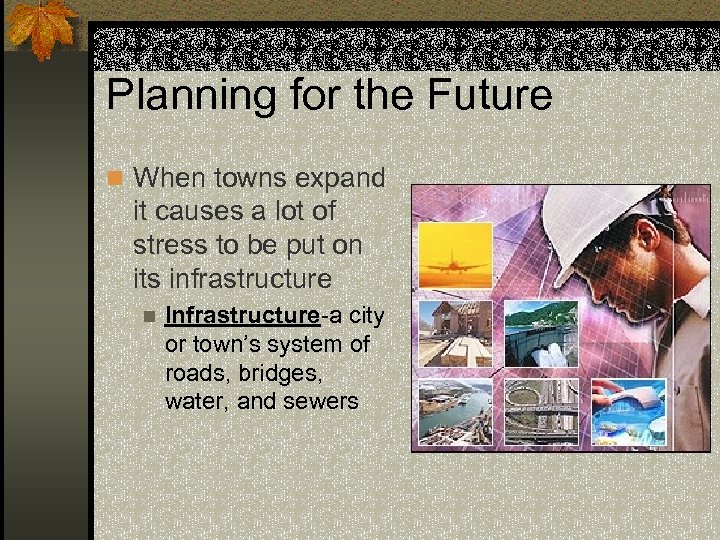 Planning for the Future n When towns expand it causes a lot of stress to be put on its infrastructure n Infrastructure-a city or town’s system of roads, bridges, water, and sewers
 Evaluating Priorities and Resources n Priorities-the goals a community considers to be most important or most urgent n In setting priorities, a community must first decide what it values most and rank their goals in order of importance
 Evaluating Priorities and Resources n Resources-the money, people, and materials available to accomplish the community’s goals n Ex. )a community has decided to improve its public transportation system—they must consider: is there enough $$$, will the roads be able to support it, etc.
 Education and Social Issues
 Public Education n The states have complete control over their education systems n The federal government gives schools a little support, but imposes certain rules on local schools