


 Скачать презентацию ROOF Eastern Mediterranean University Faculty of Interior Architecture
ROOF.pptx
- Количество слайдов: 16

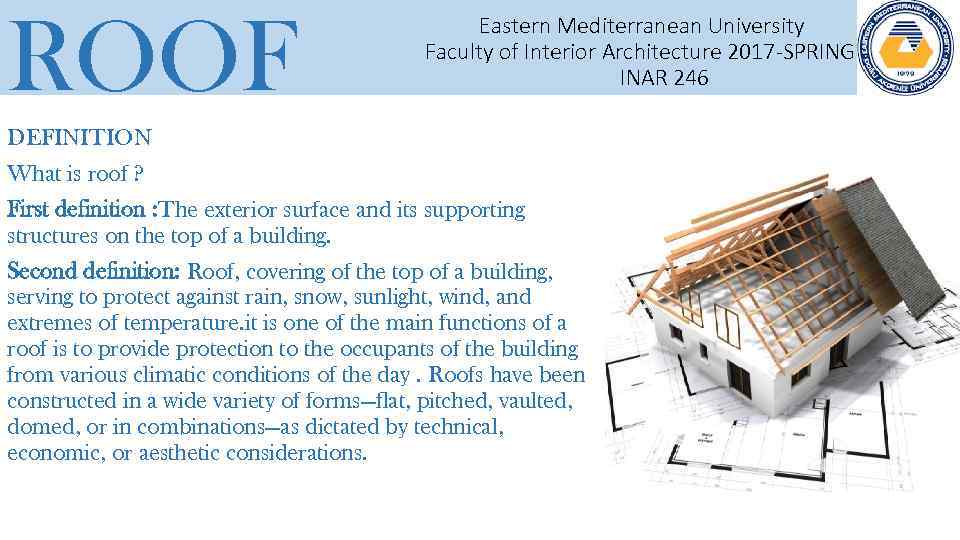 ROOF Eastern Mediterranean University Faculty of Interior Architecture 2017 -SPRING INAR 246 DEFINITION What is roof ? First definition : The exterior surface and its supporting structures on the top of a building. Second definition: Roof, covering of the top of a building, serving to protect against rain, snow, sunlight, wind, and extremes of temperature. it is one of the main functions of a roof is to provide protection to the occupants of the building from various climatic conditions of the day. Roofs have been constructed in a wide variety of forms—flat, pitched, vaulted, domed, or in combinations—as dictated by technical, economic, or aesthetic considerations.
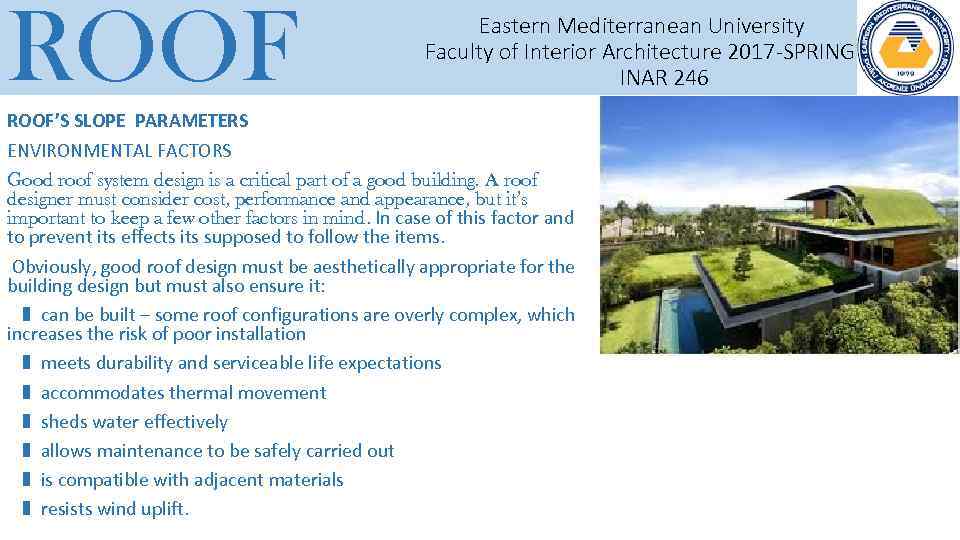 ROOF Eastern Mediterranean University Faculty of Interior Architecture 2017 -SPRING INAR 246 ROOF’S SLOPE PARAMETERS ENVIRONMENTAL FACTORS Good roof system design is a critical part of a good building. A roof designer must consider cost, performance and appearance, but it’s important to keep a few other factors in mind. In case of this factor and to prevent its effects its supposed to follow the items. Obviously, good roof design must be aesthetically appropriate for the building design but must also ensure it: ❚ can be built – some roof configurations are overly complex, which increases the risk of poor installation ❚ meets durability and serviceable life expectations ❚ accommodates thermal movement ❚ sheds water effectively ❚ allows maintenance to be safely carried out ❚ is compatible with adjacent materials ❚ resists wind uplift.
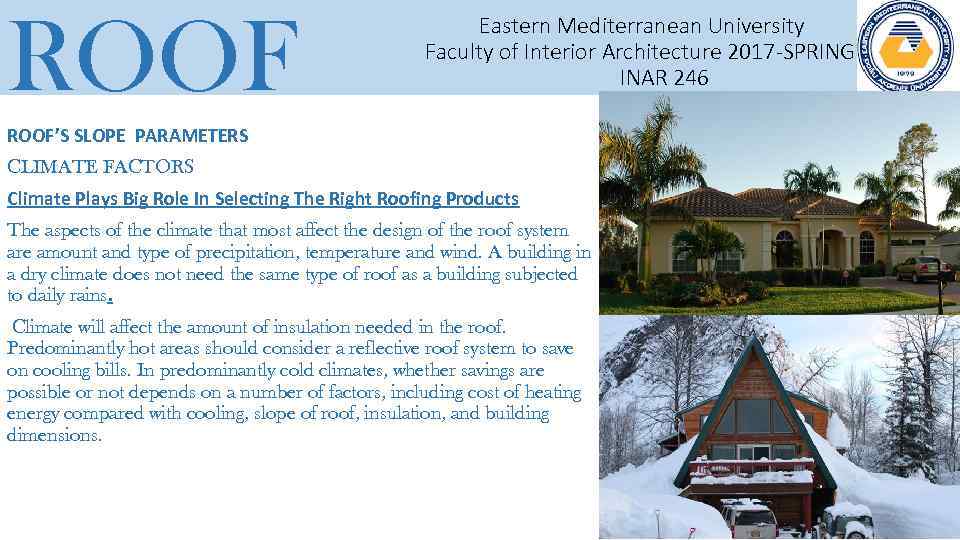 ROOF Eastern Mediterranean University Faculty of Interior Architecture 2017 -SPRING INAR 246 ROOF’S SLOPE PARAMETERS CLIMATE FACTORS Climate Plays Big Role In Selecting The Right Roofing Products The aspects of the climate that most affect the design of the roof system are amount and type of precipitation, temperature and wind. A building in a dry climate does not need the same type of roof as a building subjected to daily rains. Climate will affect the amount of insulation needed in the roof. Predominantly hot areas should consider a reflective roof system to save on cooling bills. In predominantly cold climates, whether savings are possible or not depends on a number of factors, including cost of heating energy compared with cooling, slope of roof, insulation, and building dimensions.
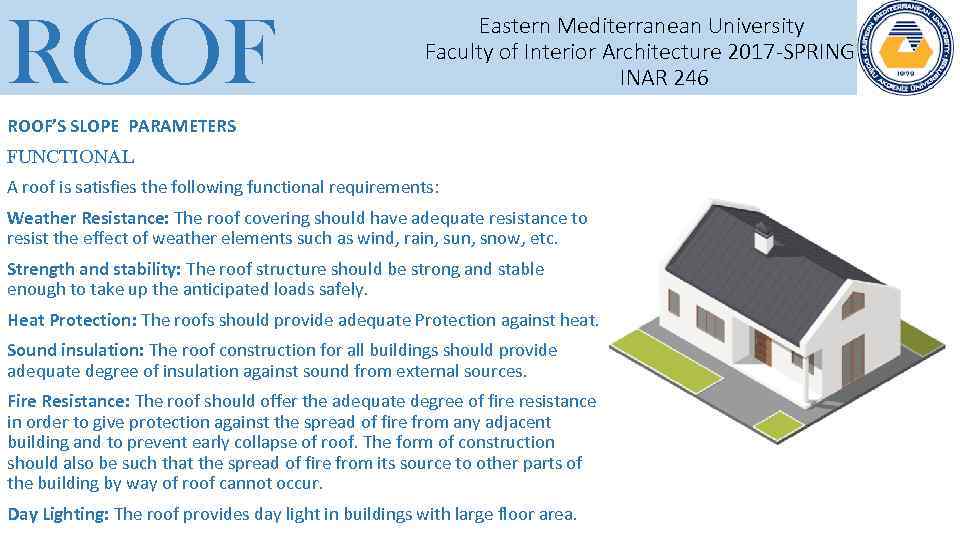 ROOF Eastern Mediterranean University Faculty of Interior Architecture 2017 -SPRING INAR 246 ROOF’S SLOPE PARAMETERS FUNCTIONAL A roof is satisfies the following functional requirements: Weather Resistance: The roof covering should have adequate resistance to resist the effect of weather elements such as wind, rain, sun, snow, etc. Strength and stability: The roof structure should be strong and stable enough to take up the anticipated loads safely. Heat Protection: The roofs should provide adequate Protection against heat. Sound insulation: The roof construction for all buildings should provide adequate degree of insulation against sound from external sources. Fire Resistance: The roof should offer the adequate degree of fire resistance in order to give protection against the spread of fire from any adjacent building and to prevent early collapse of roof. The form of construction should also be such that the spread of fire from its source to other parts of the building by way of roof cannot occur. Day Lighting: The roof provides day light in buildings with large floor area.
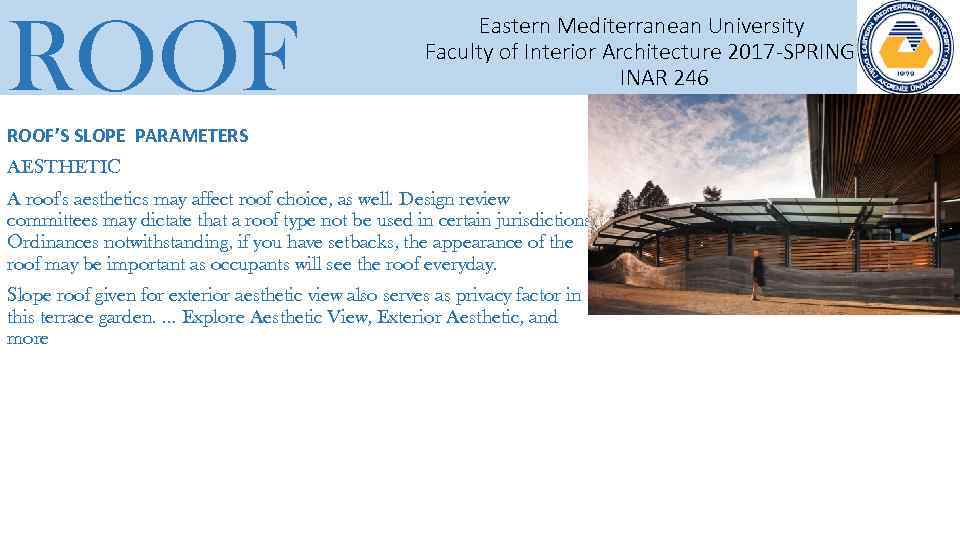 ROOF Eastern Mediterranean University Faculty of Interior Architecture 2017 -SPRING INAR 246 ROOF’S SLOPE PARAMETERS AESTHETIC A roof's aesthetics may affect roof choice, as well. Design review committees may dictate that a roof type not be used in certain jurisdictions. Ordinances notwithstanding, if you have setbacks, the appearance of the roof may be important as occupants will see the roof everyday. Slope roof given for exterior aesthetic view also serves as privacy factor in this terrace garden. . Explore Aesthetic View, Exterior Aesthetic, and more
 ROOF Eastern Mediterranean University Faculty of Interior Architecture 2017 -SPRING INAR 246 ROOF’S SLOPE PARAMETERS Cultural and Traditional factor /Reasons for exploring the traditional methods and putting in design • Traditional or indigenous construction technologies have an importance that extends beyond their form and decoration. They should be examined for more than one reason: • Indigenous methods may be more economic for a region where they are applied. • Structural, environmental, and functional benefits derived from these methods may be much higher than those derived using contemporary methods. • Study of indigenous methods may provide some direction toward the transfer of traditional skills for the effective use of contemporary materials.
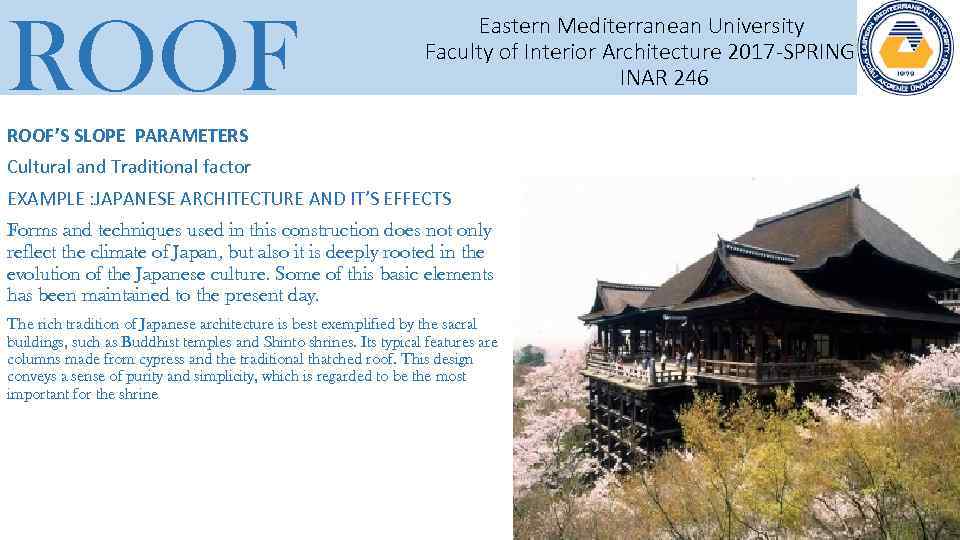 ROOF Eastern Mediterranean University Faculty of Interior Architecture 2017 -SPRING INAR 246 ROOF’S SLOPE PARAMETERS Cultural and Traditional factor EXAMPLE : JAPANESE ARCHITECTURE AND IT’S EFFECTS Forms and techniques used in this construction does not only reflect the climate of Japan, but also it is deeply rooted in the evolution of the Japanese culture. Some of this basic elements has been maintained to the present day. The rich tradition of Japanese architecture is best exemplified by the sacral buildings, such as Buddhist temples and Shinto shrines. Its typical features are columns made from cypress and the traditional thatched roof. This design conveys a sense of purity and simplicity, which is regarded to be the most important for the shrine
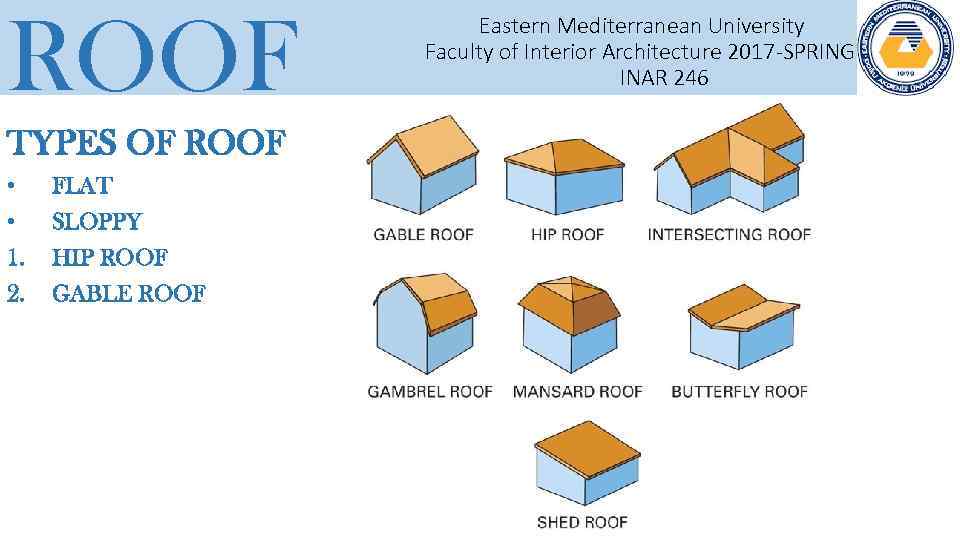 ROOF TYPES OF ROOF • • 1. 2. FLAT SLOPPY HIP ROOF GABLE ROOF Eastern Mediterranean University Faculty of Interior Architecture 2017 -SPRING INAR 246
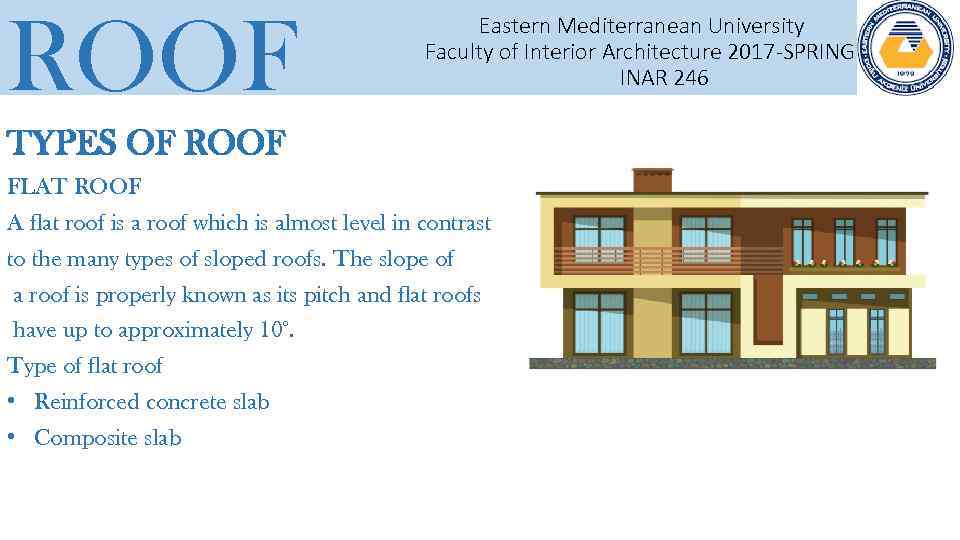 ROOF Eastern Mediterranean University Faculty of Interior Architecture 2017 -SPRING INAR 246 TYPES OF ROOF FLAT ROOF A flat roof is a roof which is almost level in contrast to the many types of sloped roofs. The slope of a roof is properly known as its pitch and flat roofs have up to approximately 10°. Type of flat roof • Reinforced concrete slab • Composite slab
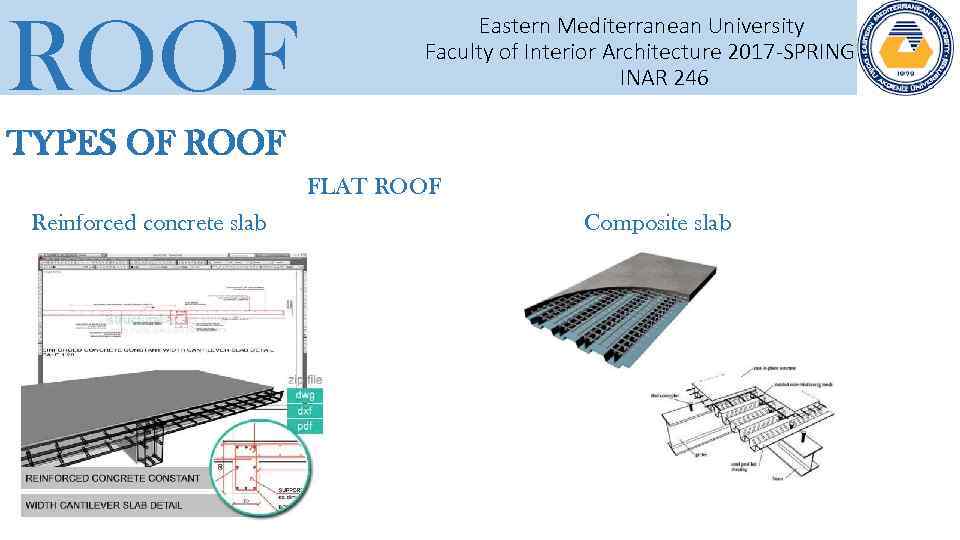 ROOF Eastern Mediterranean University Faculty of Interior Architecture 2017 -SPRING INAR 246 TYPES OF ROOF FLAT ROOF Reinforced concrete slab Composite slab
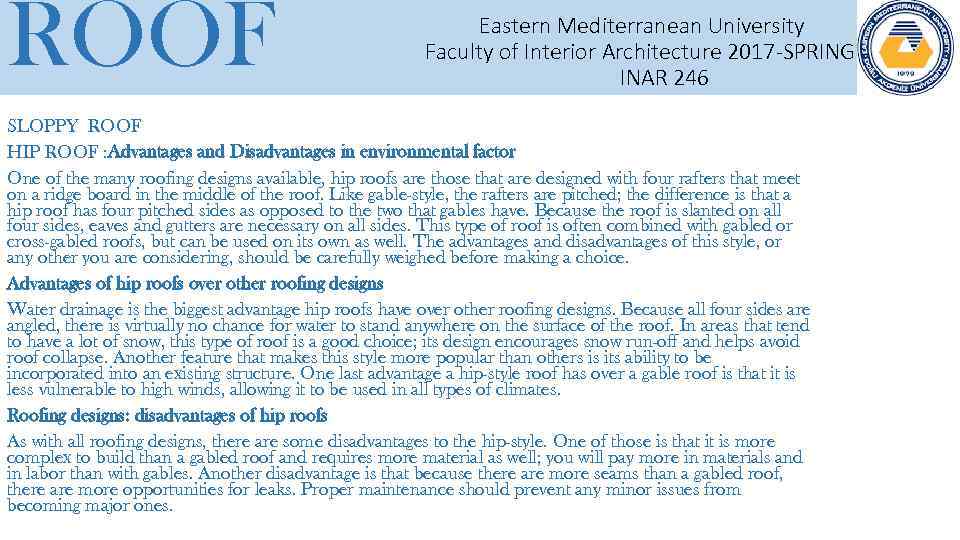 ROOF Eastern Mediterranean University Faculty of Interior Architecture 2017 -SPRING INAR 246 SLOPPY ROOF HIP ROOF : Advantages and Disadvantages in environmental factor One of the many roofing designs available, hip roofs are those that are designed with four rafters that meet on a ridge board in the middle of the roof. Like gable-style, the rafters are pitched; the difference is that a hip roof has four pitched sides as opposed to the two that gables have. Because the roof is slanted on all four sides, eaves and gutters are necessary on all sides. This type of roof is often combined with gabled or cross-gabled roofs, but can be used on its own as well. The advantages and disadvantages of this style, or any other you are considering, should be carefully weighed before making a choice. Advantages of hip roofs over other roofing designs Water drainage is the biggest advantage hip roofs have over other roofing designs. Because all four sides are angled, there is virtually no chance for water to stand anywhere on the surface of the roof. In areas that tend to have a lot of snow, this type of roof is a good choice; its design encourages snow run-off and helps avoid roof collapse. Another feature that makes this style more popular than others is its ability to be incorporated into an existing structure. One last advantage a hip-style roof has over a gable roof is that it is less vulnerable to high winds, allowing it to be used in all types of climates. Roofing designs: disadvantages of hip roofs As with all roofing designs, there are some disadvantages to the hip-style. One of those is that it is more complex to build than a gabled roof and requires more material as well; you will pay more in materials and in labor than with gables. Another disadvantage is that because there are more seams than a gabled roof, there are more opportunities for leaks. Proper maintenance should prevent any minor issues from becoming major ones.
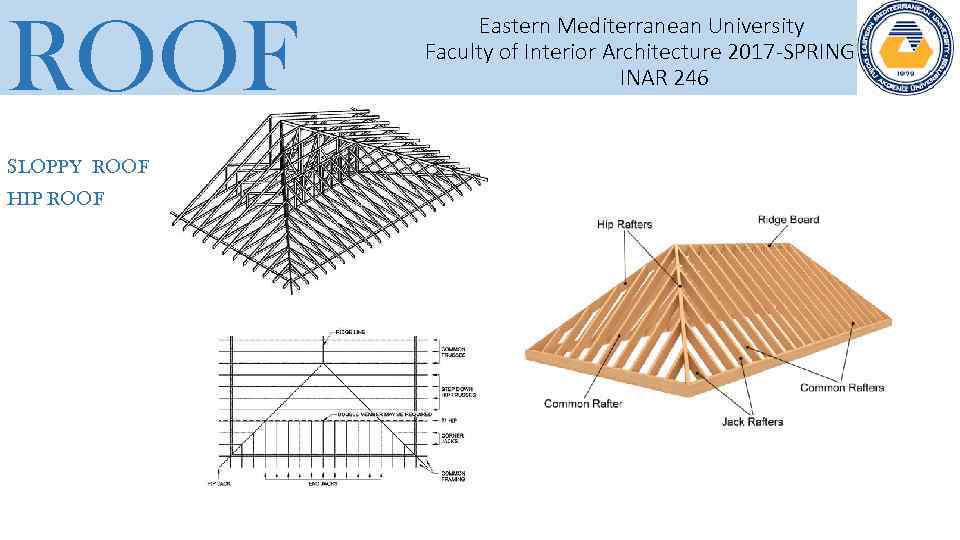 ROOF SLOPPY ROOF HIP ROOF Eastern Mediterranean University Faculty of Interior Architecture 2017 -SPRING INAR 246
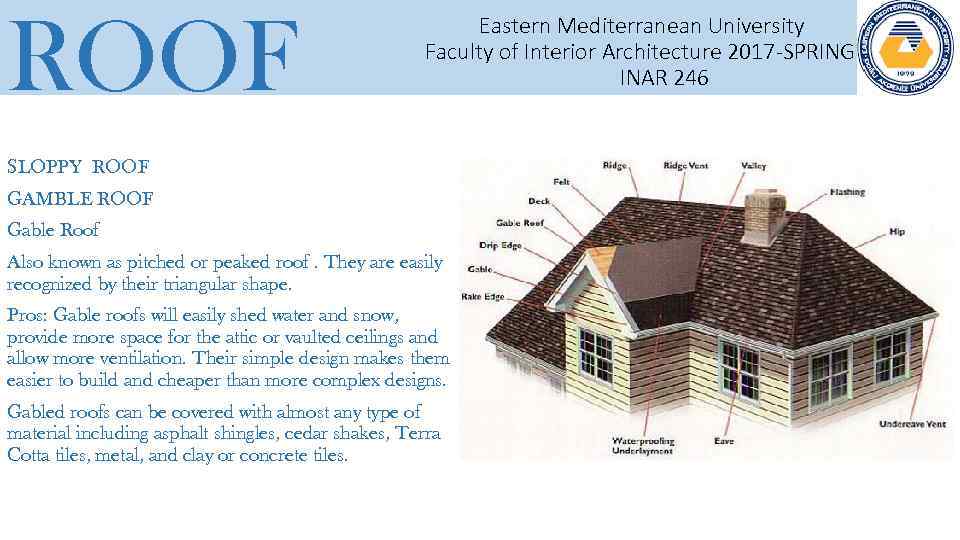 ROOF Eastern Mediterranean University Faculty of Interior Architecture 2017 -SPRING INAR 246 SLOPPY ROOF GAMBLE ROOF Gable Roof Also known as pitched or peaked roof. They are easily recognized by their triangular shape. Pros: Gable roofs will easily shed water and snow, provide more space for the attic or vaulted ceilings and allow more ventilation. Their simple design makes them easier to build and cheaper than more complex designs. Gabled roofs can be covered with almost any type of material including asphalt shingles, cedar shakes, Terra Cotta tiles, metal, and clay or concrete tiles.
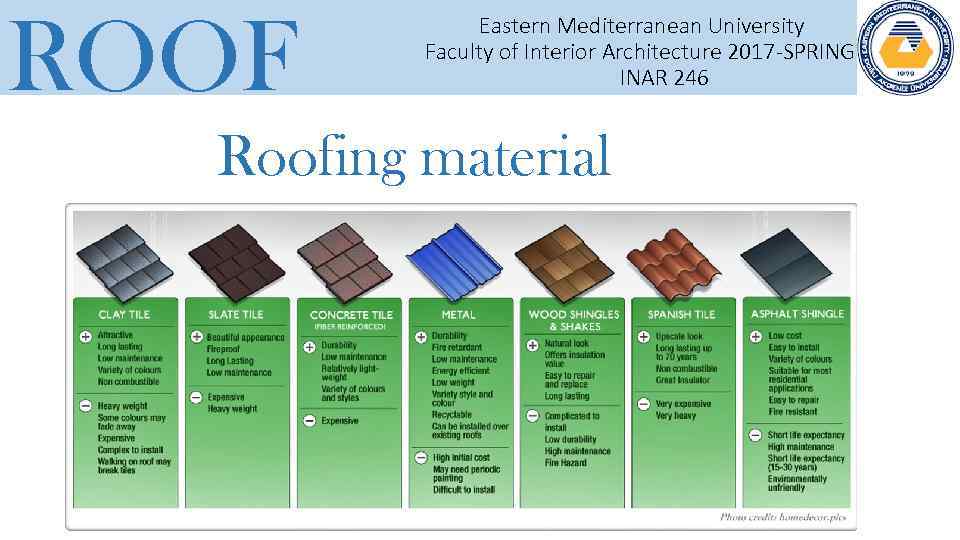 ROOF Eastern Mediterranean University Faculty of Interior Architecture 2017 -SPRING INAR 246 Roofing material
 ROOF Eastern Mediterranean University Faculty of Interior Architecture 2017 -SPRING INAR 246 THANKS FOR LISTENING