


 Скачать презентацию Ronald F White Ph D Professor of Philosophy
079e87a1d9f75d1330371b84a97403a0.ppt
- Количество слайдов: 11
 Ronald F. White, Ph. D. Professor of Philosophy College of Mount St. Joseph
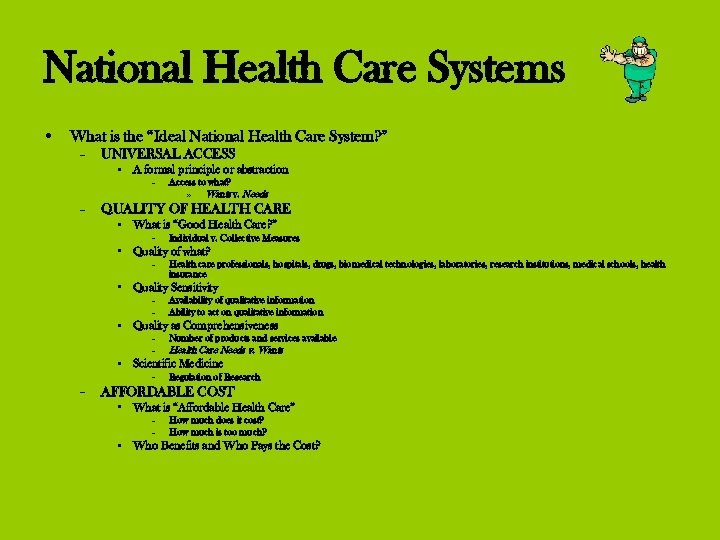 National Health Care Systems • What is the “Ideal National Health Care System? ” – UNIVERSAL ACCESS • A formal principle or abstraction – Access to what? » – Wants v. Needs QUALITY OF HEALTH CARE • What is “Good Health Care? ” – Individual v. Collective Measures • Quality of what? – Health care professionals, hospitals, drugs, biomedical technologies, laboratories, research institutions, medical schools, health insurance • Quality Sensitivity – – Availability of qualitative information Ability to act on qualitative information • Quality as Comprehensiveness – – Number of products and services available Health Care Needs v. Wants • Scientific Medicine – – Regulation of Research AFFORDABLE COST • What is “Affordable Health Care” – – How much does it cost? How much is too much? • Who Benefits and Who Pays the Cost?
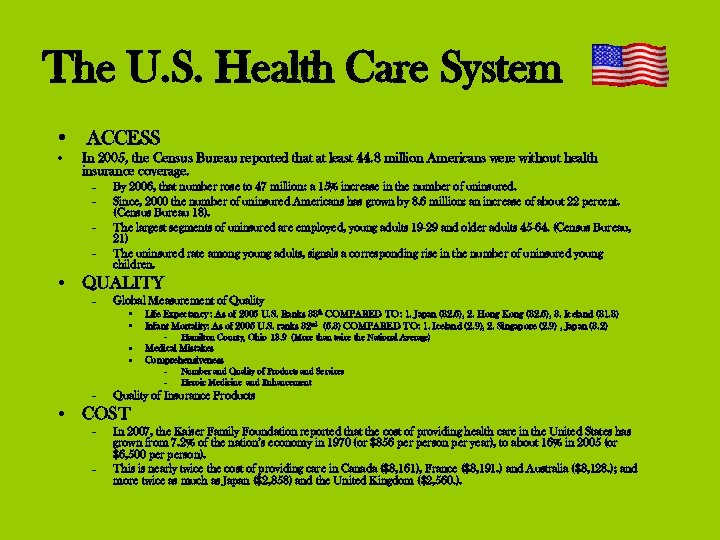 The U. S. Health Care System • ACCESS • In 2005, the Census Bureau reported that at least 44. 8 million Americans were without health insurance coverage. – – By 2006, that number rose to 47 million: a 15% increase in the number of uninsured. Since, 2000 the number of uninsured Americans has grown by 8. 6 million: an increase of about 22 percent. (Census Bureau 18). The largest segments of uninsured are employed, young adults 19 -29 and older adults 45 -64. (Census Bureau, 21) The uninsured rate among young adults, signals a corresponding rise in the number of uninsured young children. • QUALITY – Global Measurement of Quality Life Expectancy : As of 2006 U. S. Ranks 38 th COMPARED TO: 1. Japan (82. 6), 2. Hong Kong (82. 6), 3. Iceland (81. 8) Infant Mortality: As of 2006 U. S. ranks 32 nd (6. 3) COMPARED TO: 1. Iceland (2. 9), 2. Singapore (2. 9) , Japan (3. 2) • • – • • Medical Mistakes Comprehensiveness – – – Hamilton County, Ohio 13. 9 (More than twice the National Average) Number and Quality of Products and Services Heroic Medicine and Enhancement Quality of Insurance Products • COST – – In 2007, the Kaiser Family Foundation reported that the cost of providing health care in the United States has grown from 7. 2% of the nation’s economy in 1970 (or $356 person per year), to about 16% in 2005 (or $6, 500 person). This is nearly twice the cost of providing care in Canada ($3, 161), France ($3, 191. ) and Australia ($3, 128. ); and more twice as much as Japan ($2, 358) and the United Kingdom ($2, 560. ).
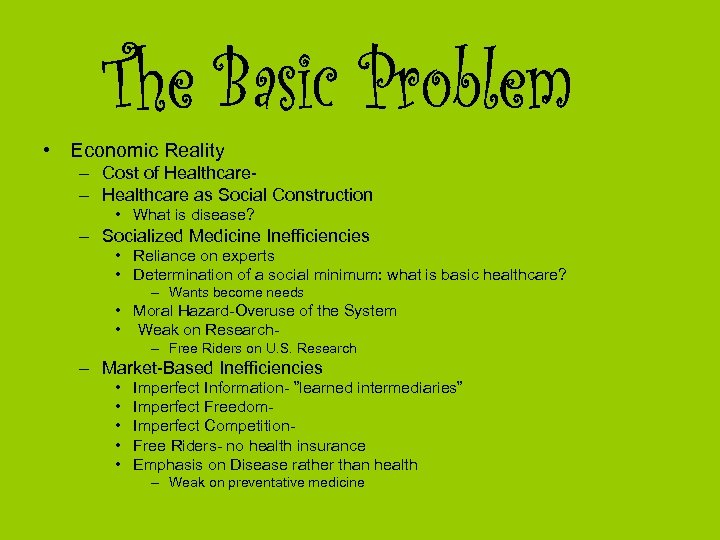 • Economic Reality – Cost of Healthcare– Healthcare as Social Construction • What is disease? – Socialized Medicine Inefficiencies • Reliance on experts • Determination of a social minimum: what is basic healthcare? – Wants become needs • Moral Hazard-Overuse of the System • Weak on Research– Free Riders on U. S. Research – Market-Based Inefficiencies • • • Imperfect Information- ”learned intermediaries” Imperfect Freedom. Imperfect Competition. Free Riders- no health insurance Emphasis on Disease rather than health – Weak on preventative medicine
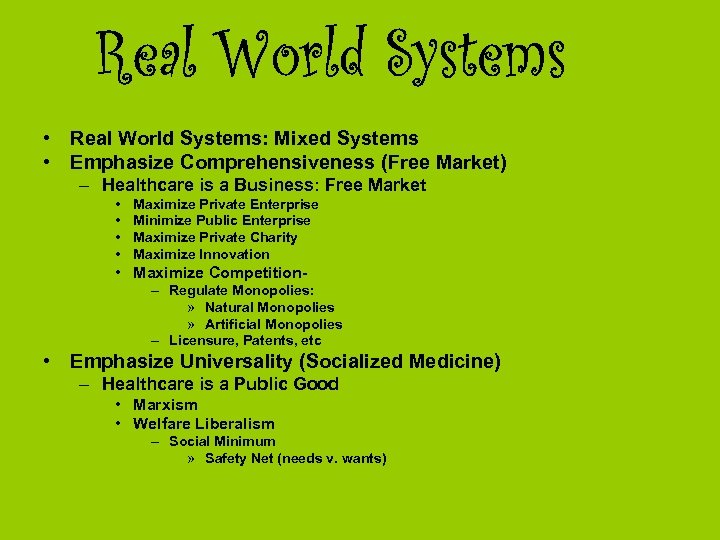 • Real World Systems: Mixed Systems • Emphasize Comprehensiveness (Free Market) – Healthcare is a Business: Free Market • • Maximize Private Enterprise Minimize Public Enterprise Maximize Private Charity Maximize Innovation • Maximize Competition– Regulate Monopolies: » Natural Monopolies » Artificial Monopolies – Licensure, Patents, etc • Emphasize Universality (Socialized Medicine) – Healthcare is a Public Good • Marxism • Welfare Liberalism – Social Minimum » Safety Net (needs v. wants)
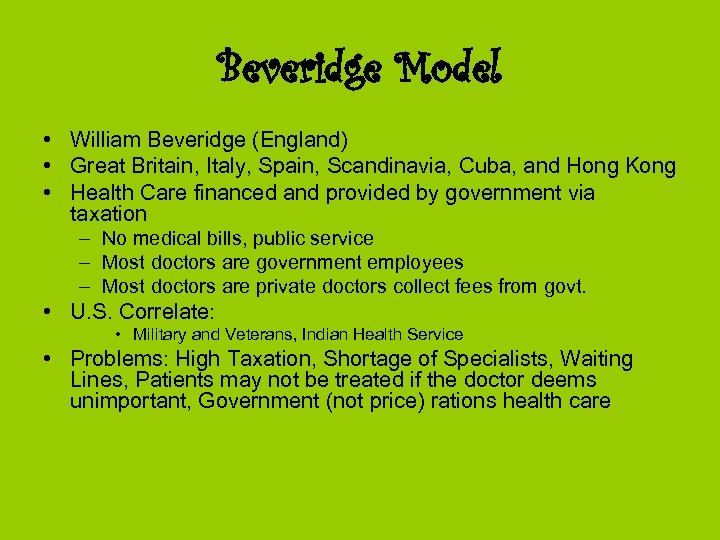 Beveridge Model • William Beveridge (England) • Great Britain, Italy, Spain, Scandinavia, Cuba, and Hong Kong • Health Care financed and provided by government via taxation – No medical bills, public service – Most doctors are government employees – Most doctors are private doctors collect fees from govt. • U. S. Correlate: • Military and Veterans, Indian Health Service • Problems: High Taxation, Shortage of Specialists, Waiting Lines, Patients may not be treated if the doctor deems unimportant, Government (not price) rations health care
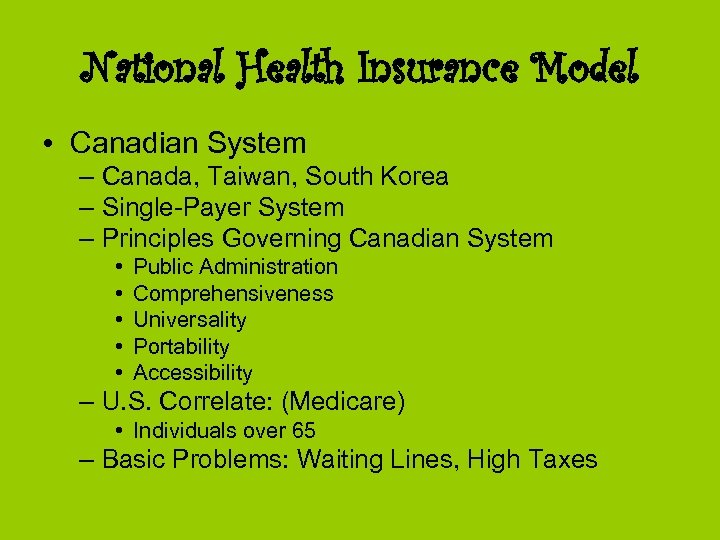 National Health Insurance Model • Canadian System – Canada, Taiwan, South Korea – Single-Payer System – Principles Governing Canadian System • • • Public Administration Comprehensiveness Universality Portability Accessibility – U. S. Correlate: (Medicare) • Individuals over 65 – Basic Problems: Waiting Lines, High Taxes
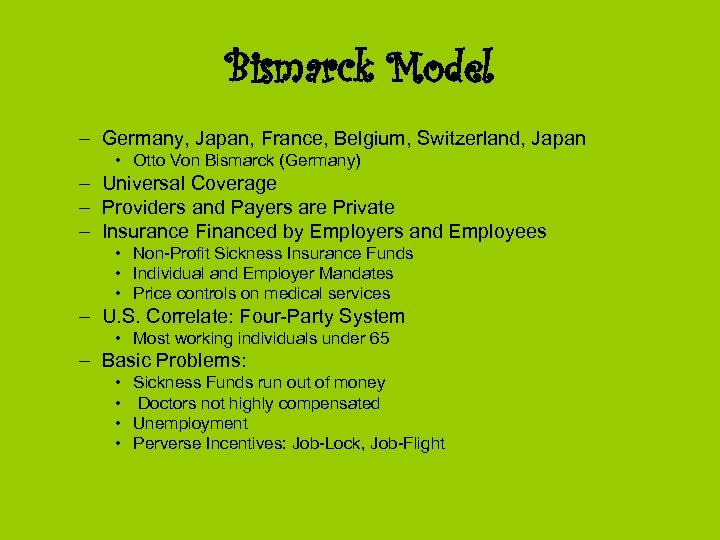 Bismarck Model – Germany, Japan, France, Belgium, Switzerland, Japan • Otto Von Bismarck (Germany) – Universal Coverage – Providers and Payers are Private – Insurance Financed by Employers and Employees • Non-Profit Sickness Insurance Funds • Individual and Employer Mandates • Price controls on medical services – U. S. Correlate: Four-Party System • Most working individuals under 65 – Basic Problems: • • Sickness Funds run out of money Doctors not highly compensated Unemployment Perverse Incentives: Job-Lock, Job-Flight
 Out-of-Pocket System • Countries without any Organized Health Care System – Somalia, Afghanistan etc. • Products and Services not covered by Countries with Health Care Systems. – Treatments that address wants (elective v. necessary treatments) • Cosmetic surgery, Sex change, weight reduction surgery etc. – Treatments with marginal cost-benefit ratios • Joint replacement surgery – Dental care, psychiatric care, pharmaceuticals – Illegal Treatments on the black market (Rhino Horn etc. ) • The United States – – Unemployed or Underemployed Uninsured with pre-existing conditions Exceed Lifetime Insurance Limits Under-Insured • Contractual Exclusions • Problems: Access to health care by the poor, inequality of quality (the rich get better care).
 Health Care Systems in the United States • Decentralized Mixed System Based on Groups • Four-Party System (workers) – Bismarck Model • Multiple Systems – Federal Employees Health Benefit Program (employees of government) – Medicare (elderly) – Beveridge Model – Medicaid (poor) – National Health Insurance Model – Veteran’s Medicine (veterans) – Beveridge Model – State Children’s Health Insurance Program (SCHIP) – National Health Insurance Model – Reauthorized in 2009 – Cobra Consolidated Budget Reconciliation Act COBRA (unemployed)
 Questions for Discussion • Why are all national health care systems always subject to “reform? ” • Are comparisons between the U. S. health care systems and European systems fair? • Why do all health care systems struggle with the conflict between “market justice” and “social justice? ”