


 Скачать презентацию ROME When In Rome Roman Empire and
7b7dd6c138e75bc47dcfc65815a98fb2.ppt
- Количество слайдов: 80
 ROME When In Rome…
 Roman Empire and Roman Peace – Octavian was given the title Augustus or “Exalted One” and declared him princips or first citizen » Did not call himself king (title hated since Etruscan times), he exercised absolute power and named his successor…just as a king would do » Under Augustus (31 BC – 14 AD), the 500 year old republic came to an end » This began the age of the Roman Empire
 – A Stable Government » Left the senate in place, but created an efficient, well-trained civil service to enforce the laws » High level jobs were open to men of talent, regardless of class » Secured the allegiance of cities and provinces to Rome by allowing them a large measure of selfgovernment
 » » Economic reforms Ordered a census or population count, to make the tax system more fair Set up postal service and issued new coins to make trade easier Put the jobless to work building roads and temples and sent others to farm the land
 » » » Efficient government for 200 years, but problem was who would rule after the emperor died Romans did not accept the idea of power passing automatically from father to son (too much like a king) Death of an emperor often led to intrigue and violence
 – Bad Emperors and Good Emperors » Some emperors were weak and incompetent » Caligula – appointed his favorite horse as consul
 • Nero – viciously persecuted Christians and was blamed for setting the great fire that destroyed much of Rome
 » » » • 96 – 180 AD, the “good emperors” Hadrian Codified Roman law making it the same for all provinces Had soldiers build a wall across Britain to hold back attackers from the non-Roman north
 » Marcus Aurelius » Read philosophy while on military campaigns and was close to Plato’s ideal of a philosopher king » Wrote Meditations which shows his Stoic philosophy and commitment to duty
 – The Pax Romana…period beginning with Augustus and ending with Marcus Aurelius… Roman Peace » Roman rule brought peace, order, and unity and prosperity to lands stretching from the Euphrates River in the east to Britain in the west…area equal to the continental United States
 » Trade flowed freely to and from distant lands in Africa and Asia » Egyptian farmers supplied Romans with grain from the Nile Valley » Ivory and gold lions and other animals used for public entertainment came from other areas of Africa » Spices, cotton, and precious stones from India » Silk and other goods came from China along the Silk Road
 • People moved easily within the Roman empire spreading ideas and knowledge, especially advances in the Hellenistic east
 – Bread and Circuses » Circus Maximus, Romes largest race course, chariots thundered around an oval course
 » » » Gladiator contests were more popular Most were slaves who had been trained to fight Battled in the arena one on one or in groups A good fighter may win his freedom Poor fighters would be killed by a thumbs down by the crowd » Gladiatorial fights were paid for by the taxes collected from the empire…way to pacify the city’s restless mobs » Also gave out free bread, despite warnings from critics against “bread and circuses”
 • General prosperity hid underlying social and economic problems…but later Roman emperors would face problems that could not be solved with bread
 SECTION III • The Roman Achievements
 – – Roman Civilization was a Blend of Greek, Hellenistic and Roman Achievements Greco-Roman Civilization – – In its early days, Rome absorbed ideas from Greek colonists in southern Italy, and borrowed heavily from Greek culture when they conquered Greece Greek art, literature, philosophy, and scientific genius represented the height of cultural achievement to the Romans emerging from their villages Adapted Greek and Hellenistic achievements just s the Greeks had absorbed ideas from Egypt and the Fertile Crescent…produced what is known as Greco-Roman civilization Trade and travel during the Pax Romana helped spread this vital new civilization
 – Literature, Philosophy, and History – Owed a lot to the Greeks…imitated style and prose and poetry, but used Latin to create their own literature
 – Poetry » Aeneid – Virgil tried to show that Rome’s past was as heroic as that of Greece » Tells of Aeneas escaping from Troy to found Rome » Written soon after Augustus came to power…hoped it would arouse patriotism and help unite Rome after years of civil wars
 » Other poets used verse to satirize or make fun of Roman society » Horace’s satires were gentle using playful wit to attack human folly » Juvenal and Martial were more biting…Martial’s poems were so harsh that he had to use fictitious names to protect himself from retribution
 History » Livy sought to rouse patriotic feeling (like Virgil) and restore traditional Roman virtues by recalling images of Rome’s heroic past…he recounted tales of great heroes such as Horatius and Cincinnatus » Tacitus wrote bitterly about Augustus and his successors » Felt they had destroyed Roman liberty » Admired the simple culture of the Germans who lived on Rome’s northern frontier and would later invade the empire
 Philosophy » Much borrowed from the Greeks » Stoicism impressed Roman thinkers like Marcus Aurelius » Stressed the importance of duty and acceptance of one’s fate » Showed concern for the well-being of all people, an idea that would be reflected in Christian teachings
 Art and Architecture – Art » Roman sculptors stressed realism like the Greeks…showing every physical feature » Broke new ground by revealing an individual’s character capturing expressions of smugness, discontent, or haughty pride » Some Roman sculptors were idealistic…transforming Augustus, who was neither handsome nor imposing, into a symbol of power and leadership » Romans beautified their homes with works of art…Pompeii shows this art of scenes from roman literature and daily life in splendid frescoes and mosaics picture made from chips of colored stone or glass
 Architecture » Romans emphasized grandeur with immense palaces, temples, and stadiums » Improved devices such as the column and the arch » Used concrete as building material and developed the rounded dome to roof large spaces…the Pantheon, a temple to all Roman gods, still stands in Rome
 Technology and Science – Romans excelled in engineering or the application of science and mathematics to develop useful structures and machines » Roman engineers built roads, bridges, and harbors throughout the empire » Roads were so solidly built hat many of them were still used long after the fall of he empire
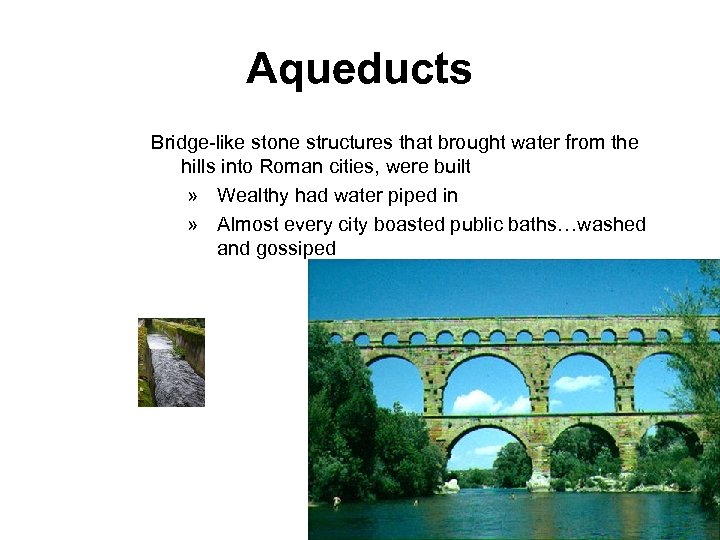 Aqueducts Bridge-like stone structures that brought water from the hills into Roman cities, were built » Wealthy had water piped in » Almost every city boasted public baths…washed and gossiped
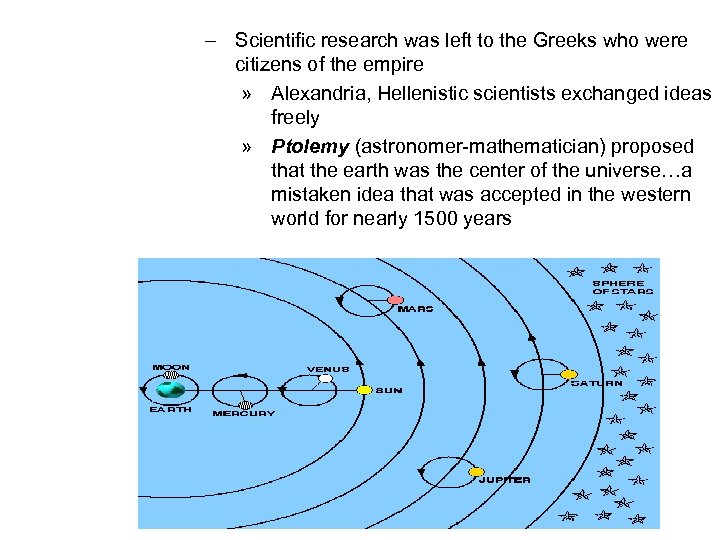 – Scientific research was left to the Greeks who were citizens of the empire » Alexandria, Hellenistic scientists exchanged ideas freely » Ptolemy (astronomer-mathematician) proposed that the earth was the center of the universe…a mistaken idea that was accepted in the western world for nearly 1500 years
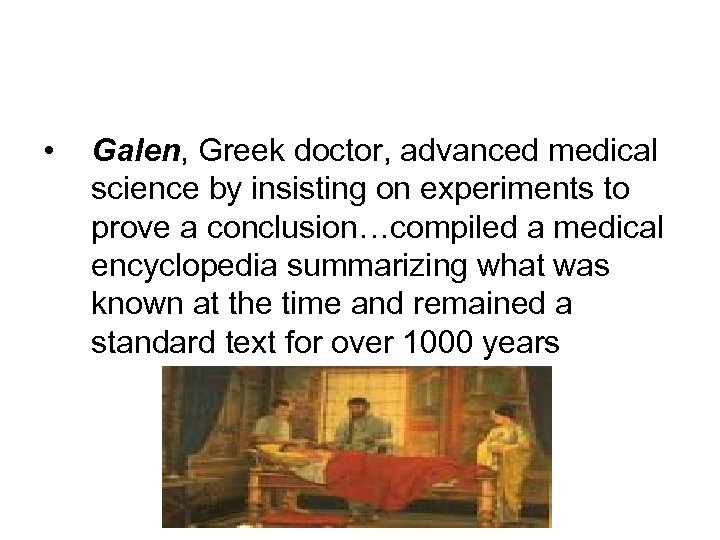 • Galen, Greek doctor, advanced medical science by insisting on experiments to prove a conclusion…compiled a medical encyclopedia summarizing what was known at the time and remained a standard text for over 1000 years
 » Put science to practical use » Applied geography to make maps » Applied medical knowledge to help doctors improve public health » Collected knowledge into encyclopedias » Pliny the Elder, a Roman scientist, compiled volumes on geography, zoology, botany, and other topics…all based on other people’s works
 Roman Law • Rule of law fostered unity and stability…principles of Roman law would become the basis for legal systems in Europe and Latin America
 – Two Systems » Civil law applied to its citizens during the republic » As time progressed, foreigners, who were not citizens, were covered by the law of nations which applied to all people under Roman rule » When Rome extended citizenship across the empire, the two systems merged
 – Common Principles » Certain basic principles evolved as Roman law developed » Accused person was presumed innocent until proven guilty » Accused was allowed to face the accuser and offer a defense against the charge » Guilt had to be established “clearer than daylight” through evidence » Judges were allowed to interpret the laws and were expected to make fair decisions
 The Rise of Christianity Section 4 – Setting the Scene – Sprang up in a distant corner of the Roman empire early on during the Pax Romana – At first, one of many religions practiced in the empire » Grew rapidly and by 395 AD, it had been declared the official religion of the Roman empire » Reshaped Roman beliefs and, when the empire fell, the Christian Church took over much of its rule becoming the central institution of western civilization for nearly 1000 years
 – Religious Diversity in the Early Empire… – Traditional Roman gods remained important to some people, but a growing number of people were looking elsewhere for spiritual fulfillment – Mystery Religions » Secret rituals and promises of special rewards » One of the most popular was the cult of Isis which originated in Egypt and offered women equal status with men » Others worshipped the Persian god Mithras, who championed good over evil and offered life after death…Mithraism was especially favored by Roman soldiers
 – ****Religious Toleration » As long as citizens showed loyalty by honoring Roman gods and acknowledging the divine spirit of the emperor, they were allowed to worship other gods as they pleased » Most people were polytheistic, so they were content to worship the Roman gods along with their own
 – Divisions in Judea » Romans conquered Judea by 63 BC where most Jews lived » To avoid violating the Jewish belief in one god, the Romans excused Jews from worshipping Roman gods » Deep divisions among the Jews » During the Hellenistic age, many Jews absorbed Greek customs and ideas » Jewish conservatives, concerned about the weakening of their religion, rejected these influences and called for strict obedience to Jewish laws and traditions » Zealots were not willing to live under Roman rule » Wanted Jews to revolt against Rome and reestablish an independent state » Some Jews believed that a messiah or anointed king sent by G-d, would soon appear to lead the Jewish people to freedom
 Jewish Revolt » In 66 AD, Roman force crushed the rebels in Judea, captured Jerusalem, and destroyed the Jewish temple » When revolt broke out again the next century, Roman armies leveled Jerusalem » Thousands of Jews were killed in the fighting and many more were enslaved and transported to various parts of the empire » Faced with destruction that resulted from the rebellions, growing numbers of Jews decided to leave Judea
 » Although they were scattered, Jews continued to survive in communities throughout the Mediterranean » Jewish Rabbis, or scholars extended and preserved the religious law as set forth in the Talmud » commitment to learning Jewish law and traditions enabled the Jews to survive over the centuries
 Jesus and His Message – Almost all we know about the life of Jesus comes from the Gospels, the first four books of the New Testament of the Bible…attributed to Matthew, Mark, Luke, and John four of Jesus’ followers…gospel comes from Old English for “good news” – Life of Jesus » Born about 4 BC in Bethlehem near Jerusalem…Gospels say: » Descendent of King David of Israel » Angel told his mother he would be great » Grew up in Nazareth and worshipped G-d and followed Jewish law » My have worked as a carpenter as a young man (like Mary’s husband, Joseph)
 » Age of 30, he began preaching to villagers near the Sea of Galilee » To help with his mission, he recruited twelve close followers, known as the apostles meaning “a person sent forth » Chief apostle was Peter » Large crowds gathered to hear Jesus’ teachings, especially when word spread that he had performed miracles of healing » Jesus often used parables, or short stories with simple moral lessons, to communicate his ideas » After three years, he and his disciples, or loyal followers went to Jerusalem to spread his message there
 The Message » Firmly rooted in Jewish tradition » Believed in one G-d and accepted the Ten Commandments » Preached obedience to the laws of Moses and defended the teachings of the Jewish prophets
 Preached new beliefs » According to his followers, he called himself the “Son of G-d” » Many people believed he was the messiah whose appearance the Jews had predicted » Claimed his mission was to bring spiritual salvation and eternal life to anyone who would believe him » In the sermon on the Mount, Jesus summed up his ethical message which echoed the Jewish ideas of mercy and sympathy for the poor and helpless » Emphasized love and taught the need for justice, morality, and service to others » Major responsibilities were to love the Lord with all your heart and love your neighbor as yourself…also, love your enemies
 Death on the Cross » Seen by some as a dangerous troublemaker by some » Jewish priests felt that he was challenging their leadership » Roman authorities saw him as a revolutionary who might lead the Jews in a rebellion against Roman rule
 » Gospels state he was betrayed by one of his disciples » Arrested by the Romans » He was condemned to death and crucified » After crucifixion, the Gospels state he rose from the dead and commanded his disciples to spread his teachings and then he ascended into heaven
 Spread of Christianity – Apostles and other disciples spread Jesus’ message and helped establish Christian communities » Preached only in Judea at first and some accepted him as the Christ (“anointed one”) » For a time, Christianity remained a sect in Judaism » Spread throughout the Roman world » According to tradition, Peter established Christianity in Rome » Paul, a Jew from Asia Minor, played the most influential role in the spread of Christianity
 **Work of Paul » Never met Jesus and had been one of the people who persecuted his followers » Had a vision in which Jesus spoke to him and he converted to the new faith deciding to spread the teachings of Jesus beyond Jewish communities to gentiles, or non Jews
 » Set Christianity on the road to becoming a world religion » Traveled around the Mediterranean and set up churches from Mesopotamia to Rome » Wrote long letters to the Christian communities and explained difficult doctrines, judged disputes, and expanded Christian teachings. . . letters are part of the New Testament » Emphasized the idea that Jesus had sacrificed his life out of love for humankind and those who believed Jesus was the son of G-d and followed his teachings would achieve salvation, or eternal life
 Persecution » Roman tolerance did not extend to Christianity » Christians did not make sacrifices to the emperor or honor the Roman gods » Christians met in secret to avoid persecution and rumors spread that they were engaged in evil practices » In times of trouble, persecution increased » Emperors like Nero tried Christians as scapegoats blaming them for social and economic ills » Thousands of Christians became martyrs, people who suffer or die for their beliefs » According to tradition, both Peter and Paul were killed in Rome during the reign of Nero
 Reasons for Christianity’s Appeal » Christianity continued to spread despite persecution » Jesus had welcomed all people, especially the humble, poor and oppressed… found comfort in his message of love, equality, human dignity, and the promise of a better life beyond the grave » Missionaries like Paul added ideas from Plato, the Stoics, and other Greek thinkers to Jesus’ message » Educated Romans were attracted to a religion that incorporated the discipline and moderation of Greek philosophy
 » Work off missionaries like Paul was made easier by the unity of the Roman empire » Traveled along Roman roads and across the Mediterranean Sea protected by Roman fleets » Early Christian documents were usually written in Greek or Latin, languages that many people in the empire understood » Persecution brought new converts » People were impressed by the strength of Christians’ belief since they were willing to die for their religion » “The blood of the martyr is the seed of the [Christian] Church, ” noted one Roman
 Triumph » Persecution finally ended in 313 AD when the emperor Constantine issued the Edict of Milan granting freedom of worship to all citizens of the Roman Empire » Constantine was influenced by his mother who was a devout Christian » Eighty years later, the emperor Theodosius (thee uh DOH shuhs) made Christianity the official religion of the Roman empire
 The Early Christian Church – Structured church was organized slowly over time – Patterns of Life and Worship » A person fully joined the Christian community by renouncing evil in the rite of baptism…baptism meant sins were forgiven by the grace of G-d » Members of the community were considered equals and they addressed each other as “brother” or “sister” » Every Sunday, the baptized would gather and eat a meal of bread and wine called the Eucharist…did it to honor Jesus whose last meal was described in the Gospels
 Role of Women » Christianity promised there is “neither Jew nor Greek, neither slave nor free…neither male nor female” » Women served as teachers and administrators » Even when they were later barred from any official role in the Church, they worked to win converts across the Roman world
 Structure of the Church » Each community had its own priest » Only men were allowed to become members of the Christian clergy » Priests came under the authority of a bishop, a Church official who was responsible for all Christians in an area called a diocese » Traced their authority to the apostles and through the apostles to Jesus himself » In the early Christian Church, all bishops were considered equal successors of the apostles
 » Gradually, bishops of the most important cities in the Roman Empire gained greater authority » Rome, Antioch, Alexandria, Jerusalem, and Constantinople gained honorary titles of patriarch and exercised authority over other bishops in their area » All of the cities with patriarchs were in the eastern empire » Church developed into a hierarchy, or organization in which officials are arranged according to rank
 Division in the Church » Rituals and structure in the Church became more defined and divisions began to arise » A major force behind the division was rivalry among the patriarchs » In the Latin speaking west, bishops of Rome, who became known as popes, began to claim greater authority over all other bishops » In the Greek speaking east, patriarchs felt that the five patriarchs should share spiritual authority as equals
 » Another source of disunity was the emergence of heresies or beliefs said to be contrary to official Church teachings…to end disputes over questions of faith, councils of Church leaders met to decide official Christian teachings » Church sent out missionaries to convert people within the empire and beyond
 Theology and Scholarship » Theology means talk or discourse about G-d (taken from Greek) » Two scholars were Clement and Origen who both lived and worked as teachers in Alexandria…both wrote in Greek » Origen was respected for his intellectual achievements » Accepted the traditions of the Gospels, but also believed that he and other Christians could reach a deeper understanding of Jesus’ teachings through reflection » Wrote several works that had a lasting influence on Christianity
 • Augustine, bishop of Hippo in North Africa, combined Greco-Roman learning, especially the philosophy of Plato, with Christian doctrine…wrote The City of G-d in 410 after Rome was sacked describing a community of those who loved G-d and would one day love with him in heaven…people with minds and hearts set only on worldly things lived outside the City of G-d
 Looking Ahead – Christian church grew, but Roman power faded – When the western Roman empire finally collapsed, the Church inherited many of its functions » Preserved and spread not only Christian teachings but also the achievements of Greco-Roman civilization
 The Long Decline • Setting the Scene
 – More than 1500 years ago, the western half of the Roman empire stumbled into ruin » Romans stunned » Historian Ammianus Marcellinus pointed to declining values » Centers of learning filled with ridiculous amusements » Libraries closed forever » Moral decay of the Roman classes » Powerful fall away into error and vice » Lower classes spend the whole night drunk or gambling » External threats to the empire such as the invading Huns could force their way through all obstacles
 – Decay had set in centuries before the final fall » Late 200 s, the empire was divided into two parts ruled by a co-emperor » Complex combination of problems led to the decline and fall of the western Roman empire
 Crisis and Reforms – Golden age of the Pax Romana ended with the death of Marcus Aurelius in 180…political and economic turmoil rocked the empire – Struggles for Power » Disruptive political pattern emerged » Emperors overthrown by political intriguers or ambitious generals who seized power with the support of their armies » Those who rose to the throne in this way only ruled for a few months or years until they were overthrown or assassinated
 » In one 50 year period, at least 26 emperors reigned…only one died of natural causes » Political violence and instability, rather than order and efficiency, became the rule
 Economic and Social Problems » Economic problems » High taxes to support the army and the bureaucracy placed heavy burdens on business people and small farmers » Farmland had been over cultivated for years and lost its productivity » Social problems…many farmers left their land sought protection from wealthy landowners » Worked on large estates and farmed small plots for themselves » They were technically free, but not allowed to leave the land
 Emperor Diocletian » 284, set out to restore order…divided the empire into two parts to make it easier to govern » He kept control of the wealthier eastern part » Appointed a co-emperor to rule the western provinces » Co-emperor was responsible to Diocletian, who retained absolute power » Tried to increase the prestige of the empire by surrounding himself with elaborate ceremonies » Wore purple robes embroidered with gold and a crown encrusted with jewels » Anyone who approached the throne had to kneel and kiss the hem of the emperor’s robe
 » Also took steps to end the empire’s economic decay » To slow inflation, or the rapid rise or prices, he fixed prices for goods and services » Other laws forced farmers to remain on the land » In cities, sons were required to follow their fathers’ occupations » Rules meant to ensure steady production of food and other goods
 Emperor Constantine » In 312, the talented general Constantine gained the throne and continued Diocletian’s reforms…took steps that changed the course of European history » Granted toleration to Christians encouraging the rapid growth of Christianity within the empire and guaranteed its future success » Built a new capital, Constantinople, on the Bosporus, the straight that connects the Black and Mediterranean seas » Made the eastern portion of the empire the center of power » The western Roman empire was in decline, but the eastern empire, which had more people and greater resources, would prosper for centuries
 Mixed results » Reforms revived the economy and, by increasing the power of government, they helped hold the empire together for another century » Reforms failed to stop the long term decline » In the end, internal problems combined with attacks from outside to bring the empire down
 Foreign Invasions • Germanic people east of the Rhine and north of the Danube had attacked for centuries…legions could hold them back when Rome was strong, and some learned Roman ways and became allies of Rome
 Impact of the Huns » » » » As early as AD 200, wars in East Asia set off a chain of events that would eventually overwhelm Rome, thousands of miles to the west Huns, a nomadic people, migrated across Central Asia By 350, the Huns reached eastern Europe and were dislodging the Germanic people in their path…Visigoths, Ostrogoths, and other Germanic peoples crossed into Roman territory seeking safety Men armed with spears moved in bands with women and children, carts, and herds, hoping to settle or Roman land The empire was in decline, so the legions could not stop the invasion Surrendered Britain, then France and Spain Only a matter of time before the invaders would march into Italy and take over Rome
 Rome Defeated » In 378, a Roman army tried to turn back the Visigoths at Adrianople, and were defeated » Roman power was fading » New waves of invaders were soon hammering at Rome’s borders, especially in the west » 410, the Visigoth general Alaric overran Italy and plundered Rome » The Vandals moved through Gaul and Spain into North Africa » Gradually, other Germanic people occupied more and more of the Western Roman Empire
 » Starting in 434, the Hun leader Attila embarked on a savage campaign of conquest across Europe » Christians called Attila the “scourge of G-d” because they believed his attacks were a punishment for the sins of humankind » Attila died in 453, but his invasion sent even more Germanic people fleeing into the Roman empire » In 476, Odoacer (oh doh AY suhr), a Germanic leader, ousted the emperor in Rome…later historians call that the “Fall of Rome”, but Rome ahd already lost many of its territories and Roman power in the west had ended
 Causes of the Fall of Rome – Military Causes » Germanic invasions led to the fall » Roman legions lacked the discipline and training of past Roman armies » To meet their needs, the Romans hired mercenaries » Foreign soldiers serving for pay, to defend its borders » Many were Germanic warriors who, according to some historians, felt little loyalty to Rome
 Political Causes » The government became more oppressive and authoritarian and lost the support of the people » Growing numbers of corrupt officials undermined loyalty as well » Frequent civil wars over succession to the thrown also undermined loyalty…rival armies battled to have their commanders chosen as emperor » Dividing the empire at a time when it was under attack may have weakened it beyond repair…richer east did little to help the west
 Economic Causes » » » » Heavier and heavier taxes needed to support the vast government bureaucracy and huge military establishment Reliance on slave labor discouraged Romans from exploring new technology Wealth of the empire dwindled as farmers abandoned their land the middle classes sank into poverty Some scholars suggest that a climatic change was another reason for reduced agricultural productivity Population itself declined as ware and epidemic diseases swept the empire Mounting expenses caused the roman government to mint coins that contained less and less silver Eventually 98% of the silver content was gone This caused prices to shoot sky high called inflation
 Social Causes » Worried Romans had, for centuries, pointed to the decline in values such as patriotism, discipline, and devotion to duty which built the empire » The need to replace citizen soldiers with mercenaries showed the decline in patriotism (people were no longer willing to die for Rome) » The upper class, which had one time provided leaders, now devoted itself to luxury and self-interest (too busy being self -indulgent…page 159 old book)
 » To hold political office had once been considered an honor and an invitation for profit (remember, you could get rich being a governor of the provinces) » By the 200 s, local officials usually lost money because they were required to pay for costly circuses and baths out of their won pockets » As society became less wealthy, taxes remained high and local tax collectors had to pay the difference out of their own pockets • Providing “bread and circuses” was expensive and may have undermined the self-reliance of the masses
 Did Rome Fall? » An emperor still ruled the eastern Roman empire which became known as the Byzantine empire and lasted for 1000 more years » “Fall of Rome” is shorthand for a long, slow change from one way of life to another » In Italy, most people lived the way they had before, just under new rulers » Many still spoke Latin and obeyed Roman laws » Over the next centuries, German customs and languages replaced much of Roman culture » Old Roman cities crumbled and Roman roads disappeared » Christian Church preserved elements of Roman civilization leading to a medieval civilization in western Europe