


 Скачать презентацию Rome The Italian Landscape Geography made Italy
f00e9e5e8e396d65af16f1e9dd83f566.ppt
- Количество слайдов: 33
 Rome
Rome
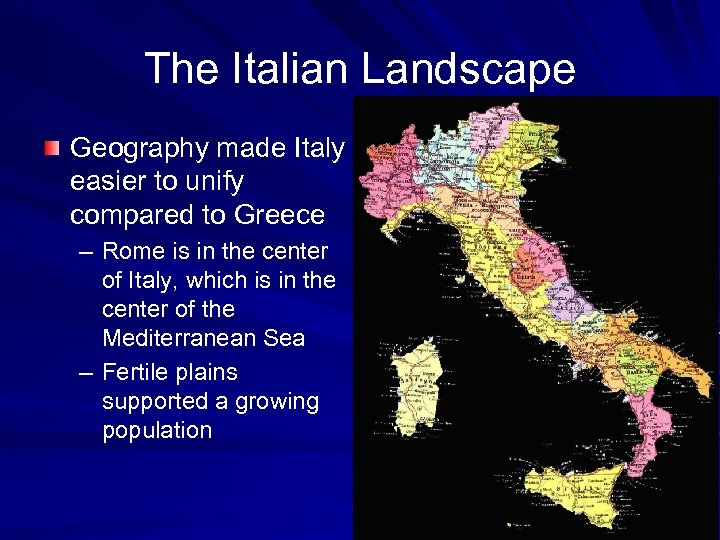 The Italian Landscape Geography made Italy easier to unify compared to Greece – Rome is in the center of Italy, which is in the center of the Mediterranean Sea – Fertile plains supported a growing population
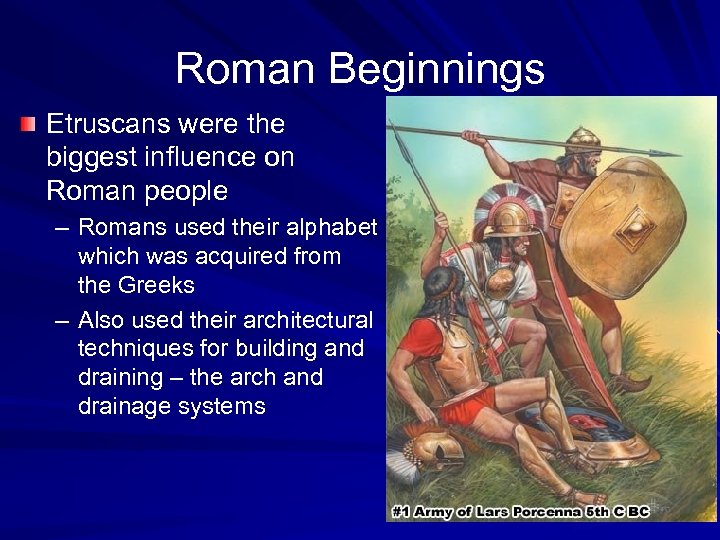 Roman Beginnings Etruscans were the biggest influence on Roman people – Romans used their alphabet which was acquired from the Greeks – Also used their architectural techniques for building and draining – the arch and drainage systems
 The Early Republic 509 B. C. – Rome was founded when the Etruscan king was driven out Romans establish a new type of government – republic – thing of people – Republic – would keep any individual from gaining too much power – They also developed a military to conquer the entire Mediterranean world
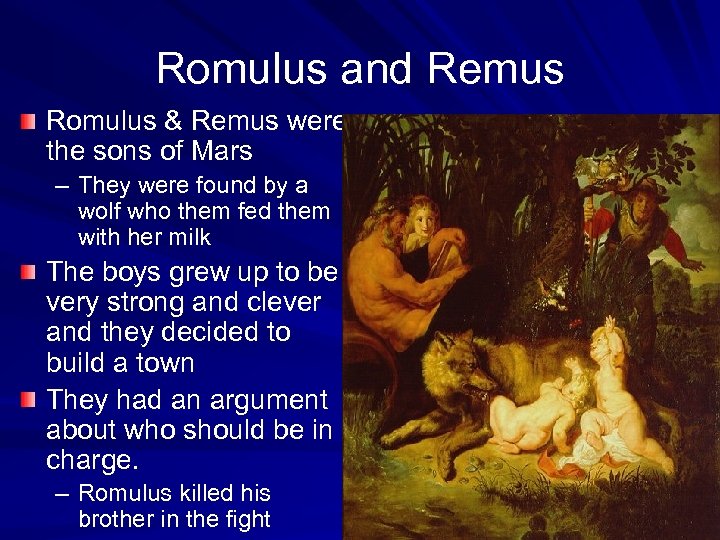 Romulus and Remus Romulus & Remus were the sons of Mars – They were found by a wolf who them fed them with her milk The boys grew up to be very strong and clever and they decided to build a town They had an argument about who should be in charge. – Romulus killed his brother in the fight
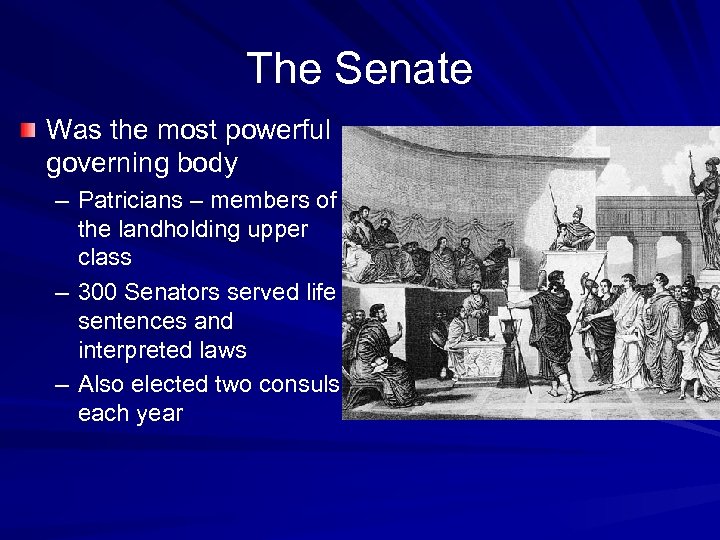 The Senate Was the most powerful governing body – Patricians – members of the landholding upper class – 300 Senators served life sentences and interpreted laws – Also elected two consuls each year
 Consuls Watched over the government and commanded the military – Consuls served only one term – Consulted with the senate Limited time in office meant Rome had a system of checks on power – If a war occurred the senate could choose a dictator that had complete control for six months
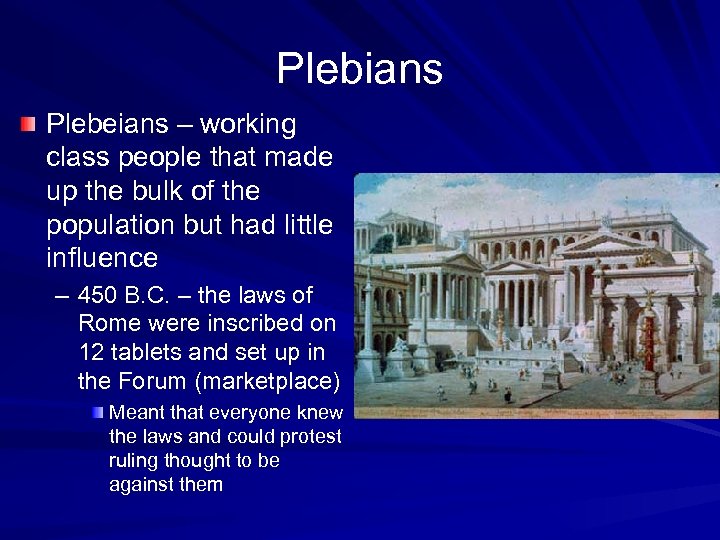 Plebians Plebeians – working class people that made up the bulk of the population but had little influence – 450 B. C. – the laws of Rome were inscribed on 12 tablets and set up in the Forum (marketplace) Meant that everyone knew the laws and could protest ruling thought to be against them
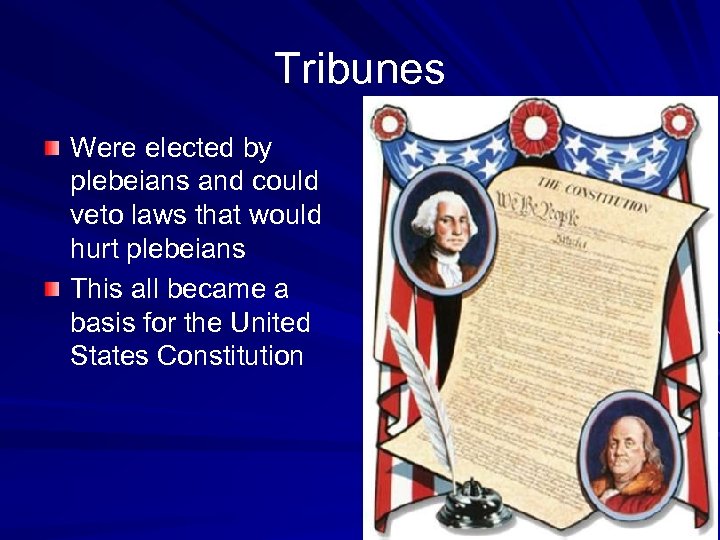 Tribunes Were elected by plebeians and could veto laws that would hurt plebeians This all became a basis for the United States Constitution
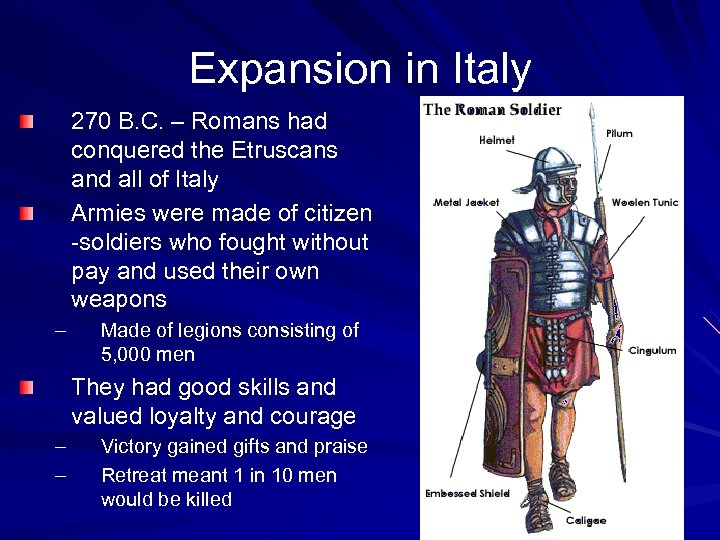 Expansion in Italy 270 B. C. – Romans had conquered the Etruscans and all of Italy Armies were made of citizen -soldiers who fought without pay and used their own weapons – Made of legions consisting of 5, 000 men They had good skills and valued loyalty and courage – – Victory gained gifts and praise Retreat meant 1 in 10 men would be killed
 Conquered People Had to pay taxes, supply soldiers and acknowledge Roman law – Rome let them keep their customs, money and local gov’t. – Some people were allowed to become citizens Other could be partial citizens who could marry Romans This all created loyalty to the empire
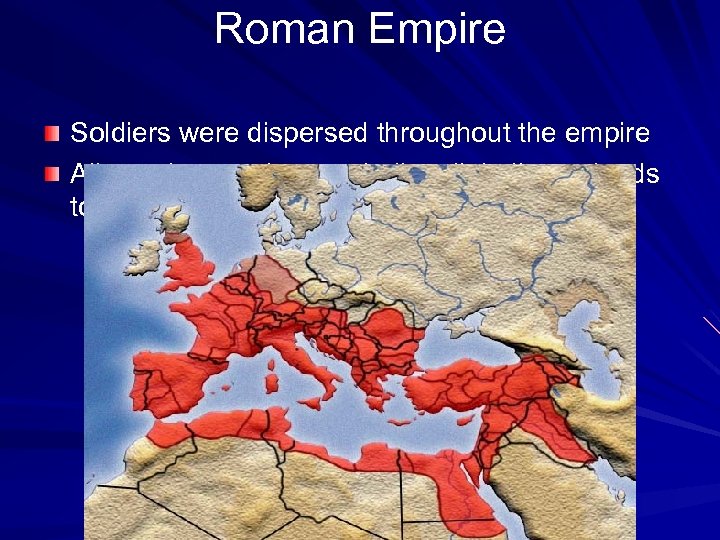 Roman Empire Soldiers were dispersed throughout the empire All weather roads were built to link distant lands to Rome
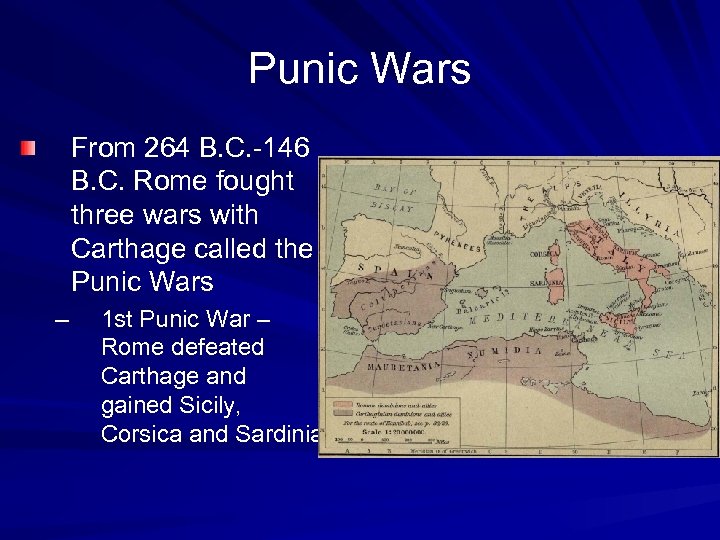 Punic Wars From 264 B. C. -146 B. C. Rome fought three wars with Carthage called the Punic Wars – 1 st Punic War – Rome defeated Carthage and gained Sicily, Corsica and Sardinia
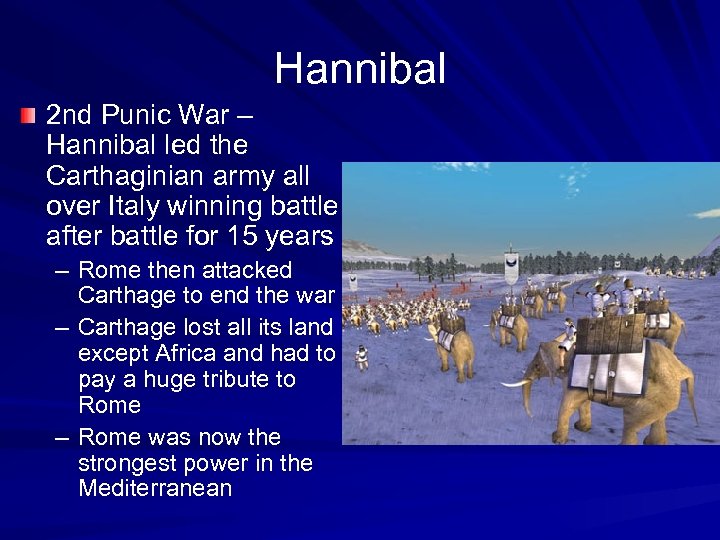 Hannibal 2 nd Punic War – Hannibal led the Carthaginian army all over Italy winning battle after battle for 15 years – Rome then attacked Carthage to end the war – Carthage lost all its land except Africa and had to pay a huge tribute to Rome – Rome was now the strongest power in the Mediterranean
 3 rd Punic War Carthage kept the peace but was attacked by Rome because they were still seen as a threat – Survivors were killed or sold into slavery – Salt was poured over their fields so nothing would grow ever again
 Ruler of the Mediterranean World Rome expanded east attacking the successors of Alexander the Great’s empire – Macedonia, Greece and Asia Minor were all conquered – Egypt allied with Rome – Rome now ruled everything from Spain to Egypt
 Effects of Expansion Rome conquered many lands and gained control of important trade routes – Some Romans became rich while many people were still poor – Government officials became greedy and corrupt Reform was implement by two tribunes Tiberius and Gaius Gracchus
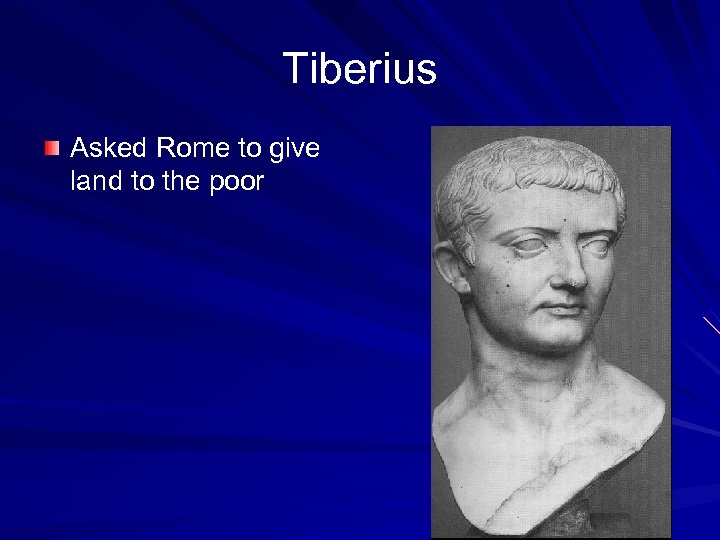 Tiberius Asked Rome to give land to the poor
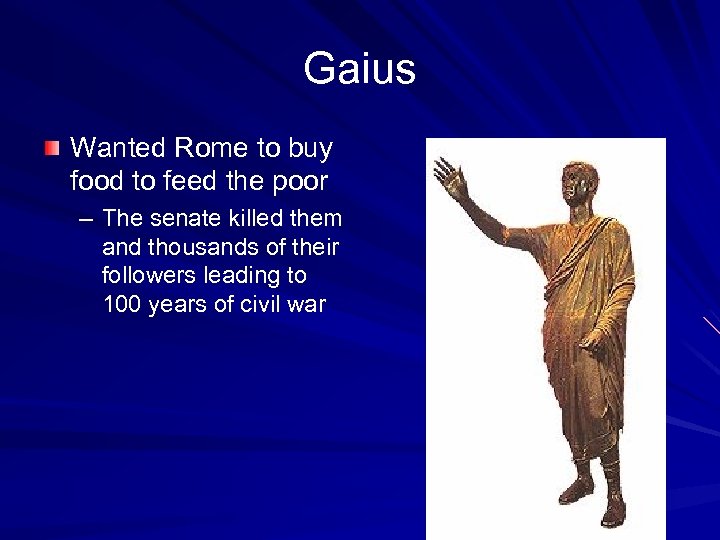 Gaius Wanted Rome to buy food to feed the poor – The senate killed them and thousands of their followers leading to 100 years of civil war
 Caesars Bid for Power 48 B. C. - Julius Caesar became the absolute ruler of Rome and implemented many reforms – Created public works to employ the jobless – Gave public land to the poor – Granted Roman citizenship to more people – Introduced a new calendar, the Julian calendar that is the basis of our calendar today Became feared because of his power and was killed by senators
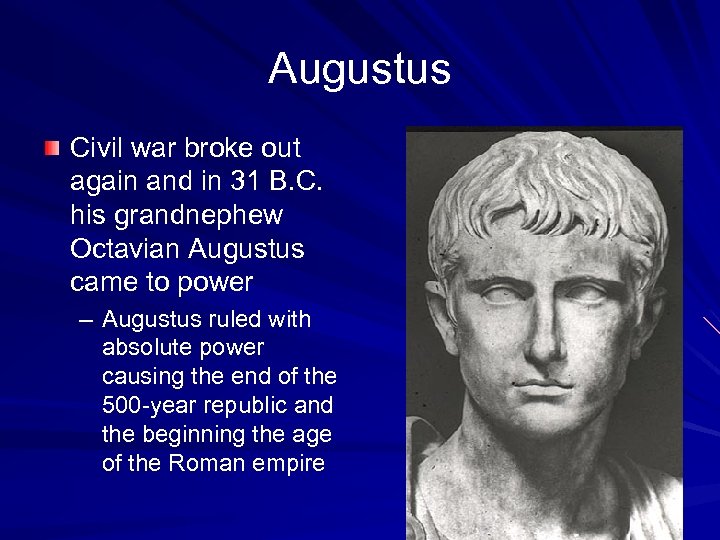 Augustus Civil war broke out again and in 31 B. C. his grandnephew Octavian Augustus came to power – Augustus ruled with absolute power causing the end of the 500 -year republic and the beginning the age of the Roman empire
 The Roman Peace The 200 -year period that began with Augustus was called the Pax Romana, or Roman Peace – This was a time of peace, order, unity and prosperity – Legions maintained roads and fleets chased pirates while trade moved freely all the way to China
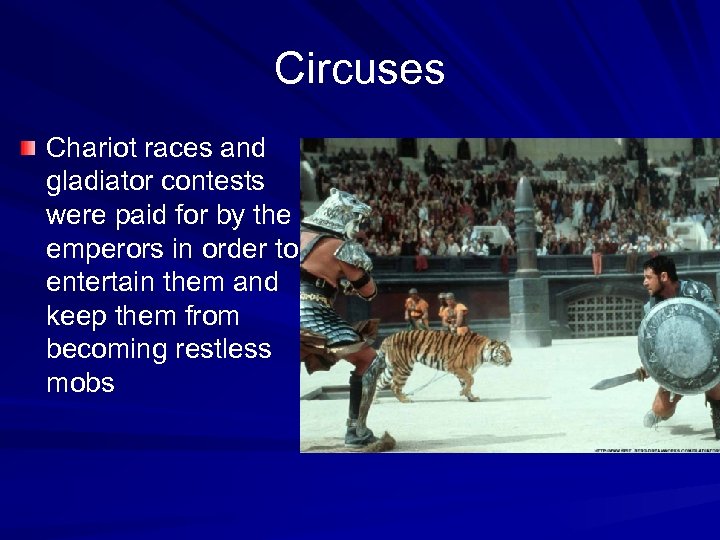 Circuses Chariot races and gladiator contests were paid for by the emperors in order to entertain them and keep them from becoming restless mobs
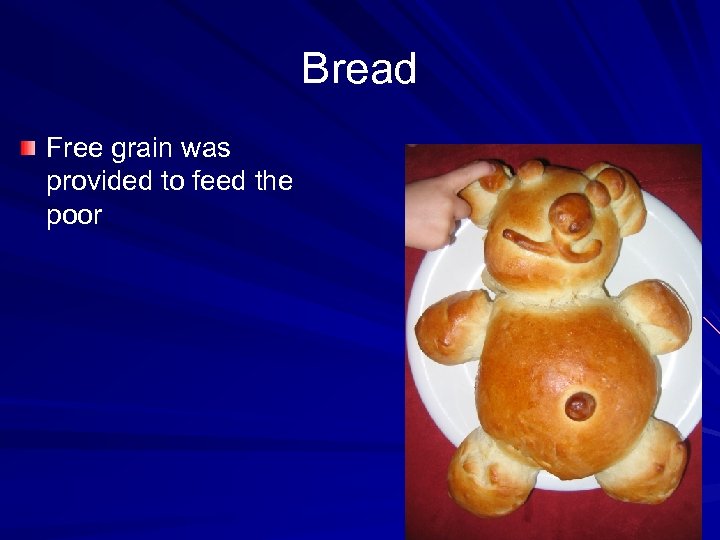 Bread Free grain was provided to feed the poor
 Jews and the Roman Empire Rome allowed its citizens to worship as they pleased Some Jewish reformers called for independence 66 A. D. - The Jews revolted but were defeated by the Romans and forced out of their homeland, Palestine
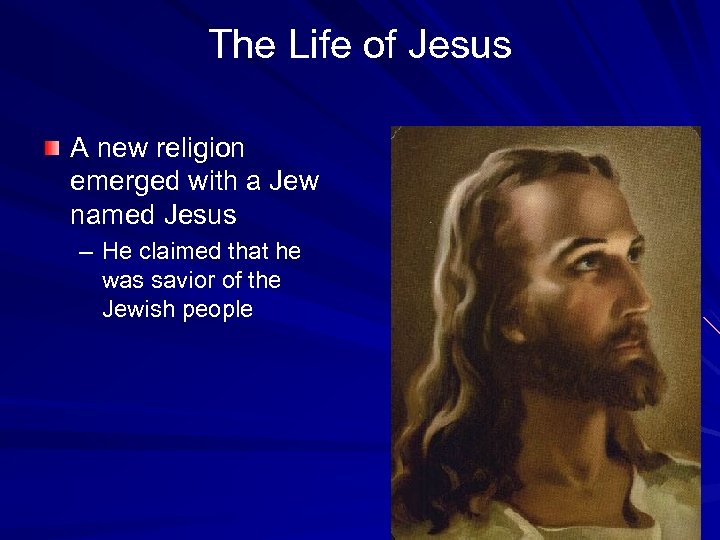 The Life of Jesus A new religion emerged with a Jew named Jesus – He claimed that he was savior of the Jewish people
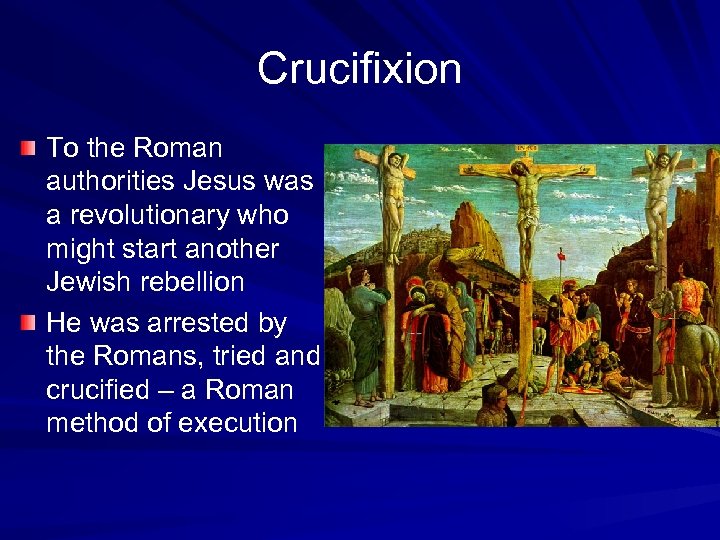 Crucifixion To the Roman authorities Jesus was a revolutionary who might start another Jewish rebellion He was arrested by the Romans, tried and crucified – a Roman method of execution
 Spread of Christianity Rome’s tolerant attitude toward religion did not extend to Christianity – Forced to meet in secret to avoid persecution – Were often accused of engaging in evil practices The inclusion of Greek philosophy in Christianity attracted educated Romans to the religion – Willingness of Christians to die for their religion impressed and brought even more converts
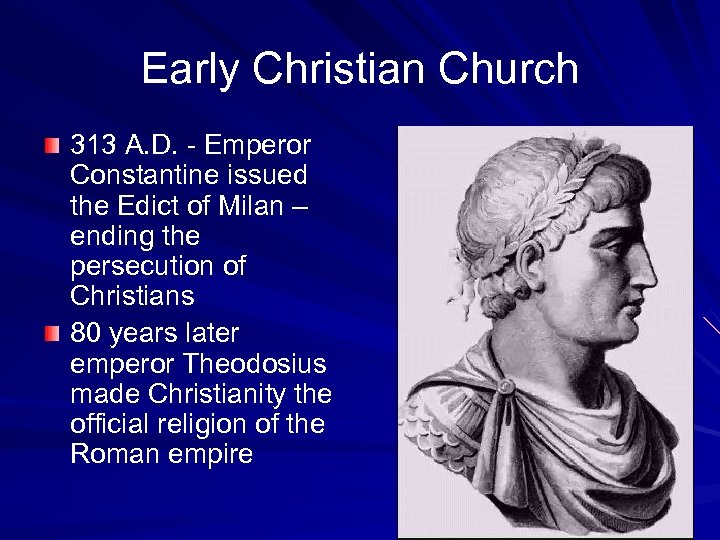 Early Christian Church 313 A. D. - Emperor Constantine issued the Edict of Milan – ending the persecution of Christians 80 years later emperor Theodosius made Christianity the official religion of the Roman empire
 Empire In Crisis After the end of Pax Romana political turmoil overtook Rome – Generals seized power, ruled for a few months to a year and were overthrown
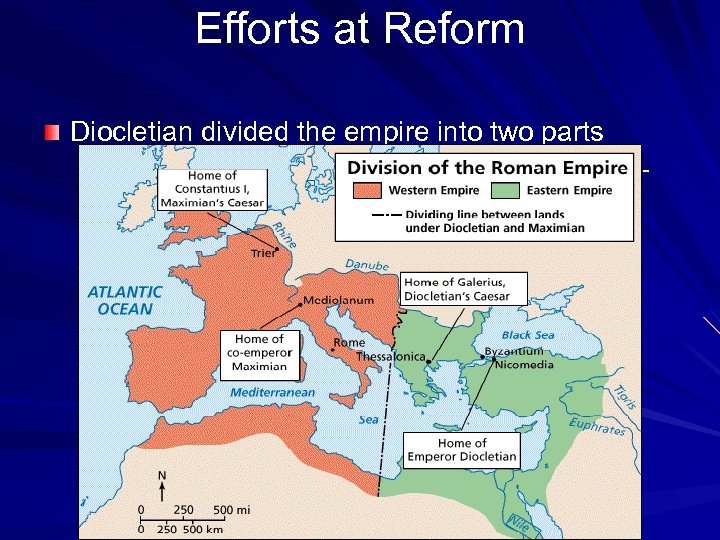 Efforts at Reform Diocletian divided the empire into two parts – Kept control of the eastern part and appointed a coemperor for the west
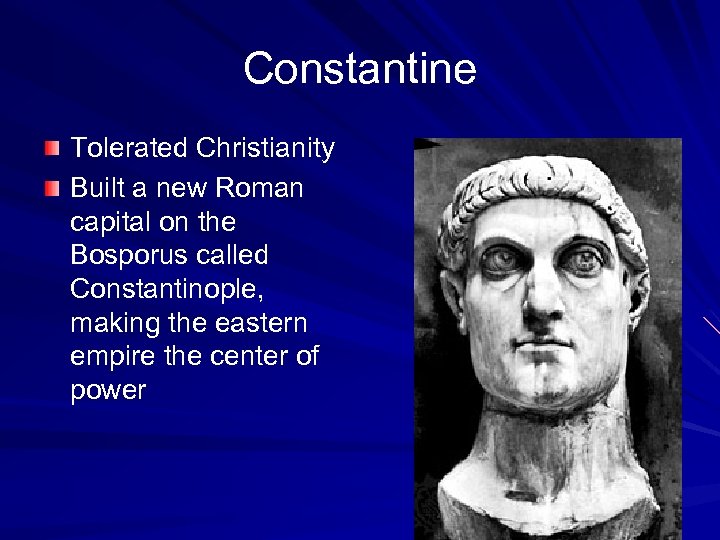 Constantine Tolerated Christianity Built a new Roman capital on the Bosporus called Constantinople, making the eastern empire the center of power
 End of Greatness Military Causes – Invasion by Germanic tribes – Roman armies lacked discipline in training in the end Political and Economic Causes – The government became oppressive and authoritarian – The division of the empire weakened it – Heavy taxes and the reliance on slave labor hampered technological advances – The population declined due to war and disease The eastern Roman empire later became known as the Byzantine empire and lasted for another 1, 000 years