


 Скачать презентацию Romanian VET following ECVET recommendation National Centre for
e81808d3c1e294e109bfe9e63c058f39.ppt
- Количество слайдов: 17
 Romanian VET following ECVET recommendation National Centre for TVET Development Romania
 Our responsibilities To assure both the relevance of the TVET developments in the perspective of the strategic, economic and social needs of the Romanian economy and society and the correlation between national approaches and European and international measures To contribute to the methodological developments referring to: the educational supply planning, the development of schools’ institutional capacity, the organization and development of the teaching-learning process, the students’ training examination and certification and the TVET quality assurance To promote social partnership for TVET development
 Our responsibilities üThrough formal education and training, technical and vocational education (VET), medium - and long-term oriented, part of ongoing training pathways üThrough apprenticeship at the workplace, short-term oriented, depending on the needs of employers
 Strategic Approach of the Initial Training through TVET üto serve the interests of young people and adults from the perspective of lifelong learning by increasing the attractiveness üto respond and, especially, to anticipate the needs and changes on the labor market üto provide relevant qualifications for the labor market üto integrate academic and vocational training üto allow flexible entry and exit in and from the system üto enable a quality training üto integrate school learning with workplace learning üto provide professional skills that enable mobility and labor market flexibility üto provide equal opportunities for all learners, including those with SEN
 The current architectural context of TVET European and National Tools: üNational Law of Education üNational Qualifications Framework correlated with the European Qualifications Framework üThe European Credit system for Vocational Education and Training (ECVET) üEuropean Reference Framework for Quality Assurance in Vocational Education and Training üEUROPASS documents ü 2020 EU Strategy ü 2010 Bruges Communicate
 What were the steps we take for ECVET 1 In Romania, a consistent and comprehensive strategy for initial VET has been implemented through PHARE and then European Social Fund projects. It covers the following aspects: ü curriculum reform starting from learning outcomes-based qualifications; ü professional development of teachers, trainers, institutional leaders and social partners in order to increase VET responsiveness to labour market needs and also to develop student-centred learning; ücompetency-based assessment and the semi-externalisation of final examinations; üparticipation of social partners in the examination commissions; ümechanisms, procedures and instruments for quality assurance; üaccreditation of VET providers, external validation and monitoring of VET providers self-evaluation reports; ücorrelation of VET provision with labour market needs through strategic forecasts and planning instruments implemented through partnerships.
 What were the steps we take for ECVET 2 For the IVET our system already experienced elaborating and piloting widespread application of the ECVET as being partner in other European projects aiming to generate a common vocational culture based on ECVET process and quality assurance instruments. The most relevant experiences are two projects: RECOMFOR – establishing a network for facilitating mobility in terms of ECVET recommendation and quality assurance tools, acting with partners from different EU countries. OPIR – promoting mobility for two qualification: stylist hairdresser and automation technician and testing ECVET instruments
 What were the steps we take for ECVET 3 According to the Law of Education üEQF Recommendation – a reference document for Romanian NQF üNational Qualifications Autority üNQF based on stakeholders implication üPartnership structures üOccupational analisys (to present data on the skills, knowledge and attitudes required by people working in an occupation) üOccupational standards (include general units, key units and specific units) üQualifications development - training standards (a document that describes learning outcomes for a qualification)
 What were the steps we take for ECVET 4 Designing methodologies and regulations that are supporting ECVET implementation: Example: CRIPT (European Social Fund project) – one of the results is a methodology for revision the qualifications in terms of ECVET recommendations.
 VET Qualifications VET training programs lead to obtaining academic and professional qualifications üProfessional qualifications üLearning-based üThey are described by Units of Competences (Learning units); a unit of competences consists from a coherent set o competences/ learning outcomes üThey lay the accent on key competences training üA professional qualification can be associated with one or more occupations üA professional qualification satisfies the possibility of a long term üEnsure the premises of the progress in career üThey can provide Continuous Professional Training
 Qualifications design - IVET TRAINING STANDARD - document describing the units of LO composing a qualification Content of TS: The units – a coherent set of learning outcomes The level of qualification No of credit points The learning outcomes The performance criteria The requirements for assessment TRAINING PROGRAM – modular approach Modules are created on the basis on units of LO Ø 1 module may consists in 1 or 2 units
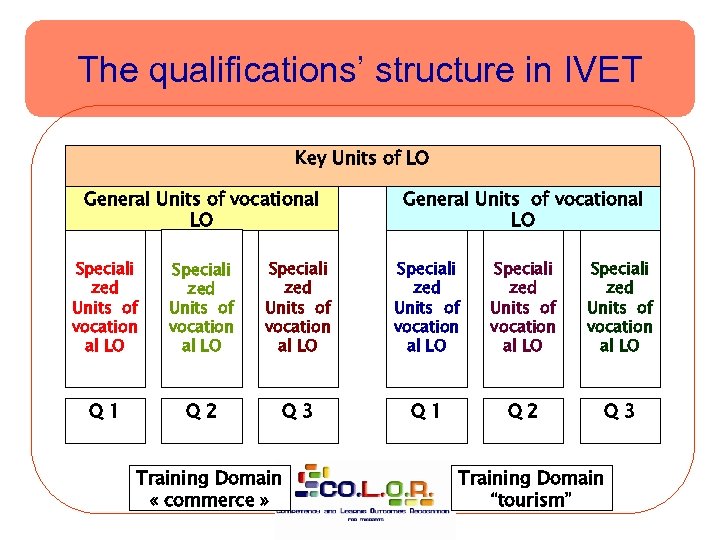 The qualifications’ structure in IVET Key Units of LO General Units of vocational LO Speciali zed Units of vocation al LO Speciali zed Units of vocation al LO Q 1 Q 2 Q 3 Training Domain « commerce » Training Domain “tourism”
 Certification in TVET Certificate of professional qualification (national) levels 1, 2, 3 and 3+ (equivalently 2, 3, 4 and 5 in EQF) üall competence units have to been demonstrated üentitles practicing one or more occupations üCertification Authority: Ministry of Education, Research, Youth and Sports
 Accumulation and Transfer Credits üProvides career development and occupational mobility in the training routes in the lifelong learning perspective üIVET, CVT and HE should be based on systems compatible or at least transparent of credits allocation and transfer üRecognition / transferability of credits between different learning systems are subject of: Ensuring consensus among all stakeholders Common principles of quality assurance in the different learning systems
 Quality assurance in VET üProfessional training standards and curriculum üAccreditation of training providers üSelf-assessment of training providers üSchool inspections of training providers as external monitoring and external evaluation üSemi-outsourced national examinations: the participation of employers in the certification exam committees üMonitor quality assurance during the certification exams
 Basics of TVET curriculum üCurriculum developed on the basis of training standards üModular Curriculum üCurriculum in local development for adaptation to local and regional qualifications relevant to the labor market üKey skills units to develop employability and interpersonal skills üTeaching methods based on student-centered learning üTeaching methods Adapted to SEN students üCompetency-based assessment and certification
 Instead of conclusions…… üQualifications are described using a learning outcomes approach. üQualifications are structured in units of learning outcomes. üQualification system uses national credit points. üRecognition of non-formal and informal learning is possible, but still not yet for IVET. üRecognition of periods of VET spent abroad is possible. üFlexible individual learning pathways are available. üPortability of learning outcomes within the country is possible. üRecognition of parts of VET qualifications from other systems, qualifications or institutions is possible. üPossibility for credit transfer across qualification systems and between qualifications exists.