


 Скачать презентацию Roman Sculpture CONTENTS v 1 Introduction v
Roman sculptureДорожинец.pptx
- Количество слайдов: 18
 Roman Sculpture
 CONTENTS: v 1. Introduction v 2. Kinds of Sculpture v 2. 1. Portraiture v 2. 2. Sarcophagi v 2. 3. Gardens v 3. Summary
 v Early Roman art was influenced by the art of Greece and that of the neighbouring Etruscans, themselves greatly influenced by their Greek trading partners. As the expanding Roman Republic began to conquer Greek territory, at first in Southern Italy and then the entire Hellenistic world, official and patrician sculpture became largely an extension of the Hellenistic style, from which specifically Roman elements are hard to disentangle, especially as so much Greek sculpture survives only in copies of the Roman period.
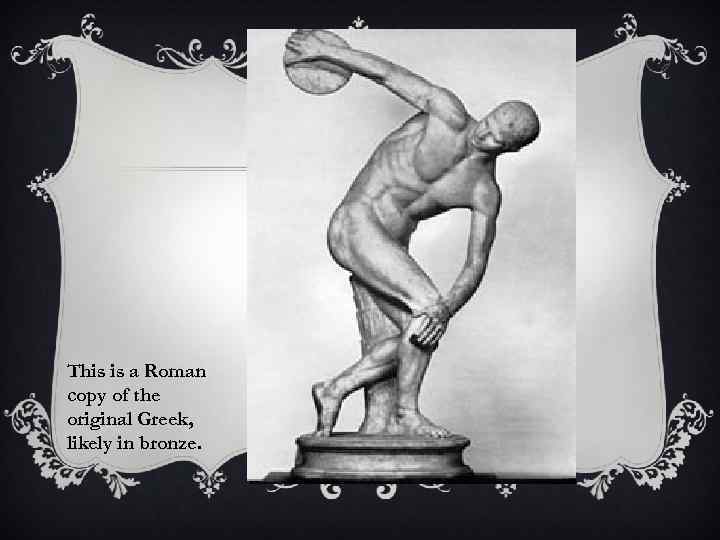 This is a Roman copy of the original Greek, likely in bronze.
 v. By the 2 nd century BC, most of the sculptors working at Rome were Greek often slaves, whose names are very rarely recorded. Vast numbers of Greek statues were imported to Rome, whether as booty or the result of extortion or commerce, and temples were often decorated with re-used Greek works.
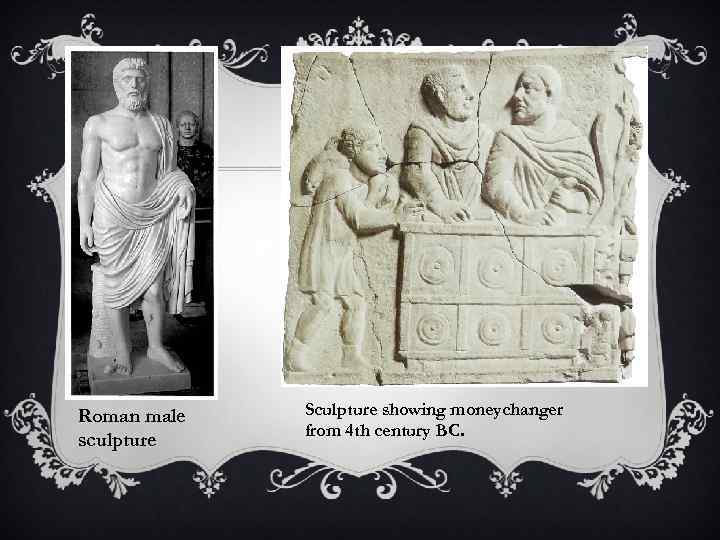 Roman male sculpture Sculpture showing moneychanger from 4 th century BC.
 v Portraiture is a dominant genre of Roman sculpture, growing perhaps from the traditional Roman emphasis on family and ancestors; the entrance hall (atrium) of a Roman elite house displayed ancestral portrait busts. During the Roman Republic, it was considered a sign of character not to gloss over physical imperfections, and to depict men in particular as rugged and unconcerned with vanity: the portrait was a map of experience. During the Imperial era, more idealized statues of Roman emperors became ubiquitous, particularly in connection with the state religion of Rome. Tombstones of even the modestly rich middle class sometimes exhibit portraits of the otherwise unknown deceased carved in relief.
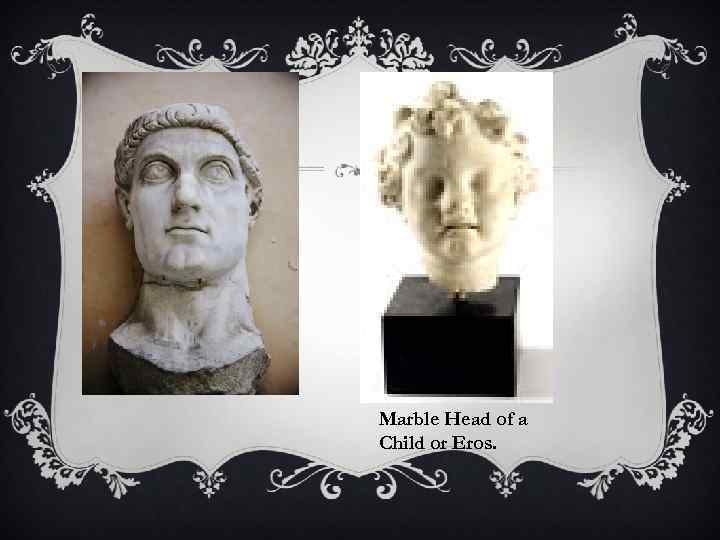 Marble Head of a Child or Eros.
 v. A central feature of a Roman temple was the cult statue of the deity. Although images of deities were also displayed in private gardens and parks, the most magnificent of the surviving statues appear to have been cult images.
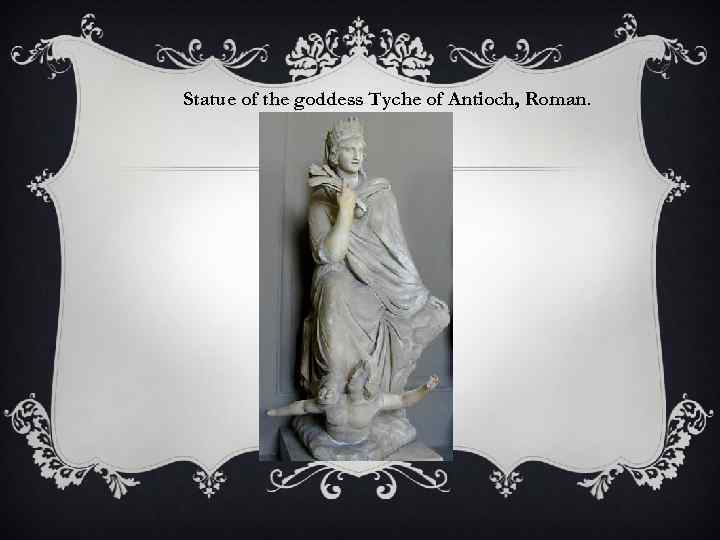 Statue of the goddess Tyche of Antioch, Roman.
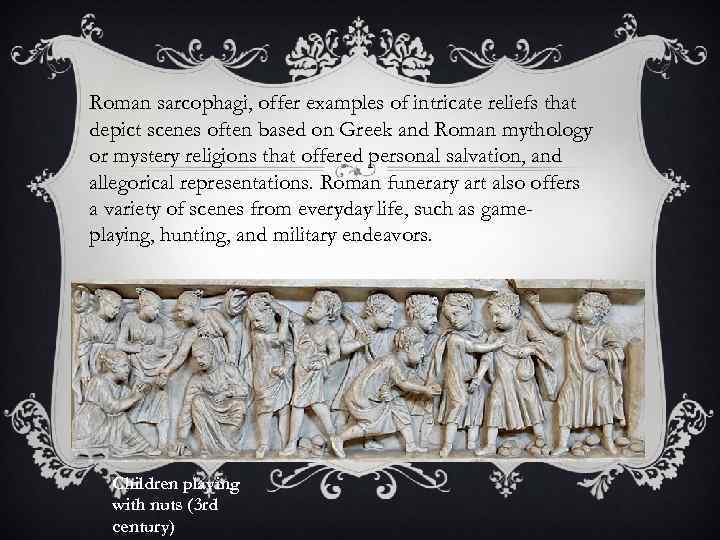 Roman sarcophagi, offer examples of intricate reliefs that depict scenes often based on Greek and Roman mythology or mystery religions that offered personal salvation, and allegorical representations. Roman funerary art also offers a variety of scenes from everyday life, such as gameplaying, hunting, and military endeavors. Children playing with nuts (3 rd century)
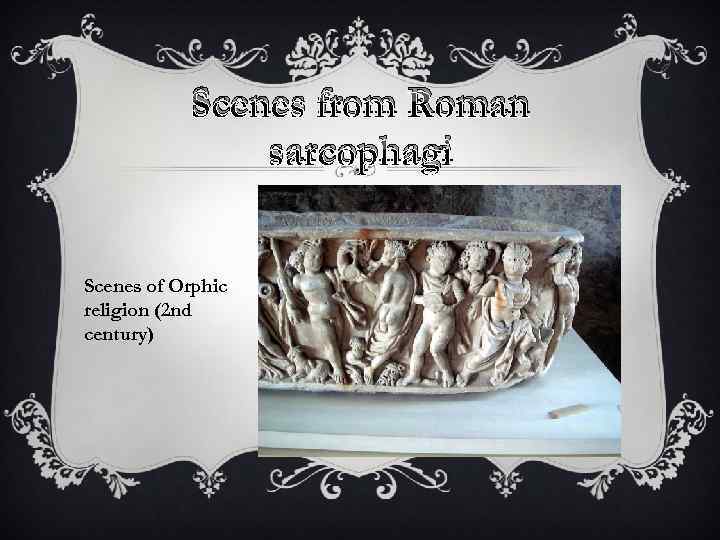 Scenes from Roman sarcophagi Scenes of Orphic religion (2 nd century)
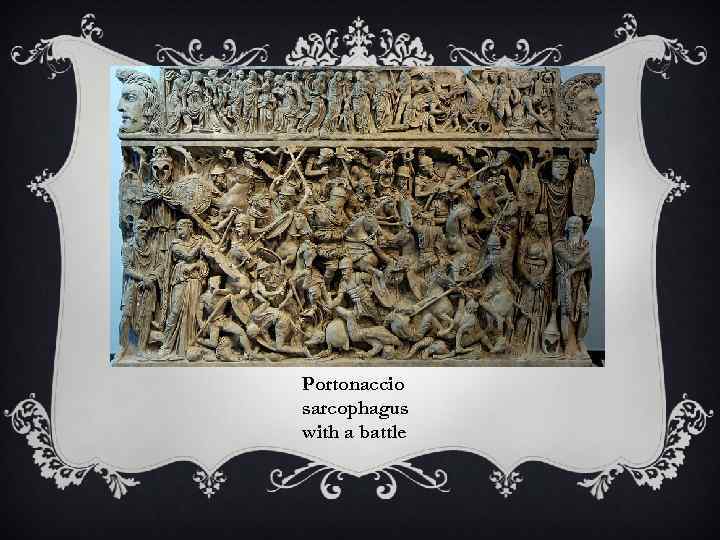 Portonaccio sarcophagus with a battle
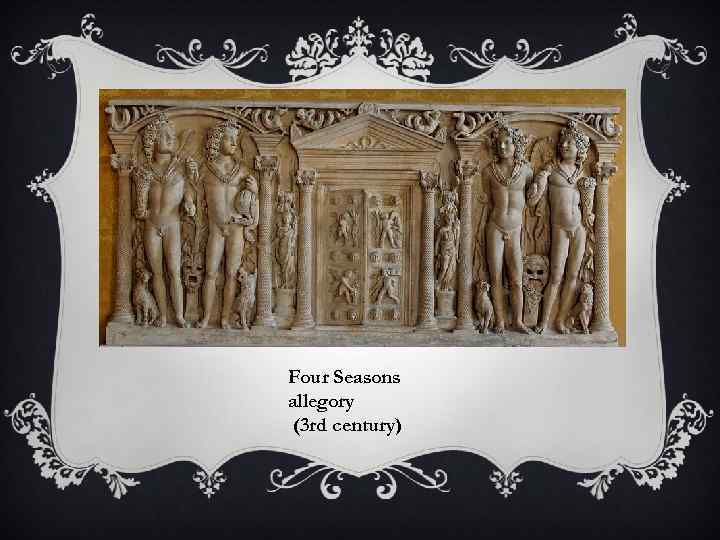 Four Seasons allegory (3 rd century)
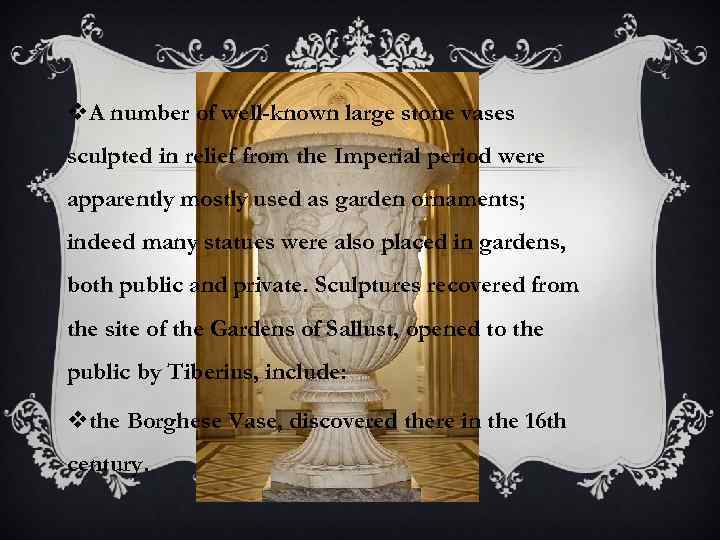 v. A number of well-known large stone vases sculpted in relief from the Imperial period were apparently mostly used as garden ornaments; indeed many statues were also placed in gardens, both public and private. Sculptures recovered from the site of the Gardens of Sallust, opened to the public by Tiberius, include: vthe Borghese Vase, discovered there in the 16 th century.
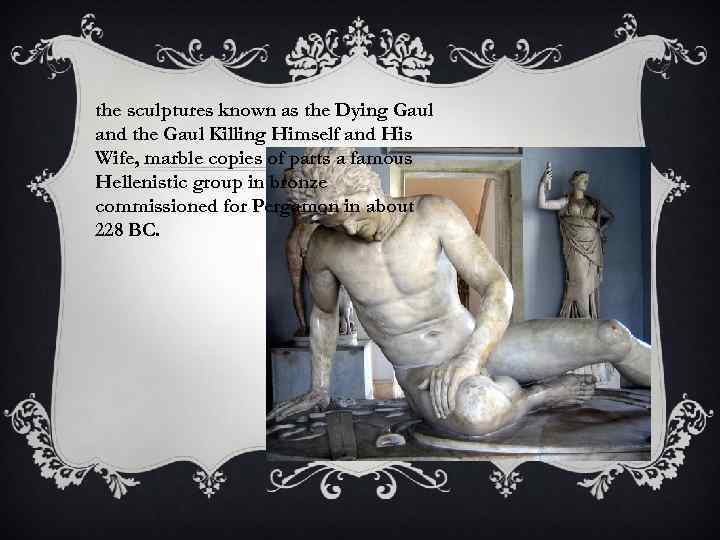 the sculptures known as the Dying Gaul and the Gaul Killing Himself and His Wife, marble copies of parts a famous Hellenistic group in bronze commissioned for Pergamon in about 228 BC.
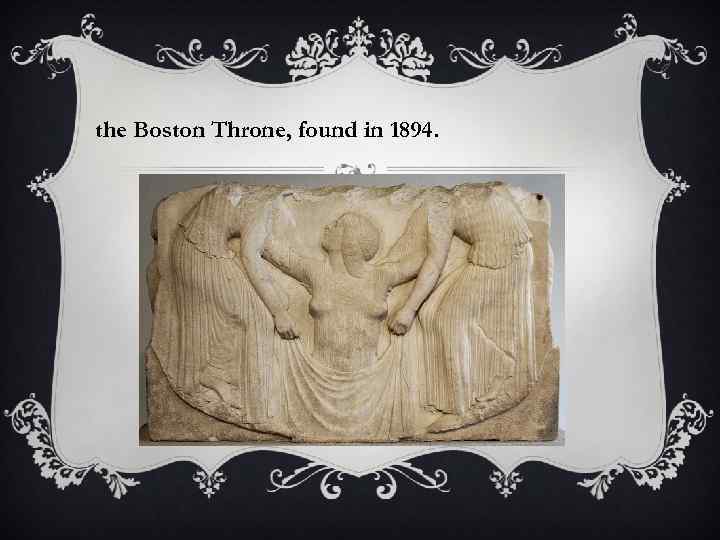 the Boston Throne, found in 1894.
 SUMMARY v Roman aesthetics prized the beauty of the human form, both male and female, and so it was essential that Roman sculptors recreate the ideal human body realistically. In this aspect, they borrowed heavily from the Greeks, but also added their own sensibilities. Roman sculptures adorned fountains, public squares and temples throughout the Roman Empire, and served a multitude of functions, in addition to improving the beauty of the built environment.