 Скачать презентацию Role of the Bundesbank in payment systems and
153f0d51da3a1f6b3ce9961e33f42242.ppt
- Количество слайдов: 34



Role of the Bundesbank in payment systems and future prospects Dr. Hans-Jürgen Friederich Head of department Payments, Account keeping, Safe-custody Accounts and Trade Settelement Deutsche Bundesbank Payment Systems on the Threshold of EU Budapest, 28 November 2002
Agenda Deutsche Bundesbank l Bundesbank in cashless payments ¡ Role of the Bundesbank ¡ Effects of the euro ¡ The relationship with banks l Large-value payments ¡ RTGSplus within TARGET ¡ Challenges for TARGET ¡ TARGET 2 - Decision and future structure ¡ Common shared platform - Benefits, principles, governance l Retail payments ¡ Interbank clearing in Germany ¡ RPS of the Bundesbank ¡ EU price regulation ¡ SEPA - View of the Bundesbank Dr. Hans-Jürgen Friederich 2
Deutsche Bundesbank Role of the BBk in cashless payments l Providing interbank infrastructures for the banking industry ¡ Individual payments (RTGSplus) ¡ Retail payments (RPS) ¡ Account holding (4. 400 accounts) l Providing payment services for BBk customers ¡ Governmental agencies (2. 200 accounts) ¡ Small-sized credit institutions (indirect access to interbank payment systems) ¡ Correspondent banking activity ¡ Commercial customers (until 2004) l Oversight of payment systems ¡ Monitoring function concerning bank`s activities and own NCB systems ¡ Not only smooth functions of payment systems, but also efficiency ¡ Participation in payment system bodies: design of payment operation agreements (technical/organisational/legal basis of the German payment system) ¡ Strategy: Co-operation instead of regulation ¡ Active implementation of standards (being more than a „catalyst“) = Own payment services set „benchmarks“ in efficiency Dr. Hans-Jürgen Friederich 3
Deutsche Bundesbank The effects of the euro. . . on the Bundesbank ¡ From a „monopoly“ towards a competitive scenario m Loss of the „home market/DM“ – advantage m Appearance of new systems (eg EBA) m Domestic markets are more and more influenced by the European dimension ¡ Massive re-engineering of all systems m High demand on IT ressources m Chance for far-reaching system improvements (eg RTGSplus) m Making procedures more efficient ¡ Implementation of international standards ¡ New definition of the NCB role m Monetary policy: Loss of importance m High degree of payment policy coordination restricts NCB independence m Need for a higher transparency on Eurosystem level m Operational cooperation between NCBs will increase m Internal rationalisation (branches reduced by 50 %, staff by more than 10 %) Dr. Hans-Jürgen Friederich 4
Deutsche Bundesbank The relationship with banks ¡ Complaints about alleged „unfair NCB competition“ m Increased degree of competition in the credit sector m Increased regulatory pressure by the Eurosystem m NCBs as „public“ service provider m Bigger banks increasingly try to integrate smaller banks (= „bank of banks“-functionality by private credit institutions) ¡ Solution for NCBs as operator of payment systems m Maximum transparency m Calculating prices on full-cost basis m Neutral and cautious policy: Security, Efficiency, Structural balance m Support of banking industry initiatives: co-operation with banks m Open and fair access also for smaller banks ¡ Central banks = service provider for, not competitor of banks Dr. Hans-Jürgen Friederich 5
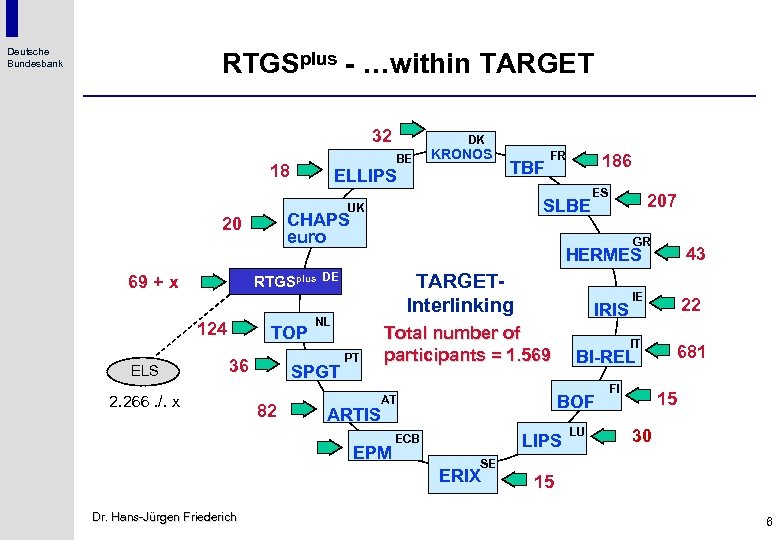
Deutsche Bundesbank RTGSplus - …within TARGET 32 BE 18 TOP 36 2. 266. /. x 82 ES 207 43 HERMES TARGETInterlinking NL PT ARTIS LIPS ECB 22 681 BI-REL BOF AT IE IT IRIS Total number of participants = 1. 569 EPM LU FI 15 30 SE ERIX Dr. Hans-Jürgen Friederich 186 GR DE SPGT FR SLBE CHAPS euro RTGSplus 124 ELS ELLIPS TBF UK 20 69 + x DK KRONOS 15 6
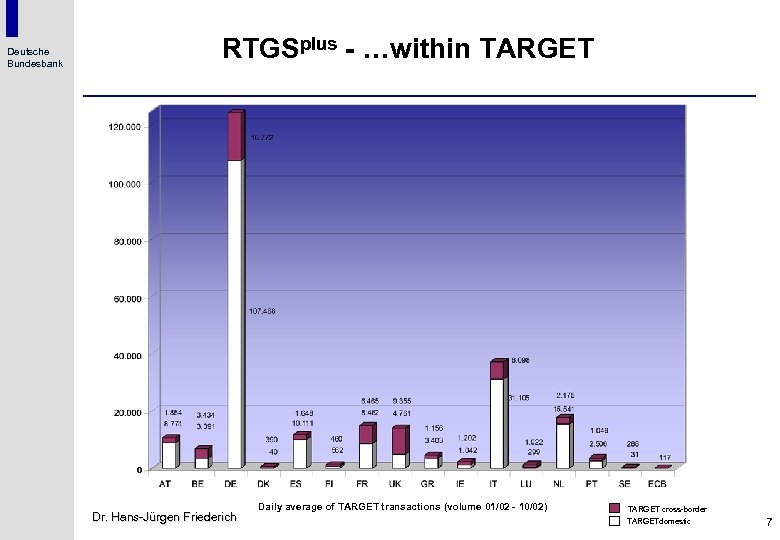
Deutsche Bundesbank RTGSplus - …within TARGET Dr. Hans-Jürgen Friederich Daily average of TARGET transactions (volume 01/02 - 10/02) TARGET cross-border TARGETdomestic 7
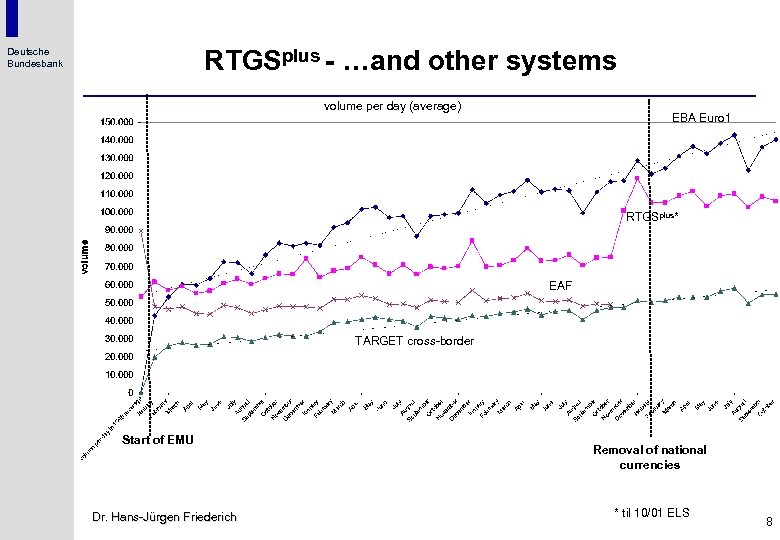
RTGSplus - …and other systems Deutsche Bundesbank volume per day (average) EBA Euro 1 RTGSplus* EAF TARGET cross-border Start of EMU Dr. Hans-Jürgen Friederich Removal of national currencies * til 10/01 ELS 8
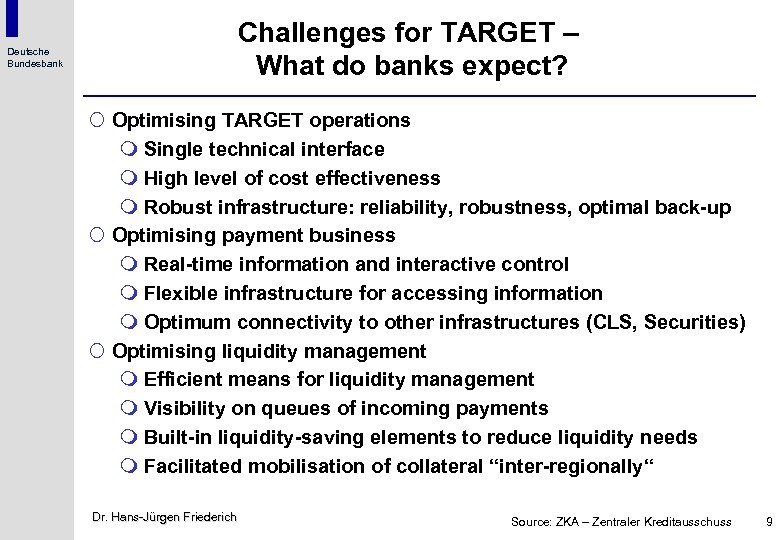
Challenges for TARGET – What do banks expect? Deutsche Bundesbank ¡ Optimising TARGET operations m Single technical interface m High level of cost effectiveness m Robust infrastructure: reliability, robustness, optimal back-up ¡ Optimising payment business m Real-time information and interactive control m Flexible infrastructure for accessing information m Optimum connectivity to other infrastructures (CLS, Securities) ¡ Optimising liquidity management m Efficient means for liquidity management m Visibility on queues of incoming payments m Built-in liquidity-saving elements to reduce liquidity needs m Facilitated mobilisation of collateral “inter-regionally“ Dr. Hans-Jürgen Friederich Source: ZKA – Zentraler Kreditausschuss 9
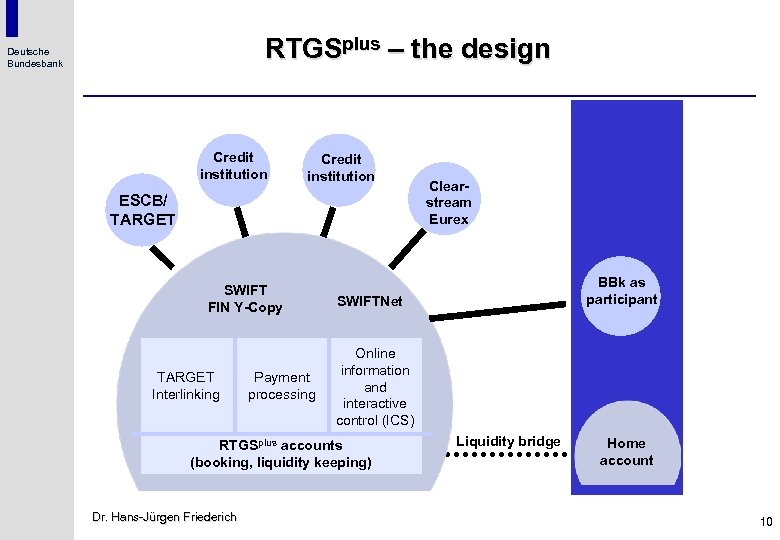
RTGSplus – the design Deutsche Bundesbank Credit institution ESCB/ TARGET SWIFT FIN Y-Copy TARGET Interlinking Payment processing BBk as participant SWIFTNet Online information and interactive control (ICS) RTGSplus accounts (booking, liquidity keeping) Dr. Hans-Jürgen Friederich Clearstream Eurex Liquidity bridge Home account 10
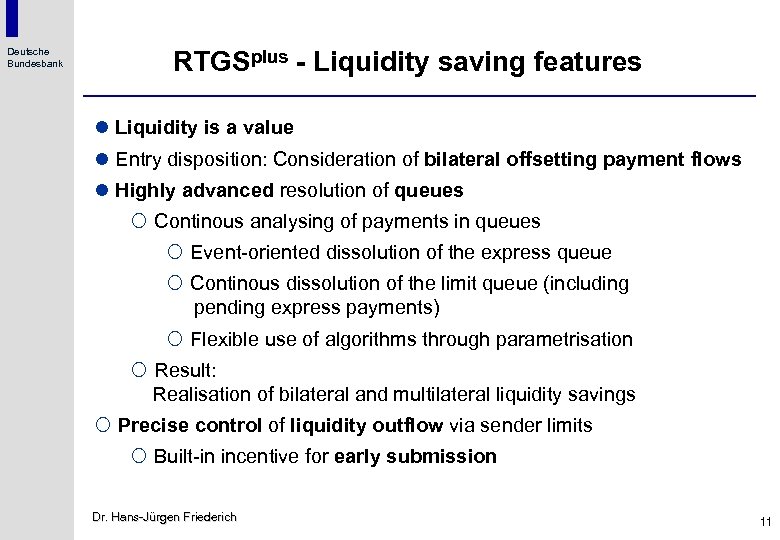
Deutsche Bundesbank RTGSplus - Liquidity saving features l Liquidity is a value l Entry disposition: Consideration of bilateral offsetting payment flows l Highly advanced resolution of queues ¡ Continous analysing of payments in queues ¡ Event-oriented dissolution of the express queue ¡ Continous dissolution of the limit queue (including pending express payments) ¡ Flexible use of algorithms through parametrisation ¡ Result: Realisation of bilateral and multilateral liquidity savings ¡ Precise control of liquidity outflow via sender limits ¡ Built-in incentive for early submission Dr. Hans-Jürgen Friederich 11
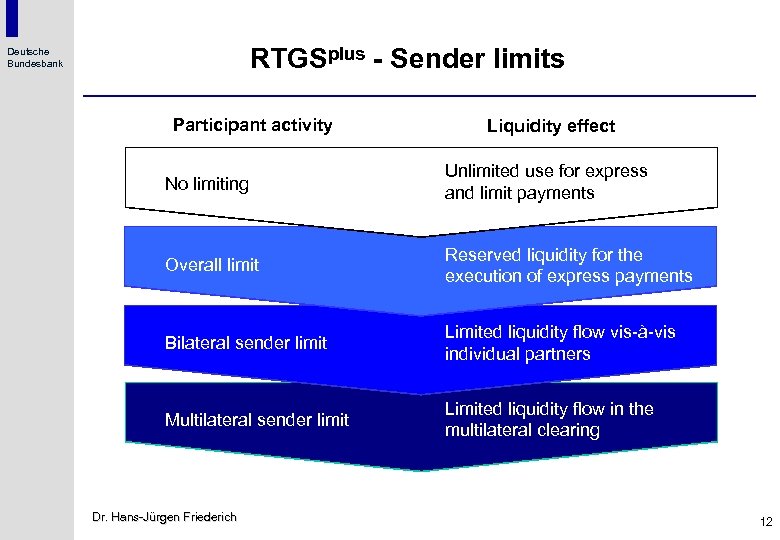
RTGSplus - Sender limits Deutsche Bundesbank Participant activity Liquidity effect No limiting Unlimited use for express and limit payments Overall limit Reserved liquidity for the execution of express payments Bilateral sender limit Limited liquidity flow vis-à-vis individual partners Multilateral sender limit Limited liquidity flow in the multilateral clearing Dr. Hans-Jürgen Friederich 12
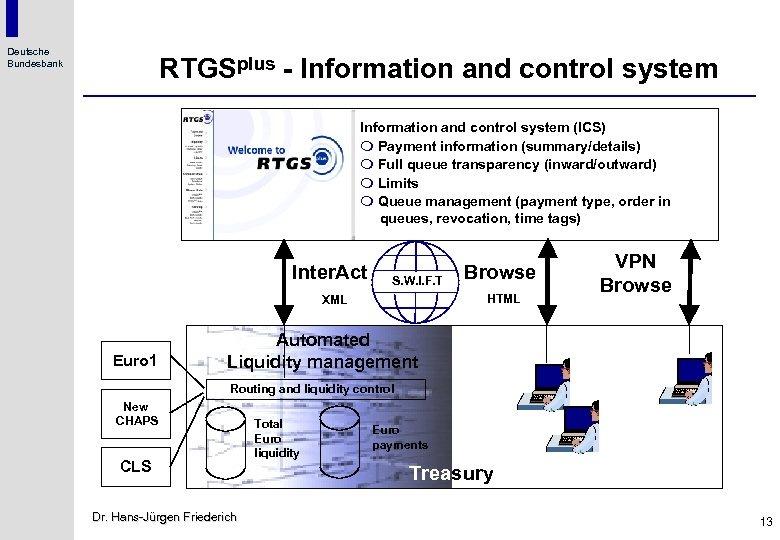
Deutsche Bundesbank RTGSplus - Information and control system (ICS) m Payment information (summary/details) m Full queue transparency (inward/outward) m Limits m Queue management (payment type, order in queues, revocation, time tags) Inter. Act S. W. I. F. T HTML XML Euro 1 Browse VPN Browse Automated Liquidity management Routing and liquidity control New CHAPS CLS Dr. Hans-Jürgen Friederich Total Euro liquidity Euro payments Treasury 13
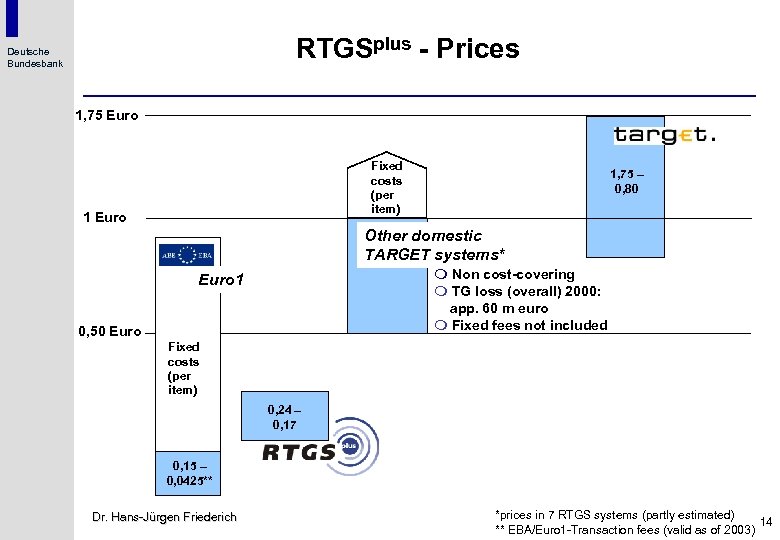
RTGSplus - Prices Deutsche Bundesbank 1, 75 Euro Fixed costs (per item) 1 Euro 1, 75 – 0, 80 Other domestic TARGET systems* m Non cost-covering m TG loss (overall) 2000: app. 60 m euro m Fixed fees not included Euro 1 0, 50 Euro Fixed costs (per item) 0, 24 – 0, 17 0, 15 – 0, 0425** Dr. Hans-Jürgen Friederich *prices in 7 RTGS systems (partly estimated) 14 ** EBA/Euro 1 -Transaction fees (valid as of 2003)
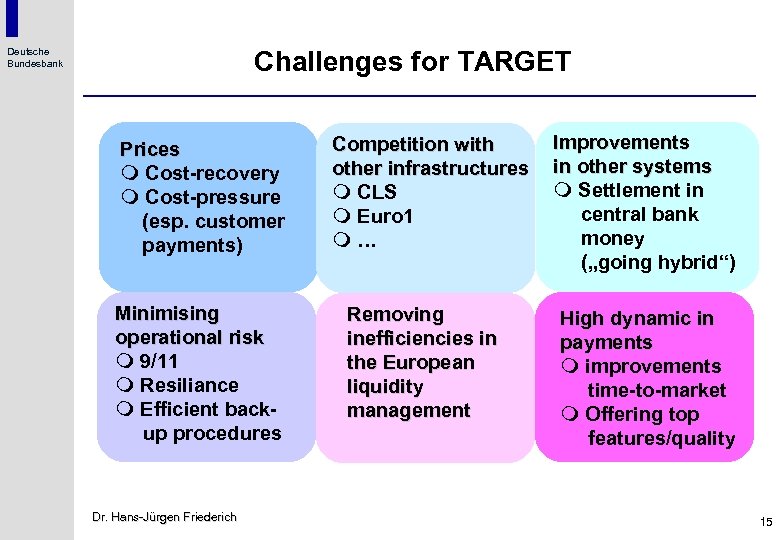
Challenges for TARGET Deutsche Bundesbank Prices m Cost-recovery m Cost-pressure (esp. customer payments) Minimising operational risk m 9/11 m Resiliance m Efficient backup procedures Dr. Hans-Jürgen Friederich Competition with other infrastructures m CLS m Euro 1 m… Removing inefficiencies in the European liquidity management Improvements in other systems m Settlement in central bank money („going hybrid“) High dynamic in payments m improvements time-to-market m Offering top features/quality 15
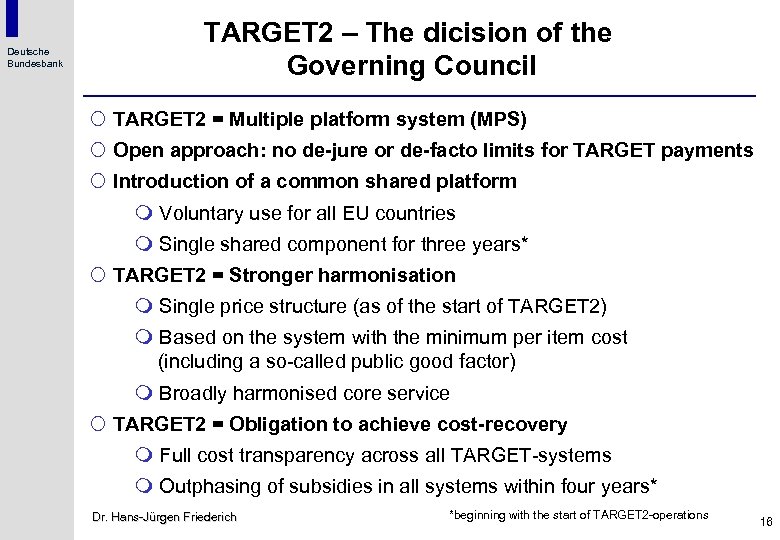
Deutsche Bundesbank TARGET 2 – The dicision of the Governing Council ¡ TARGET 2 = Multiple platform system (MPS) ¡ Open approach: no de-jure or de-facto limits for TARGET payments ¡ Introduction of a common shared platform m Voluntary use for all EU countries m Single shared component for three years* ¡ TARGET 2 = Stronger harmonisation m Single price structure (as of the start of TARGET 2) m Based on the system with the minimum per item cost (including a so-called public good factor) m Broadly harmonised core service ¡ TARGET 2 = Obligation to achieve cost-recovery m Full cost transparency across all TARGET-systems m Outphasing of subsidies in all systems within four years* Dr. Hans-Jürgen Friederich *beginning with the start of TARGET 2 -operations 16
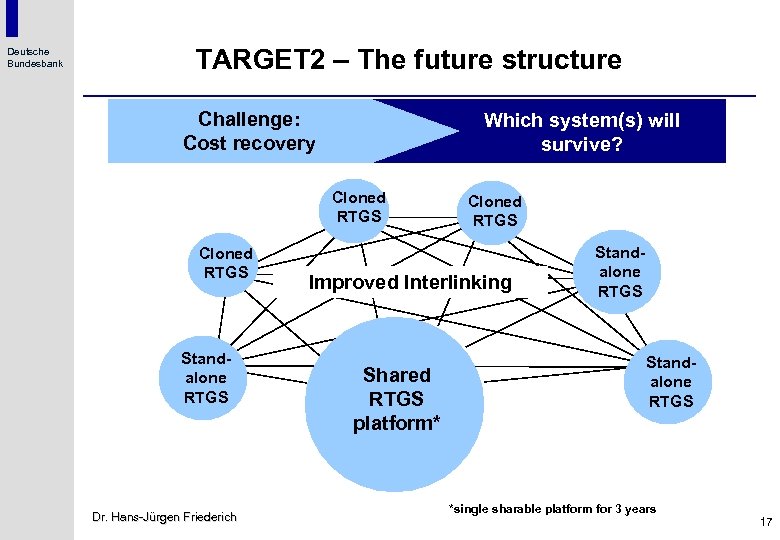
Deutsche Bundesbank TARGET 2 – The future structure Challenge: Cost recovery Which system(s) will survive? Cloned RTGS Standalone RTGS Dr. Hans-Jürgen Friederich Cloned RTGS Improved Interlinking Shared RTGS platform* Standalone RTGS *single sharable platform for 3 years 17
Deutsche Bundesbank TARGET 2 – Benefits of a shared platform ¡ Lower cost m Cost-covering price in Euro 1: app. 21 cent m Realising economies-of-scale m Avoiding high investments esp. for smaller countries ¡ Better service quality m All system features available for all participating NCBs/banks m Maximum transparency for all participating NCBs/banks m Offering top quality service levels m Lower operational risk = improved business contingency procedures ¡ Easy adaption to future requirements m „Pooling“ of scarce human and technical resources m Cost-effective and fast implementation of new features/techniques m High volume elasticity Dr. Hans-Jürgen Friederich 18
Deutsche Bundesbank TARGET 2 – Principles for a shared platform ¡ „Neutrality“ m „Shared utility concept“ - Common ownership m Co-operative governance m Indepedence from other central bank acitivities ¡ Avoiding an over-loading of the common platfom m High degree of standardisation necessary m Local requirements: Task of individual NCBs (Outside the common platform via home account) ¡ Central platform = technical service provider m Face to the customer: Responsibility of the NCBs m Shared platforms only works in the background: only one system for all NCBs m Highest level of confidentiality = „customised“ sharing by NCBs m Only one TARGET interlinking component for all NCBs Dr. Hans-Jürgen Friederich 19
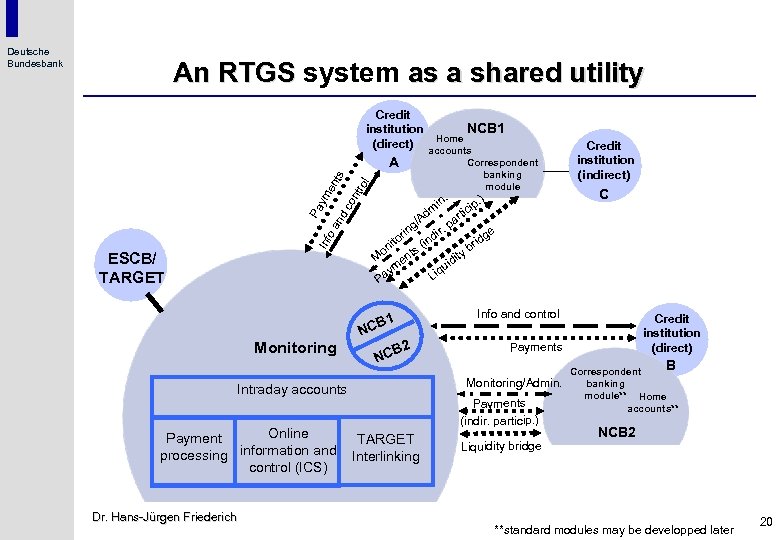
Deutsche Bundesbank An RTGS system as a shared utility Credit institution (direct) Inf oa Pa ym en ts nd co ntr ol A ESCB/ TARGET Monitoring . in Dr. Hans-Jürgen Friederich ) ip. tic r Credit institution (indirect) C dm /A pa g ir. rin ge ind ito rid ( b on nts ity M e id m iqu ay L P B 1 NC B 2 NC Info and control B Payments (indir. particip. ) TARGET Interlinking Credit institution (direct) Payments Monitoring/Admin. Intraday accounts Online Payment processing information and control (ICS) NCB 1 Home accounts Correspondent banking module Liquidity bridge Correspondent banking module** Home accounts** NCB 2 **standard modules may be developped later 20
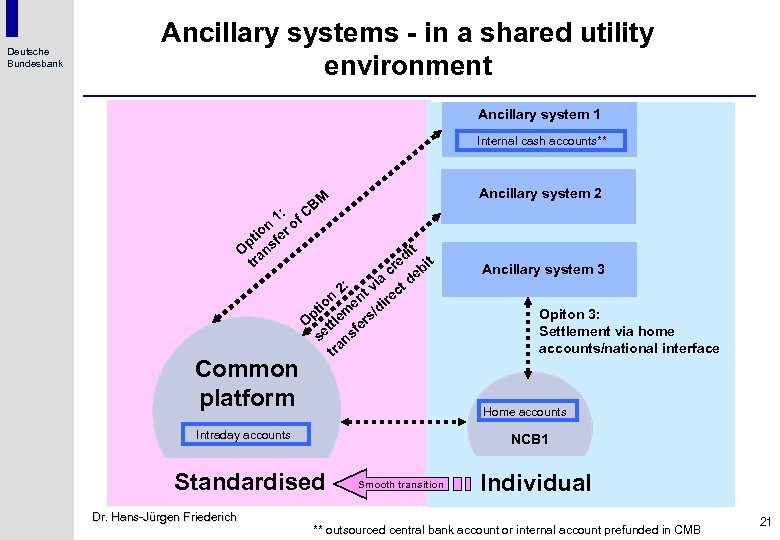
Deutsche Bundesbank Ancillary systems - in a shared utility environment Ancillary system 1 Internal cash accounts** 1: n r of io pt sfe O an tr Common platform Ancillary system 2 M CB it ed bit cr a t de i 2: t v c n n re tio me /di p O ttle fers se ns tra Opiton 3: Settlement via home accounts/national interface Home accounts Intraday accounts NCB 1 Standardised Dr. Hans-Jürgen Friederich Ancillary system 3 Smooth transition Individual ** outsourced central bank account or internal account prefunded in CMB 21
Deutsche Bundesbank Decentralised business functions l Business relations will remain at the NCBs m Customer contacts (different cultures/languages) m Monitoring of intraday accounts and traffic of “their“ customers m “Home accounts“ of their customers/non-standardised services m Monetary policy operations with their customers l “Client“-based monitoring system with maximum security m NCB has only access to data of its customers m NCB can only intervene if “own“ customer is concerned l IT just serves as a provider for certain technical functions l Technical administration is centralised Dr. Hans-Jürgen Friederich 22
Deutsche Bundesbank Governance: Relation between participanting NCBs m„One man – one vote principle“ applicable, unless otherwise agreed m But diverging interests: m Small NCBs want the same influence like larger NCBs m Larger NCBs do not to be outvoted by smaller NCBs and their banks m Solution: m Choice of common features: user-driven (+ minority rights) m Consensus decisions for fundamental questions among NCBs (eg selection of the system) m Pay-as-you-use principle: NCBs should only pay for features required by their banks m Possibly double-key voting Dr. Hans-Jürgen Friederich 23
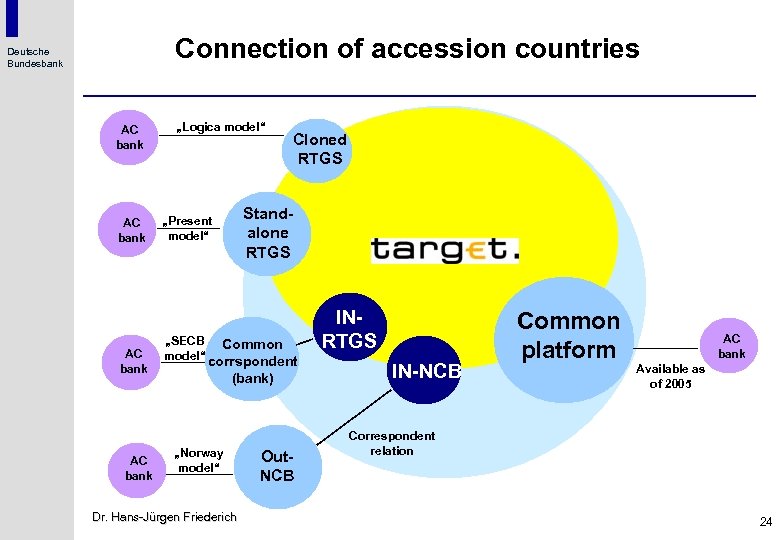
Connection of accession countries Deutsche Bundesbank AC bank „Logica model“ „Present model“ „SECB model“ Cloned RTGS Standalone RTGS Common corrspondent (bank) „Norway model“ Dr. Hans-Jürgen Friederich Out. NCB INRTGS IN-NCB Common platform AC bank Available as of 2005 Correspondent relation 24
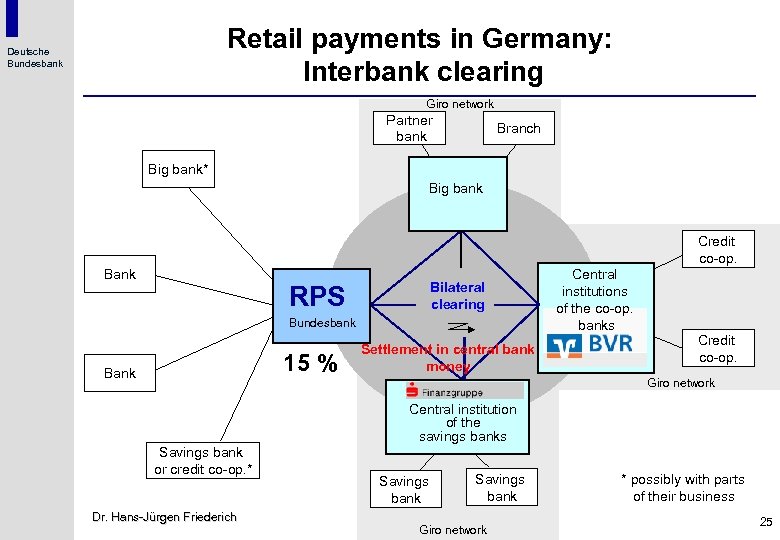
Retail payments in Germany: Interbank clearing Deutsche Bundesbank Giro network Partner bank Branch Big bank* Big bank Credit co-op. Bank Bilateral clearing RPS Bundesbank 15 % Bank Settlement in central bank money Central institutions of the co-op. banks Credit co-op. Giro network Central institution of the savings banks Savings bank or credit co-op. * Dr. Hans-Jürgen Friederich Savings bank Giro network * possibly with parts of their business 25
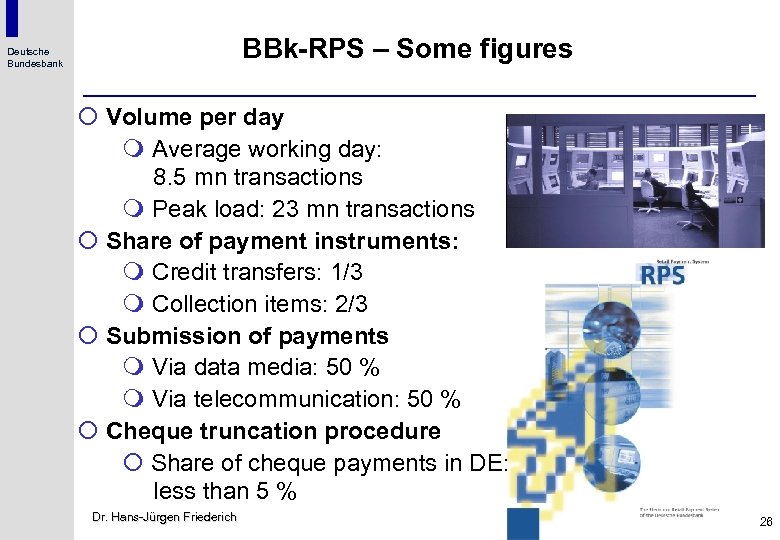
BBk-RPS – Some figures Deutsche Bundesbank ¡ Volume per day m Average working day: 8. 5 mn transactions m Peak load: 23 mn transactions ¡ Share of payment instruments: m Credit transfers: 1/3 m Collection items: 2/3 ¡ Submission of payments m Via data media: 50 % m Via telecommunication: 50 % ¡ Cheque truncation procedure ¡ Share of cheque payments in DE: less than 5 % Dr. Hans-Jürgen Friederich 26
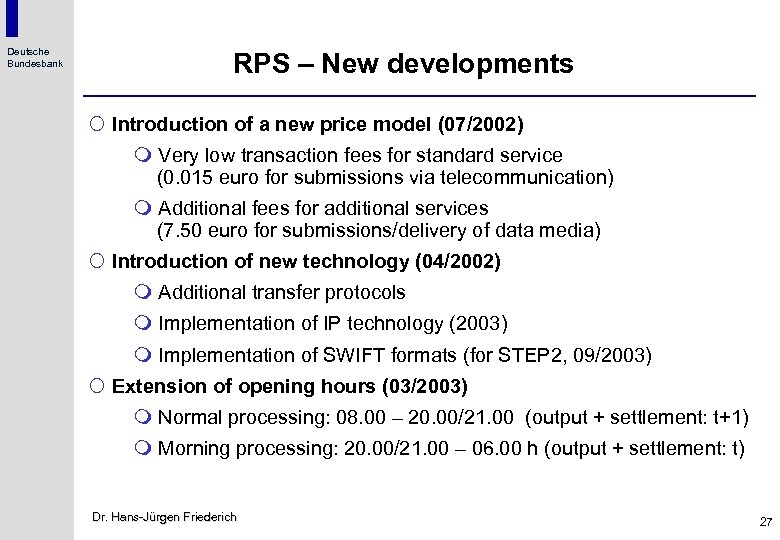
Deutsche Bundesbank RPS – New developments ¡ Introduction of a new price model (07/2002) m Very low transaction fees for standard service (0. 015 euro for submissions via telecommunication) m Additional fees for additional services (7. 50 euro for submissions/delivery of data media) ¡ Introduction of new technology (04/2002) m Additional transfer protocols m Implementation of IP technology (2003) m Implementation of SWIFT formats (for STEP 2, 09/2003) ¡ Extension of opening hours (03/2003) m Normal processing: 08. 00 – 20. 00/21. 00 (output + settlement: t+1) m Morning processing: 20. 00/21. 00 – 06. 00 h (output + settlement: t) Dr. Hans-Jürgen Friederich 27
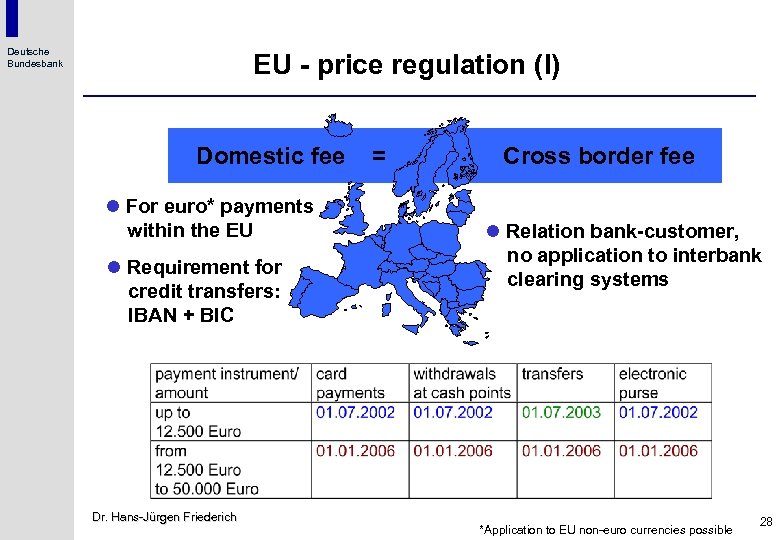
Deutsche Bundesbank EU - price regulation (I) Domestic fee l For euro* payments within the EU l Requirement for credit transfers: IBAN + BIC Dr. Hans-Jürgen Friederich = Cross border fee l Relation bank-customer, no application to interbank clearing systems *Application to EU non-euro currencies possible 28
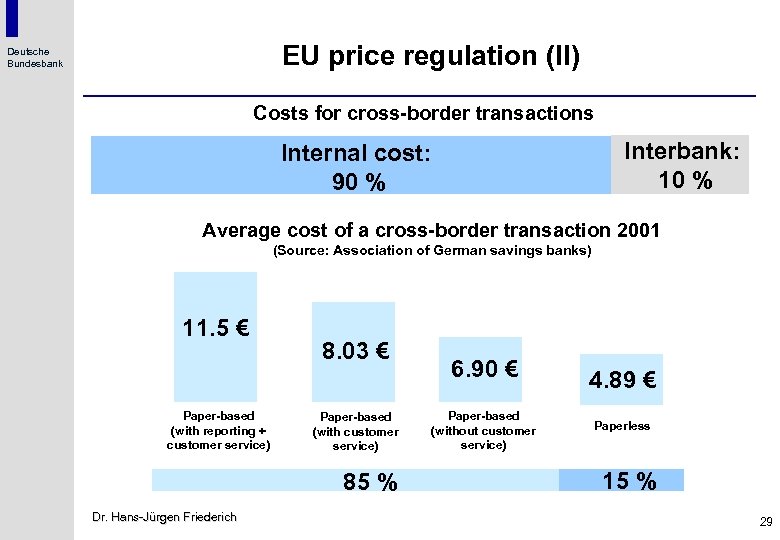
EU price regulation (II) Deutsche Bundesbank Costs for cross-border transactions Interbank: 10 % Internal cost: 90 % Average cost of a cross-border transaction 2001 (Source: Association of German savings banks) 11. 5 € Paper-based (with reporting + customer service) 8. 03 € Paper-based (with customer service) 85 % Dr. Hans-Jürgen Friederich 6. 90 € Paper-based (without customer service) 4. 89 € Paperless 15 % 29
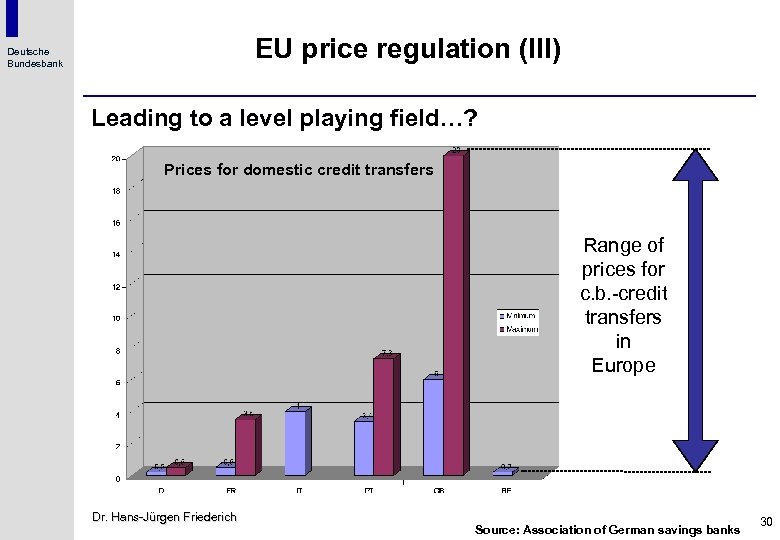
EU price regulation (III) Deutsche Bundesbank Leading to a level playing field…? Prices for domestic credit transfers Range of prices for c. b. -credit transfers in Europe Dr. Hans-Jürgen Friederich Source: Association of German savings banks 30
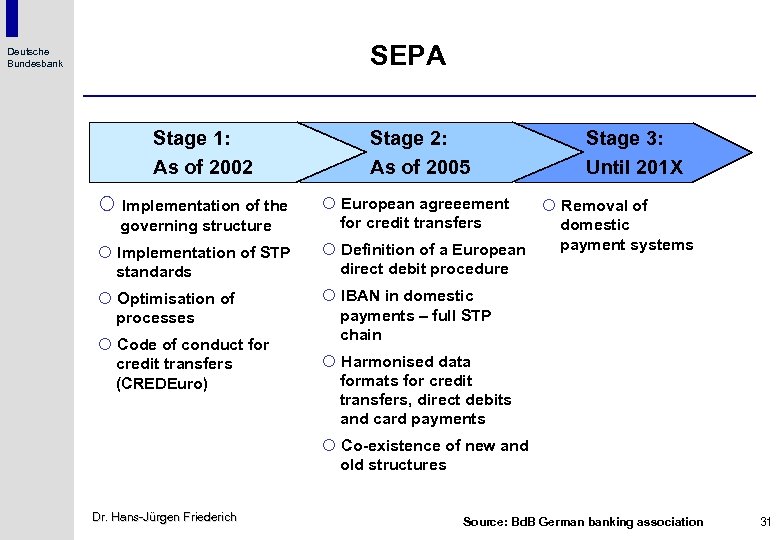
SEPA Deutsche Bundesbank Stage 1: As of 2002 ¡ Implementation of the governing structure ¡ Implementation of STP standards ¡ Optimisation of processes ¡ Code of conduct for credit transfers (CREDEuro) Stage 2: As of 2005 Stage 3: Until 201 X ¡ European agreeement for credit transfers ¡ Removal of domestic payment systems ¡ Definition of a European direct debit procedure ¡ IBAN in domestic payments – full STP chain ¡ Harmonised data formats for credit transfers, direct debits and card payments ¡ Co-existence of new and old structures Dr. Hans-Jürgen Friederich Source: Bd. B German banking association 31
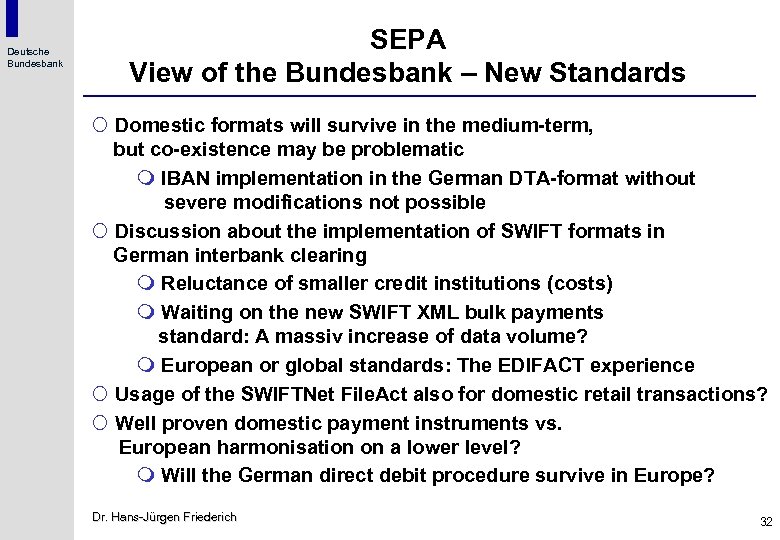
Deutsche Bundesbank SEPA View of the Bundesbank – New Standards ¡ Domestic formats will survive in the medium-term, but co-existence may be problematic m IBAN implementation in the German DTA-format without severe modifications not possible ¡ Discussion about the implementation of SWIFT formats in German interbank clearing m Reluctance of smaller credit institutions (costs) m Waiting on the new SWIFT XML bulk payments standard: A massiv increase of data volume? m European or global standards: The EDIFACT experience ¡ Usage of the SWIFTNet File. Act also for domestic retail transactions? ¡ Well proven domestic payment instruments vs. European harmonisation on a lower level? m Will the German direct debit procedure survive in Europe? Dr. Hans-Jürgen Friederich 32
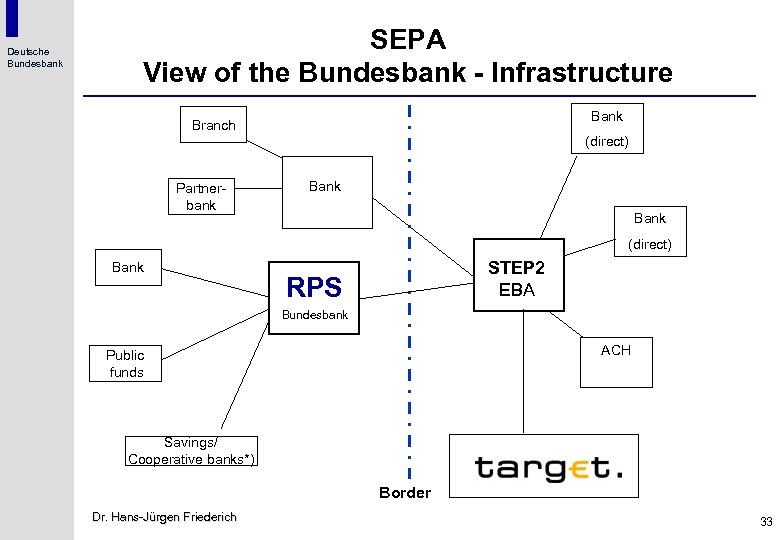
Deutsche Bundesbank SEPA View of the Bundesbank - Infrastructure Bank Branch (direct) Partnerbank Bank (direct) Bank STEP 2 EBA RPS Bundesbank ACH Public funds Savings/ Cooperative banks*) Border Dr. Hans-Jürgen Friederich 33
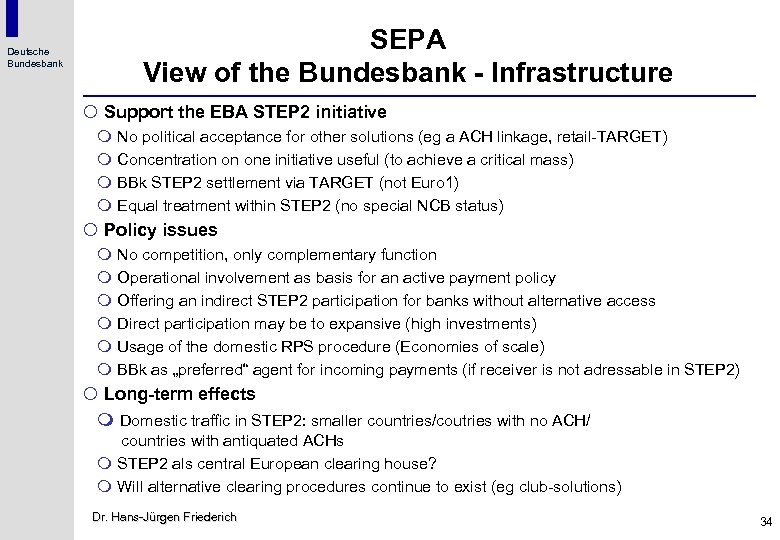
Deutsche Bundesbank SEPA View of the Bundesbank - Infrastructure ¡ Support the EBA STEP 2 initiative m No political acceptance for other solutions (eg a ACH linkage, retail-TARGET) m Concentration on one initiative useful (to achieve a critical mass) m BBk STEP 2 settlement via TARGET (not Euro 1) m Equal treatment within STEP 2 (no special NCB status) ¡ Policy issues m No competition, only complementary function m Operational involvement as basis for an active payment policy m Offering an indirect STEP 2 participation for banks without alternative access m Direct participation may be to expansive (high investments) m Usage of the domestic RPS procedure (Economies of scale) m BBk as „preferred“ agent for incoming payments (if receiver is not adressable in STEP 2) ¡ Long-term effects m Domestic traffic in STEP 2: smaller countries/coutries with no ACH/ countries with antiquated ACHs m STEP 2 als central European clearing house? m Will alternative clearing procedures continue to exist (eg club-solutions) Dr. Hans-Jürgen Friederich 34
Скачать презентацию Role of the Bundesbank in payment systems and
153f0d51da3a1f6b3ce9961e33f42242.ppt