


 Скачать презентацию Role of the actuary in Family Law after
d0a9a41007aae897c3b249e884657737.ppt
- Количество слайдов: 17
 Role of the actuary in Family Law after Jan. 1, 2012 Guy Martel, GML Actuarial Services Family Law Institute April 19, 2013
 Role of the Actuary § § § Pension valuations Income tax issues Division of a pension in pay (Ontario PBA) Double dipping issues Challenging the rules Other calculations
 Pension Valuations § § § Provincially regulated plans Federally regulated pension plans (PBSA) Federal government employees (PSSA, CFSA, RCMP, …) Foreign Plans Non-registered Supplemental plans (SERPS)
 Provincially regulated plans Parties do not want to wait Privacy: does not want employer or spouse to know Separation not finalized or other side not cooperating Missing components of value (contractual indexing, some bridge benefits) Review statement of Family Law Value
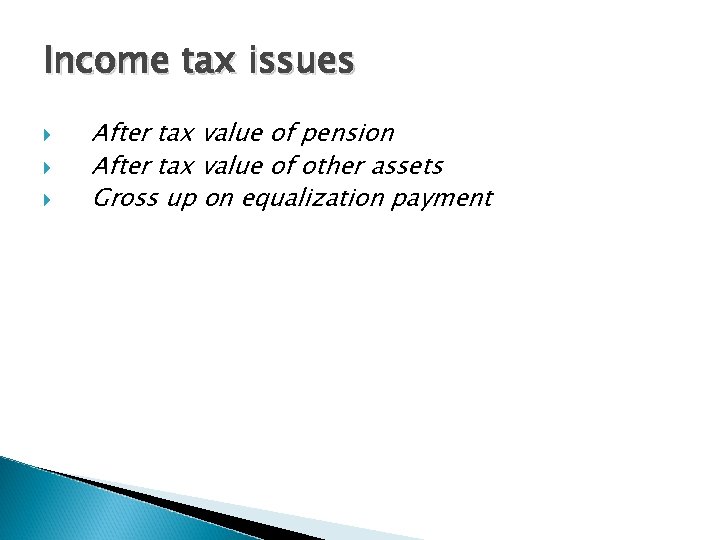 Income tax issues After tax value of pension After tax value of other assets Gross up on equalization payment
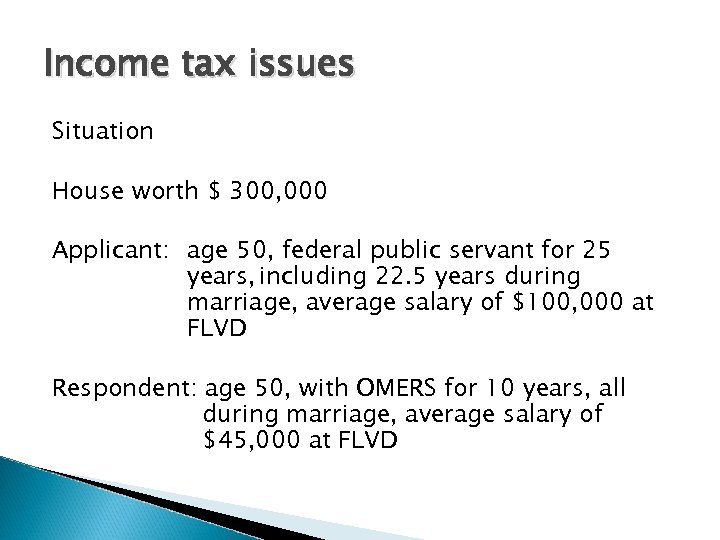 Income tax issues Situation House worth $ 300, 000 Applicant: age 50, federal public servant for 25 years, including 22. 5 years during marriage, average salary of $100, 000 at FLVD Respondent: age 50, with OMERS for 10 years, all during marriage, average salary of $45, 000 at FLVD
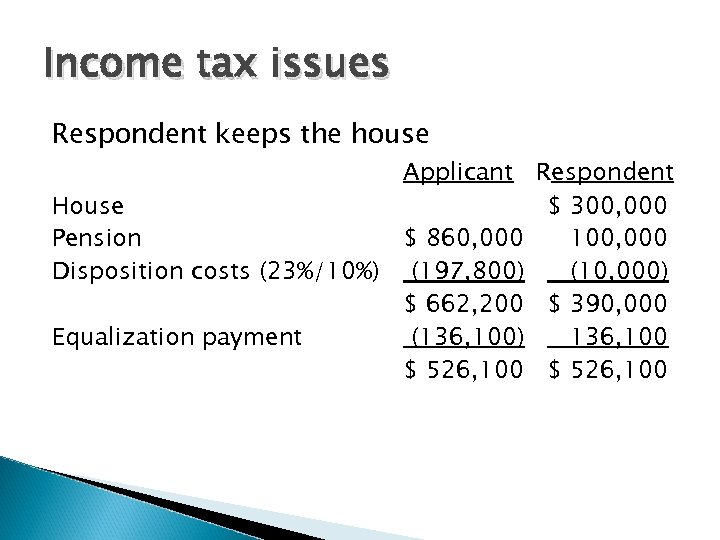 Income tax issues Respondent keeps the house Applicant Respondent House $ 300, 000 Pension $ 860, 000 100, 000 Disposition costs (23%/10%) (197, 800) (10, 000) $ 662, 200 $ 390, 000 Equalization payment (136, 100) 136, 100 $ 526, 100
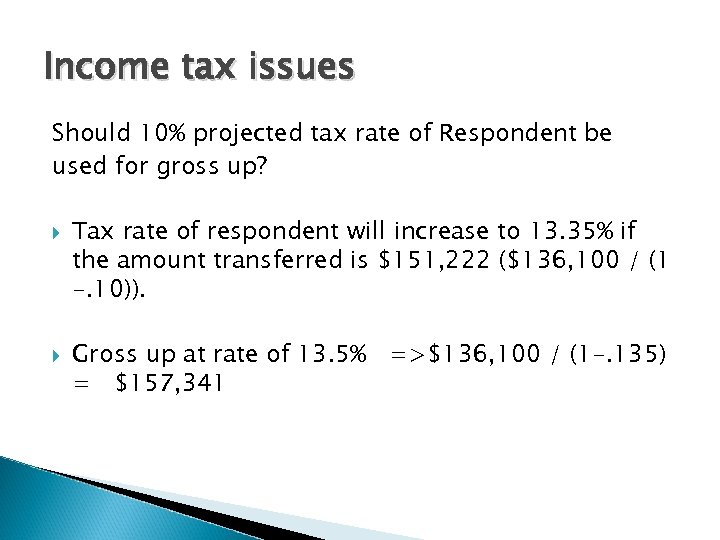 Income tax issues Should 10% projected tax rate of Respondent be used for gross up? Tax rate of respondent will increase to 13. 35% if the amount transferred is $151, 222 ($136, 100 / (1 -. 10)). Gross up at rate of 13. 5% =>$136, 100 / (1 -. 135) = $157, 341
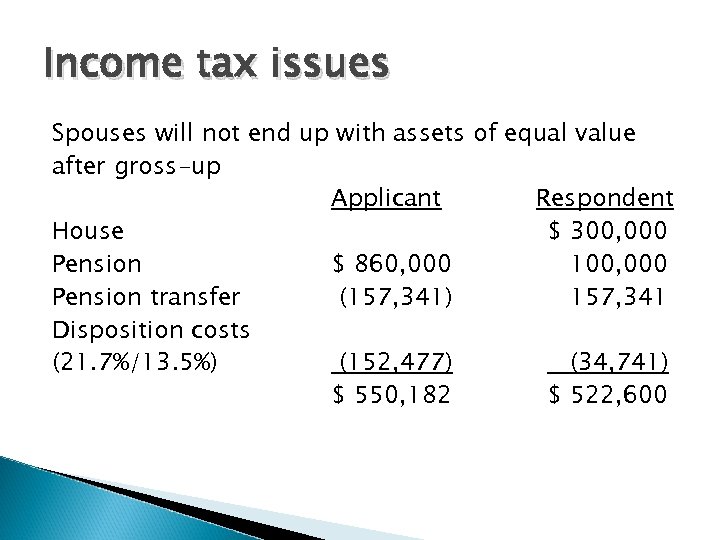 Income tax issues Spouses will not end up with assets of equal value after gross-up Applicant Respondent House $ 300, 000 Pension $ 860, 000 100, 000 Pension transfer (157, 341) 157, 341 Disposition costs (21. 7%/13. 5%) (152, 477) (34, 741) $ 550, 182 $ 522, 600
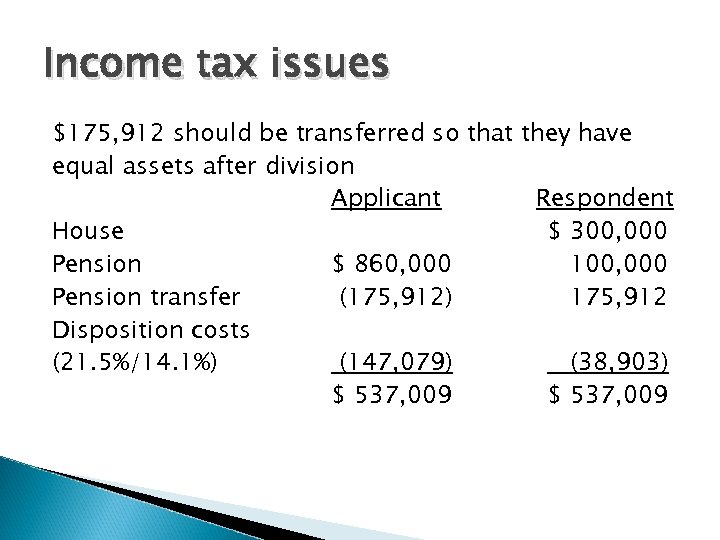 Income tax issues $175, 912 should be transferred so that they have equal assets after division Applicant Respondent House $ 300, 000 Pension $ 860, 000 100, 000 Pension transfer (175, 912) 175, 912 Disposition costs (21. 5%/14. 1%) (147, 079) (38, 903) $ 537, 009
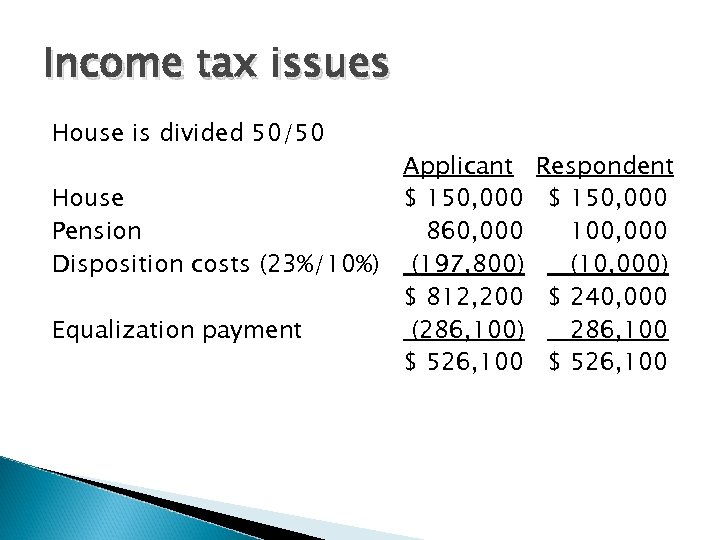 Income tax issues House is divided 50/50 Applicant House $ 150, 000 Pension 860, 000 Disposition costs (23%/10%) (197, 800) $ 812, 200 Equalization payment (286, 100) $ 526, 100 Respondent $ 150, 000 100, 000 (10, 000) $ 240, 000 286, 100 $ 526, 100
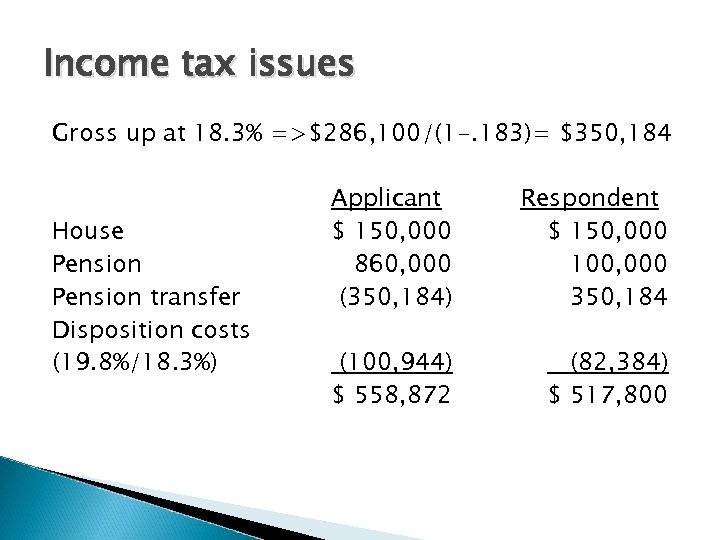 Income tax issues Gross up at 18. 3% =>$286, 100/(1 -. 183)= $350, 184 House Pension transfer Disposition costs (19. 8%/18. 3%) Applicant $ 150, 000 860, 000 (350, 184) Respondent $ 150, 000 100, 000 350, 184 (100, 944) $ 558, 872 (82, 384) $ 517, 800
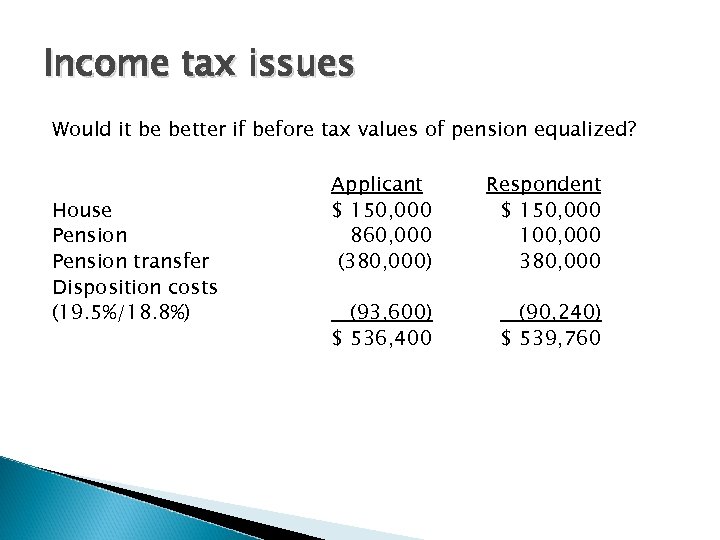 Income tax issues Would it be better if before tax values of pension equalized? House Pension transfer Disposition costs (19. 5%/18. 8%) Applicant $ 150, 000 860, 000 (380, 000) Respondent $ 150, 000 100, 000 380, 000 (93, 600) $ 536, 400 (90, 240) $ 539, 760
 Division of a pension in pay Deemed arrears repayment requirement ◦ If active at FLVD, spouse’s share will be credited with interest to date of transfer ◦ If retired at FLVD, arrears payable to spouse will be accumulated with interest ◦ Member’s pension is reduced by spouse’s share ◦ Monthly payments to member will be further reduced to recoverpayment between date of retirement and date of transfer ◦ If in pay at retirement, pension of spouse will be increased to recover payments the spouse should have received between FLVD and date of transfer
 Division of a pension in pay Example - Family Law Valuation Date: March 1, 2010 - Applicant, age 65, receives a non-indexed pension of $4, 000 per month at FLVD - Pension was entirely accrued during marriage - Division occurs March 1, 2013
 Division of a pension in pay Example - If 50% division, spouse should have received $2, 000 per month for last 36 months - Arrears of $75, 955 ($72, 000 plus interest) - Arrears represent an annual amount of $5, 804 for the applicant’s lifetime - Respondent will receive $29, 804 per year (62. 09% of pension) - Applicant will be left with $18, 196 per year (37. 91% of pension) - Spouse may have received spousal support between the FLVD and the date of division
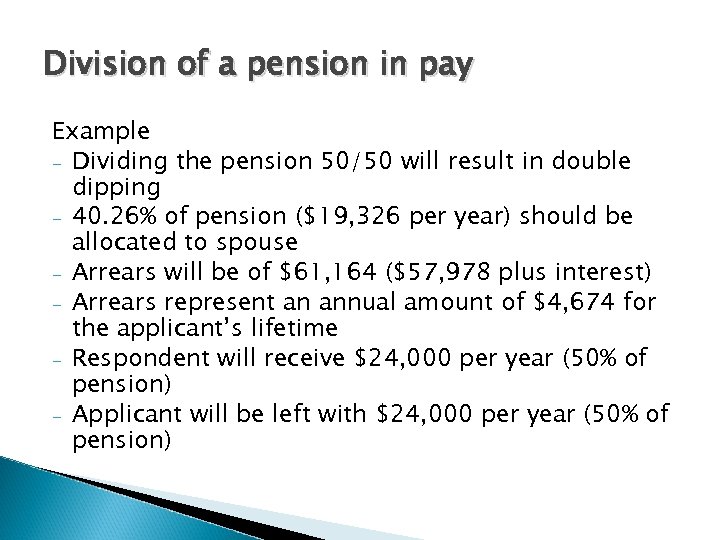 Division of a pension in pay Example - Dividing the pension 50/50 will result in double dipping - 40. 26% of pension ($19, 326 per year) should be allocated to spouse - Arrears will be of $61, 164 ($57, 978 plus interest) - Arrears represent an annual amount of $4, 674 for the applicant’s lifetime - Respondent will receive $24, 000 per year (50% of pension) - Applicant will be left with $24, 000 per year (50% of pension)