


 Скачать презентацию Role of protein aggregation in cellular degeneration a
af9f19c374b2c79b7ed9d76ddabfd87f.ppt
- Количество слайдов: 13
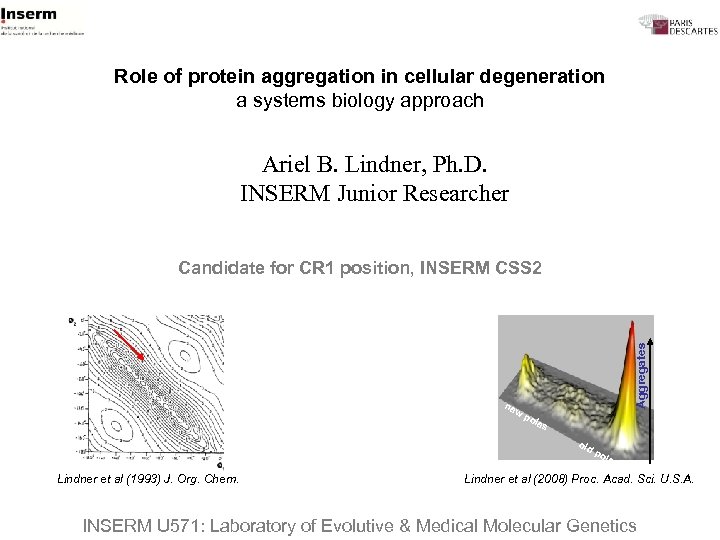 Role of protein aggregation in cellular degeneration a systems biology approach Ariel B. Lindner, Ph. D. INSERM Junior Researcher 1 m. M ne wp ole Aggregates Candidate for CR 1 position, INSERM CSS 2 s old po le s Lindner et al (1993) J. Org. Chem. Lindner et al (2008) Proc. Acad. Sci. U. S. A. INSERM U 571: Laboratory of Evolutive & Medical Molecular Genetics
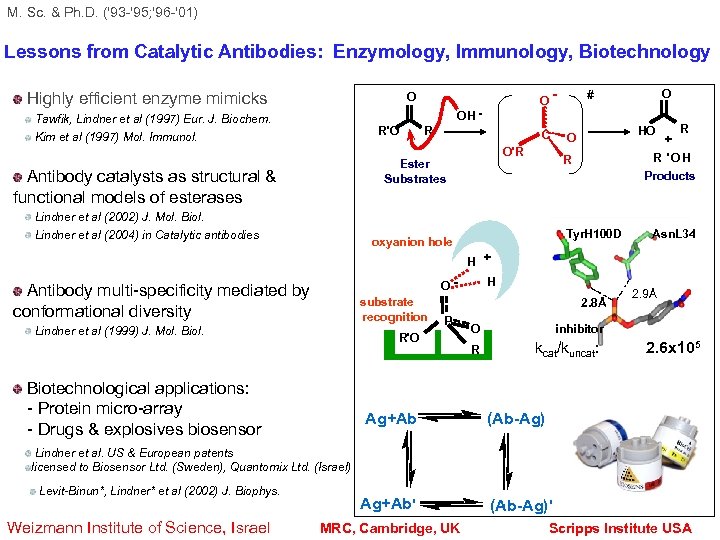 M. Sc. & Ph. D. ('93 -'95; '96 -'01) Lessons from Catalytic Antibodies: Enzymology, Immunology, Biotechnology Highly efficient enzyme mimicks O O OH - Tawfik, Lindner et al (1997) Eur. J. Biochem. R'O Kim et al (1997) Mol. Immunol. R C O'R Ester Substrates Antibody catalysts as structural & functional models of esterases Lindner et al (2002) J. Mol. Biol. Lindner et al (2004) in Catalytic antibodies - HO O + R R ' OH Products R Tyr. H 100 D oxyanion hole O # Asn. L 34 H + O- Antibody multi-specificity mediated by conformational diversity substrate recognition Lindner et al (1999) J. Mol. Biol. 2. 8Å P R'O Biotechnological applications: - Protein micro-array - Drugs & explosives biosensor H inhibitor O R 2. 9Å kcat/kuncat: Ag+Ab (Ab-Ag) Ag+Ab' 2. 6 x 10⁵ . (Ab-Ag)' Lindner et al. US & European patents licensed to Biosensor Ltd. (Sweden), Quantomix Ltd. (Israel) Levit-Binun*, Lindner* et al (2002) J. Biophys. Weizmann Institute of Science, Israel MRC, Cambridge, UK Scripps Institute USA
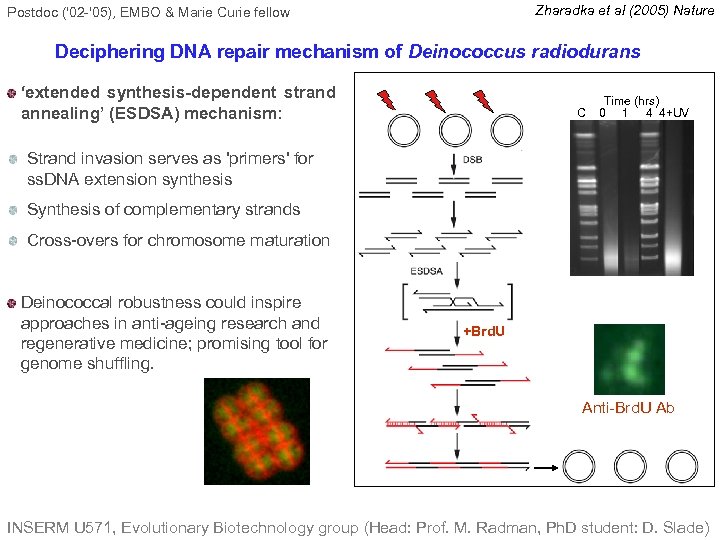 Zharadka et al (2005) Nature Postdoc ('02 -'05), EMBO & Marie Curie fellow Deciphering DNA repair mechanism of Deinococcus radiodurans ‘extended synthesis-dependent strand annealing’ (ESDSA) mechanism: C Time (hrs) 0 1 4 4+UV Strand invasion serves as 'primers' for ss. DNA extension synthesis Synthesis of complementary strands Cross-overs for chromosome maturation Deinococcal robustness could inspire approaches in anti-ageing research and regenerative medicine; promising tool for genome shuffling. +Brd. U Anti-Brd. U Ab INSERM U 571, Evolutionary Biotechnology group (Head: Prof. M. Radman, Ph. D student: D. Slade)
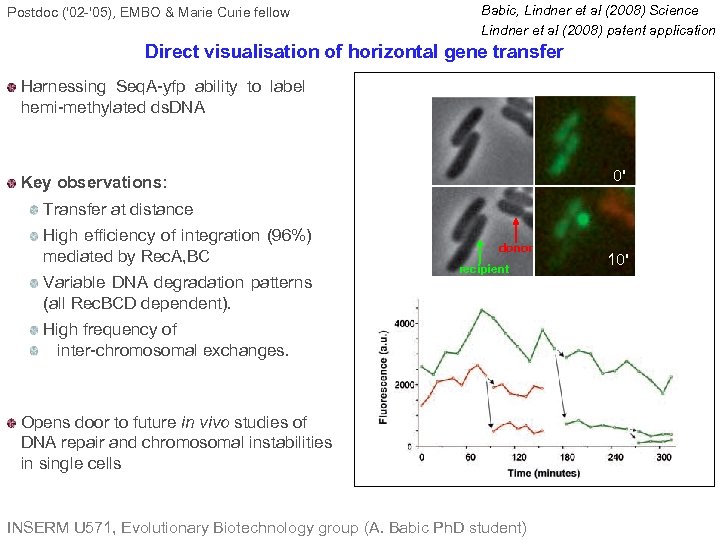 Postdoc ('02 -'05), EMBO & Marie Curie fellow Babic, Lindner et al (2008) Science Lindner et al (2008) patent application Direct visualisation of horizontal gene transfer Harnessing Seq. A-yfp ability to label hemi-methylated ds. DNA 0' Key observations: Transfer at distance High efficiency of integration (96%) mediated by Rec. A, BC Variable DNA degradation patterns (all Rec. BCD dependent). donor recipient High frequency of inter-chromosomal exchanges. Opens door to future in vivo studies of DNA repair and chromosomal instabilities in single cells INSERM U 571, Evolutionary Biotechnology group (A. Babic Ph. D student) 10' 1 mm
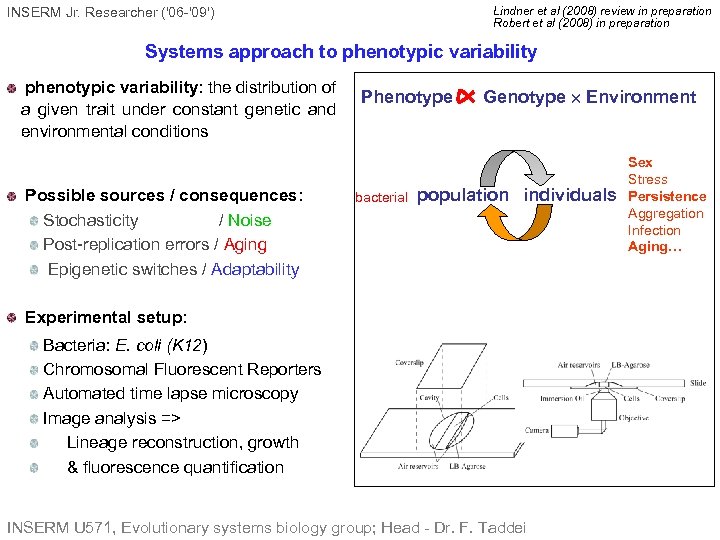 Lindner et al (2008) review in preparation Robert et al (2008) in preparation INSERM Jr. Researcher ('06 -'09') Systems approach to phenotypic variability: the distribution of a given trait under constant genetic and environmental conditions Possible sources / consequences: Stochasticity / Noise Post-replication errors / Aging Epigenetic switches / Adaptability Phenotype bacterial Genotype Environment population individuals Experimental setup: Bacteria: E. coli (K 12) Chromosomal Fluorescent Reporters Automated time lapse microscopy Image analysis => Lineage reconstruction, growth & fluorescence quantification INSERM U 571, Evolutionary systems biology group; Head - Dr. F. Taddei Sex Stress Persistence Aggregation Infection Aging…
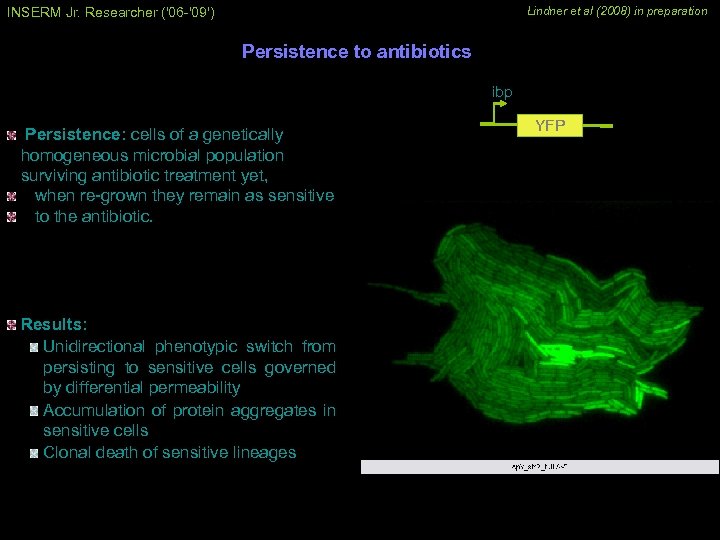 Lindner et al (2008) in preparation INSERM Jr. Researcher ('06 -'09') Persistence to antibiotics ibp Persistence: cells of a genetically homogeneous microbial population surviving antibiotic treatment yet, when re-grown they remain as sensitive to the antibiotic. Results: Unidirectional phenotypic switch from persisting to sensitive cells governed by differential permeability Accumulation of protein aggregates in sensitive cells Clonal death of sensitive lineages YFP
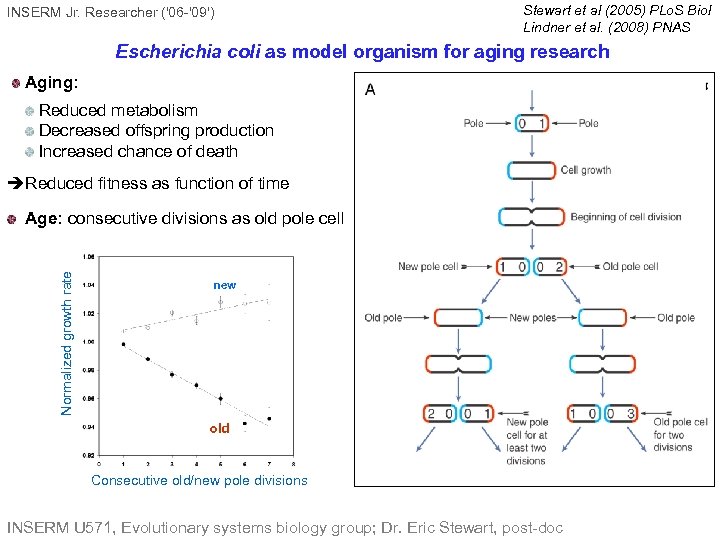 INSERM Jr. Researcher ('06 -'09') Stewart et al (2005) PLo. S Biol Lindner et al. (2008) PNAS Escherichia coli as model organism for aging research Aging: Reduced metabolism Decreased offspring production Increased chance of death Reduced fitness as function of time Normalized growth rate Age: consecutive divisions as old pole cell new old Consecutive old/new pole divisions INSERM U 571, Evolutionary systems biology group; Dr. Eric Stewart, post-doc
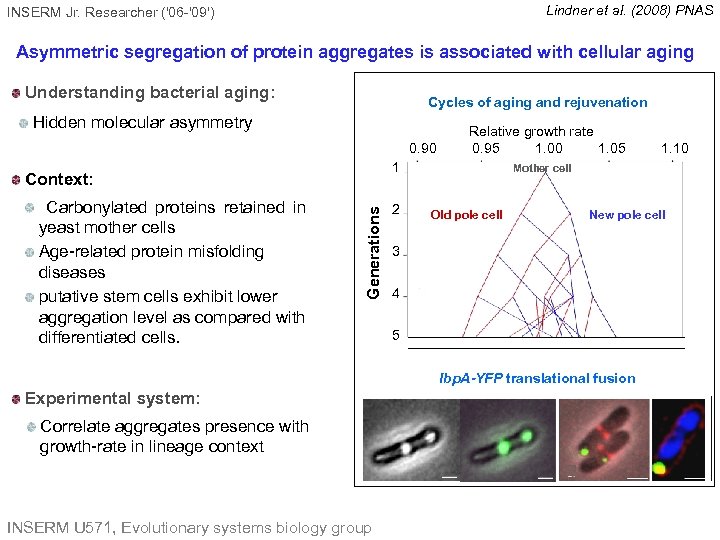 Lindner et al. (2008) PNAS INSERM Jr. Researcher ('06 -'09') Asymmetric segregation of protein aggregates is associated with cellular aging Understanding bacterial aging: Cycles of aging and rejuvenation Hidden molecular asymmetry 0. 90 1 Generations Context: Carbonylated proteins retained in yeast mother cells Age-related protein misfolding diseases putative stem cells exhibit lower aggregation level as compared with differentiated cells. Relative growth rate 0. 95 1. 00 1. 05 2 Mother cell Old pole cell New pole cell 3 4 5 Ibp. A-YFP translational fusion Experimental system: Correlate aggregates presence with growth-rate in lineage context INSERM U 571, Evolutionary systems biology group 1. 10
 INSERM Jr. Researcher ('06 -'09') Lindner et al (2008) PNAS Asymmetric segregation of protein aggregates is associated with cellular aging INSERM U 571, Evolutionary systems biology group
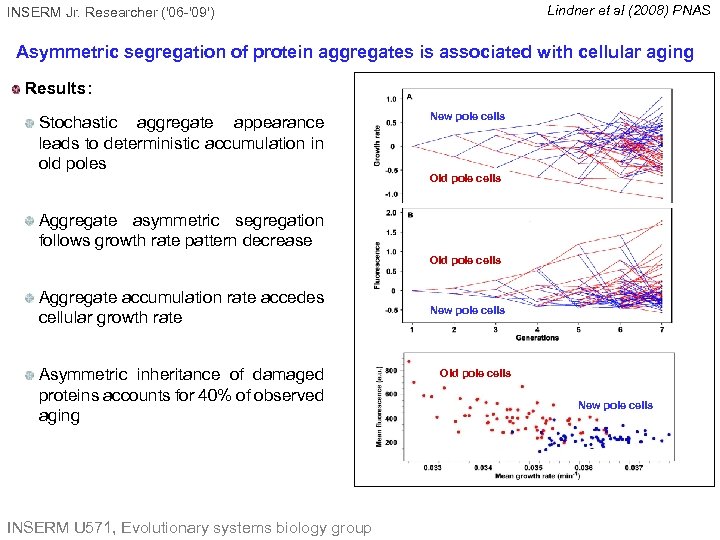 Lindner et al (2008) PNAS INSERM Jr. Researcher ('06 -'09') Asymmetric segregation of protein aggregates is associated with cellular aging Results: Stochastic aggregate appearance leads to deterministic accumulation in old poles New pole cells Old pole cells Aggregate asymmetric segregation follows growth rate pattern decrease Old pole cells Aggregate accumulation rate accedes cellular growth rate Asymmetric inheritance of damaged proteins accounts for 40% of observed aging INSERM U 571, Evolutionary systems biology group New pole cells Old pole cells New pole cells
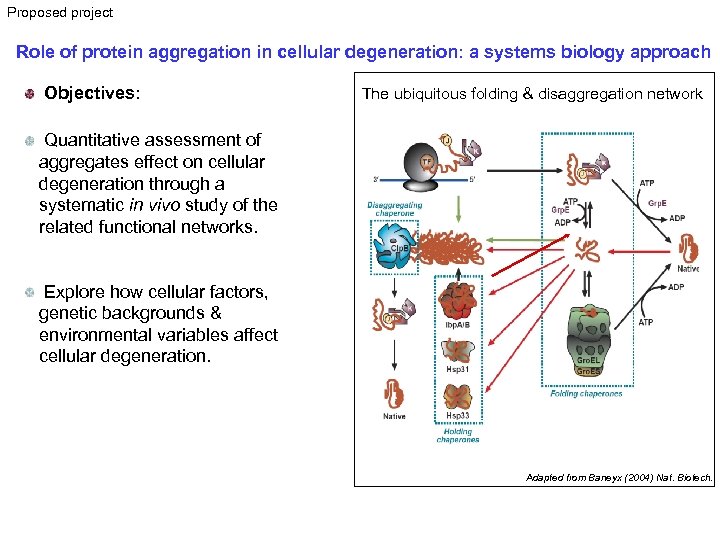 Proposed project Role of protein aggregation in cellular degeneration: a systems biology approach Objectives: The ubiquitous folding & disaggregation network Quantitative assessment of aggregates effect on cellular degeneration through a systematic in vivo study of the related functional networks. Explore how cellular factors, genetic backgrounds & environmental variables affect cellular degeneration. Adapted from Baneyx (2004) Nat. Biotech.
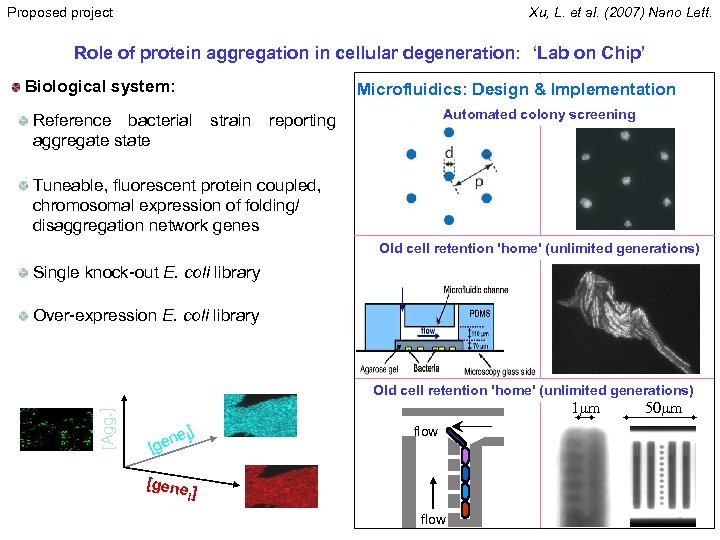 Proposed project Xu, L. et al. (2007) Nano Lett. Role of protein aggregation in cellular degeneration: ‘Lab on Chip’ Biological system: Microfluidics: Design & Implementation Reference bacterial aggregate strain Automated colony screening reporting Tuneable, fluorescent protein coupled, chromosomal expression of folding/ disaggregation network genes Old cell retention 'home' (unlimited generations) Single knock-out E. coli library Over-expression E. coli library [Agg. ] Old cell retention 'home' (unlimited generations) 1 mm ] ene j [g flow [gene i] flow 50 mm
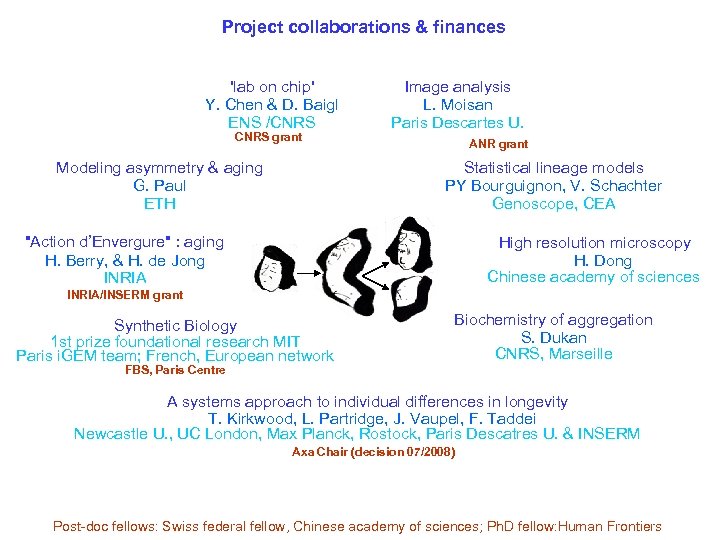 Project collaborations & finances 'lab on chip' Y. Chen & D. Baigl ENS /CNRS grant Modeling asymmetry & aging G. Paul ETH Image analysis L. Moisan Paris Descartes U. ANR grant Statistical lineage models PY Bourguignon, V. Schachter Genoscope, CEA "Action d’Envergure" : aging H. Berry, & H. de Jong INRIA High resolution microscopy H. Dong Chinese academy of sciences INRIA/INSERM grant Synthetic Biology 1 st prize foundational research MIT Paris i. GEM team; French, European network Biochemistry of aggregation S. Dukan CNRS, Marseille FBS, Paris Centre A systems approach to individual differences in longevity T. Kirkwood, L. Partridge, J. Vaupel, F. Taddei Newcastle U. , UC London, Max Planck, Rostock, Paris Descatres U. & INSERM Axa Chair (decision 07/2008) Post-doc fellows: Swiss federal fellow, Chinese academy of sciences; Ph. D fellow: Human Frontiers