


 Скачать презентацию Role of forests in Finnish climate change policy
2fec243b94a789b794540511c98b89dc.ppt
- Количество слайдов: 14
 Role of forests in Finnish climate change policy Ministerial conference and workshop on the role of boreal forest in CO 2 balance Dr. Tatu Torniainen
 Contents of the presentation 1. 2. 3. 4. Basic facts on forests and forestry in Finland Forest policy Forests and climate change profile of Finland Remarks
 The Paris Agreement and its Article 4 states e. g. that “… so as to achieve a balance between anthropogenic emissions by sources and removals by sinks of greenhouse gases in the second half of this century, …”.
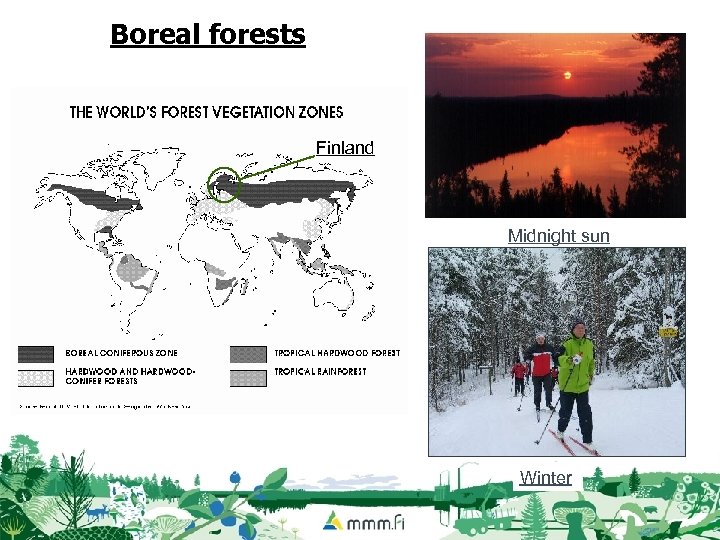 Boreal forests Finland Midnight sun Winter
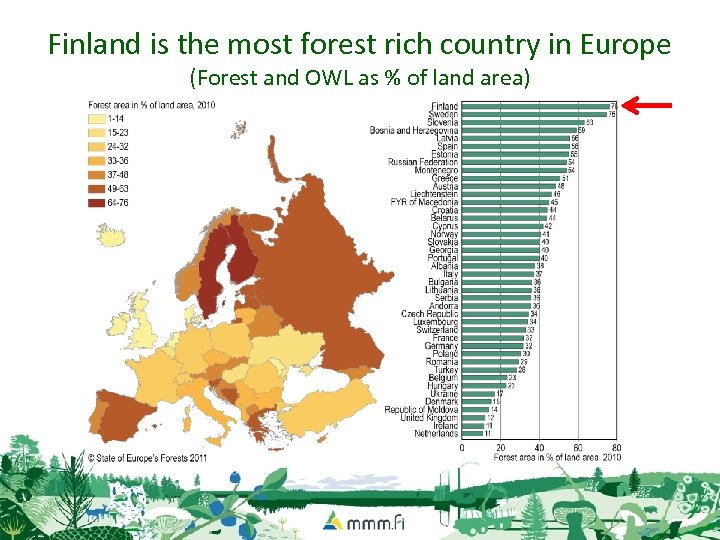 Finland is the most forest rich country in Europe (Forest and OWL as % of land area)
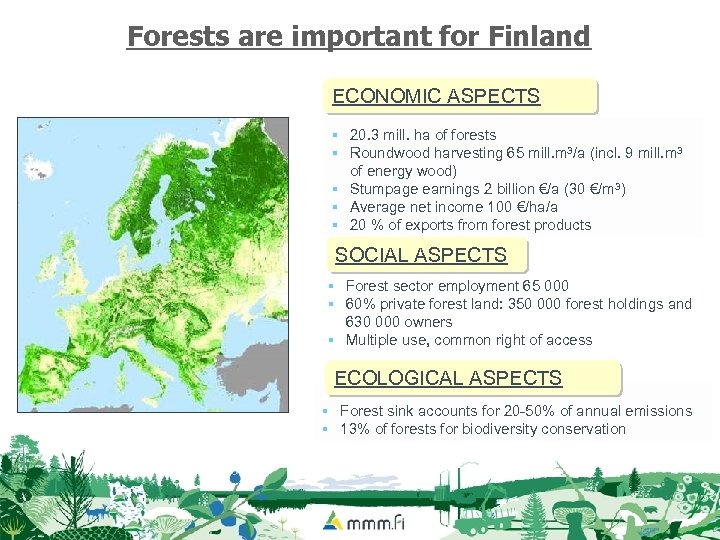 Forests are important for Finland ECONOMIC ASPECTS § 20. 3 mill. ha of forests § Roundwood harvesting 65 mill. m 3/a (incl. 9 mill. m 3 of energy wood) § Stumpage earnings 2 billion €/a (30 €/m 3) § Average net income 100 €/ha/a § 20 % of exports from forest products SOCIAL ASPECTS § Forest sector employment 65 000 § 60% private forest land: 350 000 forest holdings and 630 000 owners § Multiple use, common right of access ECOLOGICAL ASPECTS § Forest sink accounts for 20 -50% of annual emissions § 13% of forests for biodiversity conservation
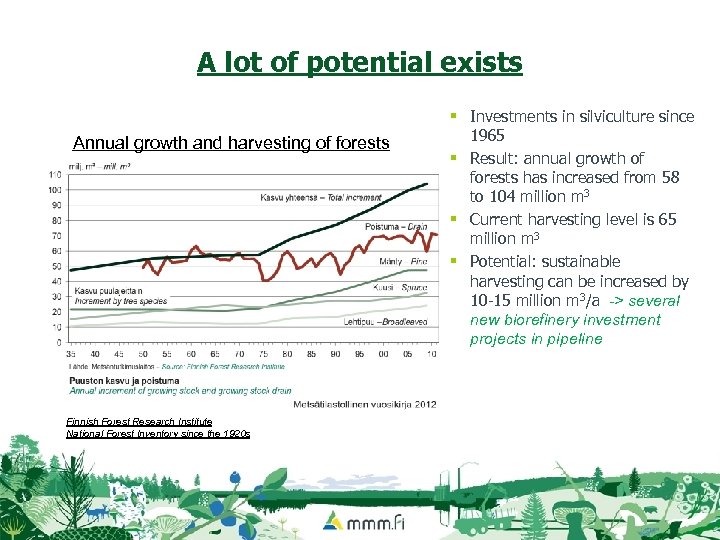 A lot of potential exists Annual growth and harvesting of forests Finnish Forest Research Institute National Forest Inventory since the 1920 s § Investments in silviculture since 1965 § Result: annual growth of forests has increased from 58 to 104 million m 3 § Current harvesting level is 65 million m 3 § Potential: sustainable harvesting can be increased by 10 -15 million m 3/a -> several new biorefinery investment projects in pipeline
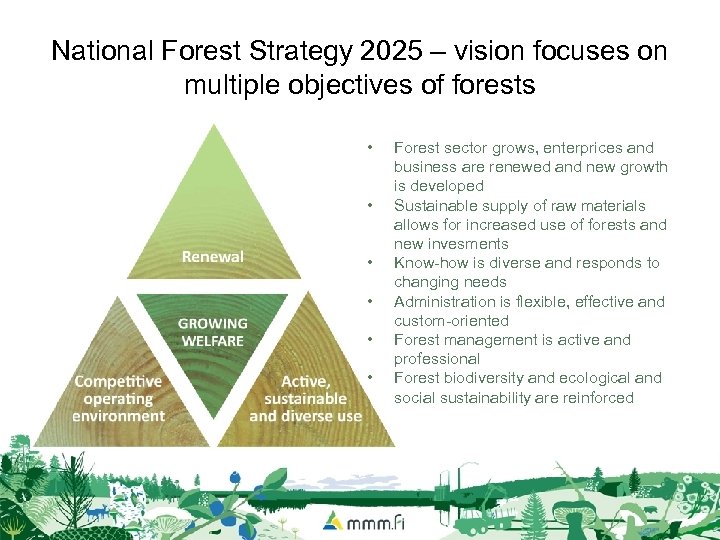 National Forest Strategy 2025 – vision focuses on multiple objectives of forests • • • Forest sector grows, enterprices and business are renewed and new growth is developed Sustainable supply of raw materials allows for increased use of forests and new invesments Know-how is diverse and responds to changing needs Administration is flexible, effective and custom-oriented Forest management is active and professional Forest biodiversity and ecological and social sustainability are reinforced
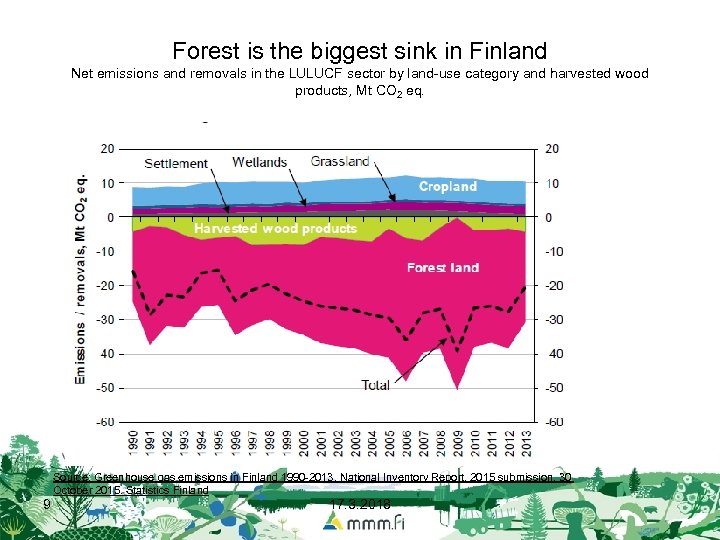 Forest is the biggest sink in Finland Net emissions and removals in the LULUCF sector by land-use category and harvested wood products, Mt CO 2 eq. 9 Source: Greenhouse gas emissions in Finland 1990 -2013. National Inventory Report. 2015 submission. 30 October 2015. Statistics Finland 17. 3. 2018
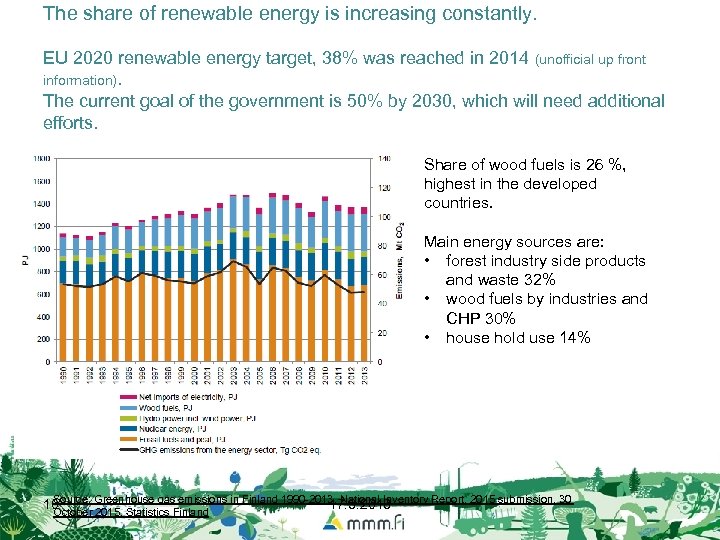 The share of renewable energy is increasing constantly. EU 2020 renewable energy target, 38% was reached in 2014 (unofficial up front information). The current goal of the government is 50% by 2030, which will need additional efforts. Share of wood fuels is 26 %, highest in the developed countries. Main energy sources are: • forest industry side products and waste 32% • wood fuels by industries and CHP 30% • house hold use 14% Source: Greenhouse gas emissions in Finland 1990 -2013. National Inventory Report. 2015 submission. 30 10 17. 3. 2018 October 2015. Statistics Finland
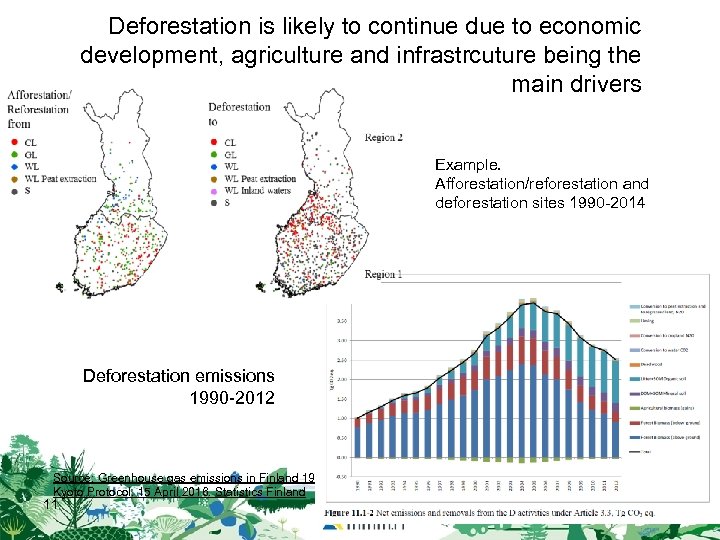 Deforestation is likely to continue due to economic development, agriculture and infrastrcuture being the main drivers Example. Afforestation/reforestation and deforestation sites 1990 -2014 Deforestation emissions 1990 -2012 Source: Greenhouse gas emissions in Finland 1990 -2014. National Inventory Report under the UNFCCC and the Kyoto Protocol. 15 April 2016. Statistics Finland 11 17. 3. 2018
 About existing accounting rules • Moving towards land based accounting – avoiding additional burden, consistency with the Convention reporting • For forests, a reference level approach is preferred way of accounting – RL should be nationally determined and represent the most recent policies, a technical assessment process to increase transparency is welcomed • It is of highly important to keep a balanced approach to different land categories for long-term enhancement of removals – equal treatment of various mitigation measures, e. g. afforestation potential varies significantly between countries, and is rather limited particularly in forest rich countries. – Current rules (FM cap of 3. 5% of the base year emissions) do not reflect situation in forest or encourage enhancement of forest sinks
 Finally • There are significant national differences between countries in terms of forest coverage, land use, forest management, natural conditions, GHG profiles and mitigation potential – flexibility is needed • Emission reductions are climate change policies’ primary goal in Finland • Forests have the potential to contribute positively to climate change mitigation in many ways – via reducing emissions and increasing removals and substituting for fossil fuels and materials with higher life-cycle emissions • At the same time forest policy has multiple objectives – Sustainable forest management is key to climate change mitigation and adaptation, as well as the maintenance of ecosystem services • It is highly important that climate change policy provides stimulus for long-term sustainable management of forests
 Thank you!