


 Скачать презентацию Role of Education and Protection of Children At-Risk
997d95a3cde0b3b873ca0427d7b73743.ppt
- Количество слайдов: 16
 Role of Education and Protection of Children At-Risk Changu Mannathoko Senior Education Advisor, UNICEF NYHQ Education Section 1
 Role of Education and Protection of Children At-Risk Bullying part of School Related Gender Based Violence • It is a violation of human rights and a barrier to girls and boys learning & reaching their full potential. • Bullying of girls and boys in and around schools is part of a broader and comprehensive program on School Related Gender Based Violence (SRGBV). • Bullying is about gender power relations and sexuality includes: behaviours like teasing, name –calling, physical violence and social exclusion. Can be physical, sexual, homophobic, cyber space , verbal or emotional in nature. • Bullying is a worldwide problem that can have negative consequences for the general school climate and for the right of girls and boys to learn in a safe environment without fear. • d Protection of Children At-Ri • k
 • School bullying may be more specifically characterized by: An intention to harm: intention suggests that the harm caused by bullying is deliberate, not accidental. • Bullying is distinguished from other forms of violence because it represents a pattern of behavior rather than an isolated event. • Bullying takes place due to unequal power relations, discrimination, gender stereotypes and social normsthat is integrated. • Comprehensive approach to SRGBV within which school bullying is integrated. 3
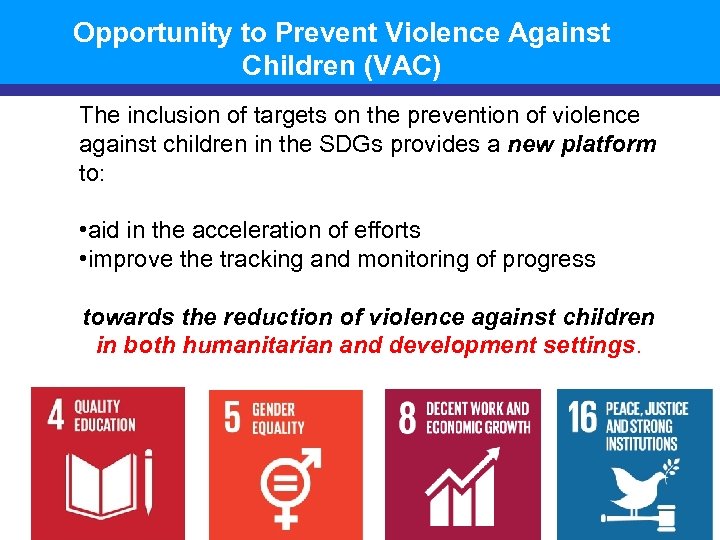 Opportunity to Prevent Violence Against Children (VAC) The inclusion of targets on the prevention of violence against children in the SDGs provides a new platform to: • aid in the acceleration of efforts • improve the tracking and monitoring of progress towards the reduction of violence against children in both humanitarian and development settings. 4
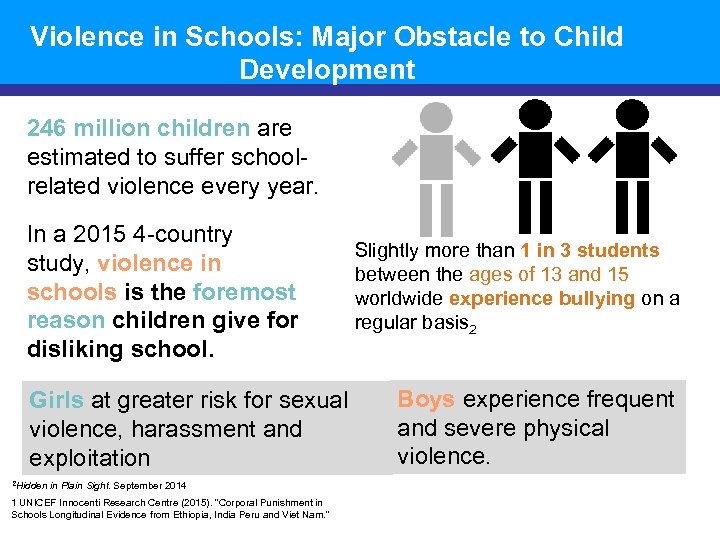 Violence in Schools: Major Obstacle to Child Development 246 million children are estimated to suffer schoolrelated violence every year. In a 2015 4 -country study, violence in schools is the foremost reason children give for disliking school. Girls at greater risk for sexual 1 violence, harassment and exploitation 2 Hidden in Plain Sight. September 2014 1 UNICEF Innocenti Research Centre (2015). “Corporal Punishment in Schools Longitudinal Evidence from Ethiopia, India Peru and Viet Nam. ” Slightly more than 1 in 3 students between the ages of 13 and 15 worldwide experience bullying on a regular basis 2 Boys experience frequent and severe physical violence.
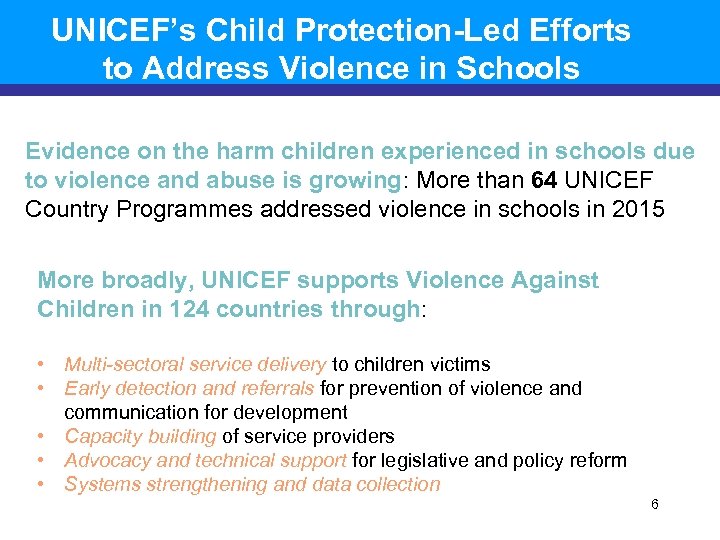 UNICEF’s Child Protection-Led Efforts to Address Violence in Schools Evidence on the harm children experienced in schools due to violence and abuse is growing: More than 64 UNICEF Country Programmes addressed violence in schools in 2015 More broadly, UNICEF supports Violence Against Children in 124 countries through: • Multi-sectoral service delivery to children victims • Early detection and referrals for prevention of violence and communication for development • Capacity building of service providers • Advocacy and technical support for legislative and policy reform • Systems strengthening and data collection 6
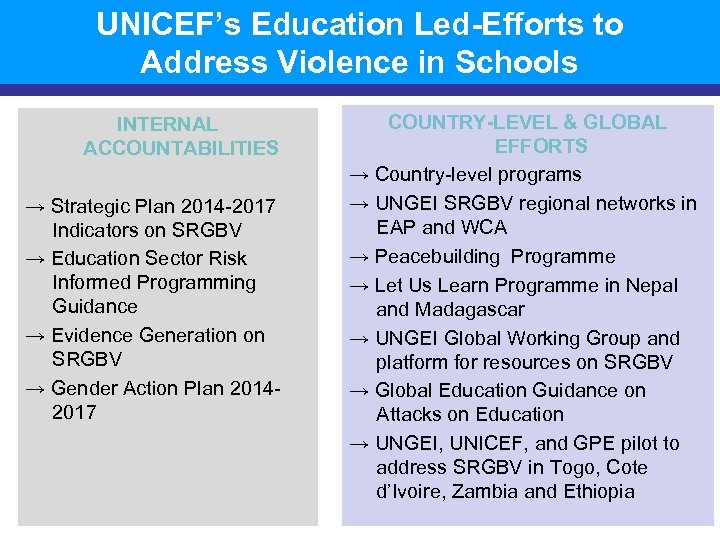 UNICEF’s Education Led-Efforts to Address Violence in Schools INTERNAL ACCOUNTABILITIES → Strategic Plan 2014 -2017 Indicators on SRGBV → Education Sector Risk Informed Programming Guidance → Evidence Generation on SRGBV → Gender Action Plan 20142017 COUNTRY-LEVEL & GLOBAL EFFORTS → Country-level programs → UNGEI SRGBV regional networks in EAP and WCA → Peacebuilding Programme → Let Us Learn Programme in Nepal and Madagascar → UNGEI Global Working Group and platform for resources on SRGBV → Global Education Guidance on Attacks on Education → UNGEI, UNICEF, and GPE pilot to address SRGBV in Togo, Cote d’Ivoire, Zambia and Ethiopia 7
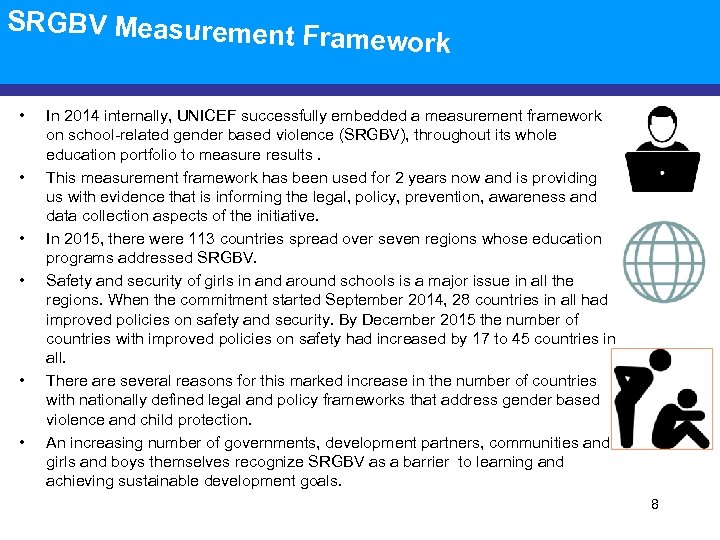 SRGBV Measuremen t Framework • • • In 2014 internally, UNICEF successfully embedded a measurement framework on school-related gender based violence (SRGBV), throughout its whole education portfolio to measure results. This measurement framework has been used for 2 years now and is providing us with evidence that is informing the legal, policy, prevention, awareness and data collection aspects of the initiative. In 2015, there were 113 countries spread over seven regions whose education programs addressed SRGBV. Safety and security of girls in and around schools is a major issue in all the regions. When the commitment started September 2014, 28 countries in all had improved policies on safety and security. By December 2015 the number of countries with improved policies on safety had increased by 17 to 45 countries in all. There are several reasons for this marked increase in the number of countries with nationally defined legal and policy frameworks that address gender based violence and child protection. An increasing number of governments, development partners, communities and girls and boys themselves recognize SRGBV as a barrier to learning and achieving sustainable development goals. 8
 Comprehensive Approach…Enabling environment in Namibia for learners to participate in decision-making • • The Review of the Education Act, Act 16 of 2001, paid attention to ensuring equitable access and quality life-long learning for all children of Namibia through making learning inclusive and learner-centred. A National Safe Schools Framework was initiated in 2015 to address issues of unsafe conditions and practices, including bullying, harassment and violence, in addition to child abuse and neglect education process amongst children and youth themselves The Social Accountability and School Governance Programme was implemented in two regions benefiting 48 schools and was increased to 148 schools in 2015. The Edu-circles reached an additional 827 girls and 800 boys to capacitate learner participation in school government promotes and supports an enabling environment for learners to participate in decisionmaking with other stakeholders and to advocate for safe schools and to encourage discussions on how schools can better interact with learners to achieve quality learning outcomes An anti-bullying campaign “Start Caring, Stop Bullying” A total of 57, 418 leaners (28, 947 girls and 28, 556 boys) from all 148 schools were directly Health Promoting Schools to deliver on Vision 2030 goal to ensure equity & quality 9
 Evidence Based Policy, Planning & Practice • The End Gender Violence in Schools Initiative (2015 -17) is a multi-year collaborative effort of UNICEF in partnership with under the Global Partnership for Education- UCL-Institute of Education, and UNGEI. • The overall aim of the initiative is to develop and promote a common and systematic approach to identification, design, and monitoring of interventions to address SRGBV and contribute to the significant and sustainable reduction of SRGBV in participating countries. • Four GPE-endorsed countries in sub-Saharan Africa- Togo, Cote d’Ivoire, Ethiopia and Zambia- have been identified to participate in the initiative, . • Emerging evidence: Global Review of Literature; policy dialogue & advocacy at all levels; national scoping studies in the 4 countries; action research; partnerships…Working Group on SRGBV; inter-sectoral collaboration; south to south collaboration, 10
 Enabling Environment Systems Strengthening…Education Sector Planning • In Uganda the innovation …Edutrac was used to report on cases of violence in schools; by the end of 2014, 47. 6% of all schools in the country used the platform to report on violence against children. • School leadership…school governing bodies • Data Must Speak! Education management systems • Attitudes and values of stakeholders at all levels • Communication for social change. . . behavioural change…social norm change. Champions and mentors at community and school level 11
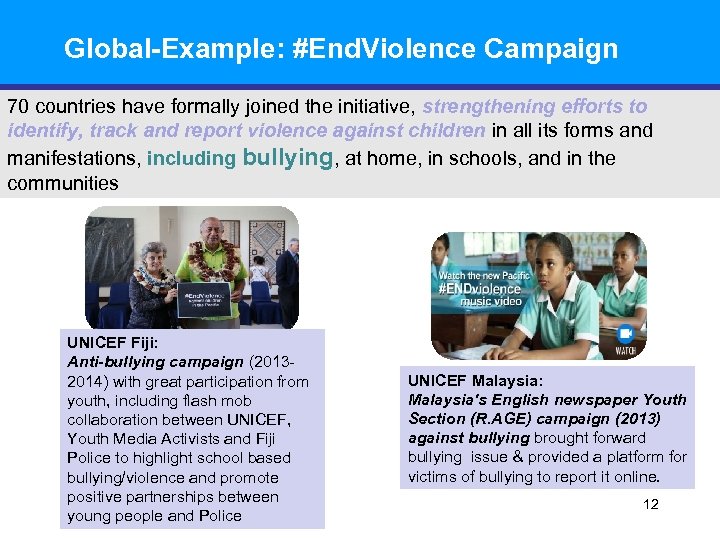 Global-Example: #End. Violence Campaign 70 countries have formally joined the initiative, strengthening efforts to identify, track and report violence against children in all its forms and manifestations, including bullying, at home, in schools, and in the communities UNICEF Fiji: Anti-bullying campaign (20132014) with great participation from youth, including flash mob collaboration between UNICEF, Youth Media Activists and Fiji Police to highlight school based bullying/violence and promote positive partnerships between young people and Police UNICEF Malaysia: Malaysia's English newspaper Youth Section (R. AGE) campaign (2013) against bullying brought forward bullying issue & provided a platform for victims of bullying to report it online. 12
 Country Specific Example – Jordan’s Ma’An Campaign Objective of Ma’An Campaign Components of Ma’An Campaign Reduce violence • Evidence based perpetrated by teachers by • Ownership 40% in the first year (2009) and • Legal & Policy framework • Capacity building 90% by the third year (2012) • School-based interventions • Promote social change RESULTS: • After one year of implementation, significant reductions of physical violence and moderate reductions of verbal violence • By 2015, 200 teachers and school community actors were mobilized on child protection, including new Code of Conduct; 4, 760 teachers were trained on protective teaching methods; and 1, 500 female teachers trained as girls’ protection focal points. 13
 Region-Specific Example: Latin America’s 2015 Strong Schools and Communities Initiative • The Issue: Violence in education settings -> permanent dropouts. Latin America and the Caribbean has the highest rate of armed violence of any region in the world. Most significant causes of Vi. S are presence of criminal groups, gangs, & weapons in and around schools. • The Stakeholders: Launched in September 2015 by UNICEF Latin America and Caribbean Regional Office with the Global Business Coalition for Education. • The Actions: • Identify and strengthen policies and programs that effectively create safe schools and protective learning environments. • Support governments to improve their capacity to fulfill the educational rights of children and adolescents, which include ensuring that schools are safe. • Promote an open dialogue among families, children and adolescents, authorities, the private sector and communities for immediate action as well as building long-standing responses. 14
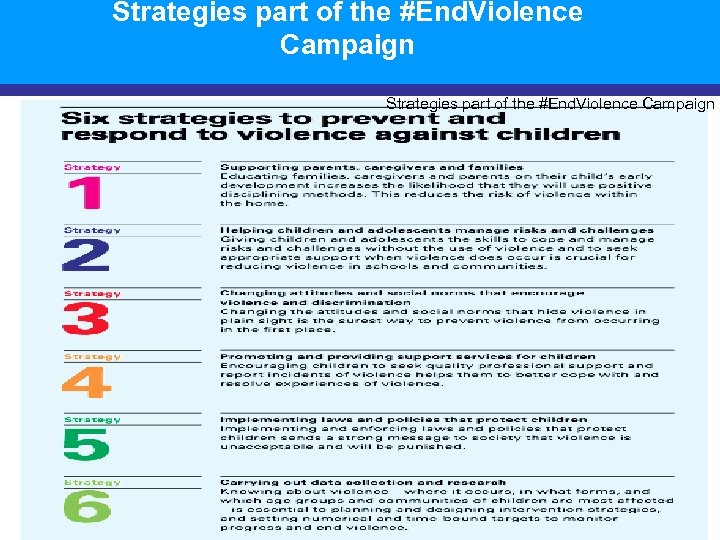 Strategies part of the #End. Violence Campaign Ending Violence Against Children:
 Successful Interventions Advocacy at Global and Regional Levels: • UNICEF’s Worldwide #End Violence Campaign • MENA’s Education Under Fire Report • LACRO’s "Strong Schools and Communities Initiative: Working Together to Build Safe Schools and Protective Learning Environments“ Global, Regional & Pilot Programs • Child-Friendly Schools Programming Globally • Let Us Learn Phase II Programme (5 Countries) Evidence-Building at Regional & Global Levels: • SRGBV formative research initiative in Togo, Cote D’Ivoire, Zambia and Ethiopia led by UNICEF, with UNGEI and GPE • SRGBV initiative with education unions in 5 Eastern and Southern African countries led by UNGEI with Education International 16 • Peace building Research Consortium