 Скачать презентацию Role of Bio-Fuels in the Indian Transport Sector
822e679e41d2712e78bff3d4a84ae4cd.ppt
- Количество слайдов: 33



Role of Bio-Fuels in the Indian Transport Sector Regional Workshop Climate Change Mitigation in the Transport Sector Aditi Dass Winrock International India ADB, May 24 -25, 2006
Winrock International India (WII) Ø An independent, not for profit organization established in 1998 Ø Pursuing activities related to energy, environment, natural resource management and sustainable development Ø Staffed by 60 professionals drawn from diverse disciplines Ø Affiliated to Winrock International, US WII SPONSORS Ø Ministries and Departments of Central and State Governments Ø Bilateral and Multilateral Agencies Ø Foundations Ø Corporate Sector
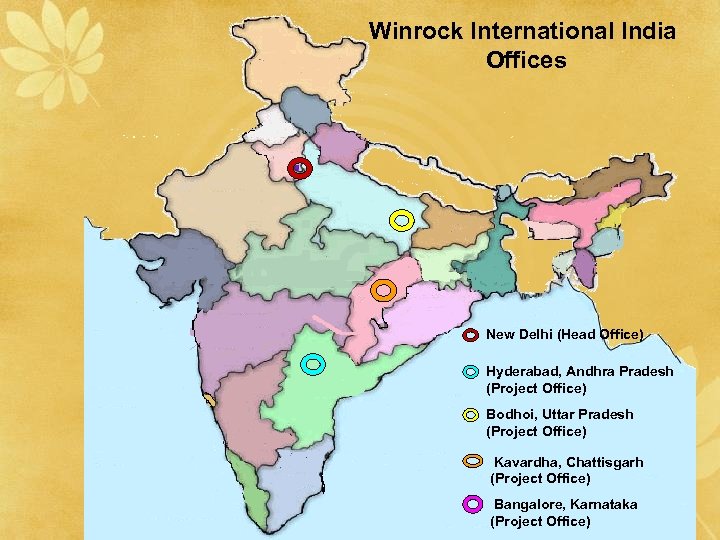
Winrock International India Offices New Delhi (Head Office) Hyderabad, Andhra Pradesh (Project Office) Bodhoi, Uttar Pradesh (Project Office) Kavardha, Chattisgarh (Project Office) Bangalore, Karnataka (Project Office)
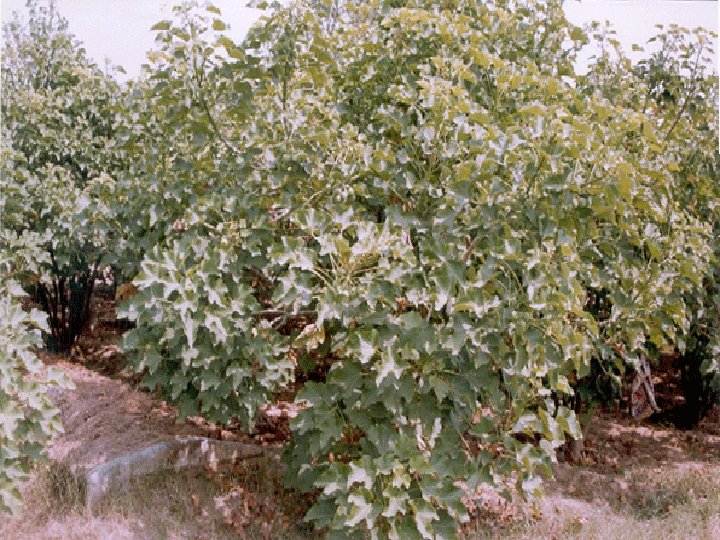
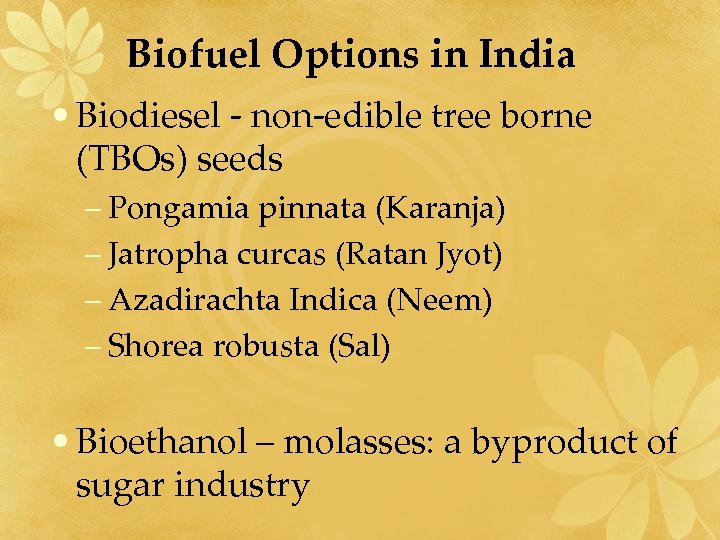
Biofuel Options in India • Biodiesel - non-edible tree borne (TBOs) seeds – Pongamia pinnata (Karanja) – Jatropha curcas (Ratan Jyot) – Azadirachta Indica (Neem) – Shorea robusta (Sal) • Bioethanol – molasses: a byproduct of sugar industry
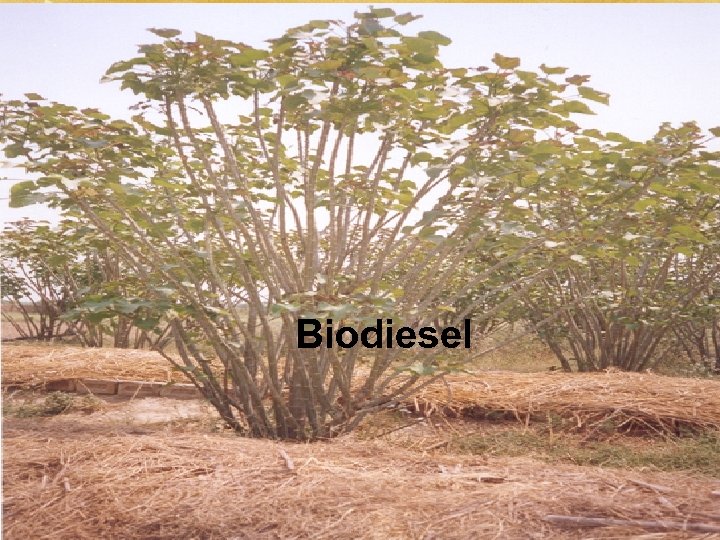
Biodiesel
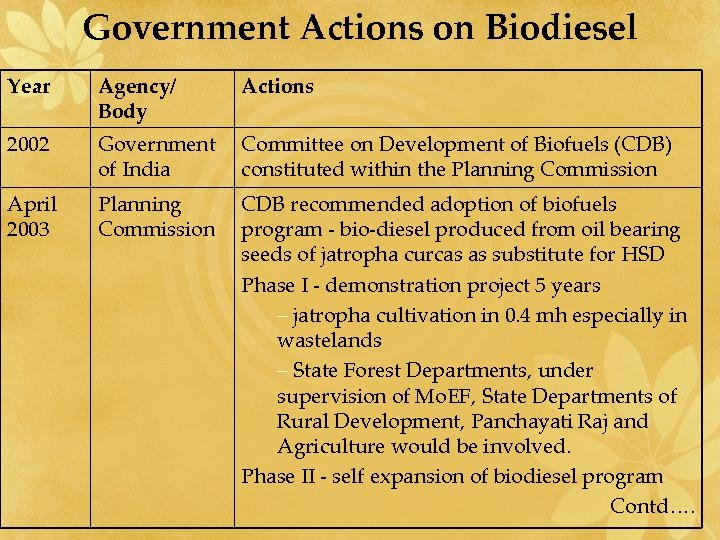
Government Actions on Biodiesel Year Agency/ Body Actions 2002 Government of India Committee on Development of Biofuels (CDB) constituted within the Planning Commission April 2003 Planning Commission CDB recommended adoption of biofuels program - bio-diesel produced from oil bearing seeds of jatropha curcas as substitute for HSD Phase I - demonstration project 5 years – jatropha cultivation in 0. 4 mh especially in wastelands – State Forest Departments, under supervision of Mo. EF, State Departments of Rural Development, Panchayati Raj and Agriculture would be involved. Phase II - self expansion of biodiesel program Contd….
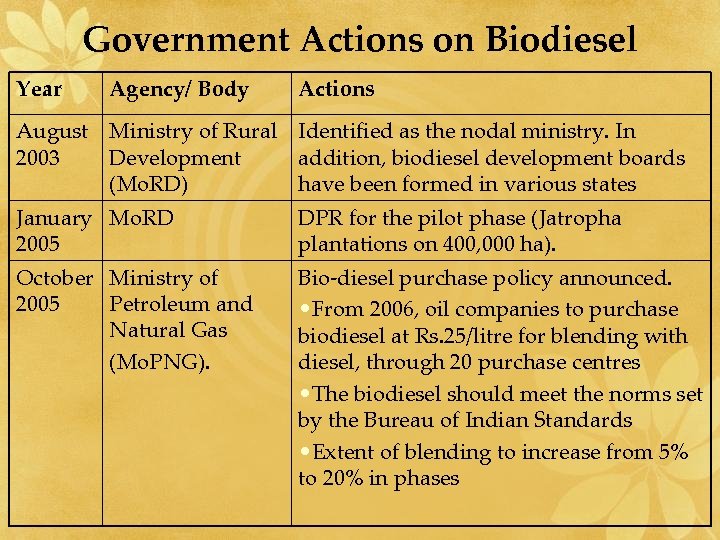
Government Actions on Biodiesel Year Agency/ Body Actions August Ministry of Rural Identified as the nodal ministry. In 2003 Development addition, biodiesel development boards (Mo. RD) have been formed in various states January Mo. RD 2005 DPR for the pilot phase (Jatropha plantations on 400, 000 ha). October Ministry of 2005 Petroleum and Natural Gas (Mo. PNG). Bio-diesel purchase policy announced. • From 2006, oil companies to purchase biodiesel at Rs. 25/litre for blending with diesel, through 20 purchase centres • The biodiesel should meet the norms set by the Bureau of Indian Standards • Extent of blending to increase from 5% to 20% in phases
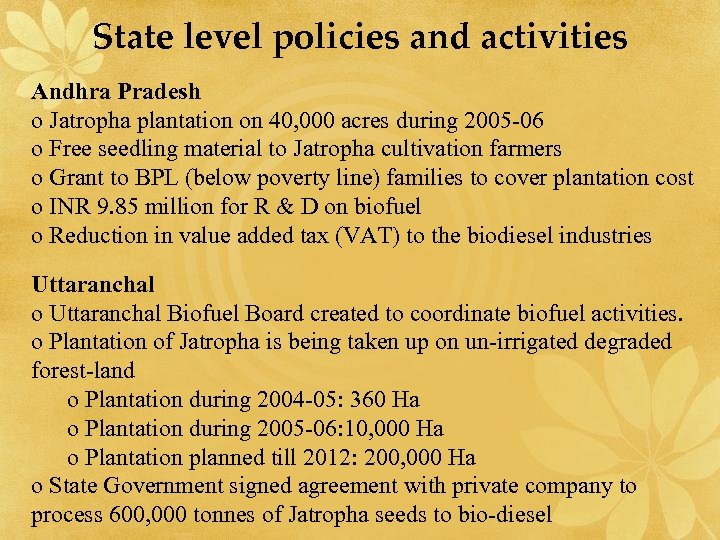
State level policies and activities Andhra Pradesh o Jatropha plantation on 40, 000 acres during 2005 -06 o Free seedling material to Jatropha cultivation farmers o Grant to BPL (below poverty line) families to cover plantation cost o INR 9. 85 million for R & D on biofuel o Reduction in value added tax (VAT) to the biodiesel industries Uttaranchal o Uttaranchal Biofuel Board created to coordinate biofuel activities. o Plantation of Jatropha is being taken up on un-irrigated degraded forest-land o Plantation during 2004 -05: 360 Ha o Plantation during 2005 -06: 10, 000 Ha o Plantation planned till 2012: 200, 000 Ha o State Government signed agreement with private company to process 600, 000 tonnes of Jatropha seeds to bio-diesel
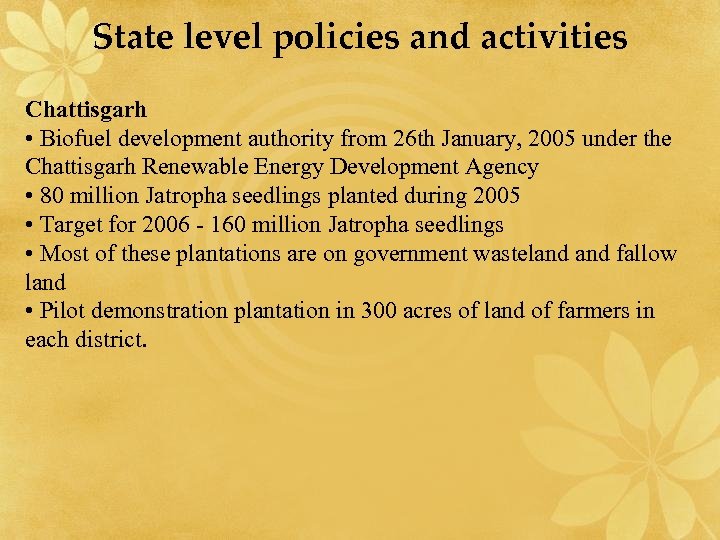
State level policies and activities Chattisgarh • Biofuel development authority from 26 th January, 2005 under the Chattisgarh Renewable Energy Development Agency • 80 million Jatropha seedlings planted during 2005 • Target for 2006 - 160 million Jatropha seedlings • Most of these plantations are on government wasteland fallow land • Pilot demonstration plantation in 300 acres of land of farmers in each district.
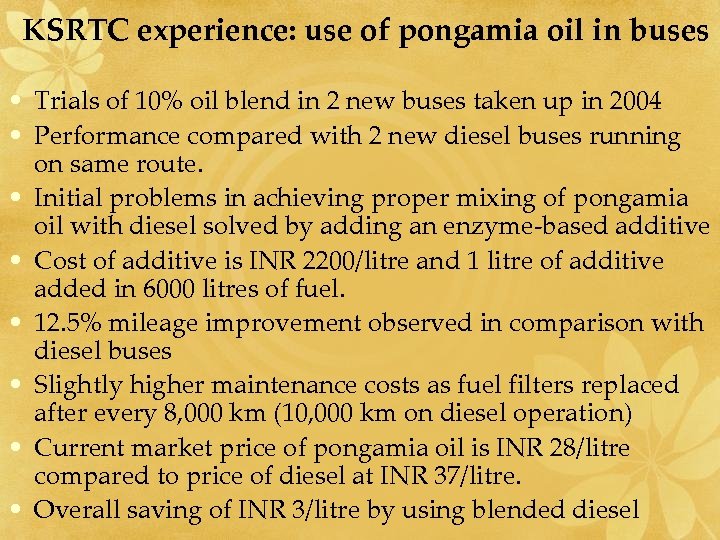
KSRTC experience: use of pongamia oil in buses • Trials of 10% oil blend in 2 new buses taken up in 2004 • Performance compared with 2 new diesel buses running on same route. • Initial problems in achieving proper mixing of pongamia oil with diesel solved by adding an enzyme-based additive • Cost of additive is INR 2200/litre and 1 litre of additive added in 6000 litres of fuel. • 12. 5% mileage improvement observed in comparison with diesel buses • Slightly higher maintenance costs as fuel filters replaced after every 8, 000 km (10, 000 km on diesel operation) • Current market price of pongamia oil is INR 28/litre compared to price of diesel at INR 37/litre. • Overall saving of INR 3/litre by using blended diesel
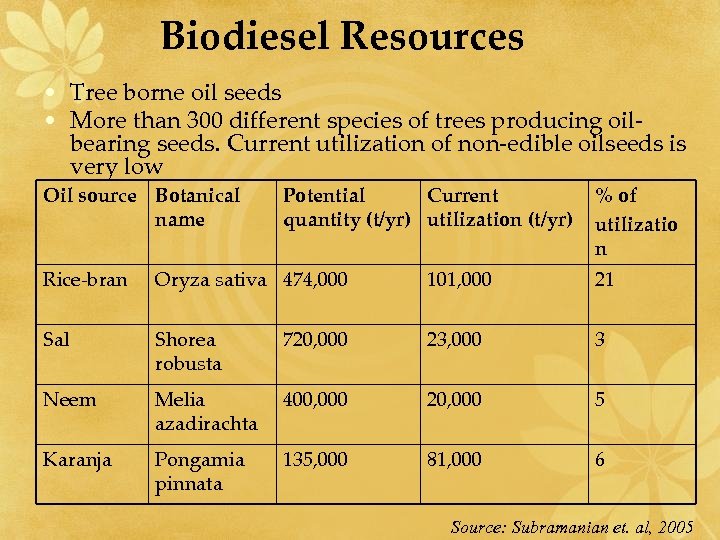
Biodiesel Resources • Tree borne oil seeds • More than 300 different species of trees producing oilbearing seeds. Current utilization of non-edible oilseeds is very low Oil source Botanical name Potential Current quantity (t/yr) utilization (t/yr) % of utilizatio n Rice-bran Oryza sativa 474, 000 101, 000 21 Sal Shorea robusta 720, 000 23, 000 3 Neem Melia azadirachta 400, 000 20, 000 5 Karanja Pongamia pinnata 135, 000 81, 000 6 Source: Subramanian et. al, 2005
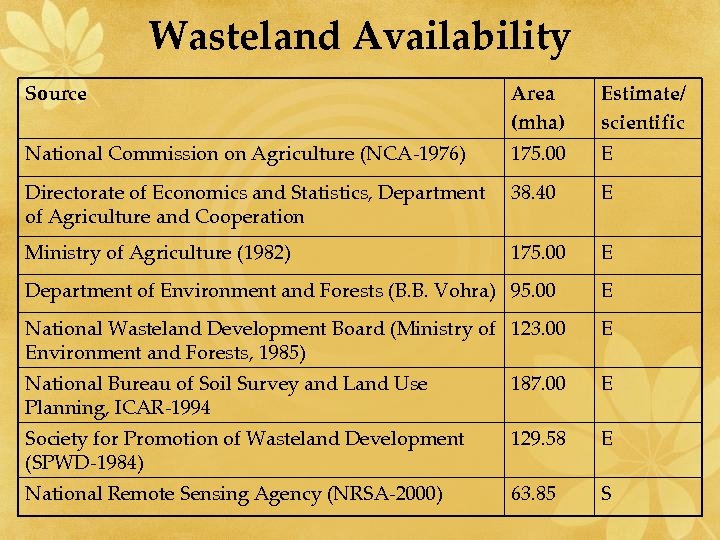
Wasteland Availability Source Area (mha) Estimate/ scientific National Commission on Agriculture (NCA-1976) 175. 00 E Directorate of Economics and Statistics, Department of Agriculture and Cooperation 38. 40 E Ministry of Agriculture (1982) 175. 00 E Department of Environment and Forests (B. B. Vohra) 95. 00 E National Wasteland Development Board (Ministry of 123. 00 Environment and Forests, 1985) E National Bureau of Soil Survey and Land Use Planning, ICAR-1994 187. 00 E Society for Promotion of Wasteland Development (SPWD-1984) 129. 58 E National Remote Sensing Agency (NRSA-2000) 63. 85 S
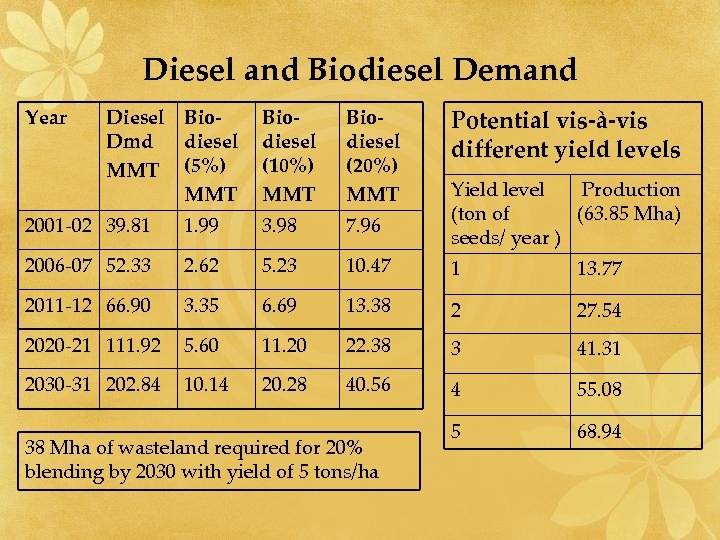
Diesel and Biodiesel Demand Year Diesel Bio. Dmd diesel MMT (5%) MMT Biodiesel (10%) MMT Biodiesel (20%) MMT Potential vis-à-vis different yield levels Yield level Production (ton of (63. 85 Mha) seeds/ year ) 2001 -02 39. 81 1. 99 3. 98 7. 96 2006 -07 52. 33 2. 62 5. 23 10. 47 1 13. 77 2011 -12 66. 90 3. 35 6. 69 13. 38 2 27. 54 2020 -21 111. 92 5. 60 11. 20 22. 38 3 41. 31 2030 -31 202. 84 10. 14 20. 28 40. 56 4 55. 08 5 68. 94 38 Mha of wasteland required for 20% blending by 2030 with yield of 5 tons/ha
Ethanol
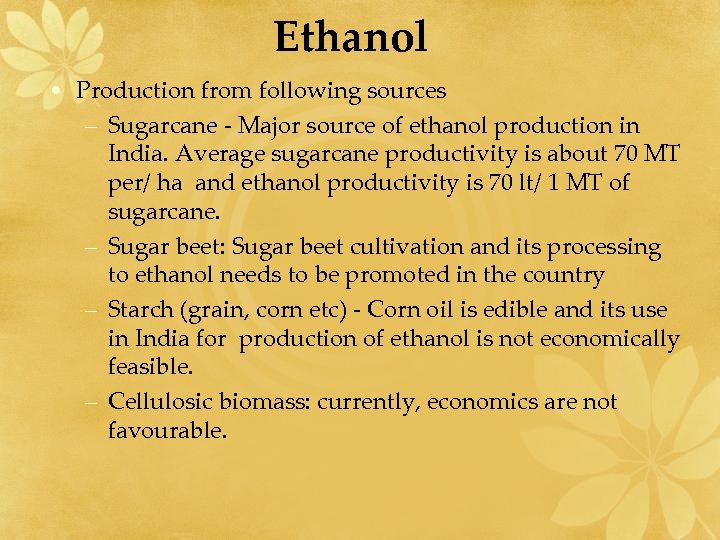
Ethanol • Production from following sources – Sugarcane - Major source of ethanol production in India. Average sugarcane productivity is about 70 MT per/ ha and ethanol productivity is 70 lt/ 1 MT of sugarcane. – Sugar beet: Sugar beet cultivation and its processing to ethanol needs to be promoted in the country – Starch (grain, corn etc) - Corn oil is edible and its use in India for production of ethanol is not economically feasible. – Cellulosic biomass: currently, economics are not favourable.
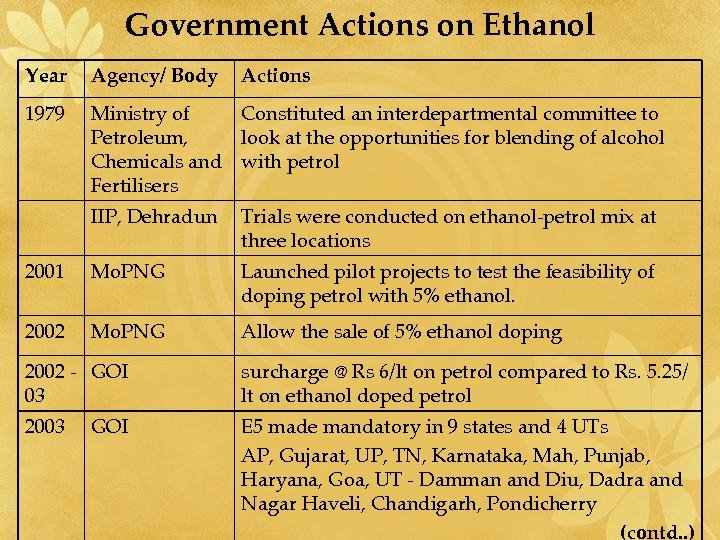
Government Actions on Ethanol Year Agency/ Body Actions 1979 Ministry of Constituted an interdepartmental committee to Petroleum, look at the opportunities for blending of alcohol Chemicals and with petrol Fertilisers IIP, Dehradun Trials were conducted on ethanol-petrol mix at three locations 2001 Mo. PNG Launched pilot projects to test the feasibility of doping petrol with 5% ethanol. 2002 Mo. PNG Allow the sale of 5% ethanol doping 2002 - GOI 03 surcharge @ Rs 6/lt on petrol compared to Rs. 5. 25/ lt on ethanol doped petrol 2003 E 5 made mandatory in 9 states and 4 UTs AP, Gujarat, UP, TN, Karnataka, Mah, Punjab, Haryana, Goa, UT - Damman and Diu, Dadra and Nagar Haveli, Chandigarh, Pondicherry (contd. . ) GOI
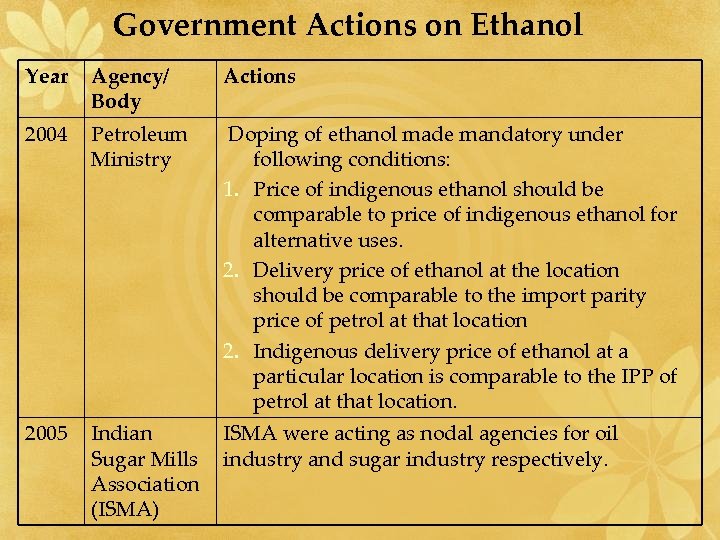
Government Actions on Ethanol Year Agency/ Body Actions 2004 Petroleum Ministry Doping of ethanol made mandatory under following conditions: 1. Price of indigenous ethanol should be comparable to price of indigenous ethanol for alternative uses. 2. Delivery price of ethanol at the location should be comparable to the import parity price of petrol at that location 2. Indigenous delivery price of ethanol at a particular location is comparable to the IPP of petrol at that location. 2005 Indian Sugar Mills Association (ISMA) ISMA were acting as nodal agencies for oil industry and sugar industry respectively.
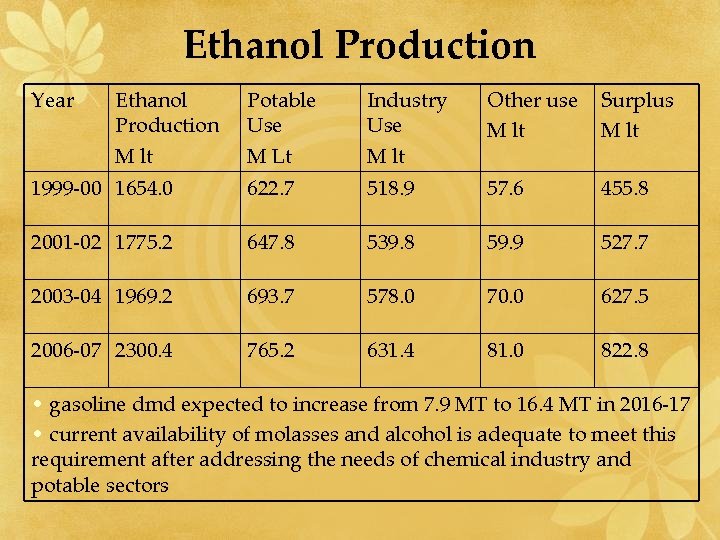
Ethanol Production Year Ethanol Production M lt Potable Use M Lt Industry Use M lt Other use M lt Surplus M lt 1999 -00 1654. 0 622. 7 518. 9 57. 6 455. 8 2001 -02 1775. 2 647. 8 539. 8 59. 9 527. 7 2003 -04 1969. 2 693. 7 578. 0 70. 0 627. 5 2006 -07 2300. 4 765. 2 631. 4 81. 0 822. 8 • gasoline dmd expected to increase from 7. 9 MT to 16. 4 MT in 2016 -17 • current availability of molasses and alcohol is adequate to meet this requirement after addressing the needs of chemical industry and potable sectors
Biofuel as Transportation Fuel
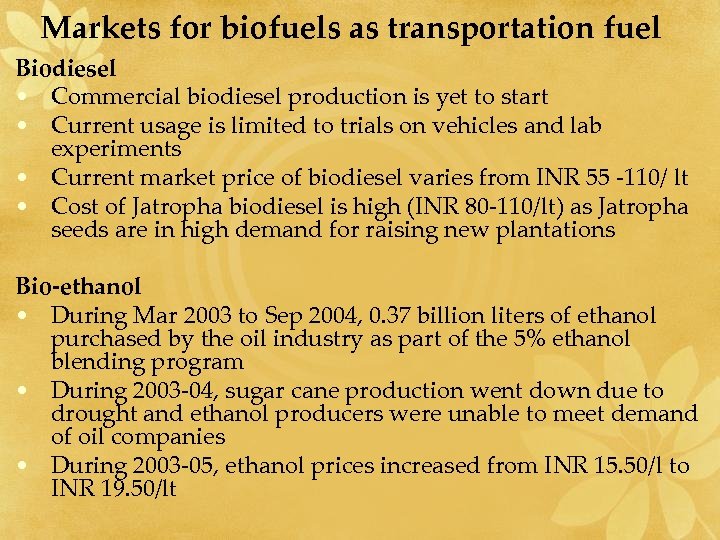
Markets for biofuels as transportation fuel Biodiesel • Commercial biodiesel production is yet to start • Current usage is limited to trials on vehicles and lab experiments • Current market price of biodiesel varies from INR 55 -110/ lt • Cost of Jatropha biodiesel is high (INR 80 -110/lt) as Jatropha seeds are in high demand for raising new plantations Bio-ethanol • During Mar 2003 to Sep 2004, 0. 37 billion liters of ethanol purchased by the oil industry as part of the 5% ethanol blending program • During 2003 -04, sugar cane production went down due to drought and ethanol producers were unable to meet demand of oil companies • During 2003 -05, ethanol prices increased from INR 15. 50/l to INR 19. 50/lt
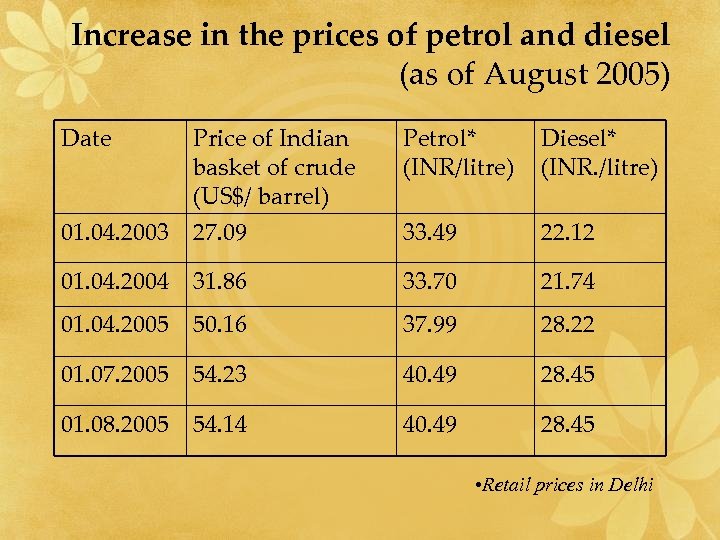
Increase in the prices of petrol and diesel (as of August 2005) Date Petrol* (INR/litre) Diesel* (INR. /litre) 01. 04. 2003 Price of Indian basket of crude (US$/ barrel) 27. 09 33. 49 22. 12 01. 04. 2004 31. 86 33. 70 21. 74 01. 04. 2005 50. 16 37. 99 28. 22 01. 07. 2005 54. 23 40. 49 28. 45 01. 08. 2005 54. 14 40. 49 28. 45 • Retail prices in Delhi
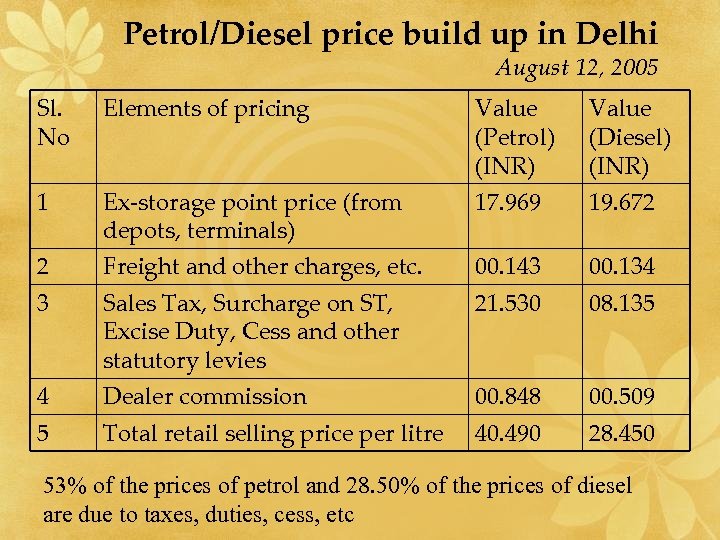
Petrol/Diesel price build up in Delhi August 12, 2005 Sl. No Elements of pricing Value (Petrol) (INR) Value (Diesel) (INR) 1 Ex-storage point price (from depots, terminals) 17. 969 19. 672 2 Freight and other charges, etc. 00. 143 00. 134 3 Sales Tax, Surcharge on ST, Excise Duty, Cess and other statutory levies 21. 530 08. 135 4 Dealer commission 00. 848 00. 509 5 Total retail selling price per litre 40. 490 28. 450 53% of the prices of petrol and 28. 50% of the prices of diesel are due to taxes, duties, cess, etc
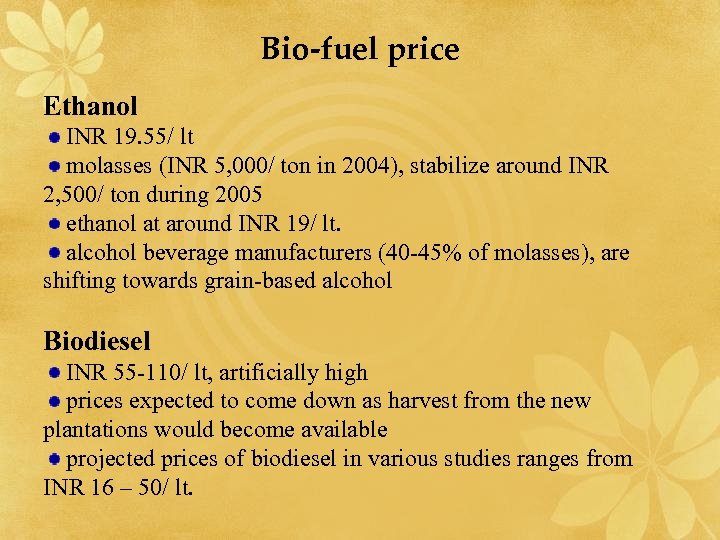
Bio-fuel price Ethanol INR 19. 55/ lt molasses (INR 5, 000/ ton in 2004), stabilize around INR 2, 500/ ton during 2005 ethanol at around INR 19/ lt. alcohol beverage manufacturers (40 -45% of molasses), are shifting towards grain-based alcohol Biodiesel INR 55 -110/ lt, artificially high prices expected to come down as harvest from the new plantations would become available projected prices of biodiesel in various studies ranges from INR 16 – 50/ lt.
Issues/ Concerns Food Security • Food grain production increased from average of 187 MT during Five Year Plan Period (1992 -97) to 202 MT per annum during IX Plan period (1997 – 2002), although average area under food grain production had remained constant at around 122 mha • Increase food production by over 50% in the next two decades • Appx. 56% is arable land, used only for about 3 months during the monsoon period. Adequate energy for irrigation, enable production of current levels of food grains, fruits and vegetables from a smaller area by multiple cropping contd …
Issues/ Concerns Energy • About 125, 000 villages in India are non-electrified/ poor, erratic and unreliable supply and farmers depend on diesel pump-sets for irrigation • Biofuels can help substitute a part of this Environmental sustainability of biofuel • Environmental impacts of biofuels need to be studied in detail • Experiments in India on biodiesel use in vehicles have shown reduction in some important air pollutants
Benefits of biofuel • Generation of new employment opportunities in raising, reaping and processing of biofuel crops • Addition to the renewable energy options for decentralised distributed generation (DDG) of electricity and for motive power applications (water pumping, milling, etc. ) in energy deficient rural India • Greening of wastelands and regeneration of degraded forest-lands, thereby helping in ecorestoration and preventing further land degradation • Better environmental performance through reduction in vehicular pollution and GHG emissions • Biofuels in vehicles results in reduction of SO 2, particulate matter, CO, etc.
Biofuel in India - Challenges Produce large quantities of biofuels at prices competitive with fossil fuel products • Deal with issue of land ownership. The land ceiling laws vary from state to state, for which resources need to be mobilized as per different kinds of farming. • Putting in place the back-to-back arrangements from farmer to expeller to bio-diesel manufacturer to final consumers is necessary for the successful implementation of the bio-diesel policy. • Financial viability of the biodiesel is yet to be proven. The varied experience in yield levels and crop management practices has led to hesitation for planting biofuel crops
Thank you !
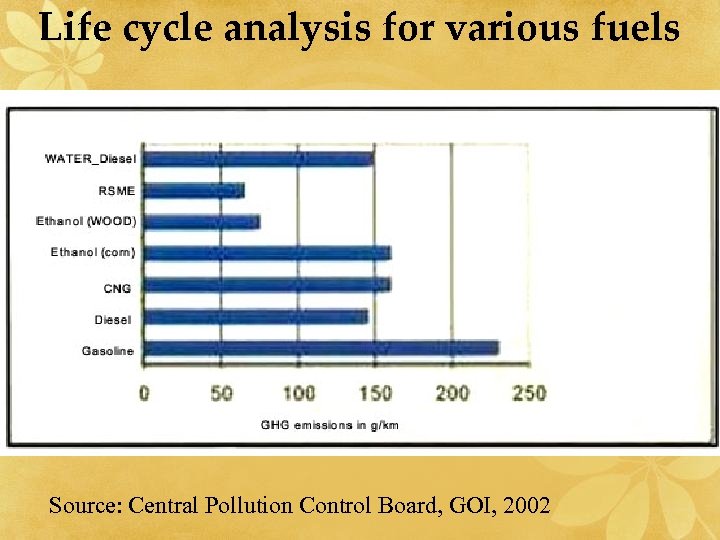
Life cycle analysis for various fuels Source: Central Pollution Control Board, GOI, 2002
Biodiesel: pilot trials and lab-scale experiments • Daimler Chrysler carried out trials with 100% Jatropha biodiesel on Mercedes-Benz C 220 CDI car during 2004. Central Salt and Marine Chemicals Research Institute (CSMCRI) supplied 1, 200 litres of Jatropha biodiesel for the trials. Covered 6, 000 km successfully with average mileage of 13. 5 km/litre • Trail by Indian railways on diesel locomotive using 5, 000 litres of imported soybean biodiesel blends (B 10, B 20, B 50, B 100) during April-May 2004 • State Road Transport Corporations of Haryana, Gujarat, Andhra Pradesh and Indian vehicle manufacturers - Tata Motors, and Mahindra & Mahindra carrying out trials with biodiesel blends.
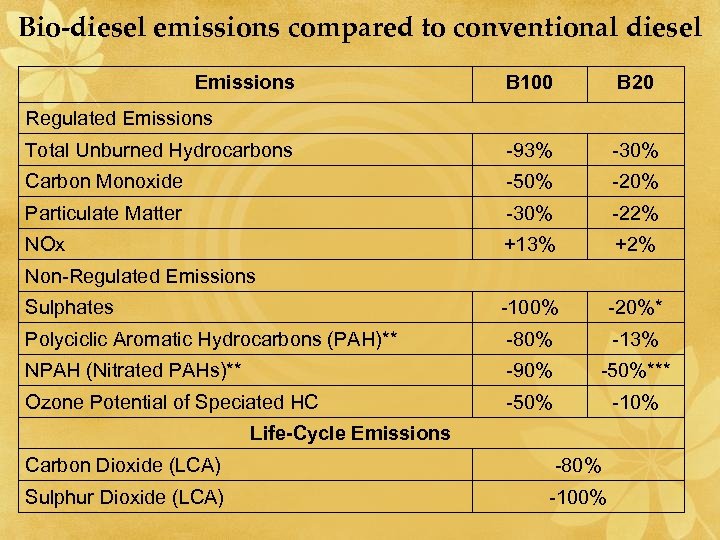
Bio-diesel emissions compared to conventional diesel Emissions B 100 B 20 Total Unburned Hydrocarbons -93% -30% Carbon Monoxide -50% -20% Particulate Matter -30% -22% NOx +13% +2% Sulphates -100% -20%* Polyciclic Aromatic Hydrocarbons (PAH)** -80% -13% NPAH (Nitrated PAHs)** -90% -50%*** Ozone Potential of Speciated HC -50% -10% Regulated Emissions Non-Regulated Emissions Life-Cycle Emissions Carbon Dioxide (LCA) -80% Sulphur Dioxide (LCA) -100%
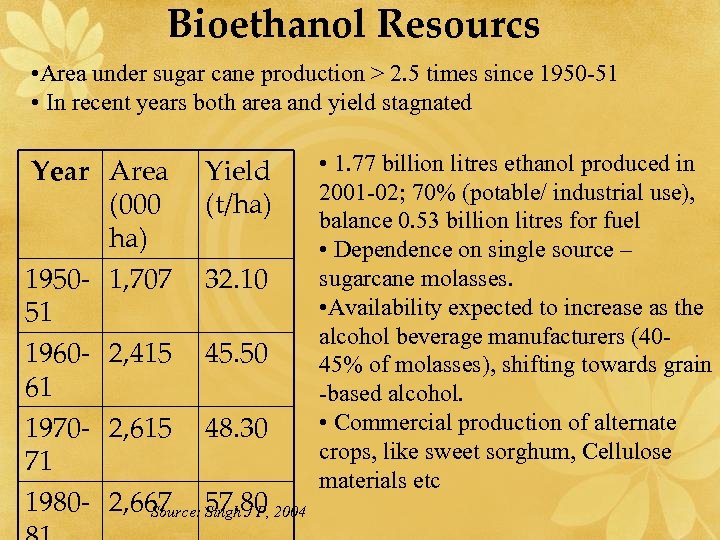
Bioethanol Resourcs • Area under sugar cane production > 2. 5 times since 1950 -51 • In recent years both area and yield stagnated Year Area Yield (000 (t/ha) 1950 - 1, 707 32. 10 51 1960 - 2, 415 45. 50 61 1970 - 2, 615 48. 30 71 1980 - 2, 667 Singh J P, 2004 Source: 57. 80 • 1. 77 billion litres ethanol produced in 2001 -02; 70% (potable/ industrial use), balance 0. 53 billion litres for fuel • Dependence on single source – sugarcane molasses. • Availability expected to increase as the alcohol beverage manufacturers (4045% of molasses), shifting towards grain -based alcohol. • Commercial production of alternate crops, like sweet sorghum, Cellulose materials etc
Скачать презентацию Role of Bio-Fuels in the Indian Transport Sector
822e679e41d2712e78bff3d4a84ae4cd.ppt