


 Скачать презентацию Роль и место туризма в современном мире Лекция
Роль и место туризма в современном мире.pptx
- Количество слайдов: 28
 Роль и место туризма в современном мире Лекция 30 октября ( «Основы туризма» ) Читает Сахарчук Е. С.
 Вариант два УКАЖИТЕ СВОЮ ФАМИЛИЮ И НОМЕР ВАРИАНТА Фамилия Ваш сосед слева ВАРИАНТ 1 УКАЖИТЕ ФАМИЛИЮ СОСЕДА ВЫ Фамилия Проверочная работа (1 -я контрольная точка) Считаем слева направо/в каждом ответном листе -3 фамилии Ваш сосед справа Вариант три УКАЖИТЕ ФАМИЛИЮ СОСЕДА
 Рейтингование в туризме Индекс конкурентоспособности сектора путешествий и туризма составляется каждые два года и охватывает 141 страну. При его подготовке используется комбинация данных из общедоступных источников и информации от международных организаций и экспертов в области путешествий и туризма.
 Travel and Tourism Competitiveness Index 2015 http: //reports. weforum. org/travel-and -tourism-competitiveness-report 2015/
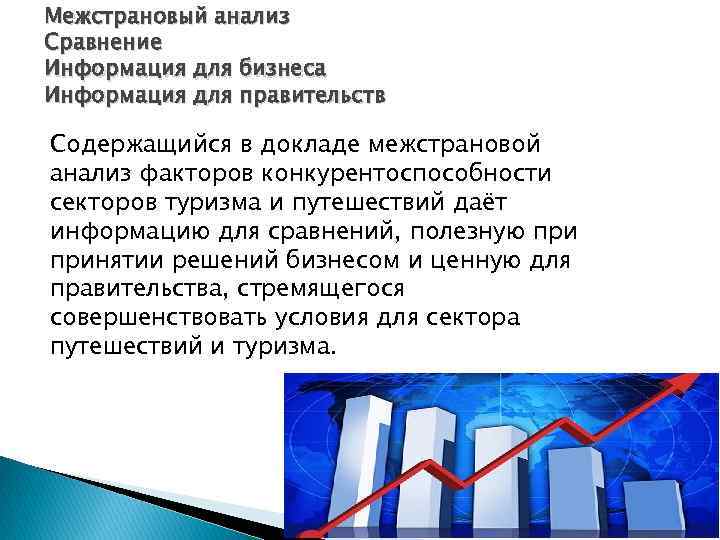 Межстрановый анализ Сравнение Информация для бизнеса Информация для правительств Содержащийся в докладе межстрановой анализ факторов конкурентоспособности секторов туризма и путешествий даёт информацию для сравнений, полезную принятии решений бизнесом и ценную для правительства, стремящегося совершенствовать условия для сектора путешествий и туризма.
 Исследование проводится ВЭФ в тесном сотрудничестве со стратегическим партнером Booz & Company и с партнерами по данным: Международной ассоциацией воздушного транспорта (IATA), Международным союзом по сохранению природы (IUCN), Всемирной организацией по туризму (UNWTO) и Всемирным советом по путешествиям и туризму (WTTC), VISA, Deloitte, Hilton, Marriott и другими.
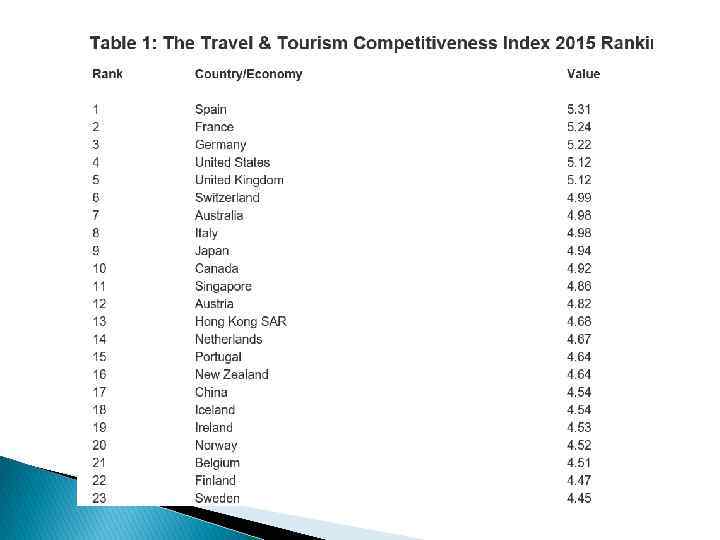
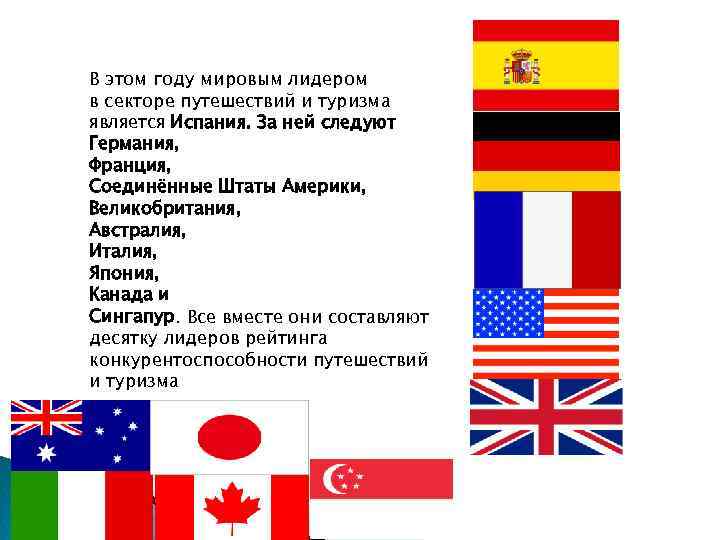 В этом году мировым лидером в секторе путешествий и туризма является Испания. За ней следуют Германия, Франция, Соединённые Штаты Америки, Великобритания, Австралия, Италия, Япония, Канада и Сингапур. Все вместе они составляют десятку лидеров рейтинга конкурентоспособности путешествий и туризма
 Pillar 1: Business Environment (12 indicators) бизнес-среда, деловая среда, деловой климат, предпринимательск ая среда, бизнесклимат
 Pillar 2: Safety and Security (5 indicators) Safety and security is a critical factor determining the competitiveness of a country’s T&T industry. Tourists are likely to be deterred from traveling to dangerous countries or regions, making it less attractive to develop the Here we take into account the costliness of common crime and violence as well as terrorism, and the extent to which police services can be relied upon to provide protection from crime. T&T sector in those places. Компонент 2: Охрана и безопасность (5 показателей)
 Pillar 3: Health and Hygiene (6 indicators) Health and hygiene is also essential for T&T competitiveness. Access to improved drinking water and sanitation is important for the comfort and health of travellers. In the event that tourists do become ill, the country’s health sector must be able to ensure they are properly cared for, as measured by the availability of physicians and hospital beds. In addition, high prevalence of HIV and malaria can have an impact on the productivity of the T&T labour force and play a role in discouraging tourists from visiting a country. Компонент 3: Здоровье и гигиена
 Pillar 4: Human Resources and Labour market (9 indicators) Quality human resources in an economy ensure that the industry has access to the collaborators it needs. The sub-components of this pillar measure how well countries develop skills through education and training, and enhance the best allocation of those skills through an efficient labour market. The former includes formal educational attainment rates and private sector involvement in upgrading human resources, such as business investment in training services and customer care. The latter includes measures of the flexibility, efficiency and openness of the labour market and the participation of women, to assess the depth of the country’s talent pool and its ability to allocate human resources to their best use. Компонент 4: человеческие ресурсы и рынок труда (9 показателей)
 Pillar 5: ICT Readiness (8 indicators) Online services and business operations have increasing importance in T&T, with internet being used for planning itineraries and booking travel and accommodation—but ICT is now so pervasive and important for all sectors, it is considered part of the general enabling environment. The sub -components of the pillar measure not only the existence of modern hard infrastructure (mobile network coverage and quality of electricity supply), but also the capacity of businesses and individuals to use and provide online services. Компонент 5: Цифровые технологии и связь
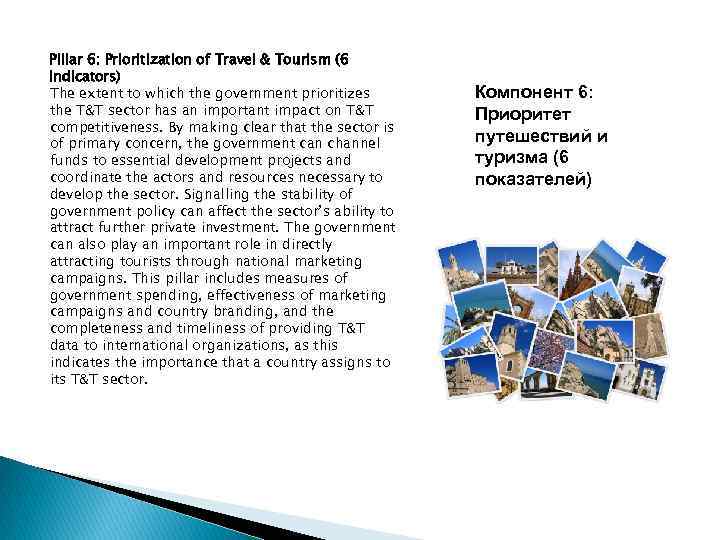 Pillar 6: Prioritization of Travel & Tourism (6 indicators) The extent to which the government prioritizes the T&T sector has an important impact on T&T competitiveness. By making clear that the sector is of primary concern, the government can channel funds to essential development projects and coordinate the actors and resources necessary to develop the sector. Signalling the stability of government policy can affect the sector’s ability to attract further private investment. The government can also play an important role in directly attracting tourists through national marketing campaigns. This pillar includes measures of government spending, effectiveness of marketing campaigns and country branding, and the completeness and timeliness of providing T&T data to international organizations, as this indicates the importance that a country assigns to its T&T sector. Компонент 6: Приоритет путешествий и туризма (6 показателей)
 Pillar 7: International Openness (3 indicators) Developing a competitive T&T sector internationally requires a certain degree of openness and travel facilitation. Restrictive policies such as cumbersome visa requirements diminish tourists’ willingness to visit a country, and indirectly reduce the availability of key services. Components measured in this pillar include the openness of the bilateral air service agreements which the government has entered, which impacts the availability of air connections to the country, and the number of regional trade agreements in force, which proxies the extent to which it is possible to provide world class tourism services.
 Pillar 8: Price Competitiveness in the T&T Industry (4 indicators) Lower costs related to travel in a country increase its attractiveness for many travellers as well as for investing in the T&T sector. Among the aspects of price competitiveness taken into account in this pillar are airfare ticket taxes and airport charges, which can make flight tickets much more expensive; the relative cost of hotel accommodation; the cost of living, proxied by purchasing power parity; and fuel price costs, which directly influence the cost of travel.
 Pillar 9: Environmental Sustainability (10 indicators) The importance of the natural environment for providing an attractive location for tourism cannot be overstated, so policies and factors enhancing environmental sustainability are an important competitive advantage in ensuring a country’s future attractiveness as a destination. This pillar consists of policy indicators such as the stringency and enforcement of the government’s environmental regulations and variables assessing the status of water, forest resources and seabeds, proxied by coastal shelf fishing pressure. Given the environmental impacts of tourism itself, we also take into account the extent to which governments prioritize the sustainable development of the T&T industry in their respective economies.
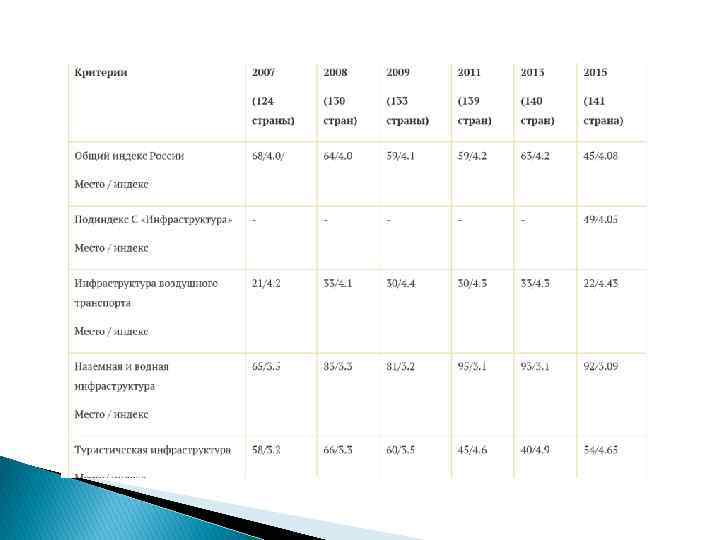
 Pillar 10: Air Transport Infrastructure (6 indicators) Air connectivity is essential for travellers’ ease of access to and from countries, as well as movement within many countries. In this pillar we measure the quantity of air transport, using indicators such as available seat kilometres, the number of departures, airport density, and the number of operating airlines, as well as the quality of air transport infrastructure for domestic and international flights.
 Pillar 11: Ground and Port Infrastructure (7 indicators) The availability of efficient and accessible transportation to key business centres and tourist attractions is vital for the T&T sector. This requires a sufficiently extensive road and railroad network, proxied by road and railroad densities, as wells as roads, railroads, and ports infrastructure that meet international standards of comfort, security and modal efficiency. The pillar also accounts for unpaved roads which enable local connections, and to some extent, can proxy the existence of picturesque roads which can, in very specific contexts, attract tourists.
 Pillar 12: Tourist Service Infrastructure (4 indicators) The availability of sufficient quality accommodation, resorts and entertainment facilities can represent a significant competitive advantage for a country. We measure the level of tourism service infrastructure through the number of “upper-level” hotel rooms complemented by the extent of access to services such as car rentals and ATMs.
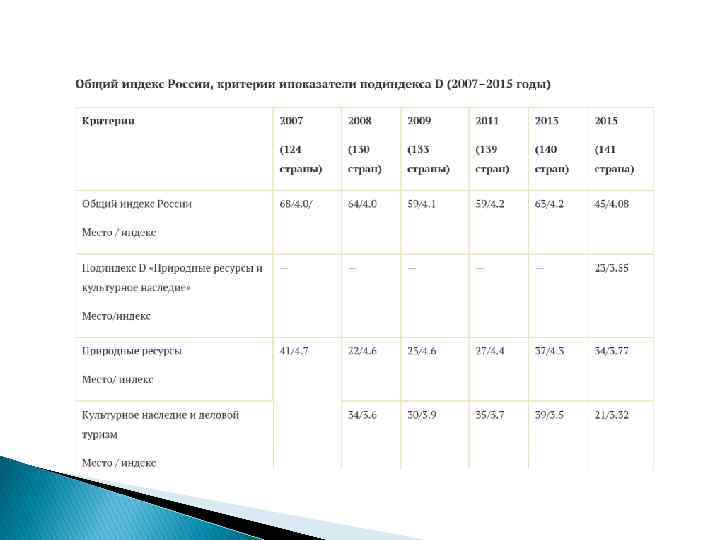
 Pillar 13: Natural Resources (5 indicators) Countries with natural assets clearly have a competitive advantage in attracting tourists. In this pillar we include a number of attractiveness measures, including the number of UNESCO natural World Heritage sites, a measure of the quality of the natural environment which proxies the beauty of its landscape, the richness of the fauna in the country as measured by the total known species of animals, and the percentage of nationally protected areas, which proxies the extent of national parks and nature reserves.
 Pillar 14: Cultural Resources and Business Travel (5 indicators) A country’s cultural resources are another critical driver of T&T competitiveness. In this pillar we include the number of UNESCO cultural World Heritage sites, the number of large stadiums that can host significant sport or entertainment events, and a new measure of digital demand for cultural and entertainment—the number of online searches related to a country’s cultural resources can allow the level of interest to be inferred. The number of international association meetings taking place in a country is included to capture, at least partially, business travel.
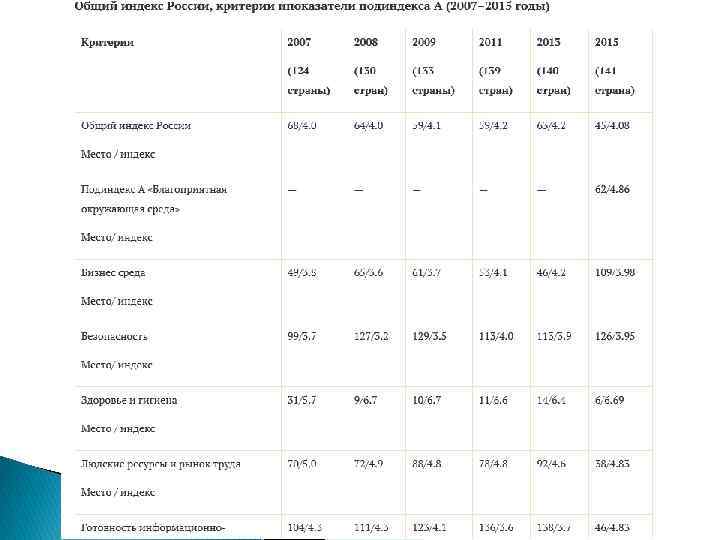
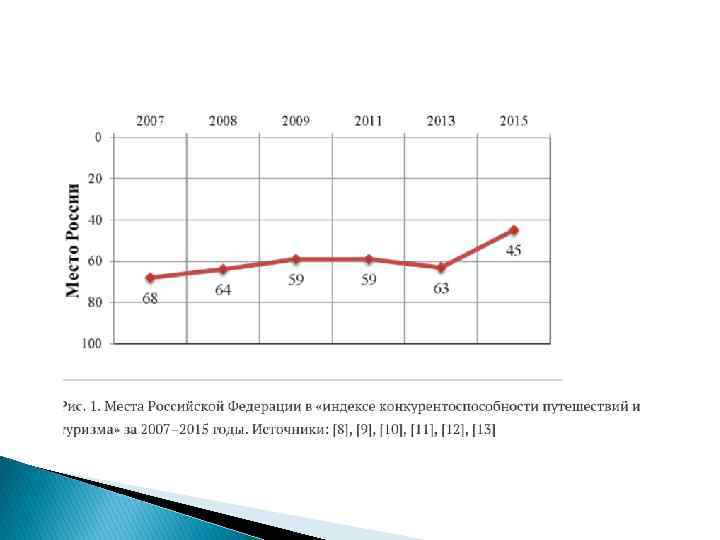
 Россия занимает 45 -е место + богатые природные и культурные ресурсы, инфраструктура воздушного транспорта телекоммуникационная инфраструктура туристические предложения в России становятся значительно более конкурентоспособными по цене благодаря значительному снижению курса рубля. - устойчивое сложившиеся мнение о состоянии безопасности в стране, качестве инфраструктуры наземного транспорта, слаборазвитая предпринимательская активность и бизнес-среда (109 место), охрана окружающей среды (106 место). На данный момент, среду путешествий и туризма в Российской Федерации международные эксперты оценивают как неблагоприятную.
 ПОСВЯЩЕНИЕ В СТУДЕНТЫ ТУРИЗМА