 Скачать презентацию Roger Ruber Dept of Physics and Astronomy Div
744a1f89f8daa3b58fbcd49182200bd0.ppt
- Количество слайдов: 37



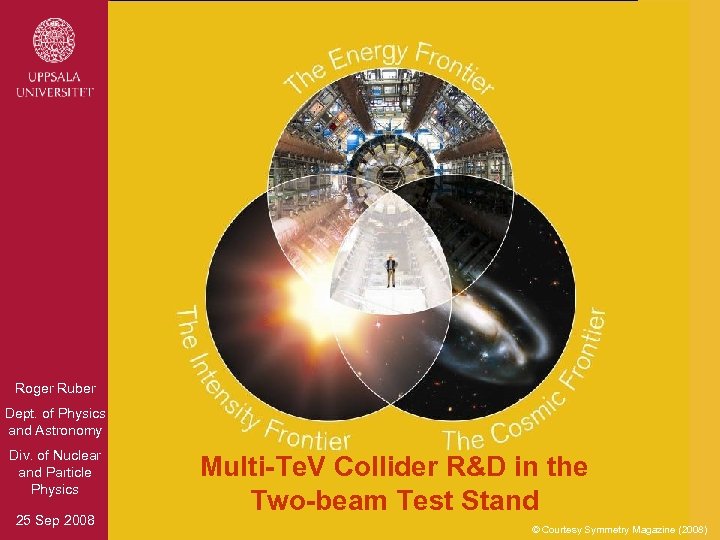
Roger Ruber Dept. of Physics and Astronomy Div. of Nuclear and Particle Physics 25 Sep 2008 Multi-Te. V Collider R&D in the Two-beam Test Stand © Courtesy Symmetry Magazine (2008)
Outline This lecture • technologies for a future linear collider • related R&D in the Two-beam Test Stand Sections 1. introduction 2. accelerating gradient 3. RF power production 4. R&D projects for a future linear collider and the Two-beam Test Stand 25 Sep 2008 Roger Ruber - Multi-Te. V Collider R&D in the Two-beam Test Stand 2
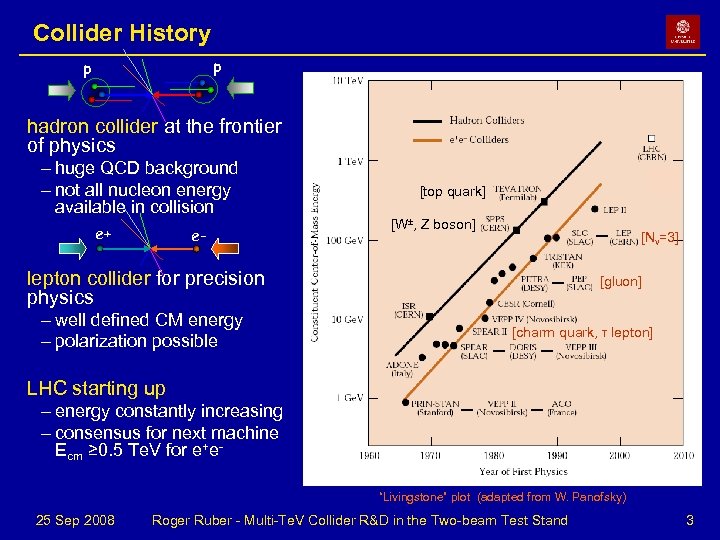
Collider History p p hadron collider at the frontier of physics – huge QCD background – not all nucleon energy available in collision e+ e- [top quark] [W±, Z boson] [Nν=3] lepton collider for precision physics – well defined CM energy – polarization possible [gluon] [charm quark, τ lepton] LHC starting up – energy constantly increasing – consensus for next machine Ecm ≥ 0. 5 Te. V for e+e“Livingstone” plot (adapted from W. Panofsky) 25 Sep 2008 Roger Ruber - Multi-Te. V Collider R&D in the Two-beam Test Stand 3
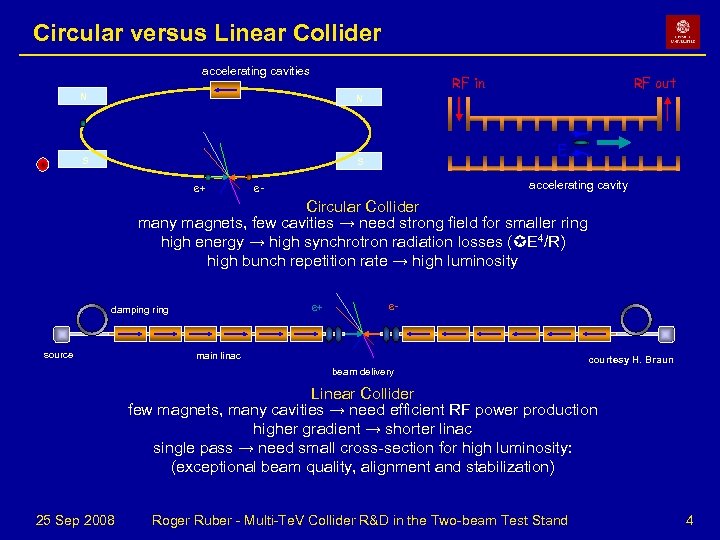
Circular versus Linear Collider accelerating cavities RF in N S S RF out N e+ E accelerating cavity e- Circular Collider many magnets, few cavities → need strong field for smaller ring high energy → high synchrotron radiation losses ( E 4/R) high bunch repetition rate → high luminosity e+ damping ring source e- main linac courtesy H. Braun beam delivery Linear Collider few magnets, many cavities → need efficient RF power production higher gradient → shorter linac single pass → need small cross-section for high luminosity: (exceptional beam quality, alignment and stabilization) 25 Sep 2008 Roger Ruber - Multi-Te. V Collider R&D in the Two-beam Test Stand 4
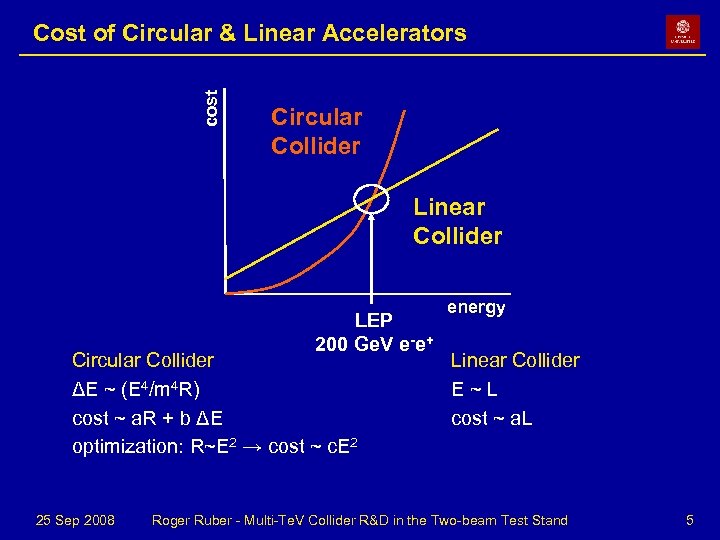
cost Cost of Circular & Linear Accelerators Circular Collider Linear Collider LEP 200 Ge. V e-e+ Circular Collider ΔE ~ (E 4/m 4 R) cost ~ a. R + b ΔE optimization: R~E 2 → cost ~ c. E 2 25 Sep 2008 energy Linear Collider E~L cost ~ a. L Roger Ruber - Multi-Te. V Collider R&D in the Two-beam Test Stand 5
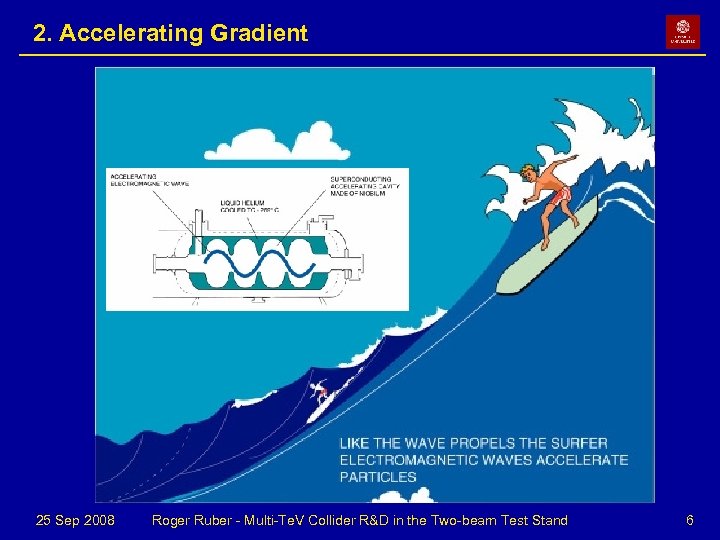
2. Accelerating Gradient 25 Sep 2008 Roger Ruber - Multi-Te. V Collider R&D in the Two-beam Test Stand 6
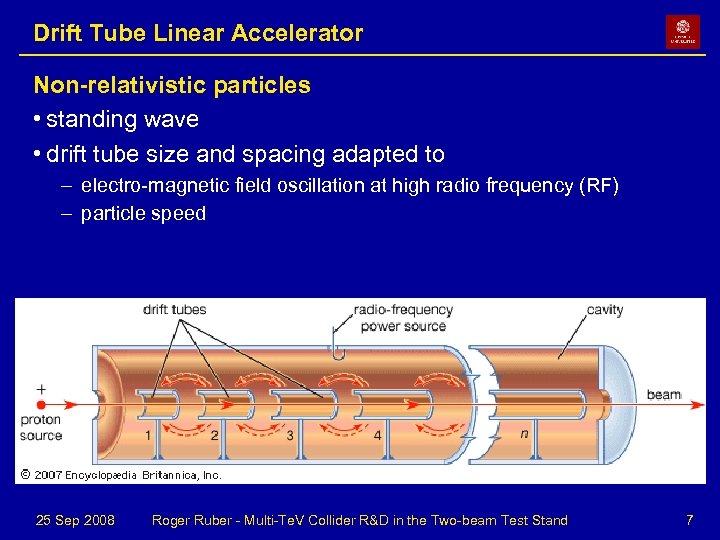
Drift Tube Linear Accelerator Non-relativistic particles • standing wave • drift tube size and spacing adapted to – electro-magnetic field oscillation at high radio frequency (RF) – particle speed 25 Sep 2008 Roger Ruber - Multi-Te. V Collider R&D in the Two-beam Test Stand 7
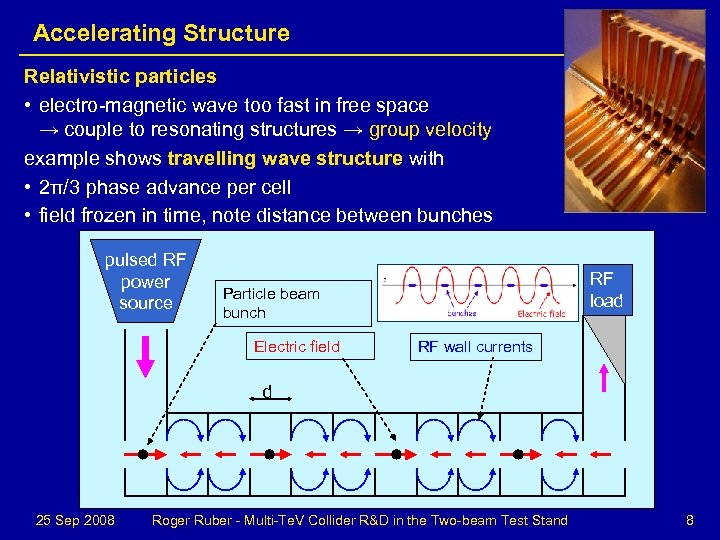
Accelerating Structure Relativistic particles • electro-magnetic wave too fast in free space → couple to resonating structures → group velocity example shows travelling wave structure with • 2π/3 phase advance per cell • field frozen in time, note distance between bunches pulsed RF power source RF load Particle beam bunch Electric field RF wall currents d 25 Sep 2008 Roger Ruber - Multi-Te. V Collider R&D in the Two-beam Test Stand 8
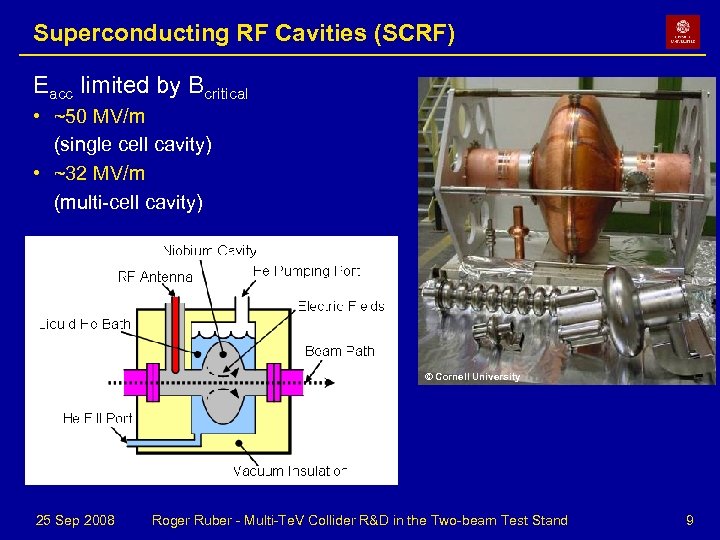
Superconducting RF Cavities (SCRF) Eacc limited by Bcritical • ~50 MV/m (single cell cavity) • ~32 MV/m (multi-cell cavity) © Cornell University 25 Sep 2008 Roger Ruber - Multi-Te. V Collider R&D in the Two-beam Test Stand 9
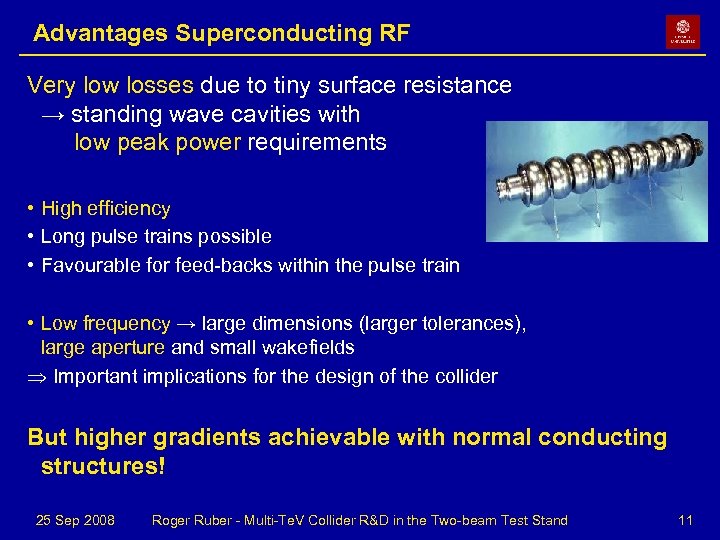
Advantages Superconducting RF Very low losses due to tiny surface resistance → standing wave cavities with low peak power requirements • High efficiency • Long pulse trains possible • Favourable for feed-backs within the pulse train • Low frequency → large dimensions (larger tolerances), large aperture and small wakefields Þ Important implications for the design of the collider But higher gradients achievable with normal conducting structures! 25 Sep 2008 Roger Ruber - Multi-Te. V Collider R&D in the Two-beam Test Stand 11
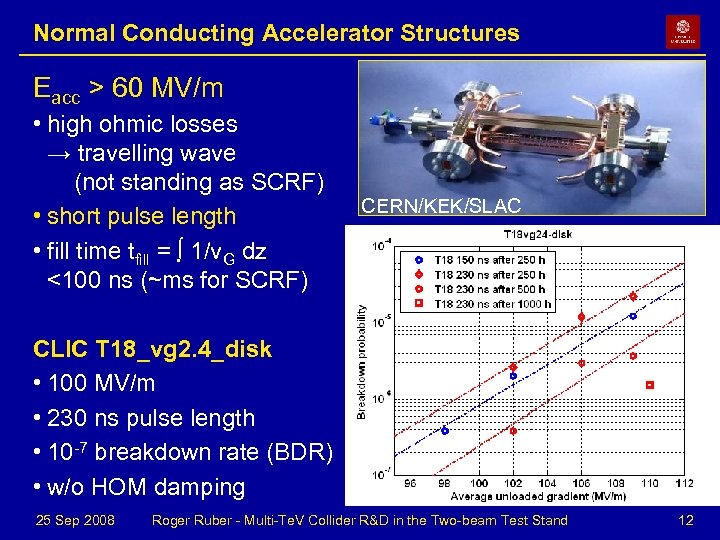
Normal Conducting Accelerator Structures Eacc > 60 MV/m • high ohmic losses → travelling wave (not standing as SCRF) • short pulse length • fill time tfill = 1/v. G dz <100 ns (~ms for SCRF) CERN/KEK/SLAC CLIC T 18_vg 2. 4_disk • 100 MV/m • 230 ns pulse length • 10 -7 breakdown rate (BDR) • w/o HOM damping 25 Sep 2008 Roger Ruber - Multi-Te. V Collider R&D in the Two-beam Test Stand 12
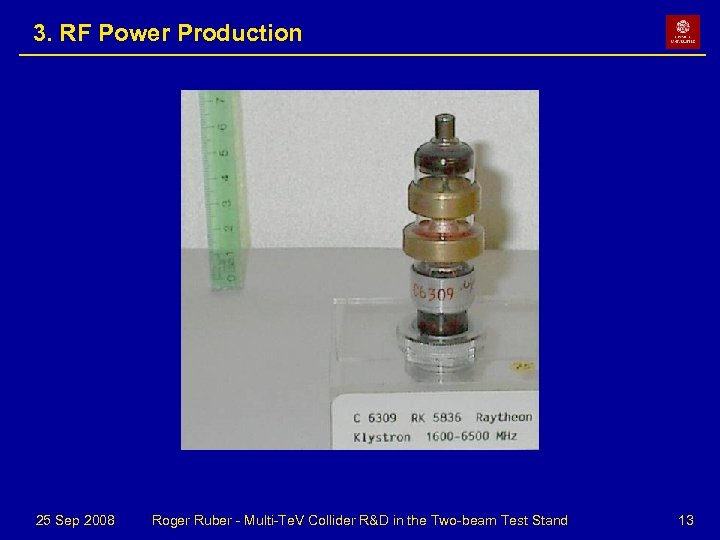
3. RF Power Production 25 Sep 2008 Roger Ruber - Multi-Te. V Collider R&D in the Two-beam Test Stand 13
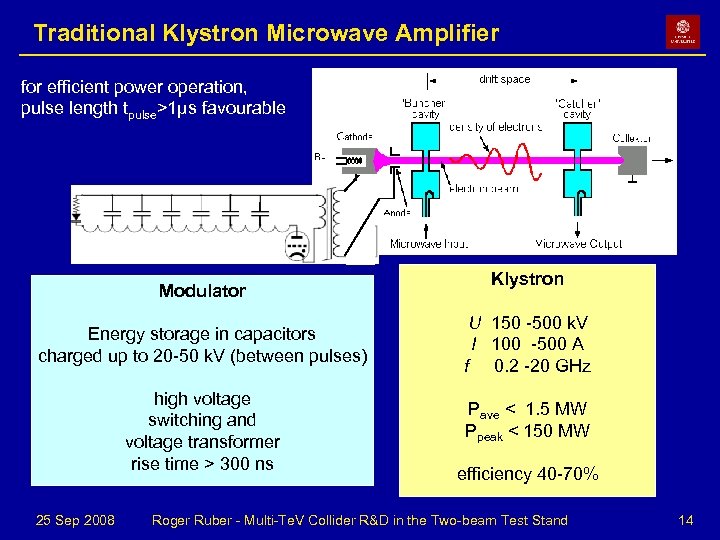
Traditional Klystron Microwave Amplifier for efficient power operation, pulse length tpulse>1μs favourable Modulator Energy storage in capacitors charged up to 20 -50 k. V (between pulses) high voltage switching and voltage transformer rise time > 300 ns 25 Sep 2008 Klystron U 150 -500 k. V I 100 -500 A f 0. 2 -20 GHz Pave < 1. 5 MW Ppeak < 150 MW efficiency 40 -70% Roger Ruber - Multi-Te. V Collider R&D in the Two-beam Test Stand 14
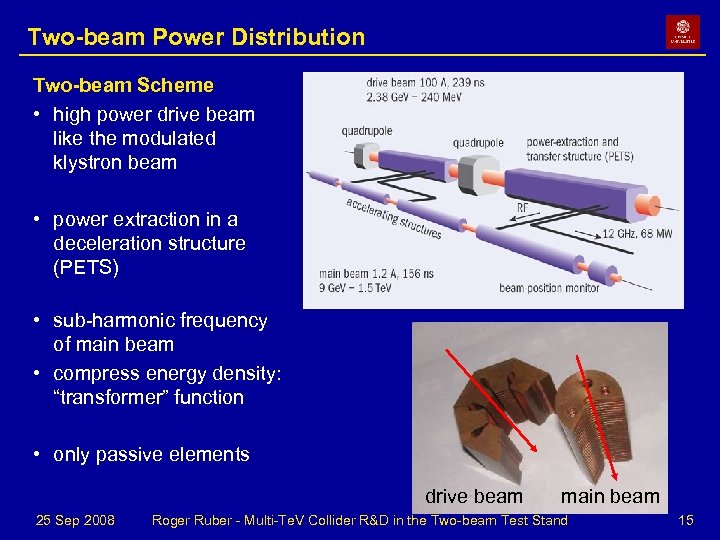
Two-beam Power Distribution Two-beam Scheme • high power drive beam like the modulated klystron beam • power extraction in a deceleration structure (PETS) • sub-harmonic frequency of main beam • compress energy density: “transformer” function • only passive elements drive beam 25 Sep 2008 main beam Roger Ruber - Multi-Te. V Collider R&D in the Two-beam Test Stand 15
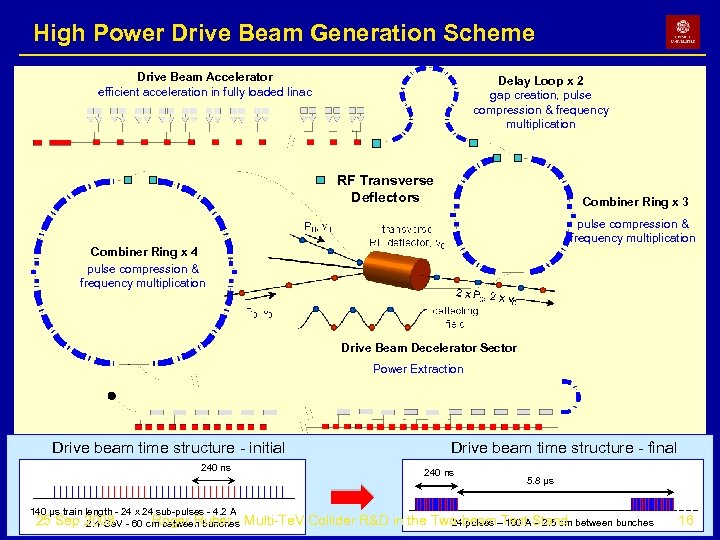
High Power Drive Beam Generation Scheme Drive Beam Accelerator efficient acceleration in fully loaded linac Delay Loop x 2 gap creation, pulse compression & frequency multiplication RF Transverse Deflectors Combiner Ring x 3 pulse compression & frequency multiplication Combiner Ring x 4 pulse compression & frequency multiplication Drive Beam Decelerator Sector Power Extraction Drive beam time structure - initial 240 ns 140 µs train length - 24 x 24 sub-pulses - 4. 2 A 25 Sep 2008 - 60 cm between bunches Roger Ruber 2. 4 Ge. V Drive beam time structure - final 240 ns 5. 8 µs Multi-Te. V Collider R&D in the Two-beam–Test Stand between bunches 24 pulses 100 A – 2. 5 cm 16
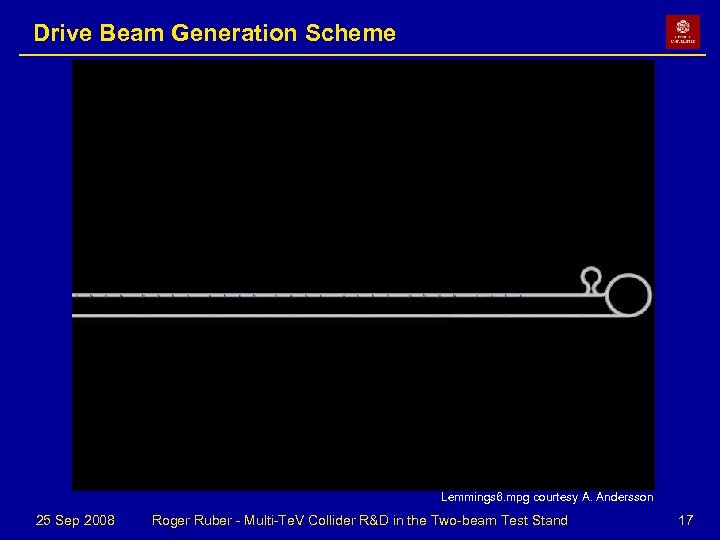
Drive Beam Generation Scheme Lemmings 6. mpg courtesy A. Andersson 25 Sep 2008 Roger Ruber - Multi-Te. V Collider R&D in the Two-beam Test Stand 17
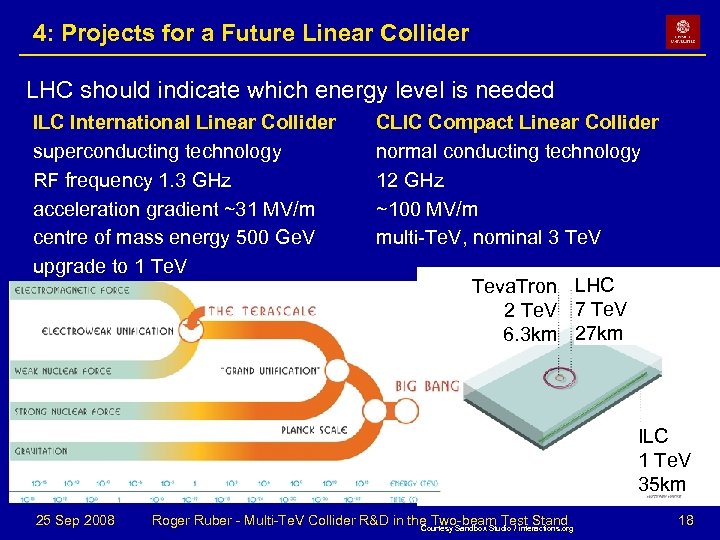
4: Projects for a Future Linear Collider LHC should indicate which energy level is needed ILC International Linear Collider superconducting technology RF frequency 1. 3 GHz acceleration gradient ~31 MV/m centre of mass energy 500 Ge. V upgrade to 1 Te. V CLIC Compact Linear Collider normal conducting technology 12 GHz ~100 MV/m multi-Te. V, nominal 3 Te. V Teva. Tron LHC 2 Te. V 7 Te. V 6. 3 km 27 km ILC 1 Te. V 35 km 25 Sep 2008 Roger Ruber - Multi-Te. V Collider R&D in the Two-beam Test Stand Courtesy Sandbox Studio / interactions. org 18
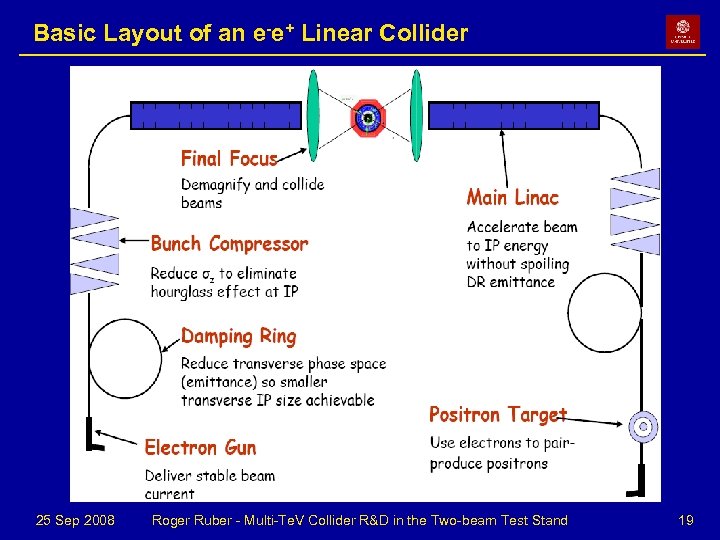
Basic Layout of an e-e+ Linear Collider 25 Sep 2008 Roger Ruber - Multi-Te. V Collider R&D in the Two-beam Test Stand 19
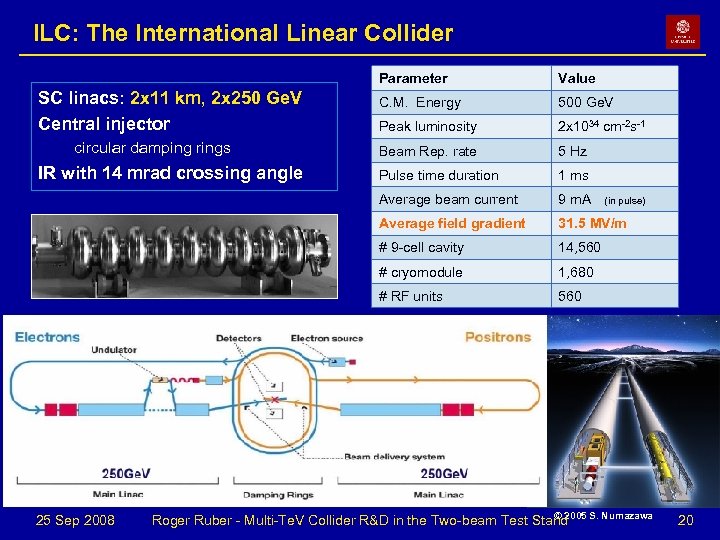
ILC: The International Linear Collider Parameter 2 x 1034 cm-2 s-1 Beam Rep. rate 5 Hz Pulse time duration 1 ms 9 m. A (in pulse) 31. 5 MV/m 14, 560 # cryomodule 1, 680 # RF units 25 Sep 2008 Peak luminosity # 9 -cell cavity IR with 14 mrad crossing angle 500 Ge. V Average field gradient circular damping rings C. M. Energy Average beam current SC linacs: 2 x 11 km, 2 x 250 Ge. V Central injector Value 560 © 2005 S. Numazawa Roger Ruber - Multi-Te. V Collider R&D in the Two-beam Test Stand 20
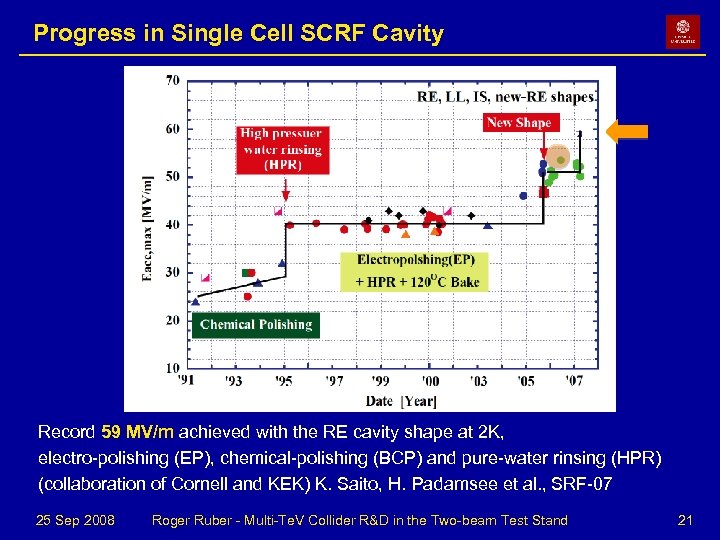
Progress in Single Cell SCRF Cavity Record 59 MV/m achieved with the RE cavity shape at 2 K, electro-polishing (EP), chemical-polishing (BCP) and pure-water rinsing (HPR) (collaboration of Cornell and KEK) K. Saito, H. Padamsee et al. , SRF-07 25 Sep 2008 Roger Ruber - Multi-Te. V Collider R&D in the Two-beam Test Stand 21
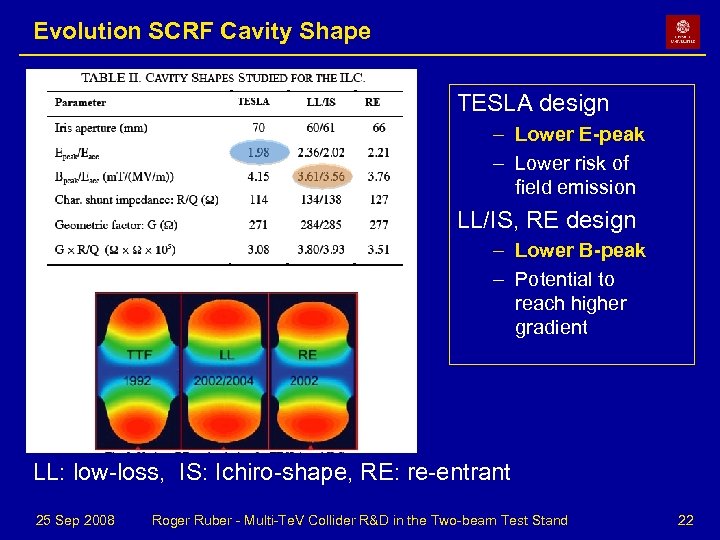
Evolution SCRF Cavity Shape TESLA design – Lower E-peak – Lower risk of field emission LL/IS, RE design – Lower B-peak – Potential to reach higher gradient LL: low-loss, IS: Ichiro-shape, RE: re-entrant 25 Sep 2008 Roger Ruber - Multi-Te. V Collider R&D in the Two-beam Test Stand 22
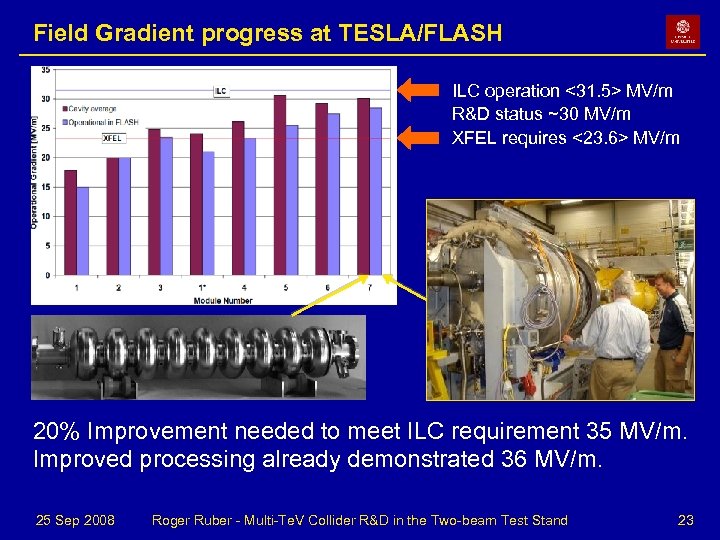
Field Gradient progress at TESLA/FLASH ILC operation <31. 5> MV/m R&D status ~30 MV/m XFEL requires <23. 6> MV/m 20% Improvement needed to meet ILC requirement 35 MV/m. Improved processing already demonstrated 36 MV/m. 25 Sep 2008 Roger Ruber - Multi-Te. V Collider R&D in the Two-beam Test Stand 23
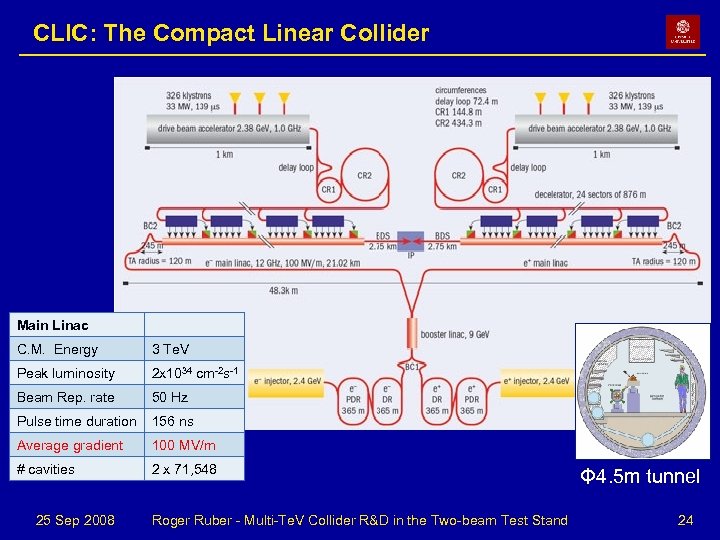
CLIC: The Compact Linear Collider Main Linac C. M. Energy 3 Te. V Peak luminosity 2 x 1034 cm-2 s-1 Beam Rep. rate 50 Hz Pulse time duration 156 ns Average gradient 100 MV/m # cavities 2 x 71, 548 25 Sep 2008 Roger Ruber - Multi-Te. V Collider R&D in the Two-beam Test Stand Φ 4. 5 m tunnel 24
The Key to CLIC Efficiency CLIC accelerating gradient: 100 MV/m RF frequency: 12 GHz 64 MW RF power / accelerating structure of 0. 233 m active length 275 MW/m Total active length for 1. 5 Te. V: 15 km individual klystrons not realistic Note: pulse length 240 ns, 50 Hz repetition rate Estimated wall power 400 MW at 7% efficiency 25 Sep 2008 Roger Ruber - Multi-Te. V Collider R&D in the Two-beam Test Stand 25
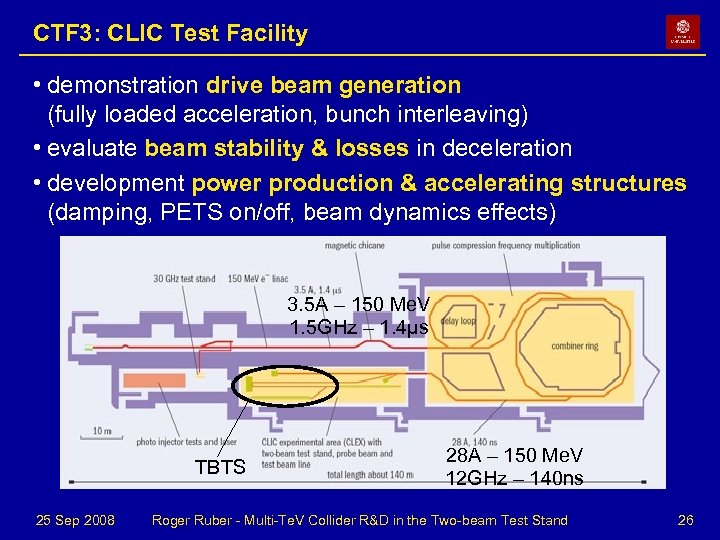
CTF 3: CLIC Test Facility • demonstration drive beam generation (fully loaded acceleration, bunch interleaving) • evaluate beam stability & losses in deceleration • development power production & accelerating structures (damping, PETS on/off, beam dynamics effects) 3. 5 A – 150 Me. V 1. 5 GHz – 1. 4µs TBTS 25 Sep 2008 28 A – 150 Me. V 12 GHz – 140 ns Roger Ruber - Multi-Te. V Collider R&D in the Two-beam Test Stand 26
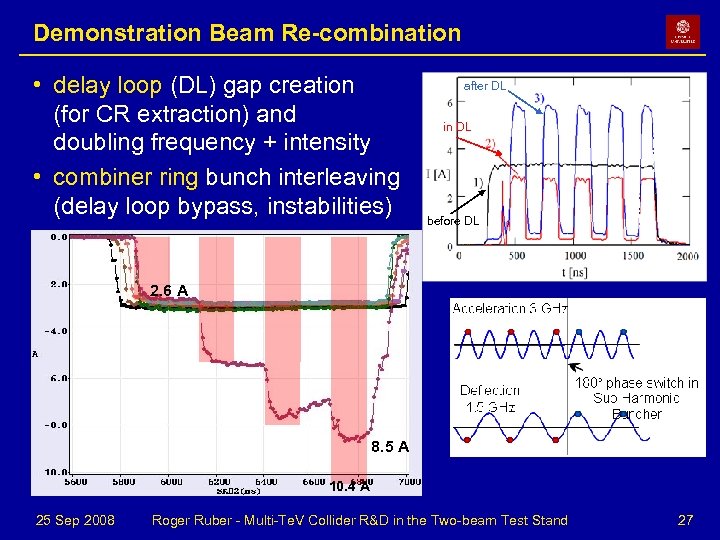
Demonstration Beam Re-combination • delay loop (DL) gap creation (for CR extraction) and doubling frequency + intensity • combiner ring bunch interleaving (delay loop bypass, instabilities) after DL 140 ns in DL before DL 2. 6 A 8. 5 A 10. 4 A 25 Sep 2008 Roger Ruber - Multi-Te. V Collider R&D in the Two-beam Test Stand 27
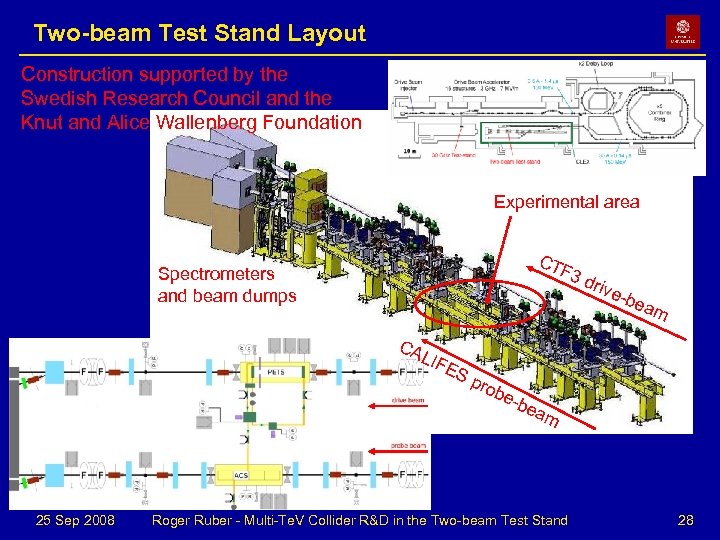
Two-beam Test Stand Layout Construction supported by the Swedish Research Council and the Knut and Alice Wallenberg Foundation Experimental area CT F 3 Spectrometers and beam dumps CA LIF 25 Sep 2008 ES pro be- driv e-b eam bea m Roger Ruber - Multi-Te. V Collider R&D in the Two-beam Test Stand 28
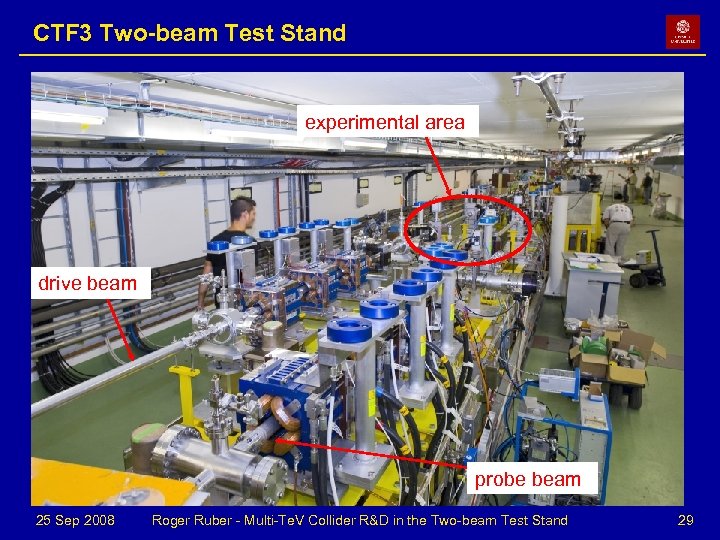
CTF 3 Two-beam Test Stand experimental area drive beam probe beam 25 Sep 2008 Roger Ruber - Multi-Te. V Collider R&D in the Two-beam Test Stand 29
CTF 3 Two-beam Test Stand Prospects Versatile facility • two-beam operation – high power drive-beam [32 A to 100 A at CLIC] – high quality probe-beam [0. 9 A to 1. 0 A at CLIC] • excellent beam diagnostics, long lever arms • easy access & flexibility for future upgrades Unique test possibilities • power production & accelerating structures – beam loading – beam kick – beam dynamics effects • full CLIC module – beam-based alignment 25 Sep 2008 Roger Ruber - Multi-Te. V Collider R&D in the Two-beam Test Stand 30
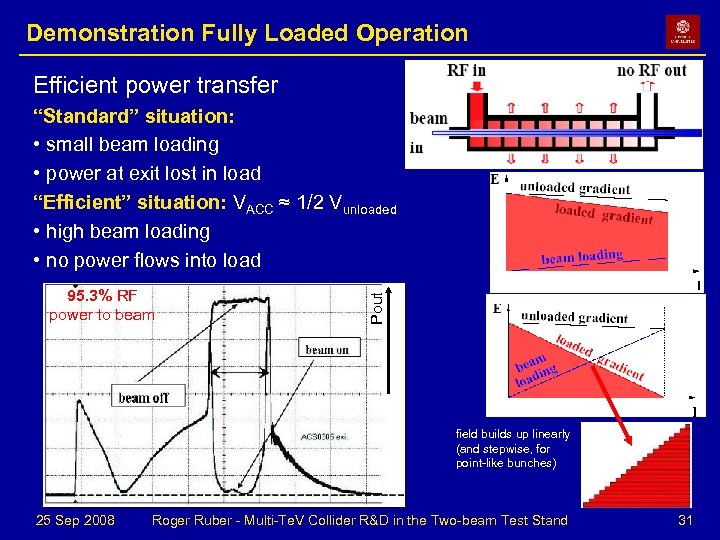
Demonstration Fully Loaded Operation Efficient power transfer 95. 3% RF power to beam Pout “Standard” situation: • small beam loading • power at exit lost in load “Efficient” situation: VACC ≈ 1/2 Vunloaded • high beam loading • no power flows into load field builds up linearly (and stepwise, for point-like bunches) 25 Sep 2008 Roger Ruber - Multi-Te. V Collider R&D in the Two-beam Test Stand 31
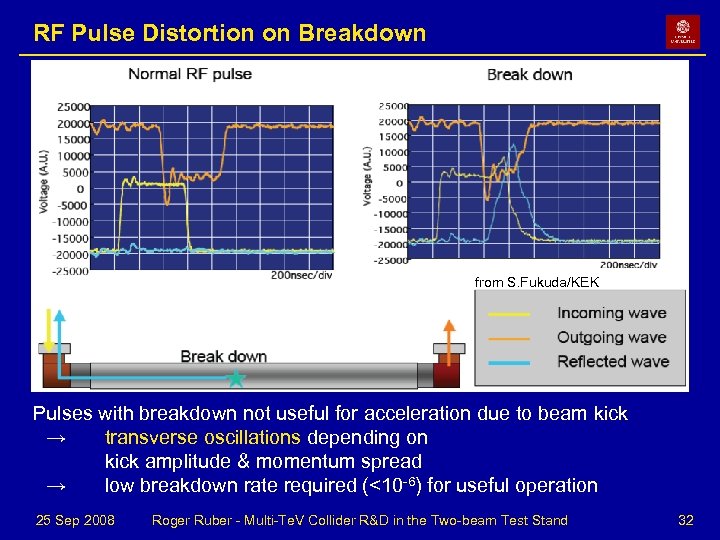
RF Pulse Distortion on Breakdown from S. Fukuda/KEK Pulses with breakdown not useful for acceleration due to beam kick → transverse oscillations depending on kick amplitude & momentum spread → low breakdown rate required (<10 -6) for useful operation 25 Sep 2008 Roger Ruber - Multi-Te. V Collider R&D in the Two-beam Test Stand 32
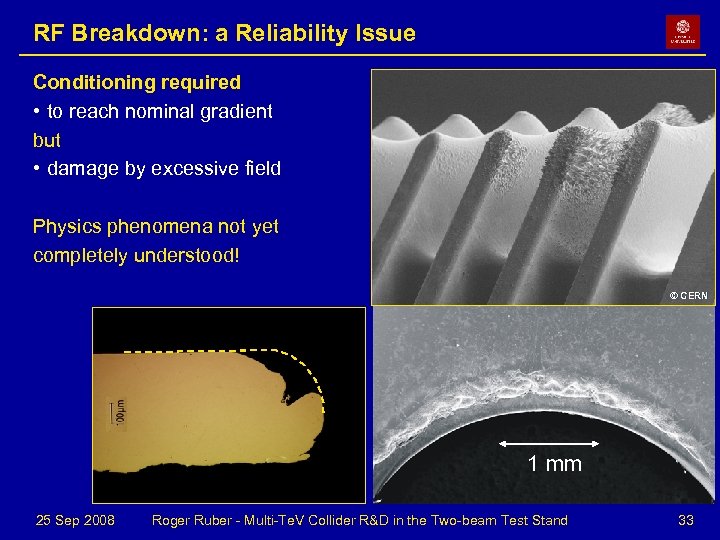
RF Breakdown: a Reliability Issue Conditioning required • to reach nominal gradient but • damage by excessive field Physics phenomena not yet completely understood! © CERN 1 mm 25 Sep 2008 Roger Ruber - Multi-Te. V Collider R&D in the Two-beam Test Stand 33
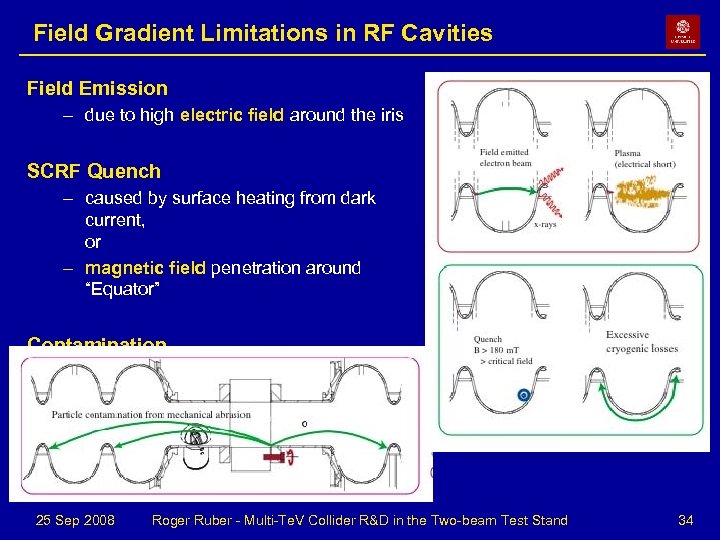
Field Gradient Limitations in RF Cavities Field Emission – due to high electric field around the iris SCRF Quench – caused by surface heating from dark current, or – magnetic field penetration around “Equator” Contamination – during assembly 25 Sep 2008 Roger Ruber - Multi-Te. V Collider R&D in the Two-beam Test Stand 34
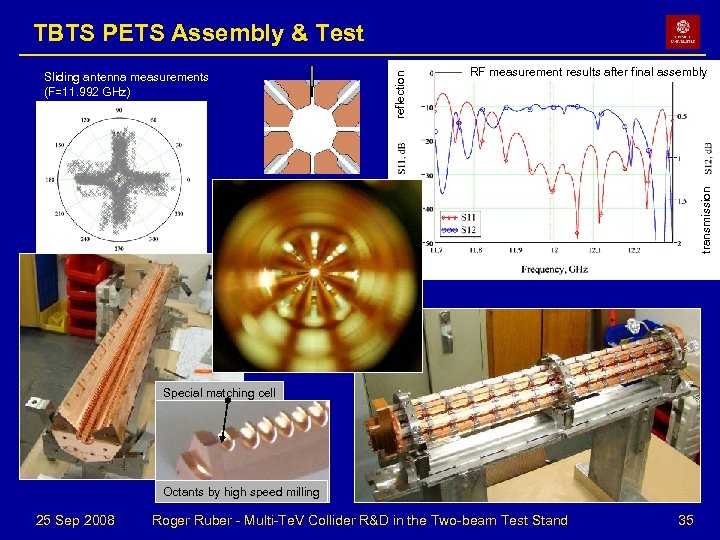
RF measurement results after final assembly transmission Sliding antenna measurements (F=11. 992 GHz) reflection TBTS PETS Assembly & Test Special matching cell Octants by high speed milling 25 Sep 2008 Roger Ruber - Multi-Te. V Collider R&D in the Two-beam Test Stand 35
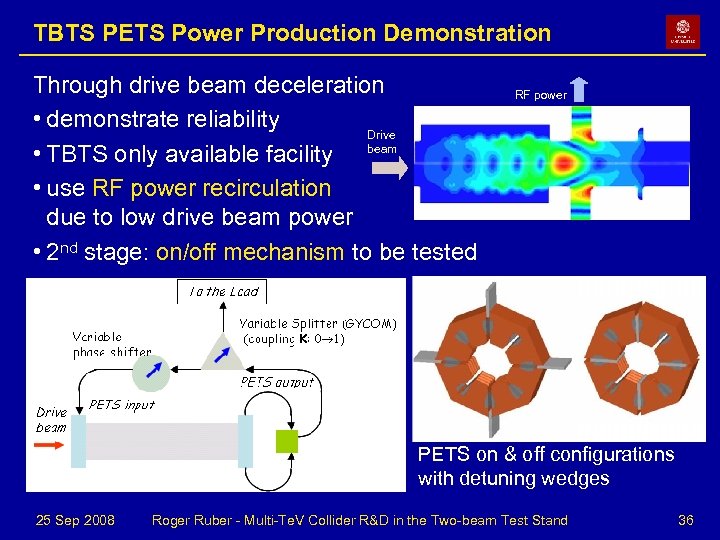
TBTS PETS Power Production Demonstration Through drive beam deceleration • demonstrate reliability Drive • TBTS only available facility beam • use RF power recirculation due to low drive beam power • 2 nd stage: on/off mechanism to be tested RF power PETS on & off configurations with detuning wedges 25 Sep 2008 Roger Ruber - Multi-Te. V Collider R&D in the Two-beam Test Stand 36
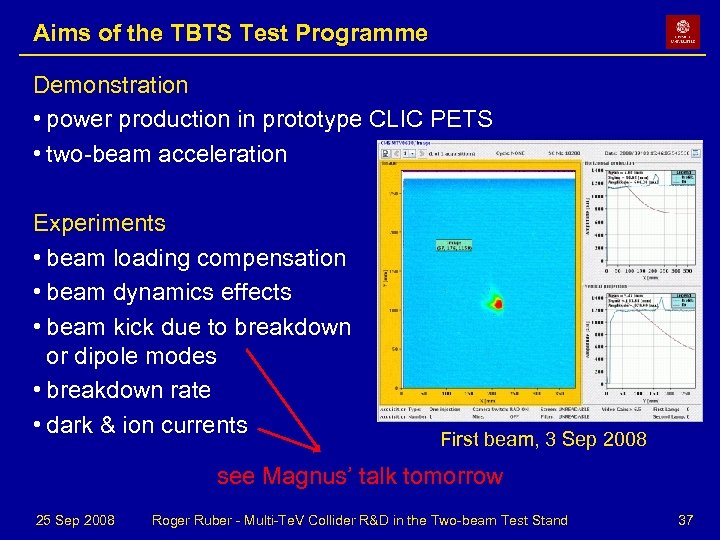
Aims of the TBTS Test Programme Demonstration • power production in prototype CLIC PETS • two-beam acceleration Experiments • beam loading compensation • beam dynamics effects • beam kick due to breakdown or dipole modes • breakdown rate • dark & ion currents First beam, 3 Sep 2008 see Magnus’ talk tomorrow 25 Sep 2008 Roger Ruber - Multi-Te. V Collider R&D in the Two-beam Test Stand 37
Acknowledgements For the contribution of material and advice, without which I would not have been able to make this presentation. My grateful thanks to • Alex Andersson, Erik Adli, Hans Braun, Daniel Schulte, Igor Syratchev, Frank Tecker, Akira Yamamoto and Volker Ziemann CERN and KEK. 25 Sep 2008 Roger Ruber - Multi-Te. V Collider R&D in the Two-beam Test Stand 38
Скачать презентацию Roger Ruber Dept of Physics and Astronomy Div
744a1f89f8daa3b58fbcd49182200bd0.ppt