


 Скачать презентацию Rocket Program Science Space Science Advisory Committee NASA
739830e4042849dfbeeacf07b2953517.ppt
- Количество слайдов: 21
 Rocket Program Science Space Science Advisory Committee NASA Headquarters 12 August 2003 Robert Pfaff Project Scientist, Sounding Rockets NASA/Goddard Space Flight Center
 Rocket Program -- General Remarks • For over 4 decades, the Sounding Rocket Program has been a jewel in the crown of NASA’s spaceflight capabilities. • Program rests solidly on 3 critical elements: -- Unique, cutting edge science missions -- Platform for the conception, testing, and development of new technology -- Training ground for students, young researchers and engineers • Two important features of the program : -- Low Cost -- Rapid, quick response
 Sounding Rockets provide NASA with a new generation of explorers • Program continues to be enormously popular with users in all Code S disciplines: Astronomy / Planetary / Solar / Geospace • Success of Program implementation is due to strong three-way partnership: P. I. • Wallops Flight Facility • NASA HQ • P. I. is firmly in charge of the mission, from proposal to payload design to making the launch decision to the data analysis and publication of results. • Rocket program not only provides hands on experience, it generates A new generation of explorers.
 Sounding Rocket Mission Categories Remote sensing (Telescopes) • Users: UV Astronomy, X-Ray, Planetary, Solar • Main requirements/features: 1. Observing platform above earth’s atmosphere 2. Fine pointing of payloads (sub arc second) 3. Real-time, joy stick uplink command positioning available 4. Payload recovery/reflight desired (launches are at White Sands) 5. Southern Hemisphere launch location (Australia) used on campaign basis 6. Ability to observe sources close to the sun (e. g. , comets, Mercury, Venus)
 Sounding Rocket Mission Categories In situ measurements • Users: Geospace (Magnetosphere, Ionosphere, Thermosphere, Mesosphere) • Main requirements/features: 1. Access to altitudes too low for satellite in situ sampling (25 -120 km region) 2. Vertical profiles of measured phenomena (cf. satellite horizontal profiles). 3. Slow vehicle speeds enable new features to be resolved; payloads “dwell” in regions of interest 4. Launch into geophysical “Targets of opportunity” (e. g. , aurora, cusp, thunderstorms, ionospheric turbulence at equator, noctilucent clouds, electrojets, metallic layers, etc. ) 5. Portability provides access to remote geophysical sites (high and low latitudes) (Continued)
 Sounding Rocket Mission Categories In situ measurements • Main requirements/features (continued): 6. Launches in conjunction with ground observations (e. g. , radars, lidars, etc. ) 7. Multiple payloads (clusters) launched on single rocket 8. Multiple, simultaneous launches (high and low apogees, different azimuths, etc. ) 9. Luminous trails to serve as tracers of geophysical parameters such as winds 10. Flights in conjunction with orbital missions (e. g. , Dynamics Explorer, TIMED) 11. Tether capabilities (e. g. , 2 km tethers between payloads have been flown) 12. Collections of atmosphere samples (24 underflights of UARS)
 Sounding Rocket Mission Categories Microgravity • Main requirements/features: 1. Long periods of “zero-G” relative to airplanes, drop towers 2. Recovery usually required (launches are at White Sands) 3. Rockets provide very low acceleration, disturbance rates relative to STS, ISS Special projects • e. g. , Aerobraking tests, technology demonstrations Education Initiatives • Over 350 Ph. D’s have completed thesis-based sounding rocket research • High school, undergraduate student launch program. Science slides
 New Directions at Wallops • High Altitude Sounding Rocket (see subsequent charts) • “Tailored” Trajectories • Small Mesospheric “Dart” payloads • Improved sub-systems (e. g. fine pointing) • Technology Roadmap developed jointly by WFF and the Sounding Rocket Working Group
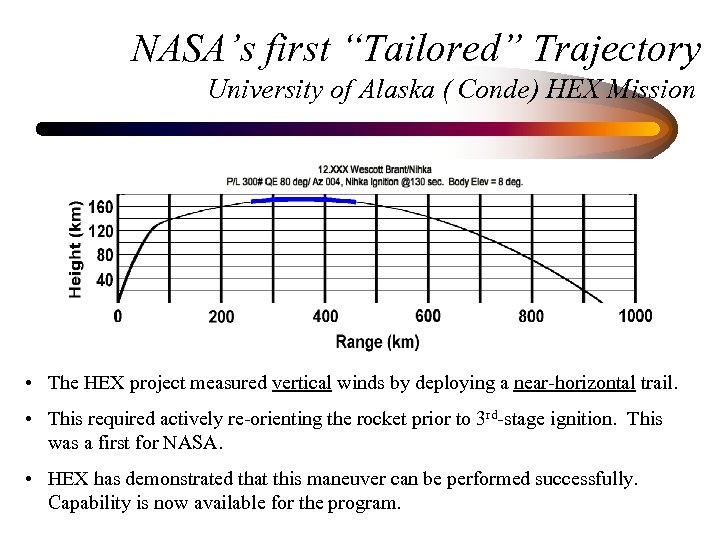 NASA’s first “Tailored” Trajectory University of Alaska ( Conde) HEX Mission • The HEX project measured vertical winds by deploying a near-horizontal trail. • This required actively re-orienting the rocket prior to 3 rd-stage ignition. This was a first for NASA. • HEX has demonstrated that this maneuver can be performed successfully. Capability is now available for the program.
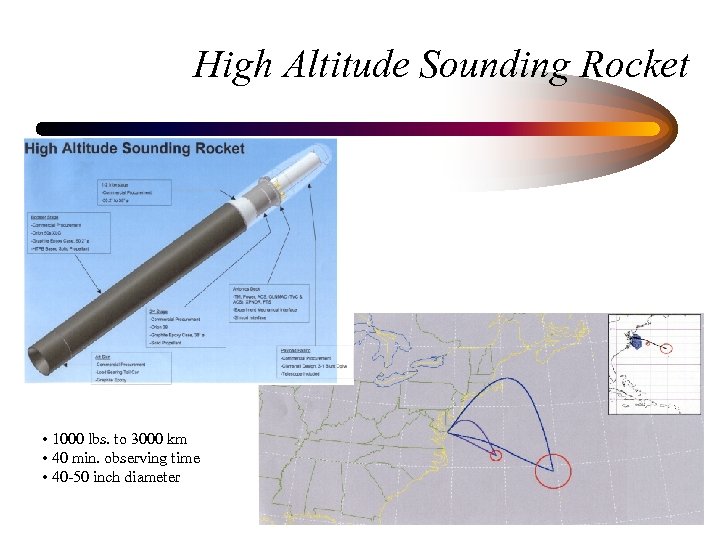 High Altitude Sounding Rocket • 1000 lbs. to 3000 km • 40 min. observing time • 40 -50 inch diameter
 High Altitude Sounding Rocket -- Astronomy / Planetary / Solar • Increased “hang time” of 40 minutes and larger diameter (~ 1 m) telescopes will provide greater sensitivity (e. g. , observing extra-galactic and other faint objects become feasible) and higher angular resolution. • Longer observing times introduce: – new class of experiments (e. g. IR Payloads that need to cool down) – ability to track temporal evolution of solar phenomena – larger number of targets to be observed on a given flight • Provides competitive observational capabilities not available on Hubble (e. g. , rockets can carry out “diffuse” experiments, observe objects near the sun, such as Venus, Mercury, comets)
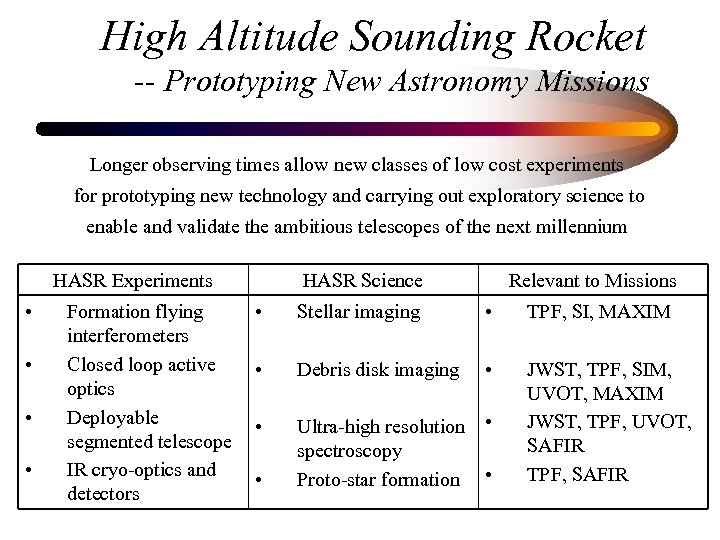 High Altitude Sounding Rocket -- Prototyping New Astronomy Missions Longer observing times allow new classes of low cost experiments for prototyping new technology and carrying out exploratory science to enable and validate the ambitious telescopes of the next millennium HASR Experiments • • Formation flying interferometers Closed loop active optics Deployable segmented telescope IR cryo-optics and detectors HASR Science Relevant to Missions • Stellar imaging • TPF, SI, MAXIM • Debris disk imaging • • Ultra-high resolution • spectroscopy Proto-star formation • JWST, TPF, SIM, UVOT, MAXIM JWST, TPF, UVOT, SAFIR TPF, SAFIR •
 High Altitude Sounding Rocket -- Geophysics • Ability to penetrate the aurora and cusp acceleration regions ( > 2500 km), and linger within these regions at low velocities • Provides ability to observe high altitude regions with constellations of well -instrumented sub-payloads • Observe magnetosphere-ionosphere coupling resonances and wave interactions with periods of 10’s of minutes • Study inner radiation belt and slot region from Wallops • Observe evolution and impact of magnetic storms on mid-latitude geospace for considerably longer times • Instrumentation testing (e. g. , high velocity environment during re-entry in lower ionosphere provides for GEC prototype tests).
 High Altitude Sounding Rocket -- Other • Microgravity Experiments – 40 minutes of “ideal” micro-gravity environment (without vibrations common on human-tendered platforms such as ISS and Shuttle) – Provides for considerably larger and longer combustion experiments • Planetary Engineering – Re-entry testing – Aerobraking – Smart landers – Aero-capture
 High Altitude Sounding Rocket -- Technical and Programmatic • Capability – – – 1000 lbs. to 3000 km altitude Approximately 40 minute of observation time after burnout High re-entry velocities 40 -50 inch payload diameter Recovery capabilities to be included • Commercial motors and hardware with in-house (NSROC) integration • FY 04 ($3. 0 M) and FY 05 ($3. 0 M) – Will fund the first demonstration flight • Goal: 1000 lbs to 3000 km for $5 M (includes rocket, nose cone, payload subsystems, operations)
 Rocket Program -- Issues & Concerns • In the last 4 years, number of Code S flights has diminished, compared to historical levels. • Planetary rocket program has been discontinued despite rave reviews and strong recommendations of Decadal Survey. • Although program funding is on more solid ground than a few years ago, promised ~ $6 M ramp-up in FY 06 must come through. • High Altitude Sounding Rocket funds have been requested in next year’s budget to start this initiative -- seek support of advisory committees!
 BACK-UP SLIDES
 “Code S” missions do not include microgravity, reimbursable, test, and student launches.
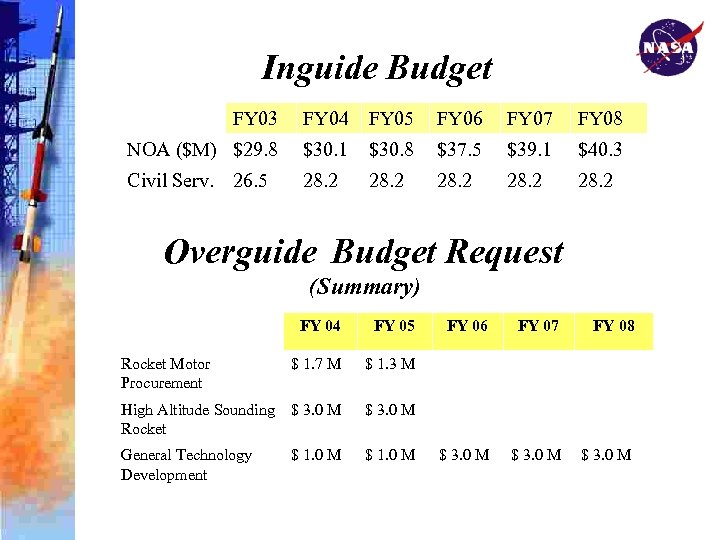 Inguide Budget FY 03 FY 04 FY 05 FY 06 FY 07 FY 08 NOA ($M) $29. 8 $30. 1 $30. 8 $37. 5 $39. 1 $40. 3 Civil Serv. 26. 5 28. 2 Overguide Budget Request (Summary) FY 04 FY 05 $ 1. 7 M $ 1. 3 M High Altitude Sounding $ 3. 0 M Rocket $ 3. 0 M General Technology Development $ 1. 0 M Rocket Motor Procurement $ 1. 0 M FY 06 FY 07 FY 08 $ 3. 0 M
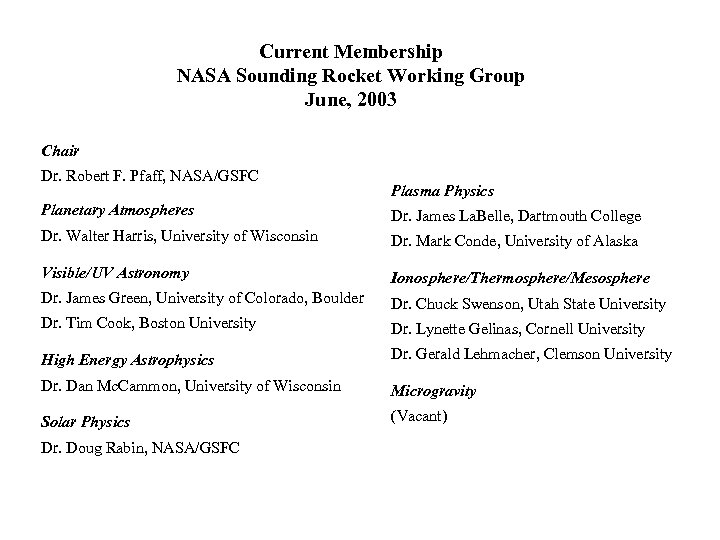 Current Membership NASA Sounding Rocket Working Group June, 2003 Chair Dr. Robert F. Pfaff, NASA/GSFC Plasma Physics Planetary Atmospheres Dr. James La. Belle, Dartmouth College Dr. Walter Harris, University of Wisconsin Dr. Mark Conde, University of Alaska Visible/UV Astronomy Ionosphere/Thermosphere/Mesosphere Dr. James Green, University of Colorado, Boulder Dr. Chuck Swenson, Utah State University Dr. Tim Cook, Boston University Dr. Lynette Gelinas, Cornell University High Energy Astrophysics Dr. Gerald Lehmacher, Clemson University Dr. Dan Mc. Cammon, University of Wisconsin Microgravity Solar Physics (Vacant) Dr. Doug Rabin, NASA/GSFC
 Current Membership NASA Sounding Rocket Working Group June, 2003