 Скачать презентацию Robustness in protein circuits adaptation in bacterial chemotaxis
dc86d059e76975a1e4f3ea5250bfc564.ppt
- Количество слайдов: 28



Robustness in protein circuits: adaptation in bacterial chemotaxis Information in Biology 2008 Oren Shoval 1
Outline • Noise is a part of life • Overview of bacterial chemotaxis • Internal mechanism of chemotaxis control • The robust model of perfect adaptation • Perfect adaptation and control theory 2
Outline • Noise is a part of life • Overview of bacterial chemotaxis • Internal mechanism of chemotaxis control • The robust model of perfect adaptation • Perfect adaptation and control theory 3
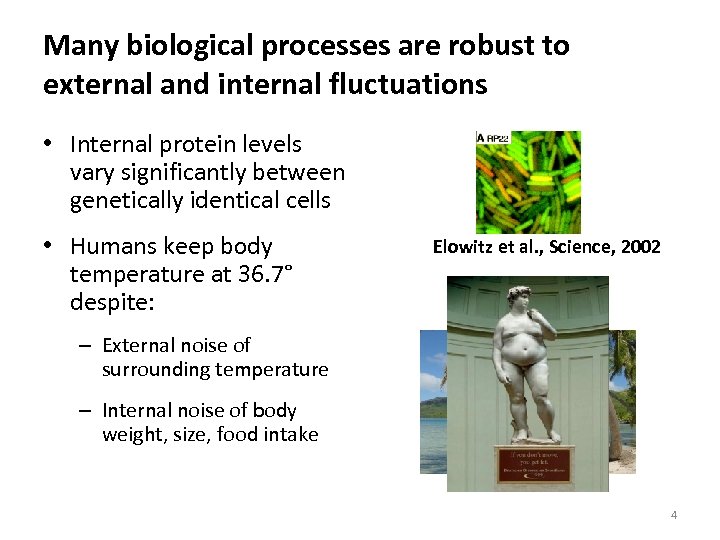
Many biological processes are robust to external and internal fluctuations • Internal protein levels vary significantly between genetically identical cells • Humans keep body temperature at 36. 7° despite: Elowitz et al. , Science, 2002 – External noise of surrounding temperature – Internal noise of body weight, size, food intake 4
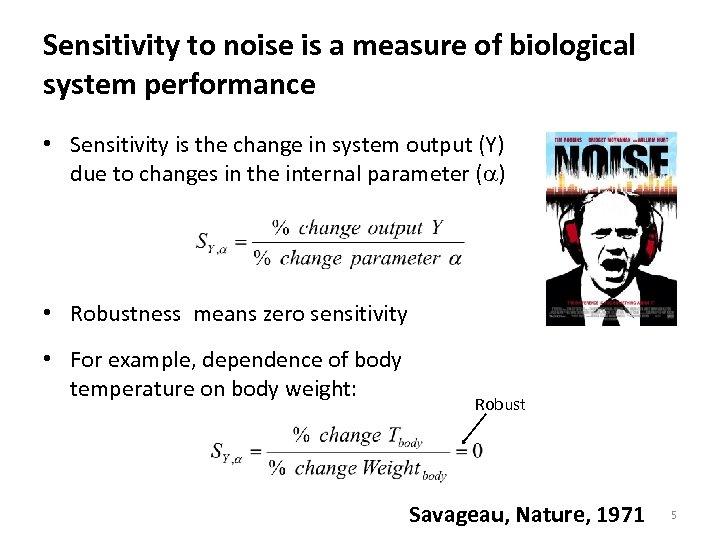
Sensitivity to noise is a measure of biological system performance • Sensitivity is the change in system output (Y) due to changes in the internal parameter ( ) • Robustness means zero sensitivity • For example, dependence of body temperature on body weight: Robust Savageau, Nature, 1971 5
Outline • Noise is a part of life • Overview of bacterial chemotaxis • Internal mechanism of chemotaxis control • The robust model of perfect adaptation • Perfect adaptation and control theory 6
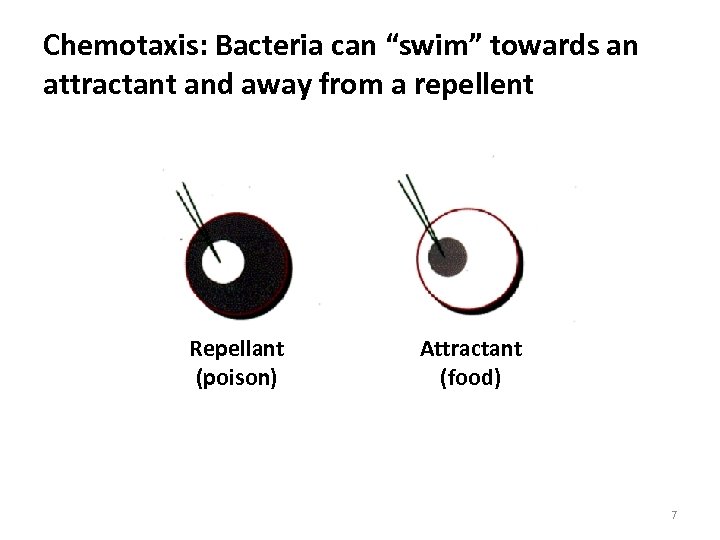
Chemotaxis: Bacteria can “swim” towards an attractant and away from a repellent Repellant (poison) Attractant (food) 7
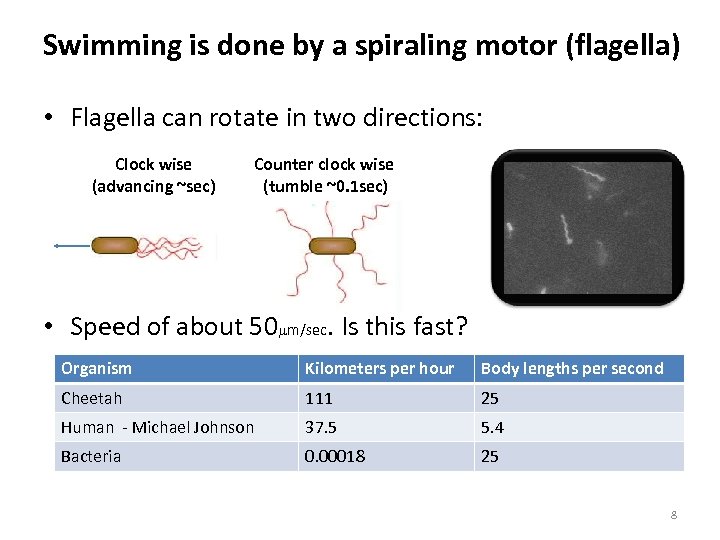
Swimming is done by a spiraling motor (flagella) • Flagella can rotate in two directions: Clock wise (advancing ~sec) Counter clock wise (tumble ~0. 1 sec) • Speed of about 50 m/sec. Is this fast? Organism Kilometers per hour Body lengths per second Cheetah 111 25 Human - Michael Johnson 37. 5 5. 4 Bacteria 0. 00018 25 8
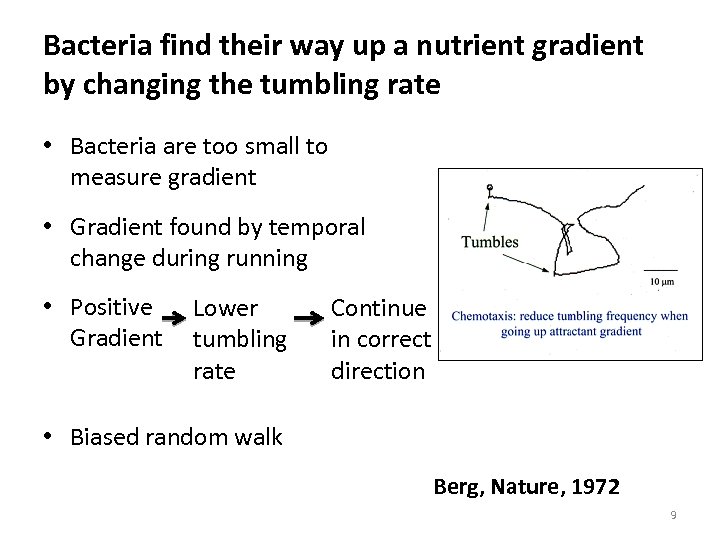
Bacteria find their way up a nutrient gradient by changing the tumbling rate • Bacteria are too small to measure gradient • Gradient found by temporal change during running • Positive Gradient Lower tumbling rate Continue in correct direction • Biased random walk Berg, Nature, 1972 9

Automated analysis of the bacteria trails enables extracting the chemotaxis parameters Parameters: • Mean free path • Tumbling rate Berg, Nature, 1972 10
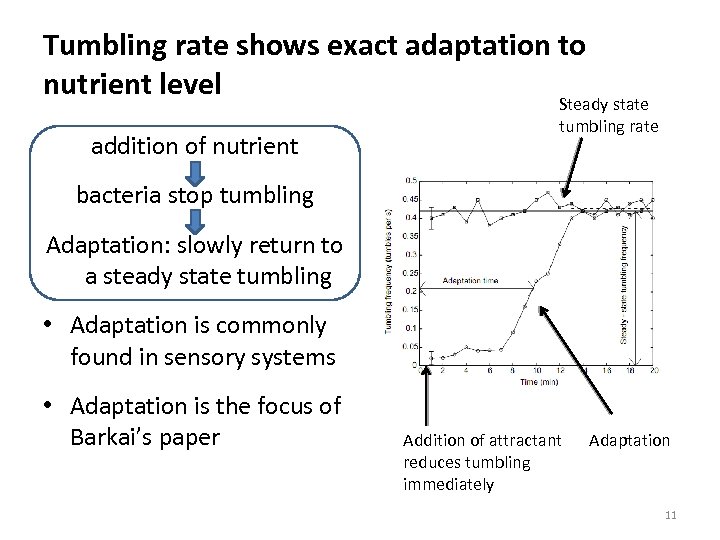
Tumbling rate shows exact adaptation to nutrient level addition of nutrient Steady state tumbling rate bacteria stop tumbling Adaptation: slowly return to a steady state tumbling • Adaptation is commonly found in sensory systems • Adaptation is the focus of Barkai’s paper Addition of attractant reduces tumbling immediately Adaptation 11
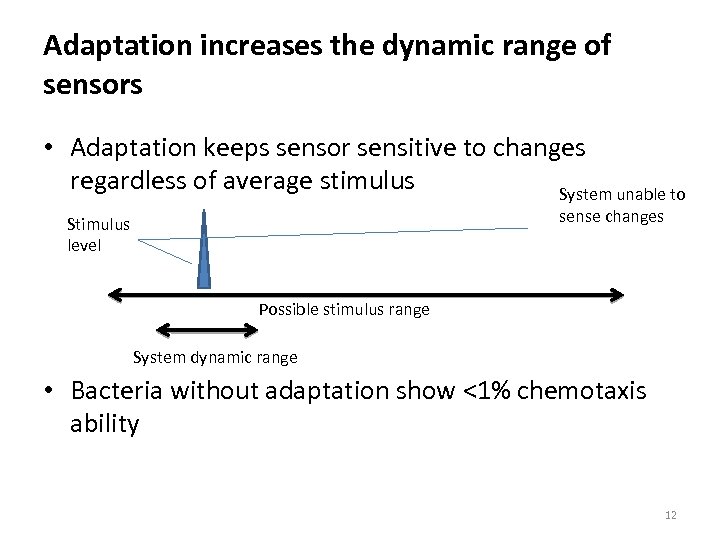
Adaptation increases the dynamic range of sensors • Adaptation keeps sensor sensitive to changes regardless of average stimulus System unable to sense changes Stimulus level Possible stimulus range System dynamic range • Bacteria without adaptation show <1% chemotaxis ability 12
Outline • Noise is a part of life • Overview of bacterial chemotaxis • Internal mechanism of chemotaxis control • The robust model of perfect adaptation • Perfect adaptation and control theory 13
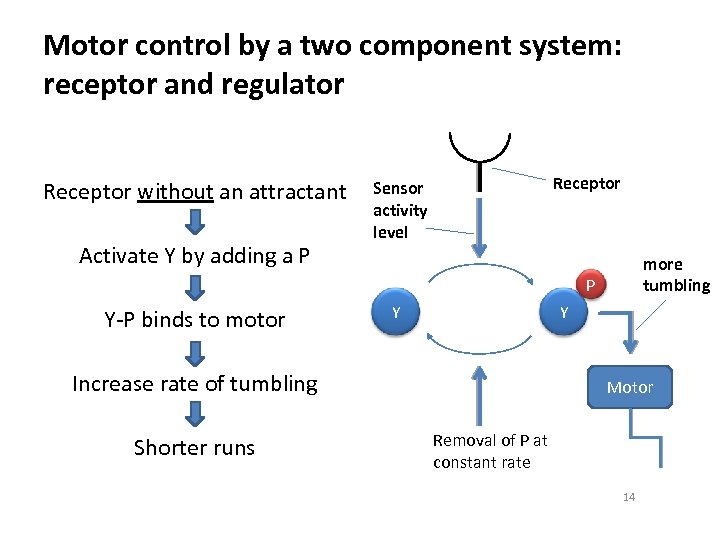
Motor control by a two component system: receptor and regulator Receptor without an attractant Activate Y by adding a P Receptor Sensor activity level more tumbling P Y-P binds to motor Y Y Increase rate of tumbling Shorter runs Motor Removal of P at constant rate 14
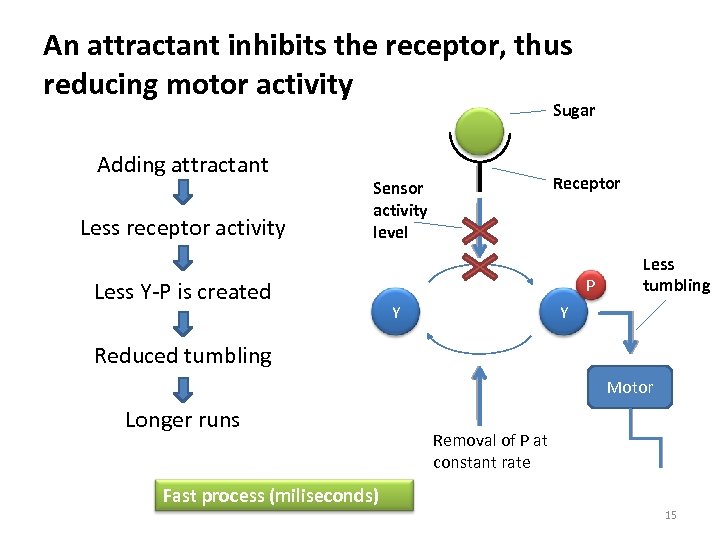
An attractant inhibits the receptor, thus reducing motor activity Sugar Adding attractant Less receptor activity Receptor Sensor activity level Less Y-P is created P Y Less tumbling Y Reduced tumbling Motor Longer runs Fast process (miliseconds) Removal of P at constant rate 15
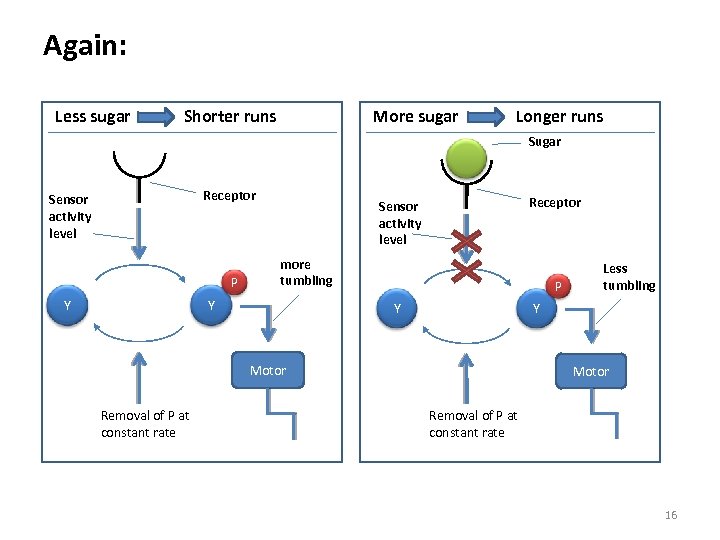
Again: Less sugar Shorter runs More sugar Longer runs Sugar Receptor Sensor activity level P Y Receptor Sensor activity level more tumbling Y P Y Y Motor Removal of P at constant rate Less tumbling Motor Removal of P at constant rate 16
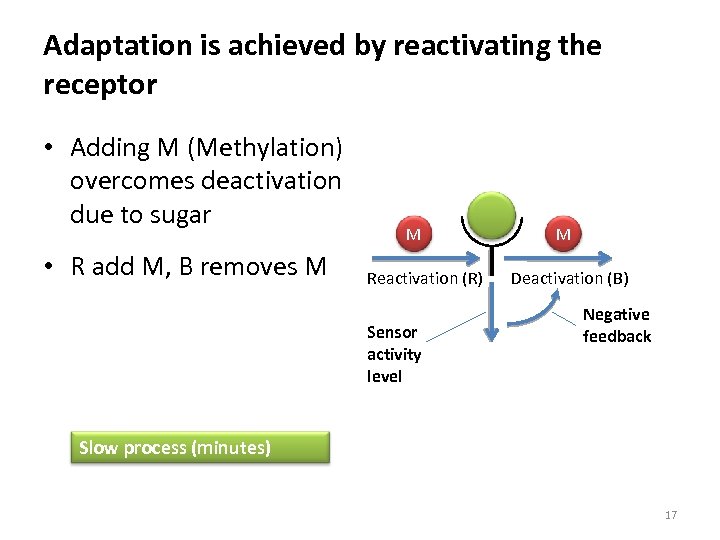
Adaptation is achieved by reactivating the receptor • Adding M (Methylation) overcomes deactivation due to sugar • R add M, B removes M M Reactivation (R) Sensor activity level M Deactivation (B) Negative feedback Slow process (minutes) 17
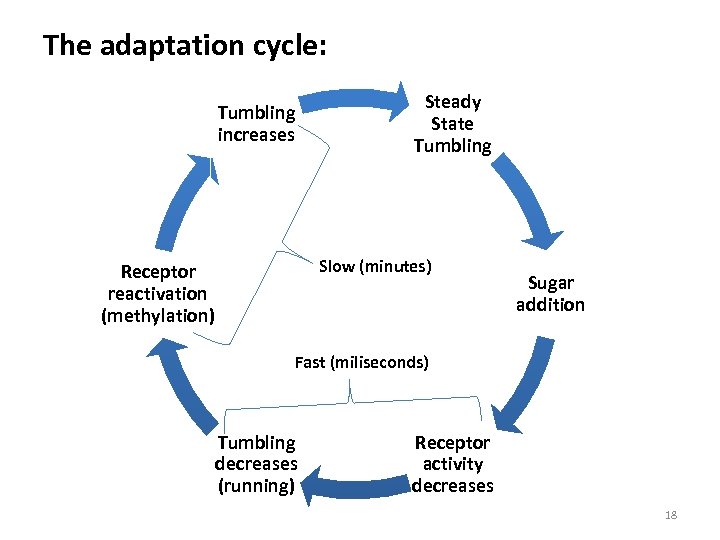
The adaptation cycle: Tumbling increases Steady State Tumbling Slow (minutes) Receptor reactivation (methylation) Sugar addition Fast (miliseconds) Tumbling decreases (running) Receptor activity decreases 18
Outline • Noise is a part of life • Overview of bacterial chemotaxis • Internal mechanism of chemotaxis control • The robust model of perfect adaptation • Perfect adaptation and control theory 19
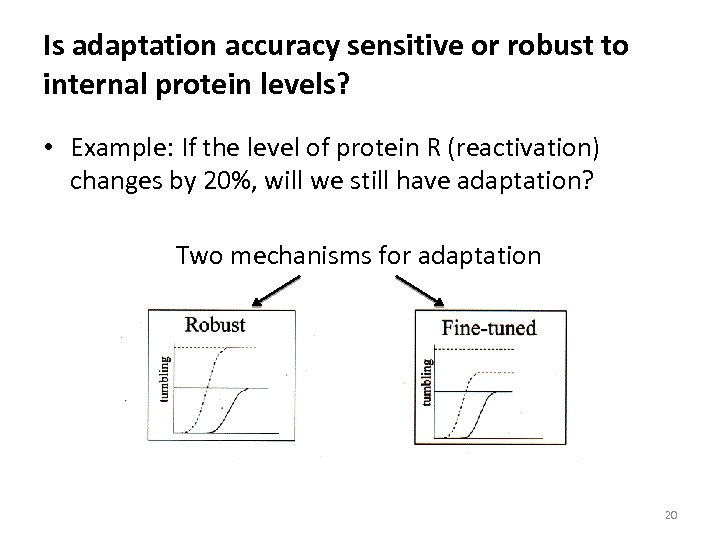
Is adaptation accuracy sensitive or robust to internal protein levels? • Example: If the level of protein R (reactivation) changes by 20%, will we still have adaptation? Two mechanisms for adaptation 20
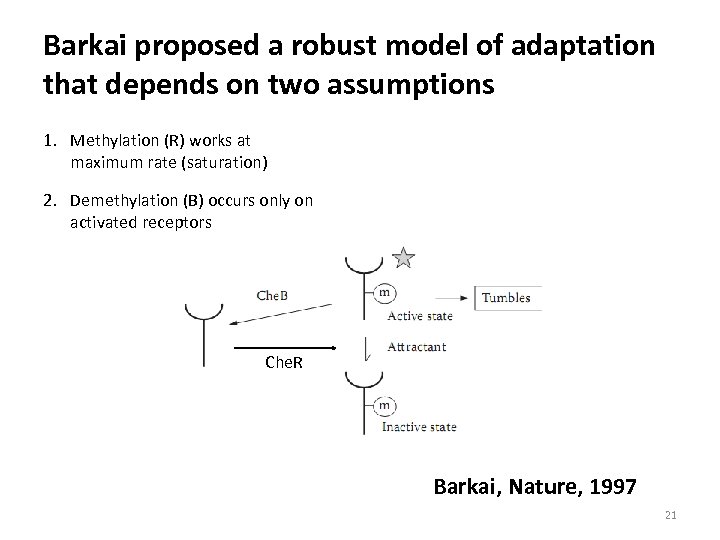
Barkai proposed a robust model of adaptation that depends on two assumptions 1. Methylation (R) works at maximum rate (saturation) 2. Demethylation (B) occurs only on activated receptors Che. R Barkai, Nature, 1997 21
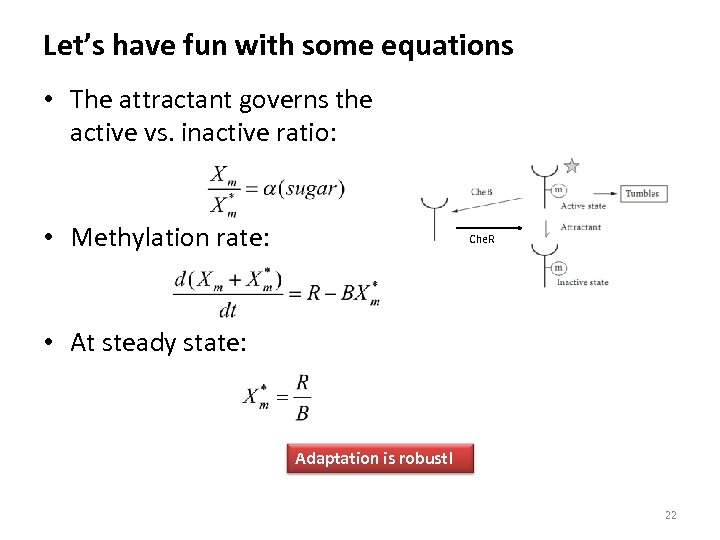
Let’s have fun with some equations • The attractant governs the active vs. inactive ratio: • Methylation rate: Che. R • At steady state: Adaptation is robust! 22
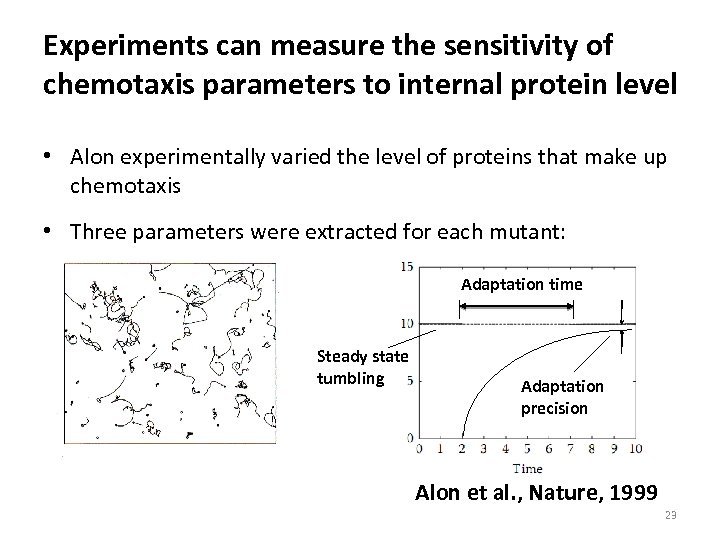
Experiments can measure the sensitivity of chemotaxis parameters to internal protein level • Alon experimentally varied the level of proteins that make up chemotaxis • Three parameters were extracted for each mutant: Adaptation time Steady state tumbling Adaptation precision Alon et al. , Nature, 1999 23
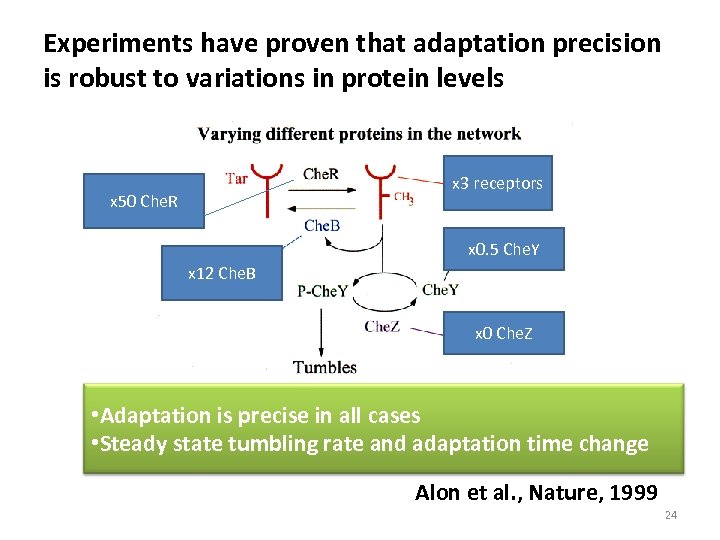
Experiments have proven that adaptation precision is robust to variations in protein levels x 3 receptors x 50 Che. R x 0. 5 Che. Y x 12 Che. B x 0 Che. Z • Adaptation is precise in all cases • Steady state tumbling rate and adaptation time change Alon et al. , Nature, 1999 24
Perfect adaptation is important, so the network is designed to keep it robust • Partial adaptation leads to <1% of wildtype chemotaxis ability • Changing the tumbling frequency and adaptation time does not affect chemotaxis ability • Exact adaptation is displayed in taxis of many other bacterial species (B. subtillis, R. sphaeroides) However, nonessential features are sensitive to protein levels 25
Outline • Noise is a part of life • Overview of bacterial chemotaxis • Internal mechanism of chemotaxis control • The robust model of perfect adaptation • Perfect adaptation and control theory 26
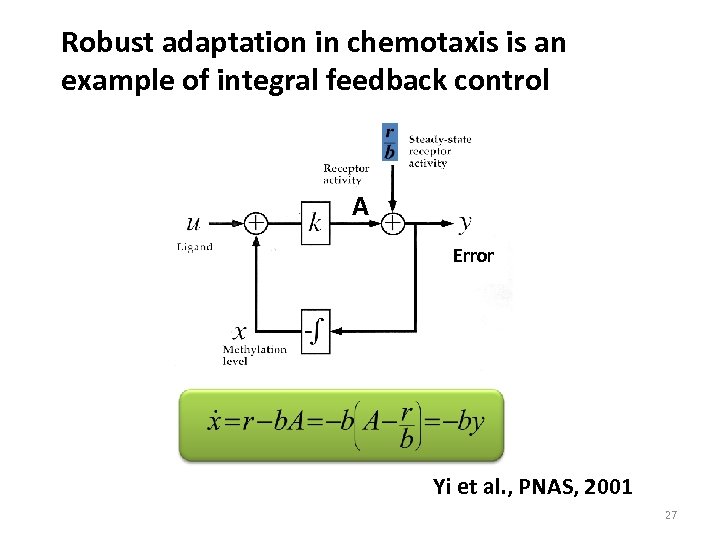
Robust adaptation in chemotaxis is an example of integral feedback control A Error Yi et al. , PNAS, 2001 27
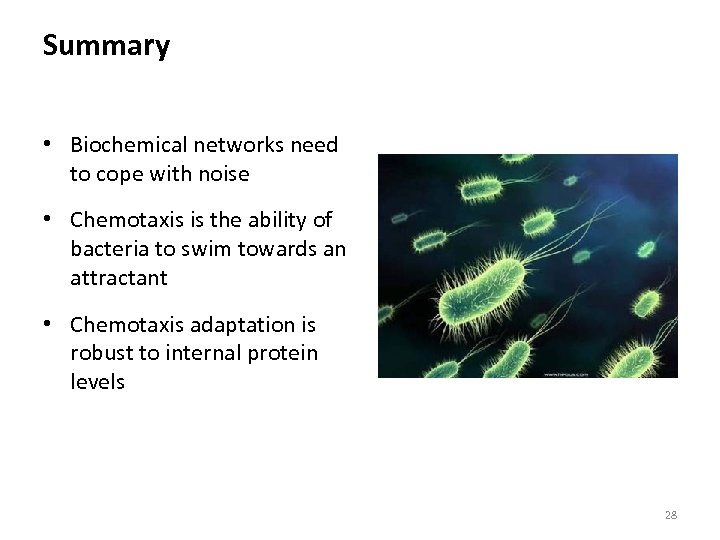
Summary • Biochemical networks need to cope with noise • Chemotaxis is the ability of bacteria to swim towards an attractant • Chemotaxis adaptation is robust to internal protein levels 28
Скачать презентацию Robustness in protein circuits adaptation in bacterial chemotaxis
dc86d059e76975a1e4f3ea5250bfc564.ppt