 Скачать презентацию Robust Visual Motion Analysis Piecewise-Smooth Optical Flow and
4219601d7d32badd2f1a5f46dd8507e7.ppt
- Количество слайдов: 54



Robust Visual Motion Analysis: Piecewise-Smooth Optical Flow and Motion-Based Detection and Tracking Ming Ye Electrical Engineering, University of Washington mingye@u. washington. edu
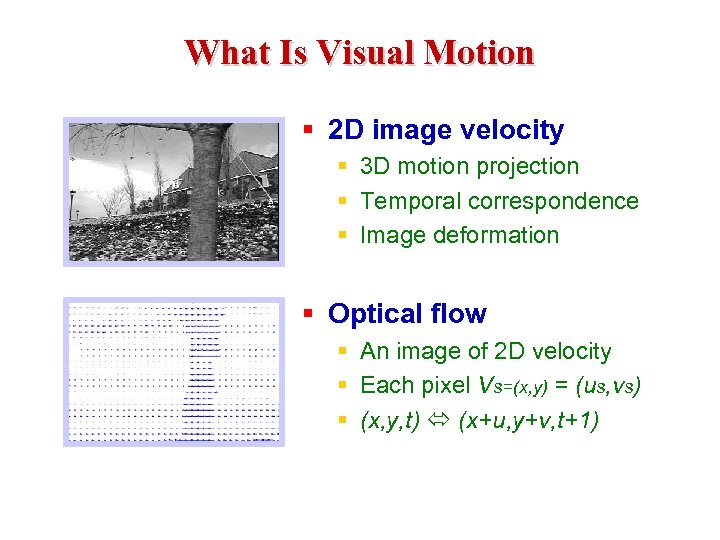
What Is Visual Motion § 2 D image velocity § 3 D motion projection § Temporal correspondence § Image deformation § Optical flow § An image of 2 D velocity § Each pixel Vs=(x, y) = (us, vs) § (x, y, t) (x+u, y+v, t+1)
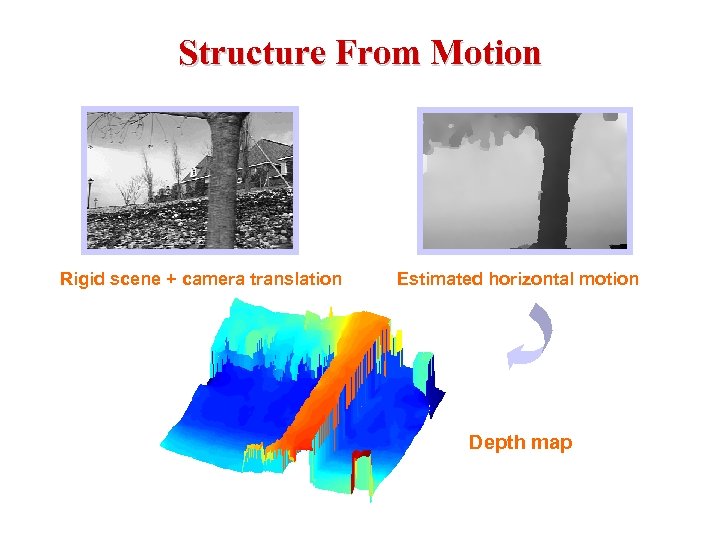
Structure From Motion Rigid scene + camera translation Estimated horizontal motion Depth map
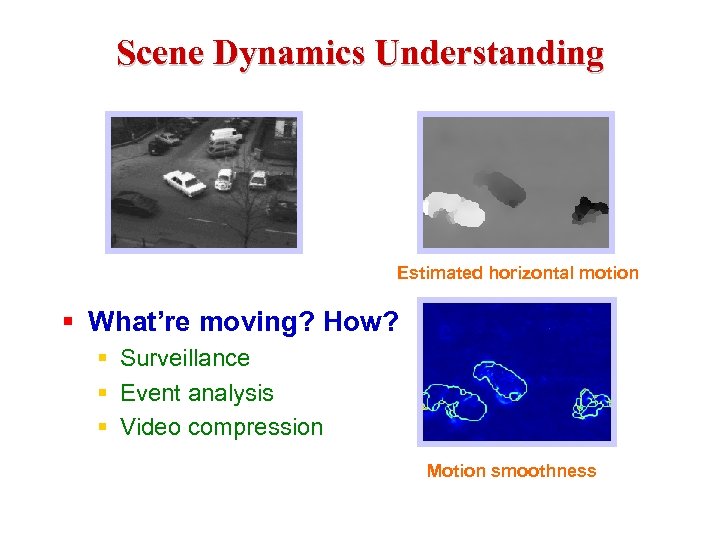
Scene Dynamics Understanding Estimated horizontal motion § What’re moving? How? § Surveillance § Event analysis § Video compression Motion smoothness
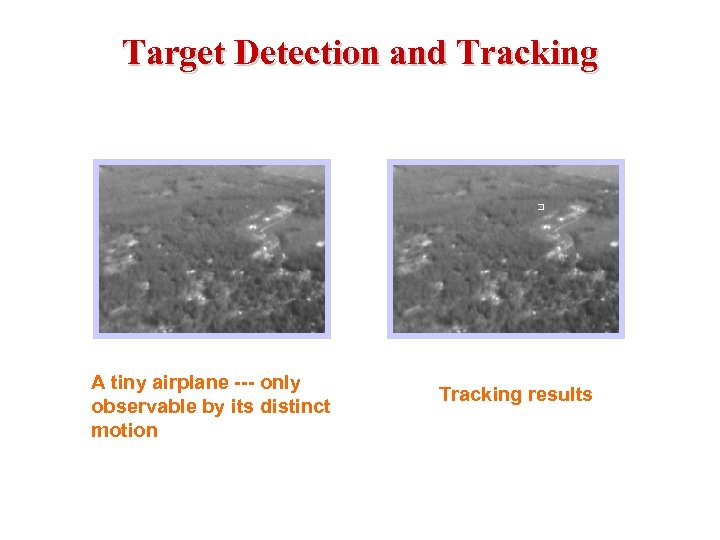
Target Detection and Tracking A tiny airplane --- only observable by its distinct motion Tracking results
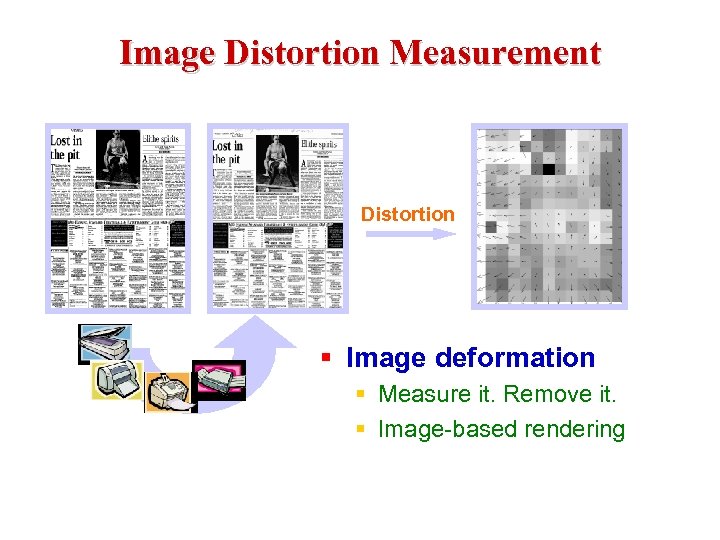
Image Distortion Measurement Distortion § Image deformation § Measure it. Remove it. § Image-based rendering
Research Areas § § § Structure from motion Scene dynamics analysis Object detection and tracking Video compression Image/video enhancement Image-based rendering § Visual motion estimation
Outline § Optical flow estimation § Background § A local method with error analysis § A Bayesian approach with global optimization § Motion-based detection and tracking
Optical Flow Estimation
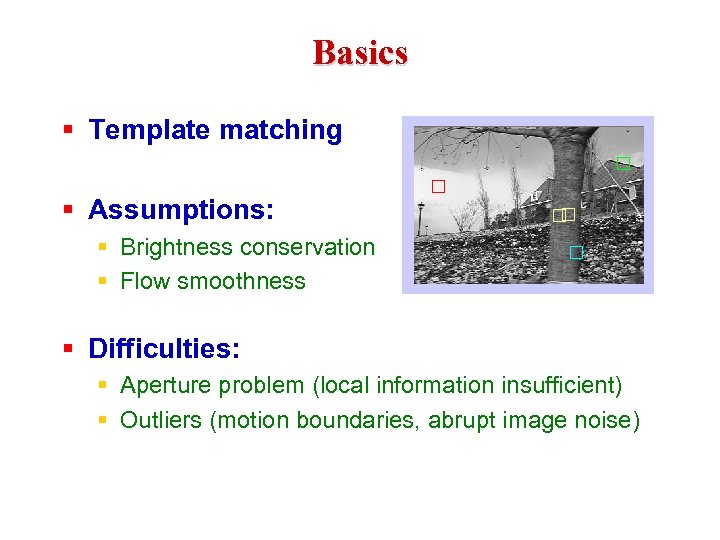
Basics § Template matching § Assumptions: § Brightness conservation § Flow smoothness § Difficulties: § Aperture problem (local information insufficient) § Outliers (motion boundaries, abrupt image noise)
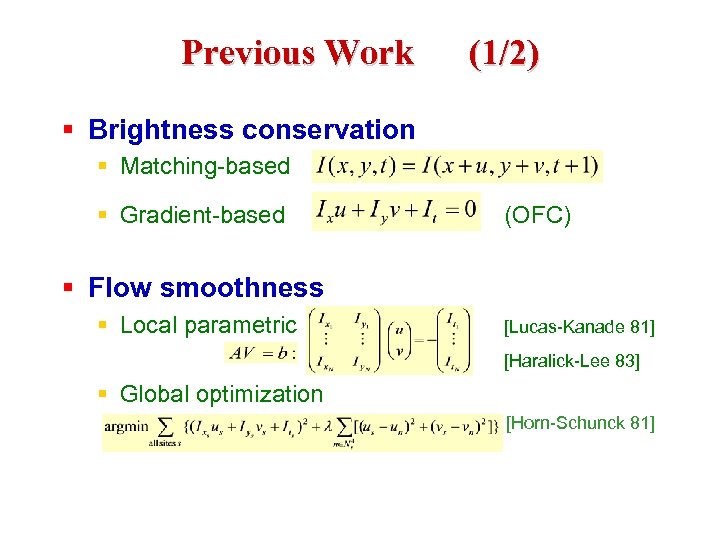
Previous Work (1/2) § Brightness conservation § Matching-based § Gradient-based (OFC) § Flow smoothness § Local parametric [Lucas-Kanade 81] [Haralick-Lee 83] § Global optimization – [Horn-Schunck 81]
![Previous Work (2/2) § Handle motion discontinuities & Outliers § Robust statistics [Black–Anandan 96]](https://present5.com/presentation/4219601d7d32badd2f1a5f46dd8507e7/image-12.jpg "Previous Work (2/2) § Handle motion discontinuities & Outliers § Robust statistics [Black–Anandan 96]")
Previous Work (2/2) § Handle motion discontinuities & Outliers § Robust statistics [Black–Anandan 96] § Many others § Higher-level methods § Problems: § Gradient calculation § Global formulation: § Computational complexity values?
Two-Stage Robust Optical Flow Estimation with Error Propagation A Local Approach
![Method § 2 -stage regression (LS) [Haralick-Lee 83, Ye-Haralick 98] image data Facet Model](https://present5.com/presentation/4219601d7d32badd2f1a5f46dd8507e7/image-14.jpg "Method § 2 -stage regression (LS) [Haralick-Lee 83, Ye-Haralick 98] image data Facet Model")
Method § 2 -stage regression (LS) [Haralick-Lee 83, Ye-Haralick 98] image data Facet Model derivatives OFC optical flow & covariance § Previous: robust OFC only § 2 -stage-robust adaptive scheme [ Ye-Haralick 00] Image data LS Facet Derivatives Robust OFC Optical flow & Confidence Robust Facet high confidence? Y N
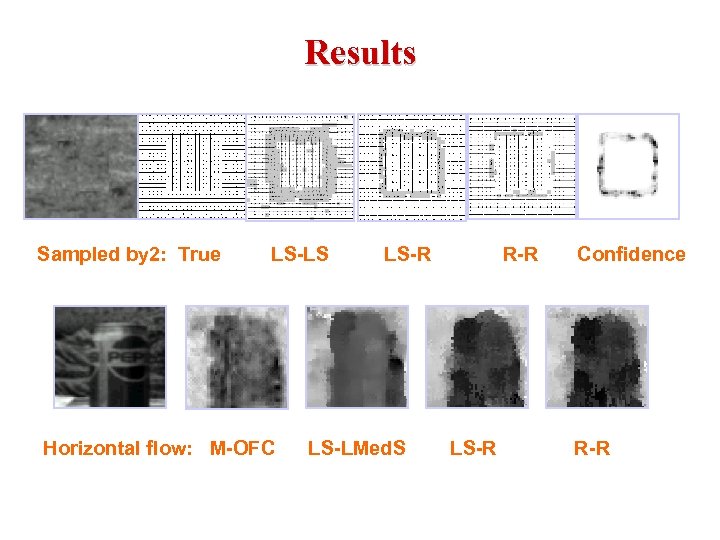
Results Sampled by 2: True LS-LS LS-R R-R Confidence Horizontal flow: M-OFC LS-LMed. S LS-R R-R
![Error Analysis § Covariance propagation [Haralick 96] § (Approx. ) linear system + small](https://present5.com/presentation/4219601d7d32badd2f1a5f46dd8507e7/image-16.jpg "Error Analysis § Covariance propagation [Haralick 96] § (Approx. ) linear system + small")
Error Analysis § Covariance propagation [Haralick 96] § (Approx. ) linear system + small errors image data Facet Model derivatives OFC optical flow & covariance § Previous work Image noise var. EIV Simoncelli 91 No No Szeliski 89 Yes No Nagel 94 No Yes Ye-Haralick 98 Yes § New: reject outliers first OFC corr. No No Yes
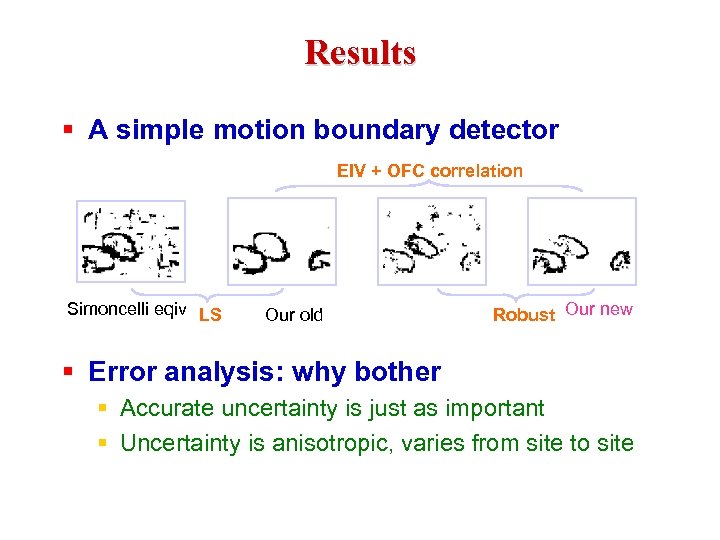
Results § A simple motion boundary detector EIV + OFC correlation Simoncelli eqiv LS Our old Robust Our new § Error analysis: why bother § Accurate uncertainty is just as important § Uncertainty is anisotropic, varies from site to site
Estimating Piecewise-Smooth Optical Flow with Global Matching and Graduated Optimization A Bayesian Approach
Problem Statement Assuming only brightness conservation and piecewise-smooth motion, find the optical flow to best describe the intensity change in three frames.
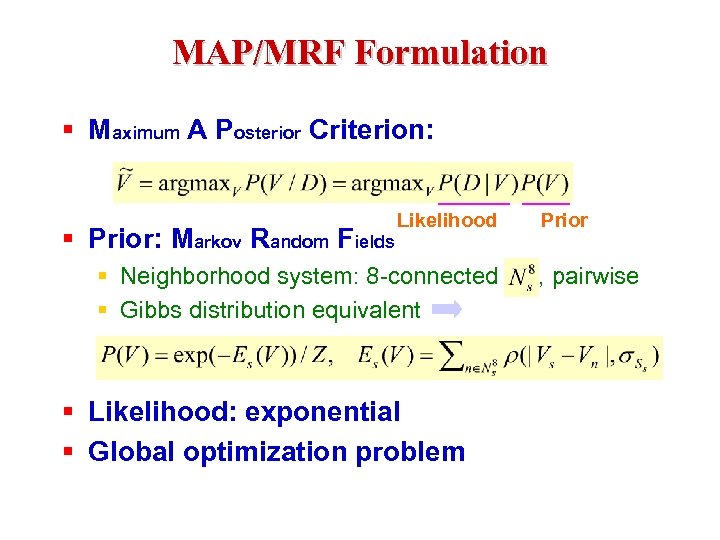
MAP/MRF Formulation § Maximum A Posterior Criterion: § Prior: Markov Random Fields Likelihood § Neighborhood system: 8 -connected § Gibbs distribution equivalent § Likelihood: exponential § Global optimization problem Prior , pairwise
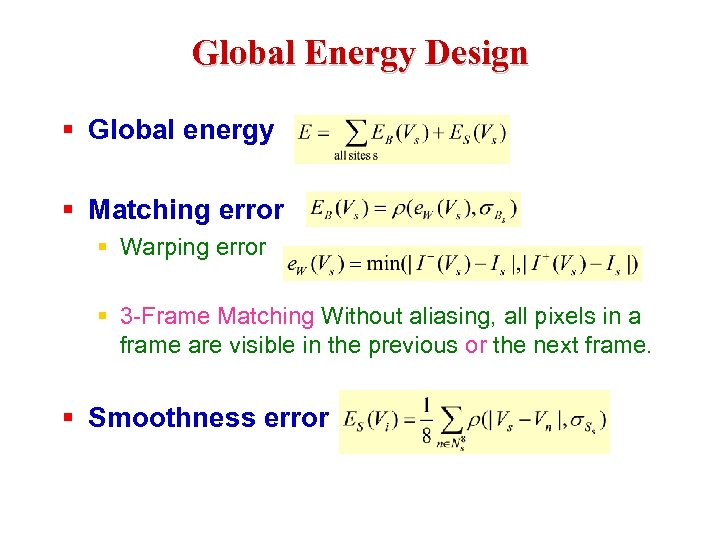
Global Energy Design § Global energy § Matching error § Warping error § 3 -Frame Matching Without aliasing, all pixels in a frame are visible in the previous or the next frame. § Smoothness error
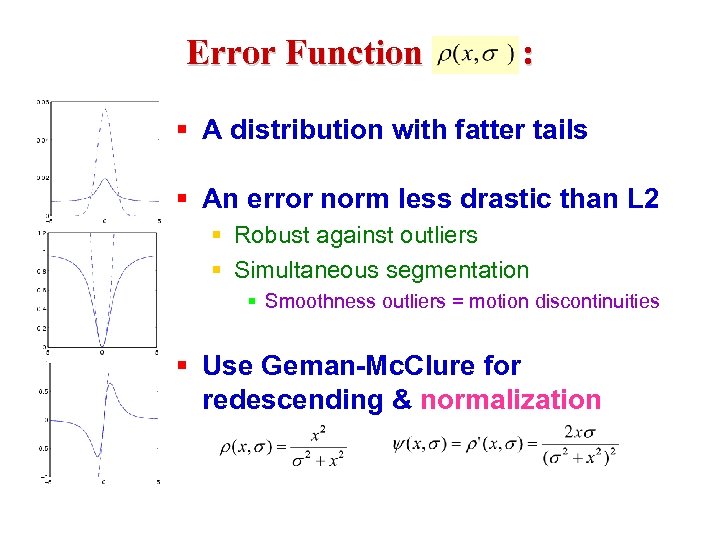
Error Function : § A distribution with fatter tails § An error norm less drastic than L 2 § Robust against outliers § Simultaneous segmentation § Smoothness outliers = motion discontinuities § Use Geman-Mc. Clure for redescending & normalization
![Advantages § Compare with [Black-Anandan 96] Proposed Brightness constr Matching-based Scales Contral para Black-Anandan](https://present5.com/presentation/4219601d7d32badd2f1a5f46dd8507e7/image-23.jpg "Advantages § Compare with [Black-Anandan 96] Proposed Brightness constr Matching-based Scales Contral para Black-Anandan")
Advantages § Compare with [Black-Anandan 96] Proposed Brightness constr Matching-based Scales Contral para Black-Anandan 96 Gradient-based Local adaptive Rigid+tuning Constant Tuning
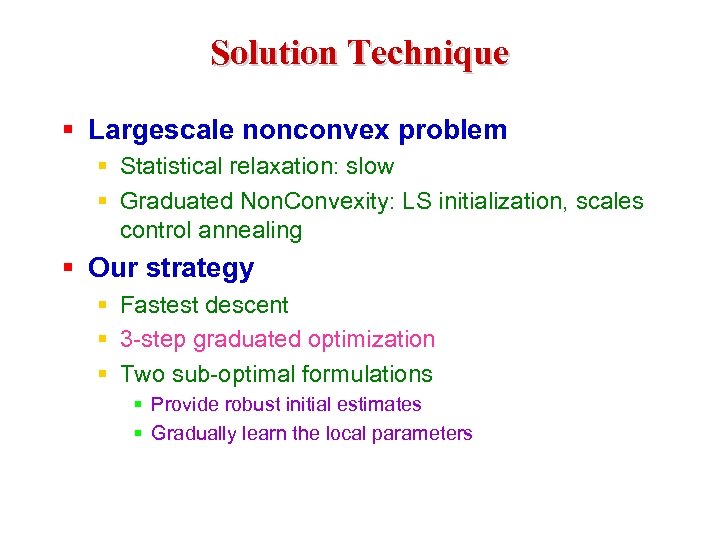
Solution Technique § Largescale nonconvex problem § Statistical relaxation: slow § Graduated Non. Convexity: LS initialization, scales control annealing § Our strategy § Fastest descent § 3 -step graduated optimization § Two sub-optimal formulations § Provide robust initial estimates § Gradually learn the local parameters
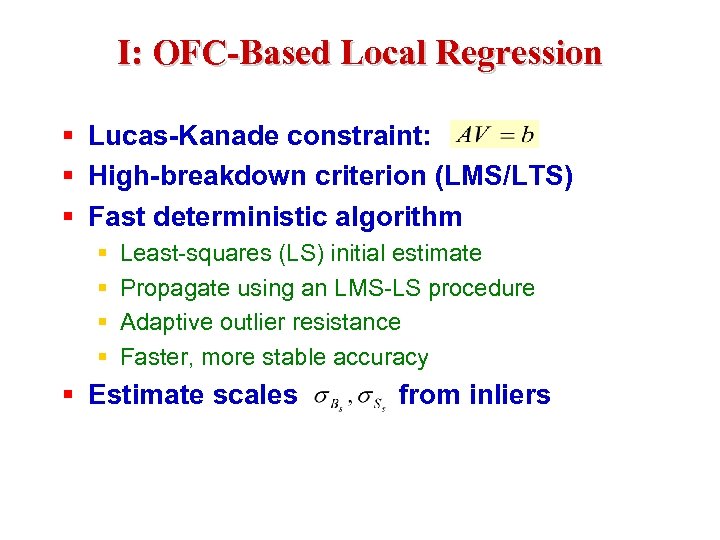
I: OFC-Based Local Regression § Lucas-Kanade constraint: § High-breakdown criterion (LMS/LTS) § Fast deterministic algorithm § § Least-squares (LS) initial estimate Propagate using an LMS-LS procedure Adaptive outlier resistance Faster, more stable accuracy § Estimate scales from inliers
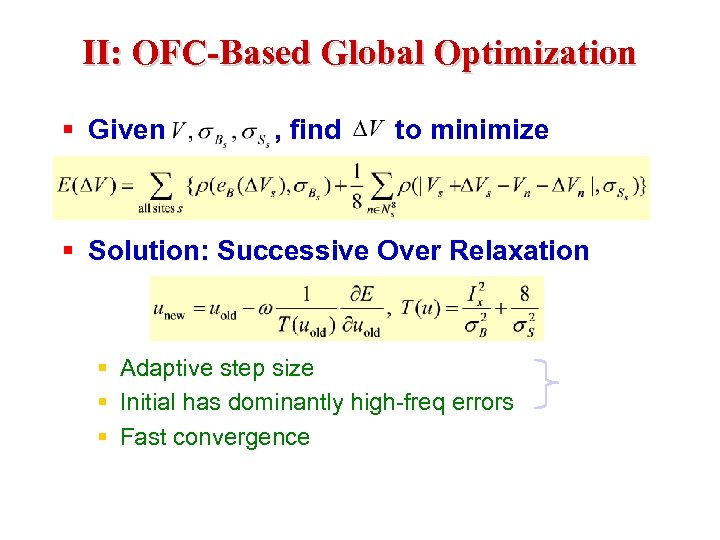
II: OFC-Based Global Optimization § Given , find to minimize § Solution: Successive Over Relaxation § Adaptive step size § Initial has dominantly high-freq errors § Fast convergence
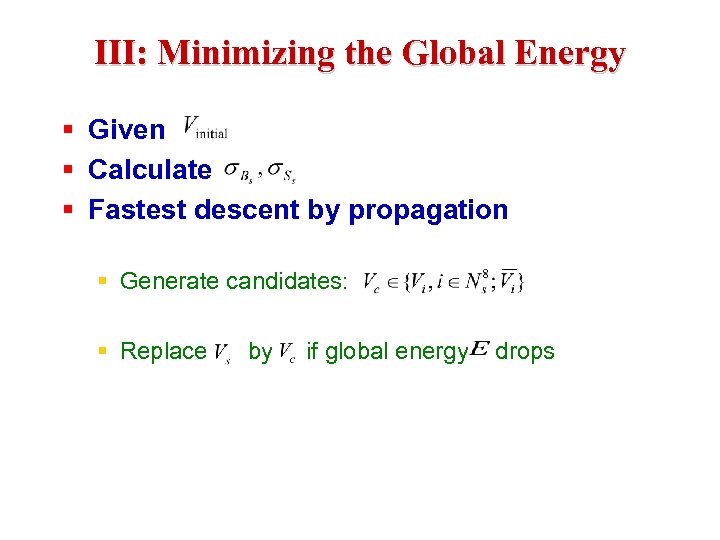
III: Minimizing the Global Energy § Given § Calculate § Fastest descent by propagation § Generate candidates: § Replace by if global energy drops
Hierarchical Process § Handle large motions (>2 pixels/frame) § Limitations: § Sub-sampling, warping and projection errors § May become the accuracy bottleneck § Step III directly works on the image data and is less sensitive to such errors
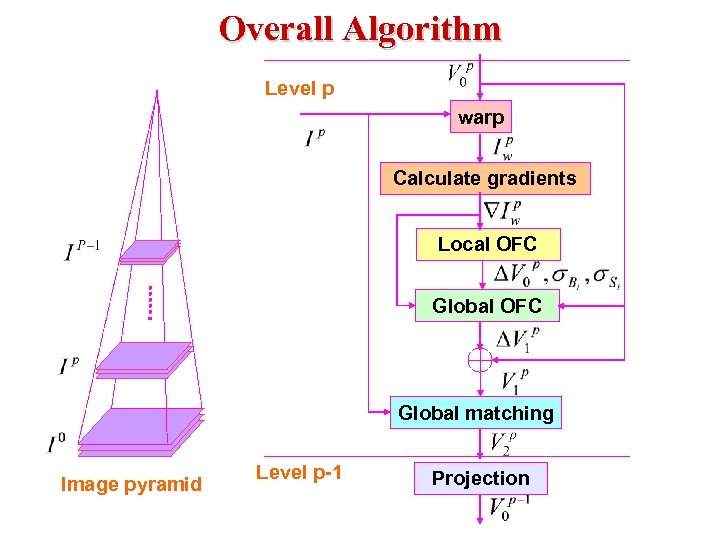
Overall Algorithm Level p warp Calculate gradients Local OFC Global matching Image pyramid Level p-1 Projection
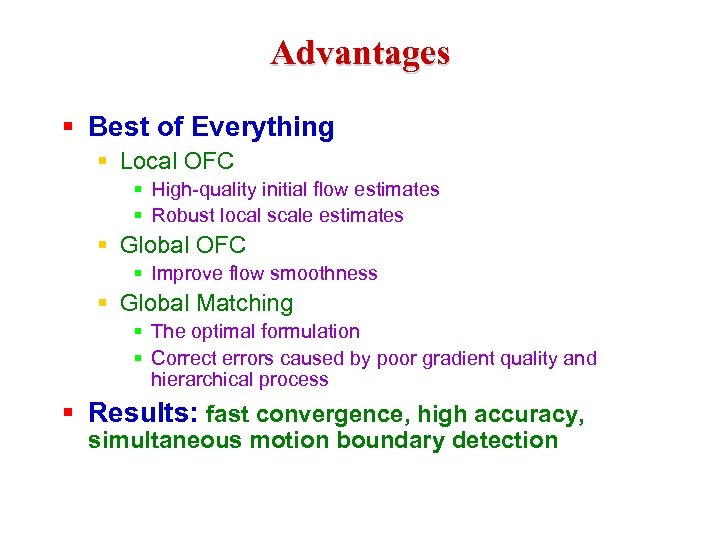
Advantages § Best of Everything § Local OFC § High-quality initial flow estimates § Robust local scale estimates § Global OFC § Improve flow smoothness § Global Matching § The optimal formulation § Correct errors caused by poor gradient quality and hierarchical process § Results: fast convergence, high accuracy, simultaneous motion boundary detection
Experiments
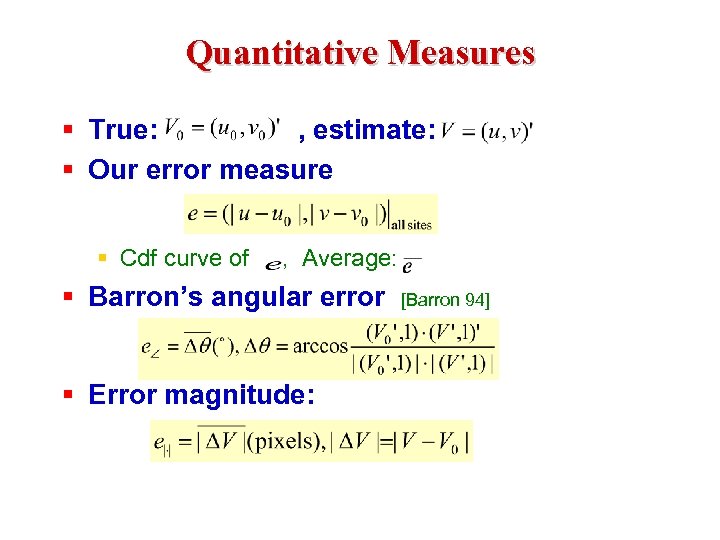
Quantitative Measures § True: , estimate: § Our error measure § Cdf curve of , Average: § Barron’s angular error [Barron 94] § Error magnitude:
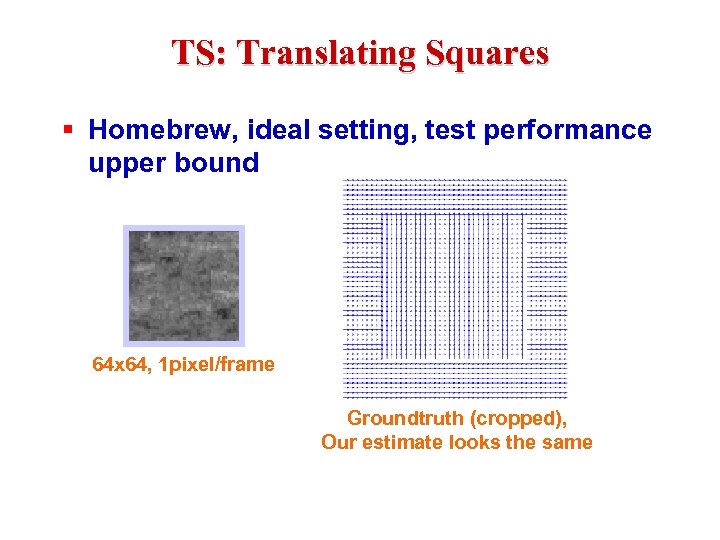
TS: Translating Squares § Homebrew, ideal setting, test performance upper bound 64 x 64, 1 pixel/frame Groundtruth (cropped), Our estimate looks the same
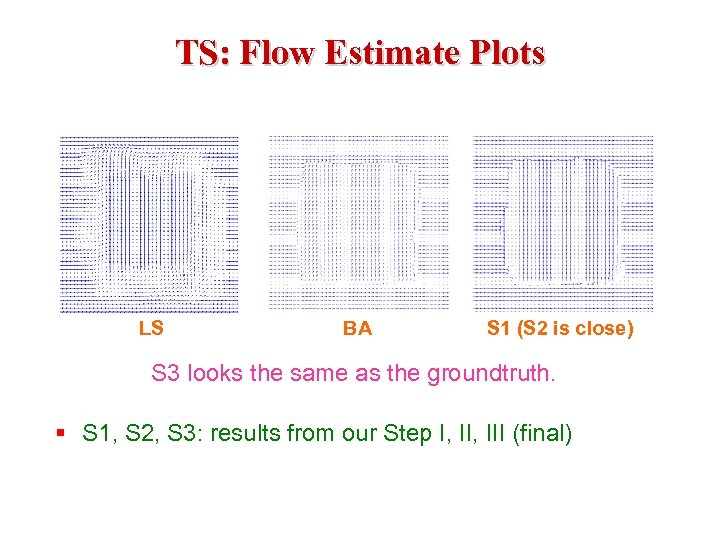
TS: Flow Estimate Plots LS BA S 1 (S 2 is close) S 3 looks the same as the groundtruth. § S 1, S 2, S 3: results from our Step I, III (final)
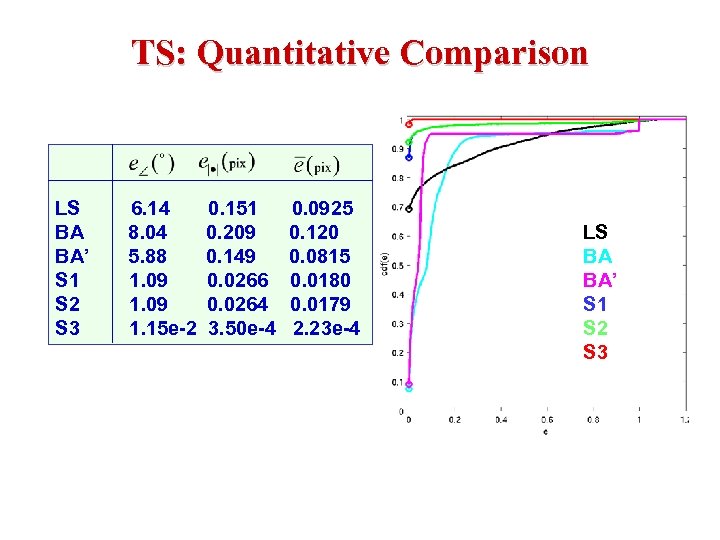
TS: Quantitative Comparison LS 6. 14 0. 151 0. 0925 BA 8. 04 0. 209 0. 120 BA’ 5. 88 0. 149 0. 0815 S 1 1. 09 0. 0266 0. 0180 S 2 1. 09 0. 0264 0. 0179 S 3 1. 15 e-2 3. 50 e-4 2. 23 e-4 LS BA BA’ S 1 S 2 S 3
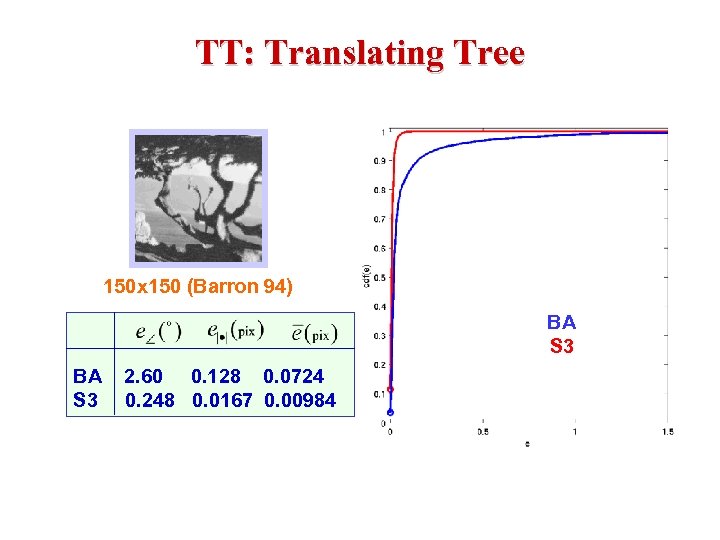
TT: Translating Tree 150 x 150 (Barron 94) BA 2. 60 0. 128 0. 0724 S 3 0. 248 0. 0167 0. 00984 BA S 3
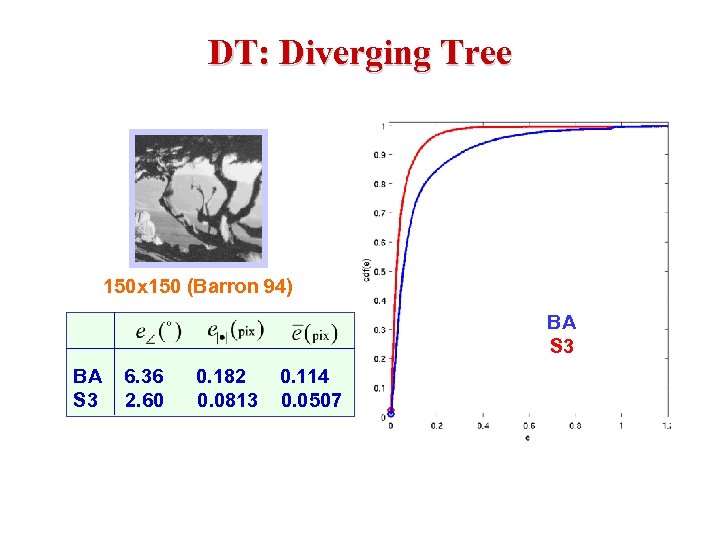
DT: Diverging Tree 150 x 150 (Barron 94) BA 6. 36 0. 182 0. 114 S 3 2. 60 0. 0813 0. 0507 BA S 3
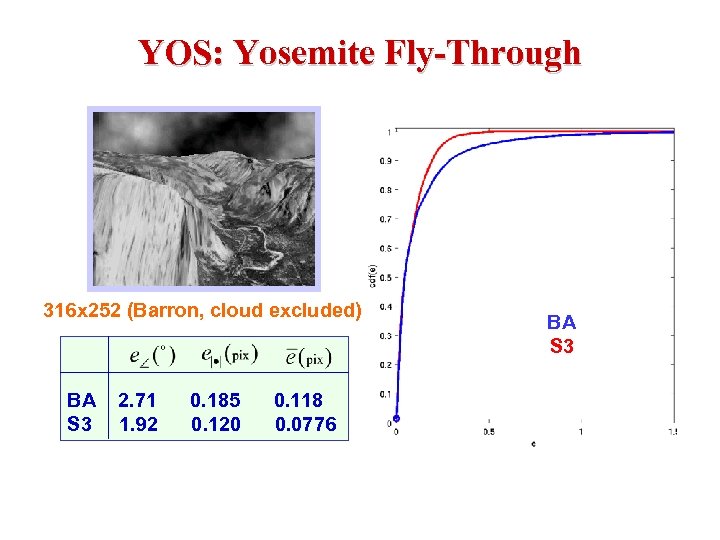
YOS: Yosemite Fly-Through 316 x 252 (Barron, cloud excluded) BA 2. 71 0. 185 0. 118 S 3 1. 92 0. 120 0. 0776 BA S 3
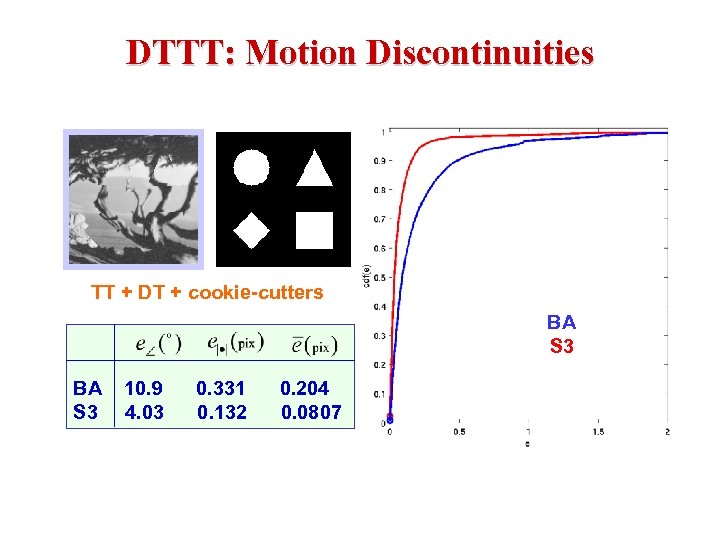
DTTT: Motion Discontinuities TT + DT + cookie-cutters BA 10. 9 0. 331 0. 204 S 3 4. 03 0. 132 0. 0807 BA S 3
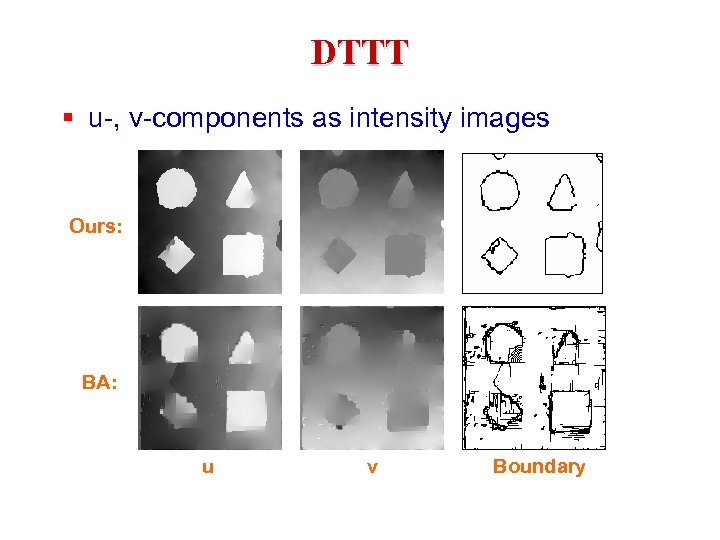
DTTT § u-, v-components as intensity images Ours: BA: u v Boundary
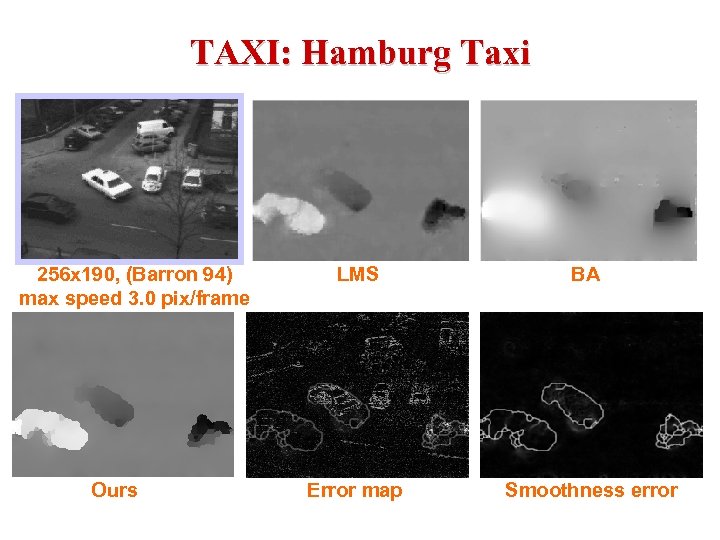
TAXI: Hamburg Taxi 256 x 190, (Barron 94) max speed 3. 0 pix/frame Ours LMS BA Error map Smoothness error
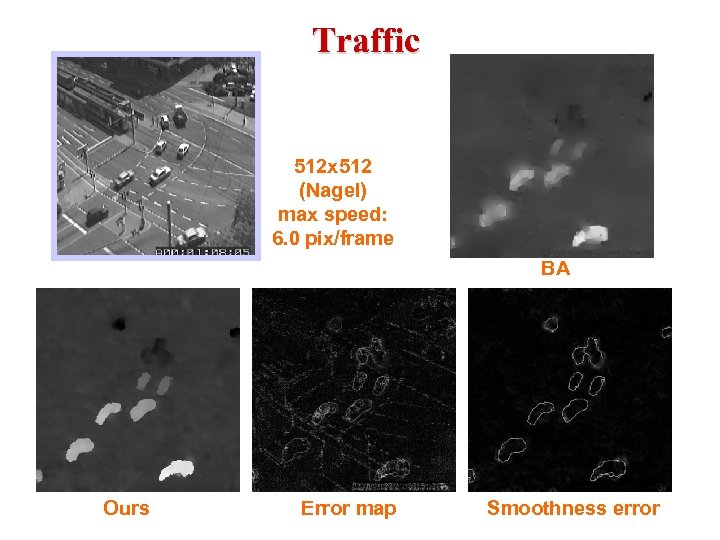
Traffic 512 x 512 (Nagel) max speed: 6. 0 pix/frame BA Ours Error map Smoothness error
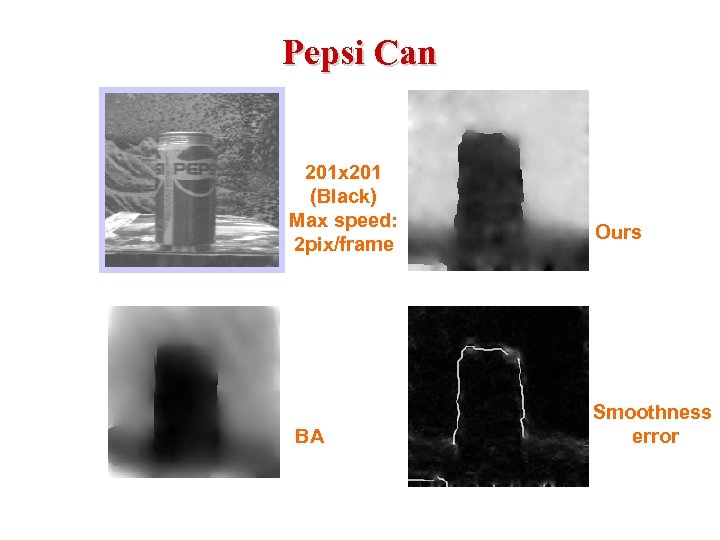
Pepsi Can 201 x 201 (Black) Max speed: 2 pix/frame BA Ours Smoothness error
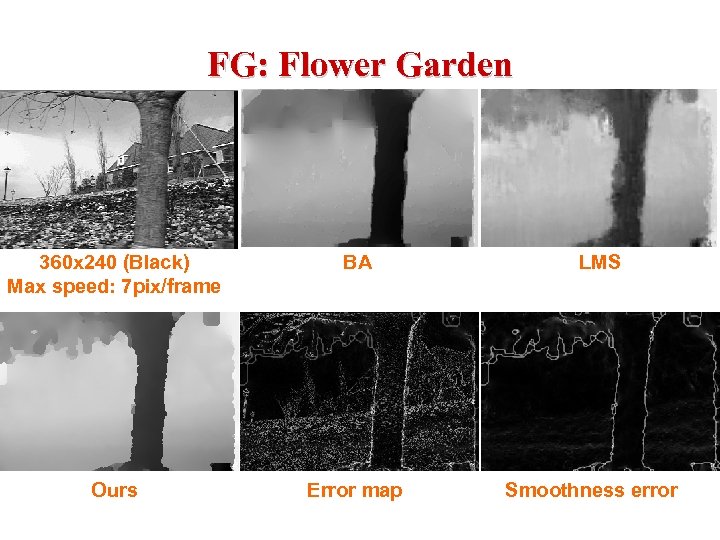
FG: Flower Garden 360 x 240 (Black) Max speed: 7 pix/frame BA Ours Error map LMS Smoothness error
Conclusion and Discussion
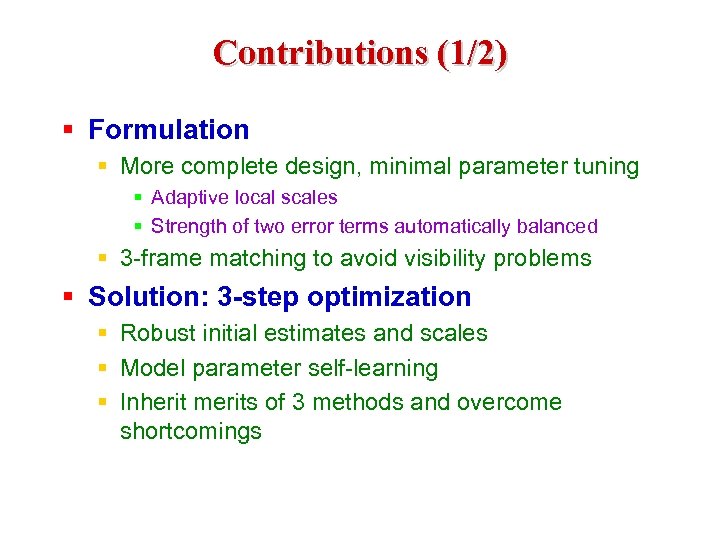
Contributions (1/2) § Formulation § More complete design, minimal parameter tuning § Adaptive local scales § Strength of two error terms automatically balanced § 3 -frame matching to avoid visibility problems § Solution: 3 -step optimization § Robust initial estimates and scales § Model parameter self-learning § Inherit merits of 3 methods and overcome shortcomings
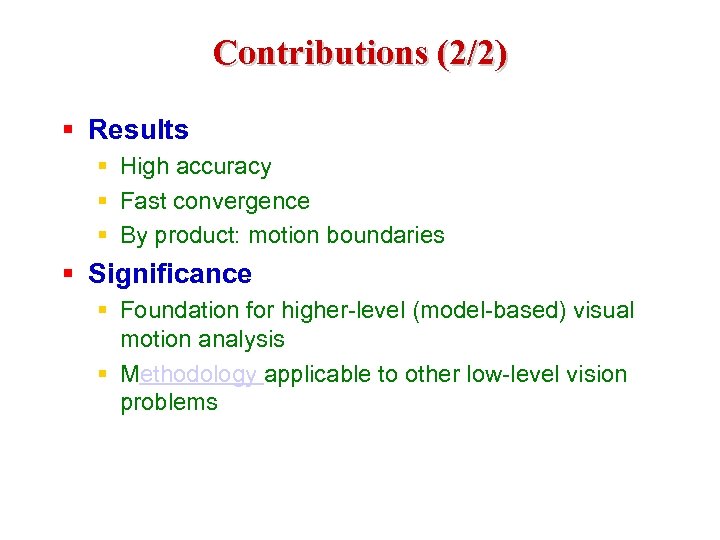
Contributions (2/2) § Results § High accuracy § Fast convergence § By product: motion boundaries § Significance § Foundation for higher-level (model-based) visual motion analysis § Methodology applicable to other low-level vision problems
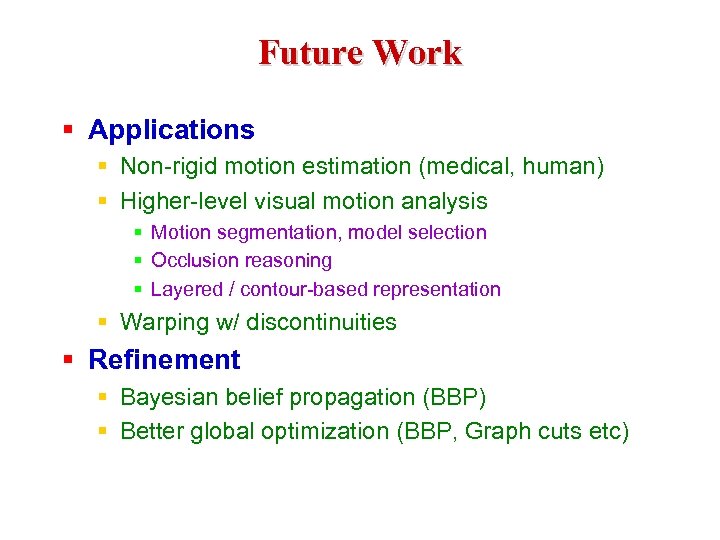
Future Work § Applications § Non-rigid motion estimation (medical, human) § Higher-level visual motion analysis § Motion segmentation, model selection § Occlusion reasoning § Layered / contour-based representation § Warping w/ discontinuities § Refinement § Bayesian belief propagation (BBP) § Better global optimization (BBP, Graph cuts etc)
A Motion-Based Bayesian Approach to Aerial Point-Target Detection and Tracking
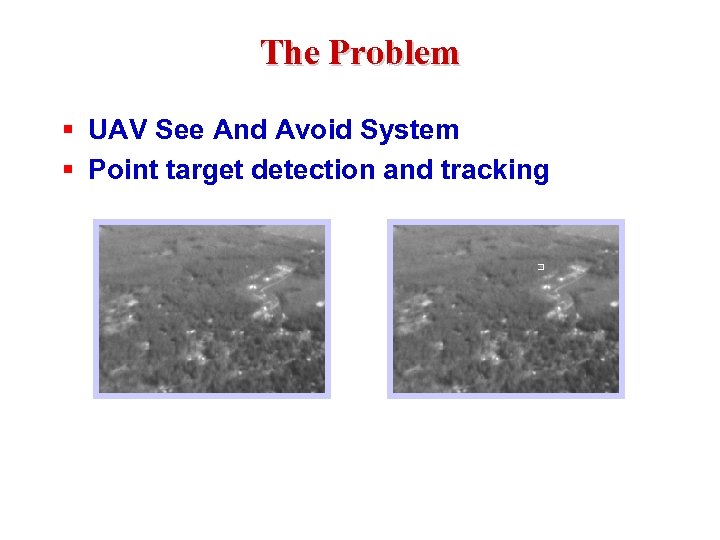
The Problem § UAV See And Avoid System § Point target detection and tracking
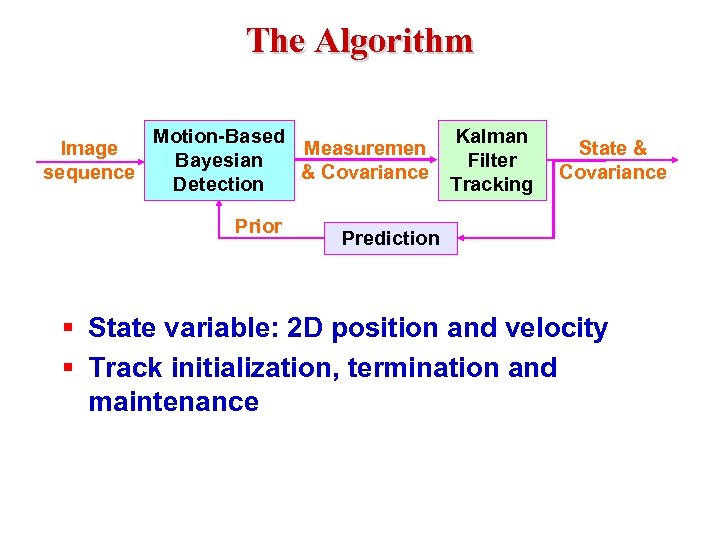
The Algorithm Image sequence Motion-Based Measuremen Bayesian & Covariance Detection Prior Kalman Filter Tracking State & Covariance Prediction § State variable: 2 D position and velocity § Track initialization, termination and maintenance
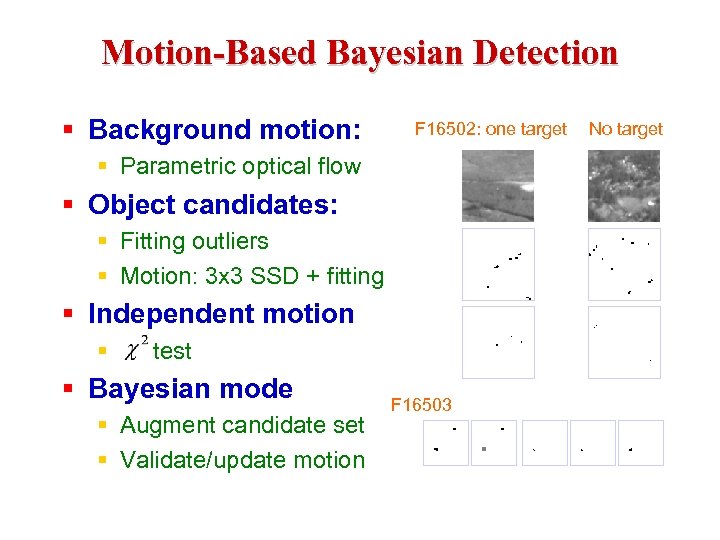
Motion-Based Bayesian Detection § Background motion: F 16502: one target § Parametric optical flow § Object candidates: § Fitting outliers § Motion: 3 x 3 SSD + fitting § Independent motion § test § Bayesian mode § Augment candidate set § Validate/update motion F 16503 No target
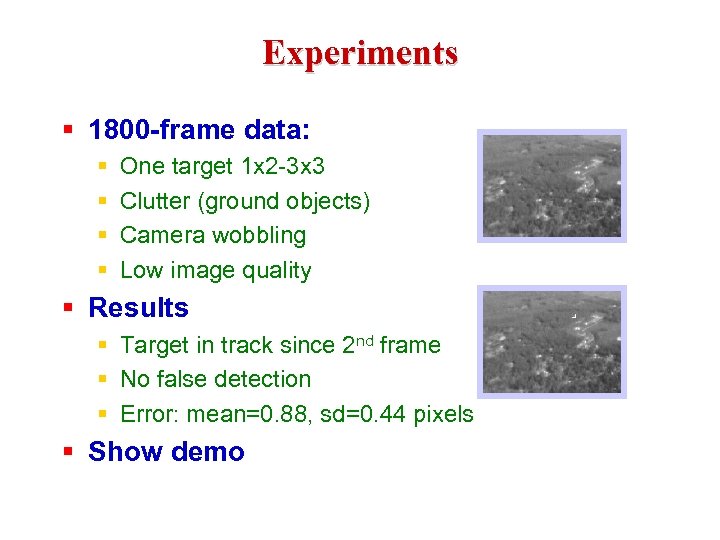
Experiments § 1800 -frame data: § § One target 1 x 2 -3 x 3 Clutter (ground objects) Camera wobbling Low image quality § Results § Target in track since 2 nd frame § No false detection § Error: mean=0. 88, sd=0. 44 pixels § Show demo
Publications Patent Pending § "Document Image Matching and Annotation Lifting", with Marshall Bern and David Goldberg, US Patent Application (filed by Xerox Corp. ), September 2001. Book Chapter § 1. Ming Ye and Robert M. Haralick, "Image Flow Estimation Using Facet Model and Covariance Propagation", Vision Interface : Real World Applications of Computer Vision (Machine Perception and Artificial Intelligence Book Series Vol. 35), (Ed. ) M. Cheriet and Y. H. Yang, World Scientific Pub Co. , pp. 209 -241, Jan. 2000. Submission/Preparation § § 2. Ming Ye, Robert M. Haralick and Linda G. Shapiro, '' Estimating Piecewise-Smooth Optical Flow with Global Matching and Graduated Optimization'', (submitted to) IEEE Trans. on Pattern Analysis and Machine Intelligence, Feb. 2002. 3. “A motion-based Bayesian approach to aerial point target detection and tracking'' (in preparation). Conference Papers § § § § 4. Ming Ye, Robert M. Haralick and Linda G. Shapiro, " Estimating Optical flow Using a Global Matching Formulation and Graduated Optimization ", (accepted to) I 6 th International Conference on Image Processing, 2002. 5. Ming Ye and Robert M. Haralick, "Local Gradient Global Matching Piecewise-Smooth Optical Flow ", IEEE Computer Society Conference on Computer Vision and Pattern Recognition, Vol. 2, pp. 712 -717, 2001. 6. Ming Ye, Marshall Bern and David Goldberg, " Document Image Matching and Annotation Lifting", Proc. International Conference on Document Analysis and Recognition, pp. 753 -760, 2001. 7. Ming Ye and Robert M. Haralick, "Two-Stage Robust Optical Flow Estimation", IEEE Computer Society Conference on Computer Vision and Pattern Recognition, Vol. 2, pp. 623 -8, 2000. 8. Ming Ye and Robert M. Haralick, "Optical Flow From A Least-Trimmed Squares Based Adaptive Approach", Proc. 15 th International Conference on Pattern Recognition, Vol. 3, pp. 1052 -1055, 2000. 9. S. Aksoy, M. Ye, M. Schauf, M. Song, Y. Wang, R. M. Haralick, J. R. Parker, J. Pivovarov, D. Royko, S. Sun and S. Farneback, "Algorithm Performance Contest", Proc. 15 th International Conference on Pattern Recognition, Vol. 4, pp. 870 -876, 2000. ICPR'00 10. Ming Ye and Robert M. Haralick, "Image Flow Estimation Using Facet Model and Covariance Propagation", Proc. Vision Interface'98, pp. 51 -58, 1998.
Скачать презентацию Robust Visual Motion Analysis Piecewise-Smooth Optical Flow and
4219601d7d32badd2f1a5f46dd8507e7.ppt