 Скачать презентацию Robust Network Design with Exponential Scenarios By Rohit
2c4c6873f2531b56aa4e322a0bc17225.ppt
- Количество слайдов: 19



Robust Network Design with Exponential Scenarios By: Rohit Khandekar Guy Kortsarz Vahab Mirrokni Mohammad Salavatipour
Outline n n n Robust vs. Stochastic Optimization Robust Two-stage Network Design Problems Related Work: Stochastic vs. Robust Our Results Algorithm for Robust Steiner Tree Conclusion
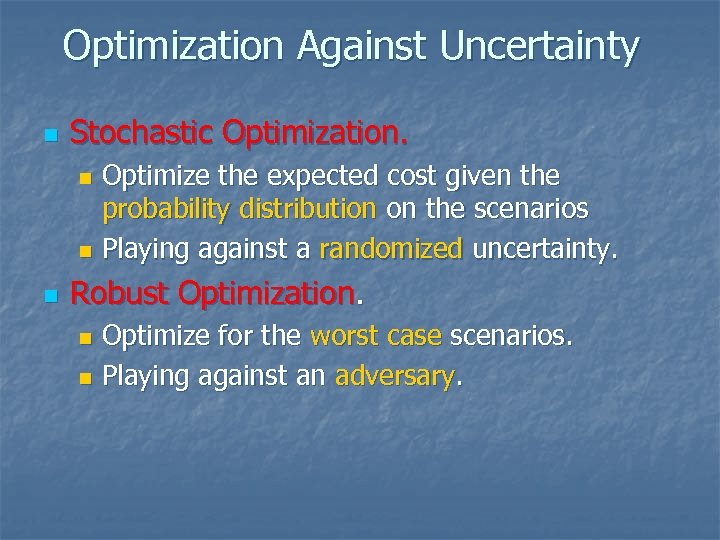
Optimization Against Uncertainty n Stochastic Optimization. Optimize the expected cost given the probability distribution on the scenarios n Playing against a randomized uncertainty. n n Robust Optimization. Optimize for the worst case scenarios. n Playing against an adversary. n
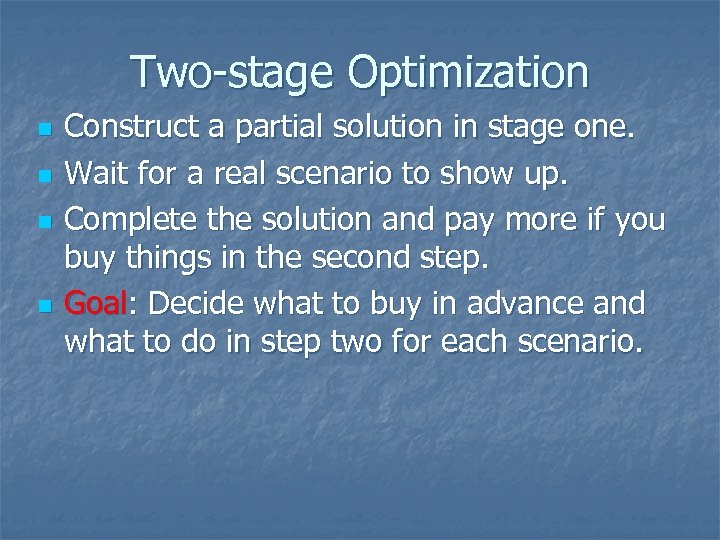
Two-stage Optimization n n Construct a partial solution in stage one. Wait for a real scenario to show up. Complete the solution and pay more if you buy things in the second step. Goal: Decide what to buy in advance and what to do in step two for each scenario.
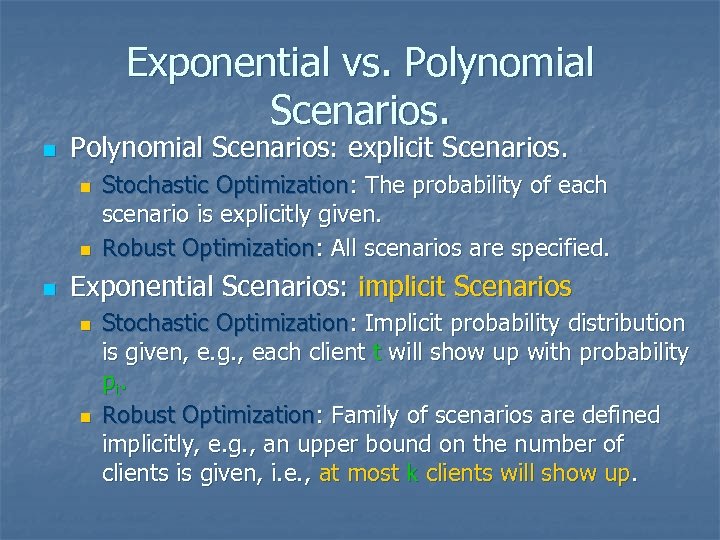
Exponential vs. Polynomial Scenarios. n Polynomial Scenarios: explicit Scenarios. n n n Stochastic Optimization: The probability of each scenario is explicitly given. Robust Optimization: All scenarios are specified. Exponential Scenarios: implicit Scenarios n n Stochastic Optimization: Implicit probability distribution is given, e. g. , each client t will show up with probability p t. Robust Optimization: Family of scenarios are defined implicitly, e. g. , an upper bound on the number of clients is given, i. e. , at most k clients will show up.
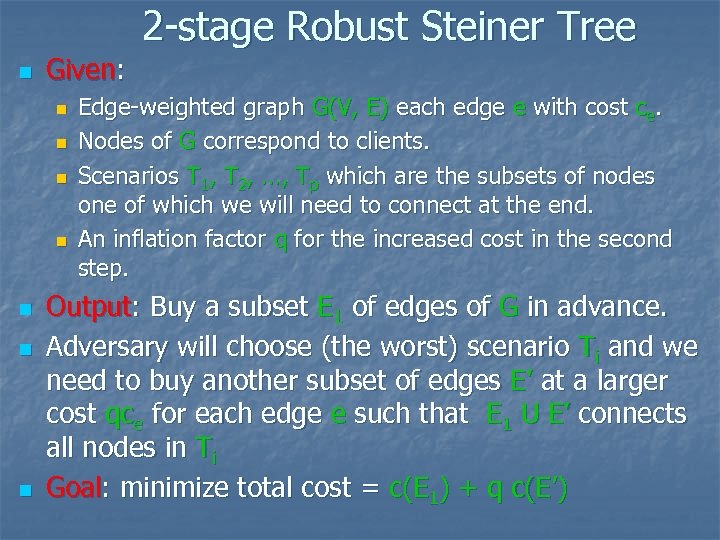
2 -stage Robust Steiner Tree n Given: n n n n Edge-weighted graph G(V, E) each edge e with cost ce. Nodes of G correspond to clients. Scenarios T 1, T 2, …, Tp which are the subsets of nodes one of which we will need to connect at the end. An inflation factor q for the increased cost in the second step. Output: Buy a subset E 1 of edges of G in advance. Adversary will choose (the worst) scenario Ti and we need to buy another subset of edges E’ at a larger cost qce for each edge e such that E 1 U E’ connects all nodes in Ti Goal: minimize total cost = c(E 1) + q c(E’)
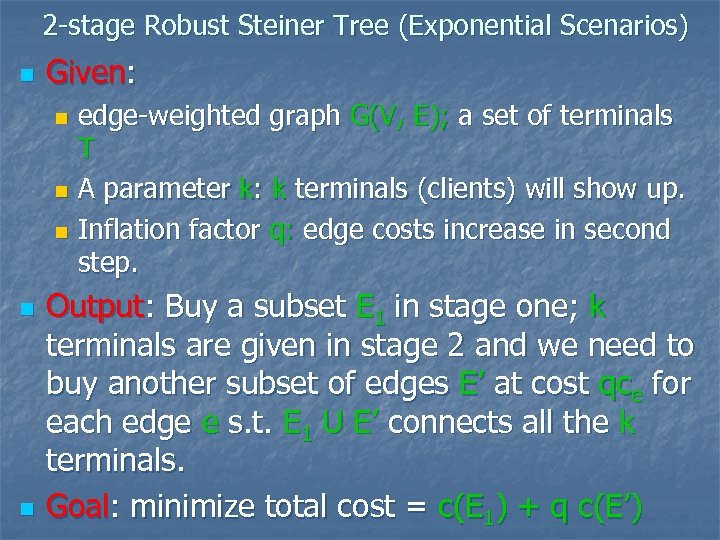
2 -stage Robust Steiner Tree (Exponential Scenarios) n Given: edge-weighted graph G(V, E); a set of terminals T n A parameter k: k terminals (clients) will show up. n Inflation factor q: edge costs increase in second step. n n n Output: Buy a subset E 1 in stage one; k terminals are given in stage 2 and we need to buy another subset of edges E’ at cost qce for each edge e s. t. E 1 U E’ connects all the k terminals. Goal: minimize total cost = c(E 1) + q c(E’)
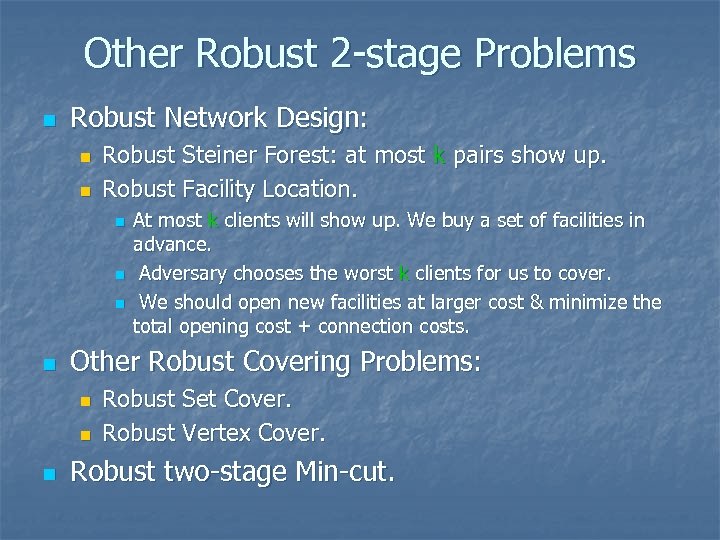
Other Robust 2 -stage Problems n Robust Network Design: n n Robust Steiner Forest: at most k pairs show up. Robust Facility Location. n n Other Robust Covering Problems: n n n At most k clients will show up. We buy a set of facilities in advance. Adversary chooses the worst k clients for us to cover. We should open new facilities at larger cost & minimize the total opening cost + connection costs. Robust Set Cover. Robust Vertex Cover. Robust two-stage Min-cut.
Robust Min Cut Problem n Robust 2 -stage Min-cut: n Given: n n n An edge-weighted graph G(V, E) each edge e with cost c_e. Pairs of nodes of G correspond to clients. An inflation factor q for the increased cost in the second step. Output: Buy a subset E_1 of edges of G in advance. Adversary will choose (the worst) pair (s_i, t_i) and we need to buy another subset of edges E’ at a larger cost qc_e for each edge e such that E_1 U E’ disconnects s_i and t_i. Goal: Choose a subset E_1 with the minimum total cost (Total Cost = cost of E_1 + q times cost of E’).
Outline n n n Robust vs. Stochastic Optimization Robust Two-stage Network Design Problems Related Work: Stochastic vs. Robust Our Results Algorithm for Robust Steiner Tree Conclusion
Related Work n Stochastic Two-stage Optimization: n n n Dye, Stougie, and Tomasgard: Two-stage matching problems Considered by Immorlica, Karger, Minkoff, and Mirrokni [IKMM] (SODA 03) and Ravi and Sinha (IPCO 03) (Two-stage covering problems). IKMM considered the exponential scenarios: each client shows up with probability p. Improved by Gupta, Pal, Ravi, and Sinha (STOC 03) using Boosted Sampling: constant-factor approximation for Steiner tree. Also later considered the black box model. Swamy and Shmoys (FOCS 04): O(log n)-approximation algorithm for two-stage stochastic set cover via solving an exponential linear program. Multi-stage Optimization: n Swamy and Shmoys (FOCS 05): sample average approximation.
Related Work Robust Two-stage Optimization: n Initiated by Ben-Tal, Gorashko, Guslitzer, and Nemirovski. n Polynomial Number of Scenarios: n Introduced by Dhamhere, Goyal, Ravi, and Singh (FOCS 05): Facility Location & Steiner Tree n Constant-factor approximation algorithms n Improved by Golovin, Goyal, and Ravi (STACS 06): Min Cut. n Constant-factor approximation algorithm for Min-cut (Is it NP-Hard? )
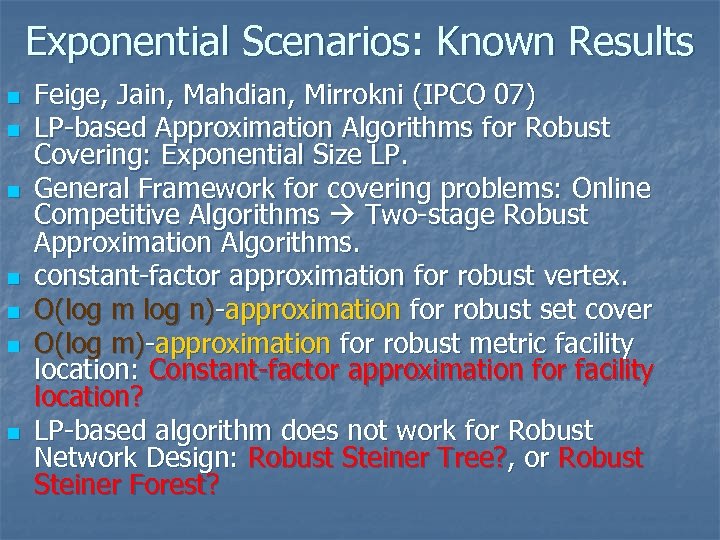
Exponential Scenarios: Known Results n n n n Feige, Jain, Mahdian, Mirrokni (IPCO 07) LP-based Approximation Algorithms for Robust Covering: Exponential Size LP. General Framework for covering problems: Online Competitive Algorithms Two-stage Robust Approximation Algorithms. constant-factor approximation for robust vertex. O(log m log n)-approximation for robust set cover O(log m)-approximation for robust metric facility location: Constant-factor approximation for facility location? LP-based algorithm does not work for Robust Network Design: Robust Steiner Tree? , or Robust Steiner Forest?
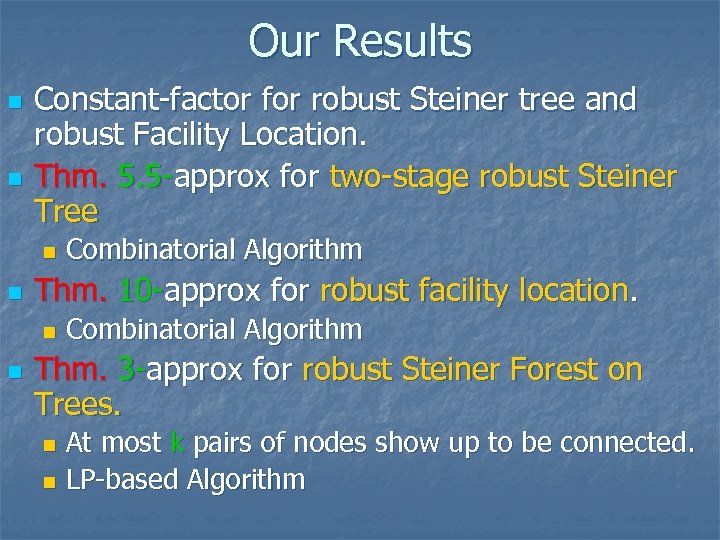
Our Results n n Constant-factor for robust Steiner tree and robust Facility Location. Thm. 5. 5 -approx for two-stage robust Steiner Tree n n Thm. 10 -approx for robust facility location. n n Combinatorial Algorithm Thm. 3 -approx for robust Steiner Forest on Trees. At most k pairs of nodes show up to be connected. n LP-based Algorithm n
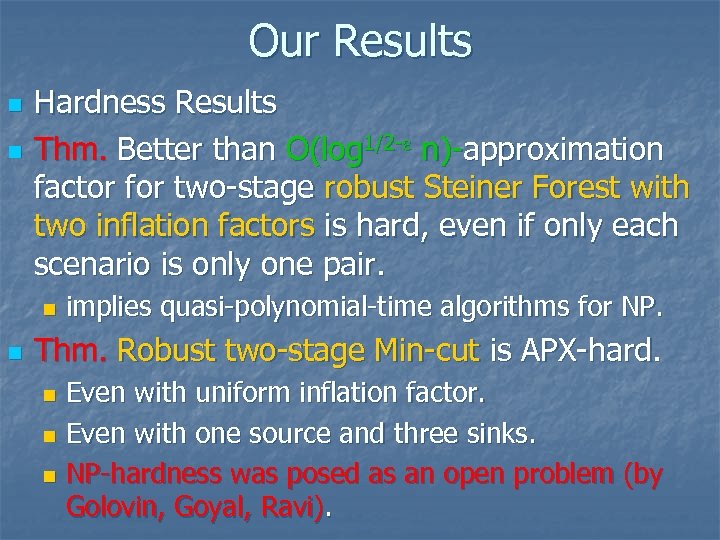
Our Results n n Hardness Results Thm. Better than O(log 1/2 - n)-approximation factor for two-stage robust Steiner Forest with two inflation factors is hard, even if only each scenario is only one pair. n n implies quasi-polynomial-time algorithms for NP. Thm. Robust two-stage Min-cut is APX-hard. Even with uniform inflation factor. n Even with one source and three sinks. n NP-hardness was posed as an open problem (by Golovin, Goyal, Ravi). n
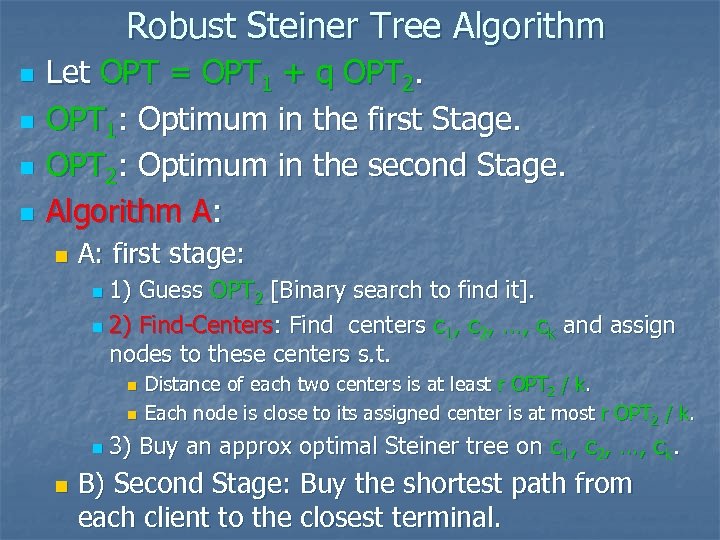
Robust Steiner Tree Algorithm n n Let OPT = OPT 1 + q OPT 2. OPT 1: Optimum in the first Stage. OPT 2: Optimum in the second Stage. Algorithm A: n A: first stage: 1) Guess OPT 2 [Binary search to find it]. n 2) Find-Centers: Find centers c 1, c 2, …, ck and assign nodes to these centers s. t. n n n Distance of each two centers is at least r OPT 2 / k. Each node is close to its assigned center is at most r OPT 2 / k. 3) Buy an approx optimal Steiner tree on c 1, c 2, …, ck. B) Second Stage: Buy the shortest path from each client to the closest terminal.
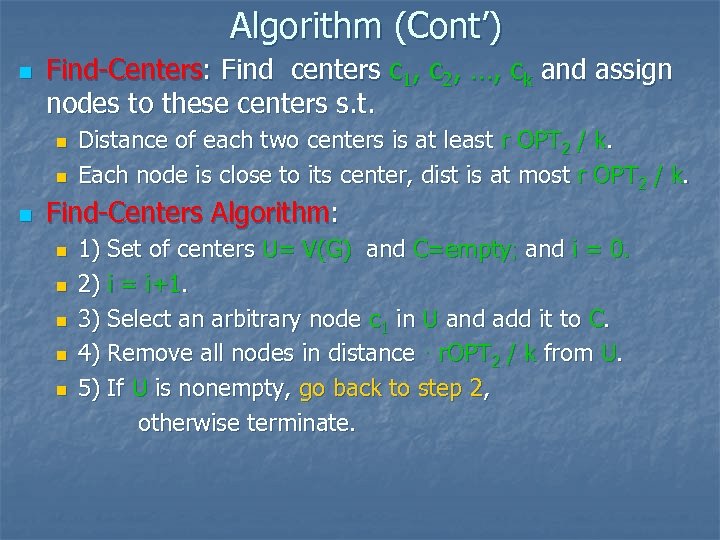
Algorithm (Cont’) n Find-Centers: Find centers c 1, c 2, …, ck and assign nodes to these centers s. t. n n n Distance of each two centers is at least r OPT 2 / k. Each node is close to its center, dist is at most r OPT 2 / k. Find-Centers Algorithm: n n n 1) Set of centers U= V(G) and C=empty; and i = 0. 2) i = i+1. 3) Select an arbitrary node c 1 in U and add it to C. 4) Remove all nodes in distance · r. OPT 2 / k from U. 5) If U is nonempty, go back to step 2, otherwise terminate.
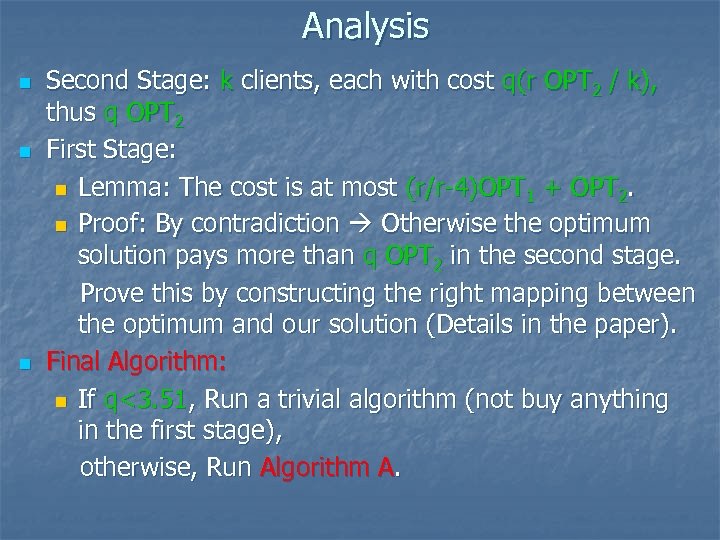
Analysis n n n Second Stage: k clients, each with cost q(r OPT 2 / k), thus q OPT 2 First Stage: n Lemma: The cost is at most (r/r-4)OPT 1 + OPT 2. n Proof: By contradiction Otherwise the optimum solution pays more than q OPT 2 in the second stage. Prove this by constructing the right mapping between the optimum and our solution (Details in the paper). Final Algorithm: n If q<3. 51, Run a trivial algorithm (not buy anything in the first stage), otherwise, Run Algorithm A.
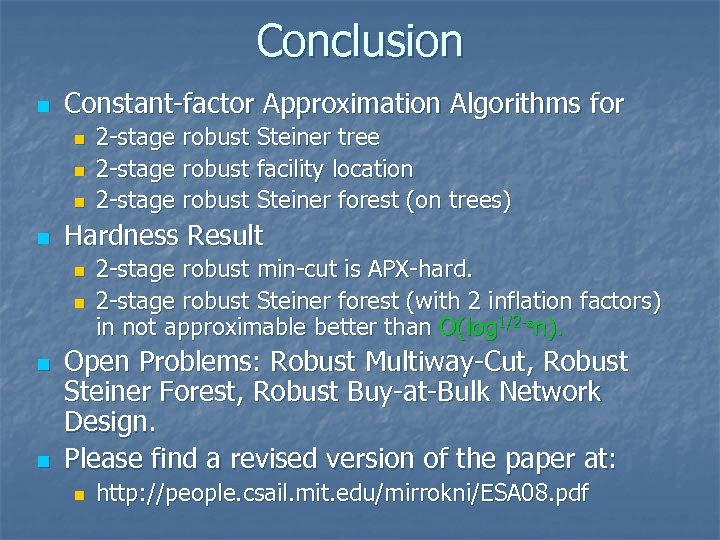
Conclusion n Constant-factor Approximation Algorithms for n n Hardness Result n n 2 -stage robust Steiner tree 2 -stage robust facility location 2 -stage robust Steiner forest (on trees) 2 -stage robust min-cut is APX-hard. 2 -stage robust Steiner forest (with 2 inflation factors) in not approximable better than O(log 1/2 - n). Open Problems: Robust Multiway-Cut, Robust Steiner Forest, Robust Buy-at-Bulk Network Design. Please find a revised version of the paper at: n http: //people. csail. mit. edu/mirrokni/ESA 08. pdf
Скачать презентацию Robust Network Design with Exponential Scenarios By Rohit
2c4c6873f2531b56aa4e322a0bc17225.ppt