 Скачать презентацию Robert Kirkpatrick GIVAS Project Manager Executive Office of
2d5bb39b5c546ab37e3934b8f72f4fa2.ppt
- Количество слайдов: 21



Robert Kirkpatrick GIVAS Project Manager Executive Office of the Secretary-General United Nations Headquarters New York
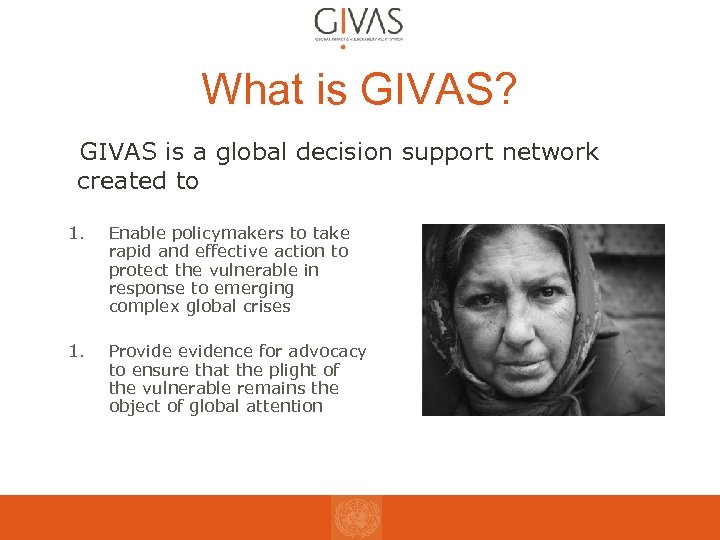
What is GIVAS? GIVAS is a global decision support network created to 1. Enable policymakers to take rapid and effective action to protect the vulnerable in response to emerging complex global crises 1. Provide evidence for advocacy to ensure that the plight of the vulnerable remains the object of global attention
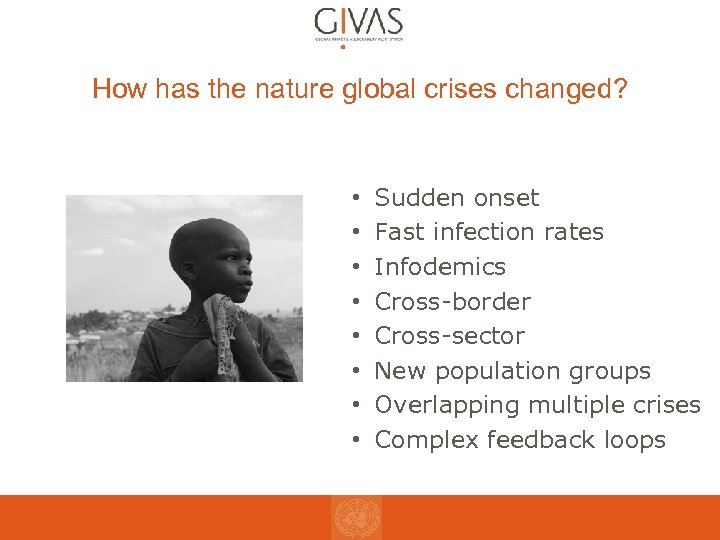
How has the nature global crises changed? • • Sudden onset Fast infection rates Infodemics Cross-border Cross-sector New population groups Overlapping multiple crises Complex feedback loops
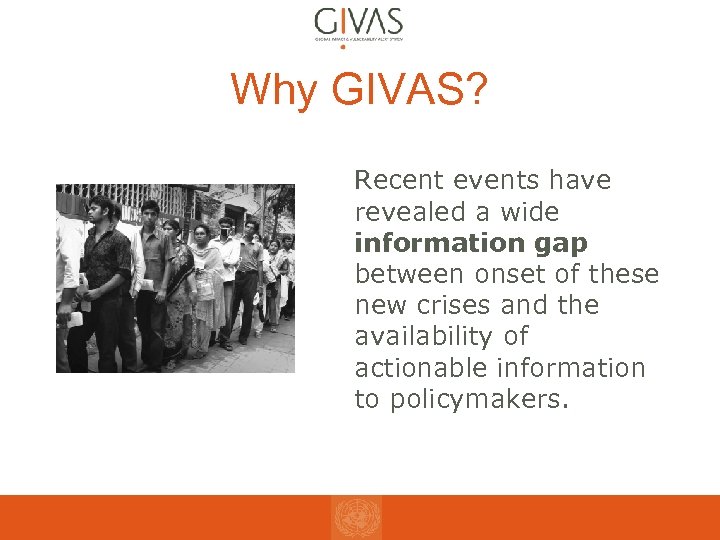
Why GIVAS? Recent events have revealed a wide information gap between onset of these new crises and the availability of actionable information to policymakers.
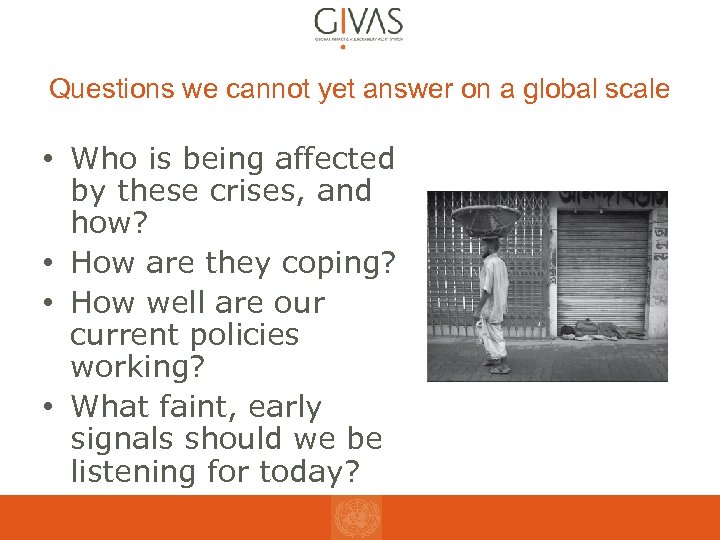
Questions we cannot yet answer on a global scale • Who is being affected by these crises, and how? • How are they coping? • How well are our current policies working? • What faint, early signals should we be listening for today?
Why GIVAS now? • • • Data is back, data is sexy Mobile phone revolution New tools for • • • Data collection Data fusion Filtering Analysis Mapping Visualization Alerting Collaboration New ways to combine human and machine intelligence New approaches to harnessing the power of collective action. Emerging global culture of sustainable grassroots technology innovation
What value will GIVAS add? • Quick-time and real-time actionable information • Cross-sectoral focus • Collaboration across disciplines, regions, and organizations • Integrate, enhance, and filter information already available • Hub for Southern Innovation
What is GIVAS not? • Another data collection technology • A global crisis early warning or forecasting system • Another top-down global indicator initiative • A tool to rank countries on some kind of vulnerability index • Yet another “one-stop-shop” web portal
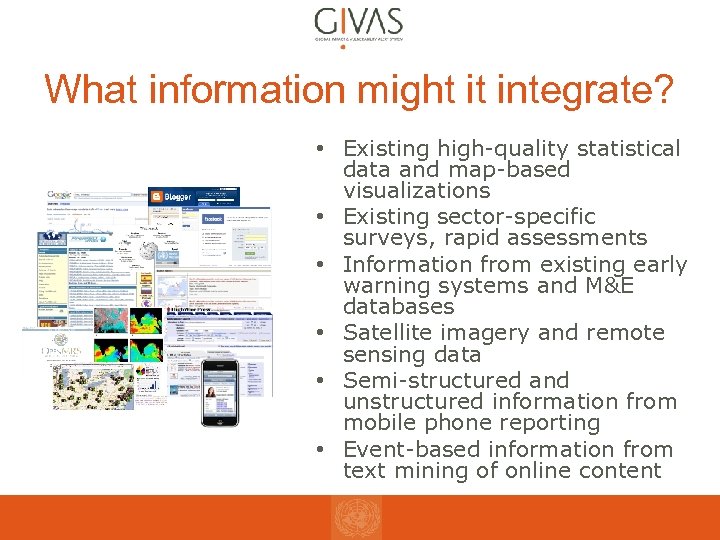
What information might it integrate? • Existing high-quality statistical data and map-based visualizations • Existing sector-specific surveys, rapid assessments • Information from existing early warning systems and M&E databases • Satellite imagery and remote sensing data • Semi-structured and unstructured information from mobile phone reporting • Event-based information from text mining of online content
Early ideas for platform capabilities • Secure, customizable online workspaces for team collaboration around streams of information • Users choose what information to integrate, and what reports to publish • Users train system to detect and interpret locallyrelevant patterns of interest • Automated indexing, text mining, mapping, and alerting • Social networking for usage incentives and quality control • Social metadata such as tagging, clustering, rating and comments. • Easy-to-use tools for interactive analysis, mapping and visualization
Challenges Data Access Data Quality Data Comparability Data Privacy & Misuse Inadequate Baseline Data Context-Specific Indicators • Fusing indicator & eventbased information • Fusing quantitative and qualitative information • • •
Operating Principles • • Make sure the vulnerable are heard. Build only where we must. Local needs drive global innovation. Focus on real needs of users. Fail fast, fail often, and learn. Make it free and open source and support open standards If information is power, shared information is more powerful still. Sharing requires trust, and trust takes time to build.
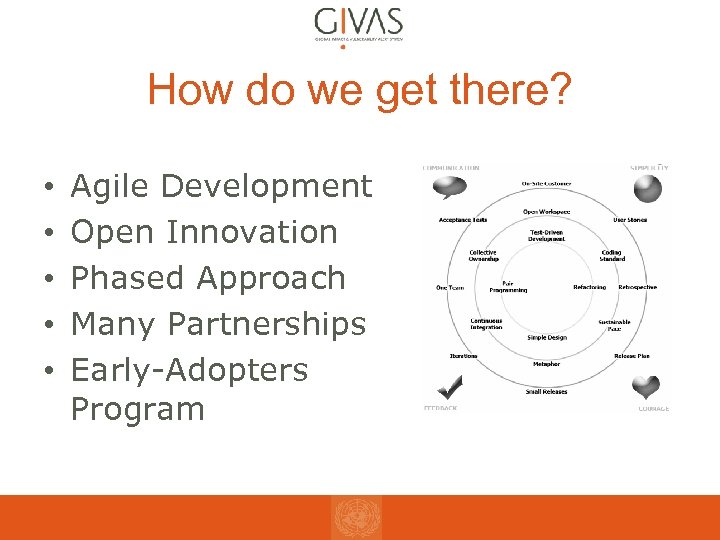
How do we get there? • • • Agile Development Open Innovation Phased Approach Many Partnerships Early-Adopters Program
Institutional Arrangement Oversight: UN Deputy Secretary-General Technical: DSG’s Technical Steering Group Strategic: Inter-Agency Advisory Group Leadership: Project Manager from outside Team: Secondments, contract staff Administration: UNOPS Location: Physically separate from EOSG Funding: Voluntary contributions from a broad range of Member States
Current Partners • 27+ UN agencies, including UNICEF, UNDP, The World Bank, WHO, WFP, UNFPA, and OCHA • Harvard University, Rutgers University, Columbia University, IDS • The Rockefeller Foundation, The UN Foundation, The Meridian Institute • The Open Mobile Consortium
Progress to date • Late April 2009 o Project start • September 2009 o o First Baseline Report to UN General Assembly and G 20 Website launch (www. voicesofthevulnerable. net) Concept film to facilitate outreach Video testimonies by people impacted by the crisis in Bangladesh, Cape Verde, Ghana, Guinea Bissau, Jamaica, Nicaragua, Romania and Uruguay • December 2009 o Launch of Rapid Impact and Vulnerability Analysis Fund (RIVAF) • January 2010 o Selection of 9 proposals for funding • March 2010 o Hiring of GIVAS Project Manager
RIVAF Round One • • • Launched December 2009, proposals selected January 2010 Support UN agency efforts to collect and analyze quick-time data Encourages joint funding approach 1 -Year timeframe, preliminary data by May 15, 2010. Initial studies on unsafe migration, crime, maternal health, women’s empowerment, women’s labor, disaster impacts, tourism, nutrition, food security, household coping strategies, and education Global, regional, and national coverage: Jordan, Egypt, Colombia, Mexico, Ghana, Ethiopia, Malawi, Zambia, Madagascar, Indonesia, and Nepal.
Inputs to Analytical Framework • Outputs from RIVAF studies • Collaboration with WFP, Columbia University, and Harvard Humanitarian Initiative to inventory and evaluate existing early warning systems • UN University analysis of vulnerability definitions across communities of practice • Paper on best practices and lessons learned from early warning and impact monitoring systems • Planned survey of existing mobile phone data collection initiatives • Planned survey of existing databases (government, UN, NGO, academe, industry) to assess utility as baseline data
Milestones: 2010 • April – October o Series of 4 workshops on requirements, challenges, opportunities, and platform design: Blue Sky Thinkers, Member States, UN agencies, and technologists. • May – December o Series of Innovation Camps (3 planned for Africa, Asia, and US) • June o First RIVAF outputs to be used in 2 nd GIVAS Report o First design prototypes and user scenarios published • September o GIVAS Team reaches 10 members (project staff, secondments) • November o First live technology demo of GIVAS Platform capabilities – visualization – collaborative analysis – pattern detection
Milestones: 2011 • March o Limited beta testing of integrated system with Early Adopters • June • Aug o Open public Beta Test (English only) o Public HTTP/REST APIs to support mash-ups • September o Public support for 2 additional official UN languages • October o Localization kit for developers • November o Mobile GIVAS client (Android? Win. Mo 7? i. Phone? ) • December o Public support for all 6 official UN languages
Email: Mobile: Skype: Facebook: Linked. In: Twitter: GChat: Blog: kirkpatrick@un. org +1 650. 796. 5709 robertkirkpatrick rgkirkpatrick humanitariantech. com Thank you!
Скачать презентацию Robert Kirkpatrick GIVAS Project Manager Executive Office of
2d5bb39b5c546ab37e3934b8f72f4fa2.ppt