


 Скачать презентацию ROADMAP TO A NATIONAL LEGAL AID SCHEME-KENYAN EXPERIENCE
a750da30881d73a136919d512a4e4838.ppt
- Количество слайдов: 20
 ROADMAP TO A NATIONAL LEGAL AID SCHEME-KENYAN EXPERIENCE By Caroline Amondi Ag. National Coordinator NATIONAL LEGAL AID AND AWARENESS PROGRAMME KENYA
 INTRODUCTION “Without equal access to the law, the system not only robs the poor of their only protection, but it places in the hands of their oppressors the most powerful and ruthless weapon ever created” Reginald Heber Smith, Justice and the Poor ( New York: The Carnegie Foundation, 1919), pg. 9
 Introduction contd… This paper seeks to highlight the roadmap that the Government of Kenya has laid in seeking to establish a national and institutional framework for legal aid in Kenya. Roadmap in this context is based on the analogy to Maps- the plans that the Government of Kenya has put in place to ensure reasonable success in the development, management and ultimate establishment of a National Legal aid scheme.
 Introduction contd… This paper seeks to highlight the roadmap that the Government of Kenya has laid in seeking to establish a national and institutional framework for legal aid in Kenya. Roadmap in this context is based on the analogy to Maps- the plans that the Government of Kenya has put in place to ensure reasonable success in the development, management and ultimate establishment of a National Legal aid scheme.
 ROADMAP TO THE ESTABLISHMENT OF A NATIONAL LEGAL AID SCHEME Recognition by the government that access to justice is a critical pillar for economic development and poverty reduction through policy initiatives. • National Poverty Eradication Plan 1999– 2015, • Poverty Reduction Strategy Paper (PRSP) of 2001 – 2004 • Investment Programme for Economic Recovery Strategy for Wealth and Employment Creation (ERS) 2003 – 2007.
 Recommendations of the said policies: that access to justice must be responsive, affordable, accessible and speedy in promoting sustainable economic development. KEY POLICY DOCUMENTS: • Vision 2030. The Vision has three pillars – economic, political and social. The political pillar, in particular, builds on various aspects of human rights and the rule of law to ensure good governance and accountability. One of the strategic areas within which the transformation of the country’s political governance systems will take place is through increasing access and quality of legal services available to the public and reducing barriers to service provision and access to justice.
 • Second Medium Term. Plan It outlines the policies, programmes and projects which the intends to implement during the five year period starting 2013 to 2017 and which are necessary to address the acute challenges of poverty, joblessness, and inequality and to facilitate faster realisation of Kenya Vision 2030. It acknowledges that to achieve the objectives set out under the Political Pillar of Vision 2030 the policy, legal and institutional reforms on Access to Justice, the Legal Aid Bill and the Small Claims Court Bill will be implemented. Legal aid and education are recognised as key programmes and are touted as flagship projects of the government, to be Implemented during the said period. .
 International Framework The Government has made commitments under various regional and international human rights declarations, standards, guidelines and instruments to enhance access to justice and provide a state funded legal aid scheme, notable being; • The International Covenant on Civil and Political Rights (ICCPR), 1966 • The UN Convention on the Rights of the Child (CRC), 1989 • The UN Convention on the Rights of Persons living with Disabilities, 2007. • UN Basic Principles on Role of Lawyers, 1990 • UN Guidelines on the Role of Prosecutors, 1990
 Regional Framework The ACHPR Principles and Guidelines on the Right to a Fair Trial and Legal Assistance in Africa, 2003. • It obligates state parties to ensure that an accused person has a right to legal assistance assigned to him or her in any case where the interest of justice so require, and without payment by the accused if he or she does not have sufficient means to pay for it. The interests of justice in criminal matters are to be determined by considering: (1) the seriousness of the offence; (2) the severity of the sentence.
 National Framework 1. Constitution of Kenya, 2010. • The Preamble at paragraph 6 “RECOGNISING the aspirations of all Kenyans for a government based on the essential values of human rights, equality, freedom, democracy, social justice and the rule of law”. • Articles 2(5) and 2(6) provide that “the general rules of international law shall form part of the law of Kenya and that any treaty or convention ratified by Kenya shall form part of the law of Kenya under this Constitution” • Article 19(1) and (2) stipulates that “The Bill of Rights is an integral part of Kenya’s democratic state and is the framework for social, economic and cultural policies, and that the purpose of recognising and protecting human rights and fundamental freedoms is to preserve the dignity of individuals and communities and to promote social justice and the realisation of the potential of all human beings.
 National Framework contd… Constitution of Kenya. • Article 25(emphasis added) Most of the rights in the Bill of Rights though fundamental are not absolute but are subject to limitation by law as espoused in Article 24. One of the hallmarks of the Constitution of Kenya is the creation of a set of non-derogable rights under Article 25 making it one of the most progressive constitutions in the world. Through the provisions of the said Article the right to a fair trial has been catapulted to a class of rights which hitherto was reserved to rights under Article 4 (Articles 6, 7, 8(1) & (2), 11, 15, 16 and 18) of the ICCPR. of which the said right did not fall. • Article 48 obligates the state to “. . . ensure access to justice for all persons and, if any fee is required, it shall be reasonable and shall not impede access to justice”.
 National Framework contd… • Article 50 embodies the right to fair hearing and the right to a fair trial¸ which are cornerstone provision in any judicial or quasi judicial or dispute resolution process. • Article 159(2) expounds the principles by which the judicial authority is to be exercised, that justice shall be done to all irrespective of status and not be delayed. It also recognises that the purposes and principles of the Constitution must be protected and promoted. • Fifth Schedule read with Article 261 provides the timeframe for the enactment of various legislations aimed at implementing the constitution. Under the said Schedule, legislation to give effect to Article 50 or the right to fair hearing ought to be passed with four years from the date of promulgation.
 National Framework contd… Other Laws: 2. The Civil Procedure Act (CPA) Chapter 21, Laws of Kenya. 3. The Children Act, 2001 4. Persons with Disabilities Act, 2009 5. The Refugee Act, 2006. 6. The Criminal Procedure Code, Chapter 75, Laws of Kenya. 7. The Prevention, Protection and Assistance to Internally Displaced Persons and Affected Communities Act, 2012 8. Law Society of Kenya Act.
![JUDICIAL APPROACH • David Njoroge Macharia –vs-Republic e. KLR Cr. A. No. [2011] Appeal](https://present5.com/presentation/a750da30881d73a136919d512a4e4838/image-14.jpg "JUDICIAL APPROACH • David Njoroge Macharia –vs-Republic e. KLR Cr. A. No. [2011] Appeal") JUDICIAL APPROACH • David Njoroge Macharia –vs-Republic e. KLR Cr. A. No. [2011] Appeal No. 497 of 2007 The Court of Appeal looked at the right to free legal counsel at state’s expensefor the first time in Kenya and expounded on the principle of “substantial injustice”. • John. Swakav The. Director Public of Prosecutions 2 others [2013] & , e. KLR, Constitutional Petition 318 of 2011 The petitioner a human rights lawyer, on a Public Interest Litigation sought orders stopping the prosecution of all persons faced with prosecution for criminal offences that carried a death penalty until the state implemented the Provisions of Article 50(2)(h) of the Constitution and provided defence Counsel for such offenders.
JUDICIAL APPROACH • David Njoroge Macharia –vs-Republic e. KLR Cr. A. No. [2011] Appeal No. 497 of 2007 The Court of Appeal looked at the right to free legal counsel at state’s expensefor the first time in Kenya and expounded on the principle of “substantial injustice”. • John. Swakav The. Director Public of Prosecutions 2 others [2013] & , e. KLR, Constitutional Petition 318 of 2011 The petitioner a human rights lawyer, on a Public Interest Litigation sought orders stopping the prosecution of all persons faced with prosecution for criminal offences that carried a death penalty until the state implemented the Provisions of Article 50(2)(h) of the Constitution and provided defence Counsel for such offenders.
 CONCRETE STEPS 1. • • • Preliminary Design and Activities. Role of civil societies and developmient partners Multi-Stakeholder Approach: Piloting. 2. Implementation of Design and Strategies. • The National Legal Aid and Awareness Programme (NALEAP) During the piloting phase (2009 -2013) the programme employed a combination of strategies in the realisation of its core mandate namely, laying a foundation for a sustainable and responsive legal aid system; a) Provision of Legal Aid Services through Probono Lawyers and Facilitating Organisations.
 CONCRETE STEPS contd… • Creation of Legal Awareness, including Specific Engagement with the Media. • Capacity Building and Developing Networking Strategies for Justice Sector Institutions. • Promotion of the use of ADR Mechanism. • Recognition of the use of Informal Justice System. • Promotion of the use of Paralegals and Law Students. • Provision of Psycho-Social Support Services. • Advocacy on Law Reform on Access to Justice. • Identification of best practices from the region.
 CONCRETE STEPS contd… • 3. Development of a framework for a national legal aid scheme. a) Draft National Legal Aid and Awareness Policy, 2013. b) The Draft Legal Aid Bill, 2014. The aim of the Bill is to give effect to the provisions of Articles 19(2), 48, 50 (2), (g) and (h) of the Constitution to facilitate access to justice and social justice; to establish the National Legal Aid Service; to provide for legal aid, and for the funding of legal aid and for connected purposes.
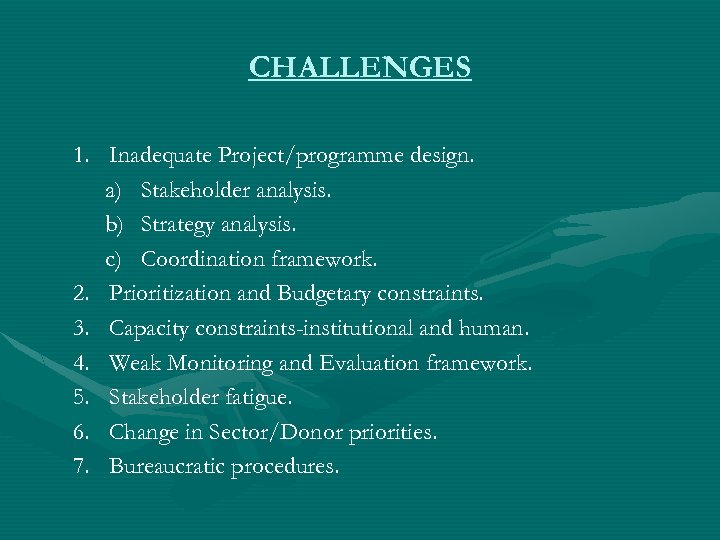 CHALLENGES 1. Inadequate Project/programme design. a) Stakeholder analysis. b) Strategy analysis. c) Coordination framework. 2. Prioritization and Budgetary constraints. 3. Capacity constraints-institutional and human. 4. Weak Monitoring and Evaluation framework. 5. Stakeholder fatigue. 6. Change in Sector/Donor priorities. 7. Bureaucratic procedures.
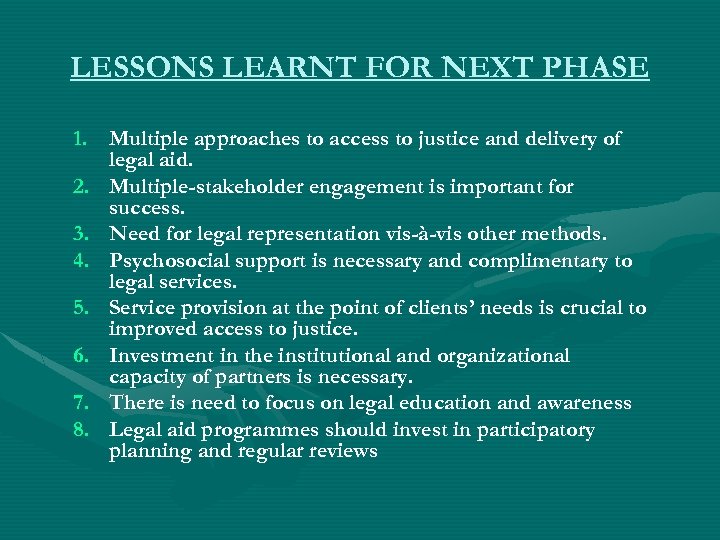 LESSONS LEARNT FOR NEXT PHASE 1. Multiple approaches to access to justice and delivery of legal aid. 2. Multiple-stakeholder engagement is important for success. 3. Need for legal representation vis-à-vis other methods. 4. Psychosocial support is necessary and complimentary to legal services. 5. Service provision at the point of clients’ needs is crucial to improved access to justice. 6. Investment in the institutional and organizational capacity of partners is necessary. 7. There is need to focus on legal education and awareness 8. Legal aid programmes should invest in participatory planning and regular reviews
 Thank You!