


 Скачать презентацию ROAD TRANSPORT WHAT WILL IT LINK IN
f7f4e4efca5b0c350c64a010df5e2e11.ppt
- Количество слайдов: 32
 ROAD TRANSPORT – WHAT WILL IT LINK IN THE FUTURE ? C. Michael Walton, Ph. D. , P. E. The University of Texas at Austin
 Vision for the Future The ultimate vision for the future is the transformation of surface transportation into an effectively managed, wellintegrated, universally available and affordable system which: § provides for the safe, secure, efficient, and economical movement of people and goods § enhances customer satisfaction, and § is compatible with environmental concerns
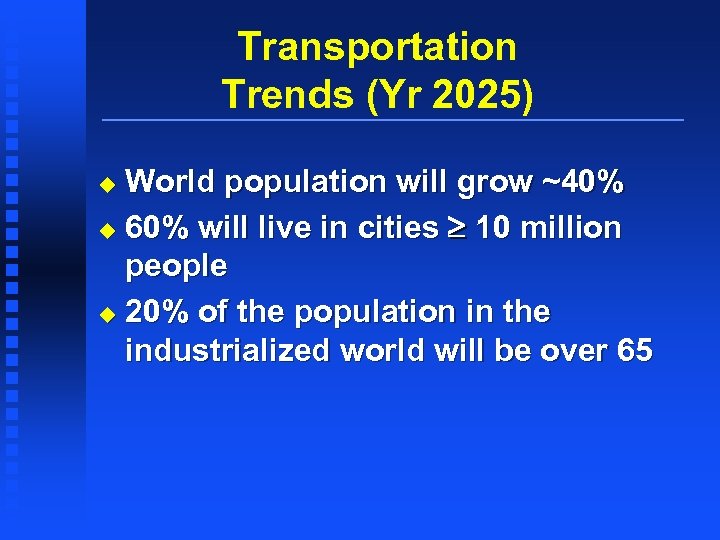 Transportation Trends (Yr 2025) World population will grow ~40% u 60% will live in cities 10 million people u 20% of the population in the industrialized world will be over 65 u
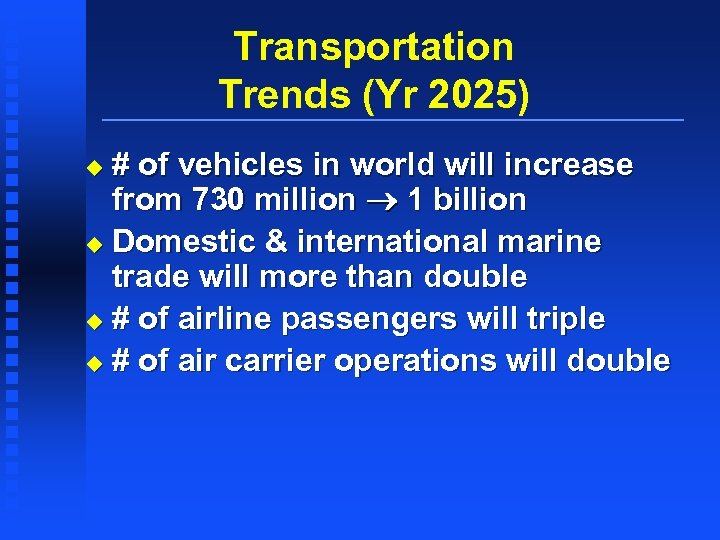 Transportation Trends (Yr 2025) # of vehicles in world will increase from 730 million 1 billion u Domestic & international marine trade will more than double u # of airline passengers will triple u # of air carrier operations will double u
 Global Transportation System u 1 of 2 Challenges § § § § § Human and social costs (e. g. , fatalities, injuries) Exploding global population and congestion Aging population Expanding trade and tourism Globalization and economic competitiveness Environmental concerns Terrorist threats Advanced technology Massive Infrastructure
 Global Transportation System u 2 of 2 Opportunities § § § § Eliminate transportation-related deaths, injuries and crashes Provide access and mobility Reduce travel time and cost Increase throughput of people and freight regardless of weather conditions Eliminate environmental emissions, including noise Enhance system security Advanced technology (e. g. , information, nano)
 Key Areas u u u Crash Prevention Crash Response Transportation Management Homeland Security and Natural Disasters Integrated Network of Transportation Information (INTI)
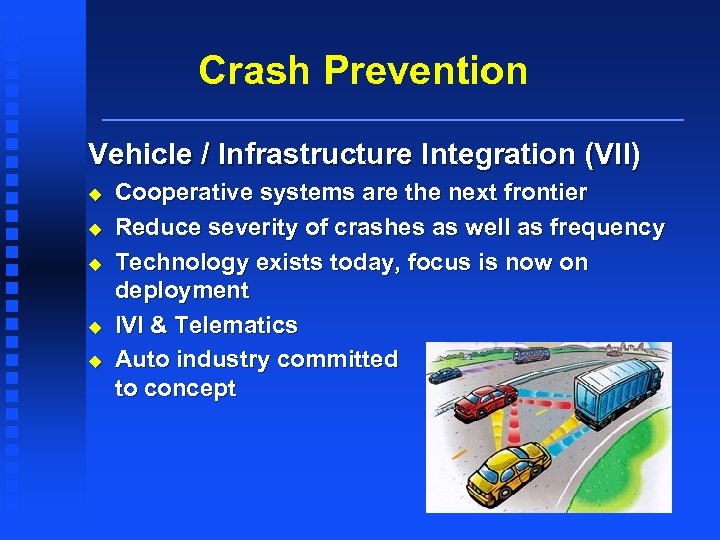 Crash Prevention Vehicle / Infrastructure Integration (VII) u u u Cooperative systems are the next frontier Reduce severity of crashes as well as frequency Technology exists today, focus is now on deployment IVI & Telematics Auto industry committed to concept
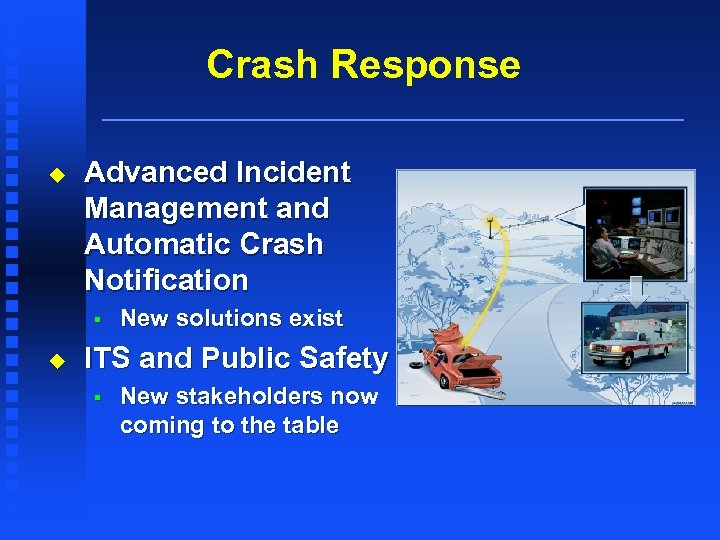 Crash Response u Advanced Incident Management and Automatic Crash Notification § u New solutions exist ITS and Public Safety § New stakeholders now coming to the table
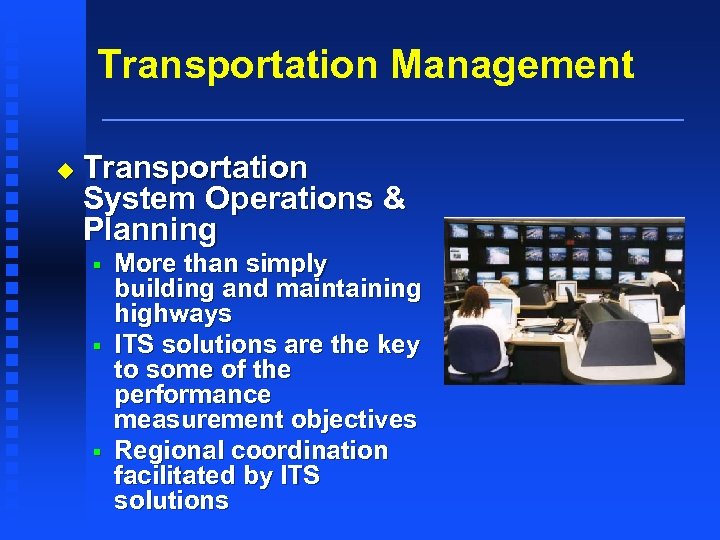 Transportation Management u Transportation System Operations & Planning § § § More than simply building and maintaining highways ITS solutions are the key to some of the performance measurement objectives Regional coordination facilitated by ITS solutions
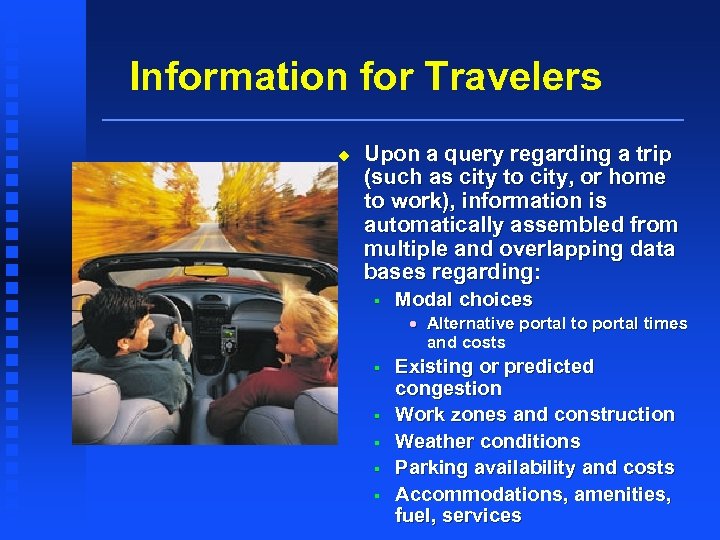 Information for Travelers u Upon a query regarding a trip (such as city to city, or home to work), information is automatically assembled from multiple and overlapping data bases regarding: § Modal choices · Alternative portal to portal times and costs § § § Existing or predicted congestion Work zones and construction Weather conditions Parking availability and costs Accommodations, amenities, fuel, services
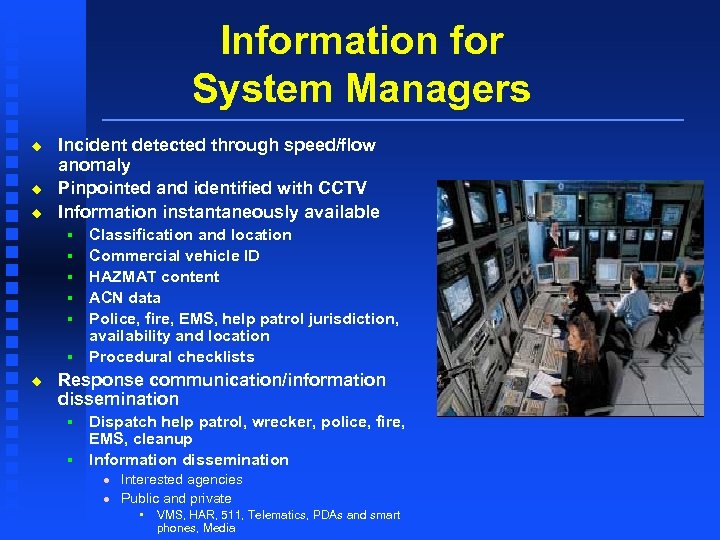 Information for System Managers u u u Incident detected through speed/flow anomaly Pinpointed and identified with CCTV Information instantaneously available Classification and location Commercial vehicle ID HAZMAT content ACN data Police, fire, EMS, help patrol jurisdiction, availability and location § Procedural checklists § § § u Response communication/information dissemination Dispatch help patrol, wrecker, police, fire, EMS, cleanup § Information dissemination § · Interested agencies · Public and private • VMS, HAR, 511, Telematics, PDAs and smart phones, Media
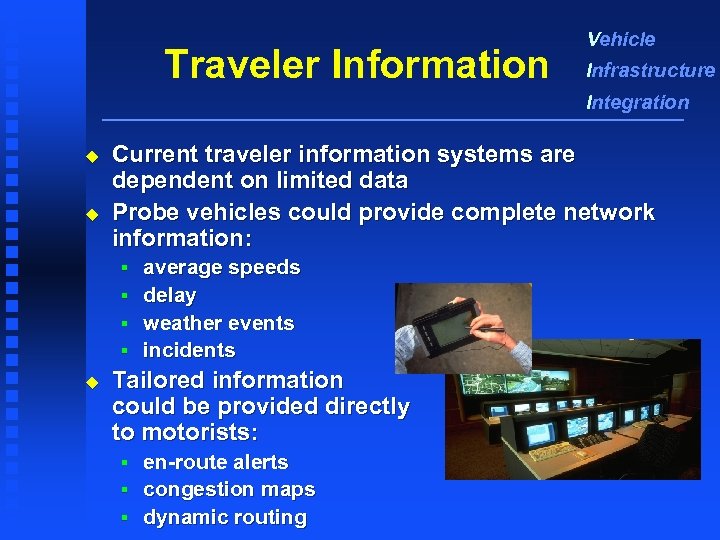 Traveler Information Vehicle Infrastructure Integration u u Current traveler information systems are dependent on limited data Probe vehicles could provide complete network information: § § u average speeds delay weather events incidents Tailored information could be provided directly to motorists: § § § en-route alerts congestion maps dynamic routing
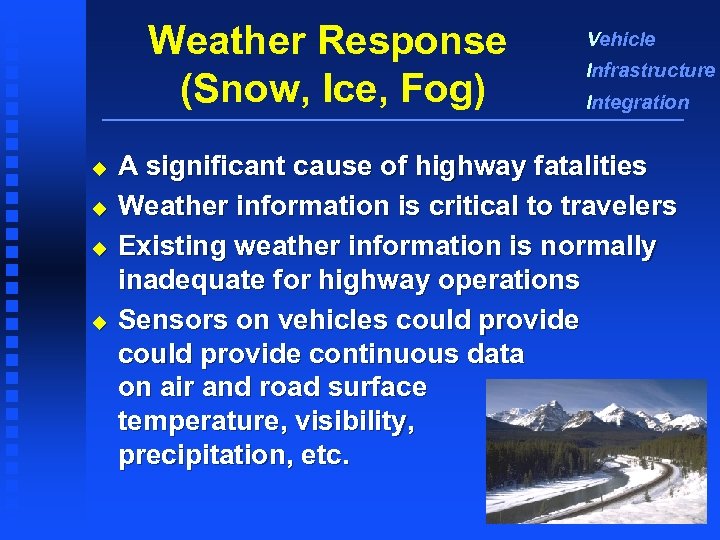 Weather Response (Snow, Ice, Fog) u u Vehicle Infrastructure Integration A significant cause of highway fatalities Weather information is critical to travelers Existing weather information is normally inadequate for highway operations Sensors on vehicles could provide continuous data on air and road surface temperature, visibility, precipitation, etc.
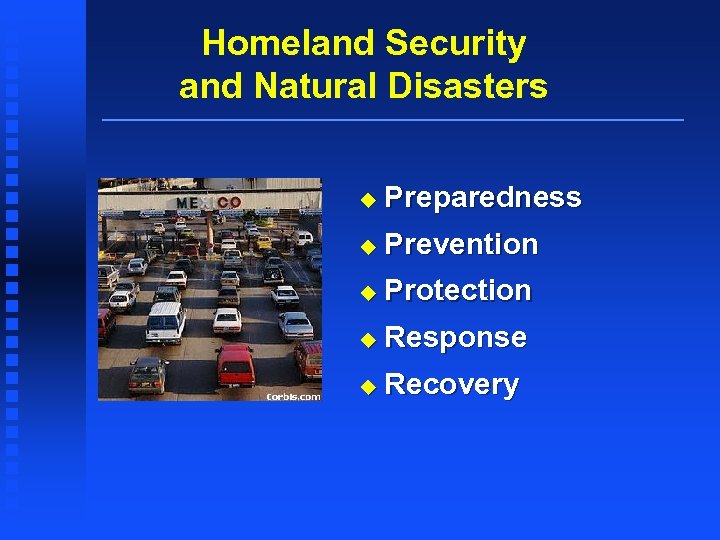 Homeland Security and Natural Disasters u Preparedness u Prevention u Protection u Response u Recovery
 Homeland Security and Natural Disasters u Response and Recovery: § u Aggressively invest in the information networks, systems and institutions to enable effective, coordinated, resilient, and dynamic management of facilities, movements and information dissemination in response to attack. Prevention: § § Aggressively invest in the technologies and information networks to enable identification, monitoring and tracking of mobile and nonmobile assets. Shared databases are necessary for effectiveness
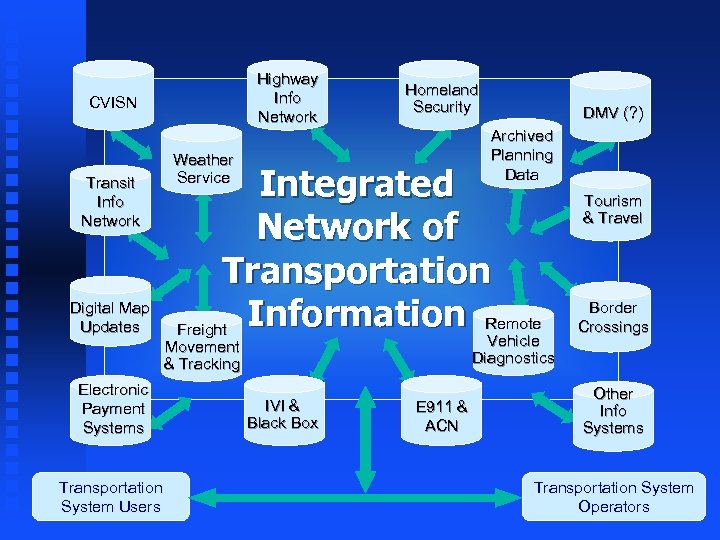 Highway Info Network CVISN Transit Info Network Digital Map Updates Homeland Security Archived Planning Data Weather Service Integrated Network of Transportation Information Remote Freight Vehicle Diagnostics Movement & Tracking Electronic Payment Systems Transportation System Users DMV (? ) IVI & Black Box E 911 & ACN Tourism & Travel Border Crossings Other Info Systems Transportation System Operators
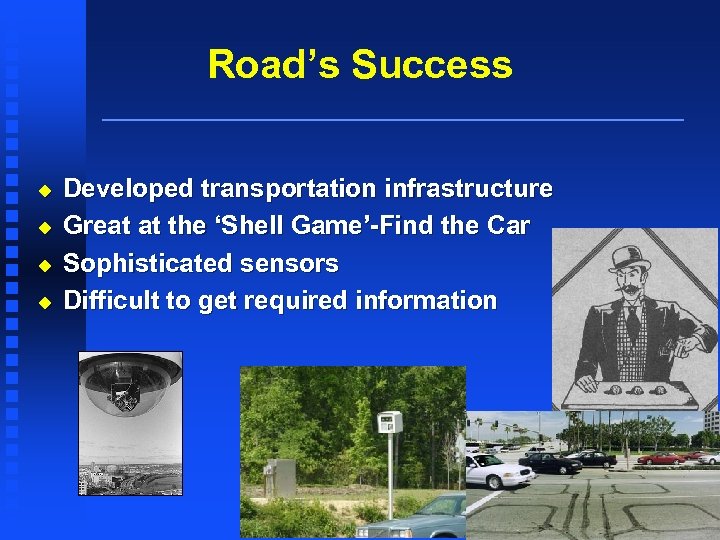 Road’s Success u u Developed transportation infrastructure Great at the ‘Shell Game’-Find the Car Sophisticated sensors Difficult to get required information
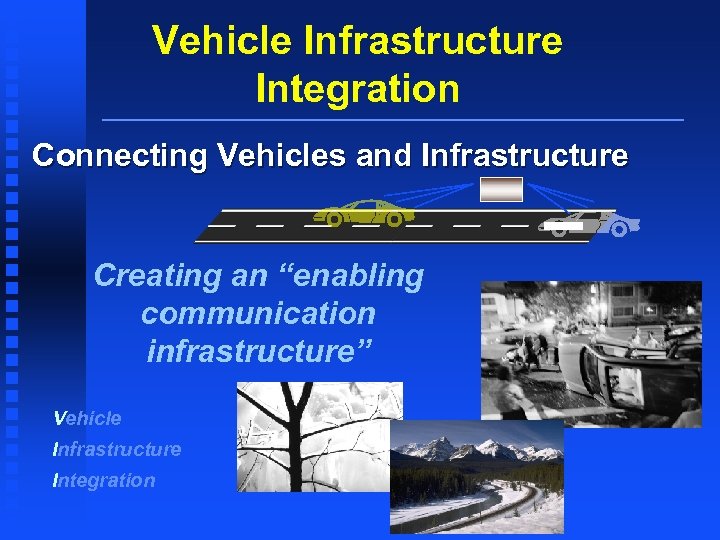 Vehicle Infrastructure Integration Connecting Vehicles and Infrastructure Creating an “enabling communication infrastructure” Vehicle Infrastructure Integration
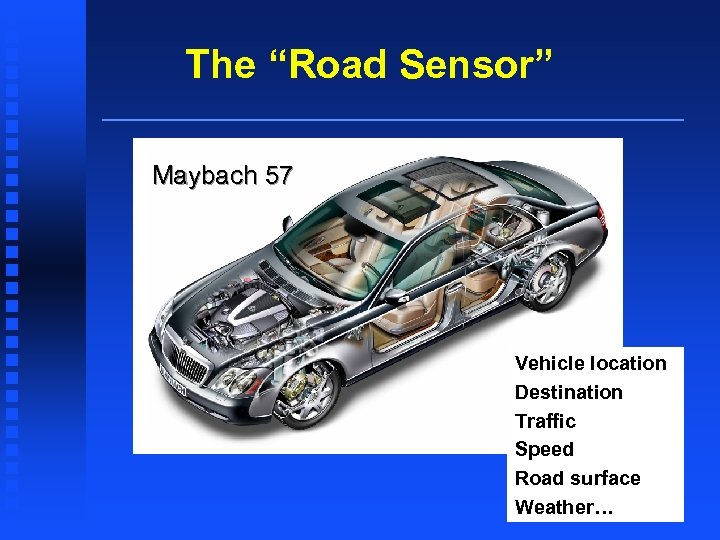 The “Road Sensor” Maybach 57 Vehicle location Destination Traffic Speed Road surface Weather…
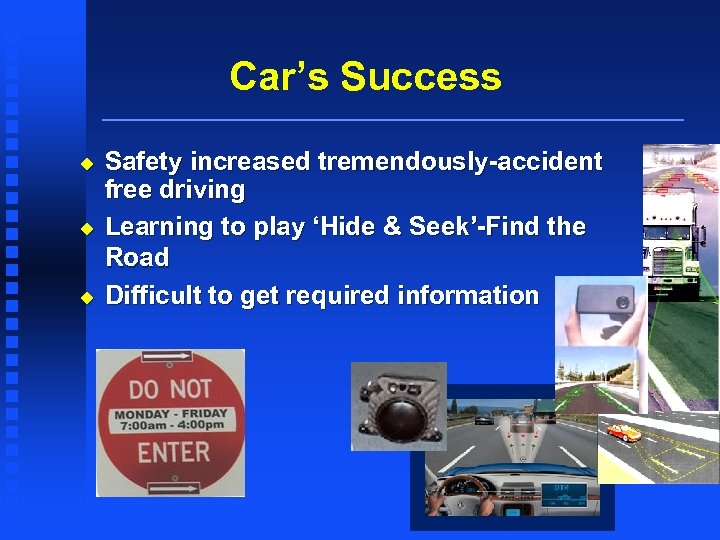 Car’s Success u u u Safety increased tremendously-accident free driving Learning to play ‘Hide & Seek’-Find the Road Difficult to get required information
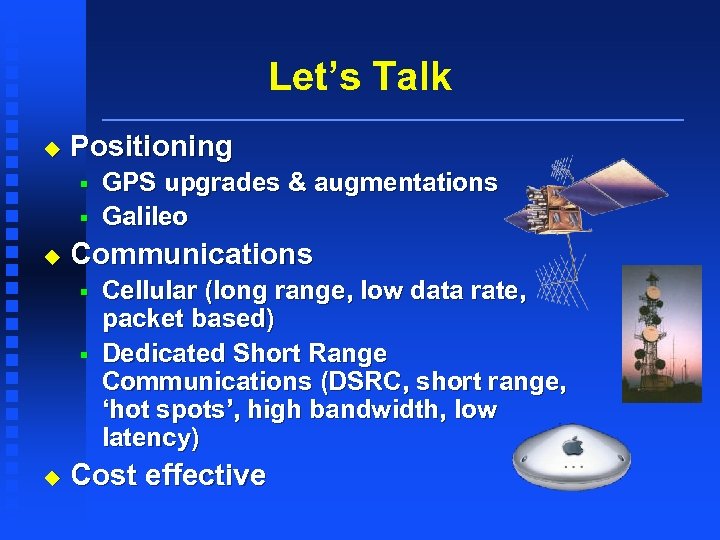 Let’s Talk u Positioning § § u Communications § § u GPS upgrades & augmentations Galileo Cellular (long range, low data rate, packet based) Dedicated Short Range Communications (DSRC, short range, ‘hot spots’, high bandwidth, low latency) Cost effective
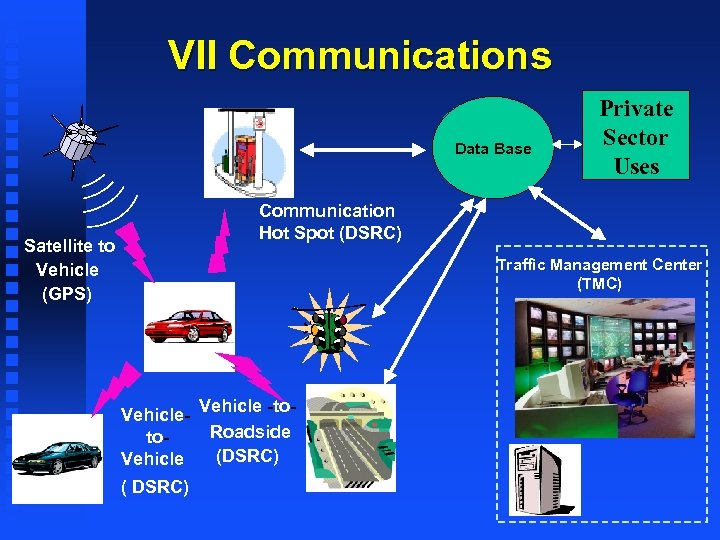 VII Communications Data Base Private Sector Uses Communication Hot Spot (DSRC) Satellite to Vehicle (GPS) Traffic Management Center (TMC) Vehicleto. Vehicle ( DSRC) Vehicle -to. Roadside (DSRC)
 Advancing Technologies Offer a Range of Opportunities in Road Pricing 1 of 2 Examples 1. Satellite-based Tolling § § Germany Swiss Customs Authority Dublin Transportation Office State of Oregon 2. High-Speed Electronic Tolling § § Open Road with either RFID tags or OCR Overhead enforcement gantries § § § Toronto 407 ETR Melbourne City. Link Sydney Westlink M 7
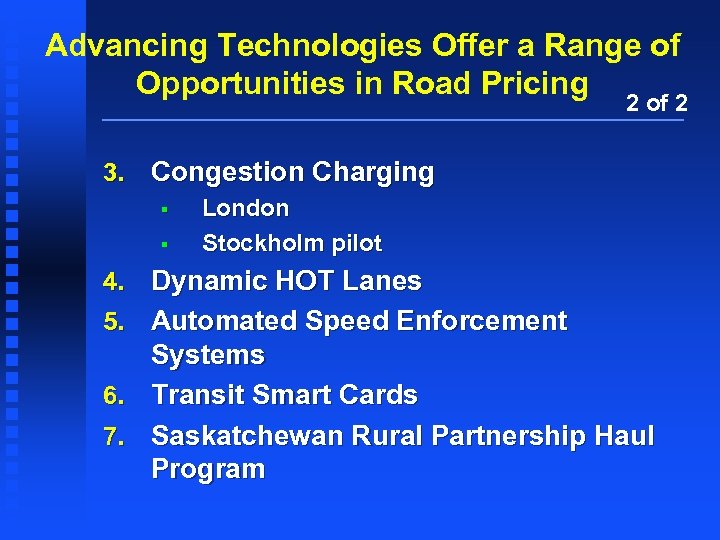 Advancing Technologies Offer a Range of Opportunities in Road Pricing 2 of 2 3. Congestion Charging § § London Stockholm pilot 4. Dynamic HOT Lanes 5. Automated Speed Enforcement Systems 6. Transit Smart Cards 7. Saskatchewan Rural Partnership Haul Program
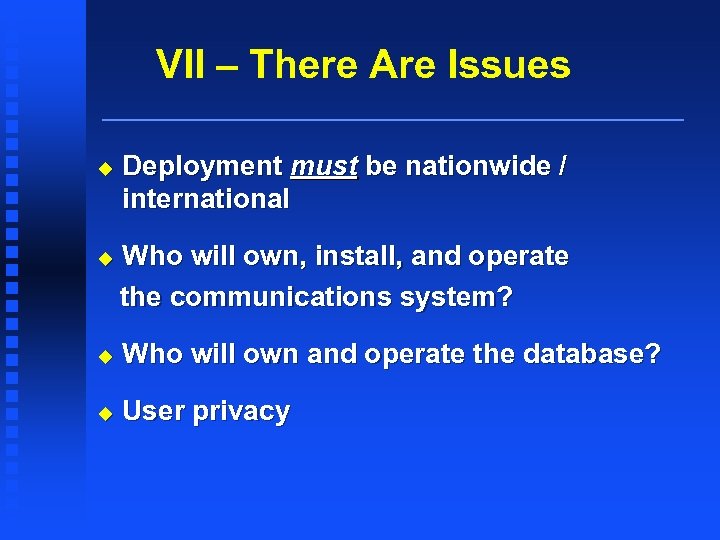 VII – There Are Issues u Deployment must be nationwide / international Who will own, install, and operate the communications system? u u Who will own and operate the database? u User privacy
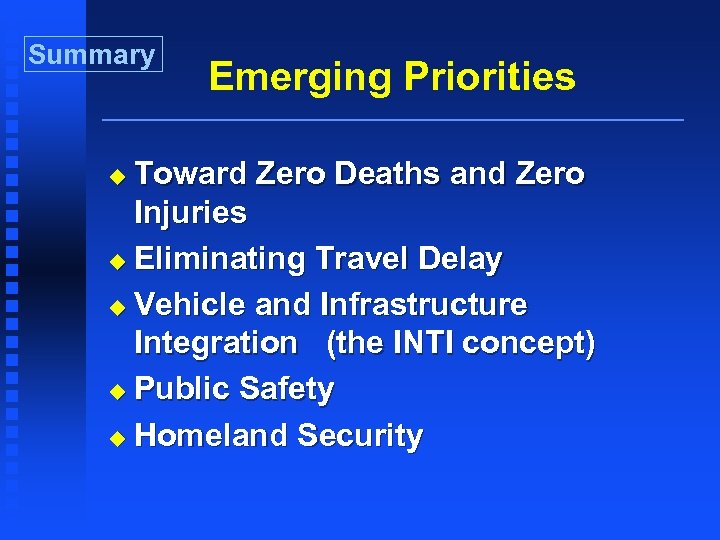 Summary Emerging Priorities Toward Zero Deaths and Zero Injuries u Eliminating Travel Delay u Vehicle and Infrastructure Integration (the INTI concept) u Public Safety u Homeland Security u
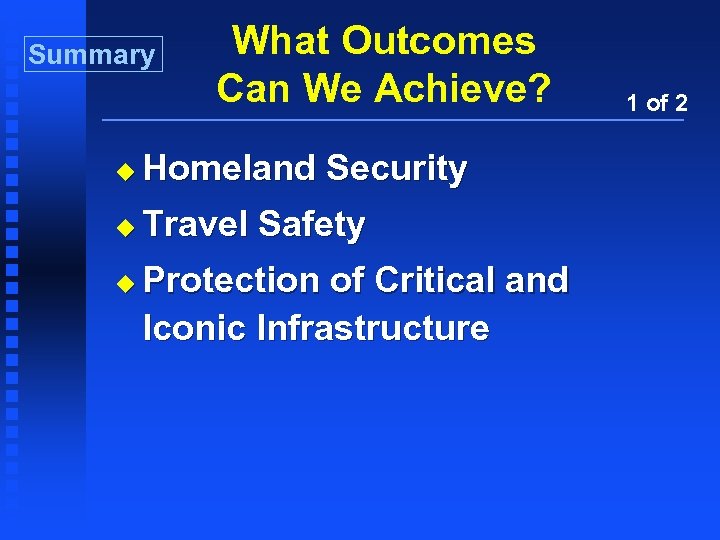 Summary What Outcomes Can We Achieve? u Homeland Security u Travel Safety u Protection of Critical and Iconic Infrastructure 1 of 2
 Summary What Outcomes Can We Achieve? 2 of 2 System Reliability and Improved Performance u Improved National and Global Economic Competitiveness u Improved Environment and Quality of Life u
 “Trucks of the future will have only a man, a dog and a computer on board. The computer will be there to control the truck, the man will be there to watch the gauges, and the dog will be there to bite the man if he attempts to touch anything” Allan Kirson, Motorola
 Conclusion Vision for the Future The ultimate vision for the future is the transformation of surface transportation into an effectively managed, wellintegrated, universally available and affordable system
 C. MICHAEL WALTON, Ph. D, PE Ernest H. Cockrell Centennial Chair in Engineering Department of Civil, Architectural and Environmental Engineering The University of Texas at Austin 1 University Station C 1761 Austin, TX 78712 -0278 512 -471 -1414; Fax 512 -471 -4995 cmwalton@mail. utexas. edu