 Скачать презентацию ROAD 443 Too Big a Bite Chapter 4
912251772f5fd214952f82bfdd0d406d.ppt
- Количество слайдов: 94




ROAD 443 “Too Big a Bite” Chapter 4 in the series "Roads to Nowhere" July 2010 Shaul Arieli www. shaularieli. com
Warning • This presentation is not likely to help anyone who thinks that the historic right of the people of Israel overrides any other right, including community rights, human rights, civil rights and property rights. • It is not intended for those who do not wish the state of Israel to remain with a Jewish majority and democratic, and be part of the family of nations. • Neither is it intended for those who think that the rule of law is a weight on the neck of “Zionism” which should be removed because “we were ordered to inherit the land” through “emptying it from its inhabitants”.
This presentation tells the story of road 443 and the area that it crosses. It seeks to present the whole picture but does not claim to be free of subjectivity, since it is based on the age old insight: “After they saw but a small part of life, the people, who live for a short time, disperse like smoke and every one believes only in what he met along his way… therefore who can claim to have found the entire thing? ” (Empedocles)
What are we about to see? • The story of road 443, in the part that connects the Palestinian villages from Beit Sira to Bitunya/Ramallah (altogether 17 km), is the story that accompanies us over the last few years. • The complexity of the plot, its twists and turns, the different versions of the various actors involved, Israel’s High Court of Justice rulings, etc. do not make it easier for those interested in knowing the entire picture. • The story of road 443 expresses the policy of Israel’s governments since 1967 with regard to the territory which it crosses. The policy of the last decade exhibits political short-sightedness, politicization of defense authority, outrageous waste of public funds, security irresponsibility, and disregard for the rule of law and banality of power.

We’ll start with a bit of Jewish History…
From the occupation of the land of Israel to the Diaspora Beit Horon is a settlement named for the Canaanite diety Horon. The settlement was built by Sheerah, daughter of Efraim: “And his daughter was Sheerah, who built Beth-horon the nether and the upper …” (Chronicles 1, chapter 7, verse 24) The settlement is mentioned again in Chronicles 2 where it says that Solomon built the two cities and made sure they were both fortified: “Also he built Beth-horon the upper, and Beth-horon the nether, fortified cities, with walls, gates, and bars. ” (Chapter 8, verse 5) Nowadays, the two Arab villiages Beit Ur Al Fauqa and Beit Ur al Tahta preserve the orginal names. Nearby them is the Israeli settlement Beit Horon, established in 1977. Road 443 is the historic ascent of Beit Horon that connects the Shephelah to the “mountain back” north of Jerusalem.
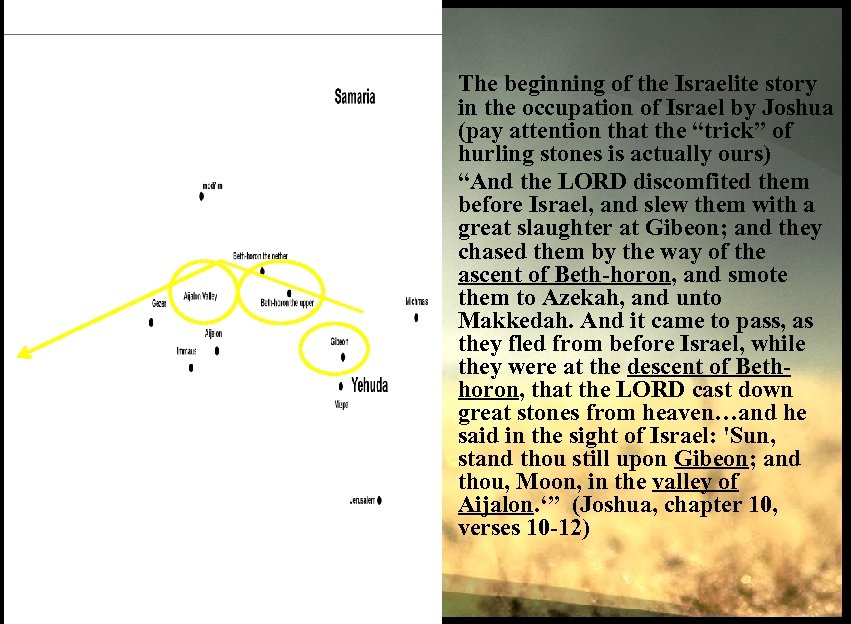
The beginning of the Israelite story in the occupation of Israel by Joshua (pay attention that the “trick” of hurling stones is actually ours) “And the LORD discomfited them before Israel, and slew them with a great slaughter at Gibeon; and they chased them by the way of the ascent of Beth-horon, and smote them to Azekah, and unto Makkedah. And it came to pass, as they fled from before Israel, while they were at the descent of Bethhoron, that the LORD cast down great stones from heaven…and he said in the sight of Israel: 'Sun, stand thou still upon Gibeon; and thou, Moon, in the valley of Aijalon. ‘” (Joshua, chapter 10, verses 10 -12)
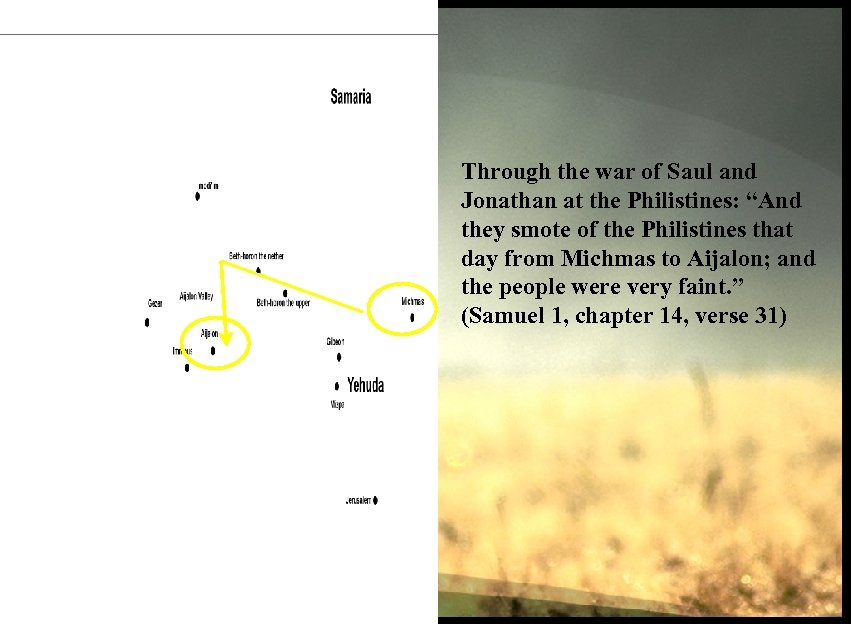
Through the war of Saul and Jonathan at the Philistines: “And they smote of the Philistines that day from Michmas to Aijalon; and the people were very faint. ” (Samuel 1, chapter 14, verse 31)
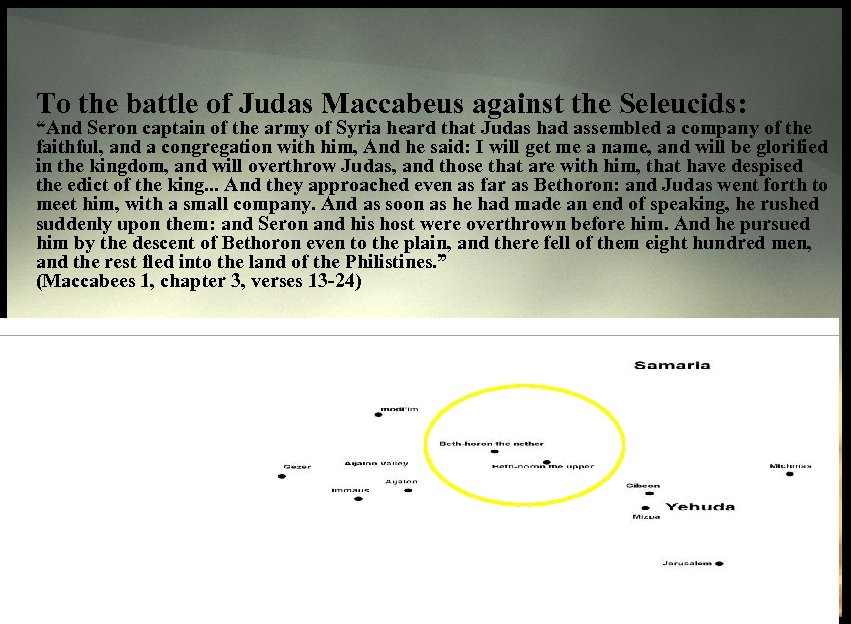
To the battle of Judas Maccabeus against the Seleucids: “And Seron captain of the army of Syria heard that Judas had assembled a company of the faithful, and a congregation with him, And he said: I will get me a name, and will be glorified in the kingdom, and will overthrow Judas, and those that are with him, that have despised the edict of the king. . . And they approached even as far as Bethoron: and Judas went forth to meet him, with a small company. And as soon as he had made an end of speaking, he rushed suddenly upon them: and Seron and his host were overthrown before him. And he pursued him by the descent of Bethoron even to the plain, and there fell of them eight hundred men, and the rest fled into the land of the Philistines. ” (Maccabees 1, chapter 3, verses 13 -24)

And back to our times…
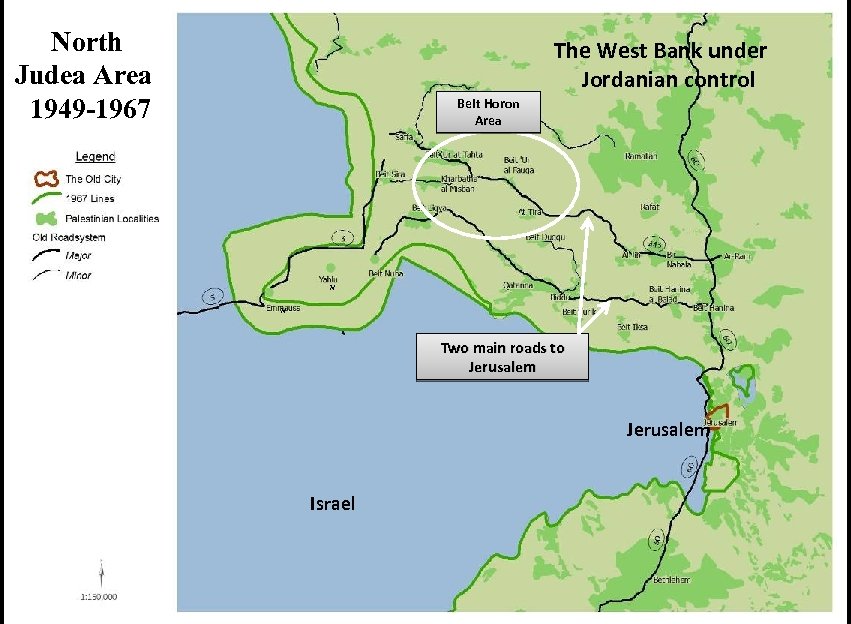
North Judea Area 1949 -1967 The West Bank under Jordanian control Beit Horon Area א א Two main roads to Jerusalem Israel
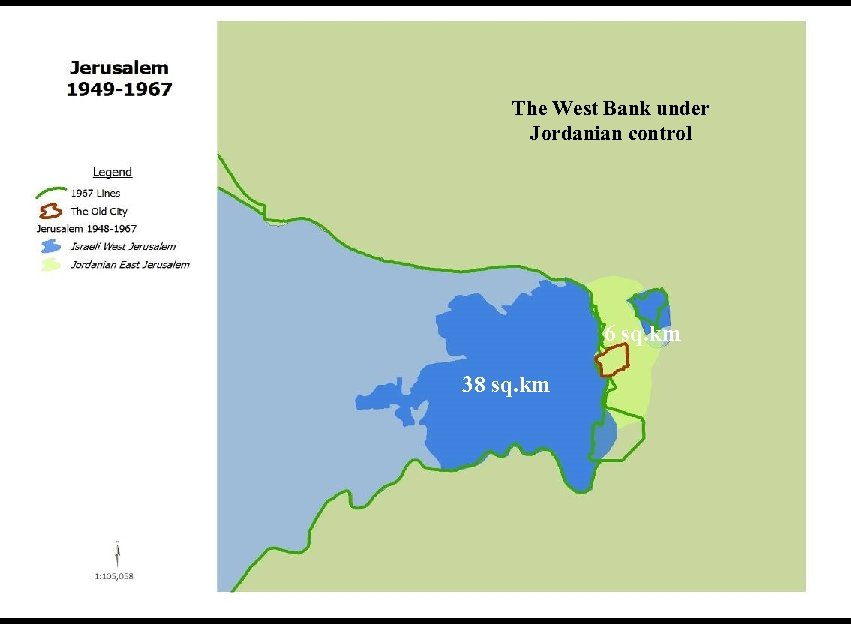
The West Bank under Jordanian control 6 sq. km 38 sq. km
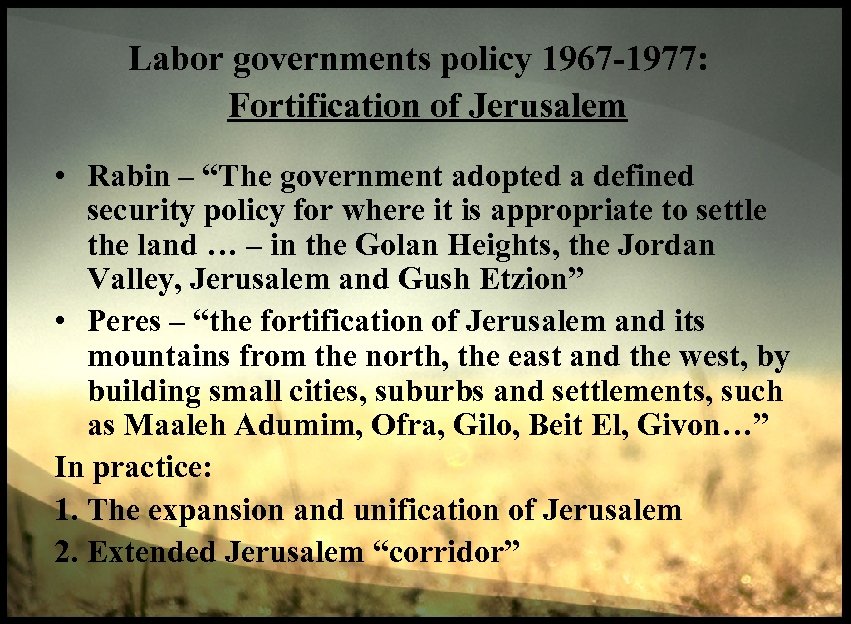
Labor governments policy 1967 -1977: Fortification of Jerusalem • Rabin – “The government adopted a defined security policy for where it is appropriate to settle the land … – in the Golan Heights, the Jordan Valley, Jerusalem and Gush Etzion” • Peres – “the fortification of Jerusalem and its mountains from the north, the east and the west, by building small cities, suburbs and settlements, such as Maaleh Adumim, Ofra, Gilo, Beit El, Givon…” In practice: 1. The expansion and unification of Jerusalem 2. Extended Jerusalem “corridor”
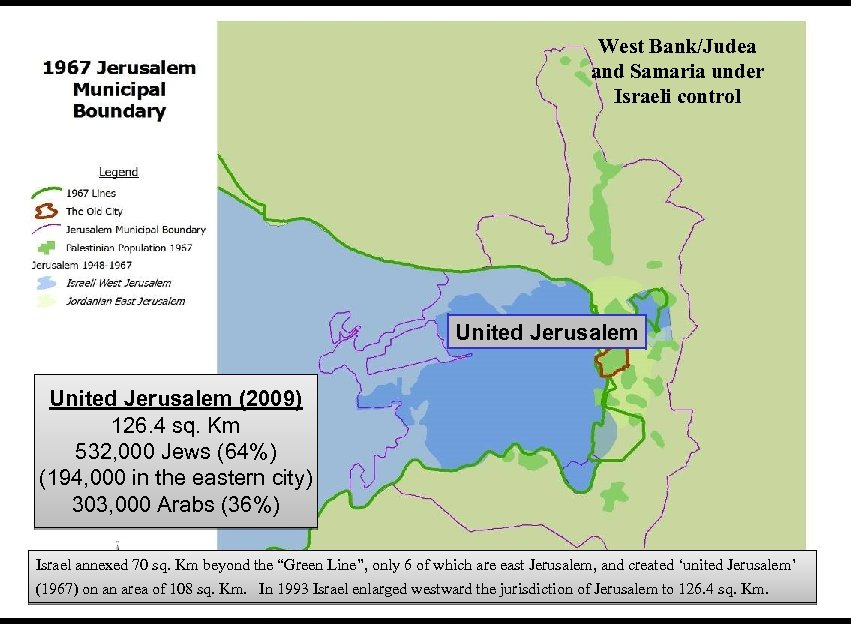
West Bank/Judea and Samaria under Israeli control United Jerusalem (2009) 126. 4 sq. Km 532, 000 Jews (64%) (194, 000 in the eastern city) 303, 000 Arabs (36%) Israel annexed 70 sq. Km beyond the “Green Line”, only 6 of which are east Jerusalem, and created ‘united Jerusalem’ (1967) on an area of 108 sq. Km. In 1993 Israel enlarged westward the jurisdiction of Jerusalem to 126. 4 sq. Km.
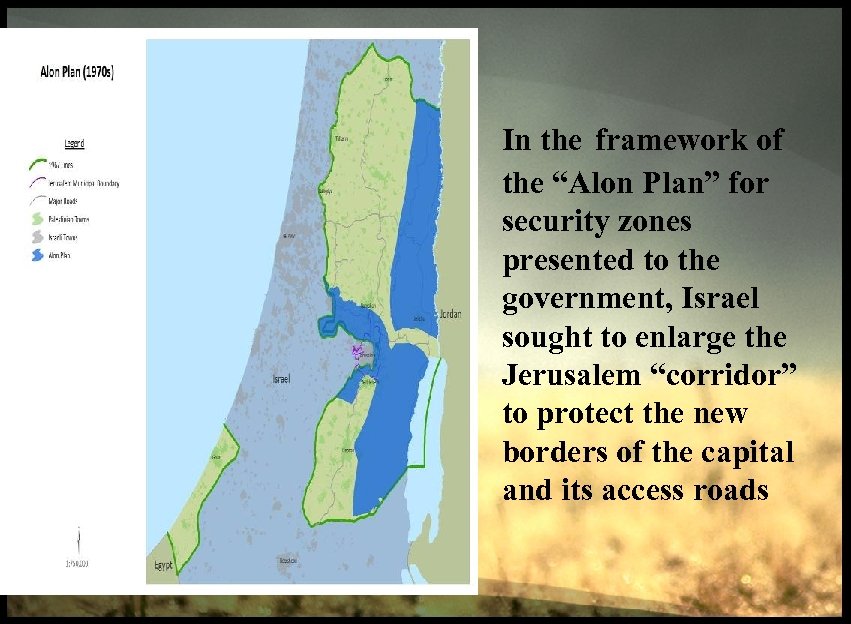
In the framework of the “Alon Plan” for security zones presented to the government, Israel sought to enlarge the Jerusalem “corridor” to protect the new borders of the capital and its access roads
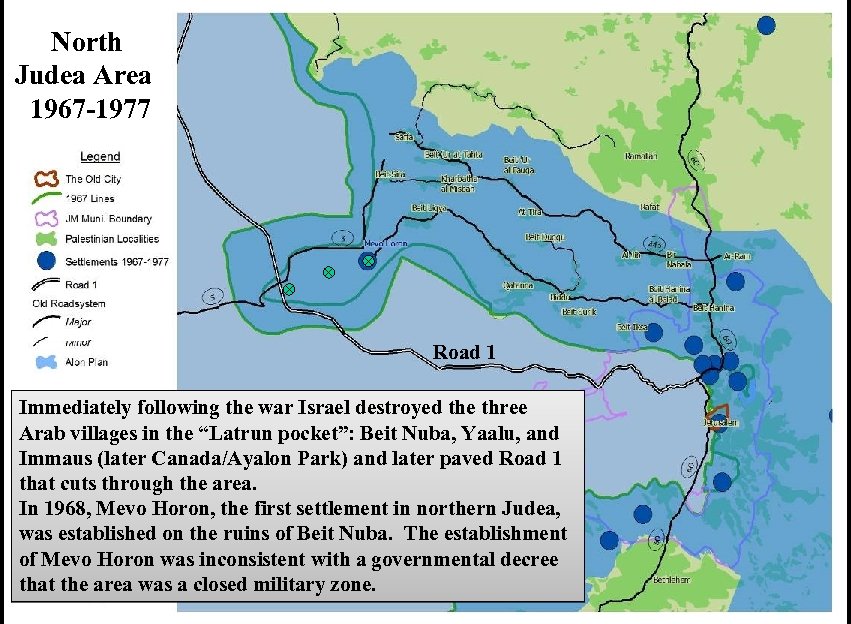
North Judea Area 1967 -1977 Road 1 Immediately following the war Israel destroyed the three Arab villages in the “Latrun pocket”: Beit Nuba, Yaalu, and Immaus (later Canada/Ayalon Park) and later paved Road 1 that cuts through the area. In 1968, Mevo Horon, the first settlement in northern Judea, was established on the ruins of Beit Nuba. The establishment of Mevo Horon was inconsistent with a governmental decree that the area was a closed military zone.
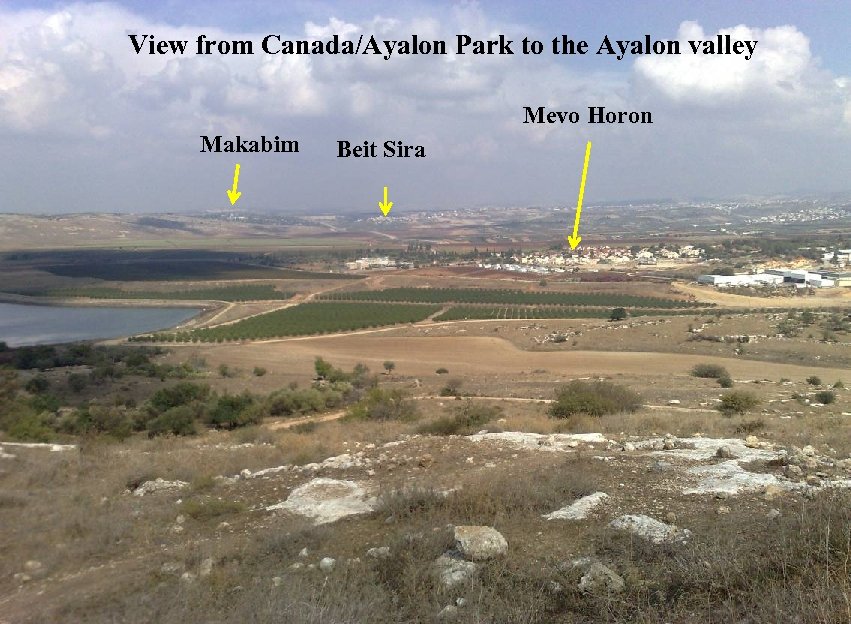
View from Canada/Ayalon Park to the Ayalon valley Mevo Horon Makabim Beit Sira
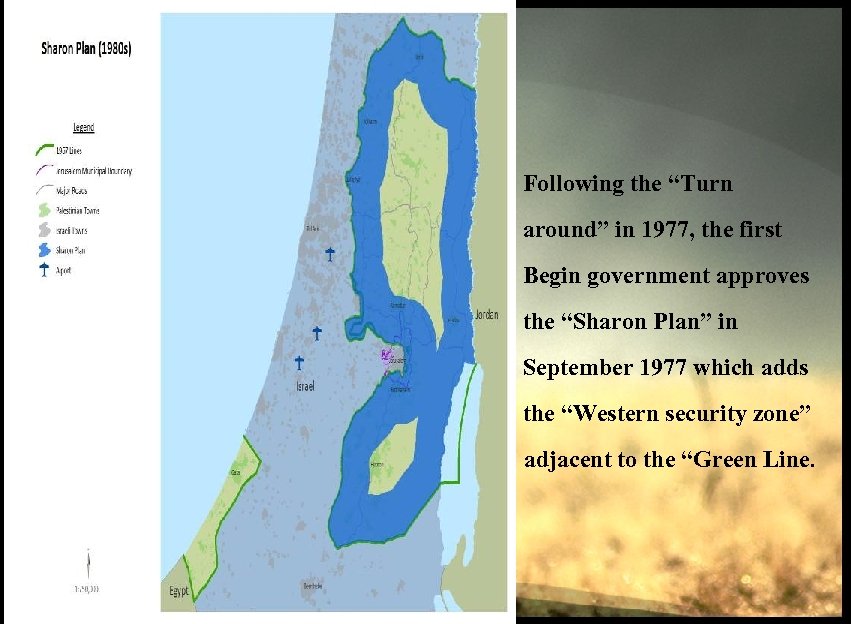
Following the “Turn around” in 1977, the first Begin government approves the “Sharon Plan” in September 1977 which adds the “Western security zone” adjacent to the “Green Line.
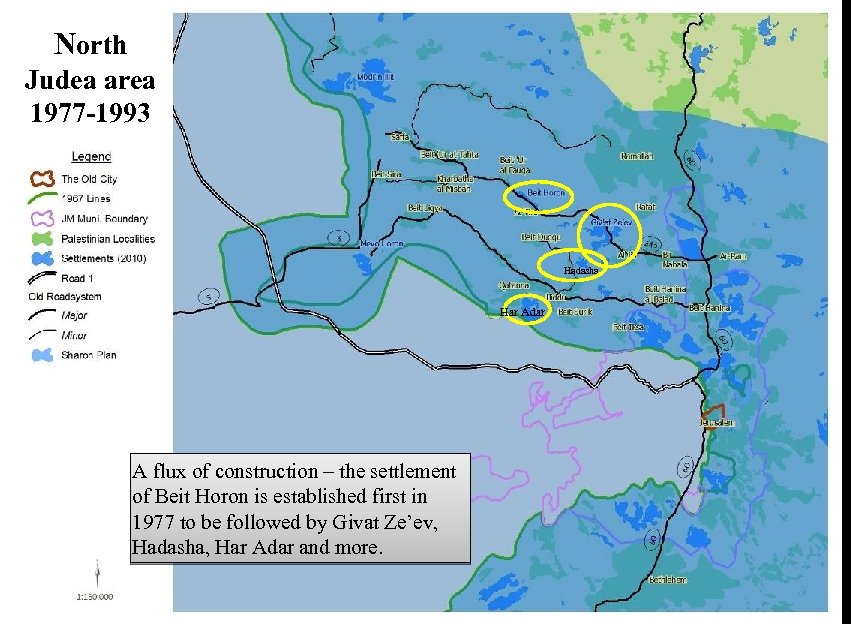
North Judea area 1977 -1993 Hadasha Har Adar A flux of construction – the settlement of Beit Horon is established first in 1977 to be followed by Givat Ze’ev, Hadasha, Har Adar and more.
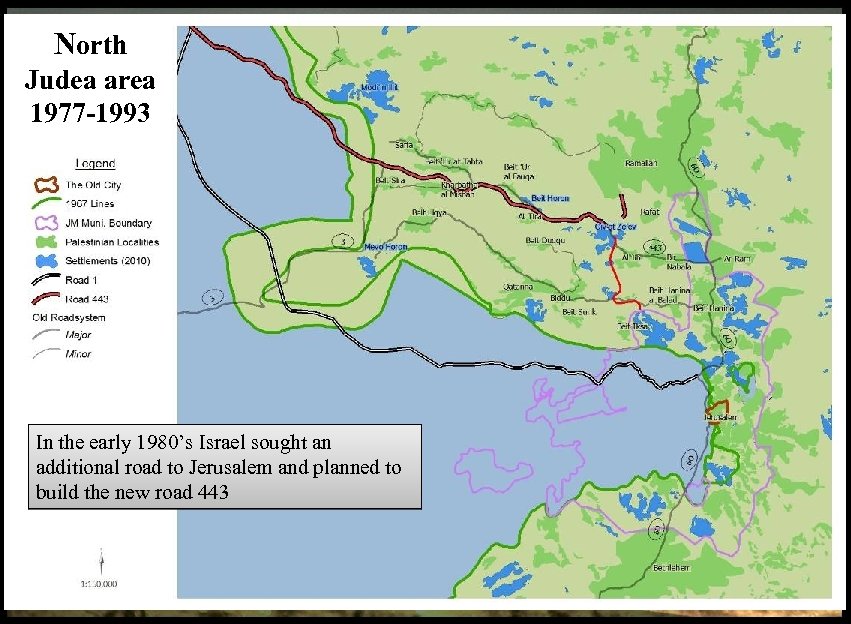
North Judea area 1977 -1993 In the early 1980’s Israel sought an additional road to Jerusalem and planned to build the new road 443
Building of the new road 443 The military commander issued expropriation orders for lands belonging to Palestinian residents of the area in favor of building road 443. In response to a petition to the High Court of Justice submitted by the residents in 1982 concerning the expropriation, the military commander declared that the purpose of the expropriation was “to improve the transportation connection between villages in the Beit Sira-Bitunya road and improve driving safety”. In other words, to safeguard the transportation needs of the local population from the villages to the regional metropolitan area of Ramallah (in line with international law principles). The High Court of Justice adds that “as it is stated, the planning of road 443 for the benefit of the local population assumed that the road will also serve Israeli residents and the transportation needs between the area and Israel”. Indeed, road 443 was built and served both populations until the year 2000. It shortened significantly the time and the comfort of driving from the villages to Ramallah.
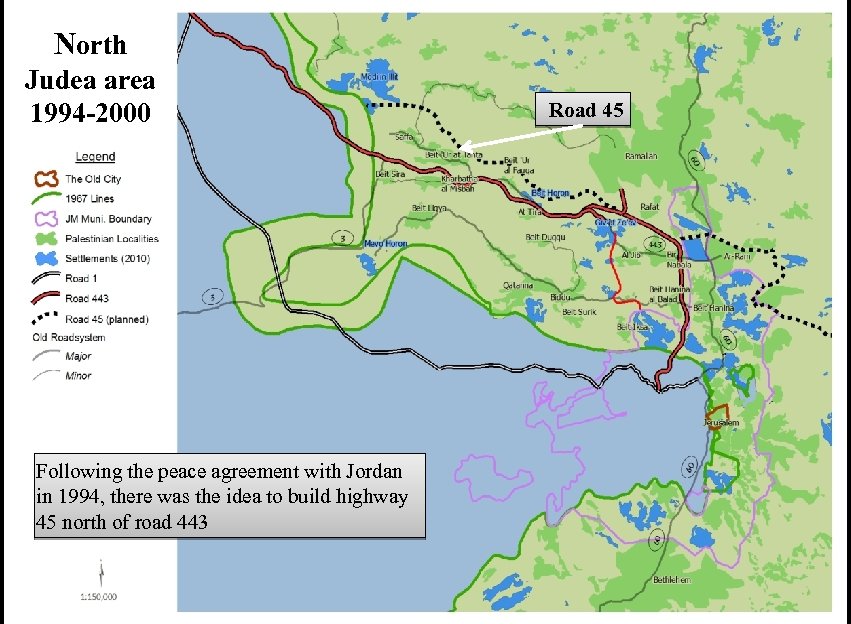
North Judea area 1994 -2000 Following the peace agreement with Jordan in 1994, there was the idea to build highway 45 north of road 443 Road 45
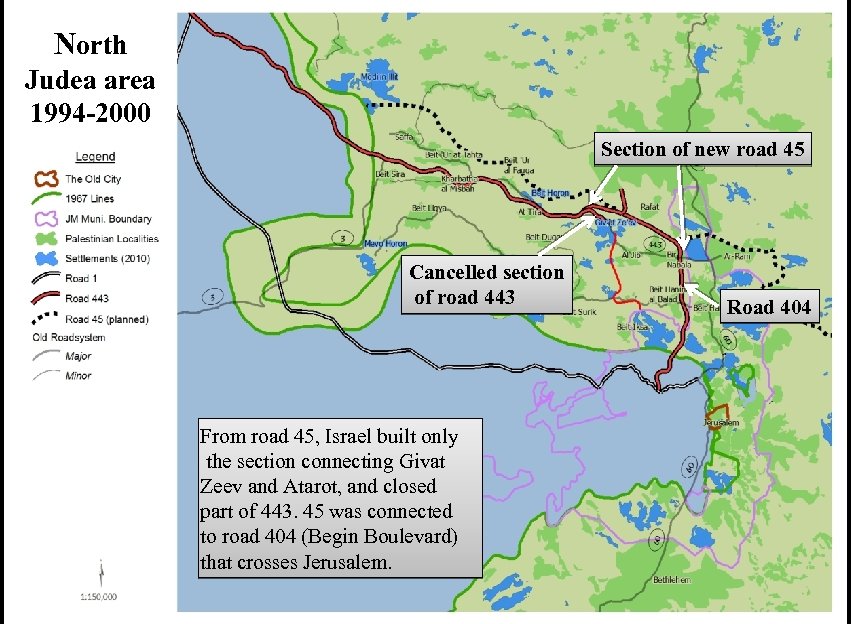
North Judea area 1994 -2000 Section of new road 45 Cancelled section of road 443 From road 45, Israel built only the section connecting Givat Zeev and Atarot, and closed part of 443. 45 was connected to road 404 (Begin Boulevard) that crosses Jerusalem. Road 404
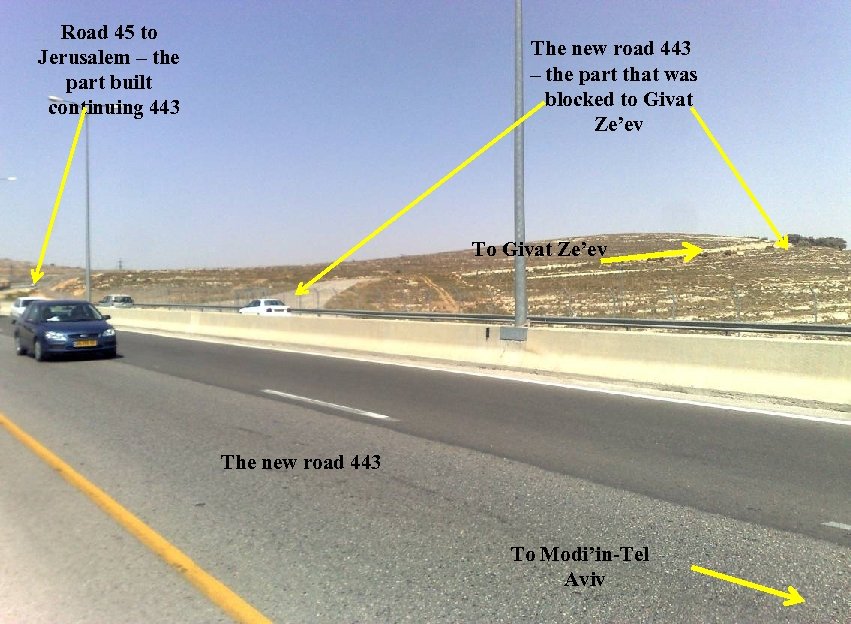
Road 45 to Jerusalem – the part built continuing 443 The new road 443 – the part that was blocked to Givat Ze’ev The new road 443 To Modi’in-Tel Aviv
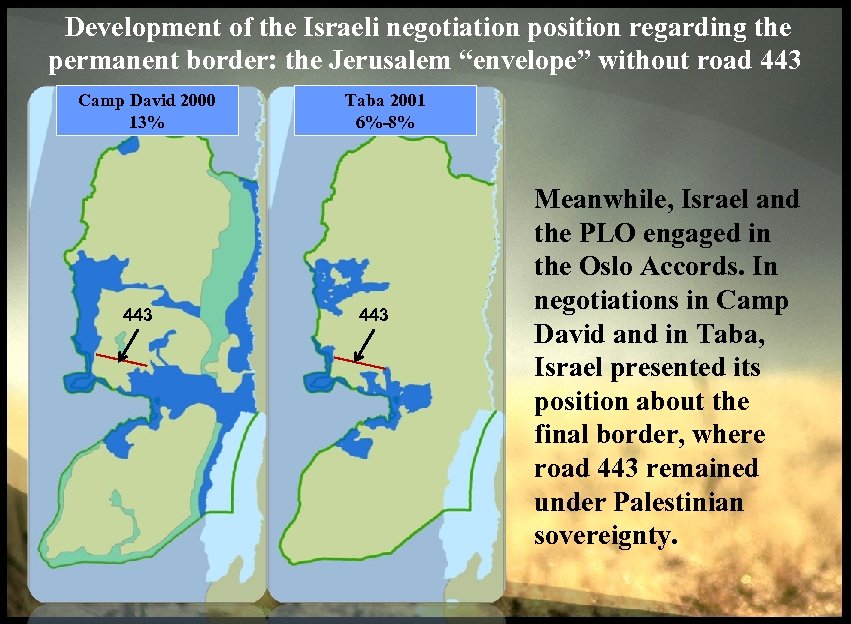
Development of the Israeli negotiation position regarding the permanent border: the Jerusalem “envelope” without road 443 Camp David 2000 13% 443 Taba 2001 6%-8% 443 Meanwhile, Israel and the PLO engaged in the Oslo Accords. In negotiations in Camp David and in Taba, Israel presented its position about the final border, where road 443 remained under Palestinian sovereignty.
The second Intifada Following the parties’ failure to reach a permanent status agreement, a wave of Palestinian terrorism erupted that included over 14, 000 attacks against Israeli citizens. The terrorism led to 1, 000 Israeli casualties and 6, 000 Israeli wounded, and forced Sharon and his government to decide about establishing the barrier. * Data from October 2000 -December 2009 The vast majority between 2001 -2003 (the height of the second Intifada).
The story of the separation fence started… The Supreme Court explains and determines that “…Regarding the authority of the military commander to build the separation fence in the area, it was ruled that according to the law of belligerent occupation, the military commander is authorized to instruct, by military considerations, the establishment of the separation fence in Judea and Samaria. . . This authorization is valid only when the essence of the establishment of the fence is military and defense considerations. We accept that the military commander cannot order the construction of the separation fence if his reasons are political. The separation fence cannot be motivated by a desire to "annex" territories to the State of Israel. The purpose of the separation fence cannot be marking a political border. ”
Despite this, it was not a secret that everyone considered the route of the fence to be the permanent border between Israel and Palestine • Livni – “the High Court of Justice delineates through its rulings on the fence the country’s borders” • Barak – “…When we build a fence it is clear that some areas are beyond the fence, and it is clear that in a permanent status agreement… these areas beyond the fence will not be part of the state of Israel” • Sharon – “…The Palestinian should have understood long ago that whatever they did not get today, it may be impossible to give tomorrow… the demographic consideration played a big role in determining the route of the separation barrier because of the concern about annexing hundreds of thousands of Palestinians who will coalesce with the Israeli Arabs…” • Olmert – “…the direction is clear, we are going towards separation from the Palestinians, to determine Israel’s permanent border”
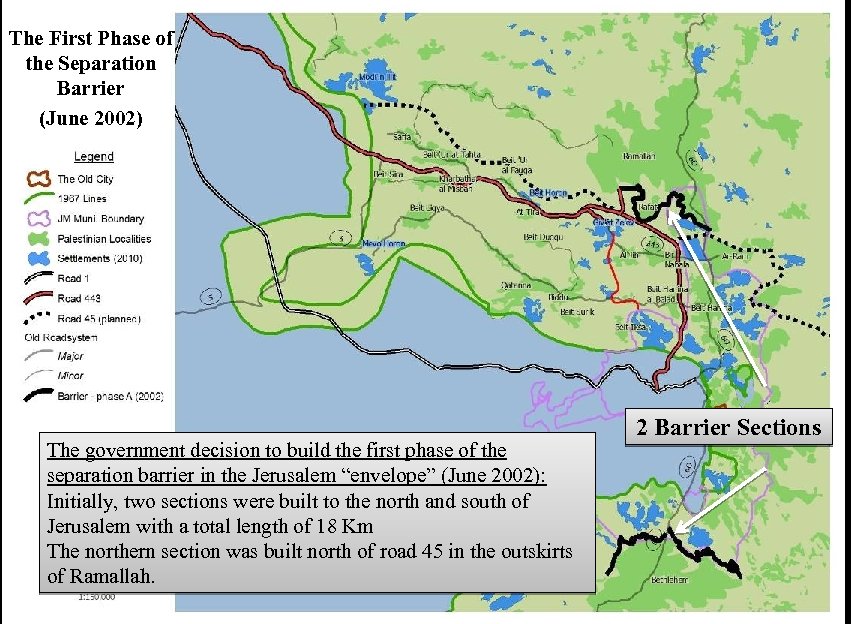
The First Phase of the Separation Barrier (June 2002) The government decision to build the first phase of the separation barrier in the Jerusalem “envelope” (June 2002): Initially, two sections were built to the north and south of Jerusalem with a total length of 18 Km The northern section was built north of road 45 in the outskirts of Ramallah. 2 Barrier Sections
… However, the attacks did not stop and Sharon was forced to bring to lay the route of the separation fence in the entire West Bank for authorization by his government, while he was determining the principles of the route “…The Palestinian should have understood long ago that whatever they did not get today, it may be impossible to give tomorrow… the demographic consideration played a big role in determining the route of the separation barrier because of the concern about annexing hundreds of thousands of Palestinians who will coalesce with the Israeli Arabs…” These are fully implemented in the area of Beit Horon and road 443/45
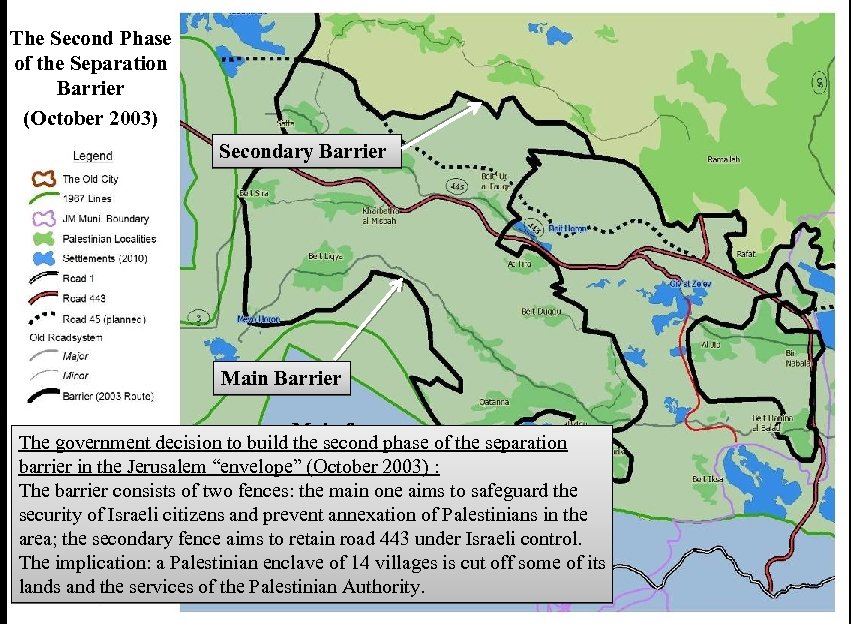
The Second Phase of the Separation Barrier (October 2003) Secondary Barrier Main fence The government decision to build the second phase of the separation barrier in the Jerusalem “envelope” (October 2003) : The barrier consists of two fences: the main one aims to safeguard the security of Israeli citizens and prevent annexation of Palestinians in the area; the secondary fence aims to retain road 443 under Israeli control. The implication: a Palestinian enclave of 14 villages is cut off some of its lands and the services of the Palestinian Authority.
The inclusion of road 443 in the “Israeli” side of the fence This move, the inclusion of road 443 in the “Israeli” side of the fence, is explained well by retired major general Uzi Dayan (in a radio interview to “Kol Barama”, May 30 2010) “ I was the National Security Advisor. There was a debate about where the security fence should go, and I said to then Prime Minister Ariel Sharon that the security fence is needed north of road 443, so as to create a situation that Jerusalem has two strategic roads. There was a big argument about this and at the end you know what he said, he told me look I understand what you are saying but this is too big a bite…” In other words, at the foundation of the route of the separation barrier there was the intention to turn road 443 to a “service” road for the passage of Israelis only from the coastal plains to Jerusalem – a decision outside the jurisdiction of the military commander, as ruled by the High Court of Justice. “The Military commander may not consider the national, economic, social interests of his own country, to the extent that they have no bearing on his security interest in the area or the interest of the local population. Even the needs of the military are military needs and not national security needs in the broader sense… an area held under military occupation is not open for economic or other exploitation” And in a clearer form: “The military government may not plan and execute a system of roads in the area held under military occupation if the aim of such planning and execution are to provide a “service road” to his own country… Such planning and execution may not be done to serve the occupying country”.
From the understanding that annexing the area north of 443 is indeed “too big a bite”, I assessed back then that the chances that such a route would pass through the international and legal system is close to zero. This is what Amnon Brazilay wrote in Ha’aretz newspaper on February 18 2004: “in recent months, retired colonel Shaul Arieli tours the country and the world with his laptop trying to convince with a presentation he prepared that the current route of the separation fence cannot work. The twisted route delineated by Sharon and the heads of the defense establishment will create enclaves inside Palestinian areas and will disconnect villages from the large Palestinian cities and therefore…, he clarifies, there is not a chance that the world will accept the route of the fence in its current state. ”
And so it was! On July 9 2004 the advisory opinion of the International Court of Justice in The Hague was published. The court ruled that building the fence in the route presented to it with its associated regime is a violation of international law. It furthered determined that it is Israel’s obligation to dismantle the fence and compensate for damages it caused (the Court did not deny the right of Israel to establish a barrier – within its own territory). On June 30 2004 the High Court of Justice rules in a petition of residents of Beit Surik and Mevaseret Zion, with the participation of the Council for Peace and Security, that building the fence is legal in principle but for the first time it disallowed a 30 Km section of the fence claiming that the damage to Palestinian rights is disproportional to the security benefit.
The Justice Ministry quickly prepared an expert opinion about the expected implications for Israel in the international arena, in light of the advisory opinion of International Court in The Hague, which was adopted by the UN General Assembly with a 150 states majority. For this reason, the Israeli government dismantled an 8 Km section of the fence in Baka a-Arbiya and rebuilt it on the Green Line, and on February 20 2005 it approved a new route for the separation fence. Its essence was dismissing the notion of an eastern fence in the Jordan Valley, cancelling the “depth fences” and reduction of the territory in the “Israeli” side of the fence from 18% of the West bank area to 9%!
However despite the dramatic change in the route of the fence, and despite the fact that there is no Israeli settlement or facility on the Bitunya range (Sheikh Zeitoun), Israel decided to leave the route of the fence north of road 443, 2. 5 Km from Givat Ze’ev, thus including in the “Israeli” side of the fence a 5 Km section of the road. It is this fact, and not the “security suit” to road 443, that deems all subsequent developments resemble the saying: “a stone thrown to a well by a fool may not be brought out by a thousand wisemen”. It is this fact that requires investing a fortune, half a billion Shekels, so as to arrange the bare minimum of Palestinian liveling arrangements that were hurt by the route.
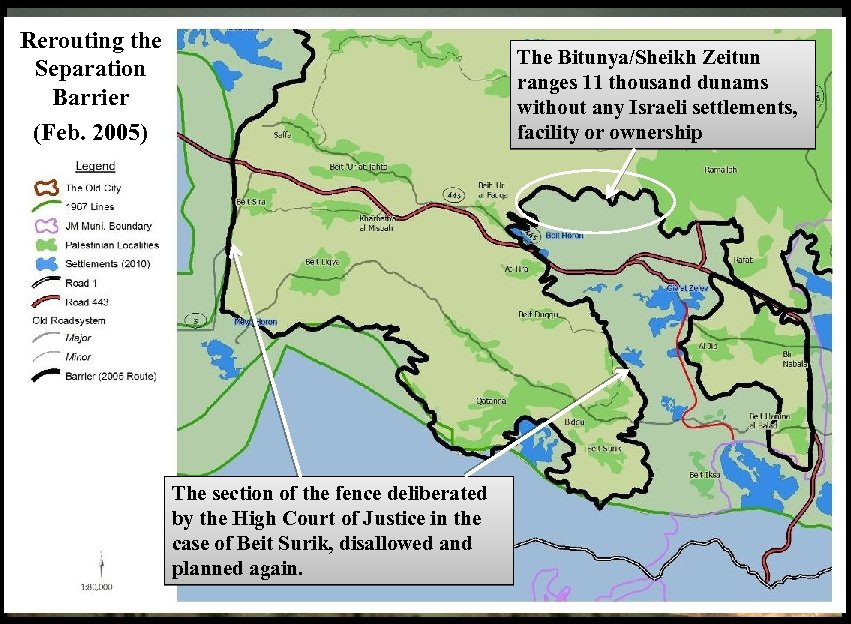
Rerouting the Separation Barrier (Feb. 2005) The Bitunya/Sheikh Zeitun ranges 11 thousand dunams without any Israeli settlements, facility or ownership The section of the fence deliberated by the High Court of Justice in the case of Beit Surik, disallowed and planned again.
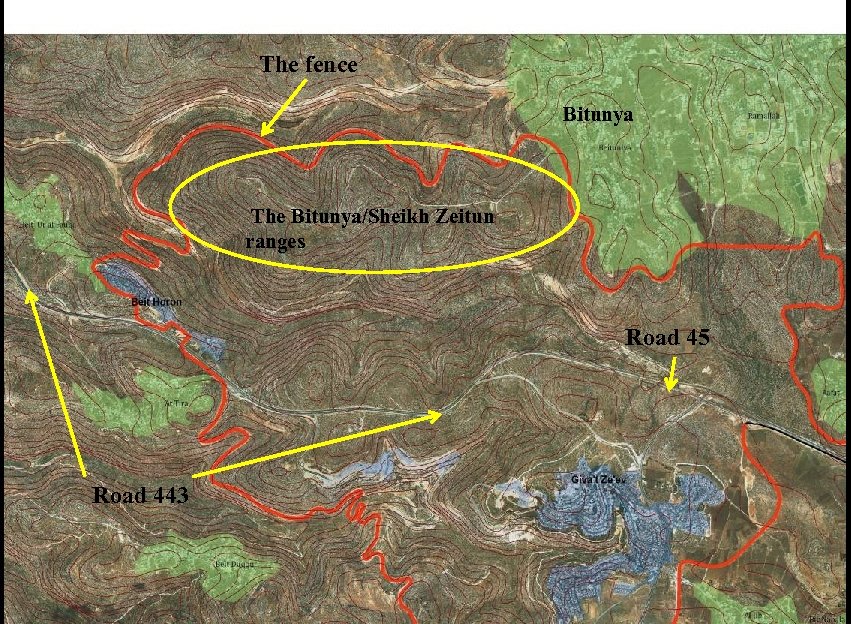
The fence Bitunya The Bitunya/Sheikh Zeitun ranges Road 45 Road 443
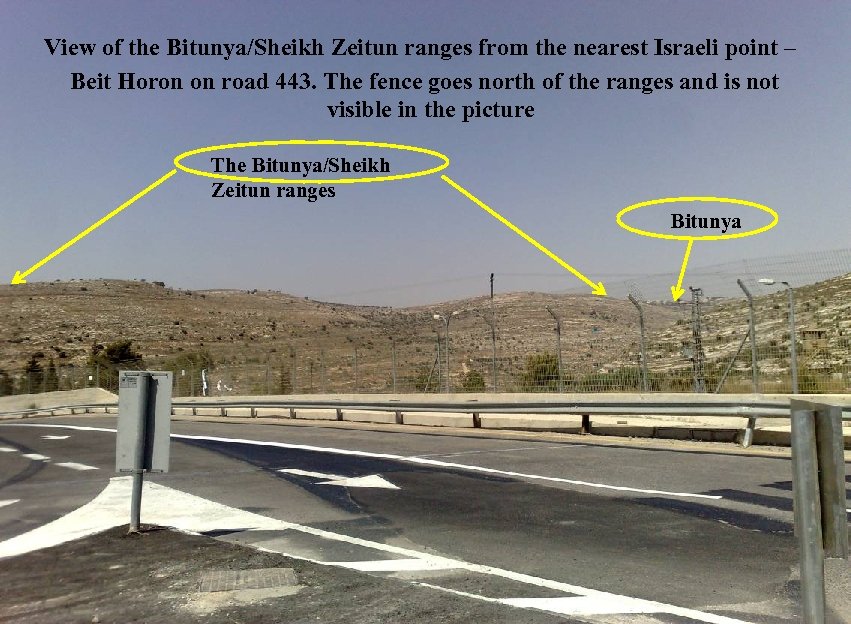
View of the Bitunya/Sheikh Zeitun ranges from the nearest Israeli point – Beit Horon on road 443. The fence goes north of the ranges and is not visible in the picture The Bitunya/Sheikh Zeitun ranges Bitunya
This was not enough for Israel. It “pulled” the route of the fence westwards to ensure the building of two new Israeli neighborhoods connecting Beit Horon to Givat Ze’ev – the Mashav neighborhood for religious population and the Agan Ha’ayalot neighborhood for the ultra-orthodox population (talking about “natural growth”) Consider the security, budgetary and environmental implications of this decision…
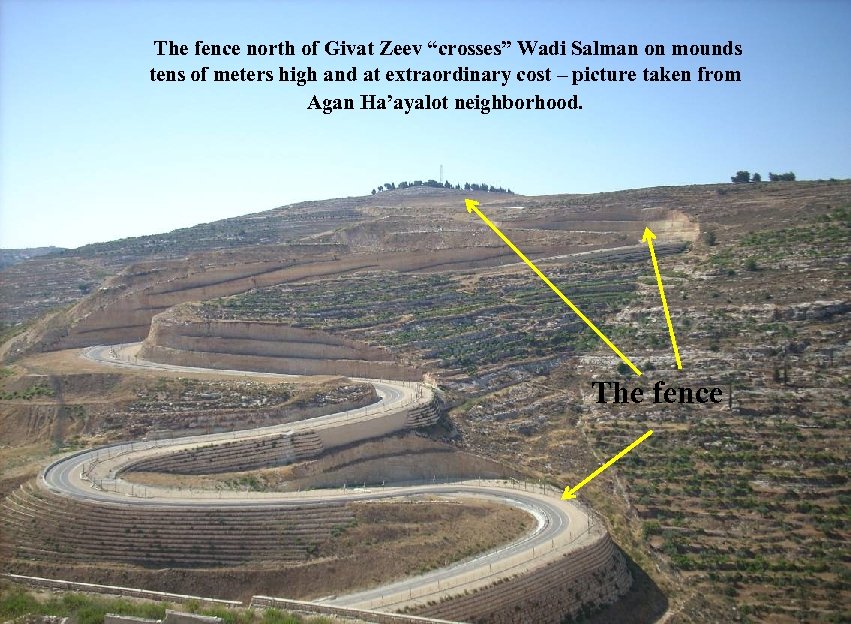
The fence north of Givat Zeev “crosses” Wadi Salman on mounds tens of meters high and at extraordinary cost – picture taken from Agan Ha’ayalot neighborhood. The fence
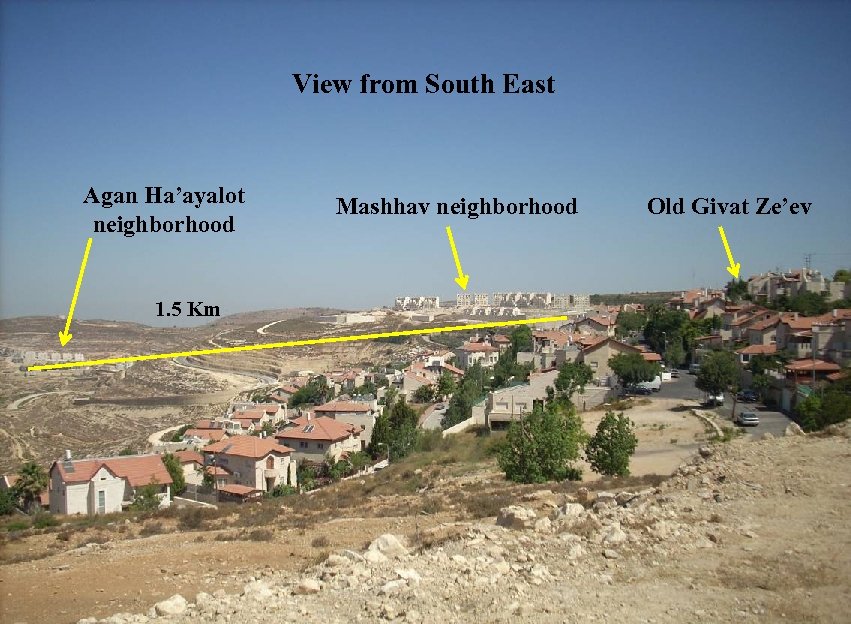
View from South East Agan Ha’ayalot neighborhood 1. 5 Km Mashhav neighborhood Old Givat Ze’ev
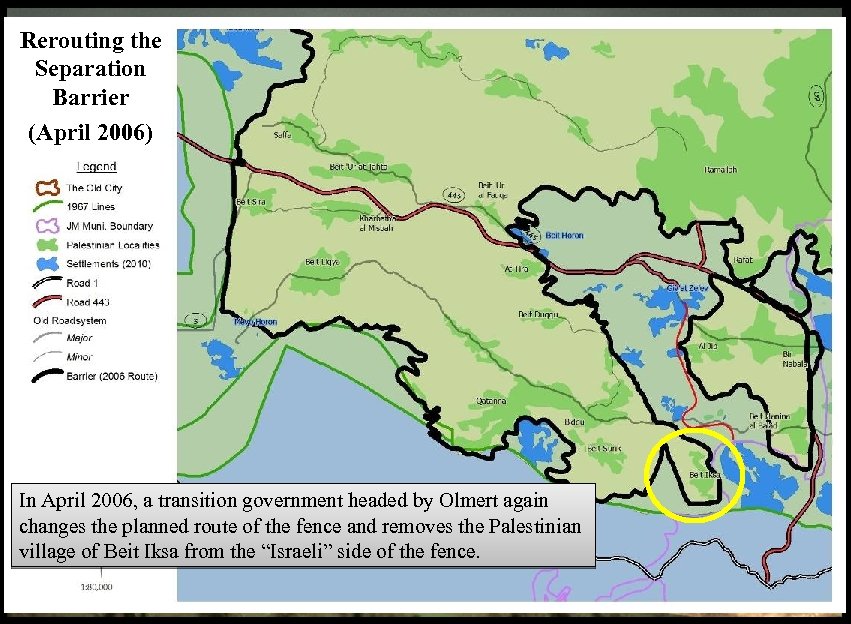
Rerouting the Separation Barrier (April 2006) In April 2006, a transition government headed by Olmert again changes the planned route of the fence and removes the Palestinian village of Beit Iksa from the “Israeli” side of the fence.
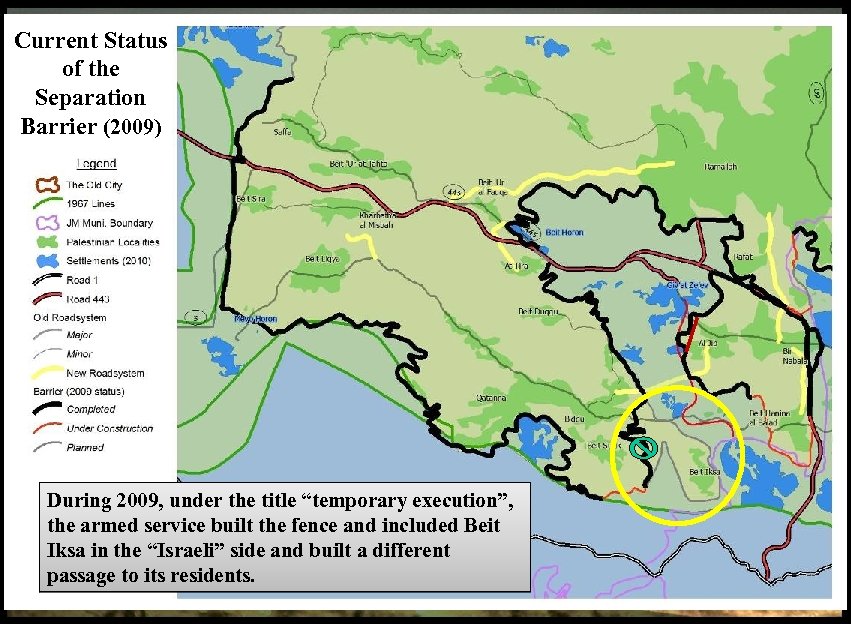
Current Status of the Separation Barrier (2009) During 2009, under the title “temporary execution”, the armed service built the fence and included Beit Iksa in the “Israeli” side and built a different passage to its residents.
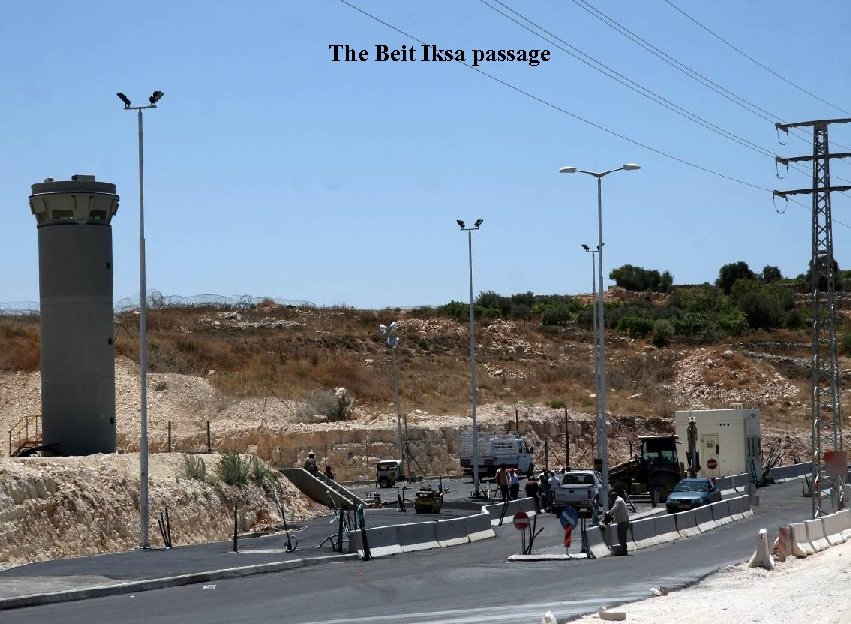
The Beit Iksa passage
What followed the decision to include road 443 in the “Israeli” side of the fence? A plan for the shaping of a new Palestinian living fabric in the shape of roads, passages, control and check points, all built between 2007 -2009 at the cost of half a billion Sekels!
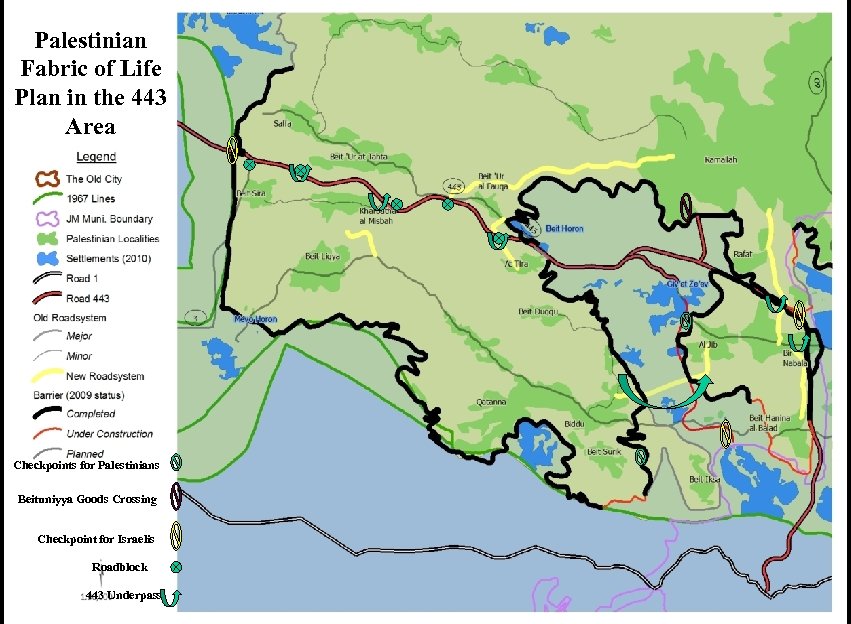
Palestinian Fabric of Life Plan in the 443 Area Checkpoints for Palestinians Beituniyya Goods Crossing Checkpoint for Israelis Roadblock 443 Underpass
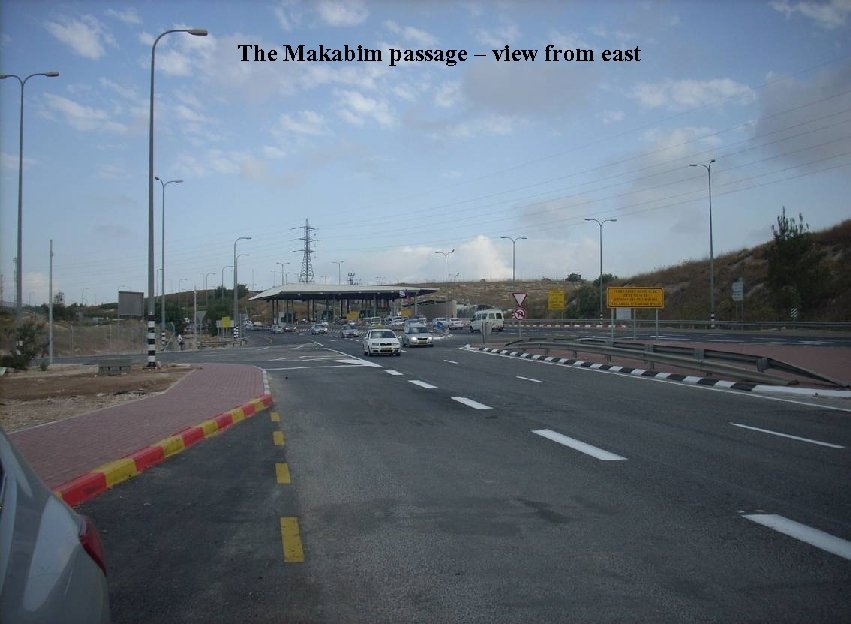
The Makabim passage – view from east
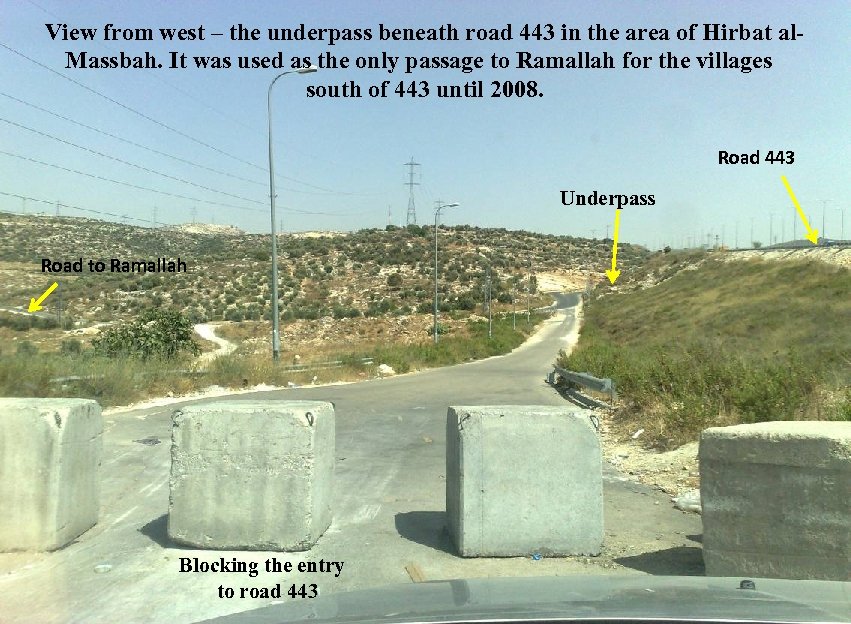
View from west – the underpass beneath road 443 in the area of Hirbat al. Massbah. It was used as the only passage to Ramallah for the villages south of 443 until 2008. Road 443 Underpass Road to Ramallah Blocking the entry to road 443
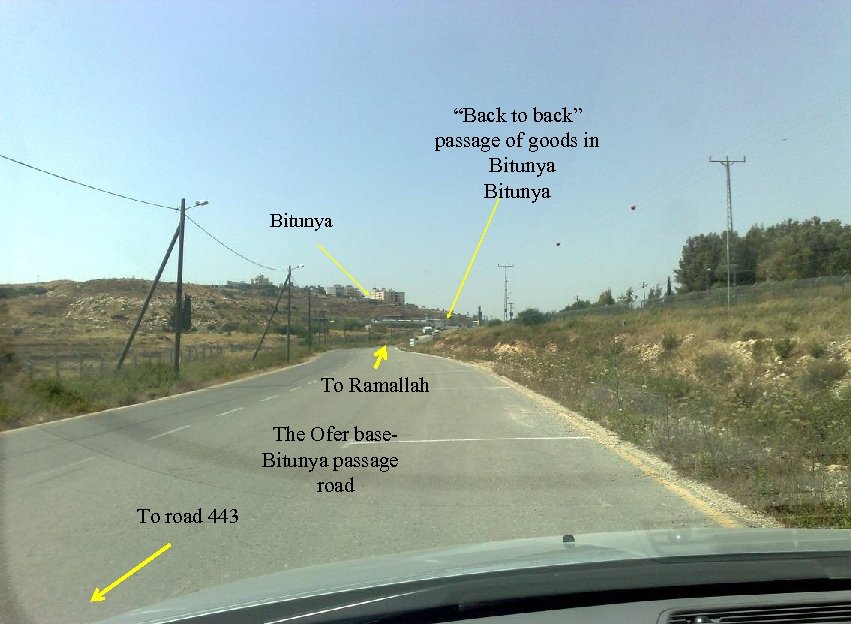
“Back to back” passage of goods in Bitunya To Ramallah The Ofer base. Bitunya passage road To road 443
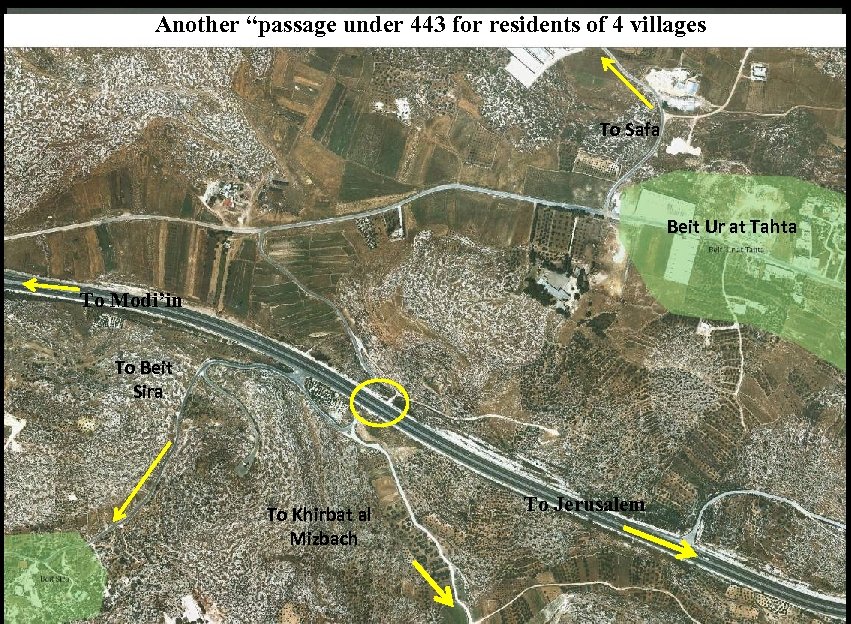
Another “passage under 443 for residents of 4 villages To Safa Beit Ur at Tahta To Modi’in To Beit Sira To Khirbat al Mizbach To Jerusalem
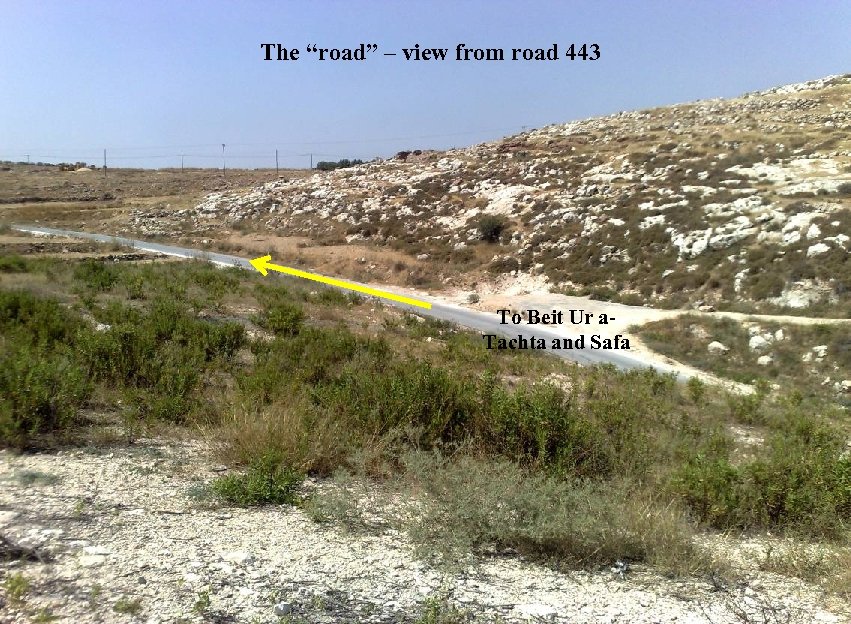
The “road” – view from road 443 To Beit Ur a. Tachta and Safa
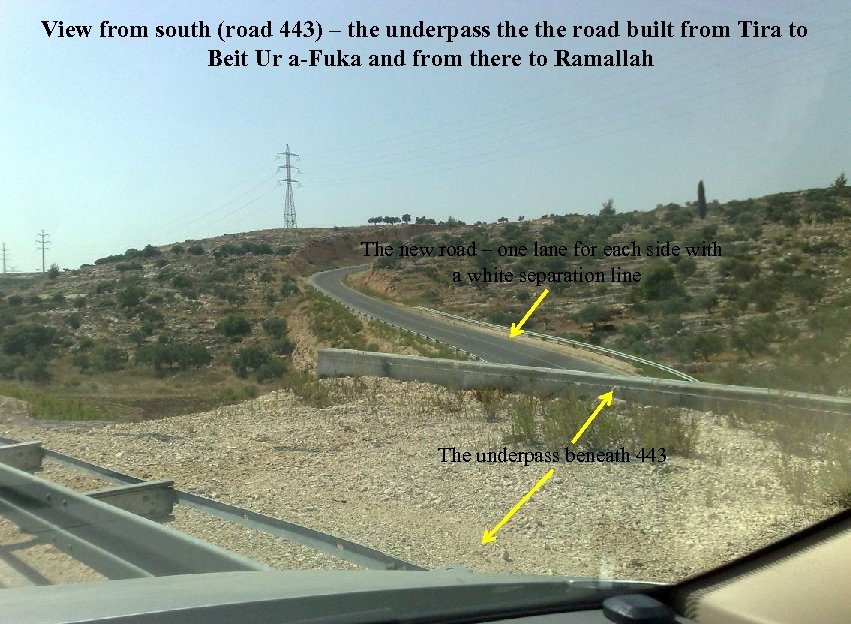
View from south (road 443) – the underpass the road built from Tira to Beit Ur a-Fuka and from there to Ramallah The new road – one lane for each side with a white separation line The underpass beneath 443
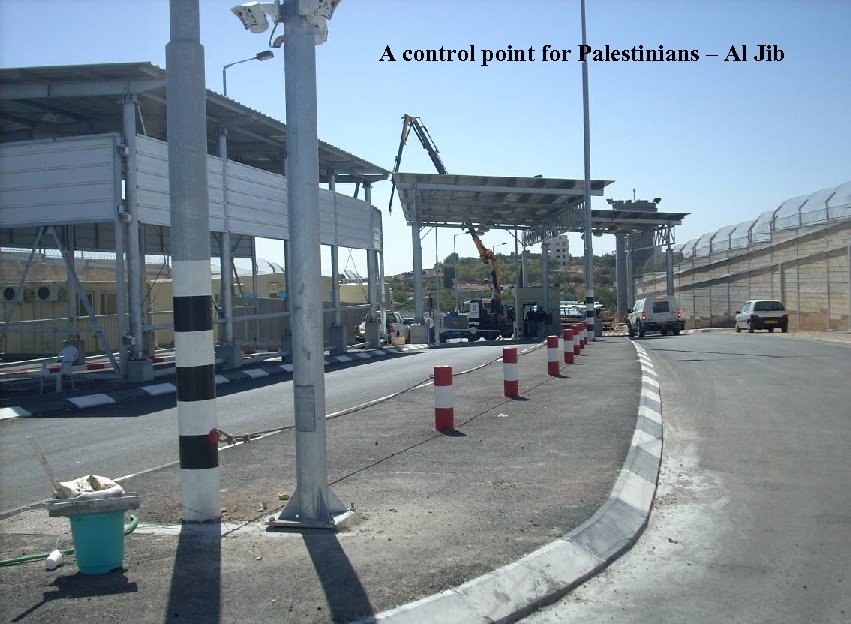
A control point for Palestinians – Al Jib
And now, to the brief history of the traffic prohibition on 443 Some 40, 000 Israeli cars travel on road 443 daily. The reality of terrorist attacks did not pass it by. Fatal attacks included shootings, throwing stones and Molotov cocktails. In 2001 a partial prevention began through checkpoints and security patrols that drove Palestinians away from the road. From 2002 – the prohibition became absolute. All access roads connecting the villages to road 443 were blocked, with villagers unable to make any use of the road. Residents of A-Tira, a village that has no other road other than its connection to 443, were forced to get a permit which was given only to a few taxis that allowed them to leave the village, until they opened by themselves a dirt road to a neighboring village (Beit Dako).
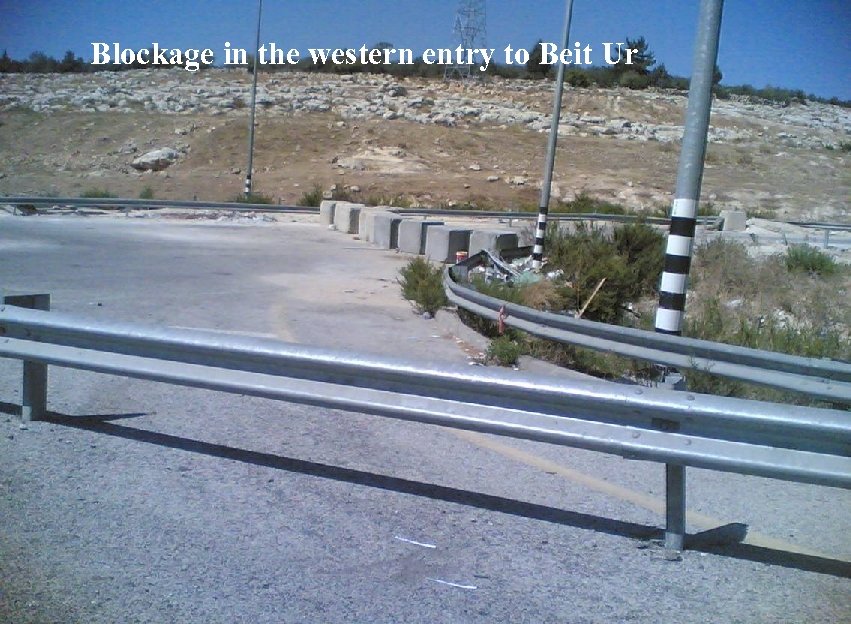
Blockage in the western entry to Beit Ur
A brief history of the traffic prohibition on 443 - continues During 5 years, the Association for Civil Rights in Israel (Adv. Yehuda Limor) petitioned the security system on behalf of the heads of villages to remove the blockages and allow the passage of Palestinian vehicles, but was denied! “… Not only was the demand not met” describes the High Court of Justice, “but the office of the legal council in Judea and Samaria in a letter dated June 18, 2006, claimed – contrary to the situation on the ground – that IDF forces do not prevent Palestinian traffic on the road…. . Following that answer the petition was submitted. Only following the submission of the petition on August 28, 2007, did major general Gadi Shamni issue an order prohibiting passage of non-Israeli vehicles on road 443, unless they have permission. . ”
A brief history of the traffic prohibition on 443 - continues The prohibition on Palestinian traffic allowed Israel to do without building passages on exits from road 443 (Makabim and Atarot) in the size necessary for the needed security checks. In the absence of Palestinian vehicles and seeking to prevent delays to Israeli traffic, the security checks in the passages is indeed sorely missed! Further, Israel used the space that “became available” on the road, and has in the past year diverted truck traffic from road 1 to road 443 during busy hours. According to a research published recently by the Jerusalem Institute, the savings to the Israeli economy owing to the reduction in traffic delays on road 1 is 350 million Shekels.
What did the High Court of Justice rule in December 2009? Judge Fogelman ruled that “The traffic restrictions imposed today by the answering party, which mean an absolute prohibition on the movement of protected residents (Palestinians) on the road, may not stay in their current form: both for lack of authority and lack of proportionality, therefore the traffic directive as well as the decision of the military commander to fully prohibit traffic of village residents must be cancelled”. At the same time, Judge Fogelman ruled that “we saw no reason to enter the decision of the military commander and force the answering party to change the operation of the Bitunya passage” (i. e. the road section between the Ofer Base junction and the Bitunya passage leading to Ramallah will not be opened).
High Court of Justice ruling in December 2009 – continued Lack of authority – With regard to admission by the answering party that road 443 is “a central traffic artery, which connects the coastal plains area and Modi’in block to the Jerusalem area. Along with road 1, road 443 constitutes one of the two access roads to the capital”, the court ruled that “if this would have been the aim at basis of building the road, the military commander would not have had the authority to instruct to build the road in the first place” It added an explanation that “the military administration may not plan and execute a system of roads in an area under military occupation, if the aim of such planning or such execution are to provide a “service road” to his own country… Such planning and execution may not take place to serve the occupying country”.
High Court of Justice ruling in December 2009 – continued Lack of proportionality – “the freedom of movement may be restricted, as mentioned, for military –security reasons. Movement restrictions may be imposed that have security benefit but a complete prohibition on the movement of protected residents is not the only mean to attain the security purpose. As is common in other roads in the area, movement restrictions may be applied that do not amount to a full prohibition”. With regard to the claims of the answering party that an alternative road was built for them, the judges ruled that Opening of the living fabric road Beit Ur-Bitunya, announced by the answering party, brought to a real moderation in the level of harm to the living fabric of the Palestinian residents. But there is no argument that this is not a multi-lane road the like of road 443, but a lower grade dual track road and is not comparable to road 443. At the same time, it does enable access to regional metropolis. ”
High Court of Justice ruling in December 2009 – continued At the end of its principle ruling the court determines that “our words so far do not imply that the military commander must allow villagers free and uninterrupted access to road 443. The military commander laid before us detailed and convincing infrastructure based on data accumulated over time that points at a real threat from such uncontrolled traffic. Without prescribing other traffic arrangements that the military commander may delineate, one must not rule out a delineated arrangement through which entry of area residents onto the road will be limited to such point or points determined by the military commander due to security considerations and conditioned by adequate security check… In the framework of the traffic arrangements to be determined, the fate of the blockades posed on access roads to villages should also e determined”. Despite the great detail provided by judge Fogelman, he concludes that “accept the above, I do not adopt at this stage a position with regard to a future arrangement or its details”.
What does that mean? In detailing the propose security plan and denying the petition to open part of the road to Bitunya, the High Court of Justice allowed and the IDF committed to redeployment of fences and checkpoints that fully annul the main purpose of building the road – “to improve the transportation connection between villages on the Beit Sira-Bitunya road and improve driving safety”. With addition of tens of millions of Shekels and in the name of security, the political purpose of shaping reality before a permanent status arrangement was met under the absurd assumption that the Palestinians would accept the fence route as a permanent border.
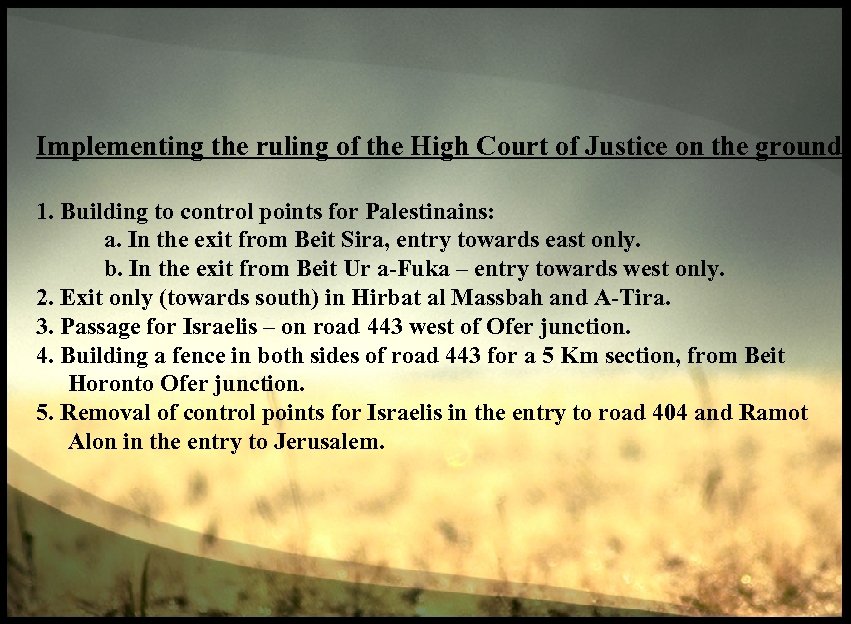
Implementing the ruling of the High Court of Justice on the ground 1. Building to control points for Palestinains: a. In the exit from Beit Sira, entry towards east only. b. In the exit from Beit Ur a-Fuka – entry towards west only. 2. Exit only (towards south) in Hirbat al Massbah and A-Tira. 3. Passage for Israelis – on road 443 west of Ofer junction. 4. Building a fence in both sides of road 443 for a 5 Km section, from Beit Horonto Ofer junction. 5. Removal of control points for Israelis in the entry to road 404 and Ramot Alon in the entry to Jerusalem.
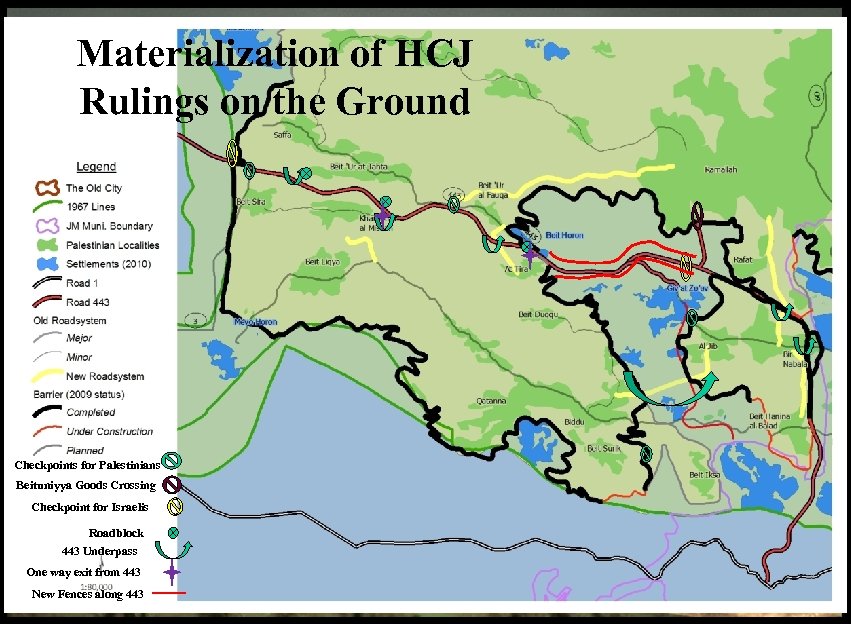
Materialization of HCJ Rulings on the Ground Checkpoints for Palestinians Beituniyya Goods Crossing Checkpoint for Israelis Roadblock 443 Underpass One way exit from 443 New Fences along 443
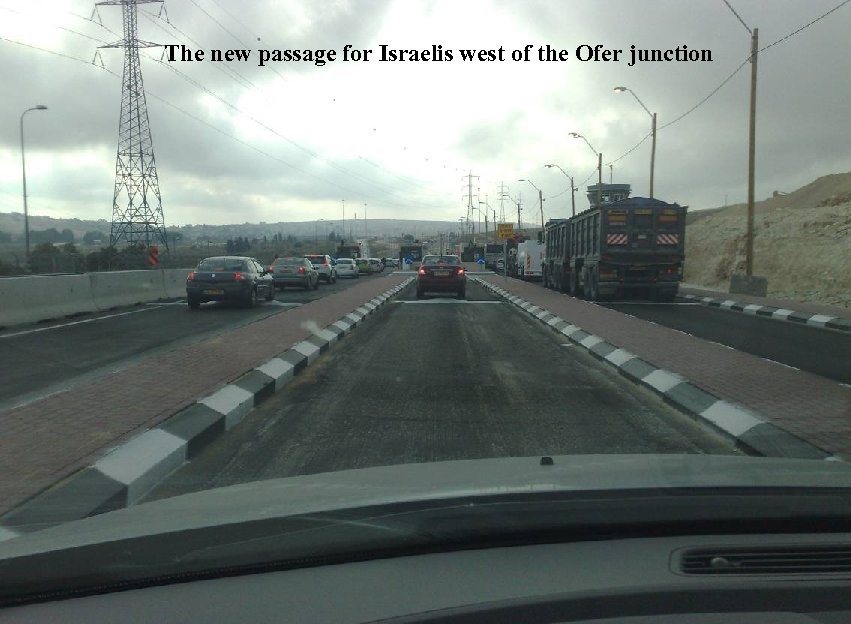
The new passage for Israelis west of the Ofer junction
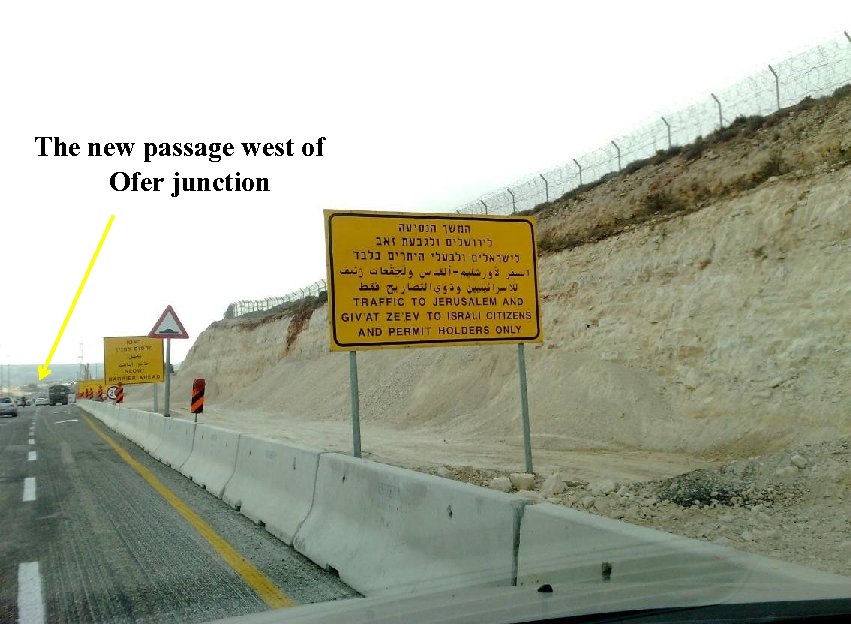
The new passage west of Ofer junction
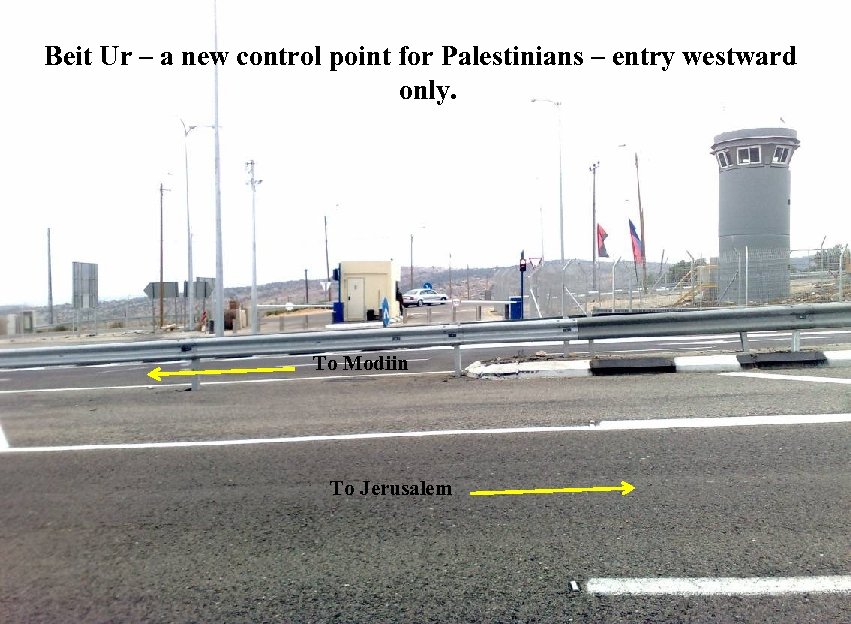
Beit Ur – a new control point for Palestinians – entry westward only. To Modiin To Jerusalem
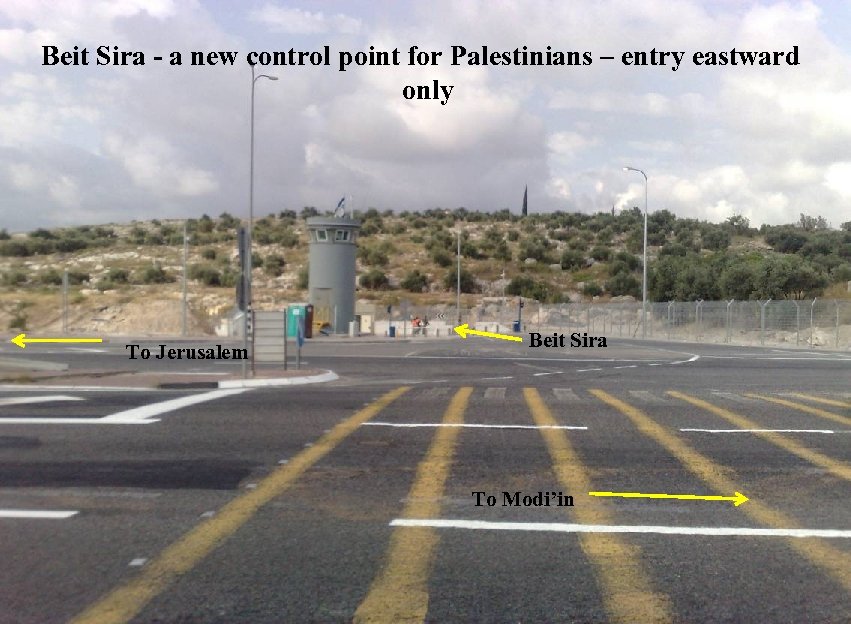
Beit Sira - a new control point for Palestinians – entry eastward only To Jerusalem Beit Sira To Modi’in
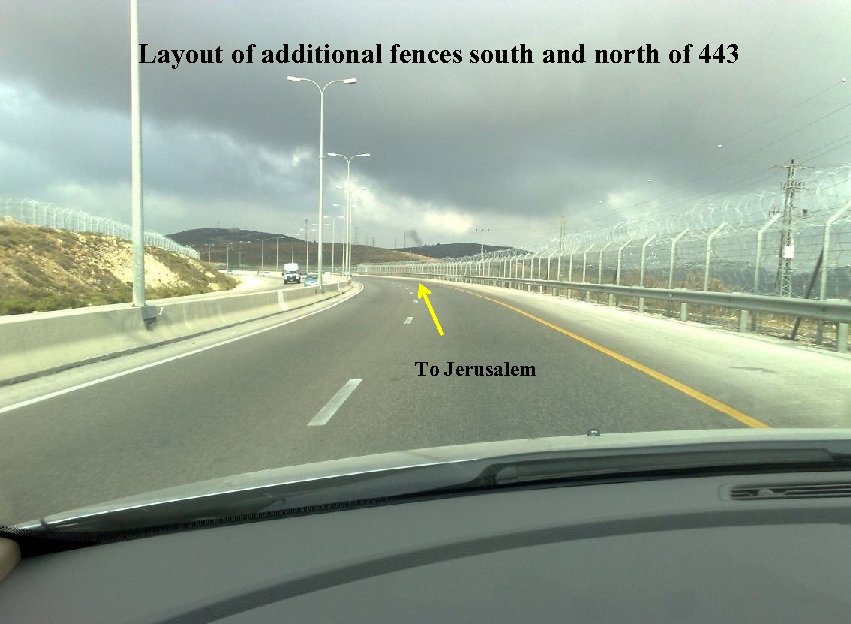
Layout of additional fences south and north of 443 To Jerusalem
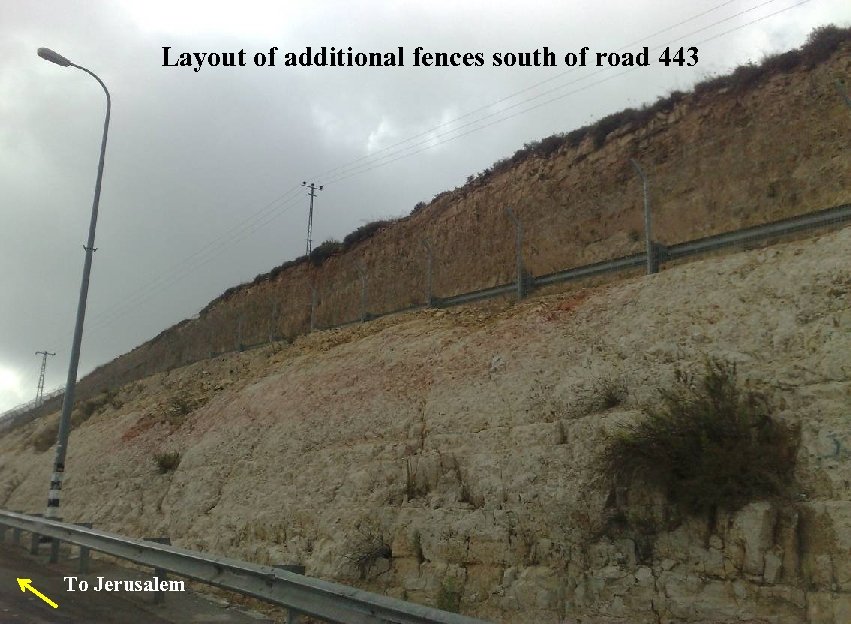
Layout of additional fences south of road 443 To Jerusalem
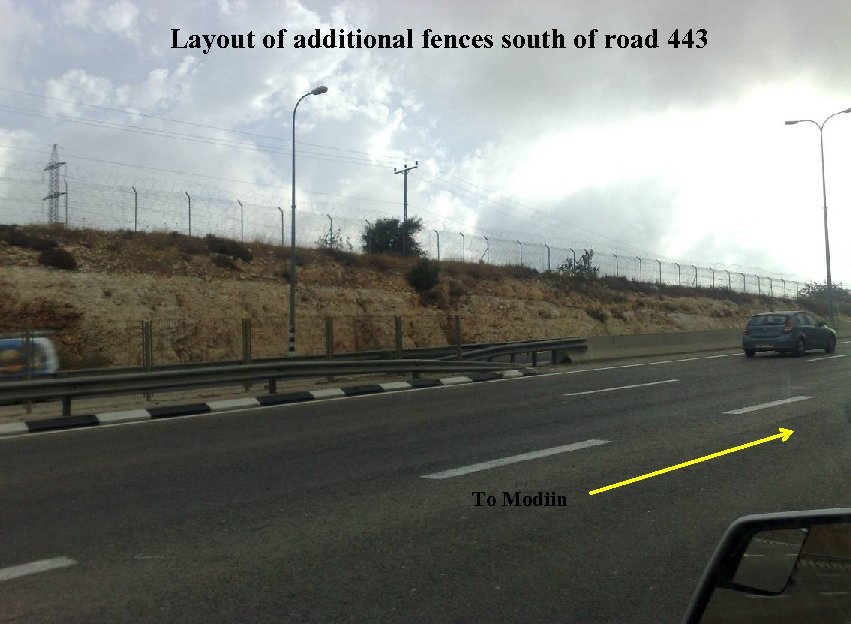
Layout of additional fences south of road 443 To Modiin
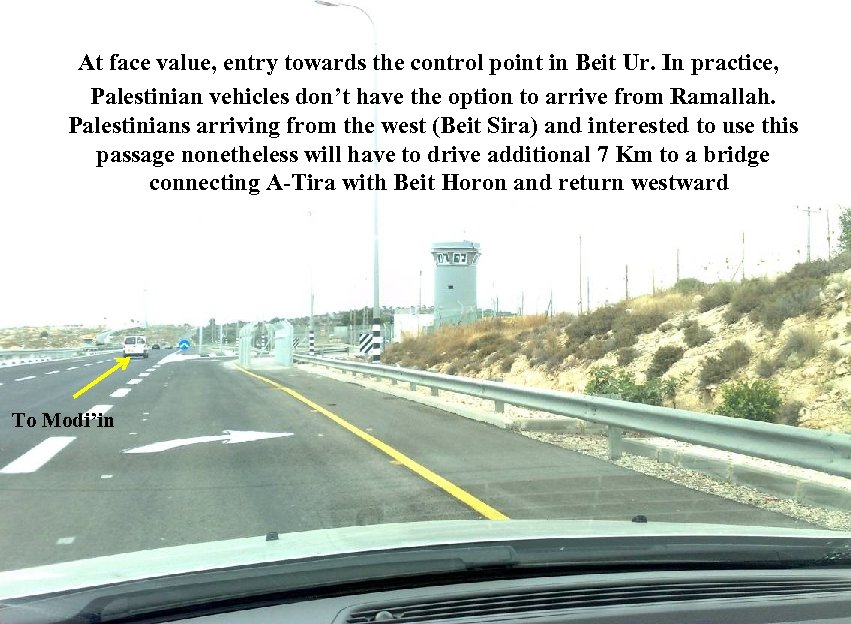
At face value, entry towards the control point in Beit Ur. In practice, Palestinian vehicles don’t have the option to arrive from Ramallah. Palestinians arriving from the west (Beit Sira) and interested to use this passage nonetheless will have to drive additional 7 Km to a bridge connecting A-Tira with Beit Horon and return westward To Modi’in
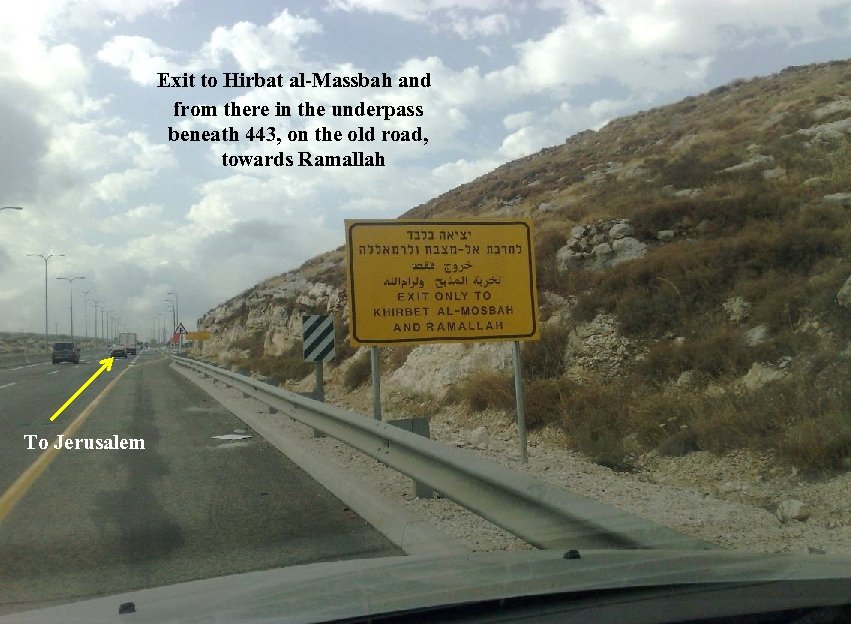
Exit to Hirbat al-Massbah and from there in the underpass beneath 443, on the old road, towards Ramallah To Jerusalem
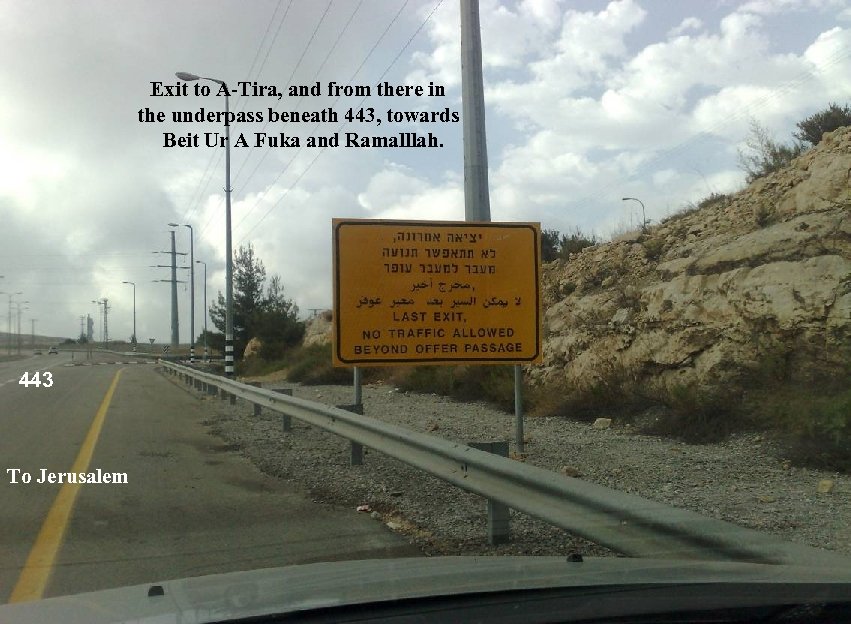
Exit to A-Tira, and from there in the underpass beneath 443, towards Beit Ur A Fuka and Ramalllah. 443 To Jerusalem
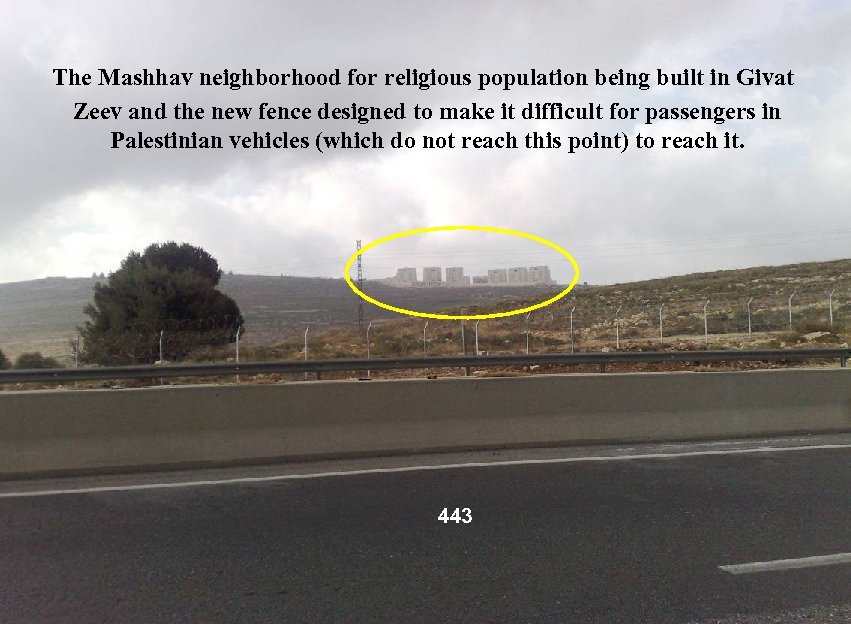
The Mashhav neighborhood for religious population being built in Givat Zeev and the new fence designed to make it difficult for passengers in Palestinian vehicles (which do not reach this point) to reach it. 443
What does this mean in practice? Out of 17 Km of road paved on Palestinian land to improve the villagers’ access to Bitunya 6. 5 Km were excluded: 1. 5 Km, from the Ofer junction to Bitunya junction, 1 Km east of the new passage for Israelis and additional 4 Km located east of the last exit towards A-Tira. For those traveling from east to west – the first and only entry to 443 is in Beit Ur. Only after following a thorough security test can the vehicle enter road 443 but only until Beit Sira (all other exits are blocked). For those travelling from west to east – the only and first point of entry to 443 is in Beit Sira. Only following a thorough security test can the vehicle enter road 443, exit to Hirbat A-Massbah or A-Tira, and from there, in the old-new roads to Ramallah.
What else have we “gained” from this story? Building the passage for Israelis in the Ofer base enabled the removal of control points for Israelis in Atarot and Ramot, in the entry to Jerusalem. This move de facto annexed the entire area of Givat Zeev, Beit Horon and Jerusalem, Israel
Do we now understand why, even after the High Court of Justice ruling that determined to annul the decree stopping Palestinians from using 443, we still do not see them use it? !!!

Is there another alternative?
Yes. A proposal by the Council for Peace and Security. That was presented to the security system as early as the end of 2003. It came to deliberation at the High Court of Justice, however the court refrained from discussing it because there has not been a petition against the “too big of a bite”. The route of the barrier north of road 443 that annexes 5 Km from the road and the Bitunya ranges to the “Israeli” side of the fence.
The main tenets of the alternative presented by the Council for Peace and Security The route of the fence will be south of road 443 and will enable share and secured use similar to other roads in the West Bank. Establishing two passages for Israelis – In Macabim and in Atarot (including passage of goods). Opening the section of road 443 that was closed towards Givat Zeev, building an interchange and control points for those exiting and entering the place from the west. That’s it!!!!
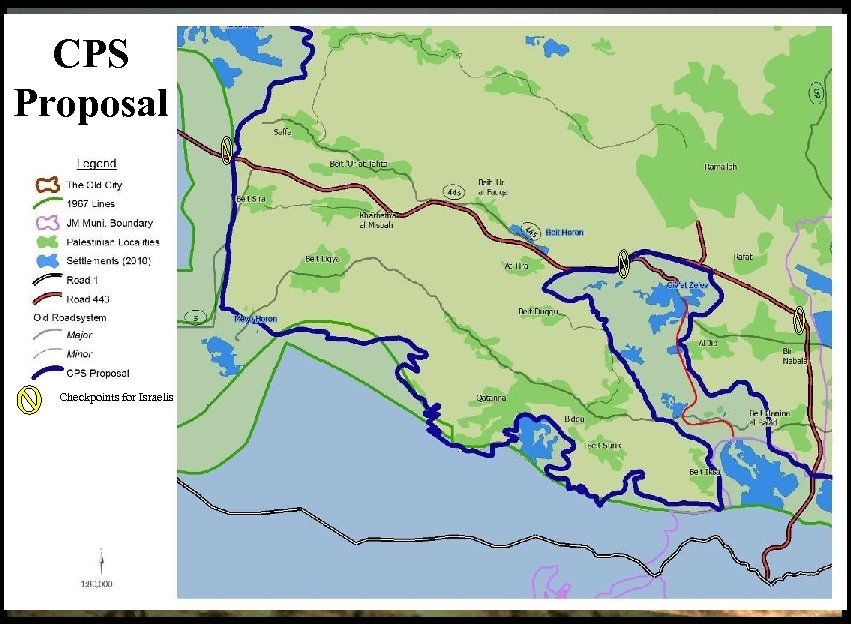
CPS Proposal Checkpoints for Israelis
How about the safety of Israeli passengers on road 443? I shall discuss the claims offered by the security system to explain the directive prohibiting Palestinian passage
1. Road 443 is unique in its traffic volume, fast and may be easily used to escape to neighboring villages. But road 5, road 60, road 1 to the east (from Ma’ale Edumim) and others have the same characteristics, yet the IDF guards them in a different manner than prohibition of Palestinian vehicles. 2. Road 443 was subject to terrorist attacks – That is true but not more than other roads and not in different settings. There is nothing unique in the threat or the response to it in road 443. It is true that the separation does not allow for the possibility of a car bomb in an Israeli vehicle or shooting from a passing vehicle. In an attack in 2001, 3 Israelis were killed and two wounded from shooting by a passing vehicle. But if this is the only available treatment, the military should have forbidden Palestinian traffic in all the West Bank roads where Israelis drive – but this is not the case! 4. Conversely, the separation makes it easier for the attacker in terms of identifying the target vehicle for all other threats – shootings, Molotov cocktails, throwing stones and IED’s. 5. Similarly, the blocks make it easier for the attacker to hide behind Similarly, the blocking makes it easier for the attacker to hide behind and enjoy the shelter, and prevent the attacked vehicle from chasing after the terrorist.
The extent of attacks in 443 is not a result of closing or opening the road, but of the entirety of factors affecting the level of violence in the Judea and Samaria area – IDF and Shabak activity, activities of the Palestinian security forces, internal Palestinian decisions and more. Therefore, an answer to the safety of passengers on road 443 must rely throughout the road on the security patterns employed in other West bank roads.
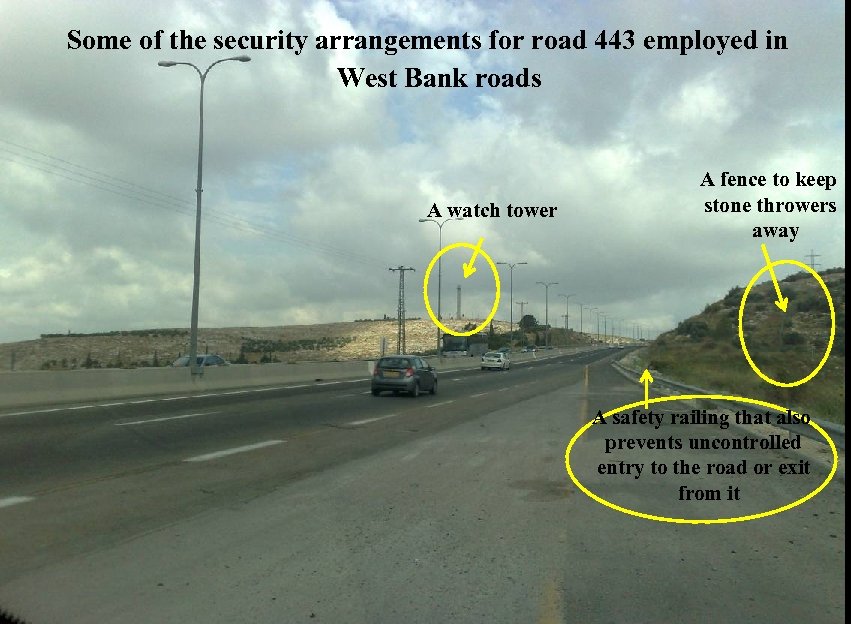
Some of the security arrangements for road 443 employed in West Bank roads A watch tower A fence to keep stone throwers away A safety railing that also prevents uncontrolled entry to the road or exit from it
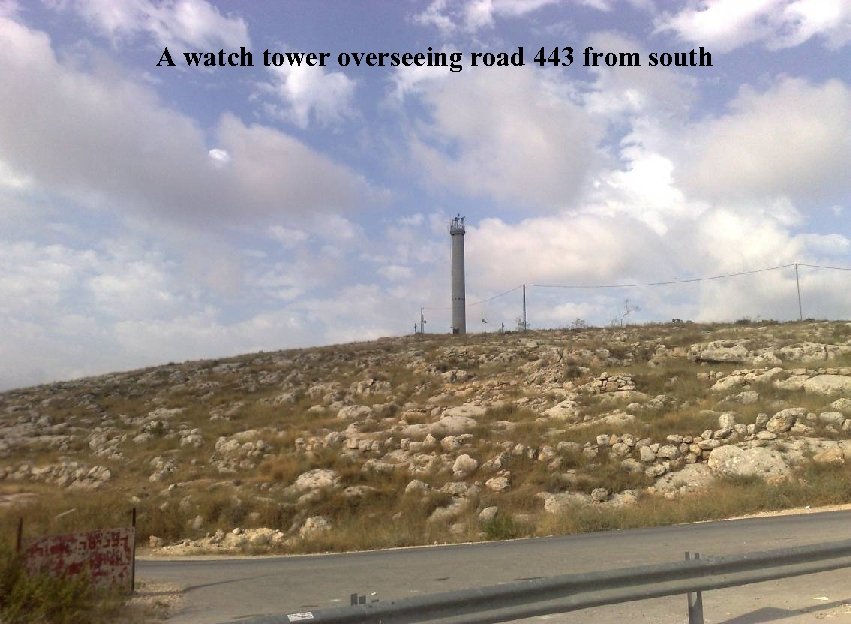
A watch tower overseeing road 443 from south
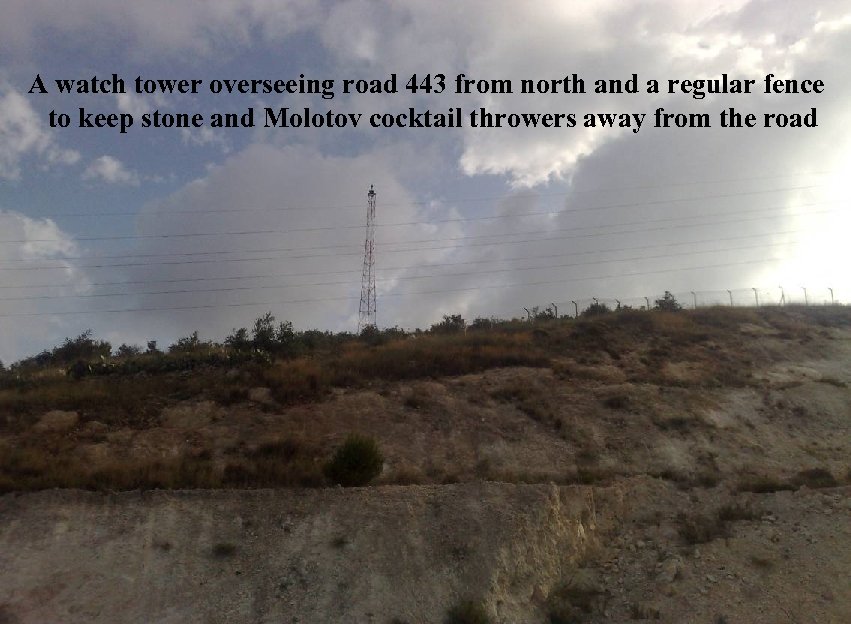
A watch tower overseeing road 443 from north and a regular fence to keep stone and Molotov cocktail throwers away from the road
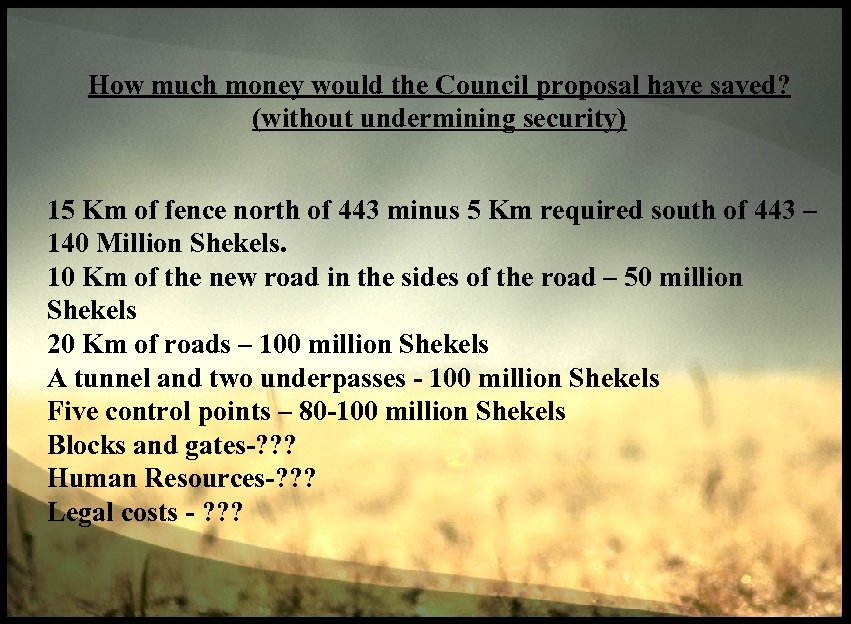
How much money would the Council proposal have saved? (without undermining security) 15 Km of fence north of 443 minus 5 Km required south of 443 – 140 Million Shekels. 10 Km of the new road in the sides of the road – 50 million Shekels 20 Km of roads – 100 million Shekels A tunnel and two underpasses - 100 million Shekels Five control points – 80 -100 million Shekels Blocks and gates-? ? ? Human Resources-? ? ? Legal costs - ? ? ?
Over half a billion Shekels!!! All out of the pockets of the Israeli tax payer!
What is the future of road 443? This road will be required for Israeli traffic under any permanent arrangement. The “Geneva Agreement” describes a transportation model that enables Israeli traffic under a special arrangement in roads under Palestinian sovereignty. Israel has the option today of changing the transportation model in road 443 and shape it to joint traffic towards a permanent agreement. Meanwhile, the Israeli government should advance transportation lines from the coastal plains to Israel, chiefly the fast train line and road 39.
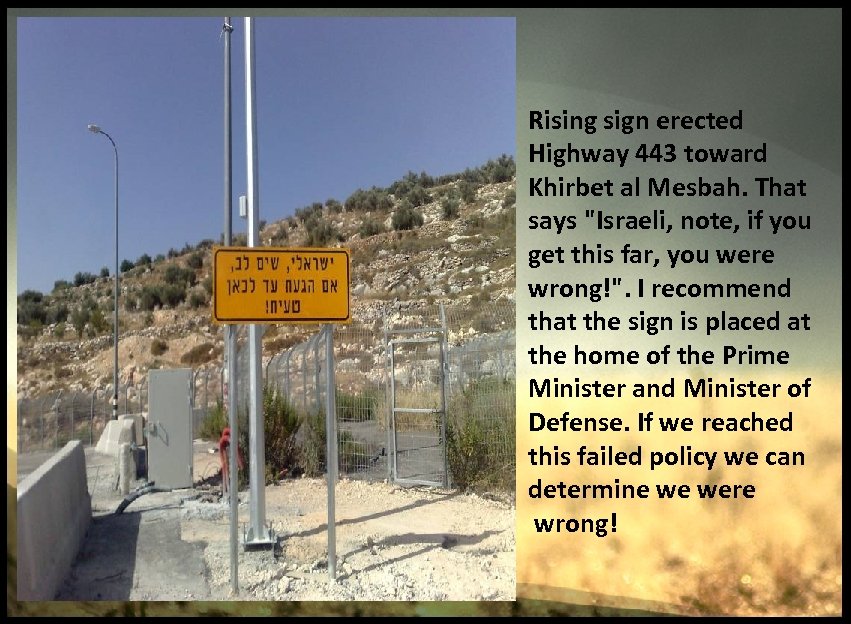
Rising sign erected Highway 443 toward Khirbet al Mesbah. That says "Israeli, note, if you get this far, you were wrong!". I recommend that the sign is placed at the home of the Prime Minister and Minister of Defense. If we reached this failed policy we can determine we were wrong!
For a more detailed study of the issue of the fence I attach links to the following items: Media interviews: http: //www. shaularieli. com/77951/ טלויזיה Press articles: http: //www. shaularieli. com/77951/2007 Power Point Presentation: http: //www. shaularieli. com/image/users/77951/ftp/my_f iles/Power-Point%20 Show/tefer. pps? id=3073476 Maps: http: //www. shaularieli. com/77951/ גדר-ההפרדה
Скачать презентацию ROAD 443 Too Big a Bite Chapter 4
912251772f5fd214952f82bfdd0d406d.ppt