


 Скачать презентацию Rivanna Investments Intro to Equity Research Rivanna
ae696dd3341db4d455fdf249b2f57f20.ppt
- Количество слайдов: 17
 Rivanna Investments: Intro to Equity Research
 Rivanna Investments First step is to gather information • Financial statement and reports (EDGAR) http: //www. sec. gov • Company website http: //www. apple. com • Third party research/ news Factset, Bloomberg, Yahoo! Finance, etc.
 Rivanna Investments • Intro to Financial Statements • Ratio Analysis • Financial Statements: Data to Information
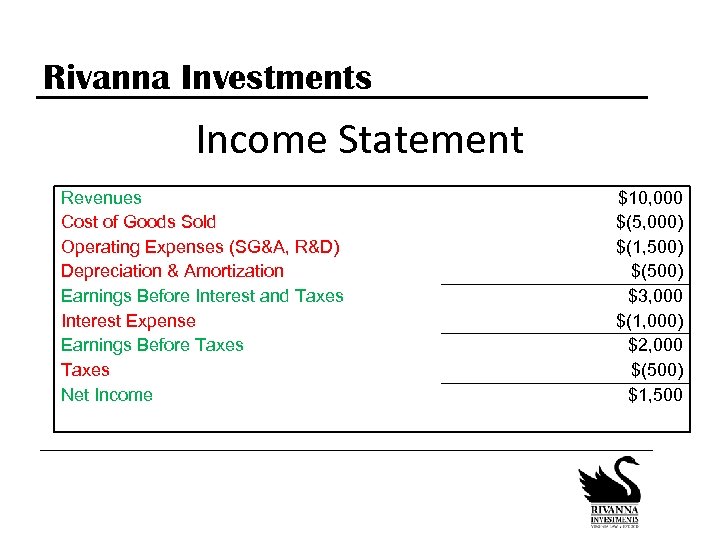 Rivanna Investments Income Statement Revenues Cost of Goods Sold Operating Expenses (SG&A, R&D) Depreciation & Amortization Earnings Before Interest and Taxes Interest Expense Earnings Before Taxes Net Income $10, 000 $(5, 000) $(1, 500) $(500) $3, 000 $(1, 000) $2, 000 $(500) $1, 500
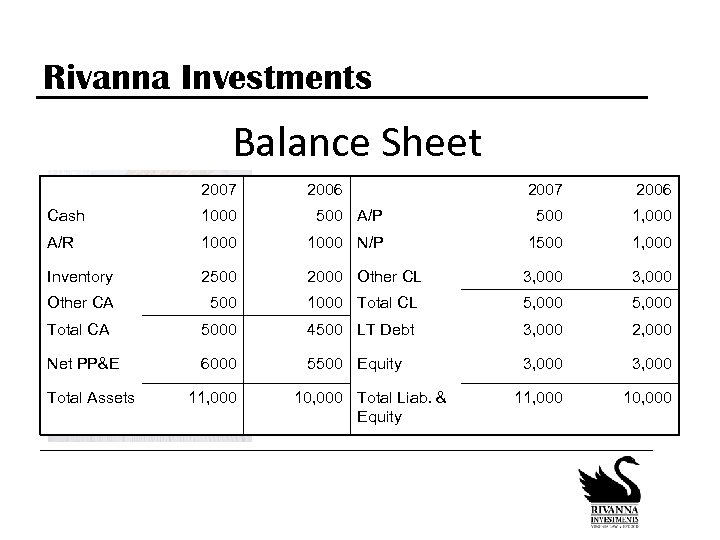 Rivanna Investments Balance Sheet 2007 2006 Cash 1000 500 A/P 500 1, 000 A/R 1000 N/P 1500 1, 000 Inventory 2500 2000 Other CL 3, 000 Other CA 500 1000 Total CL 5, 000 Total CA 5000 4500 LT Debt 3, 000 2, 000 Net PP&E 6000 5500 Equity 3, 000 11, 000 10, 000 Total Assets 11, 000 10, 000 Total Liab. & Equity
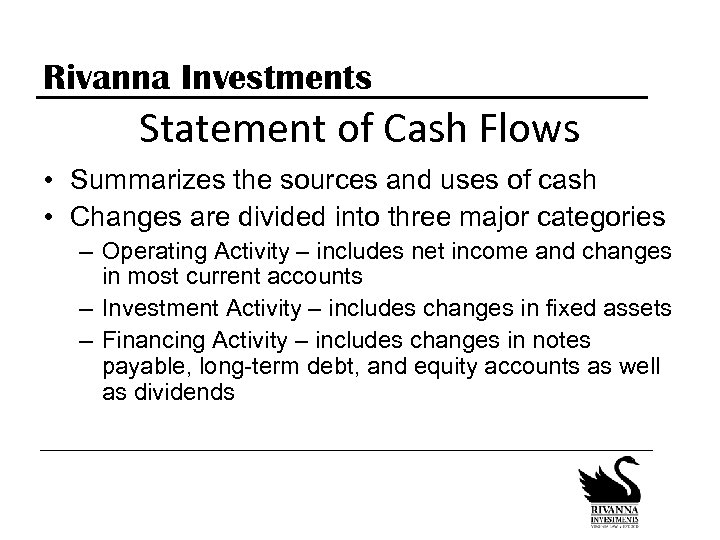 Rivanna Investments Statement of Cash Flows • Summarizes the sources and uses of cash • Changes are divided into three major categories – Operating Activity – includes net income and changes in most current accounts – Investment Activity – includes changes in fixed assets – Financing Activity – includes changes in notes payable, long-term debt, and equity accounts as well as dividends
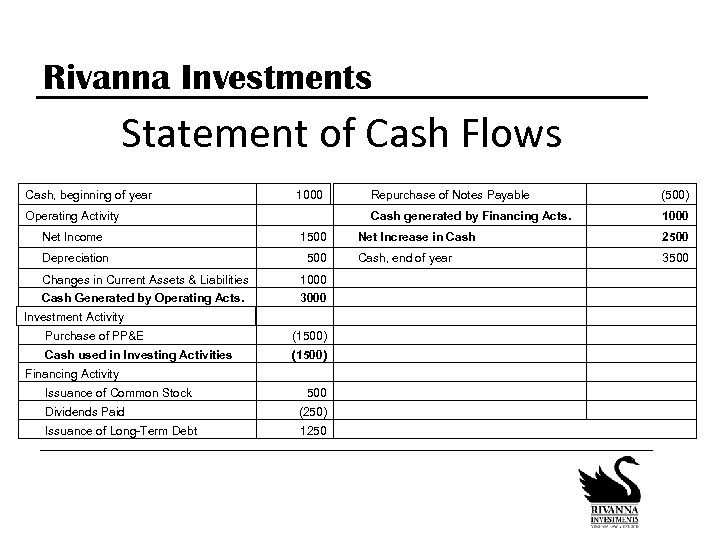 Rivanna Investments Statement of Cash Flows Cash, beginning of year 1000 Net Income 1500 Depreciation 500 Changes in Current Assets & Liabilities 1000 Cash Generated by Operating Acts. 3000 Investment Activity Purchase of PP&E (1500) Cash used in Investing Activities (1500) Financing Activity Issuance of Common Stock 500 Dividends Paid (250) Issuance of Long-Term Debt 1250 (500) Cash generated by Financing Acts. Operating Activity Repurchase of Notes Payable 1000 Net Increase in Cash 2500 Cash, end of year 3500
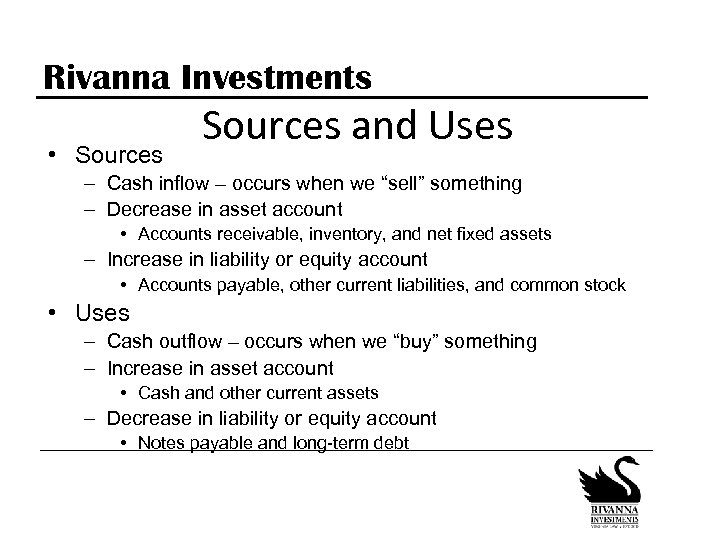 Rivanna Investments • Sources and Uses – Cash inflow – occurs when we “sell” something – Decrease in asset account • Accounts receivable, inventory, and net fixed assets – Increase in liability or equity account • Accounts payable, other current liabilities, and common stock • Uses – Cash outflow – occurs when we “buy” something – Increase in asset account • Cash and other current assets – Decrease in liability or equity account • Notes payable and long-term debt
 Rivanna Investments Ratio Analysis • Ratios also allow for better comparison through time or between companies • Ask what the ratio is trying to measure and why that information is important • Ratios are used both internally and externally
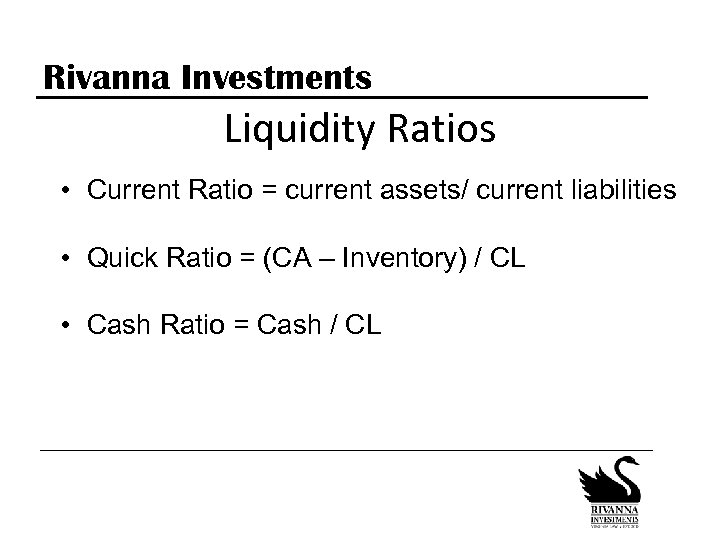 Rivanna Investments Liquidity Ratios • Current Ratio = current assets/ current liabilities • Quick Ratio = (CA – Inventory) / CL • Cash Ratio = Cash / CL
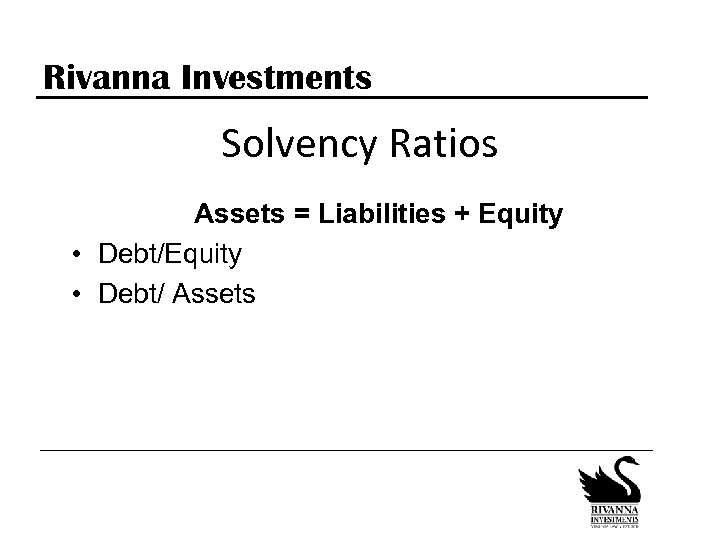 Rivanna Investments Solvency Ratios Assets = Liabilities + Equity • Debt/ Assets
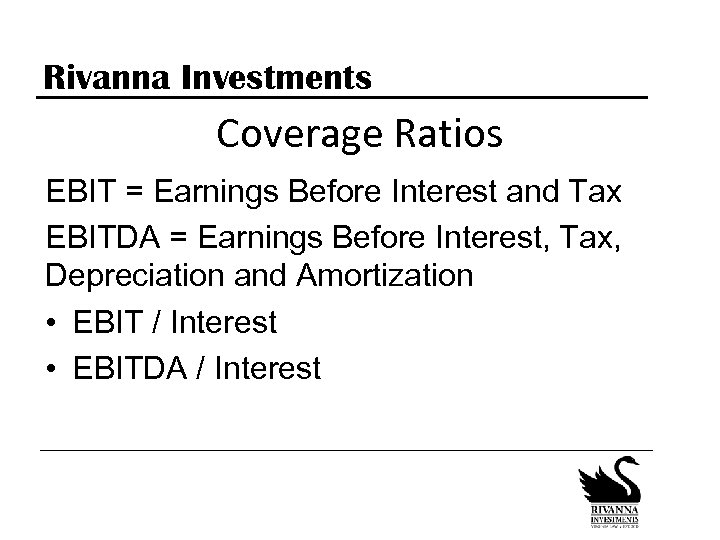 Rivanna Investments Coverage Ratios EBIT = Earnings Before Interest and Tax EBITDA = Earnings Before Interest, Tax, Depreciation and Amortization • EBIT / Interest • EBITDA / Interest
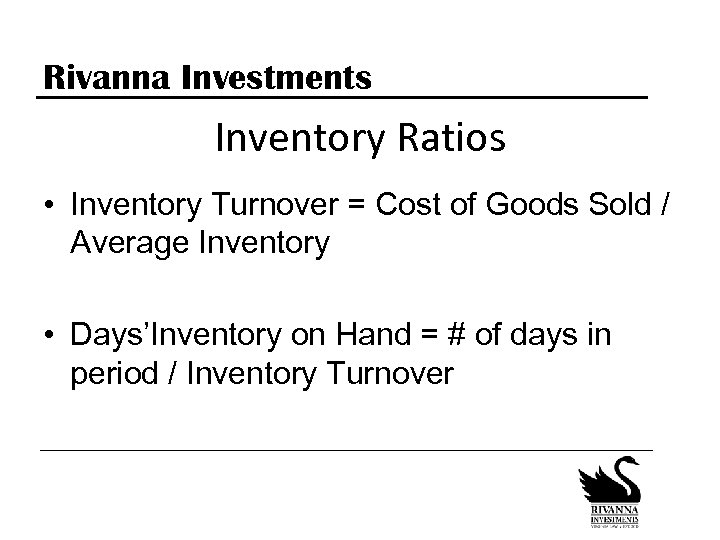 Rivanna Investments Inventory Ratios • Inventory Turnover = Cost of Goods Sold / Average Inventory • Days’Inventory on Hand = # of days in period / Inventory Turnover
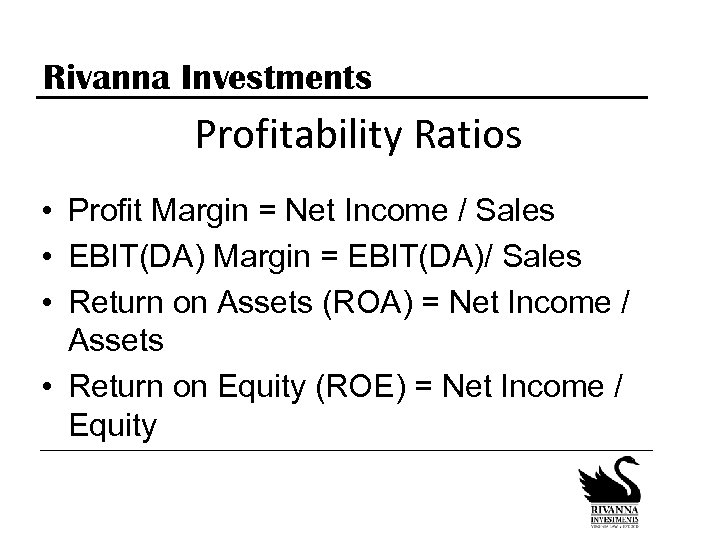 Rivanna Investments Profitability Ratios • Profit Margin = Net Income / Sales • EBIT(DA) Margin = EBIT(DA)/ Sales • Return on Assets (ROA) = Net Income / Assets • Return on Equity (ROE) = Net Income / Equity
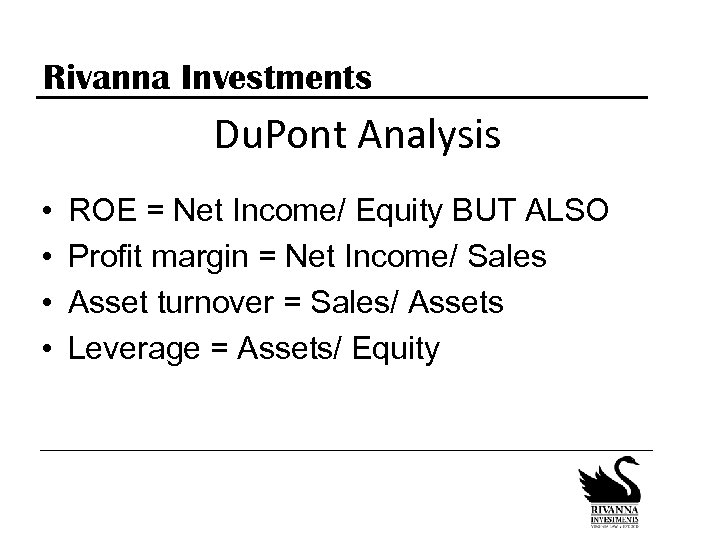 Rivanna Investments Du. Pont Analysis • • ROE = Net Income/ Equity BUT ALSO Profit margin = Net Income/ Sales Asset turnover = Sales/ Assets Leverage = Assets/ Equity
 Rivanna Investments Ratio Analysis • Ratios are not very helpful by themselves; they need to be compared to something • Time Analysis – Used to see how the firm’s performance is changing through time • Peer Group Analysis – Compare to similar companies or within industries – SIC and NAICS codes
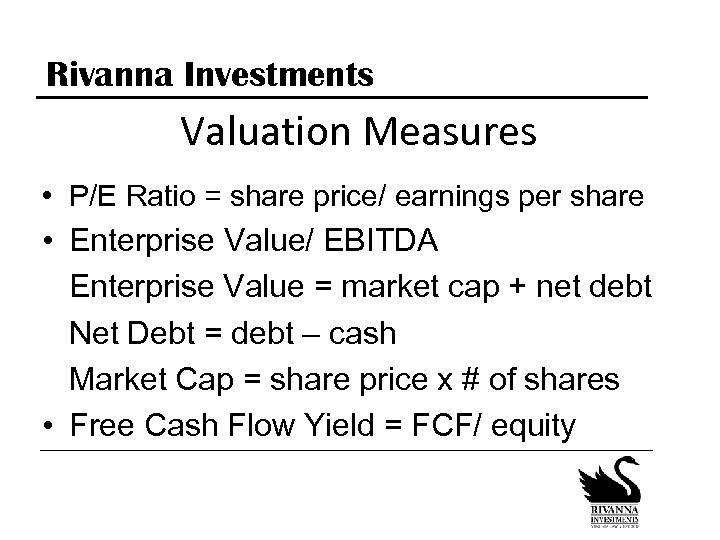 Rivanna Investments Valuation Measures • P/E Ratio = share price/ earnings per share • Enterprise Value/ EBITDA Enterprise Value = market cap + net debt Net Debt = debt – cash Market Cap = share price x # of shares • Free Cash Flow Yield = FCF/ equity