


 Скачать презентацию Risk Management Market efficiency Overview
Chapter 12.ppt
- Количество слайдов: 55
 Risk Management
 Market efficiency
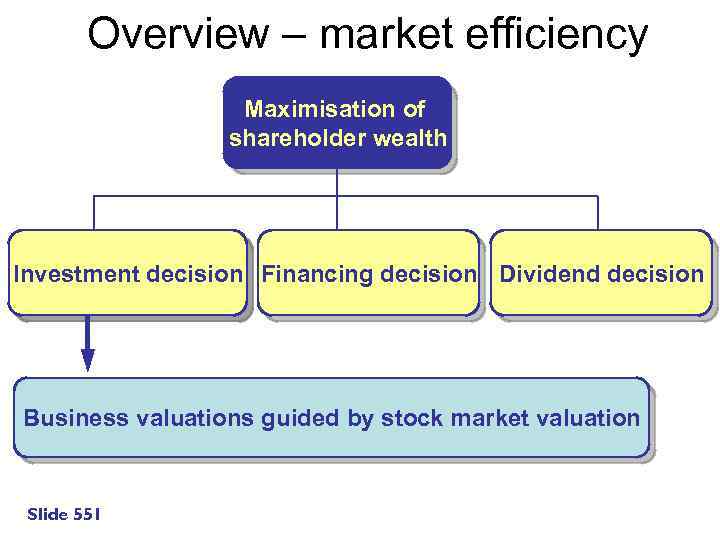 Overview – market efficiency Maximisation of shareholder wealth Investment decision Financing decision Dividend decision Business valuations guided by stock market valuation Slide 551
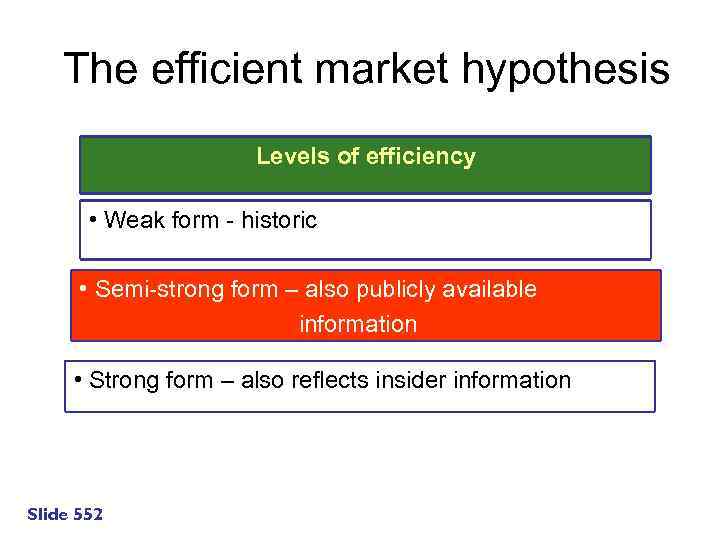 The efficient market hypothesis Levels of efficiency • Weak form - historic • Semi-strong form – also publicly available information • Strong form – also reflects insider information Slide 552
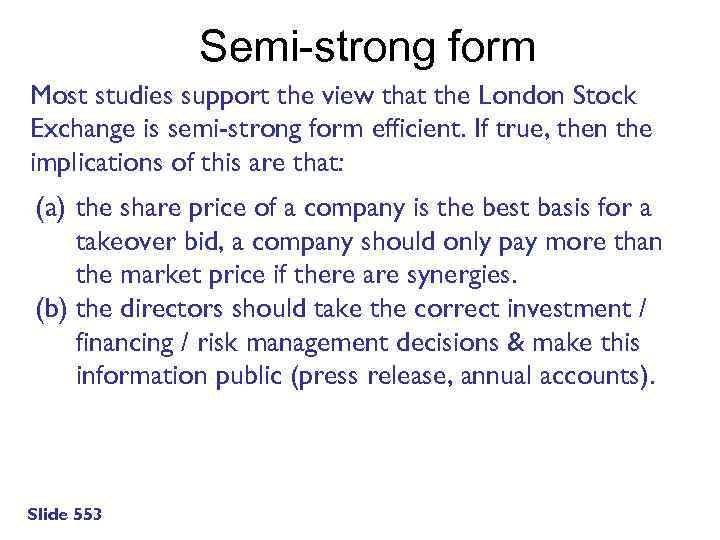 Semi-strong form Most studies support the view that the London Stock Exchange is semi-strong form efficient. If true, then the implications of this are that: (a) the share price of a company is the best basis for a takeover bid, a company should only pay more than the market price if there are synergies. (b) the directors should take the correct investment / financing / risk management decisions & make this information public (press release, annual accounts). Slide 553
 Foreign currency risk
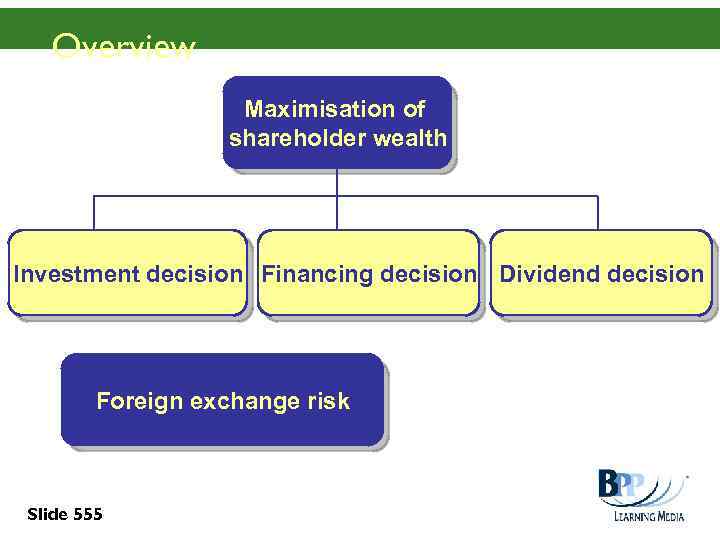 Overview Maximisation of shareholder wealth Investment decision Financing decision Dividend decision Foreign exchange risk Slide 555
 Types of foreign exchange risk Translation risk Economic risk Transaction risk
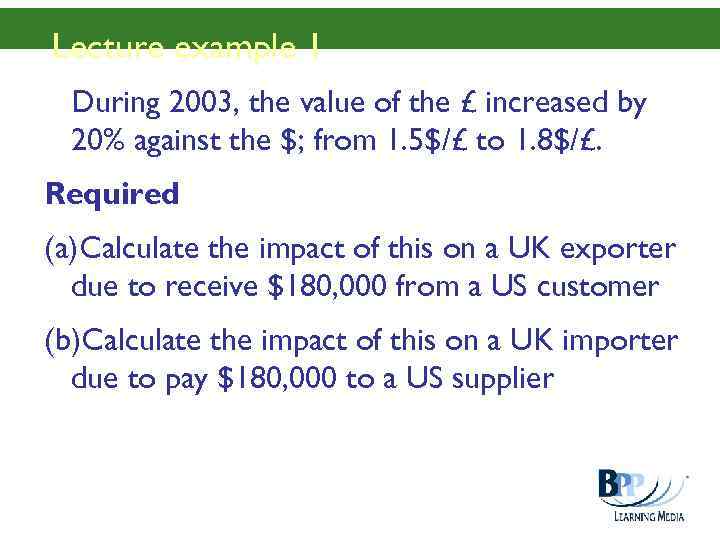 Lecture example 1 During 2003, the value of the £ increased by 20% against the $; from 1. 5$/£ to 1. 8$/£. Required (a)Calculate the impact of this on a UK exporter due to receive $180, 000 from a US customer (b)Calculate the impact of this on a UK importer due to pay $180, 000 to a US supplier
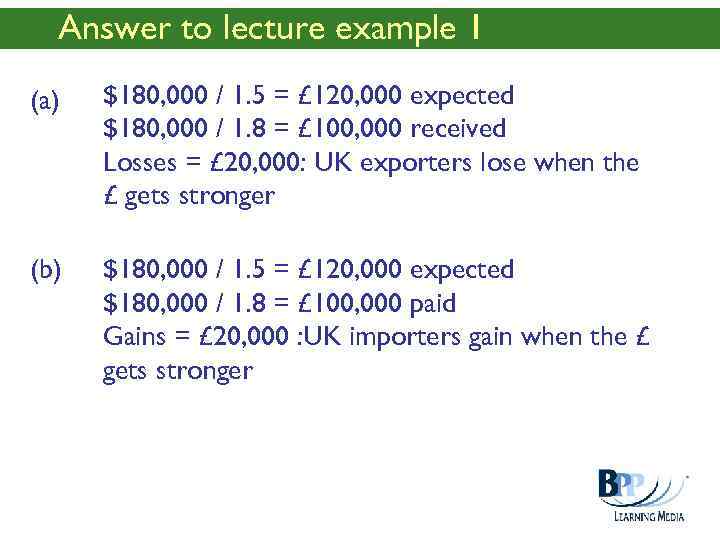 Answer to lecture example 1 (a) $180, 000 / 1. 5 = £ 120, 000 expected $180, 000 / 1. 8 = £ 100, 000 received Losses = £ 20, 000: UK exporters lose when the £ gets stronger (b) $180, 000 / 1. 5 = £ 120, 000 expected $180, 000 / 1. 8 = £ 100, 000 paid Gains = £ 20, 000 : UK importers gain when the £ gets stronger
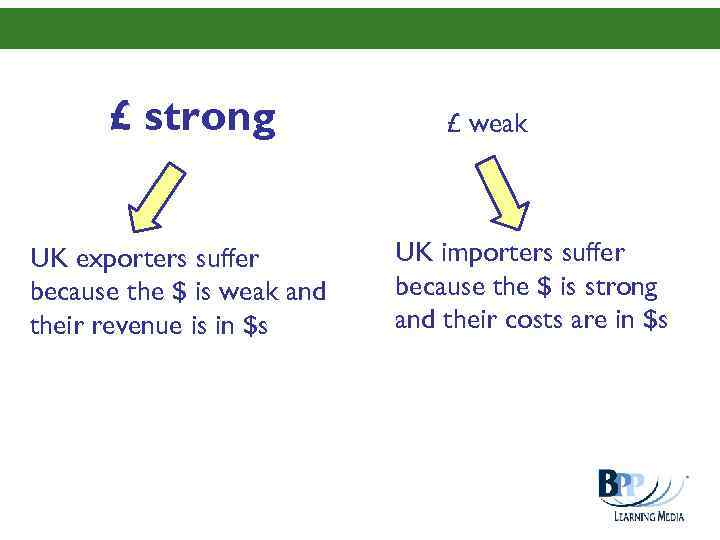 £ strong UK exporters suffer because the $ is weak and their revenue is in $s £ weak UK importers suffer because the $ is strong and their costs are in $s
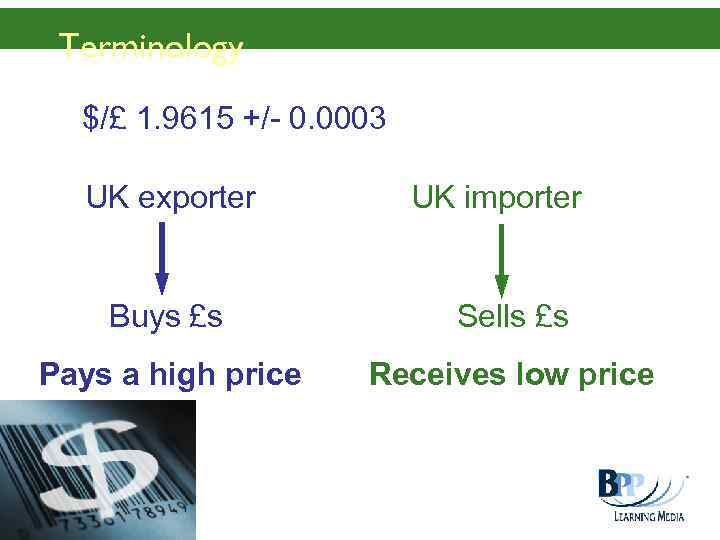 Terminology $/£ 1. 9615 +/- 0. 0003 UK exporter UK importer Buys £s Sells £s Pays a high price Receives low price Slide 560
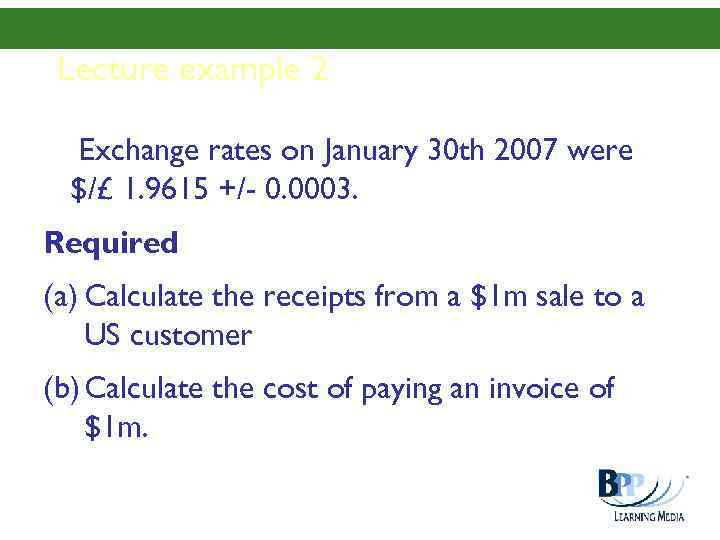 Lecture example 2 Exchange rates on January 30 th 2007 were $/£ 1. 9615 +/- 0. 0003. Required (a) Calculate the receipts from a $1 m sale to a US customer (b) Calculate the cost of paying an invoice of $1 m.
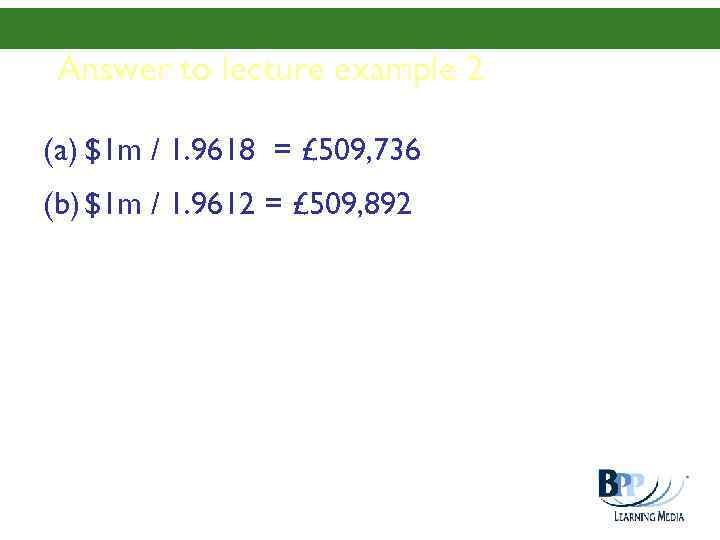 Answer to lecture example 2 (a) $1 m / 1. 9618 = £ 509, 736 (b) $1 m / 1. 9612 = £ 509, 892
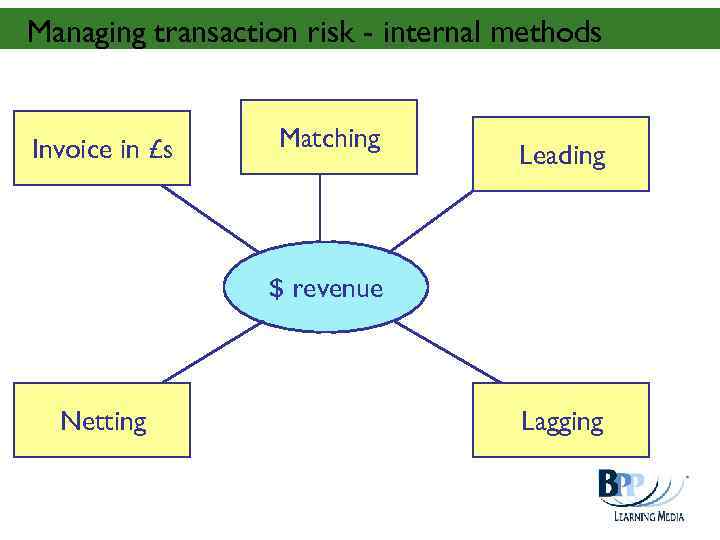 Managing transaction risk - internal methods Invoice in £s Matching Leading $ revenue Netting Lagging
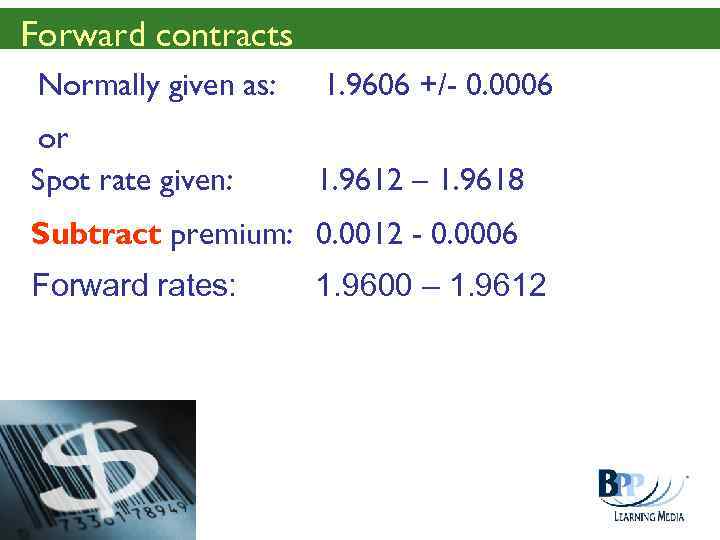 Forward contracts Normally given as: 1. 9606 +/- 0. 0006 or Spot rate given: 1. 9612 – 1. 9618 Subtract premium: 0. 0012 - 0. 0006 Forward rates: Slide 564 1. 9600 – 1. 9612
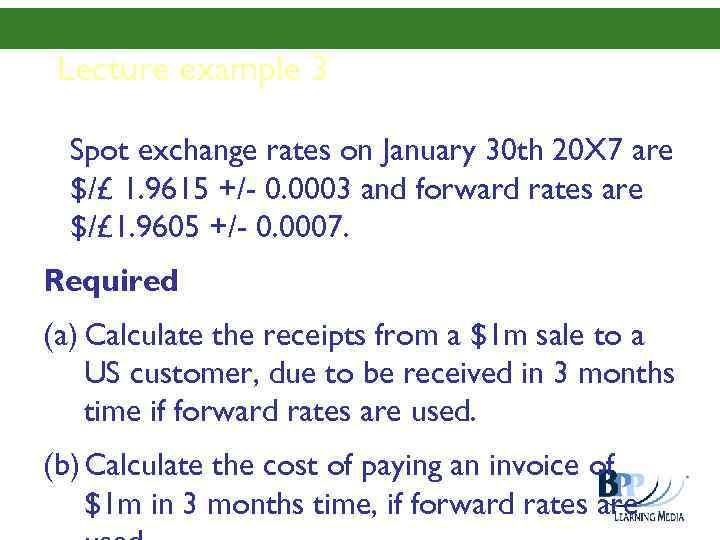 Lecture example 3 Spot exchange rates on January 30 th 20 X 7 are $/£ 1. 9615 +/- 0. 0003 and forward rates are $/£ 1. 9605 +/- 0. 0007. Required (a) Calculate the receipts from a $1 m sale to a US customer, due to be received in 3 months time if forward rates are used. (b) Calculate the cost of paying an invoice of $1 m in 3 months time, if forward rates are
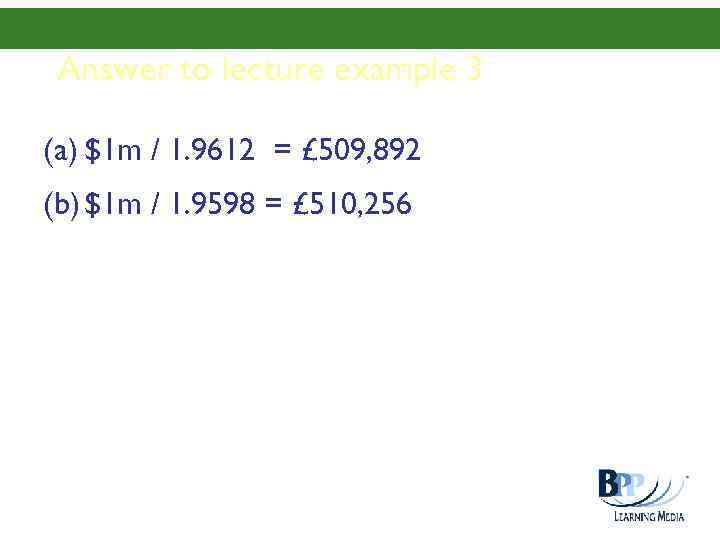 Answer to lecture example 3 (a) $1 m / 1. 9612 = £ 509, 892 (b) $1 m / 1. 9598 = £ 510, 256
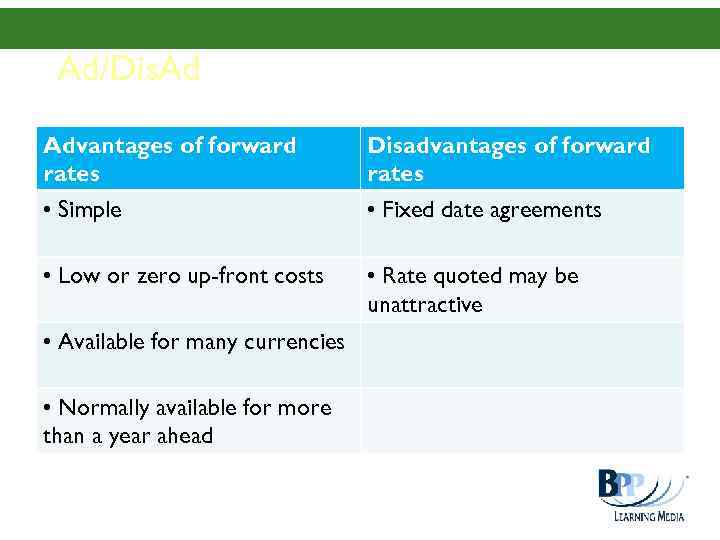 Ad/Dis. Ad Advantages of forward rates Disadvantages of forward rates • Simple • Fixed date agreements • Low or zero up-front costs • Rate quoted may be unattractive • Available for many currencies • Normally available for more than a year ahead
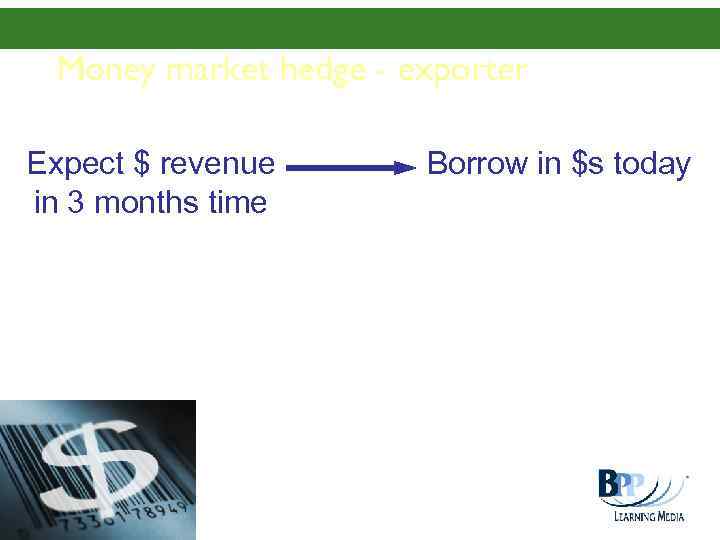 Money market hedge - exporter Expect $ revenue in 3 months time Slide 568 Borrow in $s today
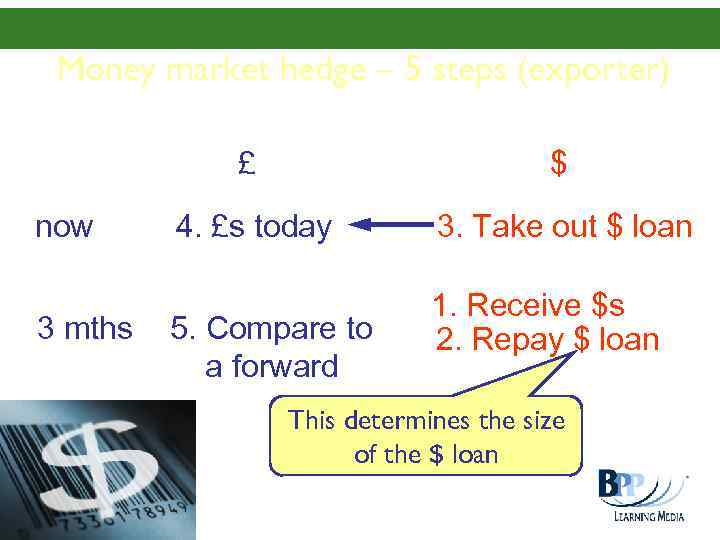 Money market hedge – 5 steps (exporter) £ now 3 mths $ 4. £s today 3. Take out $ loan 5. Compare to a forward 1. Receive $s 2. Repay $ loan This determines the size of the $ loan Slide 569
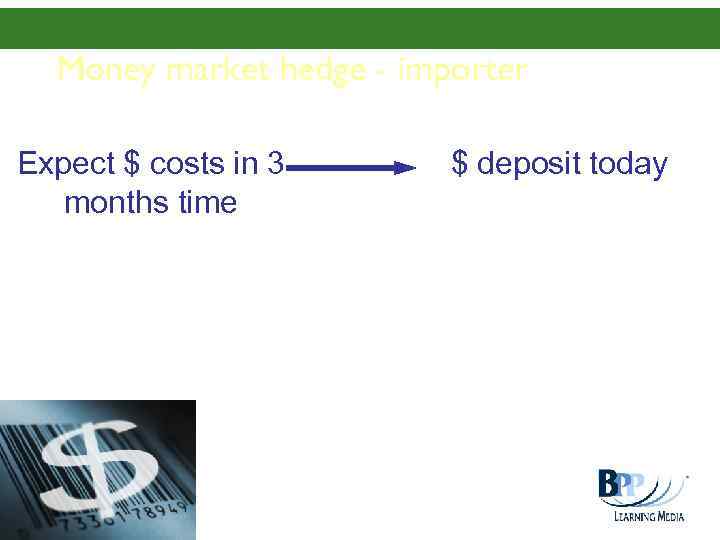 Money market hedge - importer Expect $ costs in 3 months time Slide 570 $ deposit today
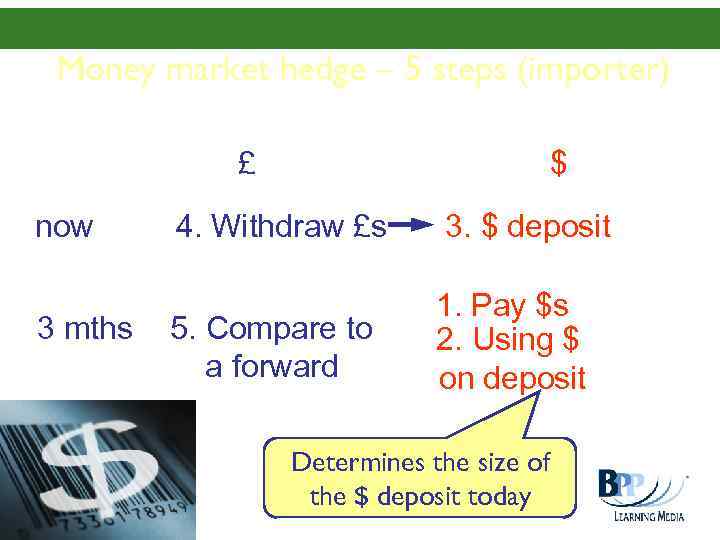 Money market hedge – 5 steps (importer) £ now 3 mths Slide 571 $ 4. Withdraw £s 3. $ deposit 5. Compare to a forward 1. Pay $s 2. Using $ on deposit Determines the size of the $ deposit today
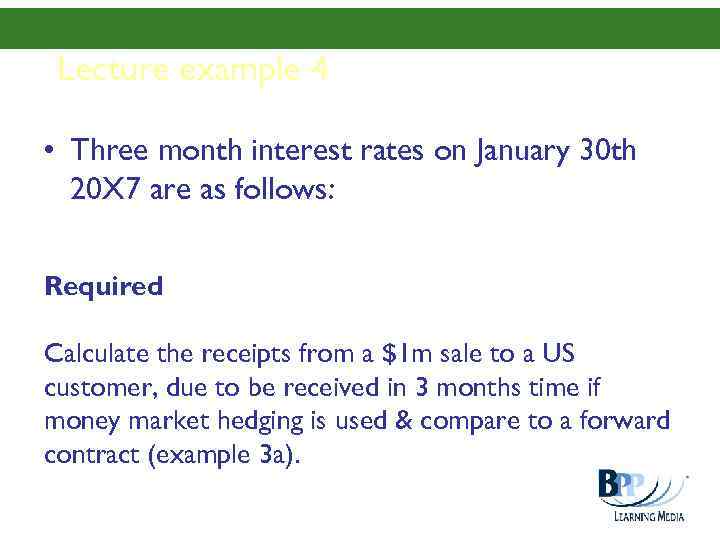 Lecture example 4 • Three month interest rates on January 30 th 20 X 7 are as follows: Required Calculate the receipts from a $1 m sale to a US customer, due to be received in 3 months time if money market hedging is used & compare to a forward contract (example 3 a).
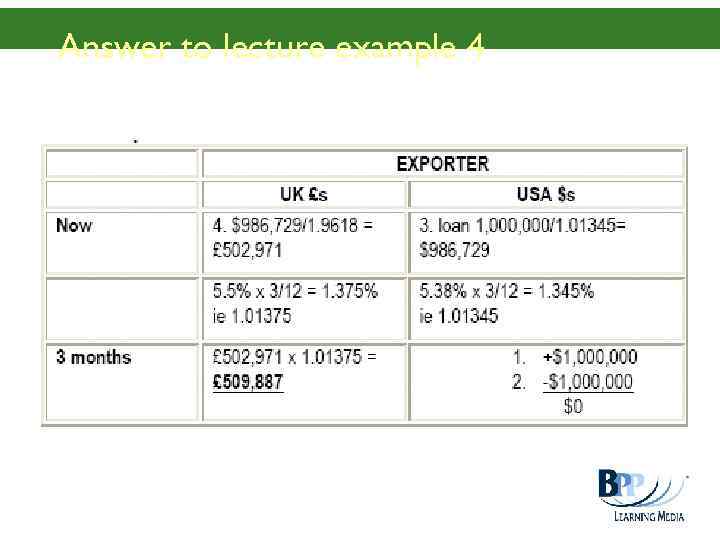 Answer to lecture example 4
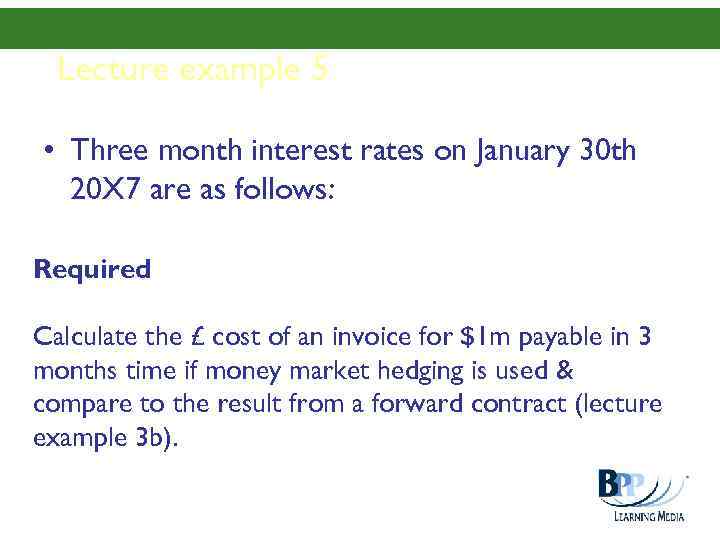 Lecture example 5 • Three month interest rates on January 30 th 20 X 7 are as follows: Required Calculate the £ cost of an invoice for $1 m payable in 3 months time if money market hedging is used & compare to the result from a forward contract (lecture example 3 b).
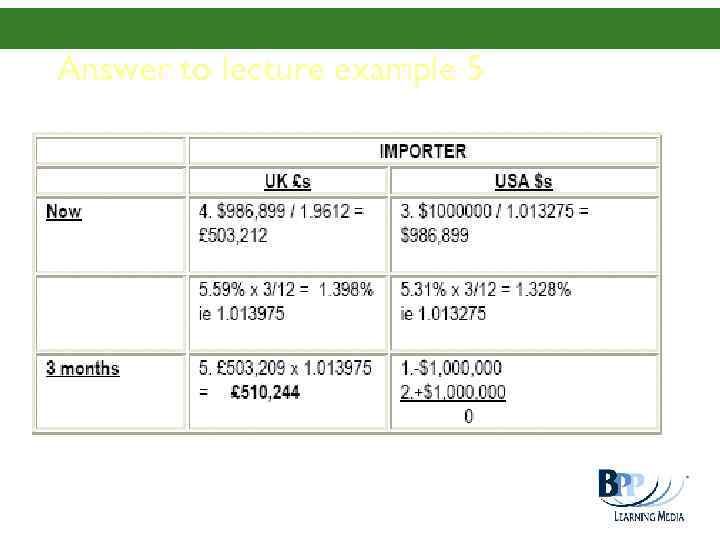 Answer to lecture example 5
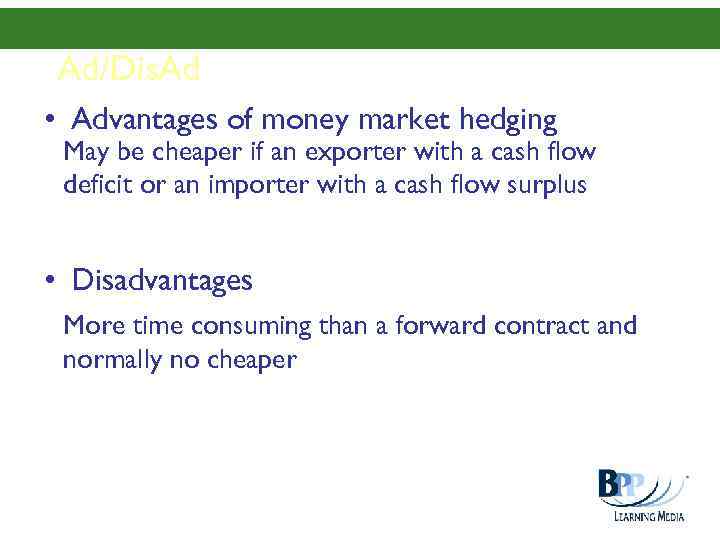 Ad/Dis. Ad • Advantages of money market hedging May be cheaper if an exporter with a cash flow deficit or an importer with a cash flow surplus • Disadvantages More time consuming than a forward contract and normally no cheaper
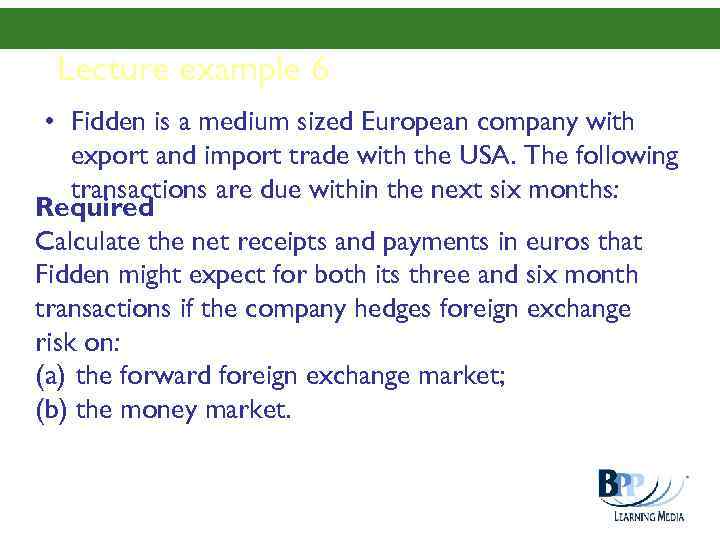 Lecture example 6 • Fidden is a medium sized European company with export and import trade with the USA. The following transactions are due within the next six months: Required Calculate the net receipts and payments in euros that Fidden might expect for both its three and six month transactions if the company hedges foreign exchange risk on: (a) the forward foreign exchange market; (b) the money market.
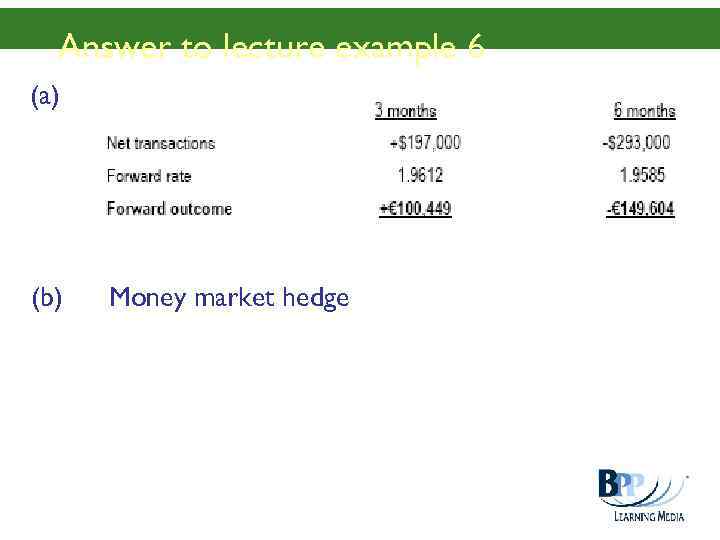 Answer to lecture example 6 (a) (b) Money market hedge
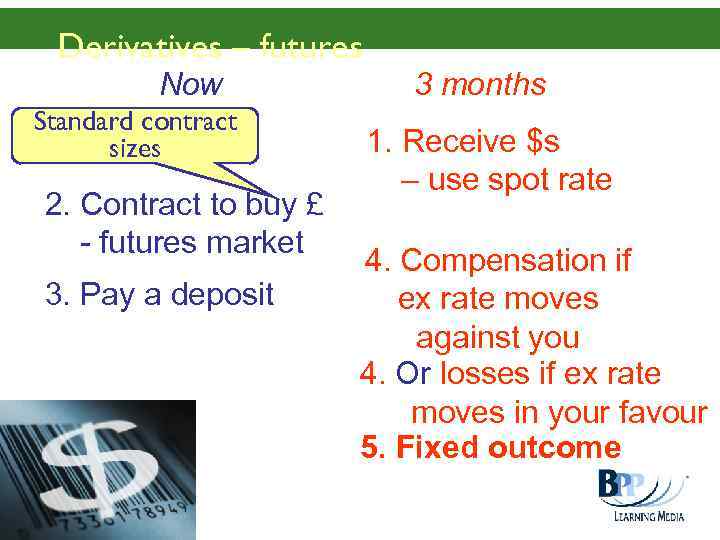 Derivatives – futures Now Standard contract sizes 2. Contract to buy £ - futures market 3. Pay a deposit Slide 579 3 months 1. Receive $s – use spot rate 4. Compensation if ex rate moves against you 4. Or losses if ex rate moves in your favour 5. Fixed outcome
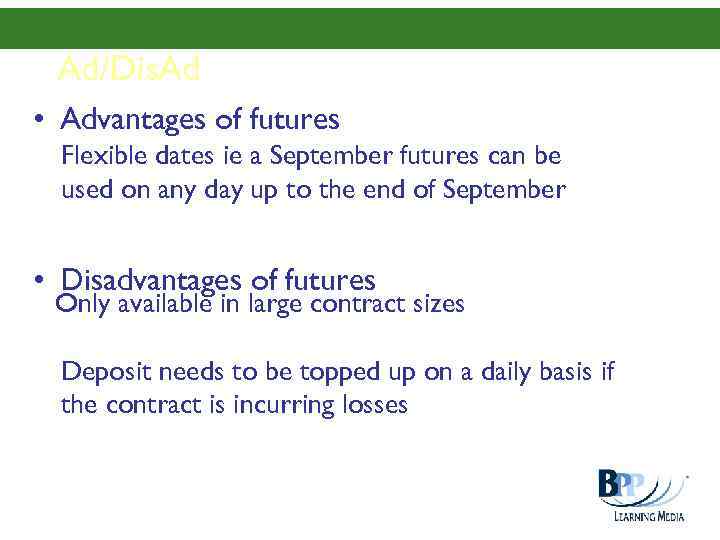 Ad/Dis. Ad • Advantages of futures Flexible dates ie a September futures can be used on any day up to the end of September • Disadvantages of futures Only available in large contract sizes Deposit needs to be topped up on a daily basis if the contract is incurring losses
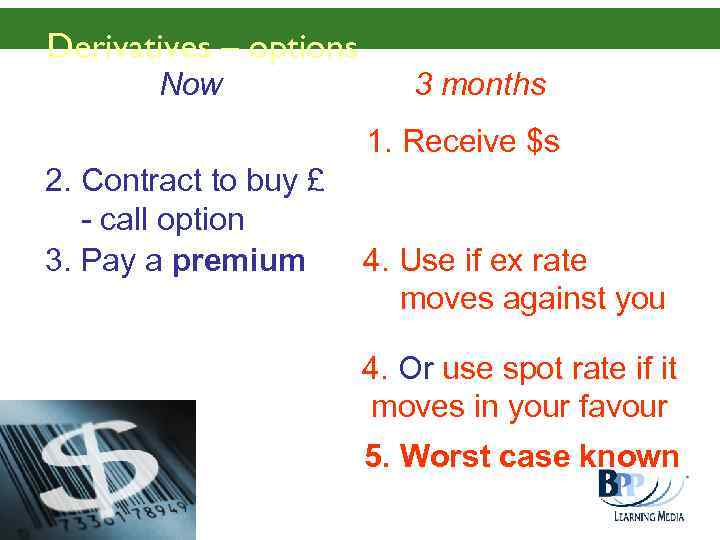 Derivatives – options Now 3 months 1. Receive $s 2. Contract to buy £ - call option 3. Pay a premium 4. Use if ex rate moves against you 4. Or use spot rate if it moves in your favour 5. Worst case known Slide 581
 Forecasting exchange rate movements • Balance of payments • Inflation • Interest rates
 Lecture example 7 The €/£ exchange rate in January 2007 was 1. 5; inflation in Europe was 2. 1% and 2. 7% in the UK Required Forecast the €/£ exchange rate for the next 3 years and comment on the implications.
 Answer to lecture example 7 (a) Spot = 1. 5 X 1. 021/1. 027 = 1. 49 in 1 year 1. 49 X 1. 021/1. 027 = 1. 48 in 2 years 1. 48 X 1. 021/1. 027 = 1. 47 in 3 years (b) Europe may become an easier place to export to & a more expensive to buy imports from.
 Lecture example 8 The £/€ exchange rate in January 2007 was 0. 6667; inflation in Europe was 2. 1% and 2. 7% in the UK. A company is considering taking out a 1 year £ 10 m bank loan in euros at 6% or in £ at 6. 6% Required Advise the company whether to take advantage of lower interest rates in Europe.
 Answer to lecture example 8 UK loan costs £ 10 m x 1. 066 to repay = £ 10. 66 m Euro loan of £ 10 m / 0. 6667 = € 15 m x 1. 06 = € 15. 9 m x 0. 6705 forward rate (see below) = £ 10. 66 m Forward in 1 year = 0. 666 x 1. 066/1. 06 (note euros are the base currency) = 0. 6705 in 1 year There is not a risk free advantage from using the cheaper euro loan.
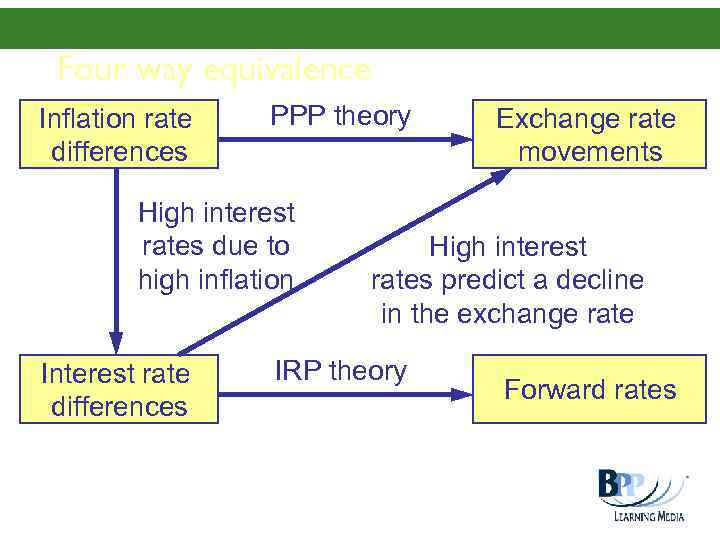 Four way equivalence Inflation rate differences PPP theory High interest rates due to high inflation Interest rate differences Exchange rate movements High interest rates predict a decline in the exchange rate IRP theory Forward rates
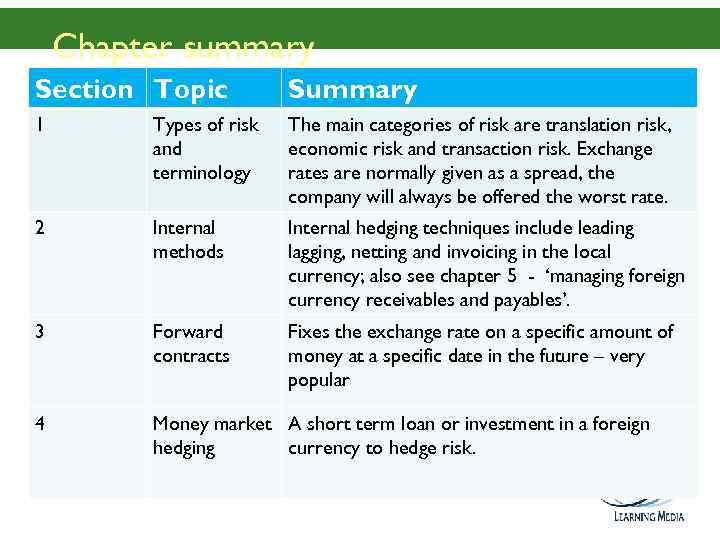 Chapter summary Section Topic Summary 1 Types of risk and terminology The main categories of risk are translation risk, economic risk and transaction risk. Exchange rates are normally given as a spread, the company will always be offered the worst rate. 2 Internal methods Internal hedging techniques include leading lagging, netting and invoicing in the local currency; also see chapter 5 - ‘managing foreign currency receivables and payables’. 3 Forward contracts Fixes the exchange rate on a specific amount of money at a specific date in the future – very popular 4 Money market A short term loan or investment in a foreign hedging currency to hedge risk.
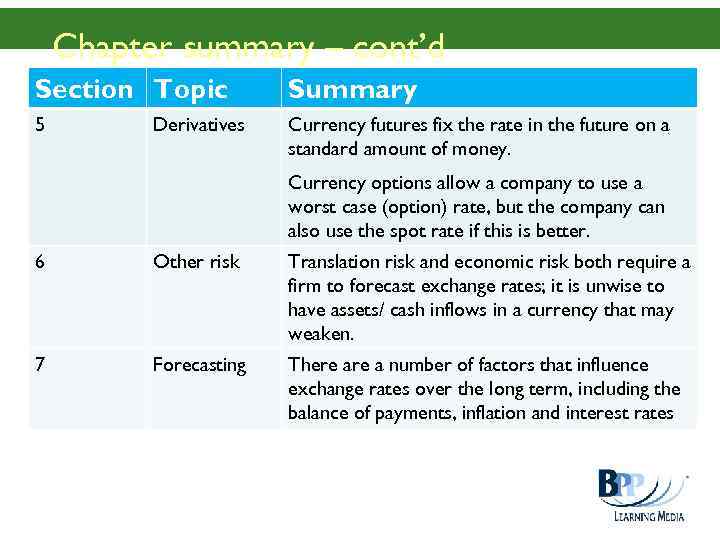 Chapter summary – cont’d Section Topic Summary 5 Currency futures fix the rate in the future on a standard amount of money. Derivatives Currency options allow a company to use a worst case (option) rate, but the company can also use the spot rate if this is better. 6 Other risk Translation risk and economic risk both require a firm to forecast exchange rates; it is unwise to have assets/ cash inflows in a currency that may weaken. 7 Forecasting There a number of factors that influence exchange rates over the long term, including the balance of payments, inflation and interest rates
 Interest rate risk
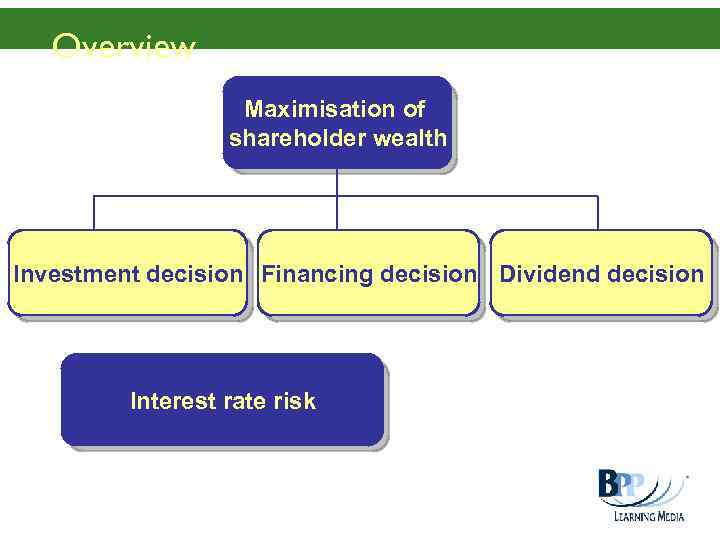 Overview Maximisation of shareholder wealth Investment decision Financing decision Dividend decision Interest rate risk
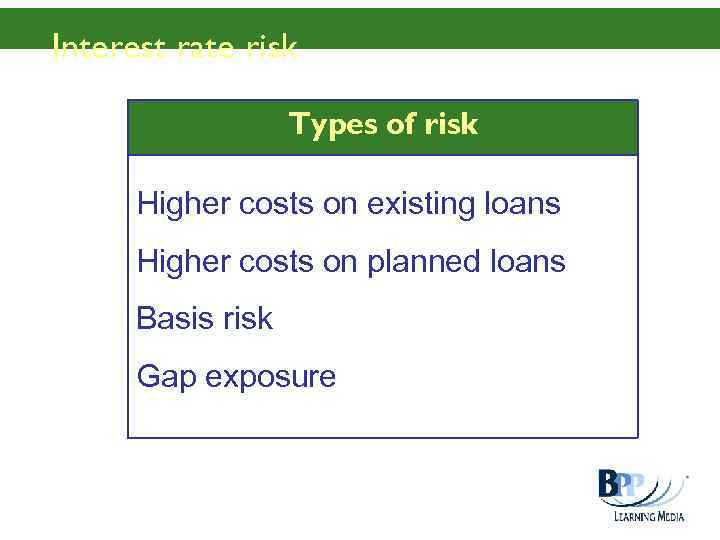 Interest rate risk Types of risk Higher costs on existing loans Higher costs on planned loans Basis risk Gap exposure
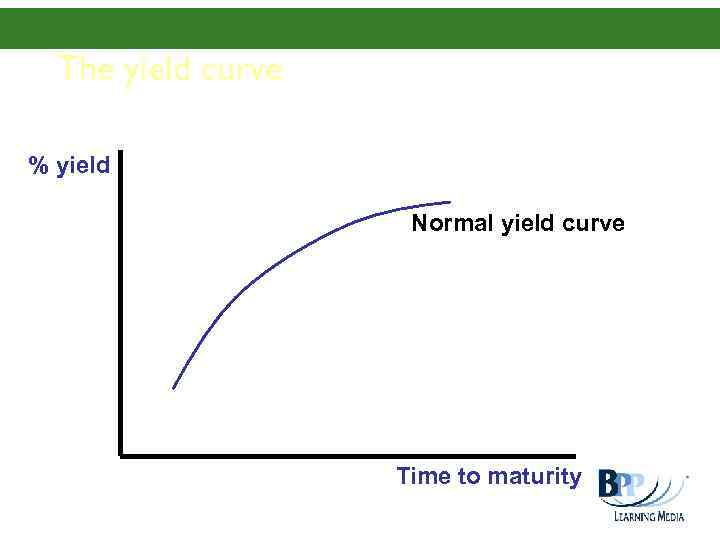 The yield curve % yield Normal yield curve Time to maturity
 (a) Expectations theory (b) Liquidity preference theory (c) Market segmentation theory
 Managing interest rate risk – internal methods • Smoothing • Matching
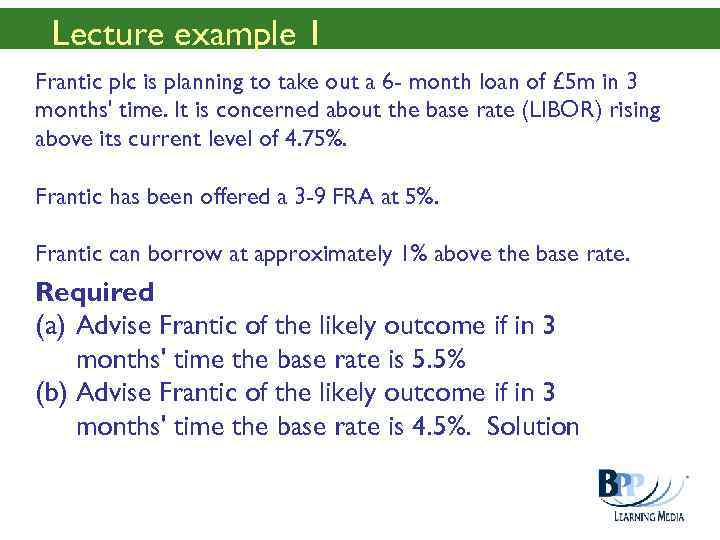 Lecture example 1 Frantic plc is planning to take out a 6 - month loan of £ 5 m in 3 months' time. It is concerned about the base rate (LIBOR) rising above its current level of 4. 75%. Frantic has been offered a 3 -9 FRA at 5%. Frantic can borrow at approximately 1% above the base rate. Required (a) Advise Frantic of the likely outcome if in 3 months' time the base rate is 5. 5% (b) Advise Frantic of the likely outcome if in 3 months' time the base rate is 4. 5%. Solution
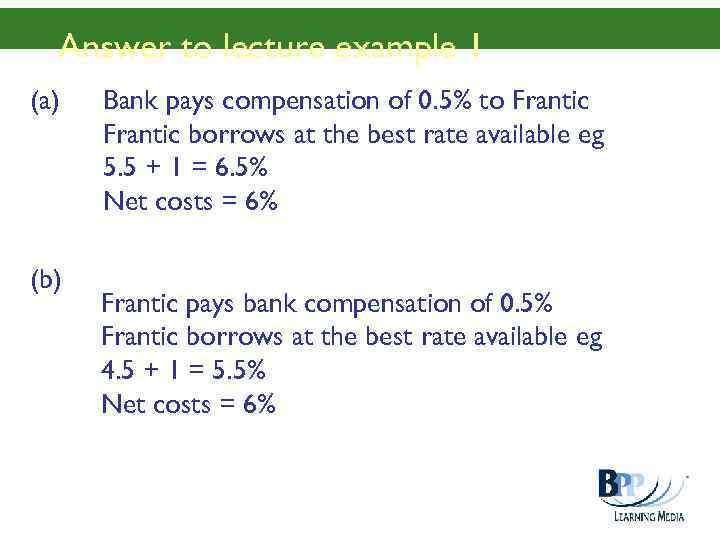 Answer to lecture example 1 (a) (b) Bank pays compensation of 0. 5% to Frantic borrows at the best rate available eg 5. 5 + 1 = 6. 5% Net costs = 6% Frantic pays bank compensation of 0. 5% Frantic borrows at the best rate available eg 4. 5 + 1 = 5. 5% Net costs = 6%
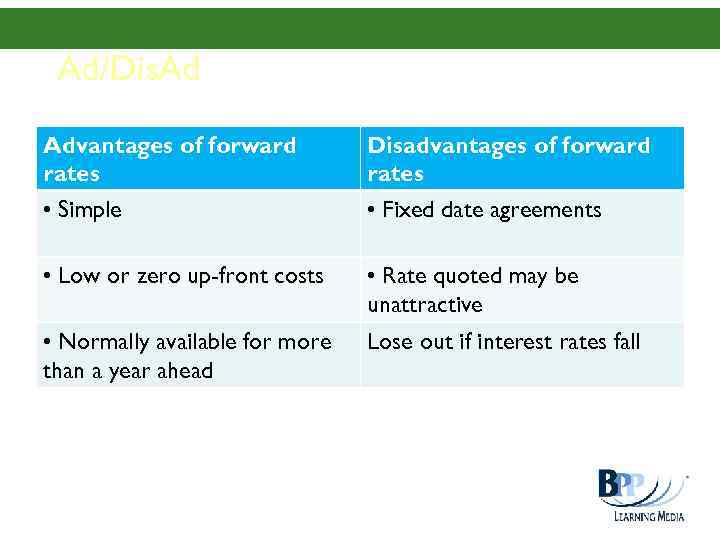 Ad/Dis. Ad Advantages of forward rates Disadvantages of forward rates • Simple • Fixed date agreements • Low or zero up-front costs • Rate quoted may be unattractive • Normally available for more than a year ahead Lose out if interest rates fall
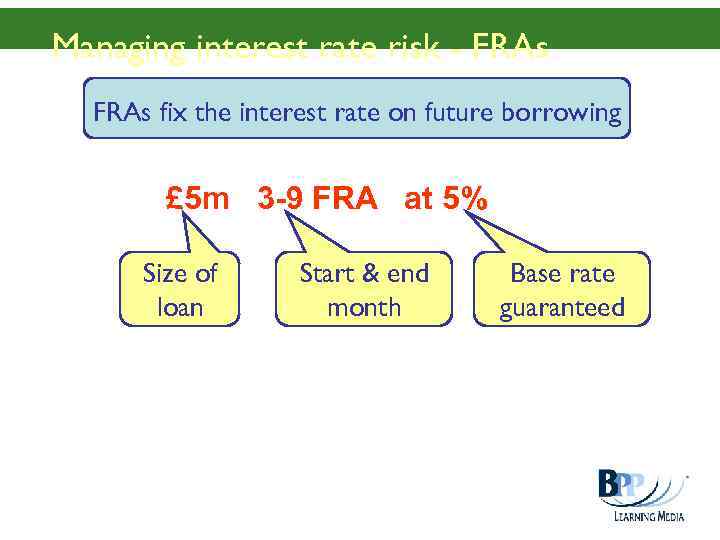 Managing interest rate risk - FRAs fix the interest rate on future borrowing £ 5 m 3 -9 FRA at 5% Size of loan Start & end month Base rate guaranteed
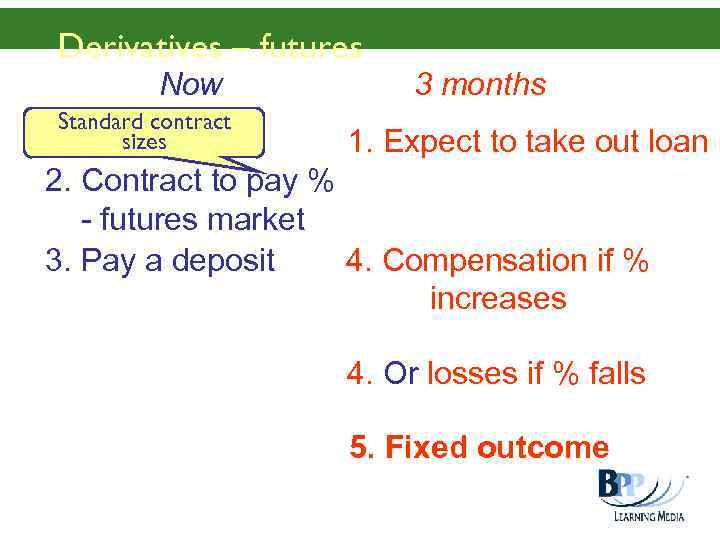 Derivatives – futures Now Standard contract sizes 3 months 1. Expect to take out loan 2. Contract to pay % - futures market 3. Pay a deposit 4. Compensation if % increases 4. Or losses if % falls 5. Fixed outcome
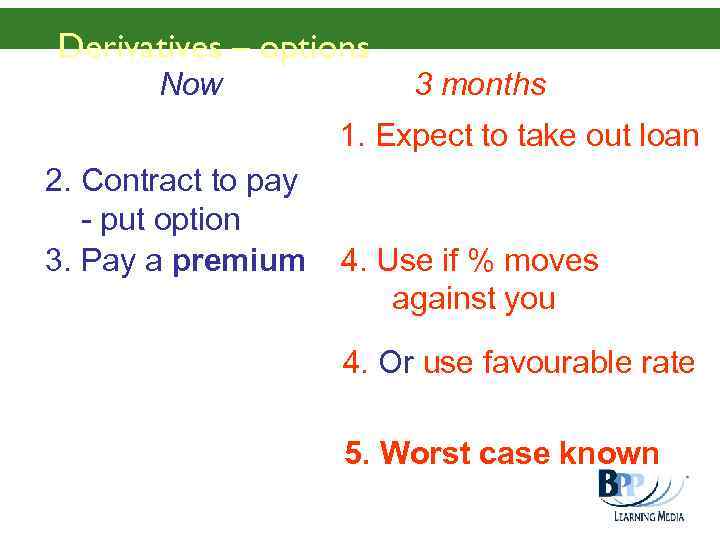 Derivatives – options Now 3 months 1. Expect to take out loan 2. Contract to pay - put option 3. Pay a premium 4. Use if % moves against you 4. Or use favourable rate 5. Worst case known
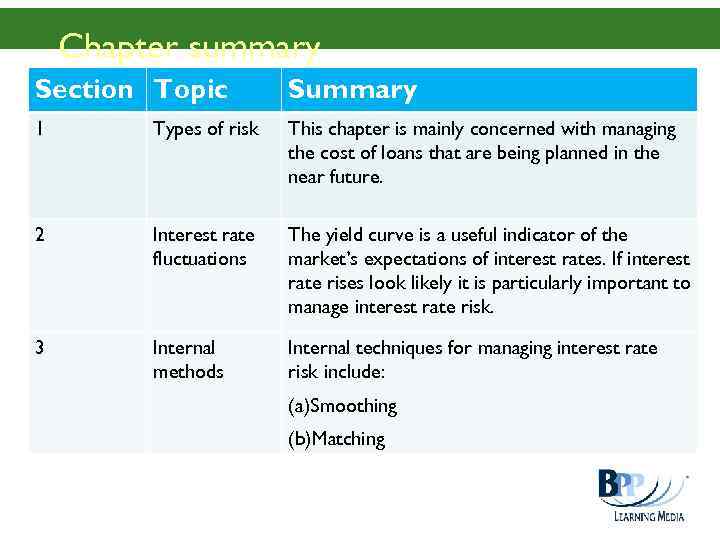 Chapter summary Section Topic Summary 1 Types of risk This chapter is mainly concerned with managing the cost of loans that are being planned in the near future. 2 Interest rate fluctuations The yield curve is a useful indicator of the market’s expectations of interest rates. If interest rate rises look likely it is particularly important to manage interest rate risk. 3 Internal methods Internal techniques for managing interest rate risk include: (a)Smoothing (b)Matching
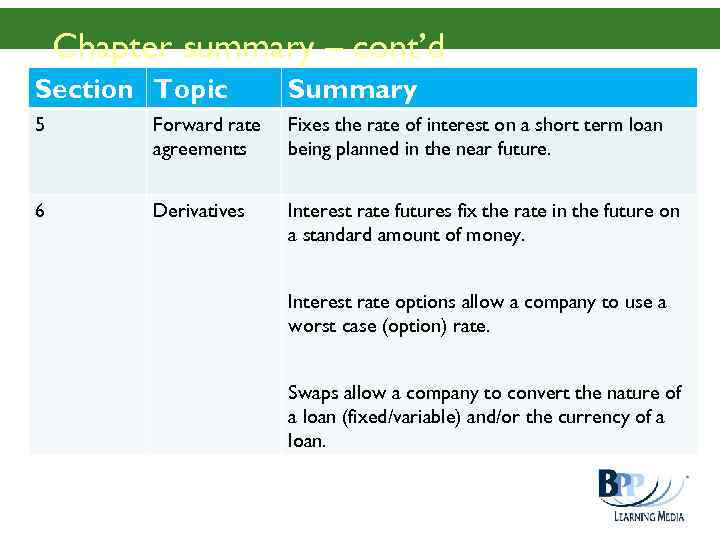 Chapter summary – cont’d Section Topic Summary 5 Forward rate agreements Fixes the rate of interest on a short term loan being planned in the near future. 6 Derivatives Interest rate futures fix the rate in the future on a standard amount of money. Interest rate options allow a company to use a worst case (option) rate. Swaps allow a company to convert the nature of a loan (fixed/variable) and/or the currency of a loan.