


 Скачать презентацию Risk Assessment and Risk Management of Living Modified
152294e78d03d1d2eb2a853da39318f3.ppt
- Количество слайдов: 22
 Risk Assessment and Risk Management of Living Modified Organisms under the Cartagena Protocol on Biosafety Ryan Hill and Cyrie Sendashonga Secretariat of the Convention on Biological Diversity 1
 Outline • Introduction to the Protocol, including current status and key provisions • Risk assessment – provisions and relevant decisions of the COP/MOP • Risk management – provisions and relevant decisions of the COP/MOP • Future work 2
 What is the Biosafety Protocol? • A Protocol to the Convention on Biological Diversity • The CBD was one of three conventions agreed by governments at the 1992 Rio Earth Summit, and has three objectives: conservation of biodiversity, sustainable use of its components, fair and equitable sharing of the benefits arising • Mandate for a Protocol came from Article 19. 3 of the Convention, and from Chapter 16 of Agenda 21 3
 Defining LMO Article 3: • “Living modified organism” means any living organism that possesses a novel combination of genetic material obtained through the use of modern biotechnology. • Terms “living organism” and “modern biotechnology” are also defined. 4
 Objective of the Protocol • In accordance with the precautionary approach contained in Principle 15 of the Rio Declaration, to contribute to ensuring an adequate level of protection in the field of the safe transfer, handling and use of LMOs resulting from modern biotechnology that may have adverse effects on the conservation and sustainable use of biodiversity, taking also into account risks to human health, and specifically focusing on transboundary movements. ” 5
 Scope of the Protocol Article 4: • This Protocol shall apply to the transboundary movement, transit, handling and use of all LMOs that may have adverse effects on the conservation and sustainable use of biological diversity, taking also into account risks to human health. 6
 Current Status • Negotiated from mid-90 s; adopted in January 2000; entered into force September 2003 • Currently 124 Parties • First Meeting of Parties (MOP-1) was held Feb 2004; adopted a medium-term programme of work (2005 -2008) • MOP-2 was held May-June 2005 • MOP-3 scheduled for March 2006 7
 Key Provisions • Decision-making procedures for import of LMOs (Advance Informed Agreement; LMOs-FFP) • Risk assessment and risk management • Information-sharing and the Biosafety Clearing-House • Handling, Transport, Packaging, Identification • Capacity-Building • Compliance • Liability and redress • Public Awareness and Participation • Socio-economic considerations 8
 Decision-Making Procedures 1. Advance Informed Agreement Procedure • Applies to first transboundary movement of LMOs for release into the environment (e. g. , crops for planting) • Exporter notifies importer in advance • Importer takes decision in accordance with risk assessment, and may take into account socioeconomic considerations • Importer can require exporter to conduct and/or pay for the assessment 9
 Decision-Making Procedures 2. LMOs for Direct Use as Food or Feed, or for Processing • Domestic regulatory framework applies • Most regulatory frameworks require risk assessment 3. LMOs in transit or for contained use are not subject to the AIA procedure * Note: The decision-making procedures will be reviewed at MOP-4, in accordance with the medium-term programme of work and Articles 29. 4 and 35 concerning review of implementation of the Protocol. 10
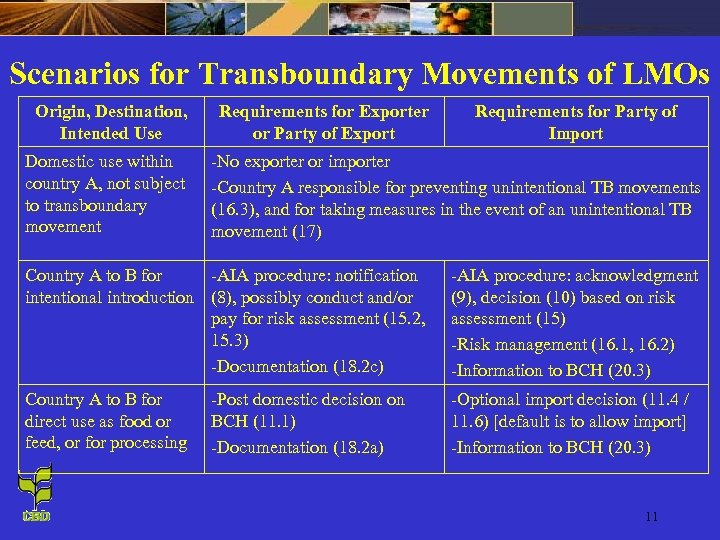 Scenarios for Transboundary Movements of LMOs Origin, Destination, Intended Use Domestic use within country A, not subject to transboundary movement Requirements for Exporter or Party of Export -No exporter or importer -Country A responsible for preventing unintentional TB movements (16. 3), and for taking measures in the event of an unintentional TB movement (17) Country A to B for -AIA procedure: notification intentional introduction (8), possibly conduct and/or pay for risk assessment (15. 2, 15. 3) -Documentation (18. 2 c) Country A to B for direct use as food or feed, or for processing Requirements for Party of Import -Post domestic decision on BCH (11. 1) -Documentation (18. 2 a) -AIA procedure: acknowledgment (9), decision (10) based on risk assessment (15) -Risk management (16. 1, 16. 2) -Information to BCH (20. 3) -Optional import decision (11. 4 / 11. 6) [default is to allow import] -Information to BCH (20. 3) 11
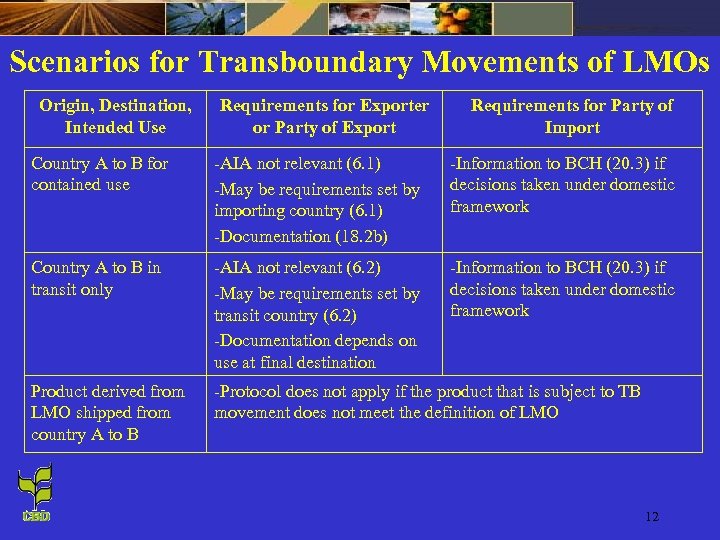 Scenarios for Transboundary Movements of LMOs Origin, Destination, Intended Use Requirements for Exporter or Party of Export Requirements for Party of Import Country A to B for contained use -AIA not relevant (6. 1) -May be requirements set by importing country (6. 1) -Documentation (18. 2 b) -Information to BCH (20. 3) if decisions taken under domestic framework Country A to B in transit only -AIA not relevant (6. 2) -May be requirements set by transit country (6. 2) -Documentation depends on use at final destination -Information to BCH (20. 3) if decisions taken under domestic framework Product derived from LMO shipped from country A to B -Protocol does not apply if the product that is subject to TB movement does not meet the definition of LMO 12
 Risk Assessment (Article 15 and Annex III) • To be carried out on a case-by-case basis • Scientifically sound and transparent, taking into account recognized risk assessment techniques • Lack of scientific knowledge or consensus does not indicate particular level of risk, absence of risk, or acceptable risk • Comparative risk assessment (i. e. , consider risks in the context of risks posed by non-modified recipients or parental organisms) • General methodology and points to consider described in Annex III (follows the conventional paradigm) 13
 Risk Assessment Methodology (Annex III, Paragraph 8) • • • Hazard identification – what could go wrong? Likelihood of adverse effects Consequences if those effects occur Risk = fcn (likelihood, consequences), for each risk pathway or mechanism Are risks manageable and how? Management strategies and monitoring 14
 Risk Management (Article 16) Parties are required to • manage and control risks identified in risk assessments carried out under the Protocol • take measures to prevent unintentional transboundary movements • ensure LMOs undergo appropriate periods of observation prior to use • cooperate regarding identification of LMOs and their traits, and associated management of LMOs ** Links between risk assessment and management are made in Article 16 and Annex III 15
 MOP Decisions MOP-2 (decision BS-II/9): • considered a review of existing guidance materials on risk assessment and risk management • Requested the Executive Secretary to convene regional workshops on capacity-building and exchange of experiences • Established an Ad Hoc Technical Expert Group on risk assessment, which will meet in November 2005 and make recommendations to MOP-3 16
 Risk Assessment AHTEG Terms of Reference: • Consider the nature and scope of existing approaches and guidance materials for risk assessment • Evaluate the above, and identify gaps • Identify areas where limitations in capacity are of critical importance 17
 MOP-3 will consider risk assessment and risk management in more detail based on: • the report of the AHTEG • the review of guidance materials, and submissions received for MOP-2 • information on experiences and progress in implementing Articles 15 and 16 submitted in interim national reports 18
 Capacity-Building • Protocol calls for cooperation in the development and/or strengthening of human resources and institutional capacities in biosafety • MOP-1 adopted an action plan for building capacity, and a coordination mechanism for implementation of the action plan The most pressing capacity needs in general include: • Capacity to use and provide all required information to the Biosafety Clearing-House • Capacity to make informed decisions based on risk assessment and other factors 19
 The Importance of Collaboration 1. 2. 3. 4. 5. 6. 7. A wide-range of expertise is needed to contribute to operationalizing the provisions of the Protocol that have a scientific underpinning Many international agreements have overlapping areas of competence Parties to the Protocol have an obligation to implement Articles 15 and 16; consistency with IPPC standards (e. g. , ISPM-11) is important CBD and IPPC secretariats have a joint work plan Biosafety Protocol expertise was involved in the revision of ISPM-11 MOP-2 specifically requested the Executive Secretary to reinforce cooperation with IPPC, Codex and OIE There is need for collaboration at national level among agencies that take the lead in various fora (as noted, for example, by ICPM-7) 20
 Participation in Protocol-related Processes • • • Participate at MOPs as government delegates, or as representatives of organizations (observers are welcome) Organize side-events at MOPs (governments, organizations, and institutions) Submit views (as governments or organizations) when appropriate Offer expertise to existing capacity-building projects (see databases on the BCH) Offer expertise directly to Parties if requested (funding available if on the biosafety roster of experts) 21
 Further Information • The CBD Secretariat (Biosafety Programme) Montreal, Canada • Email: secretariat@biodiv. org Tel: + 1 514 288 -3330 Fax: + 1 514 288 -6588 • The CBD Website – www. biodiv. org • The BCH Website – bch. biodiv. org 22