


 Скачать презентацию RISK ASSESSMENT A ROPE ACCESS PERSPECTIVE ALAN
A Forrest Presentation 3 (1).pptx
- Количество слайдов: 26
 RISK ASSESSMENT – A ROPE ACCESS PERSPECTIVE ALAN FORREST IRATA Lead Auditor IRATA Assessor & Instructor Original IRATA Level 3 – North Sea 1989 Worldwide Independent Consultant MOSCOW 2016
 WHAT IS A RISK ASSESSMENT? Some Definitions: A systematic process of evaluating the potential risks that may be involved in a projected activity or undertaking. Specific and detailed work instruction for the effective protection of all members of the work team and others affected by their actions. A risk assessment is not about creating huge amounts of paperwork, but rather about identifying sensible measures to control the risks in your workplace. MOSCOW 2016
 TERMINOLOGY Hazard – Potential danger. Risk - Likelihood of hazard resulting in a negative outcome. Consequence – Negative outcome. Control - Eliminating, or minimising, the potential for a negative outcome. MOSCOW 2016
 UK LEGAL PERSPECTIVE Management of Health & Safety at Work Regulations 1999: 3, - (1) Every employer shall make a suitable and sufficient assessment of – (a) the risks to the health and safety of his employees to which they are exposed whilst they are at work; and (b) the risks to the health and safety of persons not in his employment arising out of or in connection with the conduct by him of his undertaking. MOSCOW 2016
 WHO IS THE RISK ASSESSMENT FOR? The company? The client? The workers? The auditor? The judge? MOSCOW 2016
 WHO IS PREPARING THE RISK ASSESSMENT? The company or supervisor? Blank page or generic? Training and assessment Qualification and capability. MOSCOW 2016
 WHO IS CHECKING AND ACCEPTING THE RISK ASSESSMENT? Client representatives. Are they familiar enough with specialist activities to make informed judgments? Educate clients to help their understanding – training, demonstration, explanation. . . A client who understands what he is looking at is liable to be more relaxed and understanding towards “unusual” activity in their facility. MOSCOW 2016
 INITIAL COMMUNICATION & UNDERSTANDING Supervisors – Involved in preparation, experienced and alert to environment. Workers – Initial communication and understanding, layout and presentation, language. Declaration with Signatures: “I have been fully briefed in the attached risk assessment, I understand all aspects of it and agree to follow its contents. Particularly, I understand my personal roles and responsibilities with the team” MOSCOW 2016
 ONGOING COMMUNICATION & UNDERSTANDING Meaningful pre-work meetings: Daily Work Plan Risk Assessment Daily Review Access Method Rigging Considerations Hazards to rope Rescue Plan Individual Team Member Roles Exclusion Zones Tools & Materials Weather MOSCOW 2016
 WHO IS ULTIMATELY RESPONSIBLE? The Company, was fined £ 100, 000 after pleading guilty to breaching Regulation 4 of the Work at Height Regulations 2005. Following the case, the HSE Inspector, said: “This was a tragic incident and the death could have been prevented had The Company planned the job correctly and put suitable safety measures in place. “Assessing the risks of that job properly would have identified that the potentially sharp edge presented a very clear danger to anyone suspended and working on ropes rigged against it. “However, the company failed to do this so failed to take safety precautions and instead, The Individual fell to his death. ” MOSCOW 2016
 RISK ASSESSMENT IS A PROCESS The UK Health and Safety Executive's Five Steps to Risk Assessment. Step 1: Identify the hazards. Step 2: Decide who, or what, might be harmed and how. Step 3: Evaluate the risks and decide on precautions. Step 4: Record your findings and implement them. Step 5: Review your risk assessment and update if necessary. MOSCOW 2016
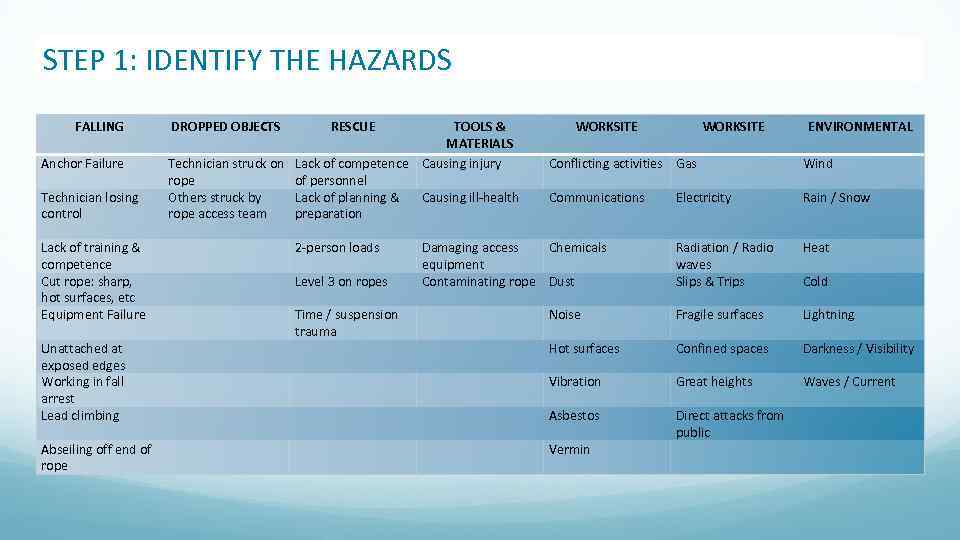 STEP 1: IDENTIFY THE HAZARDS FALLING Anchor Failure Technician losing control Lack of training & competence Cut rope: sharp, hot surfaces, etc Equipment Failure Unattached at exposed edges Working in fall arrest Lead climbing Abseiling off end of rope DROPPED OBJECTS RESCUE TOOLS & MATERIALS Technician struck on Lack of competence Causing injury rope of personnel Others struck by Lack of planning & Causing ill-health rope access team preparation 2 -person loads Level 3 on ropes Time / suspension trauma WORKSITE ENVIRONMENTAL Conflicting activities Gas Wind Communications Electricity Rain / Snow Radiation / Radio waves Slips & Trips Heat Noise Fragile surfaces Lightning Hot surfaces Confined spaces Darkness / Visibility Vibration Great heights Waves / Current Asbestos Direct attacks from public Damaging access Chemicals equipment Contaminating rope Dust Vermin Cold
 STEP 2: DECIDE WHO, OR WHAT, MIGHT BE HARMED AND HOW WHO? Our work team, including varying capabilities and experience within the team. Other workers on site. WHAT? Property and equipment damage. Environmental damage. MOSCOW 2016
 STEP 3: EVALUATE THE RISKS. MOSCOW 2016
 STEP 3: DECIDE ON PRECAUTIONS (CONTROLS). There is a hierarchy of approach when considering control measures: Remove the hazard completely Try a less hazardous material or option Prevent access to the hazard Organise work to reduce exposure to the hazard Increase level of information, training and supervision Issue PPE and provide welfare facilities MOSCOW 2016
 STEP 4: RECORD YOUR FINDINGS Format 1 – using matrix Job Steps Hazard description and effect • • People, Property or Environment at Risk Initial Risk (from matrix) Hazard Consequence Chance of Occurrence Controls Risk Rating List All Controls Required Residual Risk (from matrix) Controlled Hazard Consequence Controlled Chance of Occurrence Residual Risk Rating Repetitive Complex Subjective Attempt to be quantitative MOSCOW 2016
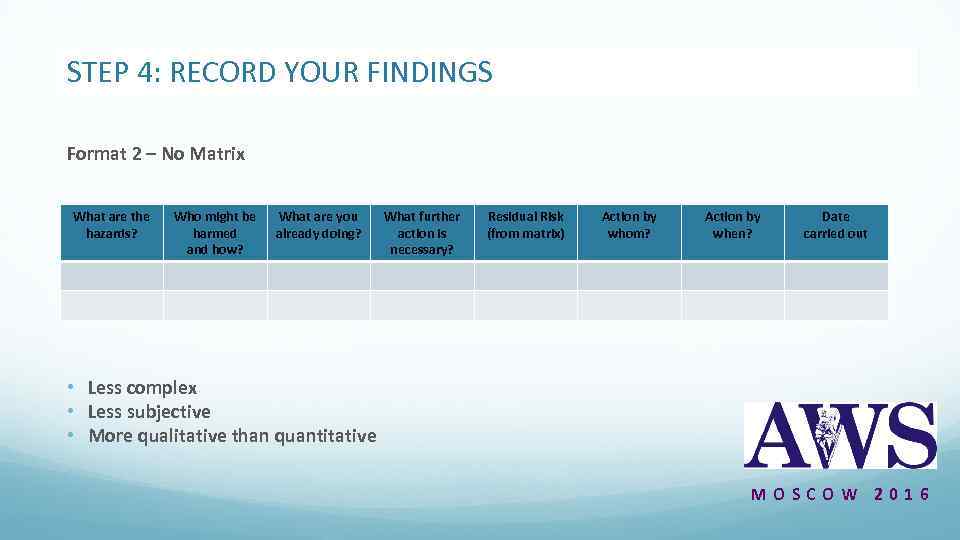 STEP 4: RECORD YOUR FINDINGS Format 2 – No Matrix What are the hazards? Who might be harmed and how? What are you already doing? What further action is necessary? Residual Risk (from matrix) Action by whom? Action by when? Date carried out • Less complex • Less subjective • More qualitative than quantitative MOSCOW 2016
 STEP 5: REVIEW THE RISK ASSESSMENT. Things change - review what you are doing on an ongoing basis: • Have there been any significant changes in your environment? • Can you make any improvements? • Has anyone noticed a problem? • Have you learnt anything from accidents or near misses? • Make sure your risk assessment stays up to date. MOSCOW 2016
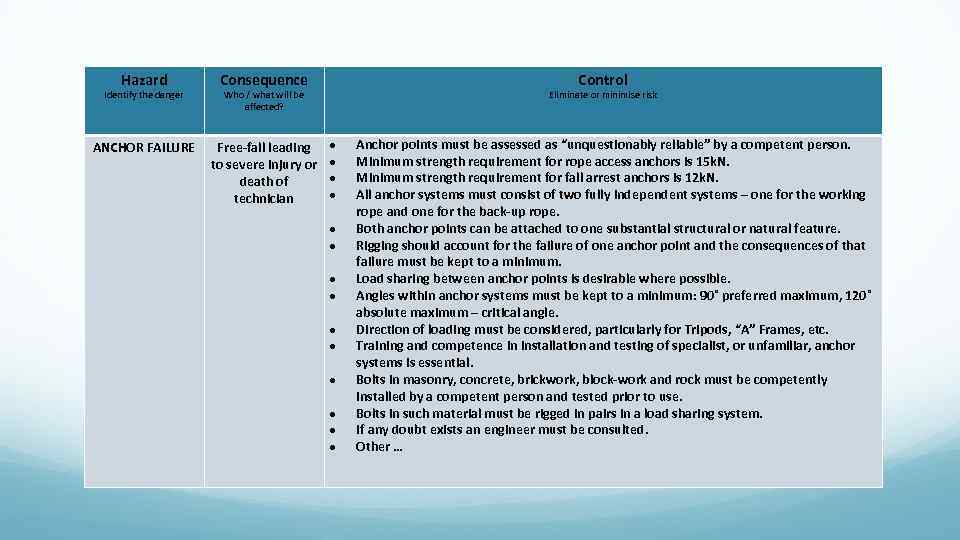 Hazard Consequence ANCHOR FAILURE Free-fall leading to severe injury or death of technician Identify the danger Control Who / what will be affected? Eliminate or minimise risk Anchor points must be assessed as “unquestionably reliable” by a competent person. Minimum strength requirement for rope access anchors is 15 k. N. Minimum strength requirement for fall arrest anchors is 12 k. N. All anchor systems must consist of two fully independent systems – one for the working rope and one for the back-up rope. Both anchor points can be attached to one substantial structural or natural feature. Rigging should account for the failure of one anchor point and the consequences of that failure must be kept to a minimum. Load sharing between anchor points is desirable where possible. Angles within anchor systems must be kept to a minimum: 90˚ preferred maximum, 120˚ absolute maximum – critical angle. Direction of loading must be considered, particularly for Tripods, “A” Frames, etc. Training and competence in installation and testing of specialist, or unfamiliar, anchor systems is essential. Bolts in masonry, concrete, brickwork, block-work and rock must be competently installed by a competent person and tested prior to use. Bolts in such material must be rigged in pairs in a load sharing system. If any doubt exists an engineer must be consulted. Other …
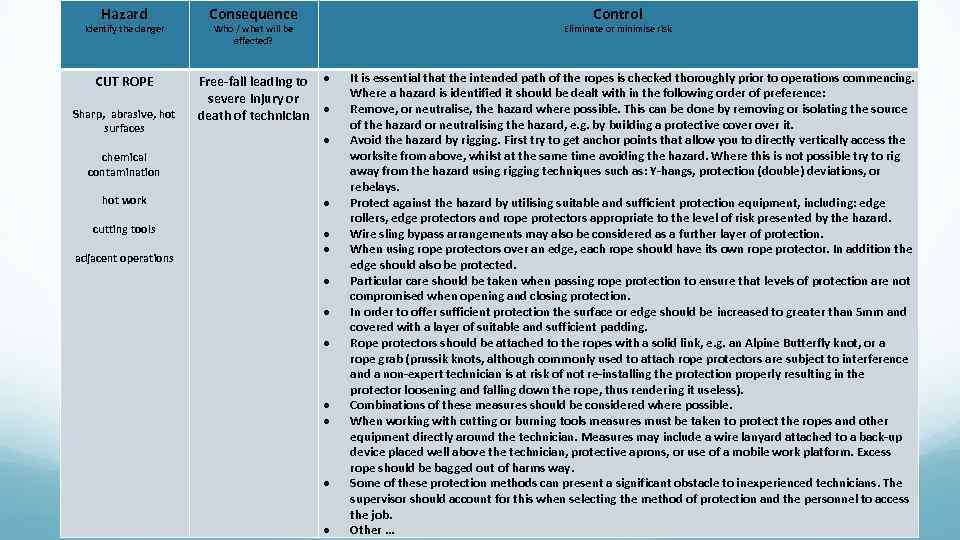 Hazard Consequence CUT ROPE Free-fall leading to severe injury or death of technician Identify the danger Sharp, abrasive, hot surfaces Control Who / what will be affected? Eliminate or minimise risk chemical contamination hot work cutting tools adjacent operations It is essential that the intended path of the ropes is checked thoroughly prior to operations commencing. Where a hazard is identified it should be dealt with in the following order of preference: Remove, or neutralise, the hazard where possible. This can be done by removing or isolating the source of the hazard or neutralising the hazard, e. g. by building a protective cover it. Avoid the hazard by rigging. First try to get anchor points that allow you to directly vertically access the worksite from above, whilst at the same time avoiding the hazard. Where this is not possible try to rig away from the hazard using rigging techniques such as: Y-hangs, protection (double) deviations, or rebelays. Protect against the hazard by utilising suitable and sufficient protection equipment, including: edge rollers, edge protectors and rope protectors appropriate to the level of risk presented by the hazard. Wire sling bypass arrangements may also be considered as a further layer of protection. When using rope protectors over an edge, each rope should have its own rope protector. In addition the edge should also be protected. Particular care should be taken when passing rope protection to ensure that levels of protection are not compromised when opening and closing protection. In order to offer sufficient protection the surface or edge should be increased to greater than 5 mm and covered with a layer of suitable and sufficient padding. Rope protectors should be attached to the ropes with a solid link, e. g. an Alpine Butterfly knot, or a rope grab (prussik knots, although commonly used to attach rope protectors are subject to interference and a non-expert technician is at risk of not re-installing the protection properly resulting in the protector loosening and falling down the rope, thus rendering it useless). Combinations of these measures should be considered where possible. When working with cutting or burning tools measures must be taken to protect the ropes and other equipment directly around the technician. Measures may include a wire lanyard attached to a back-up device placed well above the technician, protective aprons, or use of a mobile work platform. Excess rope should be bagged out of harms way. Some of these protection methods can present a significant obstacle to inexperienced technicians. The supervisor should account for this when selecting the method of protection and the personnel to access the job. Other …
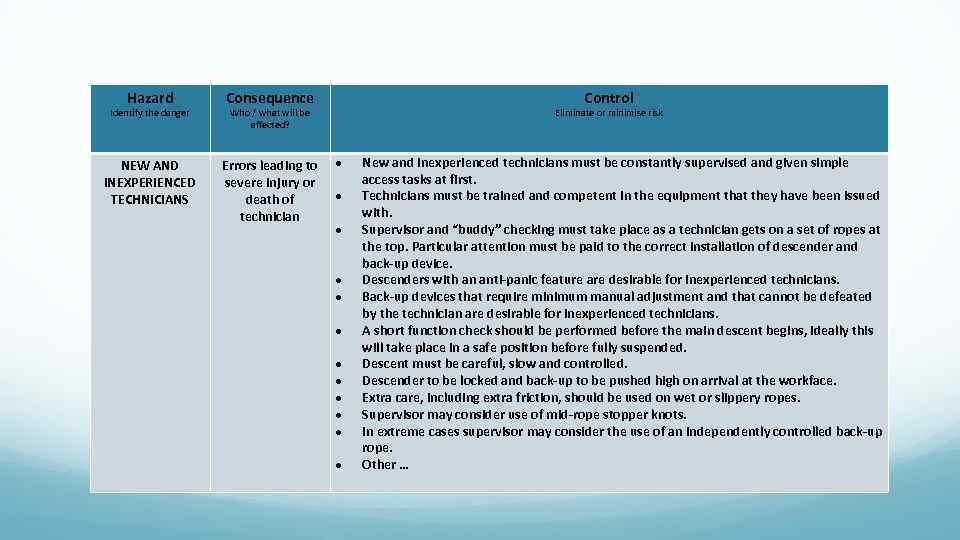 Hazard Consequence NEW AND INEXPERIENCED TECHNICIANS Errors leading to severe injury or death of technician Identify the danger Control Who / what will be affected? Eliminate or minimise risk New and inexperienced technicians must be constantly supervised and given simple access tasks at first. Technicians must be trained and competent in the equipment that they have been issued with. Supervisor and “buddy” checking must take place as a technician gets on a set of ropes at the top. Particular attention must be paid to the correct installation of descender and back-up device. Descenders with an anti-panic feature are desirable for inexperienced technicians. Back-up devices that require minimum manual adjustment and that cannot be defeated by the technician are desirable for inexperienced technicians. A short function check should be performed before the main descent begins, ideally this will take place in a safe position before fully suspended. Descent must be careful, slow and controlled. Descender to be locked and back-up to be pushed high on arrival at the workface. Extra care, including extra friction, should be used on wet or slippery ropes. Supervisor may consider use of mid-rope stopper knots. In extreme cases supervisor may consider the use of an independently controlled back-up rope. Other …
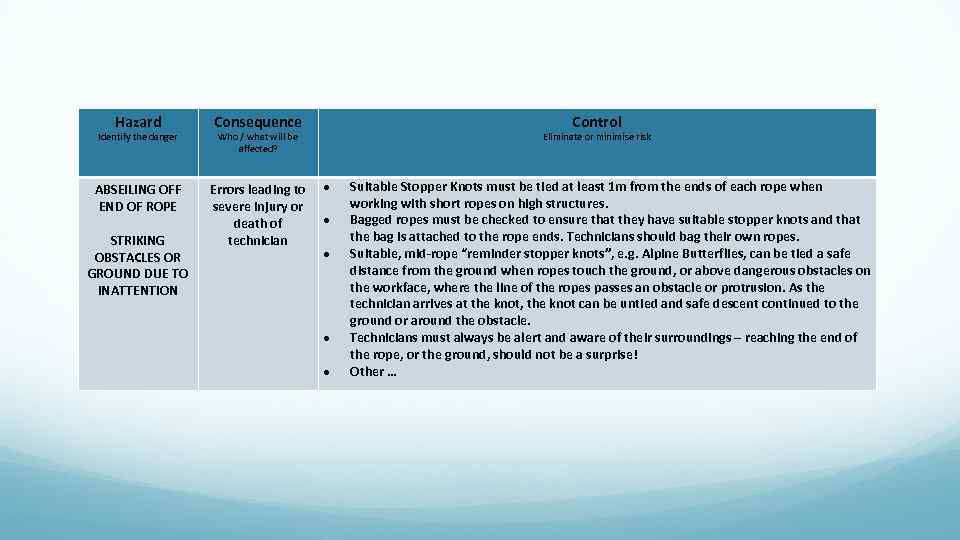 Hazard Consequence ABSEILING OFF END OF ROPE Errors leading to severe injury or death of technician Identify the danger STRIKING OBSTACLES OR GROUND DUE TO INATTENTION Control Who / what will be affected? Eliminate or minimise risk Suitable Stopper Knots must be tied at least 1 m from the ends of each rope when working with short ropes on high structures. Bagged ropes must be checked to ensure that they have suitable stopper knots and that the bag is attached to the rope ends. Technicians should bag their own ropes. Suitable, mid-rope “reminder stopper knots”, e. g. Alpine Butterflies, can be tied a safe distance from the ground when ropes touch the ground, or above dangerous obstacles on the workface, where the line of the ropes passes an obstacle or protrusion. As the technician arrives at the knot, the knot can be untied and safe descent continued to the ground or around the obstacle. Technicians must always be alert and aware of their surroundings – reaching the end of the rope, or the ground, should not be a surprise! Other …
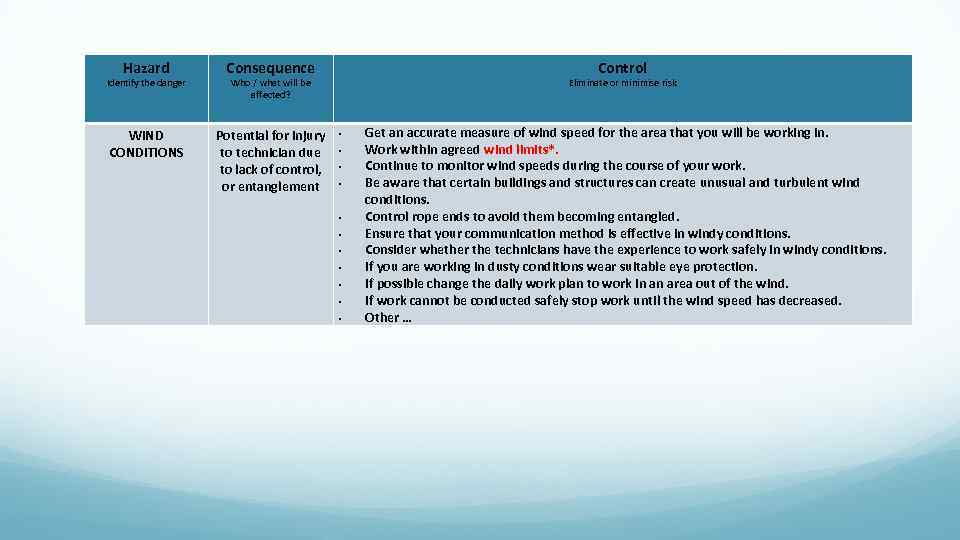 Hazard Consequence WIND CONDITIONS Potential for injury to technician due to lack of control, or entanglement Identify the danger Control Who / what will be affected? Eliminate or minimise risk • • • Get an accurate measure of wind speed for the area that you will be working in. Work within agreed wind limits*. Continue to monitor wind speeds during the course of your work. Be aware that certain buildings and structures can create unusual and turbulent wind conditions. Control rope ends to avoid them becoming entangled. Ensure that your communication method is effective in windy conditions. Consider whether the technicians have the experience to work safely in windy conditions. If you are working in dusty conditions wear suitable eye protection. If possible change the daily work plan to work in an area out of the wind. If work cannot be conducted safely stop work until the wind speed has decreased. Other …
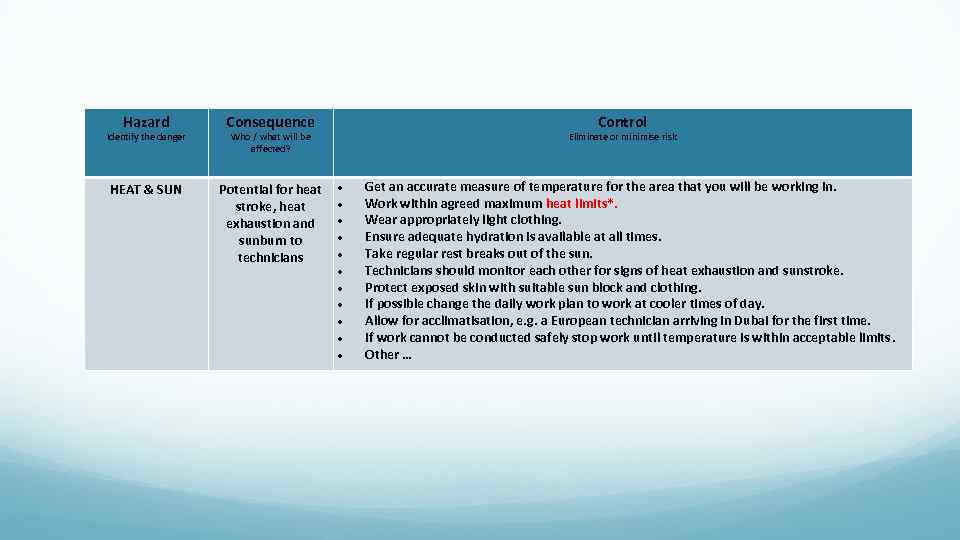 Hazard Consequence HEAT & SUN Potential for heat stroke, heat exhaustion and sunburn to technicians Identify the danger Control Who / what will be affected? Eliminate or minimise risk Get an accurate measure of temperature for the area that you will be working in. Work within agreed maximum heat limits*. Wear appropriately light clothing. Ensure adequate hydration is available at all times. Take regular rest breaks out of the sun. Technicians should monitor each other for signs of heat exhaustion and sunstroke. Protect exposed skin with suitable sun block and clothing. If possible change the daily work plan to work at cooler times of day. Allow for acclimatisation, e. g. a European technician arriving in Dubai for the first time. If work cannot be conducted safely stop work until temperature is within acceptable limits. Other …
 OBJECTIVES Engage all technicians in process. Enable Supervisors through training. Involve clients in the process by educating them so that they know what is going on. Maintain and enhance the safety record and reputation of rope access in industry worldwide. MOSCOW 2016
 Questions? Comments? alan@ffzero. com MOSCOW 2016