


 Скачать презентацию Risk and Return 5 -1 Risk and
191ee937750a05e4de4140ac129370f8.ppt
- Количество слайдов: 45
 Risk and Return 5 -1
 Risk and Return u Defining Risk and Return u Using Probability Distributions to Measure Risk u Attitudes u Risk Toward Risk and Return in a Portfolio Context u Diversification u The 5 -2 Capital Asset Pricing Model (CAPM)
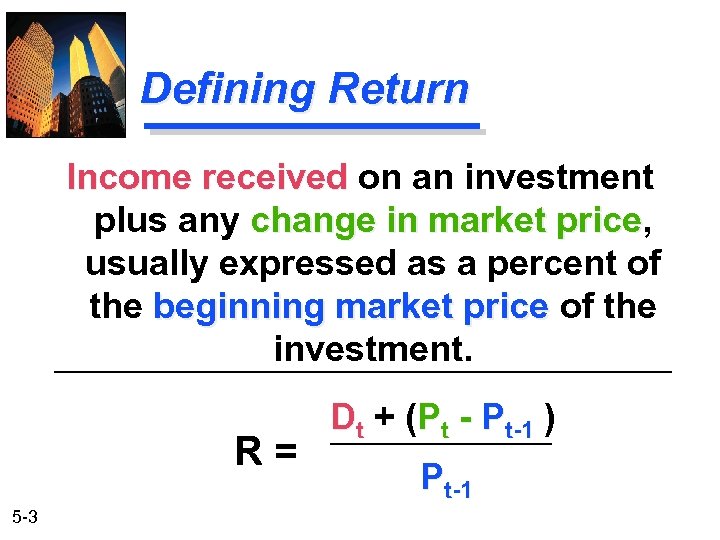 Defining Return Income received on an investment plus any change in market price, price usually expressed as a percent of the beginning market price of the investment. R= 5 -3 Dt + (Pt - Pt-1 ) Pt-1
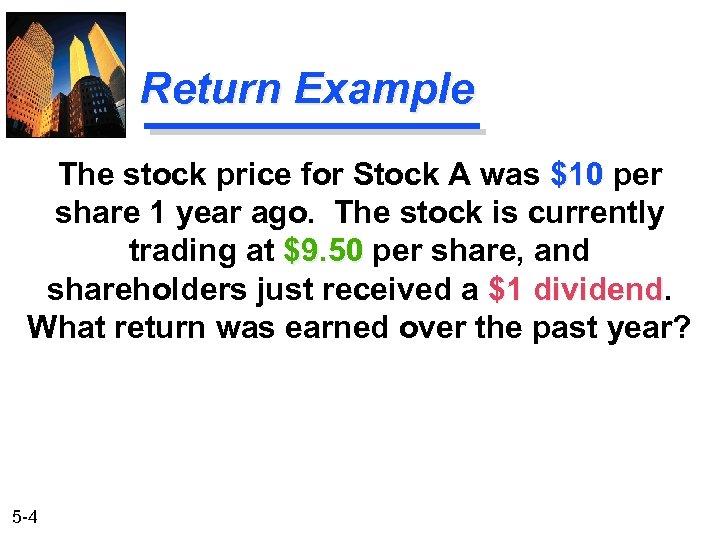 Return Example The stock price for Stock A was $10 per share 1 year ago. The stock is currently trading at $9. 50 per share, and shareholders just received a $1 dividend What return was earned over the past year? 5 -4
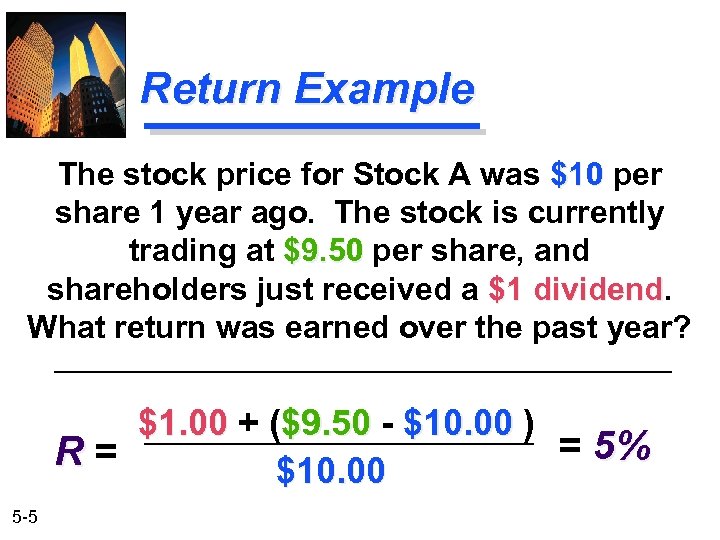 Return Example The stock price for Stock A was $10 per share 1 year ago. The stock is currently trading at $9. 50 per share, and shareholders just received a $1 dividend What return was earned over the past year? $1. 00 + ($9. 50 - $10. 00 ) = 5% R= $10. 00 5 -5
 Defining Risk The variability of returns from those that are expected. What rate of return do you expect on your investment (savings) this year? What rate will you actually earn? Does it matter if it is a bank CD or a share of stock? 5 -6
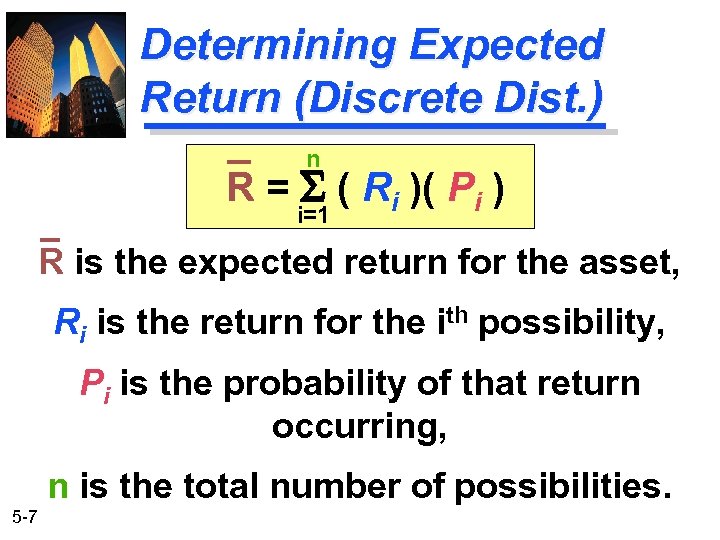 Determining Expected Return (Discrete Dist. ) n R = S ( Ri )( Pi ) i=1 R is the expected return for the asset, Ri is the return for the ith possibility, Pi is the probability of that return occurring, n is the total number of possibilities. 5 -7
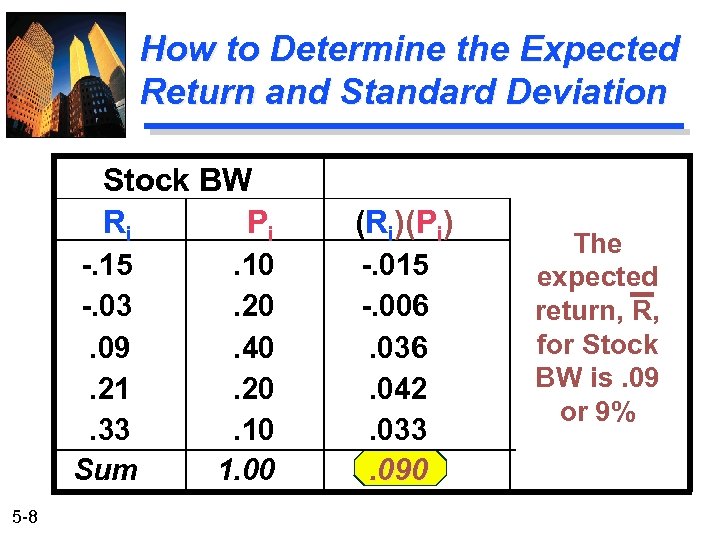 How to Determine the Expected Return and Standard Deviation Stock BW Ri Pi -. 15 -. 03. 09. 21. 33 Sum 5 -8 . 10. 20. 40. 20. 10 1. 00 (Ri)(Pi) -. 015 -. 006. 036. 042. 033. 090 The expected return, R, for Stock BW is. 09 or 9%
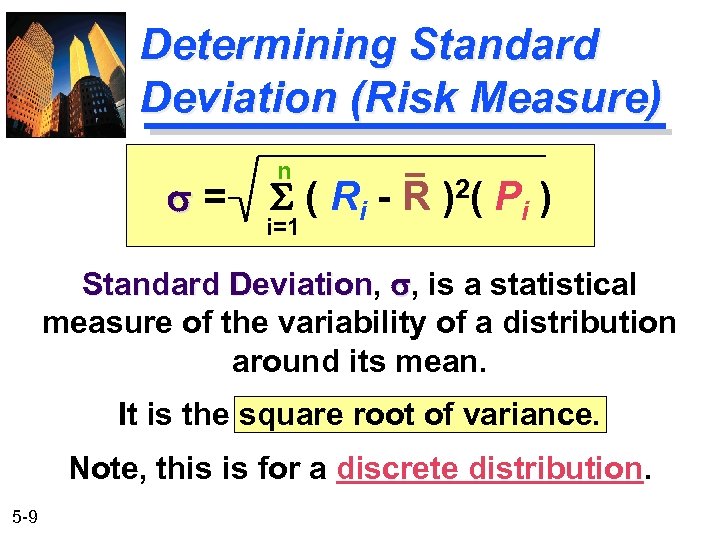 Determining Standard Deviation (Risk Measure) s= n S ( R i - R ) 2( P i ) i=1 Standard Deviation, s, is a statistical Deviation measure of the variability of a distribution around its mean. It is the square root of variance. Note, this is for a discrete distribution. 5 -9
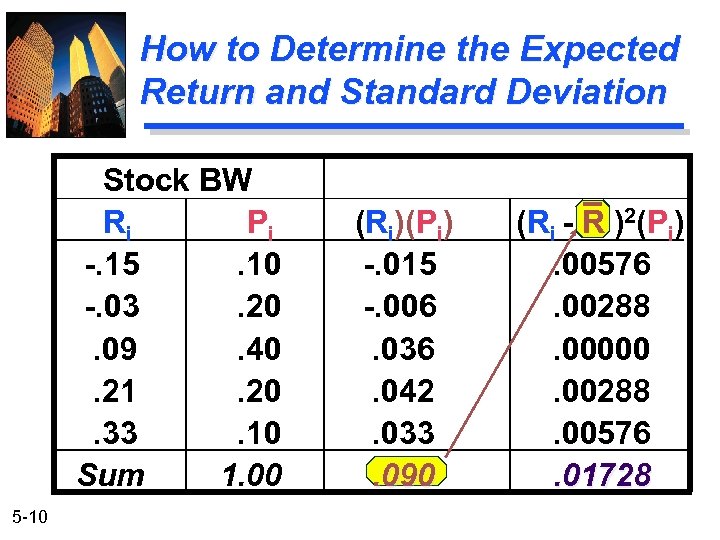 How to Determine the Expected Return and Standard Deviation Stock BW Ri Pi -. 15. 10 -. 03. 20. 09. 40. 21. 20. 33. 10 Sum 1. 00 5 -10 (Ri)(Pi) -. 015 -. 006. 036. 042. 033. 090 (Ri - R )2(Pi). 00576. 00288. 00000. 00288. 00576. 01728
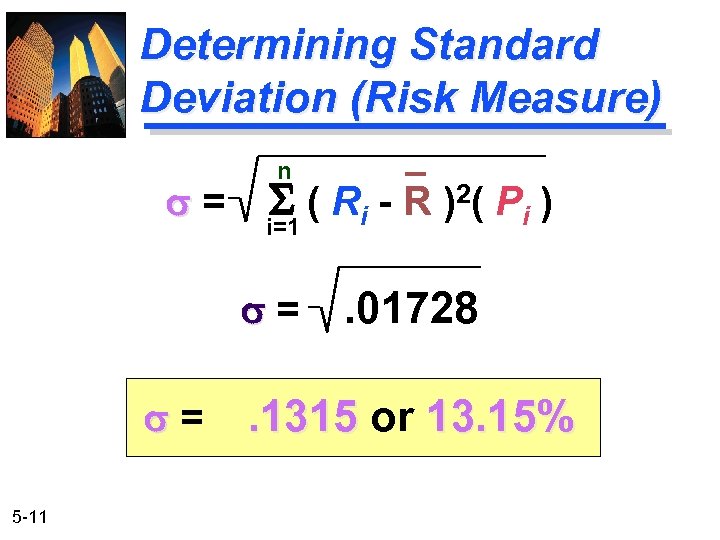 Determining Standard Deviation (Risk Measure) s= n S ( R i - R ) 2( P i ) i=1 s= s= 5 -11 . 01728 . 1315 or 13. 15%
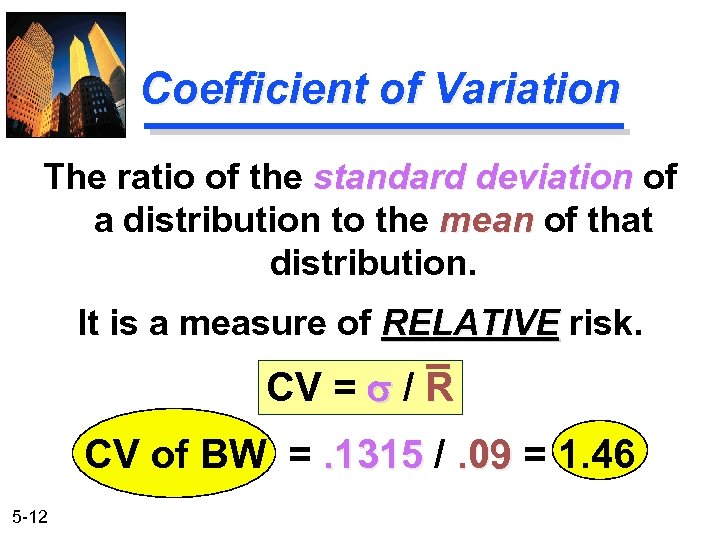 Coefficient of Variation The ratio of the standard deviation of a distribution to the mean of that distribution. It is a measure of RELATIVE risk. CV = s / R CV of BW =. 1315 /. 09 = 1. 46 5 -12
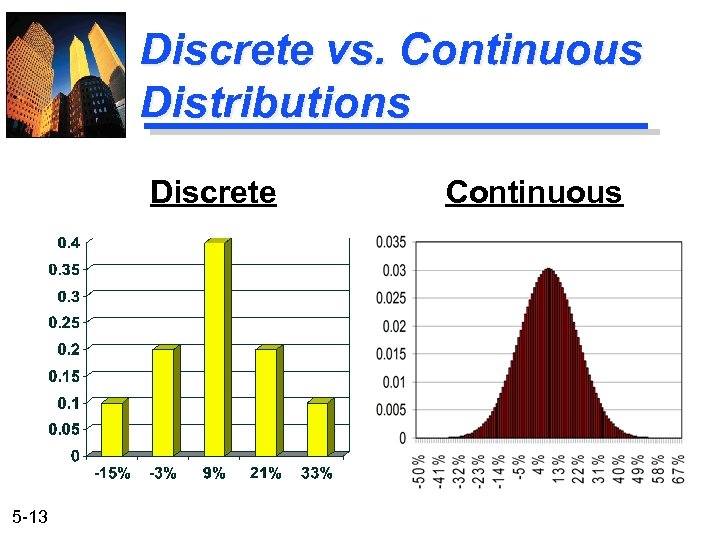 Discrete vs. Continuous Distributions Discrete 5 -13 Continuous
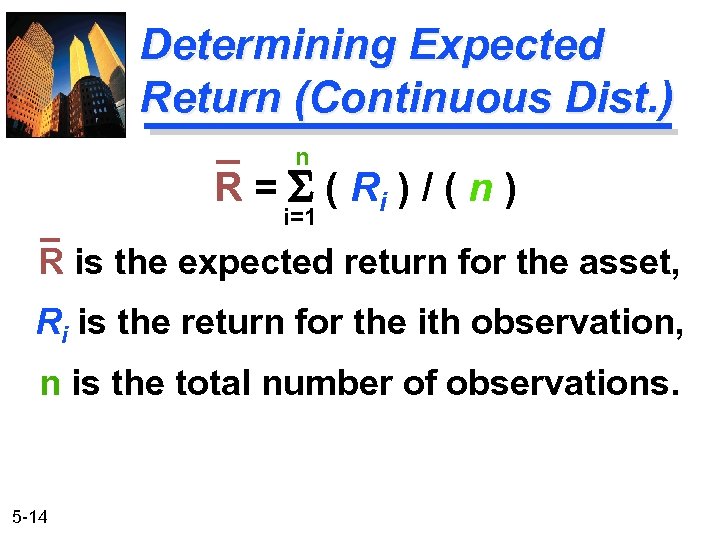 Determining Expected Return (Continuous Dist. ) n R = S ( Ri ) / ( n ) i=1 R is the expected return for the asset, Ri is the return for the ith observation, n is the total number of observations. 5 -14
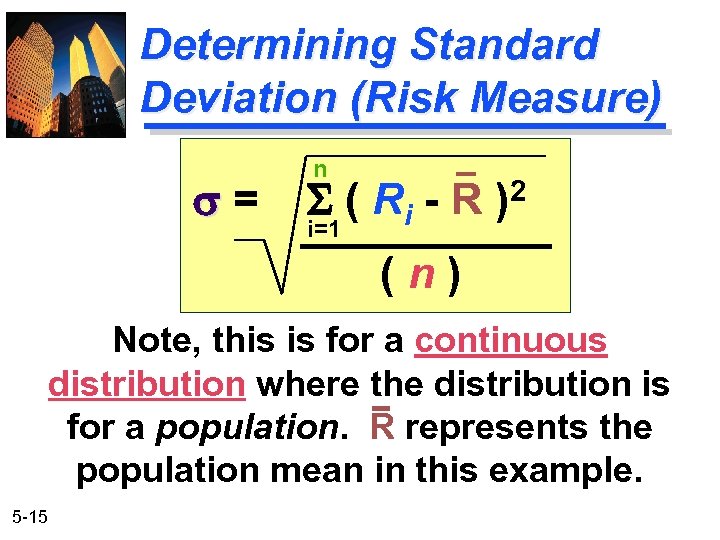 Determining Standard Deviation (Risk Measure) s= n S ( Ri - R ) 2 i=1 (n) Note, this is for a continuous distribution where the distribution is for a population. R represents the population mean in this example. 5 -15
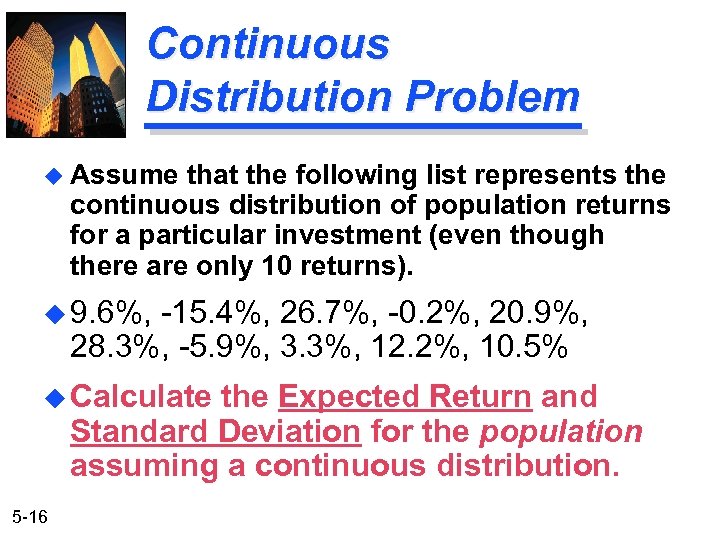 Continuous Distribution Problem u Assume that the following list represents the continuous distribution of population returns for a particular investment (even though there are only 10 returns). u 9. 6%, -15. 4%, 26. 7%, -0. 2%, 20. 9%, 28. 3%, -5. 9%, 3. 3%, 12. 2%, 10. 5% u Calculate the Expected Return and Standard Deviation for the population assuming a continuous distribution. 5 -16
 Risk Attitudes Certainty Equivalent (CE) is the CE amount of cash someone would require with certainty at a point in time to make the individual indifferent between that certain amount and an amount expected to be received with risk at the same point in time. 5 -17
 Risk Attitudes Certainty equivalent > Expected value Risk Preference Certainty equivalent = Expected value Risk Indifference Certainty equivalent < Expected value Risk Aversion 5 -18 Most individuals are Risk Averse
 Risk Attitude Example You have the choice between (1) a guaranteed dollar reward or (2) a coin-flip gamble of $100, 000 (50% chance) or $0 (50% chance). The expected value of the gamble is $50, 000. u Mary requires a guaranteed $25, 000, or more, to call off the gamble. u Raleigh is just as happy to take $50, 000 or take the risky gamble. u Shannon gamble. 5 -19 requires at least $52, 000 to call off the
 Risk Attitude Example What are the Risk Attitude tendencies of each? Mary shows “risk aversion” because her “certainty equivalent” < the expected value of the gamble. Raleigh exhibits “risk indifference” because her “certainty equivalent” equals the expected value of the gamble. Shannon reveals a “risk preference” because her “certainty equivalent” > the expected value of the gamble. 5 -20
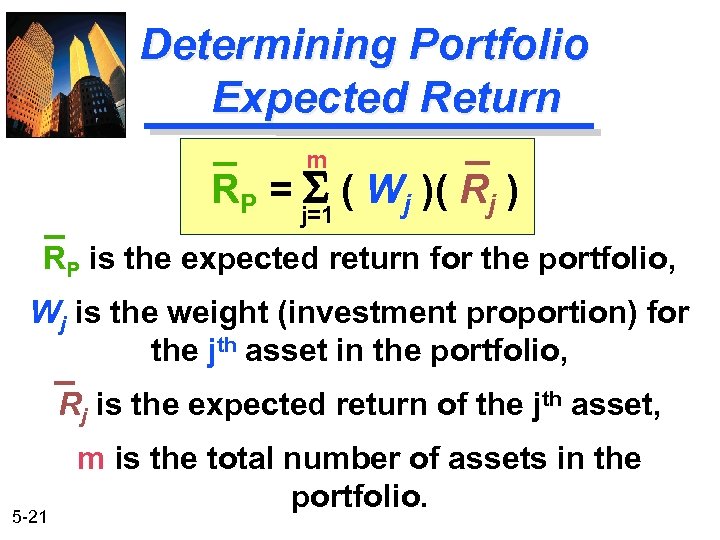 Determining Portfolio Expected Return m RP = S ( Wj )( Rj ) j=1 RP is the expected return for the portfolio, Wj is the weight (investment proportion) for the jth asset in the portfolio, Rj is the expected return of the jth asset, 5 -21 m is the total number of assets in the portfolio.
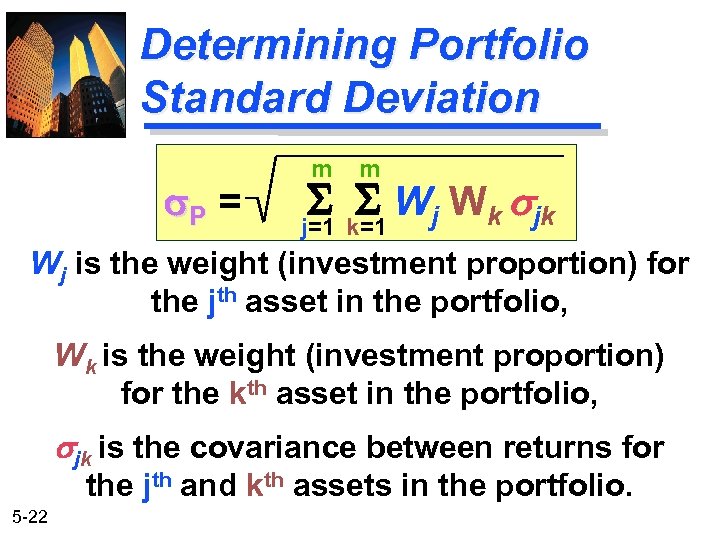 Determining Portfolio Standard Deviation s. P = m m S k=1 Wj Wk sjk S j=1 Wj is the weight (investment proportion) for the jth asset in the portfolio, Wk is the weight (investment proportion) for the kth asset in the portfolio, sjk is the covariance between returns for the jth and kth assets in the portfolio. 5 -22
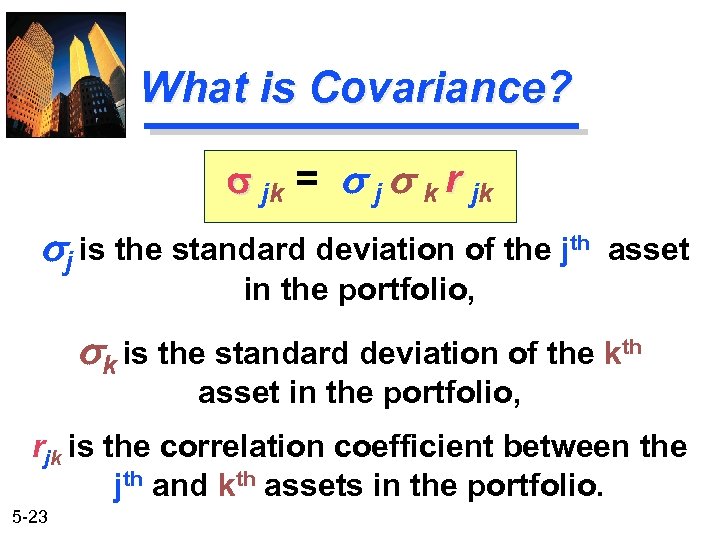 What is Covariance? s jk = s j s k r jk sj is the standard deviation of the jth asset in the portfolio, sk is the standard deviation of the kth asset in the portfolio, rjk is the correlation coefficient between the jth and kth assets in the portfolio. 5 -23
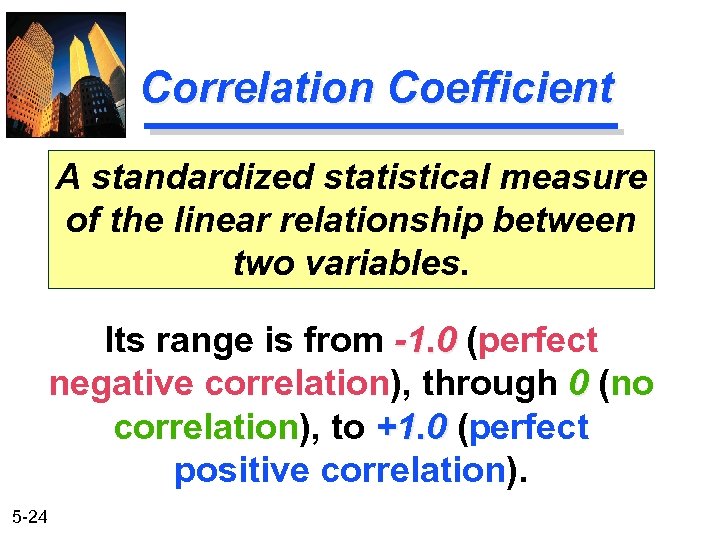 Correlation Coefficient A standardized statistical measure of the linear relationship between two variables. Its range is from -1. 0 (perfect negative correlation), through 0 (no correlation), to +1. 0 (perfect positive correlation). 5 -24
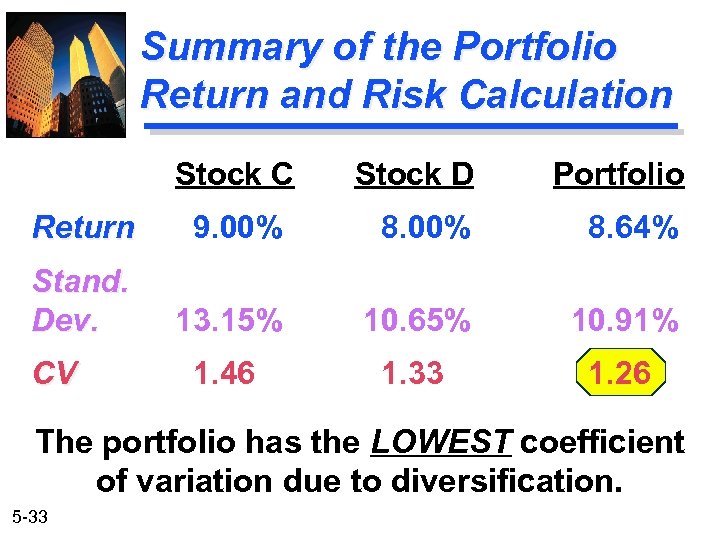 Summary of the Portfolio Return and Risk Calculation Stock C Stock D Portfolio Return 9. 00% 8. 64% Stand. Dev. 13. 15% 10. 65% 10. 91% 1. 46 1. 33 1. 26 CV The portfolio has the LOWEST coefficient of variation due to diversification. 5 -33
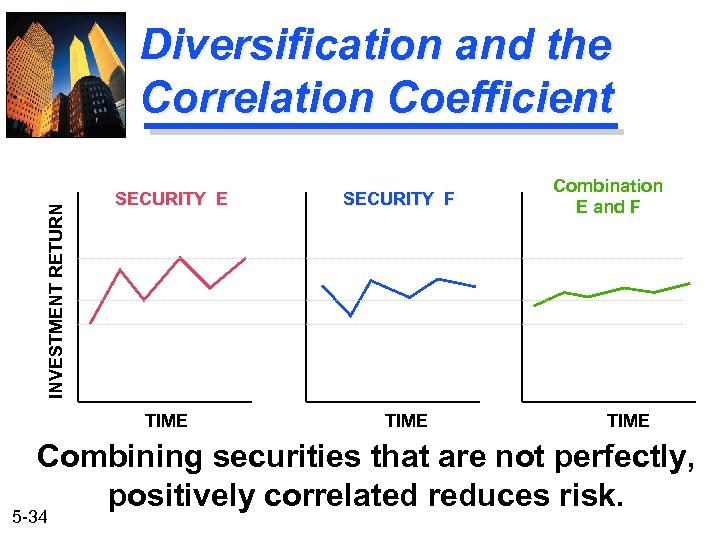 INVESTMENT RETURN Diversification and the Correlation Coefficient SECURITY E TIME SECURITY F TIME Combination E and F TIME Combining securities that are not perfectly, positively correlated reduces risk. 5 -34
 Total Risk = Systematic Risk + Unsystematic Risk Systematic Risk is the variability of return on stocks or portfolios associated with changes in return on the market as a whole. Unsystematic Risk is the variability of return on stocks or portfolios not explained by general market movements. It is avoidable through diversification. 5 -35
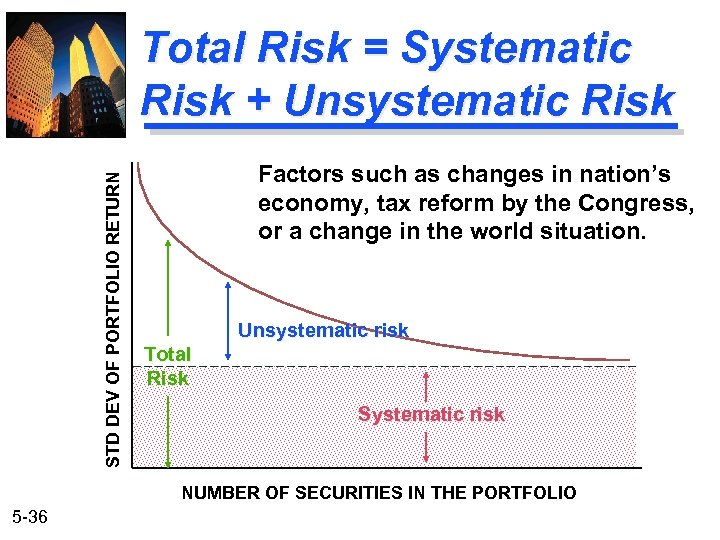 STD DEV OF PORTFOLIO RETURN Total Risk = Systematic Risk + Unsystematic Risk Factors such as changes in nation’s economy, tax reform by the Congress, or a change in the world situation. Unsystematic risk Total Risk Systematic risk NUMBER OF SECURITIES IN THE PORTFOLIO 5 -36
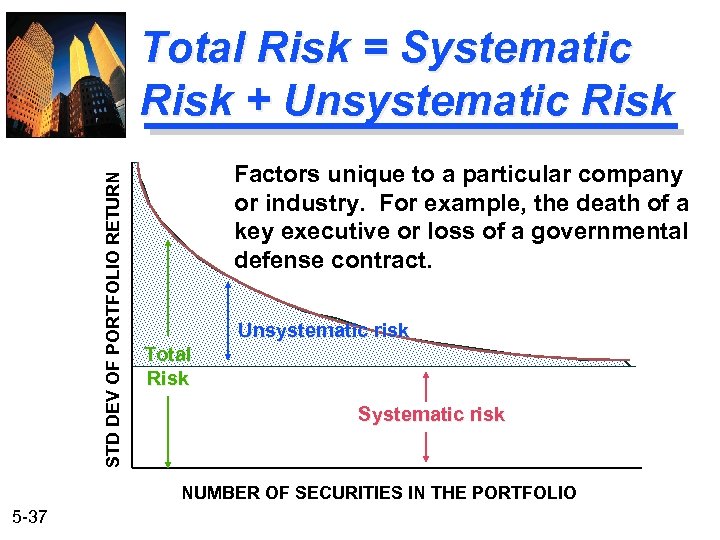 STD DEV OF PORTFOLIO RETURN Total Risk = Systematic Risk + Unsystematic Risk Factors unique to a particular company or industry. For example, the death of a key executive or loss of a governmental defense contract. Unsystematic risk Total Risk Systematic risk NUMBER OF SECURITIES IN THE PORTFOLIO 5 -37
 Capital Asset Pricing Model (CAPM) CAPM is a model that describes the relationship between risk and expected (required) return; in this model, a security’s expected (required) return is the risk-free rate plus a premium based on the systematic risk of the security. 5 -38
 CAPM Assumptions 1. 2. Homogeneous investor expectations over a given period. 3. Risk-free asset return is certain (use short- to intermediate-term Treasuries as a proxy). 4. 5 -39 Capital markets are efficient. Market portfolio contains only systematic risk (use S&P 500 Index or similar as a proxy).
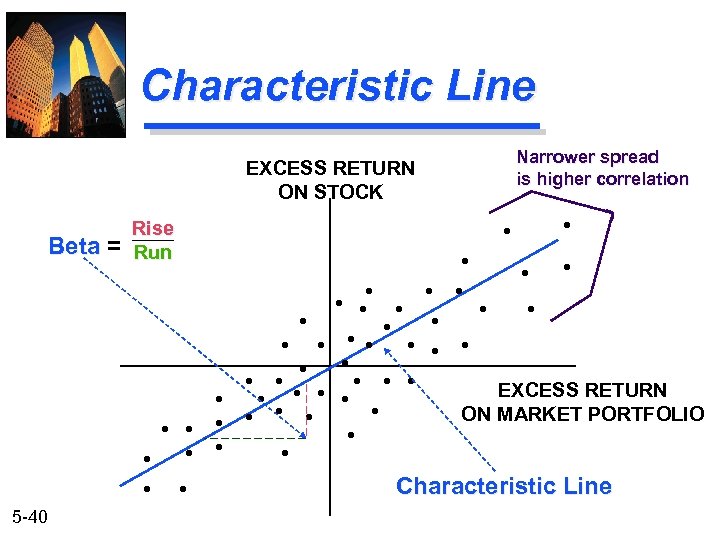 Characteristic Line EXCESS RETURN ON STOCK Beta = Narrower spread is higher correlation Rise Run EXCESS RETURN ON MARKET PORTFOLIO Characteristic Line 5 -40
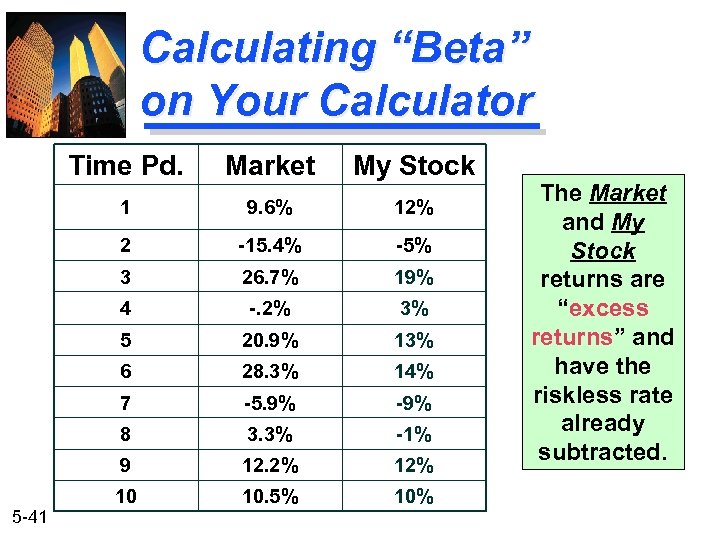 Calculating “Beta” on Your Calculator Time Pd. My Stock 1 9. 6% 12% 2 -15. 4% -5% 3 26. 7% 19% 4 -. 2% 3% 5 20. 9% 13% 6 28. 3% 14% 7 -5. 9% -9% 8 3. 3% -1% 9 5 -41 Market 12. 2% 10 10. 5% 10% The Market and My Stock returns are “excess returns” and have the riskless rate already subtracted.
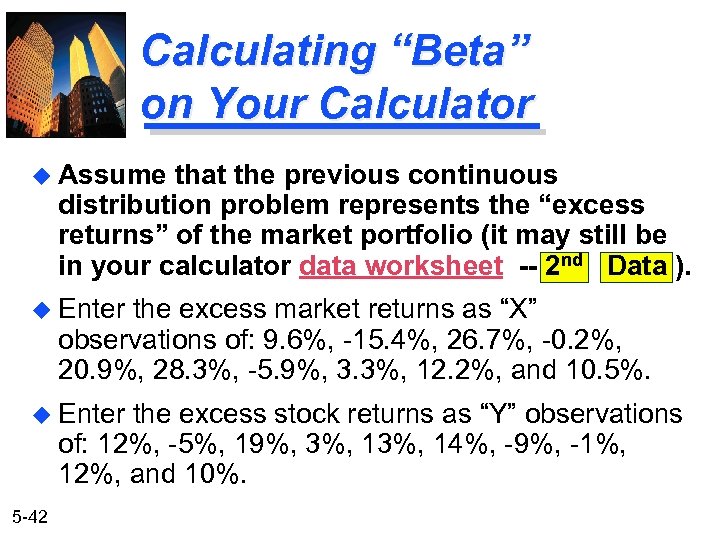 Calculating “Beta” on Your Calculator u Assume that the previous continuous distribution problem represents the “excess returns” of the market portfolio (it may still be in your calculator data worksheet -- 2 nd Data ). u Enter the excess market returns as “X” observations of: 9. 6%, -15. 4%, 26. 7%, -0. 2%, 20. 9%, 28. 3%, -5. 9%, 3. 3%, 12. 2%, and 10. 5%. u Enter the excess stock returns as “Y” observations of: 12%, -5%, 19%, 3%, 14%, -9%, -1%, 12%, and 10%. 5 -42
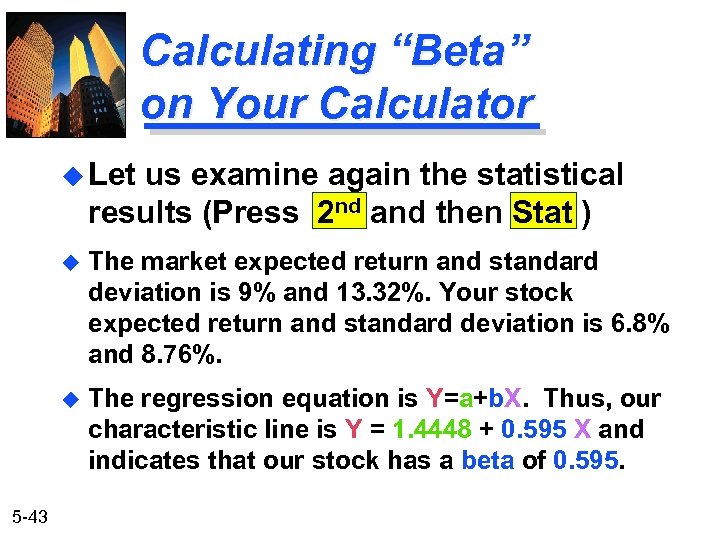 Calculating “Beta” on Your Calculator u Let us examine again the statistical results (Press 2 nd and then Stat ) u u 5 -43 The market expected return and standard deviation is 9% and 13. 32%. Your stock expected return and standard deviation is 6. 8% and 8. 76%. The regression equation is Y=a+b. X. Thus, our characteristic line is Y = 1. 4448 + 0. 595 X and indicates that our stock has a beta of 0. 595.
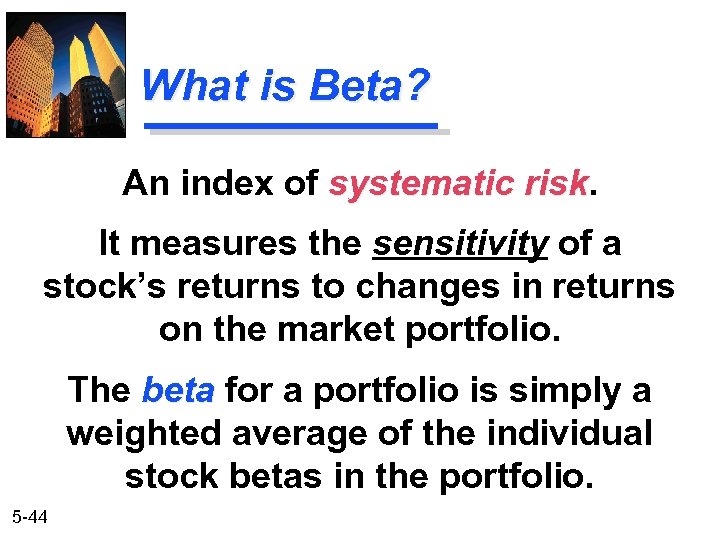 What is Beta? An index of systematic risk It measures the sensitivity of a stock’s returns to changes in returns on the market portfolio. The beta for a portfolio is simply a weighted average of the individual stock betas in the portfolio. 5 -44
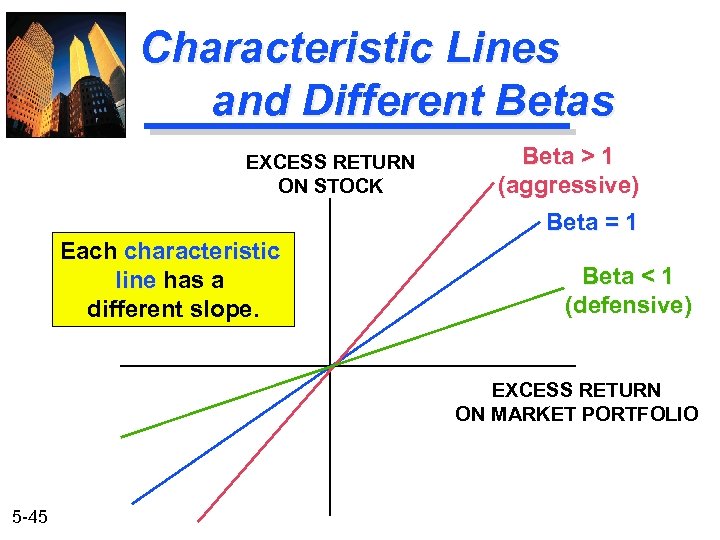 Characteristic Lines and Different Betas EXCESS RETURN ON STOCK Beta > 1 (aggressive) Beta = 1 Each characteristic line has a different slope. Beta < 1 (defensive) EXCESS RETURN ON MARKET PORTFOLIO 5 -45
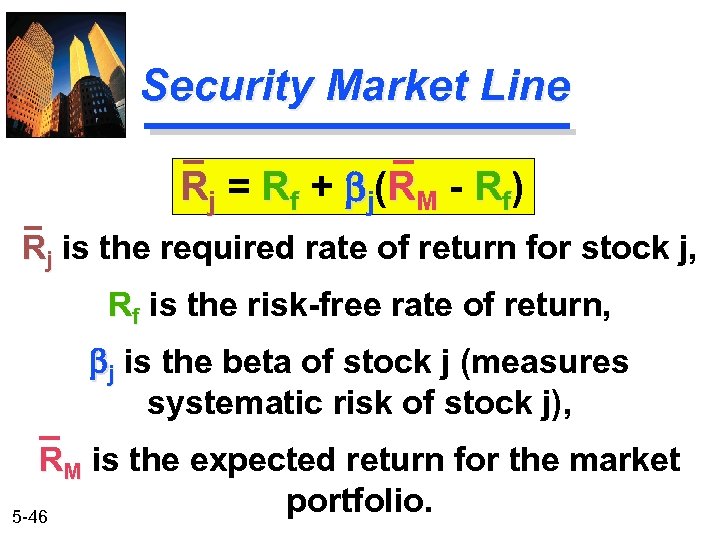 Security Market Line R j = R f + b j ( R M - R f) Rj is the required rate of return for stock j, Rf is the risk-free rate of return, bj is the beta of stock j (measures systematic risk of stock j), RM is the expected return for the market portfolio. 5 -46
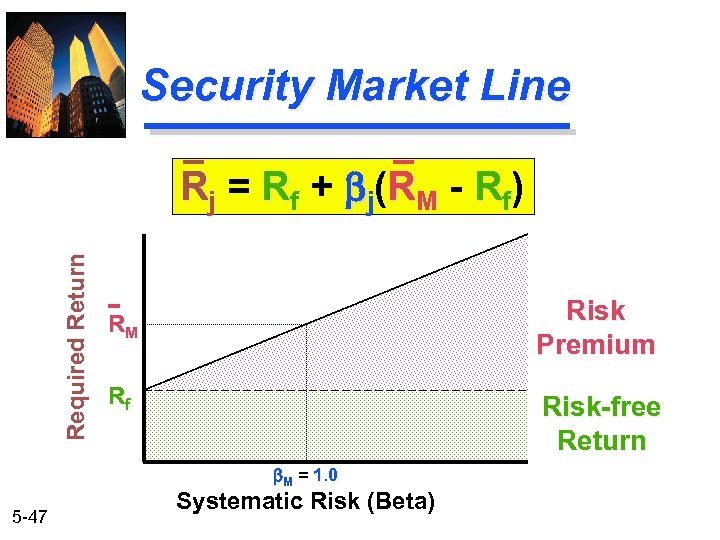 Security Market Line Required Return R j = R f + b j ( R M - R f) Risk Premium RM Rf Risk-free Return b. M = 1. 0 5 -47 Systematic Risk (Beta)
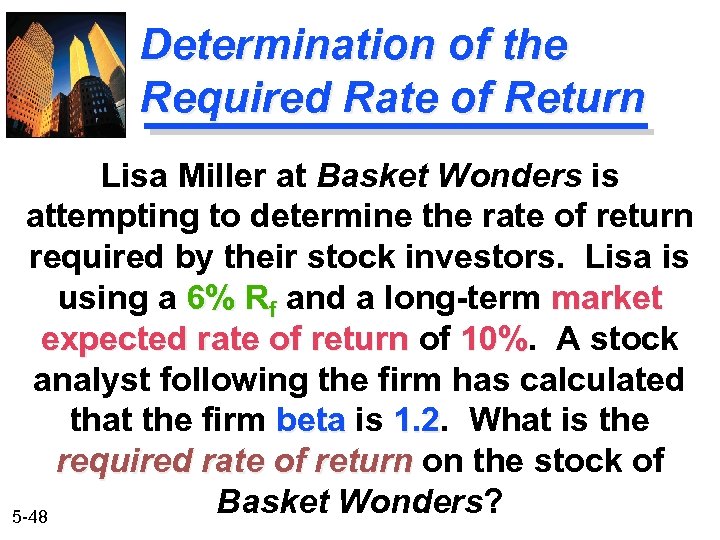 Determination of the Required Rate of Return Lisa Miller at Basket Wonders is attempting to determine the rate of return required by their stock investors. Lisa is using a 6% Rf and a long-term market expected rate of return of 10%. A stock 10% analyst following the firm has calculated that the firm beta is 1. 2. What is the 1. 2 required rate of return on the stock of Basket Wonders? 5 -48
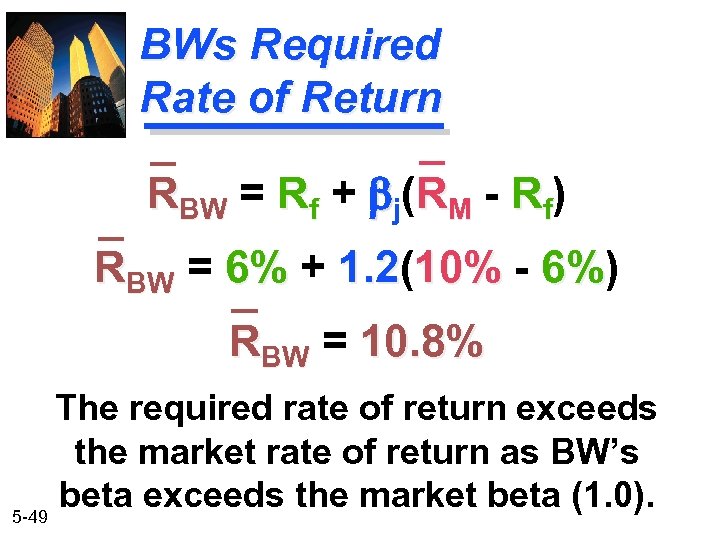 BWs Required Rate of Return RBW = Rf + bj(RM - Rf) RBW = 6% + 1. 2(10% - 6%) 1. 2 6% RBW = 10. 8% The required rate of return exceeds the market rate of return as BW’s beta exceeds the market beta (1. 0). 5 -49
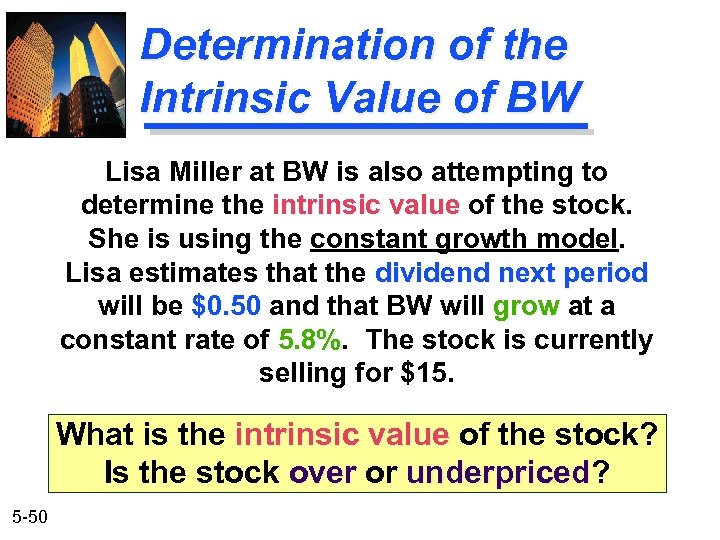 Determination of the Intrinsic Value of BW Lisa Miller at BW is also attempting to determine the intrinsic value of the stock. She is using the constant growth model. Lisa estimates that the dividend next period will be $0. 50 and that BW will grow at a constant rate of 5. 8%. The stock is currently 5. 8% selling for $15. What is the intrinsic value of the stock? Is the stock over or underpriced? underpriced 5 -50
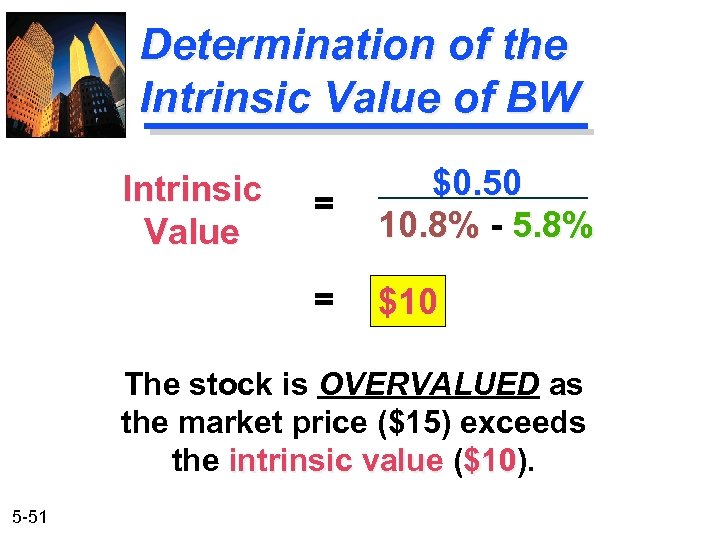 Determination of the Intrinsic Value of BW = $0. 50 10. 8% - 5. 8% = Intrinsic Value $10 The stock is OVERVALUED as the market price ($15) exceeds the intrinsic value ($10). $10 5 -51
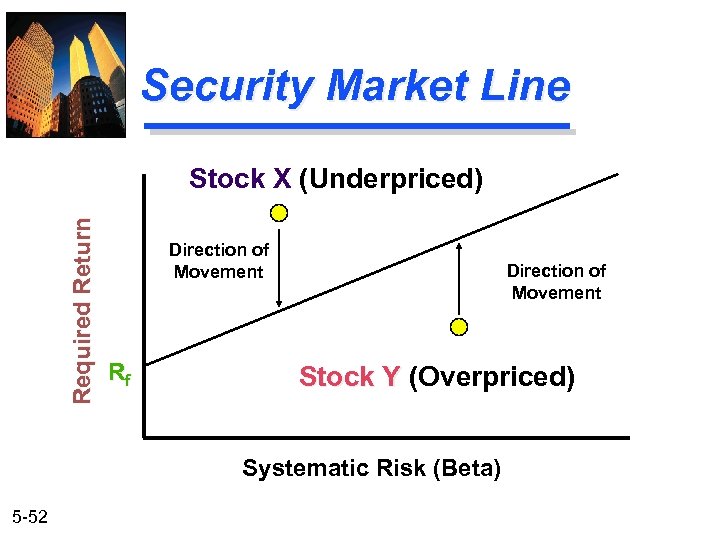 Security Market Line Required Return Stock X (Underpriced) Direction of Movement Rf Direction of Movement Stock Y (Overpriced) Systematic Risk (Beta) 5 -52
 Determination of the Required Rate of Return Small-firm Effect Price / Earnings Effect January Effect These anomalies have presented serious challenges to the CAPM theory. 5 -53