


 Скачать презентацию RISING Rare ISotope INvestigation at GSI Phases and
0a8ed362d54002197163b4cd3e992a68.ppt
- Количество слайдов: 29
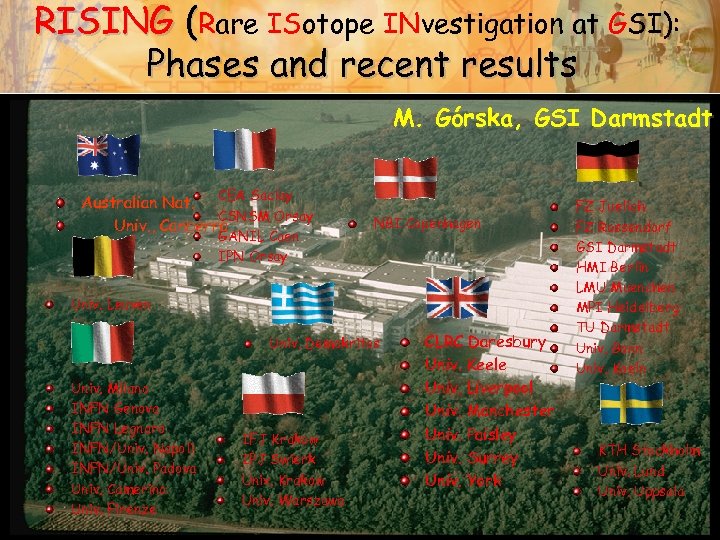 RISING (Rare ISotope INvestigation at GSI): Phases and recent results M. Górska, GSI Darmstadt Australian Nat. CEA Saclay CSNSM Orsay Univ. , Canberra GANIL Caen IPN Orsay NBI Copenhagen Univ. Leuven Univ. Demokritos Univ. Milano INFN Genova INFN Legnaro INFN/Univ. Napoli INFN/Univ. Padova Univ. Camerino Univ. Firenze IFJ Krakow IPJ Swierk Univ. Krakow Univ. Warszawa CLRC Daresbury Univ. Keele Univ. Liverpool Univ. Manchester Univ. Paisley Univ. Surrey Univ. York FZ Juelich FZ Rossendorf GSI Darmstadt HMI Berlin LMU Muenchen MPI Heidelberg TU Darmstadt Univ. Bonn Univ. Koeln KTH Stockholm Univ. Lund Univ. Uppsala
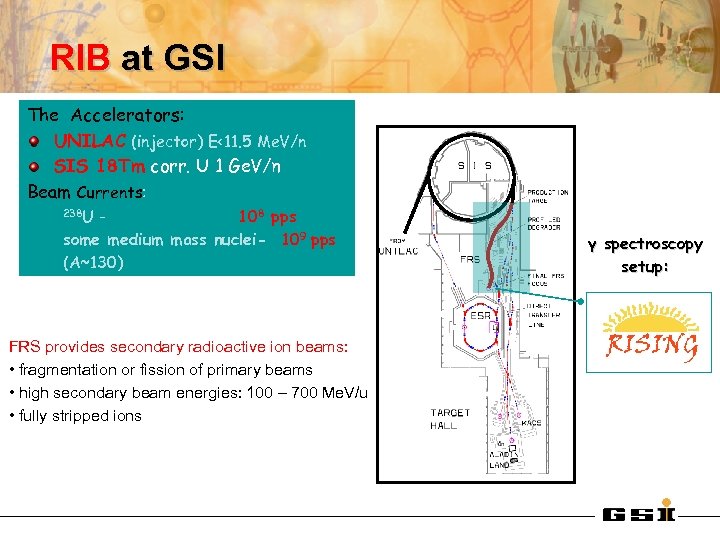 RIB at GSI The Accelerators: UNILAC (injector) E<11. 5 Me. V/n SIS 18 Tm corr. U 1 Ge. V/n Beam Currents: 238 U 108 pps some medium mass nuclei- 109 pps (A~130) FRS provides secondary radioactive ion beams: • fragmentation or fission of primary beams • high secondary beam energies: 100 – 700 Me. V/u • fully stripped ions γ spectroscopy setup:
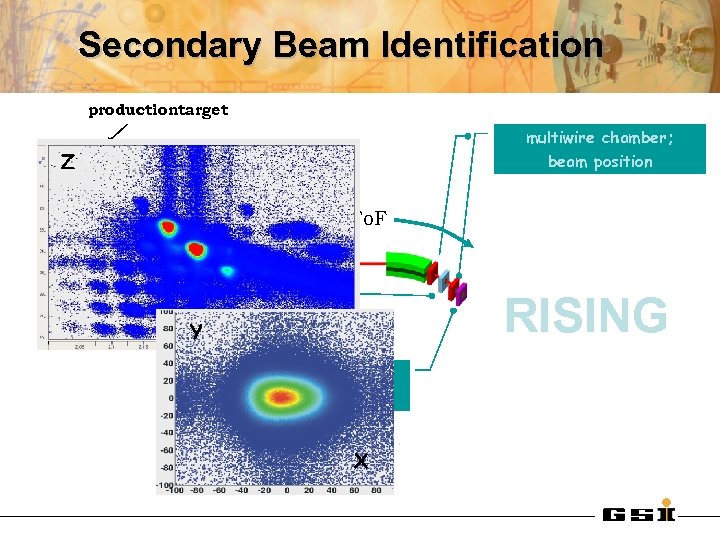 Secondary Beam Identification productiontarget multiwire chamber; beam position Z To. F scintillator MUSIC ionization Ychamber; Z RISING A/Q scintillator X
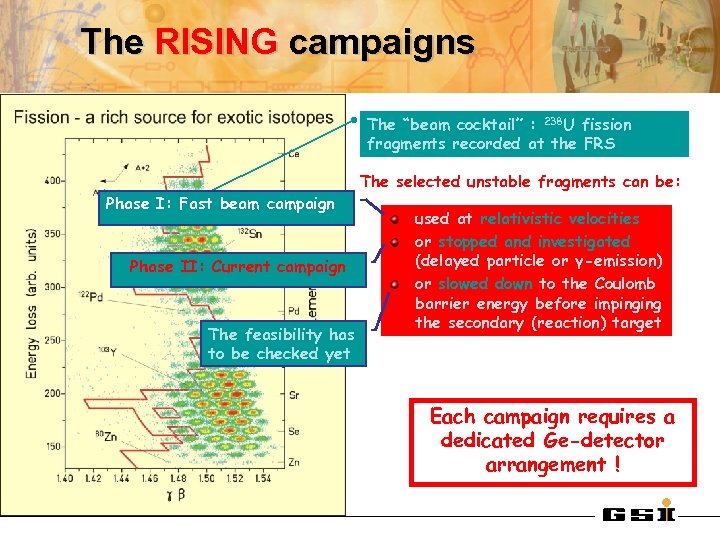 The RISING campaigns The “beam cocktail” : 238 U fission fragments recorded at the FRS The selected unstable fragments can be: Phase I: Fast beam campaign Phase II: Current campaign The feasibility has to be checked yet used at relativistic velocities or stopped and investigated (delayed particle or γ-emission) or slowed down to the Coulomb barrier energy before impinging the secondary (reaction) target Each campaign requires a dedicated Ge-detector arrangement !
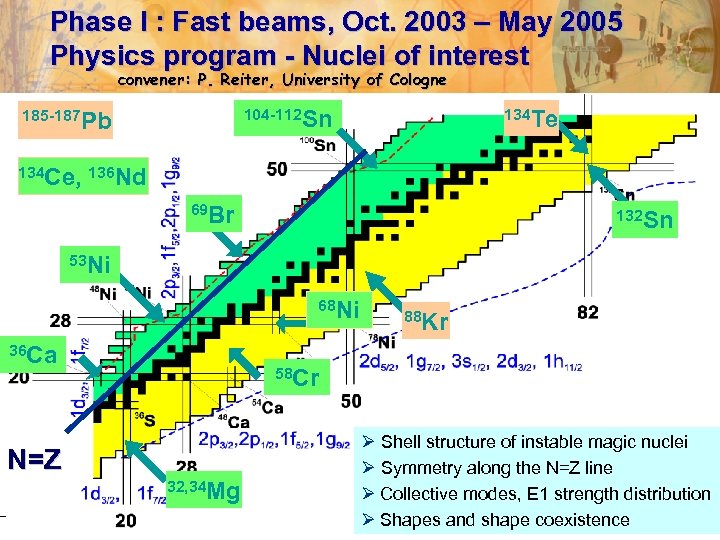 Phase I : Fast beams, Oct. 2003 – May 2005 Physics program - Nuclei of interest convener: P. Reiter, University of Cologne 104 -112 Sn 185 -187 Pb 134 Te 134 Ce, 136 Nd 69 Br 132 Sn 53 Ni 68 Ni 36 Ca 88 Kr 58 Cr N=Z 32, 34 Mg Ø Shell structure of instable magic nuclei Ø Symmetry along the N=Z line Ø Collective modes, E 1 strength distribution Ø Shapes and shape coexistence
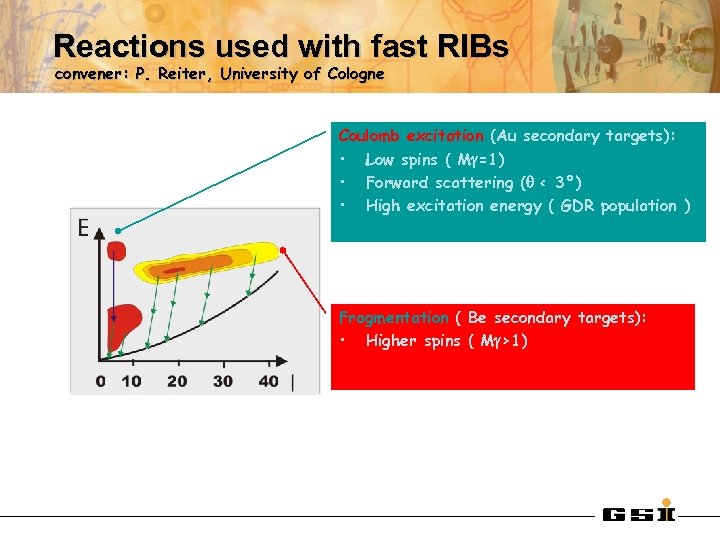 Reactions used with fast RIBs convener: P. Reiter, University of Cologne Coulomb excitation (Au secondary targets): • Low spins ( Mg=1) • Forward scattering ( < 3°) • High excitation energy ( GDR population ) Fragmentation ( Be secondary targets): • Higher spins ( Mg>1)
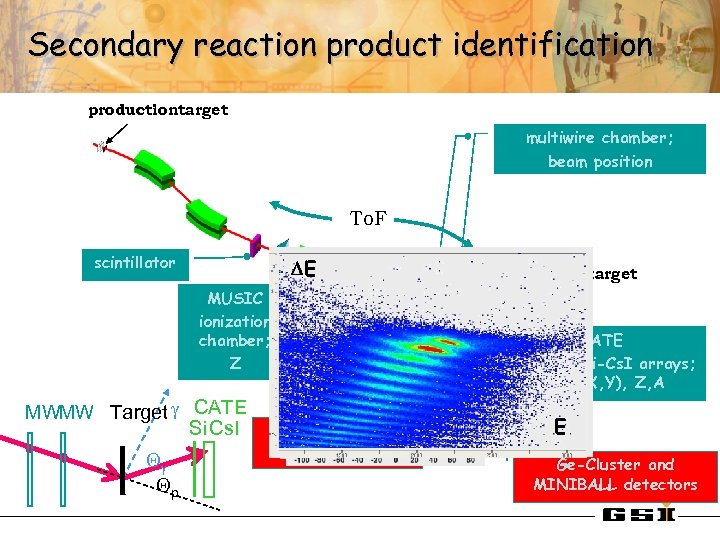 Secondary reaction product identification productiontarget multiwire chamber; beam position To. F scintillator DE MUSIC ionization chamber; Z MWMW Target g CATE Si Cs. I Qg Qp reaction target Y CATE Si-Cs. I arrays; (X, Y), Z, A scintillator HECTOR Ba. F 2 detectors X E Ge-Cluster and MINIBALL detectors
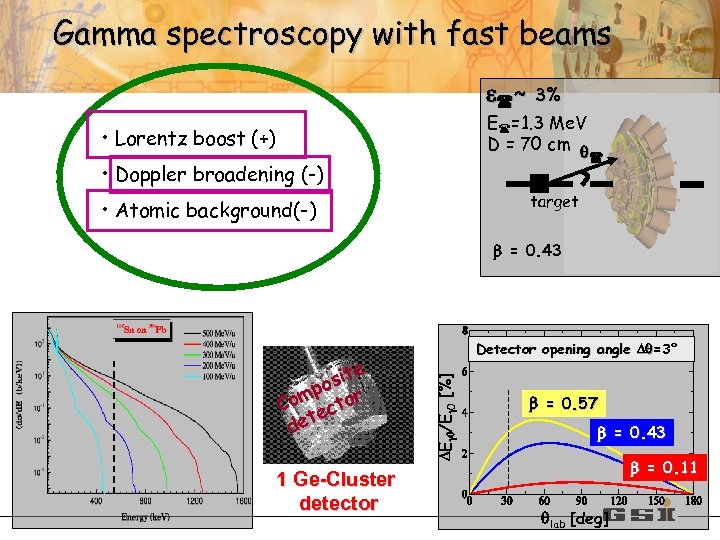 Gamma spectroscopy with fast beams ~ 3% E =1. 3 Me. V D = 70 cm • Lorentz boost (+) • Doppler broadening (-) target • Atomic background(-) = 0. 43 1 Ge-Cluster detector DEg 0/Eg 0 [%] te osi p om ctor C e det Detector opening angle D =3° = 0. 57 = 0. 43 = 0. 11 lab [deg]
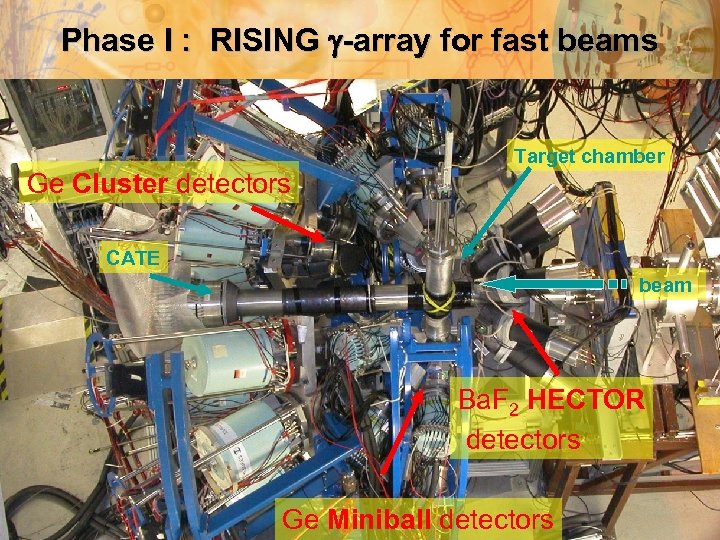 Phase I : RISING g-array for fast beams Target chamber Ge Cluster detectors CATE beam Ba. F 2 HECTOR detectors Ge Miniball detectors
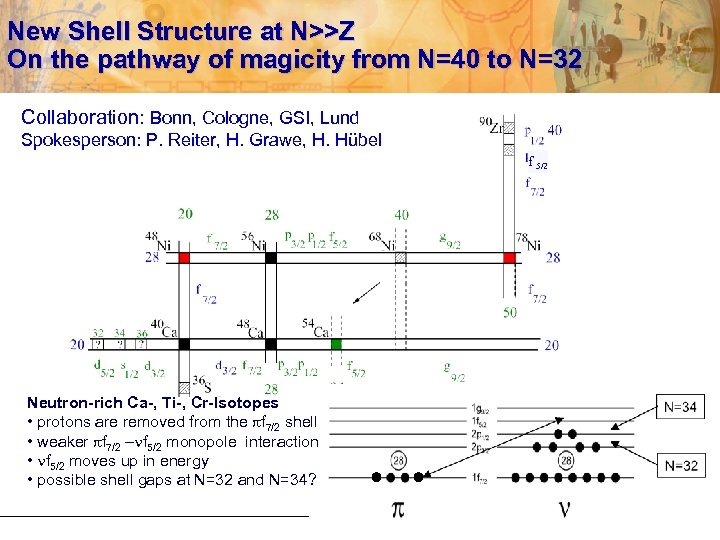 New Shell Structure at N>>Z On the pathway of magicity from N=40 to N=32 Collaboration: Bonn, Cologne, GSI, Lund Spokesperson: P. Reiter, H. Grawe, H. Hübel f 5/2 Neutron-rich Ca-, Ti-, Cr-Isotopes • protons are removed from the pf 7/2 shell • weaker pf 7/2 –nf 5/2 monopole interaction • nf 5/2 moves up in energy • possible shell gaps at N=32 and N=34?
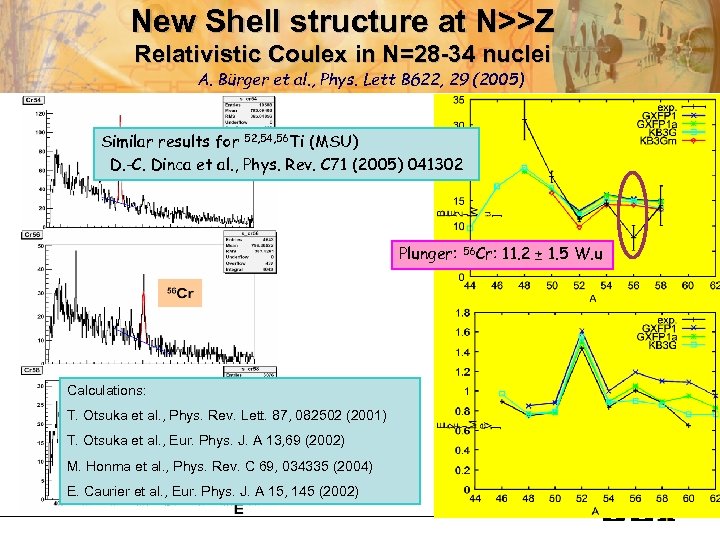 New Shell structure at N>>Z Relativistic Coulex in N=28 -34 nuclei A. Bürger et al. , Phys. Lett B 622, 29 (2005) Similar results for 52, 54, 56 Ti (MSU) D. -C. Dinca et al. , Phys. Rev. C 71 (2005) 041302 Plunger: Calculations: T. Otsuka et al. , Phys. Rev. Lett. 87, 082502 (2001) T. Otsuka et al. , Eur. Phys. J. A 13, 69 (2002) M. Honma et al. , Phys. Rev. C 69, 034335 (2004) E. Caurier et al. , Eur. Phys. J. A 15, 145 (2002) 56 Cr: 11. 2 ± 1. 5 W. u
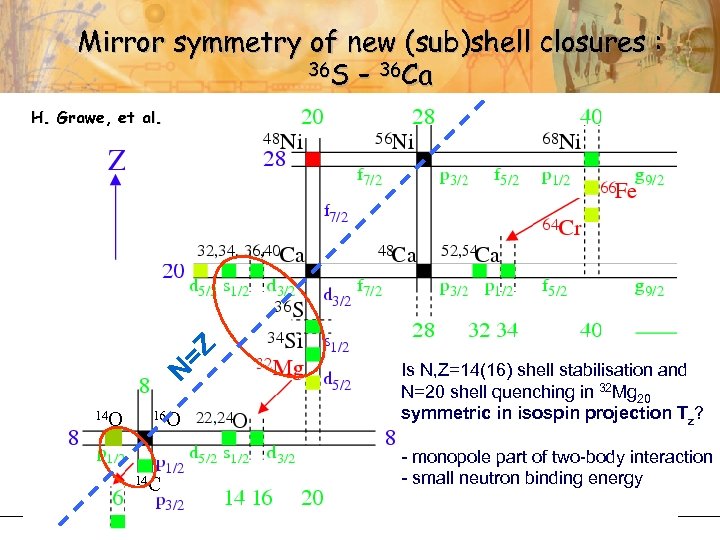 Mirror symmetry of new (sub)shell closures : 36 S – 36 Ca N =Z H. Grawe, et al. 14 O 16 O 14 C Is N, Z=14(16) shell stabilisation and N=20 shell quenching in 32 Mg 20 symmetric in isospin projection Tz? - monopole part of two-body interaction - small neutron binding energy
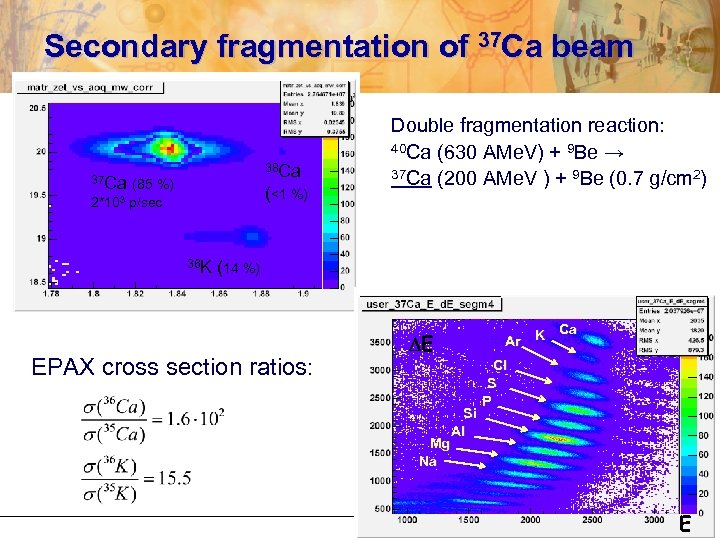 Secondary fragmentation of 37 Ca beam 38 Ca 37 Ca (85 %) (<1 %) 2*103 p/sec Double fragmentation reaction: 40 Ca (630 AMe. V) + 9 Be → 37 Ca (200 AMe. V ) + 9 Be (0. 7 g/cm 2) 36 K (14 %) EPAX cross section ratios: Ca Ar K DE Mg Na Si Al ~800 ke. V Cl S P E
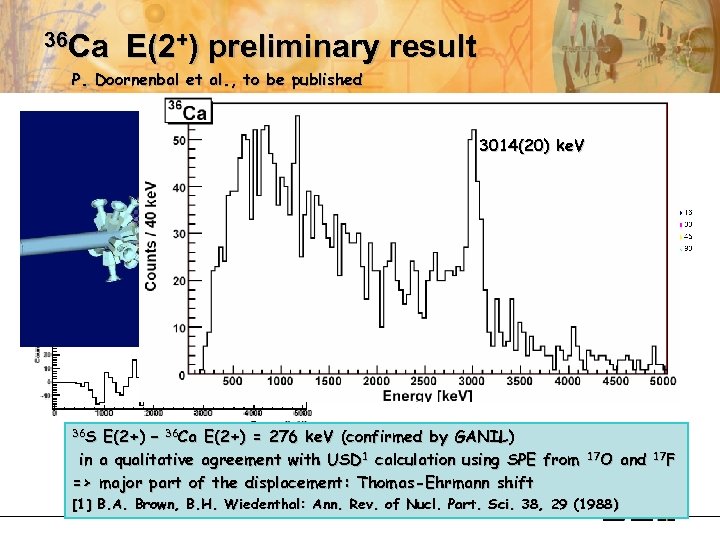 36 Ca E(2+) preliminary result P. Doornenbal et al. , to be published Cluster 3014(20) ke. V Miniball Ba. F 2 36 S E(2+) – 36 Ca E(2+) = 276 ke. V (confirmed by GANIL) in a qualitative agreement with USD 1 calculation using SPE from => major part of the displacement: Thomas-Ehrmann shift 17 O [1] B. A. Brown, B. H. Wiedenthal: Ann. Rev. of Nucl. Part. Sci. 38, 29 (1988) and 17 F
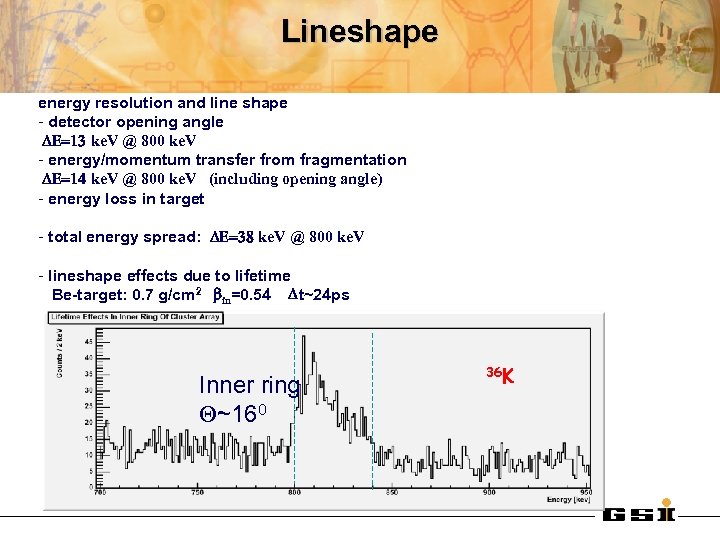 Lineshape energy resolution and line shape - detector opening angle DE=13 ke. V @ 800 ke. V - energy/momentum transfer from fragmentation DE=14 ke. V @ 800 ke. V (including opening angle) - energy loss in target - total energy spread: DE=38 ke. V @ 800 ke. V - lineshape effects due to lifetime Be-target: 0. 7 g/cm 2 in=0. 54 Dt~24 ps Inner ring Q~160 36 K
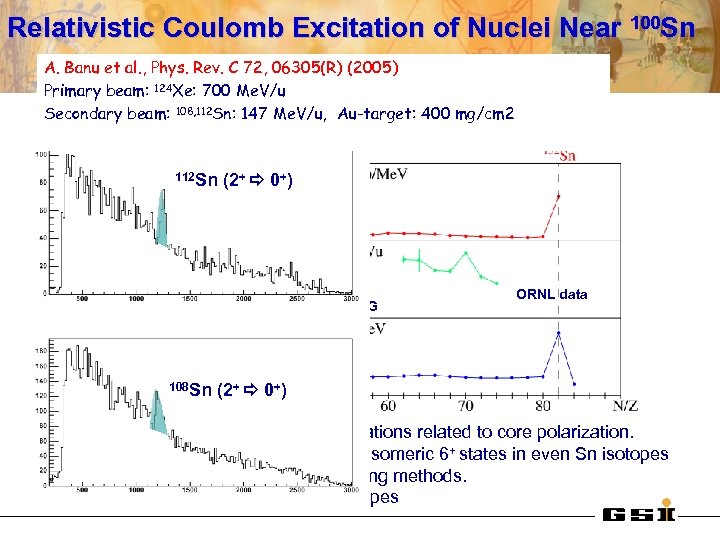 Relativistic Coulomb Excitation of Nuclei Near 100 Sn A. Banu et al. , Phys. Rev. C 72, Stockholm, (2005) Legnaro, Warsaw, Debrecen, Collaboration: Lund, Uppsala, 06305(R) Keele, 124 Xe: 700 Me. V/u Primary beam: Liverpool, Surrey, York, GSI Spokesperson: C. Fahlander, Lund, M. Au-target: Secondary beam: 108, 112 Sn: 147 Me. V/u, Gorska, GSI 400 mg/cm 2 112 Sn (2+ 0+) RISING ORNL data 108 Sn (2+ 0+) • B(E 2, 2+->0+) values provide E 2 correlations related to core polarization. • Lifetime measurements hampered by isomeric 6+ states in even Sn isotopes • 2+->0+ decay too fast for electronic timing methods. • Coulomb excitation of instable Sn isotopes
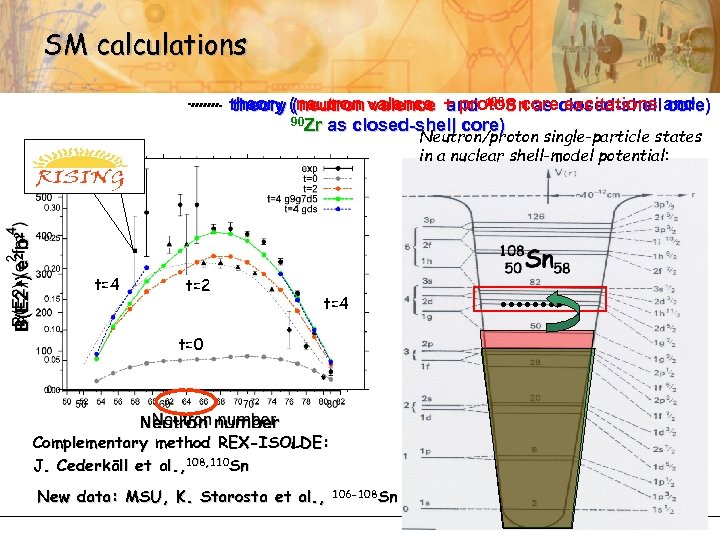 SM calculations theory (neutron valence + proton core excitations and theory (neutron valence and 100 Sn as closed-shell core) 90 Zr as closed-shell core) Neutron/proton single-particle states in a nuclear shell-model potential: B(E 2 ) e 2 b 2 This work t=4 t=2 t=4 t=0 Neutron number Complementary method REX-ISOLDE: J. Cederkäll et al. , 108, 110 Sn New data: MSU, K. Starosta et al. , 106 -108 Sn • • • •
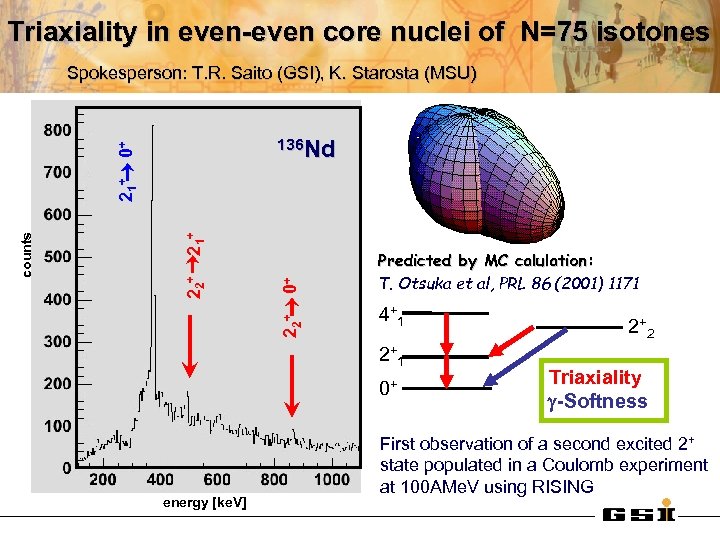 Triaxiality in even-even core nuclei of N=75 isotones Spokesperson: T. R. Saito (GSI), K. Starosta (MSU) 22+ 0+ 22+ 21+ counts 21+ 0+ 136 Nd Predicted by MC calulation: T. Otsuka et al, PRL 86 (2001) 1171 4+ 1 2+ 1 0+ energy [ke. V] 2+ 2 Triaxiality g-Softness First observation of a second excited 2+ state populated in a Coulomb experiment at 100 AMe. V using RISING
 RISING Fast beam collaboration: P. Reiter
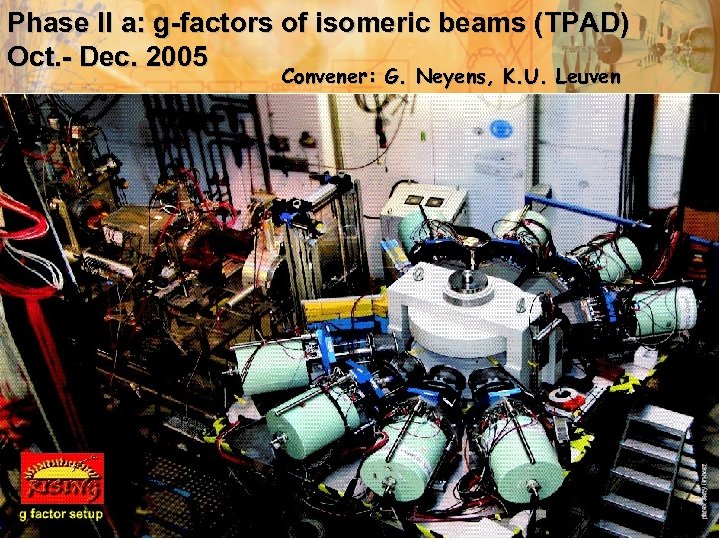 Phase II a: g-factors of isomeric beams (TPAD) Oct. - Dec. 2005 Convener: G. Neyens, K. U. Leuven
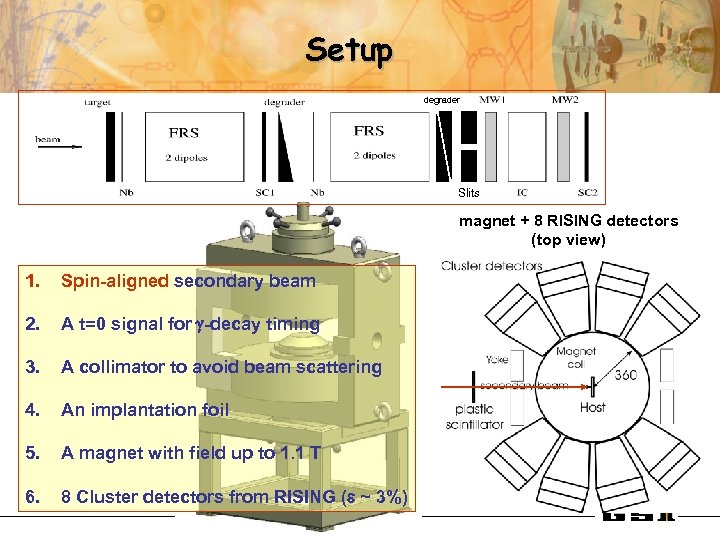 Setup degrader Slits magnet + 8 RISING detectors (top view) 1. Spin-aligned secondary beam 2. A t=0 signal for g-decay timing 3. A collimator to avoid beam scattering 4. An implantation foil 5. A magnet with field up to 1. 1 T 6. 8 Cluster detectors from RISING ( ~ 3%)
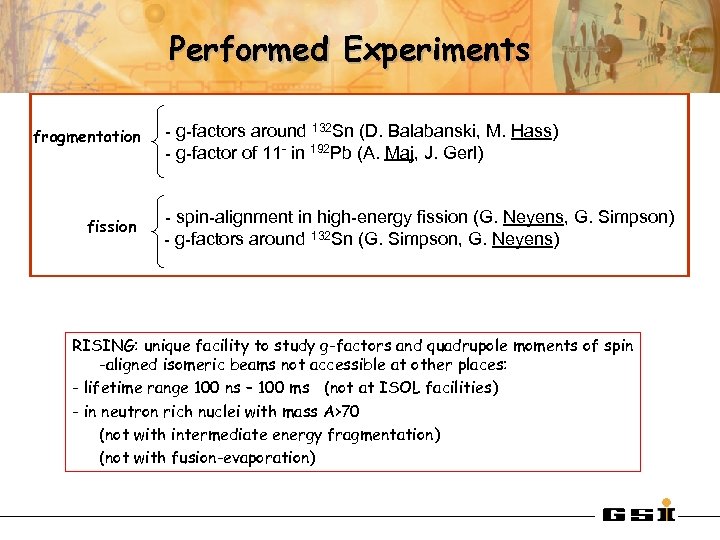 Performed Experiments - g-factors around fragmentation (D. Balabanski, M. Hass) - g-factor of 11 - in 192 Pb (A. Maj, J. Gerl) fission 132 Sn - spin-alignment in high-energy fission (G. Neyens, G. Simpson) - g-factors around 132 Sn (G. Simpson, G. Neyens) RISING: unique facility to study g-factors and quadrupole moments of spin -aligned isomeric beams not accessible at other places: - lifetime range 100 ns – 100 ms (not at ISOL facilities) - in neutron rich nuclei with mass A>70 (not with intermediate energy fragmentation) (not with fusion-evaporation)
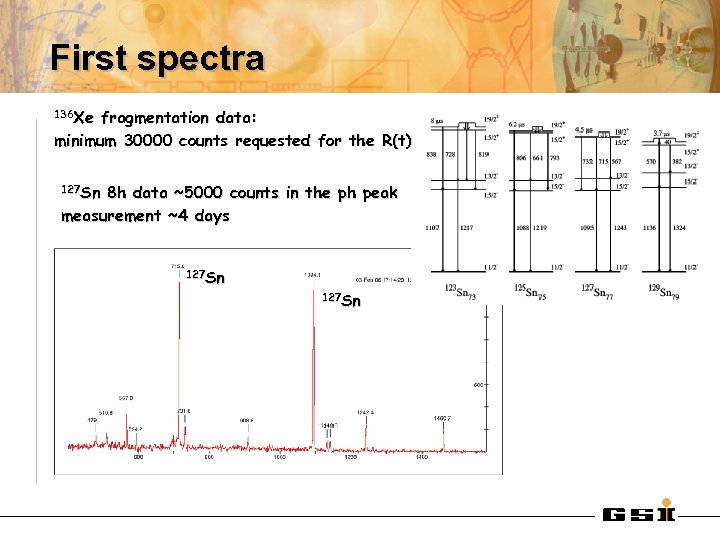 First spectra 136 Xe fragmentation data: minimum 30000 counts requested for the R(t) 127 Sn 8 h data ~5000 counts in the ph peak measurement ~4 days 127 Sn
 g-RISING collaboration: G. Neyens PARTICIPANTS 1. K. U. Leuven, Belgium: S. Mallion, G. Neyens, P. Himpe, N. Vermeulen, D. Yordanov 2. University of Sofia, Bulgaria: A. Blazhev, R. Lozeva, P. Detistov, L. Atanasova, G. Damyanova 3. CEA, Bruyères le Chatel, France: G. Bélier, J. M. Daugas, V. Meot, O. Roig 4. ILL Grenoble, France: G. Simpson, I. S. Tsekhanovich 5. CENBG Bordeaux, France: I. Matea, K. Turzó 6. GSI-Darmstadt, Germany: F. Becker, J. Gerl, H. Grawe, M. Gorska, I. Kojuharov, T. Saitoh, H. J. Wollersheim 7. IKP Koeln, Germany: J. Jolie, A. Richard, A. Scherillo 8. IKHP Rossendorf, Germany: R. Schwengner 9. The Weizmann Institute, Israel: S. Chamoli, G. Goldring, M. Hass, B. S. Nara Singh, I. Regev, S. Vaintraub 10. University of Camerino, Italy: D. Balabanski, G. Lo Bianco, K. Galdnishki, A. Saltarelli, C. Petrache 11. University of Milano, Italy: G. Benzoni, N. Blasi, A. Bracco, F. Camera, B. Million, S. Leoni, O. Wieland 12. IFJ-PAN Krakow, Poland: P. Bednarczyk, J. Grébosz, M. Kmiecik, M. Lach, A. Maj, K. Mazurek, K. H. Maier 13. Warsaw University, Poland: M. Pfűtzner, A. Korgul W. Méczyński, J. Styczeń 14. NIPNE, Bucharest, Romania: M. Ionescu-Bujor, A. Iordachescu, G. Ilie 15. Universidad Autonoma de Madrid, Spain: A. Jungclaus 16. ISOLDE-CERN, Switzerland: G. Georgiev 17. Manchester University, U. K: A. G. Smith, R. Orlandi 18. University of Surrey, UK: Zs. Podolyàk, P. Regan, P. M. Walker
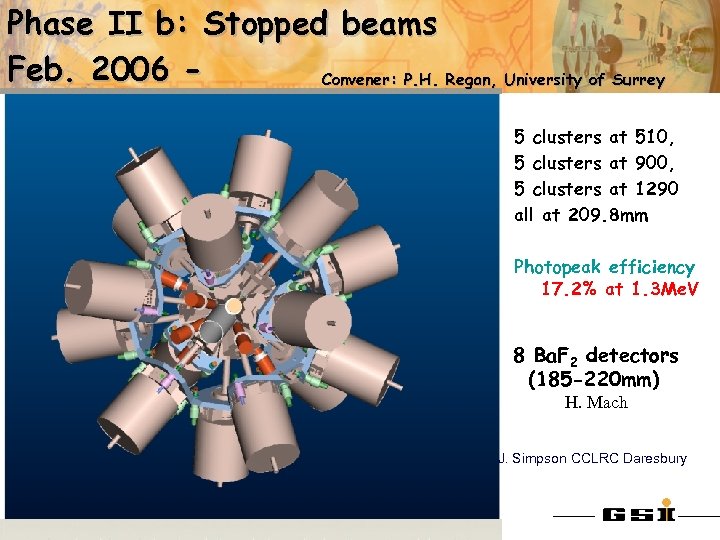 Phase II b: Stopped beams Feb. 2006 Convener: P. H. Regan, University of Surrey 5 clusters at 510, 5 clusters at 900, 5 clusters at 1290 all at 209. 8 mm Photopeak efficiency 17. 2% at 1. 3 Me. V 8 Ba. F 2 detectors (185 -220 mm) H. Mach J. Simpson CCLRC Daresbury
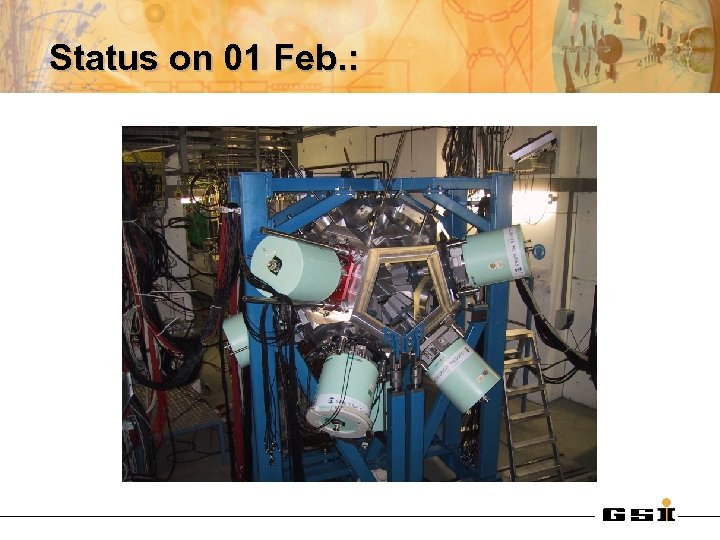 Status on 01 Feb. :
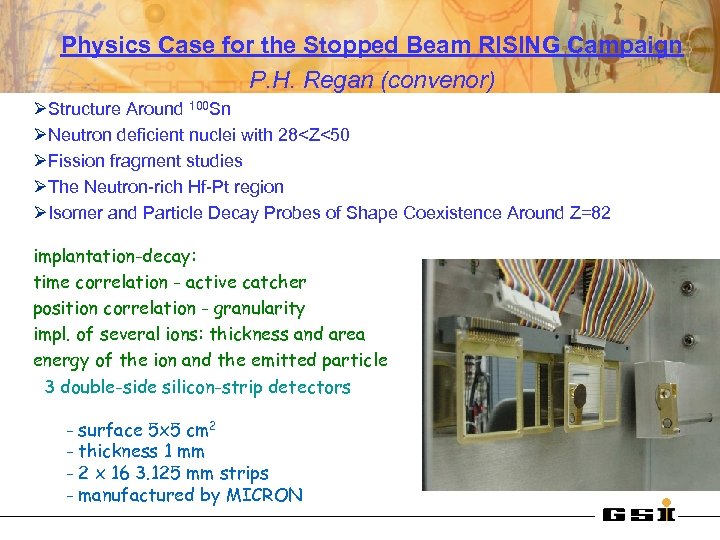 Physics Case for the Stopped Beam RISING Campaign P. H. Regan (convenor) ØStructure Around 100 Sn ØNeutron deficient nuclei with 28
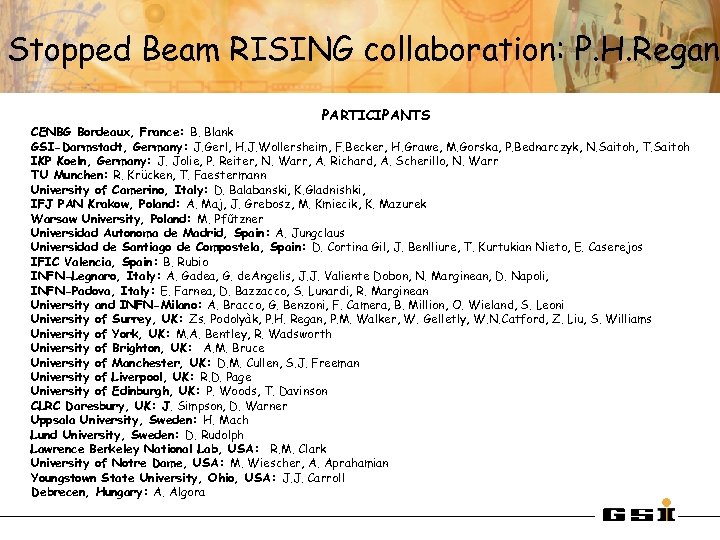 Stopped Beam RISING collaboration: P. H. Regan PARTICIPANTS CENBG Bordeaux, France: B. Blank GSI-Darmstadt, Germany: J. Gerl, H. J. Wollersheim, F. Becker, H. Grawe, M. Gorska, P. Bednarczyk, N. Saitoh, T. Saitoh IKP Koeln, Germany: J. Jolie, P. Reiter, N. Warr, A. Richard, A. Scherillo, N. Warr TU Munchen: R. Krücken, T. Faestermann University of Camerino, Italy: D. Balabanski, K. Gladnishki, IFJ PAN Krakow, Poland: A. Maj, J. Grebosz, M. Kmiecik, K. Mazurek Warsaw University, Poland: M. Pfűtzner Universidad Autonoma de Madrid, Spain: A. Jungclaus Universidad de Santiago de Compostela, Spain: D. Cortina Gil, J. Benlliure, T. Kurtukian Nieto, E. Caserejos IFIC Valencia, Spain: B. Rubio INFN-Legnaro, Italy: A. Gadea, G. de. Angelis, J. J. Valiente Dobon, N. Marginean, D. Napoli, INFN-Padova, Italy: E. Farnea, D. Bazzacco, S. Lunardi, R. Marginean University and INFN-Milano: A. Bracco, G. Benzoni, F. Camera, B. Million, O. Wieland, S. Leoni University of Surrey, UK: Zs. Podolyàk, P. H. Regan, P. M. Walker, W. Gelletly, W. N. Catford, Z. Liu, S. Williams University of York, UK: M. A. Bentley, R. Wadsworth University of Brighton, UK: A. M. Bruce University of Manchester, UK: D. M. Cullen, S. J. Freeman University of Liverpool, UK: R. D. Page University of Edinburgh, UK: P. Woods, T. Davinson CLRC Daresbury, UK: J. Simpson, D. Warner Uppsala University, Sweden: H. Mach Lund University, Sweden: D. Rudolph Lawrence Berkeley National Lab, USA: R. M. Clark University of Notre Dame, USA: M. Wiescher, A. Aprahamian Youngstown State University, Ohio, USA: J. J. Carroll Debrecen, Hungary: A. Algora
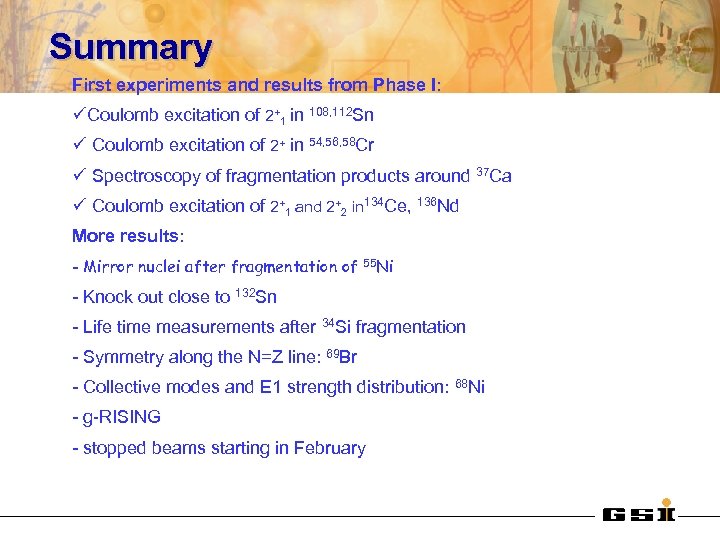 Summary First experiments and results from Phase I: üCoulomb excitation of 2+1 in 108, 112 Sn ü Coulomb excitation of 2+ in 54, 56, 58 Cr ü Spectroscopy of fragmentation products around 37 Ca ü Coulomb excitation of 2+1 and 2+2 in 134 Ce, 136 Nd More results: - Mirror nuclei after fragmentation of 55 Ni - Knock out close to 132 Sn - Life time measurements after 34 Si fragmentation - Symmetry along the N=Z line: 69 Br - Collective modes and E 1 strength distribution: 68 Ni - g-RISING - stopped beams starting in February