


 Скачать презентацию Riparia — a center where science informs policy
c3fa07cd095ec0183643a21e1eef5b21.ppt
- Количество слайдов: 21
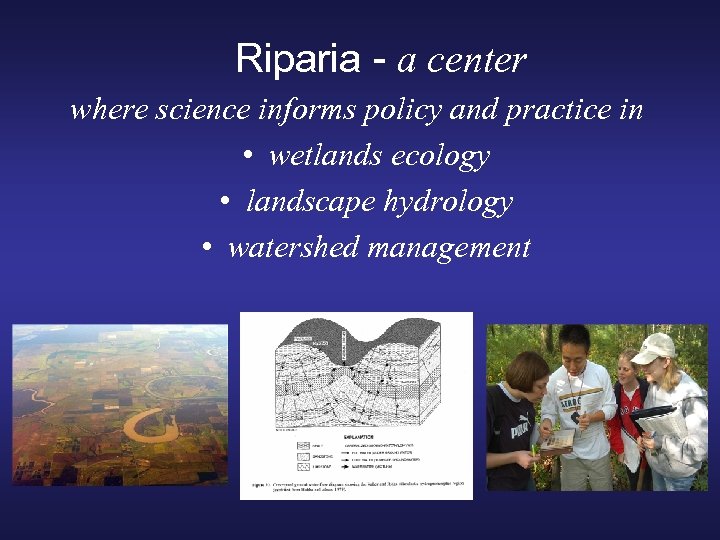 Riparia - a center where science informs policy and practice in • wetlands ecology • landscape hydrology • watershed management
 Outline • The Center - Introduction • The Name - Intrigue • The Present - Integration • The Future - Innovation
 The Center - Introduction Riparia, broadly defined, refers to areas of transition between water and land (Latin derivation) Riparia will link the traditional strengths of the Cooperative Wetlands Center in wetlands and surface waters, with stronger connections to sub-surface hydrologic fluxes, and within the context of terrestrial surroundings Riparia will help integrate water science across EESI centers, faculty, students & staff; meshes with the strategic plan, and meets the requirements for a center
 Penn State Cooperative Wetlands Center Established 1993, located in Department of Geography (Walker Building) Penn State Institutes of Energy and the Environment Faculty/Staff (7), Graduate students (6 -8) Project examples - interdisciplinary & multi-institution: Atlantic Slope Consortium – USEPA 5 yr, $6 M, 6 institutions, 40 investig. Climate Change Project – USEPA 3 yr, $900 K, 3 colleges, 6 investig. Bog Turtle Habitat Conservation Plan – USDI 4 yr, $575 K, 12 investig. Outreach & Service: Tradition of leadership in academic, agency & professional organizations Provide objective information to a variety of audiences
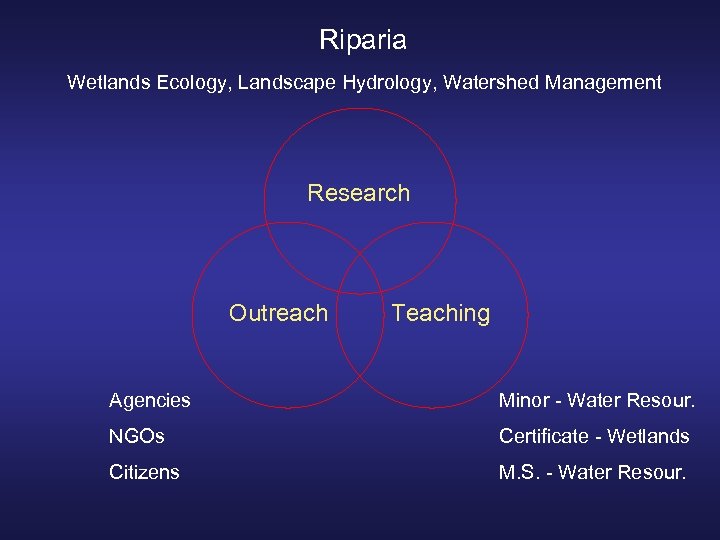 Riparia Wetlands Ecology, Landscape Hydrology, Watershed Management Research Outreach Teaching Agencies Minor - Water Resour. NGOs Certificate - Wetlands Citizens M. S. - Water Resour.
 The Name - Intrigue • Simple, representative, bold • Raises questions & elicits conversations • Creates recognition to build endowments
 The Present - Integration • Integrating among physical, chemical, and biological fluxes between atmosphere, surface waters, ground waters, and lands - across multiple spatial and temporal scales • Integrating field experimentation, theory, modeling, monitoring, and experiential learning • Integrating natural and social sciences, working with other units • Integrating among missions - research, teaching, and outreach • Integrating water among University units - departments, centers, institutes, programs and external collaborators and sponsors
 Focal Research Areas • Wetlands Ecology Use collection of reference wetlands (>200) for studies of fluxes at site, reach, watershed, and landscape scales Understand intersections of wetlands with other “waters”, freshwater and coastal systems, & terrestrial systems Continue monitoring, assessment and policy investigations Some graphics not included in remainder due to file limitations
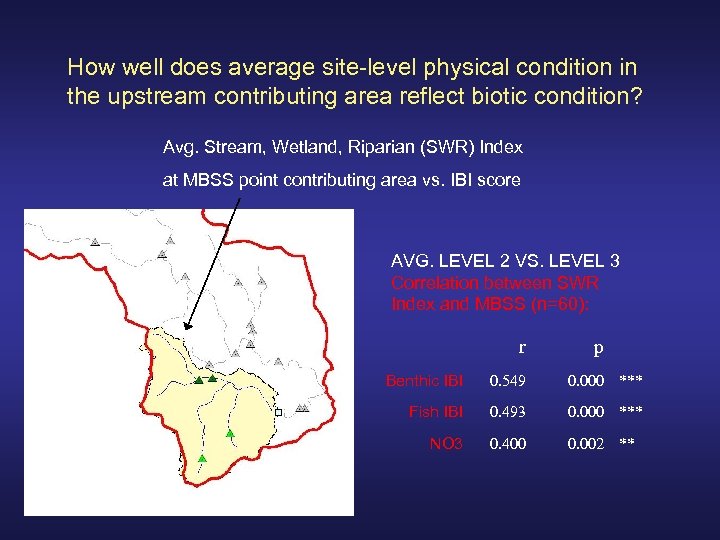 How well does average site-level physical condition in the upstream contributing area reflect biotic condition? Avg. Stream, Wetland, Riparian (SWR) Index at MBSS point contributing area vs. IBI score AVG. LEVEL 2 VS. LEVEL 3 Correlation between SWR Index and MBSS (n=60): r p Benthic IBI 0. 549 0. 000 *** Fish IBI 0. 493 0. 000 *** NO 3 0. 400 0. 002 **
 Focal Research Areas • Landscape Hydrology Water quantity, residence times, & pathways Spatial and temporal characteristics of regional & global syst. Linkages across aqueous geochemistry, geophysical processes, hydrologic modeling, and human impacts Hillslope graphic
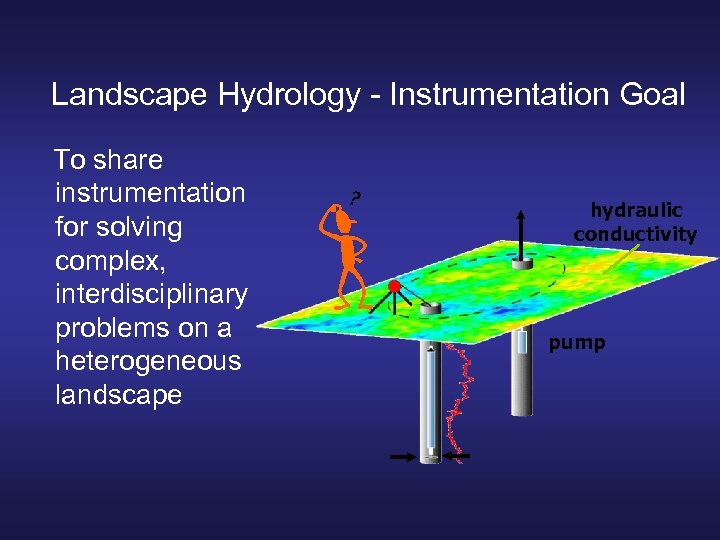 Landscape Hydrology - Instrumentation Goal To share instrumentation for solving complex, interdisciplinary problems on a heterogeneous landscape hydraulic conductivity pump
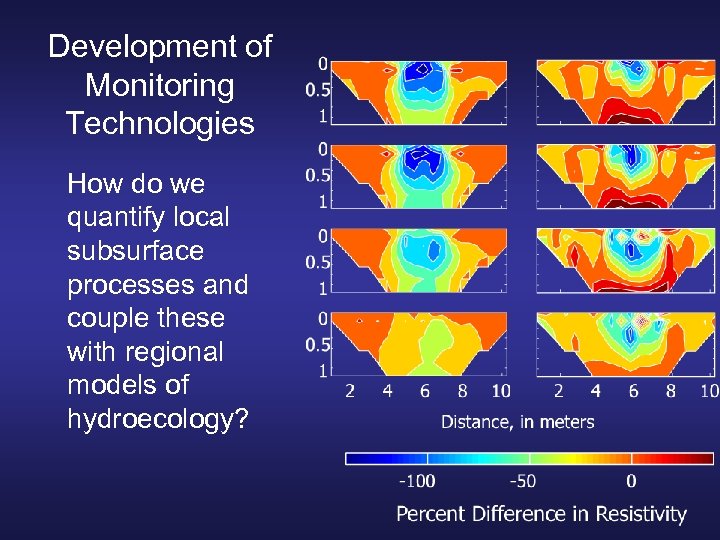 Development of Monitoring Technologies How do we quantify local subsurface processes and couple these with regional models of hydroecology?
 Focal Research Areas • Watershed Management Water resources policy - state, national, international studies Investigate threats to freshwater supplies & quality Examine issues of biodiversity, restoration, and contaminants graphics
 Research and Funding Opportunities • More competitive with expanded expertise • Recent water-related initiatives & opportunities: NEON, CLEANER, CUASHI, USEPA OWOW NSF - global water cycle, land use/land cover NSF - Emerging Topics in Biogeochemical Cycles (ETBC) NSF - Coupled Natural & Human Systems *NSF - Critical Zone Observatory (CZO) *Susquehanna River Basin HOS • Current and potential collaborations: Water Resources Research Center (PSIEE) Center for Environmental Informatics (EESI) Environment & Natural Resources Institute (Ag. Sci) Coop. Agreemt. - USDA, Agric. Research Serv. MOUs with land & water conservancies …
 Instruction and Advising • Coordinate: – Minor in Water Resources (suggested) – Administer on-line Certificate in Wetlands Science and Policy (planned) – Coordinate on-line M. S. , Water Resources (EMS) • Recruit and support high-quality students • Sponsor student symposium in water science and policy across campus • Promote experiential learning - undergr/grad
 Ecological & Hydrological Analysis & Equipment Program • Promote access to lab & field techniques & instrumentation • Compile interactive database of waterrelated analytical tools & approaches to: – coordinate graduate student rotations – coordinate proposals for large equipment – increase efficiency & accessibility of ecological and hydrologial practices at Penn State
 Administrative Structure • Executive Director (Robert P. Brooks) • Director (Denice Heller Wardrop) • Assoc. /Asst. Directors & Coordinators (to be determined) • Associate and Affiliate Faculty • PSIEE, EESI, EMS, Geog, Geosc, +
 Personnel • Associates Current (CWC) Rob Brooks, Denice Wardrop, Joe Bishop, Gian Rocco, Mary Easterling, Sarah Miller, Suzy Yetter New (Riparia) Kamini Singha, Greg Knight, Erica Smithwick Ecohydrologist (potential position, EESI & Geography interest) • Affiliates Jenn Macalady, … • Technicians Hannah Ingram, … • Graduate Students (currently 6 -8, will expand…) • Undergraduate Interns • Advisory Committee (3 -5 internal & external)
 Finances • Seek grants, contracts, gifts & endowments • Requesting $20, 000/yr from EESI Enhanced stipends for 2 -3 high-quality graduate students Annual student research symposium in water science Summer wages for undergraduate interns & graduates Supplemental travel funds for Riparia members Enhanced & expanded web presence Support for Eco- & Hydro- Lab & Equipment Database • Existing CWC funds used for travel, wages, supplies, and miscellany
 The Future - Innovation • How can we advance the science at the intersections of disciplines? • What solutions can be discovered to address critical issues? • What delivery systems can we use to reach multiple audiences?
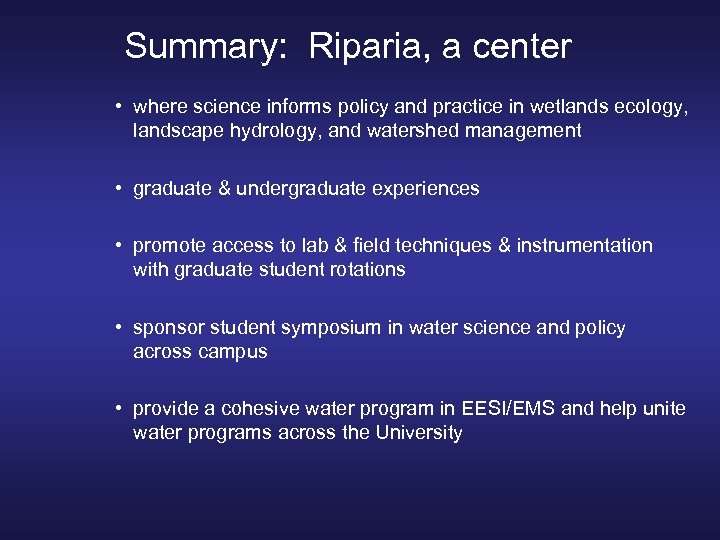 Summary: Riparia, a center • where science informs policy and practice in wetlands ecology, landscape hydrology, and watershed management • graduate & undergraduate experiences • promote access to lab & field techniques & instrumentation with graduate student rotations • sponsor student symposium in water science and policy across campus • provide a cohesive water program in EESI/EMS and help unite water programs across the University