


 Скачать презентацию RIO OIL and GAS UK Trade Missions DOING
e05c260d10d0d69af255b1257598bacf.ppt
- Количество слайдов: 34
 RIO OIL and GAS UK Trade Missions DOING BUSINESS IN BRAZIL By Stirling Leech September 13 th, 2010
 CONTENTS 1. Introduction 2. The Legal Framework 3. Local Content Rules 4. Certification wtih Petrobras (CRCC) 5. Agency Agreements (“Representação Comercial”) 6. Distribution Agreements 7. Other Similar Forms of Doing Business 8. Joint Ventures 9. Consortiums/Consortia 10. Licenses/Licensing Agreements 11. Establishing a Company/Office 12. The Regulatory Environment
 CONTENTS Cont. d 13. The Regulatory Environment 14. Taxation 15. Labour Issues 16. Immigration and Visa Issues 17. The Consumer Guide 18. Conclusion
 1. Introduction l Almost any market entry approach is open to foreign companies seeking to tap into the huge Brazilian market direct sales (imports, exports), distributors, consortiums, joint ventures, licensing or start ups. l The appropriate form depends largely on the product or service, as well as the international experience of the company and its sales goals. l Small companies with financial and manpower restraints usually rely on agents or distributors to sell their products. This form of sales is most favoured by companies that have limited overseas market experience or exposure. They are low investment risks and this form permits penetration into a foreign market such as Brazil which otherwise would be impossible.
 1. Introduction Cont. d A company that has done its due diligence and has invested in a serious market analysis for its products would most likely prefer to enter into a partnership or joint venture. This permits it to have a participation in the development, marketing and growth of the product, and allows it to invest capital and know how in the venture, maximizing growth potential. l Many times it is preferable to license one’s rights to a local manufacturer rather than entering into a possible competitive situation with a local company. The importance of market research cannot be overstressed. l When the form of market entry is ready for implementation, the product will usually dictate the sales channel. Basically the channel that has proven successful for you in Europe will usually prove successful in Brazil too, although there are several elements of the Brazilian system that you need to be aware of. l
 2. The Legal Framework l The Brazilian legal system is based on Codes and legislation enacted by the appropriate legislative power at the Federal, State and Municipal levels. l Historically, Brazil has used Napoleonic law. The principal source of Brazilian Civil Law is the Civil Code, which was reformed in 2002. l The Brazilian judiciary is organized into Federal and State Courts. There are various Appellate Courts, the Appeal Courts including the Superior Court of Justice and the Brazilian Supreme Court, both located in Brasilia. l The administration of justice is slow and cumbersome. l Note that many Brazilian entities will insist on Brazilian law and/or arbitration in their contracts.
 3. Local Content Rules l Brazil and Petrobras' huge shipping list. l Brazil a gold mine for suppliers and service providers in the offshore petroleum industry. l But there is a catch l These vendors will likely be required to meet an ever growing local contract percentage established by Petrobras. l Basically, local content consists of contractual commitments whereby oil companies are required to procure a minimum percentage of equipment and services from local suppliers.
 3. Local Content Rules Cont. d l And Petrobras will have targets to reach with ANP which it will pass on. l Significant domestic content will become gradually omnipresent in all new PB auctions and contracts. l Technology intensive products and services will carry a lower local content percentage than low tech activities. l Consequence: interested companies should create local subsidiaries and look for local partnerships, areas to establish new facilities and bases for operations.
 4. Certification with Petrobras (CRCC) l In addition, enlistment with Petrobras (PB) of vendors/suppliers to the PB Service Providers' List (CRCC) will gradually become omnipresent in all new PB auctions and contracts. l The CRCC is intended to prequalify companies and products so that when Petrobras needs such products or services, bidding or negotiation will be simpler and faster, largely based on price and delivery capabilities. This will dispense with a thorough examination of products on a case by case basis, which currently is time consuming and counter productive for Petrobras.
 4. Certification with Petrobras (CRCC) Cont. d l The aim of CRCC is to build a database of service providers and suppliers organized according to their products or services, so as to expedite Petrobras' purchasing process. l On the basis of information contained in the CRCC database, Petrobras will invite companies to participate in biddings or direct purchase negotiations. l In a few months, companies without CRCC registration will be prevented from selling or providing services to Petrobras. Moreover, there is a noticeable trend in making CRCC enrollment a requirement for qualification of companies for biddings.
 5. Agency Agreements ("Representação comercial") l In Brazil agency agreements, as well as the activities of independent commercial agents in Brazil, are subject to specific legislation, as well as provisions in the Civil Code. l In the normal way, in Brazil, the agent does not purchase the merchandise from the supplier; the supplier sells it directly to the consumer through the mediation of the agent, and the agent receives his commission. l When an agent has the power to bind the represented company or principal abroad, the latter may be subject to income tax in Brazil (traditionally at 20% of the amount of sales). l Independent commercial agents in Brazil are required to register with the Regional Councils of Independent Commercial Agents.
 5. Agency Agreements Cont. d l Commissions are usually subject to monetary correction if not paid up to the 15 th day of the month subsequent to the issue of the invoice. l The law provides for certain basic obligations of the principal and the agent. Note that the law also provides that the amount of indemnification due to the agent in the event of termination of the agreement without cause cannot be less one twelfths of the total compensation received by the agent during the term it exercised the representation. l There also defined events which give the right of termination.
 6. Distribution Agreements l Of course, the distribution agreement covers the relationship between the manufacturer/supplier and the buyer/distributor, who buys the supplier's products to resell in an established territory. The distributor, as elsewhere, exercises its activities for his own account. l Unlike with the agency agreement, there is no specific legislation that regulates the distribution agreement in Brazil. l Accordingly, distribution relationships are governed generally by the Brazilian Civil Code and the Consumer Rights Code.
 6. Distribution Agreements Cont. d l All distribution agreements must be in writing and must specify a number of conditions. l Indemnification due upon the termination of the agreement shall be that established in the agreement. In the absence of such a provision, the indemnification shall be limited to losses and damages incurred. l A non competition clause can be established for after termination. The violation of this clause by the distributor will only entitle the supplier to obtain an indemnification for the losses and damages incurred and not to specific performance.
 7. Other Similar Forms Of Doing Business The Mandate ("Mandato Mercantil") l The mandate is an agreement by which a person undertakes to performs acts or manage the interests of a commercial nature, and for the account of a merchant against remuneration. The mandate is governed by certain provisions of the Brazilian Civil Law Code. The Commission ("Comissão Mercantil") l The commission is the agreement under which a merchant undertakes to perform acts or transact business of a commercial nature in favour of and following the instructions of another person, acting, however in his own name, for undertaking obligations before third parties with whom he transacts, against remuneration. The Commission is also governed by certain provision of the Brazilian Civil Law Code.
 8. Joint Ventures l As mentioned, partnerships or joint ventures permit the company to have a participation in the development, marketing and the product, and allows it to invest capital or know how in the venture, maximizing growth potential. l The legal meaning of the expression ‘joint venture’ under Brazilian law encompass different types of contract arrangements, including consortium contracts, the establishment of a local company and so on. l As in the common law system, joint ventures in Brazil might be so called pure contractual joint ventures or joint venture companies.
 8. Joint Ventures Cont. d l In the case of the pure contractual joint venture, the type of business will determine the different contractual form, and the relevant provisions of the Civil Law Code which may apply. Depending also on the nature of the business and the type of arrangement, some special laws may also apply. l The concept of a non incorporated joint venture as a separate corporate entity does not exist in Brazil. Accordingly, parties to a non incorporated joint venture are taxed individually. Their tax liabilities are based on their tax status and their share of the joint venture taxable income. l If it is an incorporated joint venture, the foreign party will be an investor in the Brazilian company and should be registered as an investor before the Brazilian Central Bank and Brazilian Federal Tax Authorities. Dividends on profits are tax free.
 8. Joint Ventures Cont. d l The incorporated joint venture itself is taxed in the same way as any corporate entity. l Incorporated joint ventures are usually structured in the form of a limitada or sociedade anonima, which I will refer to shortly. l The rights and obligations of the joint ventures in such companies are regulated by joint venture agreements, articles of association, by laws, shareholders' agreements and the applicable corporate law.
 9. Consortiums /Consortia l Among the various forms of association provided for in Brazilian legislation, the consortium has recently gained a larger dimension. l On introducing the consortium figure, the Brazilian Commercial Law intended to facilitate the common activity of companies to leverage a certain purpose without constitution of a new legal entity in fact. l A consortium will not constitute a corporate entity and the consortium members only bind themselves to observe the conditions stipulated in the respective contracts, with each member being liable for its own obligations, and there being no joint liability implied in case of breach of any contractual covenant.
 10. Licenses/ Licensing Agreements l Brazil has begun to attract ever greater amounts of licensing, including use of trade marks, technology transfer and franchises. This marks a dramatic turnaround from just a few years ago when such transactions were difficult because of strict administrative supervision, legislation heavily biased towards the licensee and widespread illegal abuse of intellectual property. l Licensing agreements are now common forms of accessing the Brazilian market. Careful structuring of such an arrangement is required. All licensing and technical assistance, including trade mark licenses, must be registered. l A major concern historically of foreign companies trading with Brazil has been protection of intellectual property rights. Brazil has in recent years entirely replaced its legislation on intellectual property.
 10. Licenses/ Licensing Agreements Cont. d l The National Institute of Industrial Property (INPI) regulates matters pertaining to industrial property patents, trade marks, manufacturing processes, technology and know how. It's headquarters are here in Rio. All forms of license property and technology transfer must be registered with the INPI in order to remit royalties and fees and ensure tax deductibility for the local partner. l Royalty remittances requires certification from the INPI and registration with the Central Bank. Remittances of royalties and fees to a parent or unrelated foreign licenser are generally limited to 1% 5% of gross sales, depending on the product. l Licensers interested in finding suitable partners foreign technology transfer should consult the Investment Promotion and Technology Transfer System (IPTTS), created for this purpose.
 11. Establishing a Company /Office l Either setting up a company in Brazil or acquiring an existing entity are obviously options for investing in Brazil. l Setting up new companies is relatively easy and inexpensive. Acquisitions of existing companies are monitored by the Central Bank. l When setting up a new legal entity in Brazil, given that the incorporation of a branch requires authorization granted via a decree by the Executive Power the process is generally bureaucratic and lengthy. In view of this, the majority of foreign businesses in Brazil are set up under the form of subsidiaries.
 11. Establishing a Company /Office Cont. d l Brazilian law provides for several types of companies, when incorporating a subsidiary in Brazil. The most frequently used corporate forms are the 'sociedade anonima' (S. A. ) and the 'sociedade limitada' (Ltda. ). In both cases the participants have limited liability. A limitada, which resembles a U. S. or UK Limited Liability Company (LLC), requires at least two partners but all partners have limited liability. l A limitada offers a number of practical advantages, and this corporate form is recommended if the investor desires simplicity and flexibility in the corporate structure, reduced maintenance costs and the inapplicability of several legal formalities, which are mandatory in the case of a sociedade anônima.
 11. Establishing a Company /Office Cont. d l A limitada must have at least two shareholders who can be foreign and one Administrator who can be foreign (but who must be domiciled in Brazil). l The sociedade anônima, is a company in which decisions are generally taken by majority vote and in which the management is separate from the shareholders. It is a corporate form usually utilized by ventures capable of gathering concentrations of financial resources from a large number of investors. l As a general statement, the limitada is usually appropriate in the case of wholly owned subsidiaries, and the sociedade anônima form may be preferable for ventures having a larger number or different groups of shareholders.
 12. The Regulatory Environment l The Brazilian business environment is highly regulated. 13. Environmental Control l The increasing worldwide concepts of 'sustainable development' and 'environmental impact' must be taken into account when considering investment in Brazil.
 14. Taxation l Taxation relating to business operations in Brazil is a vast and complex field, comprising numerous Federal, State and Municipal taxes. l There is no double taxation treaty with the UK.
 15. Labour Issues l Employees are well protected under the Brazilian Law regime and you need to take good advice here as well. l Legal entities, with three or more employees, are obliged to maintain a proportionality of two thirds of Brazilian employees to one third of foreign employees. The proportionality must also be observed in relation to the payroll/remuneration.
 16. Immigration and Visa Issues l The permanent visa is granted to foreign individuals who intend to settle in Brazil and who satisfy specific requirements established by the National Immigration Council and Labour Ministry. l The temporary business visa permits a foreign individual to enter Brazil for a short term on a specific business assignment.
 17. The Consumer Guide l Note the Consumer Protection Code of 1990 which is a comprehensive Code setting out consumer’s rights regarding products and services. Amongst many other things, it provides for strict liability of manufacturers and service suppliers for direct and indirect damages caused to end consumers.
 18. Conclusion l Brazil is an exciting market: there are significant opportunities. l But there also still significant challenges, including significant bureaucracy, complex tax and labour legislation, an ever changing regulatory environment and local content rules l So, be well advised!.
 Contact: Stirling Leech Clyde & Co LLP Av. Rio Branco 257/808 Cep 20040 009 Rio de Janeiro Brazil Tel: 5521 2217 7700 Fax: 5521 2217 7720 Mob: +44 (0) 7879 032 042 Mob: +55 (21) 8887 7719 stirling. leech@clydeco. com Clyde & Co LLP Rua Padre João Manoel 199/2 Conjunto 23 & 24 Cerqueira César Cep 01411 011 São Paulo – Brazil Tel/Fax: 5511 2768 8720
 Abu Dhabi Tel: +971 2 644 6633 Fax: +971 2 644 2422 Email: mero@clydeco. ae Bangalore* London Tel: +44 (0)20 7623 1244 Fax: +44 (0)20 7623 5427 Email: info@clydeco. com Moscow Tel: +91 (0) 80 4016 0000 Tel: +7 495 601 9006 Fax: +91 (0) 80 4016 0001 Fax: +7 495 601 9005 Email: bangalore@almtlegal. com Email: clyde. co@mail. ru Belgrade* Tel: +381 11 303 8822 Fax: +381 11 303 8309 Email: clyde@clydeco. rs Caracas Tel: +58 212 2785 7118 Fax: +58 212 285 5098 Email: clyde. co@cantv. net Doha Tel: +974 496 7434 Fax: +974 496 7412 Email: mero@clydeco. qa Dubai Tel: +971 4 331 1102 Fax: +971 4 311 9920 Email: mero@clydeco. ae Guildford Tel: +44 (0)1483 555 Fax: +44 (0)1483 567 330 Email: info@clydeco. com Hong Kong Tel: +852 2878 8600 Fax: +852 2522 5907 Email: clyde@clyde. com. hk Mumbai* Tel: +91 (0) 22 4001 0000 Fax: +91 (0) 22 4001 0001 Email: mumbai@almtlegal. com Nantes Tel: +33 (0)2 40 47 00 71 Fax: +33 (0)2 40 35 84 82 Email: nantes. office@clydeco. fr New York Tel: +1 212 710 3900 Fax: +1 212 710 3959 Email: info@clydeco. us Paris Tel: +33 (0)1 44 43 88 88 Fax: +33 (0)1 44 43 88 77 Email: paris. office@clydeco. fr Piraeus Tel: +30 210 417 0001 Fax: +30 210 417 0002 Email: info@clyde. gr Riyadh* Tel: +966 1 279 5212 Fax: +966 1 279 5101 Email: enquiry@albosailylawoffice. com Rio de Janeiro Tel: +55 21 2217 7700 Fax: +55 21 2217 7720 Email: enquiries@beaumont. com. br San Francisco Tel: +1 415 365 9800 Fax: +1 415 365 9801 Email: info@clydeco. us Shanghai Tel: +86 21 5877 5128 Fax: +86 21 5877 9128 Email: clyde@clydeco. com. cn Singapore Tel: +65 6544 6500 Fax: +65 6544 6501 Email: post@clyde. com. sg St Petersburg* Tel: +7 812 232 2297 Fax: +7 812 233 8109 Email: mp@musinandpartners. ru *Associated office Clyde & Co LLP is a limited liability partnership registered in England Wales. Regulated by the Solicitors Regulation Authority. © Clyde & Co LLP 2009
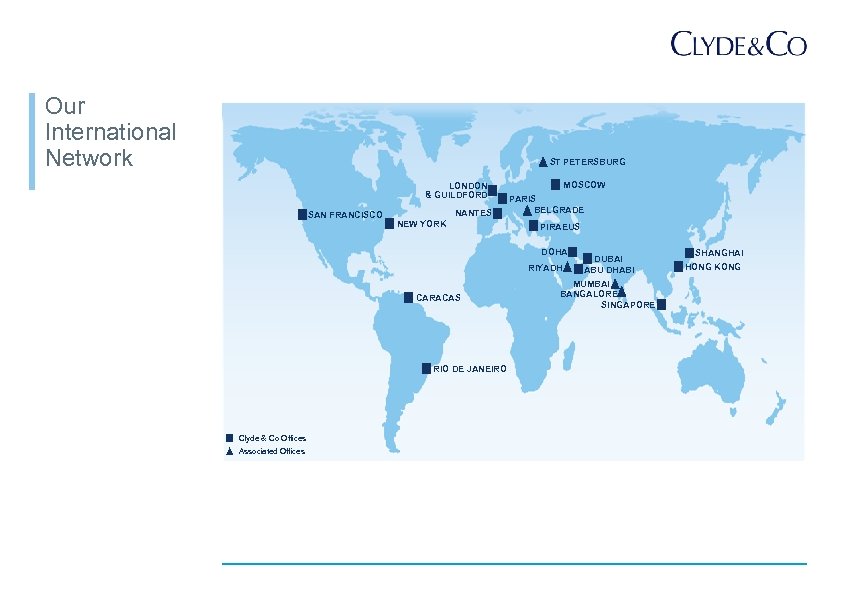 Our International Network ST PETERSBURG LONDON & GUILDFORD SAN FRANCISCO NANTES NEW YORK MOSCOW PARIS BELGRADE PIRAEUS DOHA RIYADH CARACAS RIO DE JANEIRO Clyde & Co Offices Associated Offices DUBAI ABU DHABI MUMBAI BANGALORE SINGAPORE SHANGHAI HONG KONG
 Clyde & Co LLP is a limited liability partnership registered in England Wales. Regulated by the Solicitors Regulation Authority. © Clyde & Co LLP 2008