


 Скачать презентацию Ring Fencing of System Operation and independent functioning
6ea863ac5bc9d7ead1d72607ab3d583e.ppt
- Количество слайдов: 62
 Ring Fencing of System Operation and independent functioning of Load Despatch Centres by Western Regional Load Despatch Centre, Mumbai PSTI Bengaluru 20 th April 2011
 Outline • Unbundling………rationale • Ring fencing of System Operation • Milestones & Achievements • The ultimate mantra to functional autonomy 2
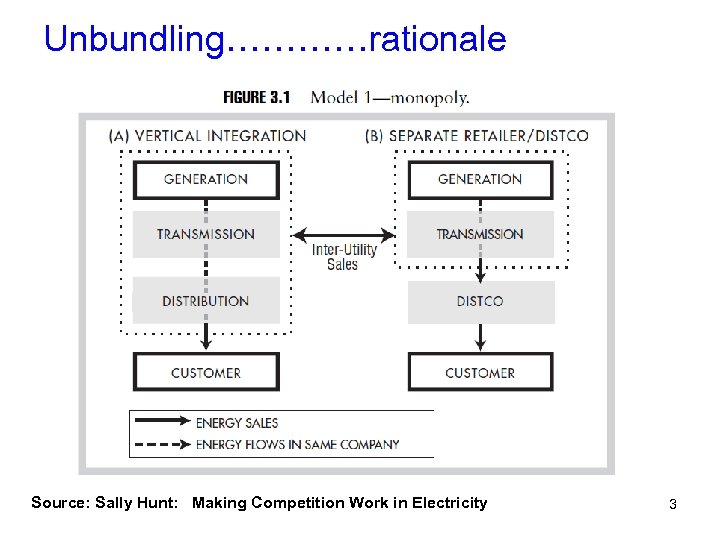 Unbundling…………rationale Source: Sally Hunt: Making Competition Work in Electricity 3
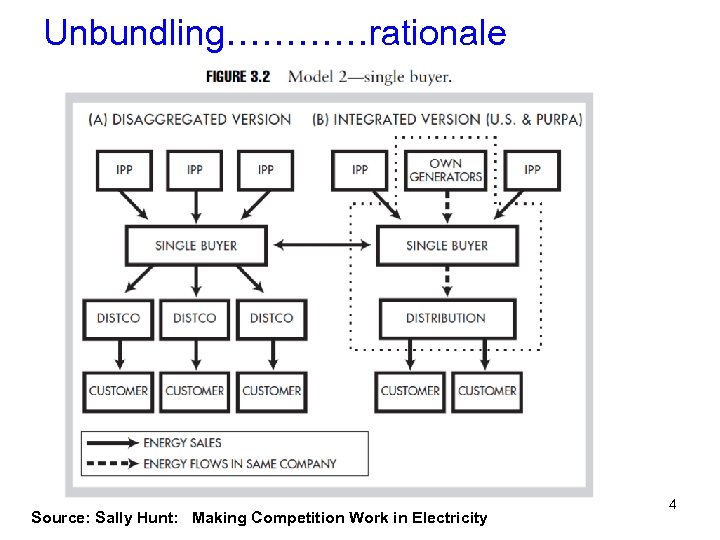 Unbundling…………rationale Source: Sally Hunt: Making Competition Work in Electricity 4
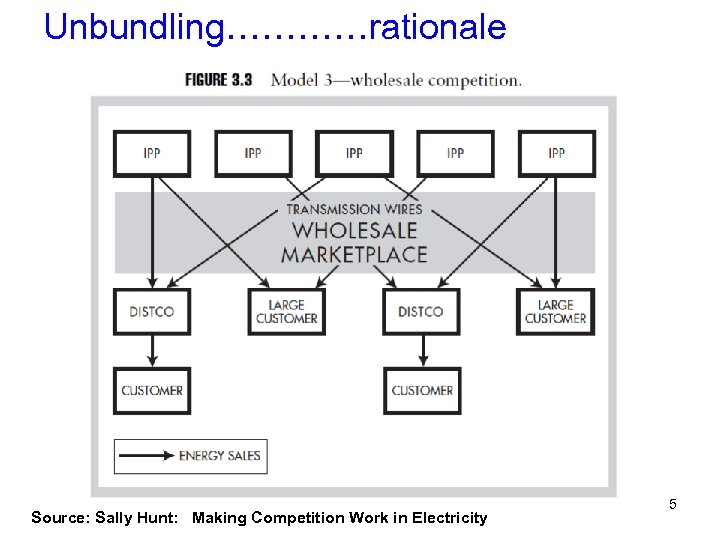 Unbundling…………rationale Source: Sally Hunt: Making Competition Work in Electricity 5
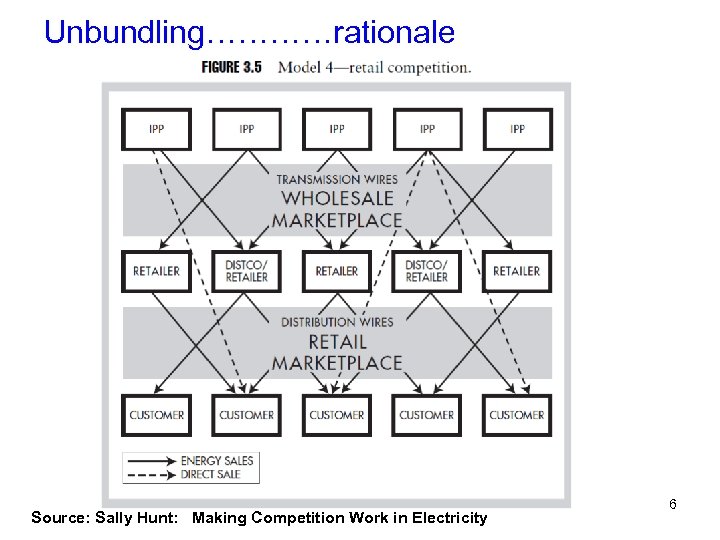 Unbundling…………rationale Source: Sally Hunt: Making Competition Work in Electricity 6
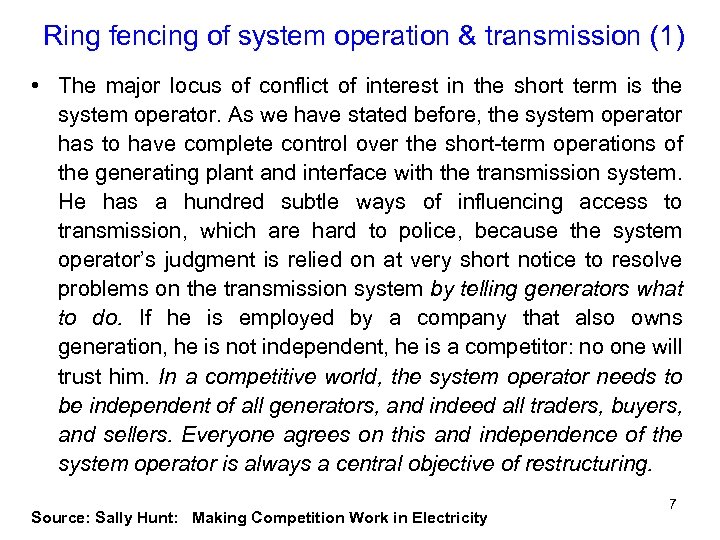 Ring fencing of system operation & transmission (1) • The major locus of conflict of interest in the short term is the system operator. As we have stated before, the system operator has to have complete control over the short-term operations of the generating plant and interface with the transmission system. He has a hundred subtle ways of influencing access to transmission, which are hard to police, because the system operator’s judgment is relied on at very short notice to resolve problems on the transmission system by telling generators what to do. If he is employed by a company that also owns generation, he is not independent, he is a competitor: no one will trust him. In a competitive world, the system operator needs to be independent of all generators, and indeed all traders, buyers, and sellers. Everyone agrees on this and independence of the system operator is always a central objective of restructuring. Source: Sally Hunt: Making Competition Work in Electricity 7
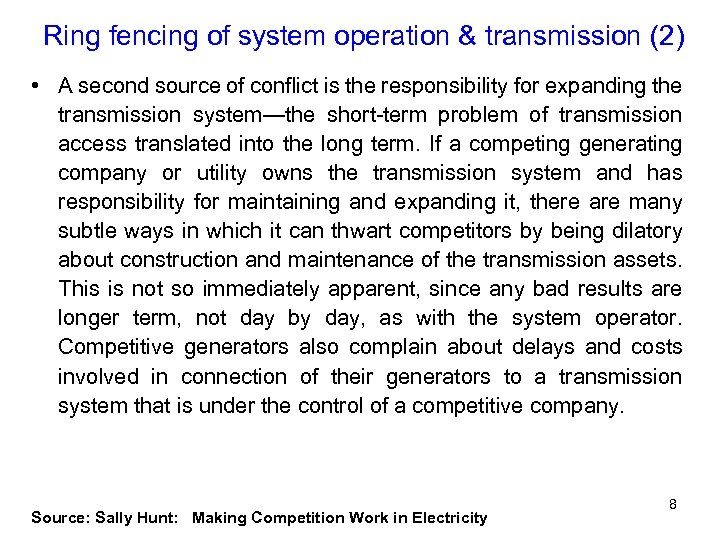 Ring fencing of system operation & transmission (2) • A second source of conflict is the responsibility for expanding the transmission system—the short-term problem of transmission access translated into the long term. If a competing generating company or utility owns the transmission system and has responsibility for maintaining and expanding it, there are many subtle ways in which it can thwart competitors by being dilatory about construction and maintenance of the transmission assets. This is not so immediately apparent, since any bad results are longer term, not day by day, as with the system operator. Competitive generators also complain about delays and costs involved in connection of their generators to a transmission system that is under the control of a competitive company. Source: Sally Hunt: Making Competition Work in Electricity 8
 Other areas necessitating functional autonomy • Non-discriminatory open access • Outage planning • Backing down or re-scheduling • Switching instructions • Availability certification • Real time data availability at LDCs • Metering and settlement system • Incident investigation and analysis • Proper feedback to planners and regulators 9
 Milestones and achievements • Pre 1994: RLDCs were operated by CEA with budgetary support from Govt. of India. • 1994 -1996: RLDCs transferred in a progressive manner to POWERGRID. Budgetary support from GOI stops. • July 1998: CEA finalizes an adhoc arrangement for reimbursement of RLDC expenses. (Rs. 12 Crores for 1996 -97) 10
 Milestones and achievements…. . contd/ • 8 th May 2003: CERC approves RLDC fees and charges from 20002001 ( Rs. 21. 52 Crs. in the starting year) • 2005 onwards: ULDC scheme charges merged with RLDC fees & charges and approved by CERC • 5 th Nov 2007: Interactive session convened by Ministry of Power with Forum of Regulators and State Government. Pradhan Committee on Ring fencing of LDCs constituted in Feb 2008 after this meeting. • 4 th July 2008: Ministry of Power directed POWERGRID formation of POSOCO 11
 Milestones and achievements…. . contd/ • 11 th August 2008: Gireesh B. Pradhan Committee Report on” “ Manpower, Certification and Incentives for System Operation and Ring fencing Load Despatch Centres” submitted. Report accepted and a meeting called on 7 th Oct 2008 by Secretary Power. • 15 th Nov 2008: Forum of Regulators (FOR) approves formation of ‘Forum of Load Despatchers (FOLD) and approves FOLD charter in Jan 2009 • 20 th March 2009: Power System Operation Corporation Ltd. incorporated as a 100% subsidiary of POWERGRID with authorized share capital of Rs. 200 crores. 12
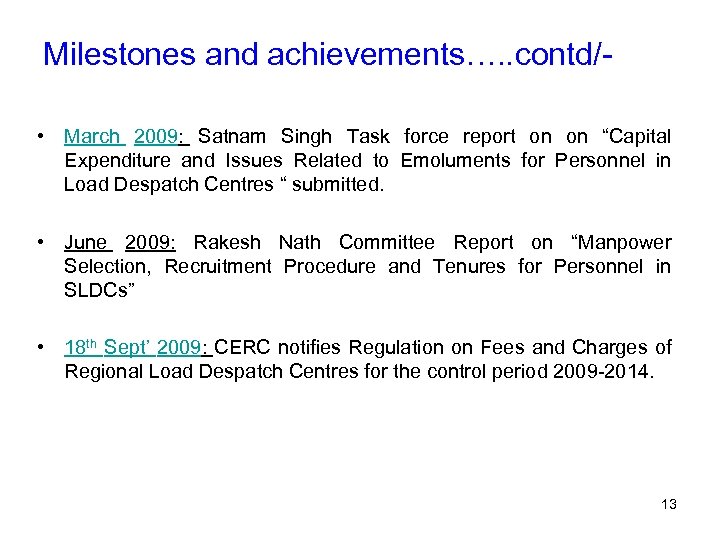 Milestones and achievements…. . contd/ • March 2009: Satnam Singh Task force report on on “Capital Expenditure and Issues Related to Emoluments for Personnel in Load Despatch Centres “ submitted. • June 2009: Rakesh Nath Committee Report on “Manpower Selection, Recruitment Procedure and Tenures for Personnel in SLDCs” • 18 th Sept’ 2009: CERC notifies Regulation on Fees and Charges of Regional Load Despatch Centres for the control period 2009 -2014. 13
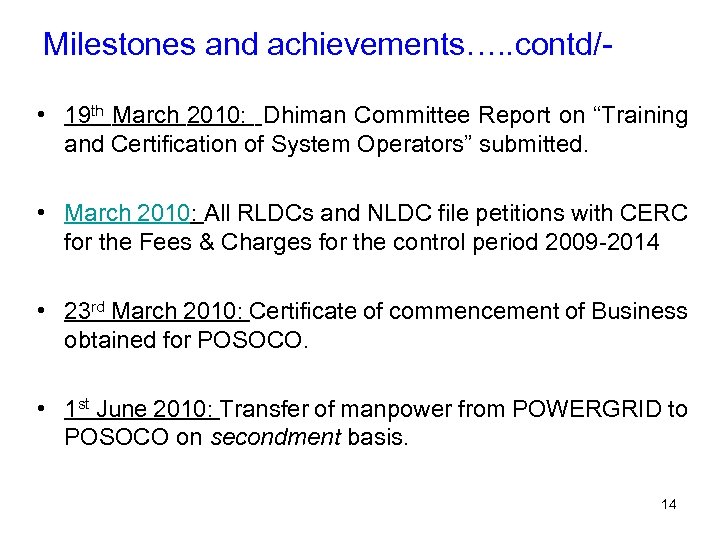 Milestones and achievements…. . contd/ • 19 th March 2010: Dhiman Committee Report on “Training and Certification of System Operators” submitted. • March 2010: All RLDCs and NLDC file petitions with CERC for the Fees & Charges for the control period 2009 -2014 • 23 rd March 2010: Certificate of commencement of Business obtained for POSOCO. • 1 st June 2010: Transfer of manpower from POWERGRID to POSOCO on secondment basis. 14
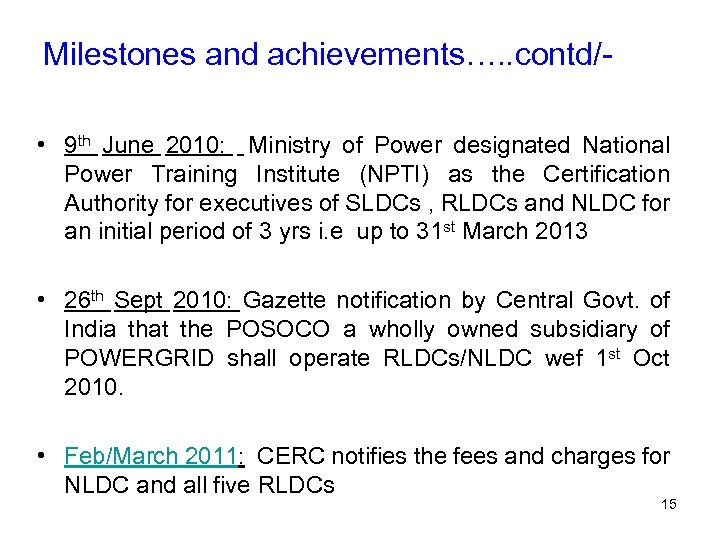 Milestones and achievements…. . contd/ • 9 th June 2010: Ministry of Power designated National Power Training Institute (NPTI) as the Certification Authority for executives of SLDCs , RLDCs and NLDC for an initial period of 3 yrs i. e up to 31 st March 2013 • 26 th Sept 2010: Gazette notification by Central Govt. of India that the POSOCO a wholly owned subsidiary of POWERGRID shall operate RLDCs/NLDC wef 1 st Oct 2010. • Feb/March 2011: CERC notifies the fees and charges for NLDC and all five RLDCs 15
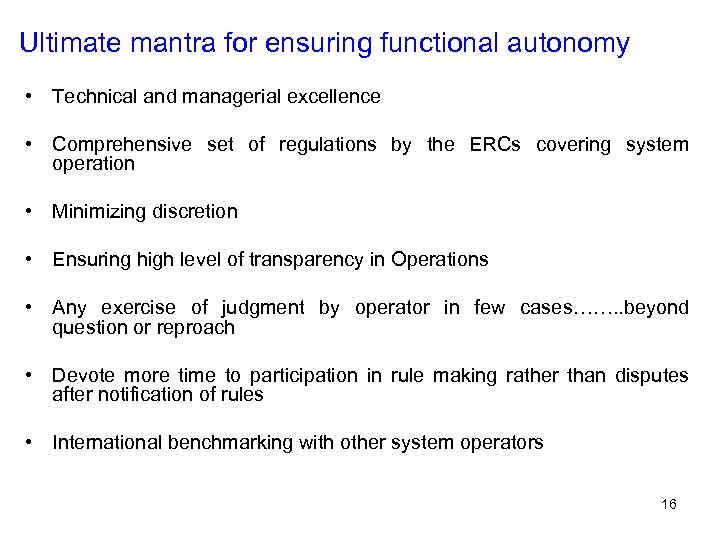 Ultimate mantra for ensuring functional autonomy • Technical and managerial excellence • Comprehensive set of regulations by the ERCs covering system operation • Minimizing discretion • Ensuring high level of transparency in Operations • Any exercise of judgment by operator in few cases……. . beyond question or reproach • Devote more time to participation in rule making rather than disputes after notification of rules • International benchmarking with other system operators 16
 Thank you Discussion……… 17
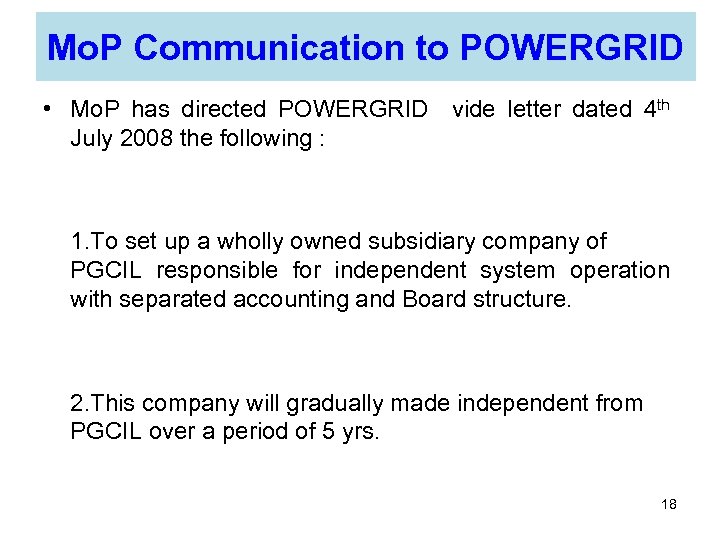 Mo. P Communication to POWERGRID • Mo. P has directed POWERGRID vide letter dated 4 th July 2008 the following : 1. To set up a wholly owned subsidiary company of PGCIL responsible for independent system operation with separated accounting and Board structure. 2. This company will gradually made independent from PGCIL over a period of 5 yrs. 18
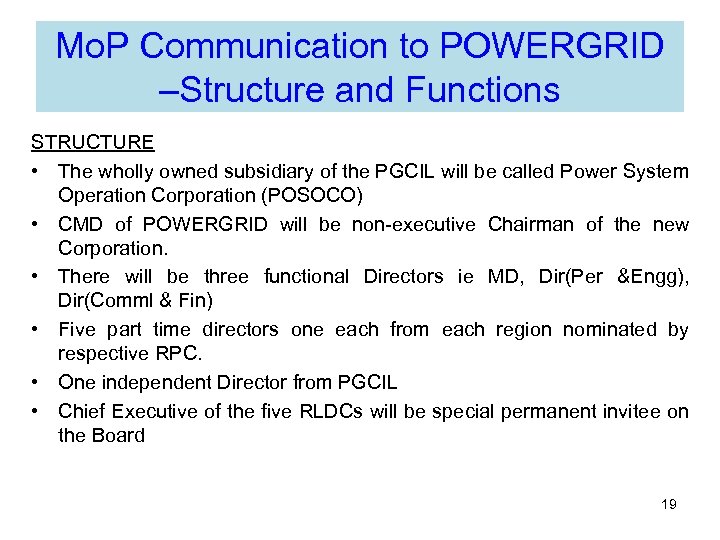 Mo. P Communication to POWERGRID –Structure and Functions STRUCTURE • The wholly owned subsidiary of the PGCIL will be called Power System Operation Corporation (POSOCO) • CMD of POWERGRID will be non-executive Chairman of the new Corporation. • There will be three functional Directors ie MD, Dir(Per &Engg), Dir(Comml & Fin) • Five part time directors one each from each region nominated by respective RPC. • One independent Director from PGCIL • Chief Executive of the five RLDCs will be special permanent invitee on the Board 19
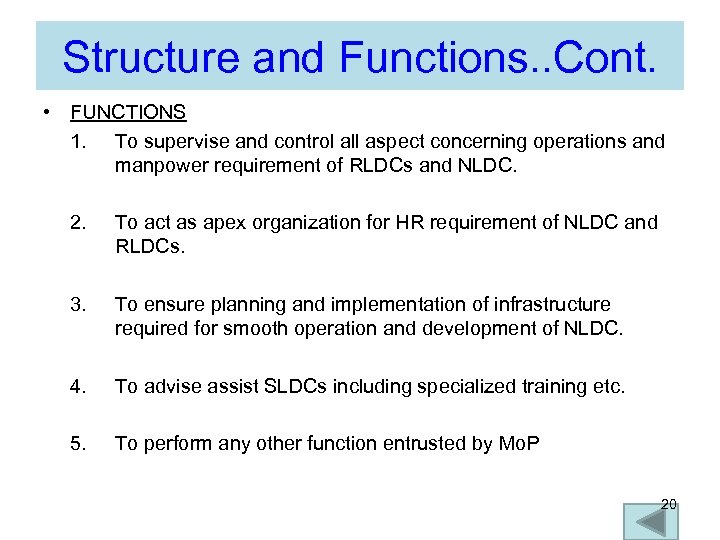 Structure and Functions. . Cont. • FUNCTIONS 1. To supervise and control all aspect concerning operations and manpower requirement of RLDCs and NLDC. 2. To act as apex organization for HR requirement of NLDC and RLDCs. 3. To ensure planning and implementation of infrastructure required for smooth operation and development of NLDC. 4. To advise assist SLDCs including specialized training etc. 5. To perform any other function entrusted by Mo. P 20
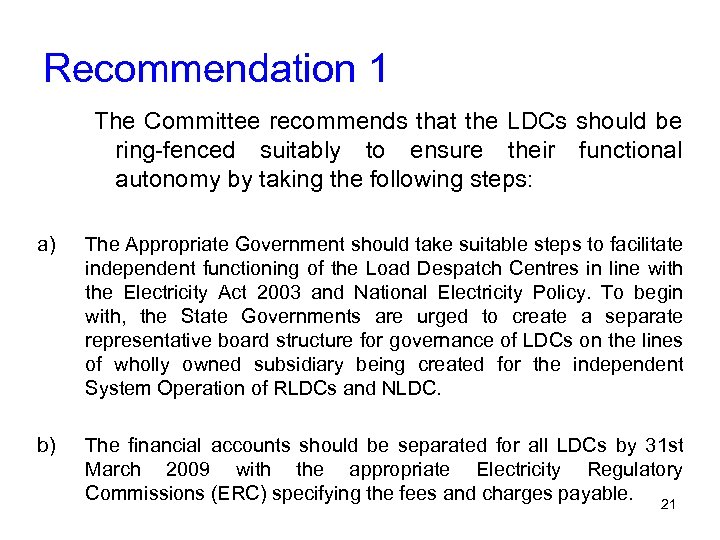 Recommendation 1 The Committee recommends that the LDCs should be ring-fenced suitably to ensure their functional autonomy by taking the following steps: a) The Appropriate Government should take suitable steps to facilitate independent functioning of the Load Despatch Centres in line with the Electricity Act 2003 and National Electricity Policy. To begin with, the State Governments are urged to create a separate representative board structure for governance of LDCs on the lines of wholly owned subsidiary being created for the independent System Operation of RLDCs and NLDC. b) The financial accounts should be separated for all LDCs by 31 st March 2009 with the appropriate Electricity Regulatory Commissions (ERC) specifying the fees and charges payable. 21
 Recommendation 1 (contd/-) c) Capital Expenditure (CAPEX) plans for modernization of all LDCs during 2009 -12 should be submitted and the approval of the respective Electricity Regulatory Commission (ERC) should be obtained by 31 st March 2009. The Central Transmission Utility (CTU) and Regional Load Despatch Centres (RLDCs) should extend the necessary assistance to SLDCs in this area. d) In the next stage, rolling 5 -year CAPEX plans should be prepared by each LDC and got approved by the respective ERCs to take care of the system expansion, associated real-time data requirements as well as technological innovations and obsolescence of control centre equipment. ERCs may examine CAPEX proposal considering a shorter life cycle of 7 -10 years for such equipment. 22
 Recommendation 2 For making LDCs financially self-reliant, the Electricity Regulatory Commissions (ERCs) should recognize three distinct revenue streams: a) Fees and charges for system operation b) Tariff for decision support system and IT infrastructure (currently only ULDC tariff) c) Operating charges for scheduling, metering and settlement for market players. d) All Generating Companies and licensees using the services of the LDCs would make all the above payments. In addition the LDCs could provide value added services (studies, manpower development, reports, access to data archives etc), on chargeable basis. 23
 Recommendation 3 The Committee recommends a) Introduction of a system of certification of System Operators by an independent Central body, similar to the system followed in case of Air Traffic Controllers. b) Establishment of a Central Institute for training of System Operators. Initially the National Power Training Institute (NPTI) may be entrusted with the responsibility of training and certification. c) Within the next one year, all the course material, systems and procedures required for administering a “basic level” of training and certification should be developed. 24
 Recommendation 3 (contd/-) The Committee recommends d) All LDCs must ensure that all the personnel of LDCs undergo this ‘basic level’ training and certification and only certified personnel staff the LDCs within two years from the release of this report. The appropriate Electricity Regulatory Commissions would be furnished with an Annual Compliance Report of this requirement. Subsequently advanced level training and certification programme must be introduced. e) Fresh recruitment at regular intervals for lowering the average of the work force in the LDCs. f) Introduction of suitably designed courses in the Indian Institutes of Technology and National Institutes of Technology for ensuring availability of skilled manpower. g) Active collaboration of LDCs with educational institutes for research and development related to Indian power system and electricity 25 market operation.
 Recommendation 4 The highly specialized and technical nature of LDC function necessitates a suitable compensation structure to attract and retain talent. The Committee recommends a) The compensation structure for LDC personnel should be substantially higher than comparable companies in the power sector both in the public as well as private. b) Apart from the compensation structure, innovative incentive schemes, such as sabbaticals for higher learning and opportunities for Professional Engagement (PE) in the form of attending seminars/workshops and conferences both in India and abroad must be provided. c) Once the certification system is introduced, monetary incentives similar to Air Traffic Controllers can be provided to the System Operators based on their ratings. 26
 Recommendation 5 For standardizing and harmonizing the LDCs work, the committee recommends a) The NLDC in consultation with CEA, would lay down the “Standard Operating Procedures” (SOPs) which would be adopted by the SLDCs. Suitable Quality Standards and an Integrated Management System (IMS) may also be implemented. b) A ‘Forum of Load Despatch Centres’ with the secretariat provided by National Load Despatch Centre must be established. This Forum could take up issues of common interest and also formulate a Code of Ethics for the LDC personnel. c) At a future date, if all the State Governments agree, an umbrella structure of SLDCs integrated with RLDCs and NLDC may be considered. 27
 Task Force: Terms of Reference • To look into the – Financial aspects for augmentation and upgradation of State Load Despatch Centres – Issues related to emoluments (compensation structure, incentives etc. ) for the personnel in System Operations 28
 About the Task Force • Members – CMD, Power Finance Corporation: Chairman – Director (Finance), POWERGRID: Member – Secretary (Power), Haryana Govt. : Member – Managing Director, GETCO: Member – Secretary, CERC: Member Secretary • Meetings – 17 th December, 2008 – 27 th February, 2009 : New Delhi • Report – Submitted on 5 th May 2009 29
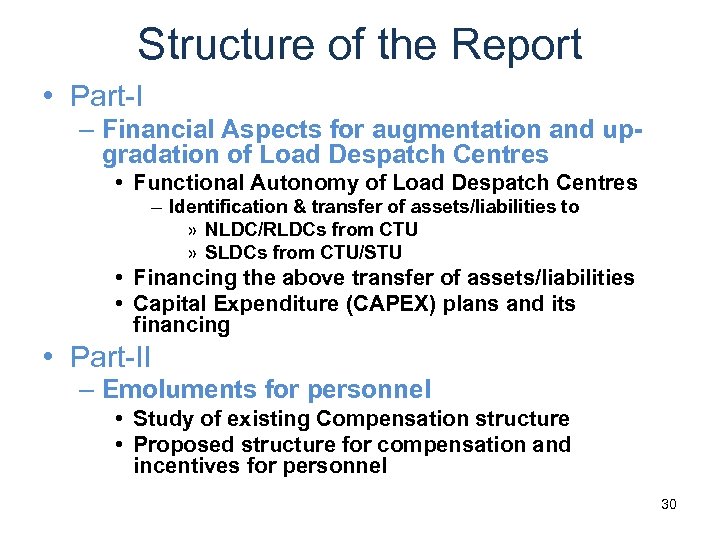 Structure of the Report • Part-I – Financial Aspects for augmentation and upgradation of Load Despatch Centres • Functional Autonomy of Load Despatch Centres – Identification & transfer of assets/liabilities to » NLDC/RLDCs from CTU » SLDCs from CTU/STU • Financing the above transfer of assets/liabilities • Capital Expenditure (CAPEX) plans and its financing • Part-II – Emoluments for personnel • Study of existing Compensation structure • Proposed structure for compensation and incentives for personnel 30
 Part-I Financial Aspects for augmentation and Upgradation 31
 Past Investments 32
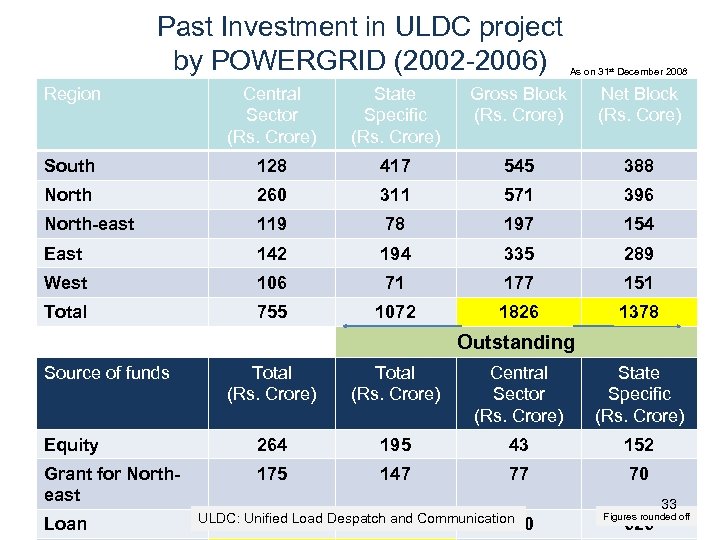 Past Investment in ULDC project by POWERGRID (2002 -2006) As on 31 st December 2008 Region Central Sector (Rs. Crore) State Specific (Rs. Crore) Gross Block (Rs. Crore) Net Block (Rs. Core) South 128 417 545 388 North 260 311 571 396 North-east 119 78 197 154 East 142 194 335 289 West 106 71 177 151 Total 755 1072 1826 1378 Outstanding Source of funds Total (Rs. Crore) Central Sector (Rs. Crore) State Specific (Rs. Crore) Equity 264 195 43 152 Grant for Northeast 175 147 77 70 Loan ULDC: Unified Load Despatch and Communication 1387 1036 410 33 Figures rounded off 626
 Segregation of Assets and Outstanding liabilities in respect of past investments • Region-wise and State-wise segregation – Carried out by the Task Force – Details as Annex-III of the Report • Total Outstanding apportioned into ‘outstanding equity’ and ‘outstanding loan’ for – Remote Terminal Units – Communication System – Control Centre Equipment Annex-III Page 57 -71 34
 Transfer of POWERGRID’s existing assets and liabilities under ULDC project: Recommendations • Central Sector Assets Para 4. 1, Page 11 – Control Centre equipment installed at NLDC/RLDCs to be transferred to the wholly owned subsidiary of POWERGRID – Building/parts of building where NLDC/RLDCs are operational along with associated facilities like staff quarters to be transferred to NLDC/RLDCs – Field equipment and communication infrastructure to remain with POWERGRID – Condemned items to be written off • State Specific Assets (under ULDC) – Control Centre equipment to be transferred to SLDC – Field equipment and communication infrastructure to be transferred to STU • Transfer to be completed by 30 th June 2009 Para 4. 8, Page 16 Field equipment: Remote Terminal Unit and associated infrastructure 35
 Financing the transfer of existing assets Recommendations • Central Sector – Transfer of assets and liabilities pertaining to NLDC/RLDCs from POWERGRID to the books of accounts of the wholly owned subsidiary Para 4. 3, Page 13 • State Specific – Three alternatives for financing suggested by Task Force Para 4. 4, Page 13 36
 • Financing transfer of State specific assets from CTU to respective STUs/SEBs and SLDCs Alternative-1 – – Preference to alternative-1 Equity liquidated by concerned STU/SLDC Loan transferred to STU/SLDC Other alternatives to be Agreement by lenders required explored in case of difficulties Capital Recovery Charge specified by SERCs – Alternative-2 Para 4. 8, Page 16 • Equity liquidated by concerned STU/SLDC • Existing loan swapped with fresh loan taken by concerned STU/SLDC • Capital Recovery Charge specified by SERCs Para 4. 4, Page 13 – Alternative-3 • • Para 4. 8, Page 16 Assets continue to be treated as given on lease POWERGRID continue to collect tariff as lease rental STU/SLDC make provisions in Annual Revenue Requirement Assets transferred to STU/SLDC after full recovery 37
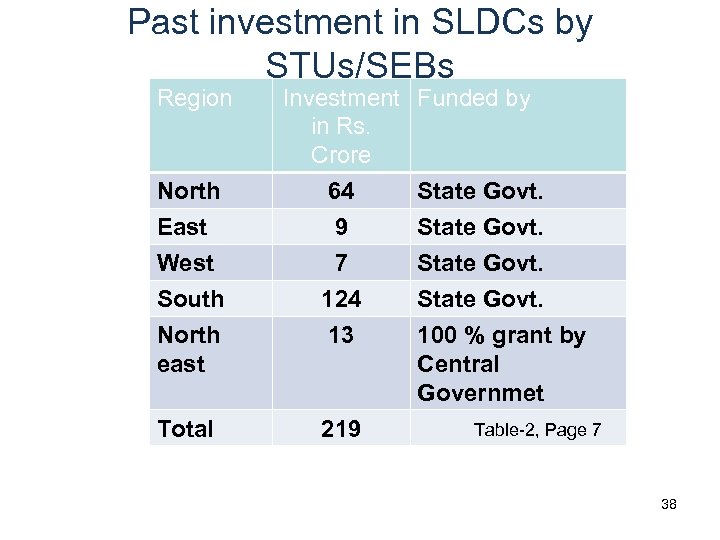 Past investment in SLDCs by STUs/SEBs Region North Investment Funded by in Rs. Crore 64 State Govt. East West 9 7 South North east 124 13 Total 219 State Govt. 100 % grant by Central Governmet Table-2, Page 7 38
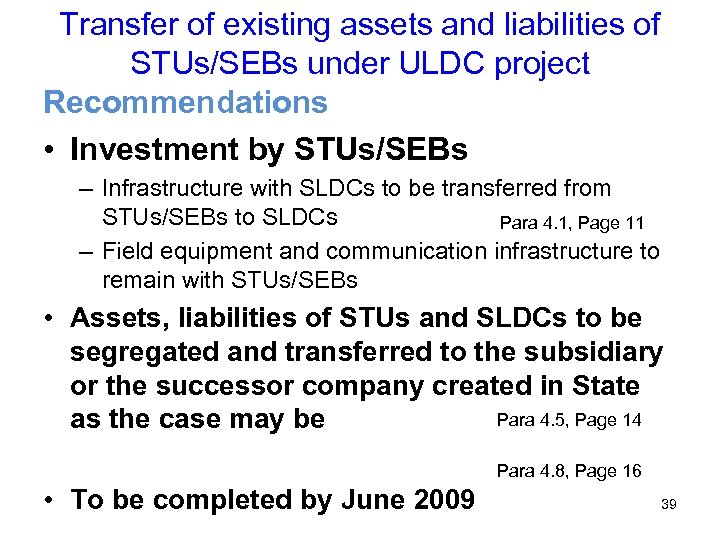 Transfer of existing assets and liabilities of STUs/SEBs under ULDC project Recommendations • Investment by STUs/SEBs – Infrastructure with SLDCs to be transferred from STUs/SEBs to SLDCs Para 4. 1, Page 11 – Field equipment and communication infrastructure to remain with STUs/SEBs • Assets, liabilities of STUs and SLDCs to be segregated and transferred to the subsidiary or the successor company created in State Para 4. 5, Page 14 as the case may be Para 4. 8, Page 16 • To be completed by June 2009 39
 Future Investments 40
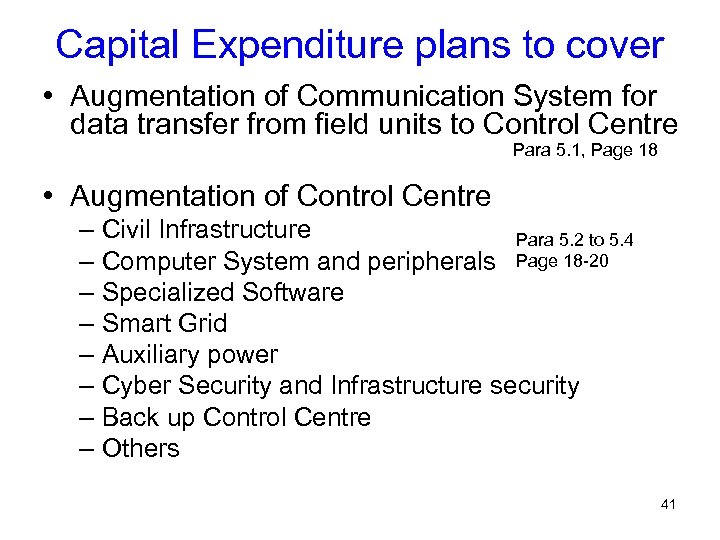 Capital Expenditure plans to cover • Augmentation of Communication System for data transfer from field units to Control Centre Para 5. 1, Page 18 • Augmentation of Control Centre – Civil Infrastructure Para 5. 2 to 5. 4 – Computer System and peripherals Page 18 -20 – Specialized Software – Smart Grid – Auxiliary power – Cyber Security and Infrastructure security – Back up Control Centre – Others 41
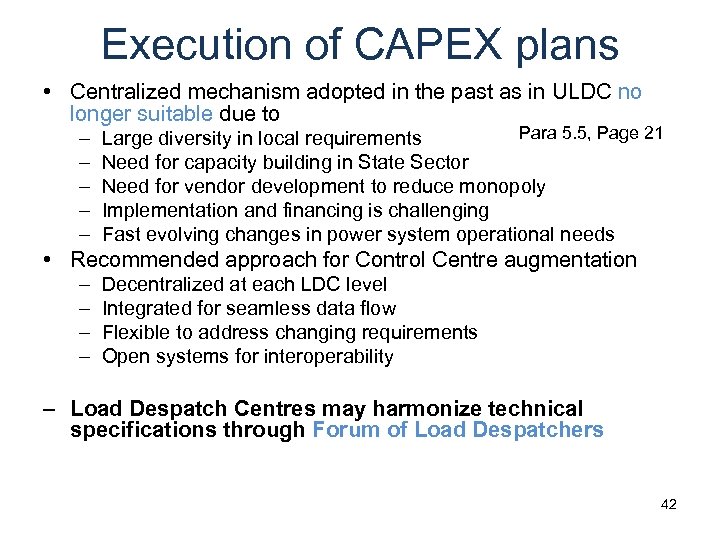 Execution of CAPEX plans • Centralized mechanism adopted in the past as in ULDC no longer suitable due to – – – Para 5. 5, Page 21 Large diversity in local requirements Need for capacity building in State Sector Need for vendor development to reduce monopoly Implementation and financing is challenging Fast evolving changes in power system operational needs • Recommended approach for Control Centre augmentation – – Decentralized at each LDC level Integrated for seamless data flow Flexible to address changing requirements Open systems for interoperability – Load Despatch Centres may harmonize technical specifications through Forum of Load Despatchers 42
 Financing CAPEX and O &M • Plans to be examined by respective ERCs • Fund requirement of moderate range • Typically Rs. 75 crore per LDC staggered over 5 years (Annex-IV) Para 6, Page 21 • Financial Institutions would be willing to lend if recovery is through ‘Fees and Charges’ approved by respective ERCs • Regulations are necessary to give comfort to the lenders Para 8 (iv), Page 26 • Revenue from Open Access to add to reserves and surplus of LDCs (Margin money for CAPEX) 43
 Methodology for recovery • Fees and Charges Para 8 (a), (b), (c), Page 25 • Charges for servicing of CAPEX – Return on Equity, Interest on Loan, Depreciation • Charges for Human Resource – Salary, perquisites, incentives, Training, Certification • Charges for O&M and General Expenses – Repair, Communication, Travel, Statutory duties, Taxes – Interest on Working Capital 44
 Revenue streams and sharing of charges • Services from LDCs Para 9, Page 27 – System Operation – Market Operation – System Logistics – Charges to be shared by beneficiaries of LDC service – Modus Operandi to be specified by Para 11, Page 28 respective ERCs 45
 Part-II Emoluments of Personnel 46
 Major Issues • Problems being experienced in attracting and retaining talent – Wide variation in emoluments among SLDCs. RLDCs/NLDC as per organizations managing LDCs Para 13, Page 32 • SLDCs managed by respective STU/SEBs • 5 RLDCs and 1 NLDC managed by POWERGRID Annex-V, Page 75 -94 – Existing emoluments incommensurate with the job responsibilities and associated physiological and mental stress Para 12, Page 30 • Urgent need for • Broad Harmonization and scaling up of emoluments to facilitate movement of personnel across different LDCs Para 14, Page 33 • Suitable incentives for personnel 47
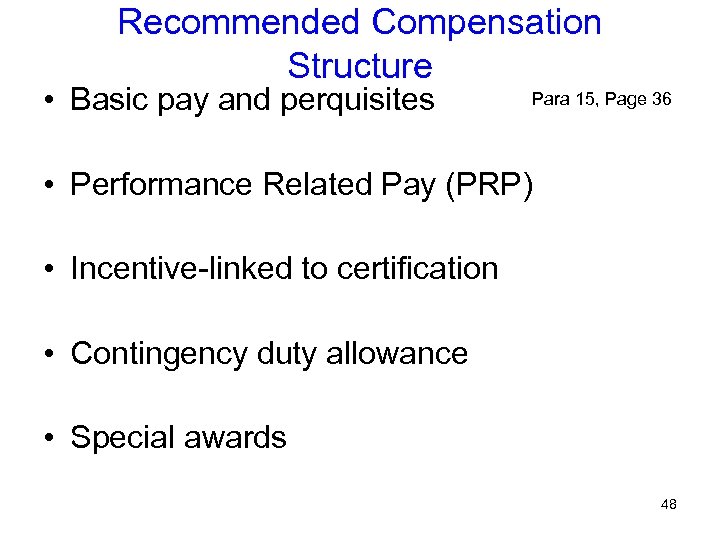 Recommended Compensation Structure • Basic pay and perquisites Para 15, Page 36 • Performance Related Pay (PRP) • Incentive-linked to certification • Contingency duty allowance • Special awards 48
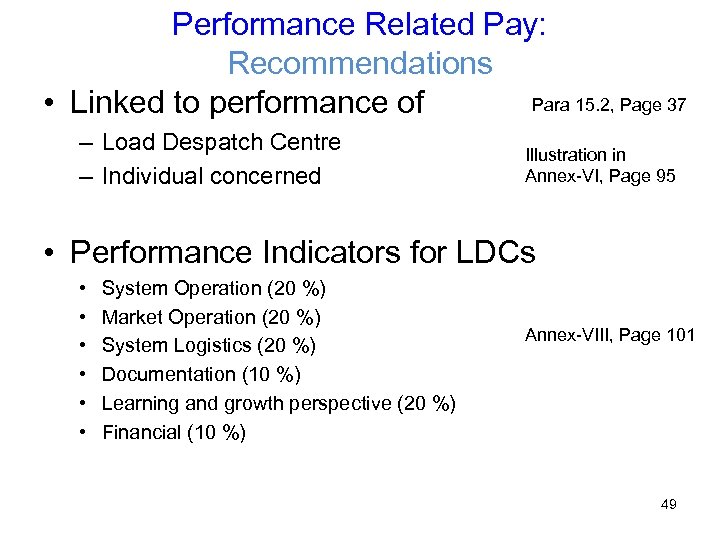 Performance Related Pay: Recommendations Para 15. 2, Page 37 • Linked to performance of – Load Despatch Centre – Individual concerned Illustration in Annex-VI, Page 95 • Performance Indicators for LDCs • • • System Operation (20 %) Market Operation (20 %) System Logistics (20 %) Documentation (10 %) Learning and growth perspective (20 %) Financial (10 %) Annex-VIII, Page 101 49
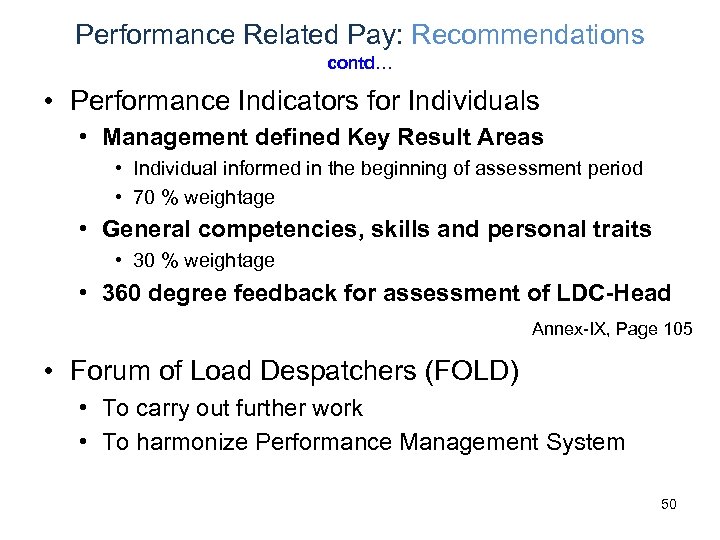 Performance Related Pay: Recommendations contd… • Performance Indicators for Individuals • Management defined Key Result Areas • Individual informed in the beginning of assessment period • 70 % weightage • General competencies, skills and personal traits • 30 % weightage • 360 degree feedback for assessment of LDC-Head Annex-IX, Page 105 • Forum of Load Despatchers (FOLD) • To carry out further work • To harmonize Performance Management System 50
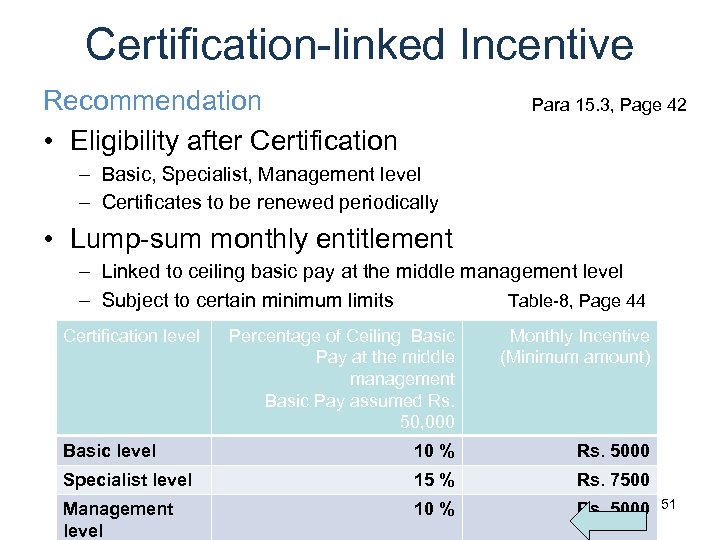 Certification-linked Incentive Recommendation • Eligibility after Certification Para 15. 3, Page 42 – Basic, Specialist, Management level – Certificates to be renewed periodically • Lump-sum monthly entitlement – Linked to ceiling basic pay at the middle management level Table-8, Page 44 – Subject to certain minimum limits Certification level Percentage of Ceiling Basic Pay at the middle management Basic Pay assumed Rs. 50, 000 Monthly Incentive (Minimum amount) Basic level 10 % Rs. 5000 Specialist level 15 % Rs. 7500 Management level 10 % Rs. 5000 51
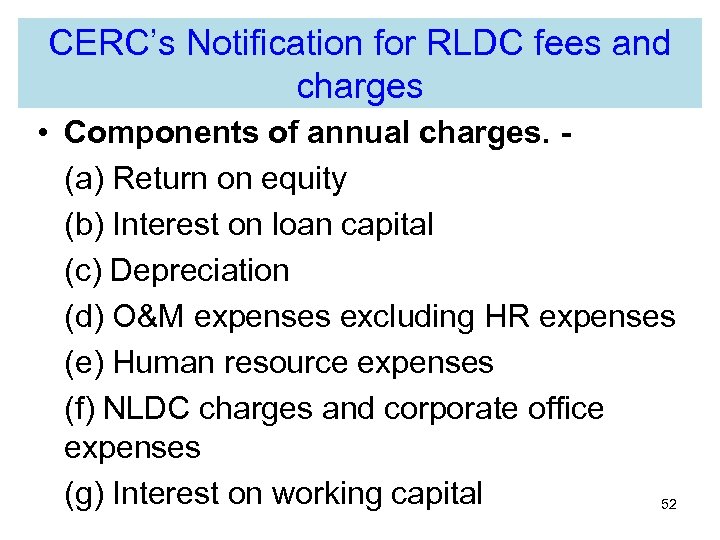 CERC’s Notification for RLDC fees and charges • Components of annual charges. (a) Return on equity (b) Interest on loan capital (c) Depreciation (d) O&M expenses excluding HR expenses (e) Human resource expenses (f) NLDC charges and corporate office expenses (g) Interest on working capital 52
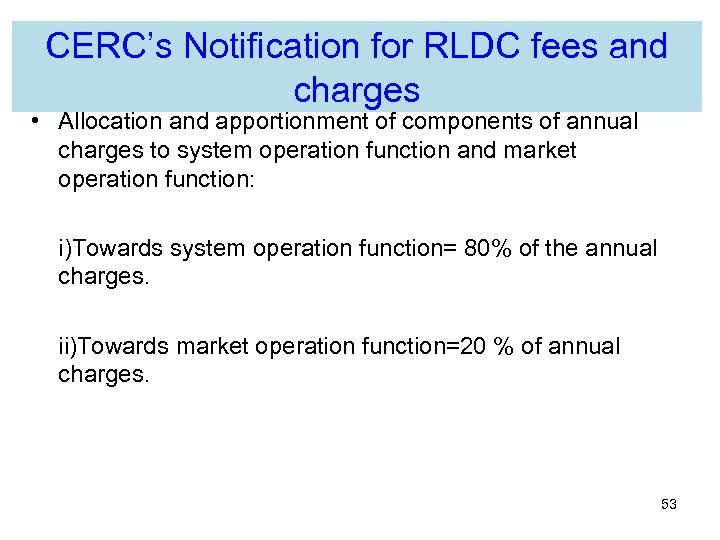 CERC’s Notification for RLDC fees and charges • Allocation and apportionment of components of annual charges to system operation function and market operation function: i)Towards system operation function= 80% of the annual charges. ii)Towards market operation function=20 % of annual charges. 53
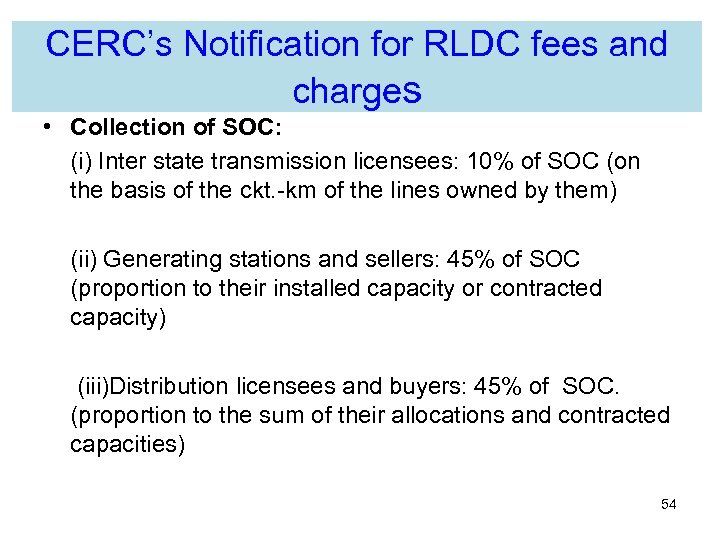 CERC’s Notification for RLDC fees and charges • Collection of SOC: (i) Inter state transmission licensees: 10% of SOC (on the basis of the ckt. -km of the lines owned by them) (ii) Generating stations and sellers: 45% of SOC (proportion to their installed capacity or contracted capacity) (iii)Distribution licensees and buyers: 45% of SOC. (proportion to the sum of their allocations and contracted capacities) 54
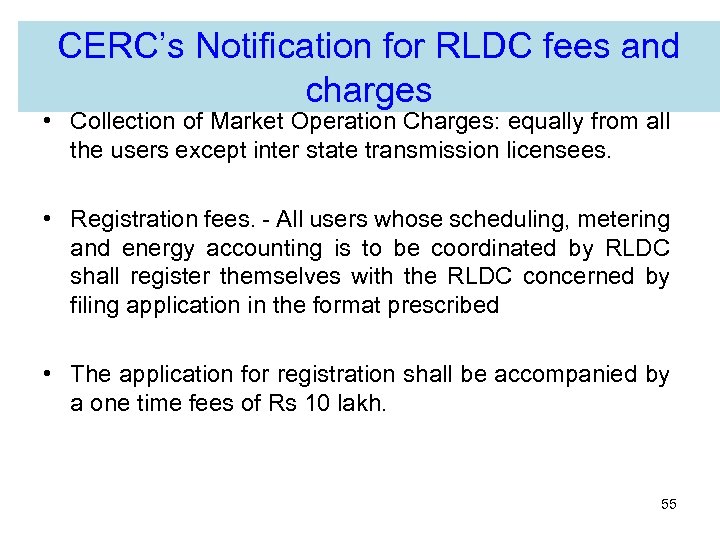 CERC’s Notification for RLDC fees and charges • Collection of Market Operation Charges: equally from all the users except inter state transmission licensees. • Registration fees. - All users whose scheduling, metering and energy accounting is to be coordinated by RLDC shall register themselves with the RLDC concerned by filing application in the format prescribed • The application for registration shall be accompanied by a one time fees of Rs 10 lakh. 55
 CERC’s Notification for RLDC fees and charges • LDC Development Fund. – The Power System Operation Company shall create and maintain a separate fund called ‘LDC Development Fund’. • The charges on account of return on equity, interest on loan, depreciation and other income of the RLDC and NLDC such as registration fee, application fee, shortterm open access charges, etc shall be deposited to the LDC development fund. 56
 CERC’s Notification for RLDC fees and charges • The Power System Operation Company shall be entitled to utilise the money deposited to the LDC development fund for loan repayment, servicing the capital raised in the form of interest and dividend payment, meeting stipulated equity portion in asset creation and margin money for raising loan from the financial institutions and funding R & D projects. 57
 CERC’s Notification for RLDC fees and charges • The LDC development fund shall not be utilized for any other revenue expenditure. • Any asset created by the Power System Operation Company out of the money deposited to the LDC development fund shall not be considered for computation of return on equity and interest on loan. 58
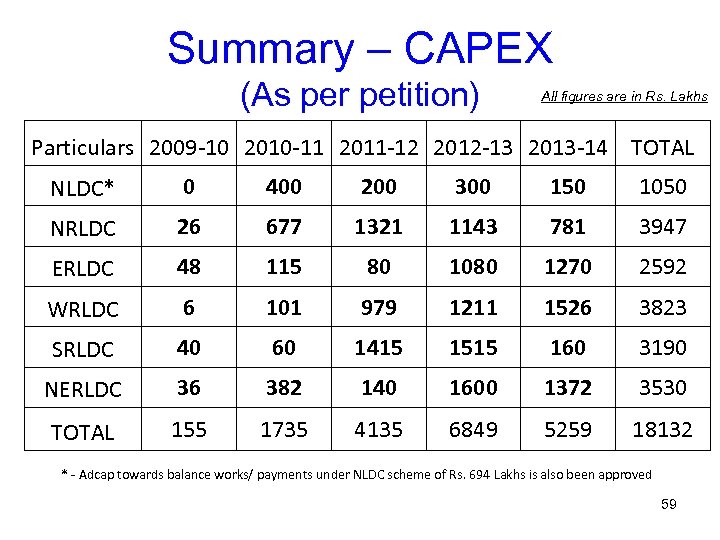 Summary – CAPEX (As per petition) All figures are in Rs. Lakhs Particulars 2009 -10 2010 -11 2011 -12 2012 -13 2013 -14 TOTAL NLDC* 0 400 200 300 150 1050 NRLDC 26 677 1321 1143 781 3947 ERLDC 48 115 80 1080 1270 2592 WRLDC 6 101 979 1211 1526 3823 SRLDC 40 60 1415 1515 160 3190 NERLDC 36 382 140 1600 1372 3530 TOTAL 155 1735 4135 6849 5259 18132 * - Adcap towards balance works/ payments under NLDC scheme of Rs. 694 Lakhs is also been approved 59
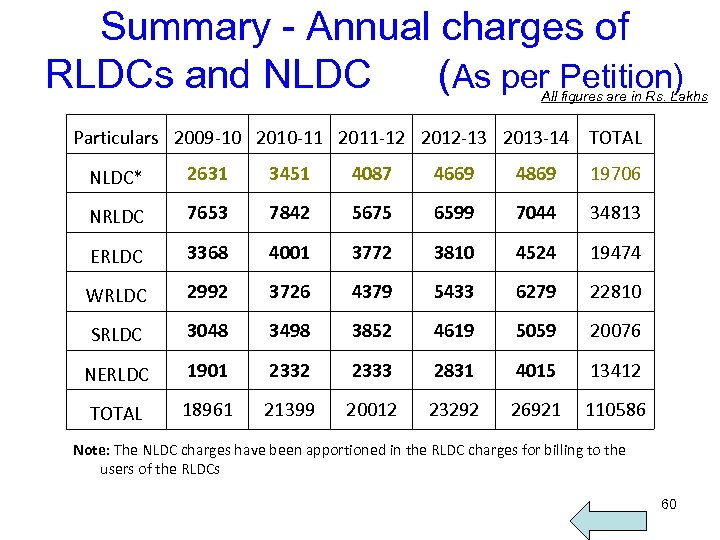 Summary - Annual charges of RLDCs and NLDC (As per Petition) All figures are in Rs. Lakhs Particulars 2009 -10 2010 -11 2011 -12 2012 -13 2013 -14 TOTAL NLDC* 2631 3451 4087 4669 4869 19706 NRLDC 7653 7842 5675 6599 7044 34813 ERLDC 3368 4001 3772 3810 4524 19474 WRLDC 2992 3726 4379 5433 6279 22810 SRLDC 3048 3498 3852 4619 5059 20076 NERLDC 1901 2332 2333 2831 4015 13412 TOTAL 18961 21399 20012 23292 26921 110586 Note: The NLDC charges have been apportioned in the RLDC charges for billing to the users of the RLDCs 60
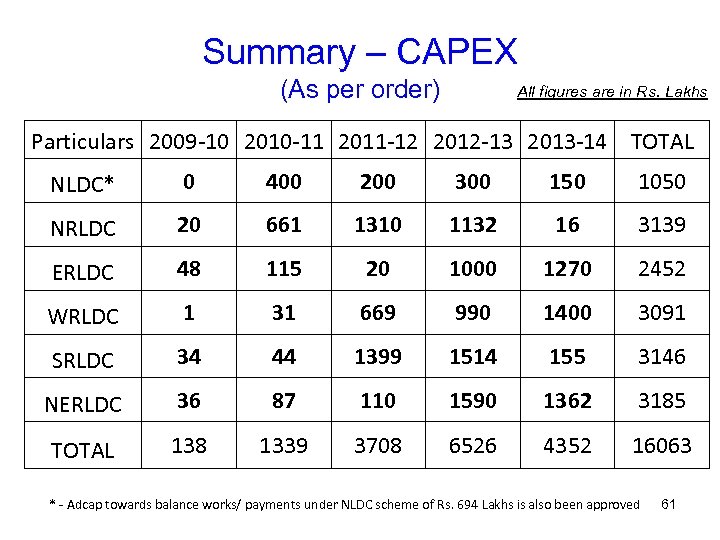 Summary – CAPEX (As per order) All figures are in Rs. Lakhs Particulars 2009 -10 2010 -11 2011 -12 2012 -13 2013 -14 TOTAL NLDC* 0 400 200 300 150 1050 NRLDC 20 661 1310 1132 16 3139 ERLDC 48 115 20 1000 1270 2452 WRLDC 1 31 669 990 1400 3091 SRLDC 34 44 1399 1514 155 3146 NERLDC 36 87 110 1590 1362 3185 TOTAL 138 1339 3708 6526 4352 16063 * - Adcap towards balance works/ payments under NLDC scheme of Rs. 694 Lakhs is also been approved 61
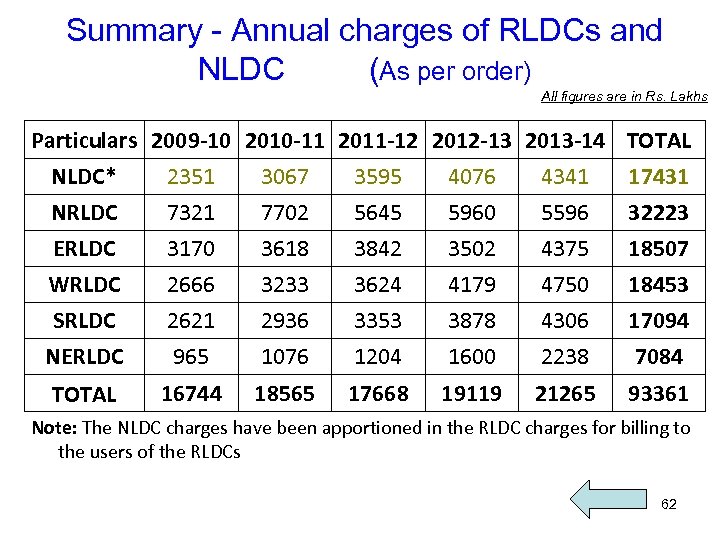 Summary - Annual charges of RLDCs and NLDC (As per order) All figures are in Rs. Lakhs Particulars 2009 -10 2010 -11 2011 -12 2012 -13 2013 -14 TOTAL NLDC* 2351 3067 3595 4076 4341 17431 NRLDC 7321 7702 5645 5960 5596 32223 ERLDC 3170 3618 3842 3502 4375 18507 WRLDC SRLDC NERLDC 2666 2621 965 3233 2936 1076 3624 3353 1204 4179 3878 1600 4750 4306 2238 18453 17094 7084 TOTAL 16744 18565 17668 19119 21265 93361 Note: The NLDC charges have been apportioned in the RLDC charges for billing to the users of the RLDCs 62