 Скачать презентацию Rick Scott Governor Barbara Palmer Director www apdcares
0d49f3b01b13fd199c293844811bea85.ppt
- Количество слайдов: 40




Rick Scott, Governor Barbara Palmer, Director www. apdcares. org

www. apdcares. org

www. apdcares. org
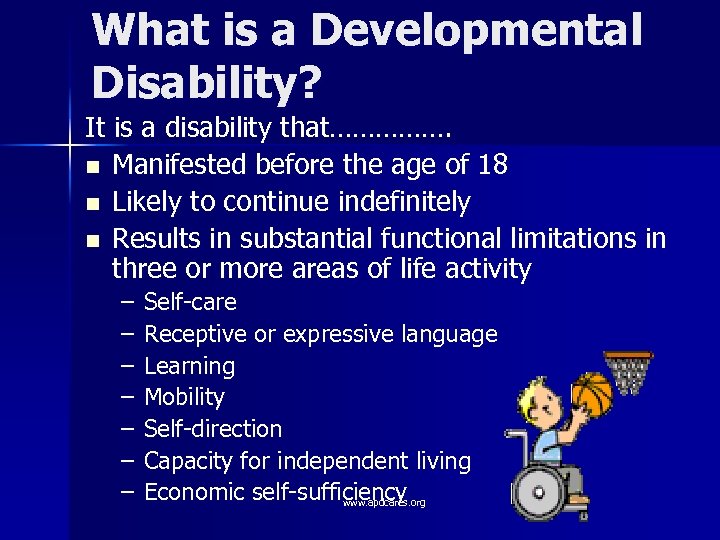
What is a Developmental Disability? It is a disability that……………. n Manifested before the age of 18 n Likely to continue indefinitely n Results in substantial functional limitations in three or more areas of life activity – – – – Self-care Receptive or expressive language Learning Mobility Self-direction Capacity for independent living Economic self-sufficiency www. apdcares. org
What are the Developmental Disabilities Categories ? In Chapter 393. 063 of the Florida Statutes, Developmental Disabilities are defined as follows: n Intellectual Disability n Autism n Cerebral Palsy n Spina Bifida n Prader Willi Syndrome n Down Syndrome n High Risk Children Ages 3 to 5 www. apdcares. org
Continued: What are the Developmental Disabilities Categories ? INTELLECTUAL DISABILITY: Evidenced by the concurrent existence of significantly sub average general intellectual functioning by an IQ two or more standard deviations below the mean on an standardized intelligence test. n www. apdcares. org
Continued: What are the Developmental Disabilities Categories Significant deficits in adaptive functioning in one or more of the following areas: n Communication skills n Self-care, home living n Social and interpersonal skills n Manifested prior to age 18 n www. apdcares. org
Continued: What are the Developmental Disabilities Categories ? n AUTISM- A neurological condition that causes severe learning, communication or behavioral disorder. It is pervasive, meaning always present and without interruption. It is a developmental disability with an age of onset during infancy or childhood. www. apdcares. org
Continued: What are the Developmental Disabilities Categories ? n CEREBRAL PALSY- A group of disabling symptoms of extended duration that can result from damage to the developing brain during the prenatal period and characterized by paralysis, spasticity, or abnormal control of movement or posture such as www. apdcares. org
Continued: What are the Developmental Disabilities Categories? poor coordination or lack of balance, which is manifested prior to three years of age. n It also means the presence of other significant motor dysfunctions appearing prior to age 18 due to perinatal, anoxia, oxygen deprivation or traumatic brain injury. n www. apdcares. org
Continued: What are the Developmental Disabilities Categories ? n SPINA BIFIDA- A condition of the spinal column and cord. Occurs when the cord fails to close. It is one of the most common developmental defects of the nervous system. www. apdcares. org
Continued: What are the Developmental Disabilities Categories ? n PRADER WILLI SYNDROME- A genetic disorder which is most often associated with a random deletion of chromosome 15. Some of the characteristics include insatiable appetite, chronic overeating, hypotonia, short stature, obesity and behaviors. www. apdcares. org
Continued: What are the Developmental Disabilities Categories? n DOWN SYNDROME – A condition caused by the presence of extra chromosomal material on chromosome 21. This disorder is often associated with impairment in cognitive ability, characteristic in physical growth and features, and congenital medical conditions. www. apdcares. org
Continued: What are the Developmental Disabilities Categories? n n n HIGH RISK - Children between the ages of 3 -5 are in this category with one or more of the following characteristics: A developmental delay in cognition, language, or physical development. A child surviving a catastrophic infectious or traumatic illness known to be associated with developmental delay. www. apdcares. org
Continued: What are the Developmental Categories? A child who has a physical or genetic anomaly associated with a developmental disability. n Under this category the child must have a confirmed diagnosis of a developmental disability as defined in Florida Statutes 393. 063 by age five. n www. apdcares. org
Referral/Intake n What is the process to become a client for the Agency for Persons with Disabilities (APD)? A person can be referred to the APD Program by a family member, school or medical personnel as well as community agencies. They can call to make a referral at (305) 810 -1018 or (305) 810 -1019. www. apdcares. org
Referral/Intake (continued) n And/or complete an APD Application online. The website is www. apdcares. org or call 1 -866 -APD CARES www. apdcares. org
Referral/Intake (continued) After the referral has been received by the intake worker, an application package will be mailed out to the individual/family within five days. The package will include a checklist of documents that need to be submitted for eligibility determination. n The individual will need to submit the necessary documents such as: n www. apdcares. org
Referral/ Intake (continued) Psychological/Psychiatric evaluations or any other medical reports n School Records n Copy of Social Security Card n Copy of Birth Certificate n Proof of Florida Residency n Proof of Legal Status n www. apdcares. org
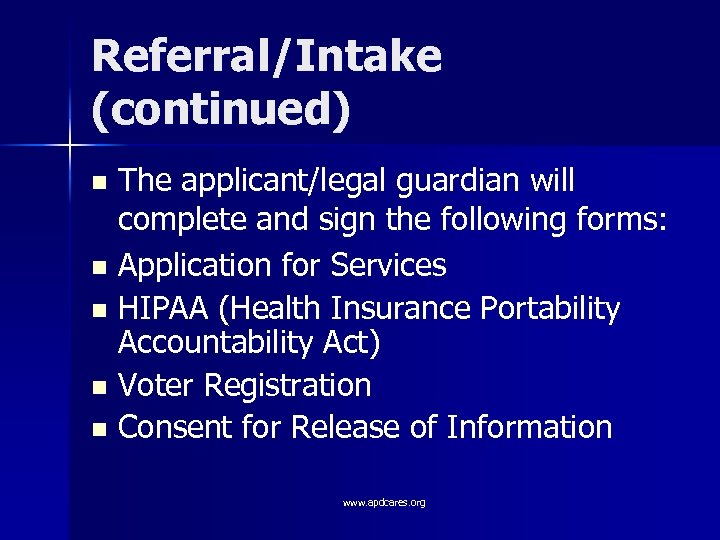
Referral/Intake (continued) The applicant/legal guardian will complete and sign the following forms: n Application for Services n HIPAA (Health Insurance Portability Accountability Act) n Voter Registration n Consent for Release of Information n www. apdcares. org
Referral/Intake (continued) n After all of the documentation and information has been received from the applicant/legal guardian, the case will be presented to the local Diagnostic & Evaluation Screening Committee to determine if the applicant is eligible for APD services. www. apdcares. org
Referral/Intake (continued) n n If additional information is needed, the case will be sent out to a contracted APD provider for a psychological evaluation. This is at no cost to the family. If the applicant is under 6 years old, the final determination for eligibility has to be made within 45 days. If the applicant is over 6 years old, the determination has to be made within 60 days. www. apdcares. org
Eligibility If applicant has been determined ineligible for APD services a due process notice will be sent. n After eligibility has been determined, a Waitlist Form is completed by APD staff with the Medicaid Waiver Waitlist date. n www. apdcares. org
Eligibility (continued) n n n An eligibility letter will be sent to the consumer/family within 10 days of the eligibility determination. At that time the case is assigned to a case manager. The letter will include the eligible diagnosis. The case manager will contact the consumer/family to schedule an appointment to complete the Initial Support Plan. This requires a face-to face contact with the APD consumer. www. apdcares. org
Eligibility (continued) n The QSI (Questionnaire Situational Information Assessment) and a Waitlist Prioritization Checklist must be completed with the consumer/family. www. apdcares. org
Waitlist Categories n The APD wait list categories are listed from the highest priority to the lowest. Category 1 is the highest priority. Category 7 is the lowest priority. Category 1 includes clients deemed to be in crisis as described in rules 65 G-1. 046 and 65 G 1. 047. Crisis includes homelessness, danger to self or others and caregiver unable to give care. • Documentation required for change: Documentation for this category requires the completion of a crisis application by the regional office. www. apdcares. org
Waitlist Categories Category 2 includes children who are from the child welfare system with an open case in the Department of Children and Family Services' statewide automated child welfare information system. – Documentation required for change: Only documentation from DCF that confirms the child is in the child welfare system will be accepted. www. apdcares. org
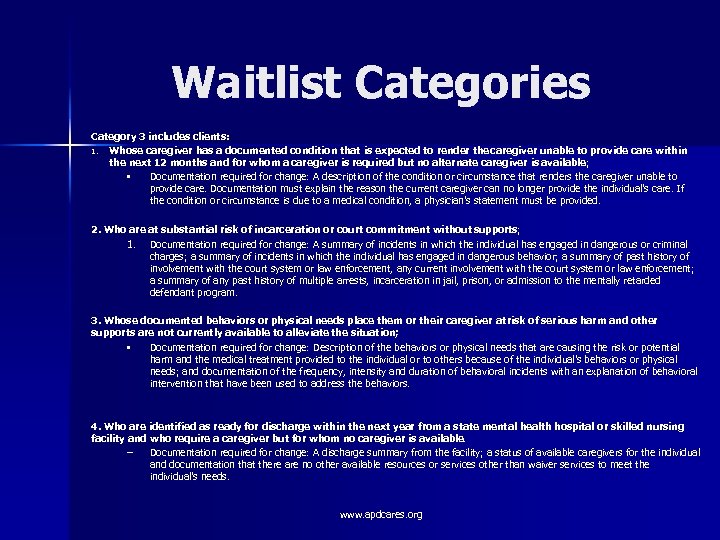
Waitlist Categories Category 3 includes clients: 1. Whose caregiver has a documented condition that is expected to render the caregiver unable to provide care within the next 12 months and for whom a caregiver is required but no alternate caregiver is available; • Documentation required for change: A description of the condition or circumstance that renders the caregiver unable to provide care. Documentation must explain the reason the current caregiver can no longer provide the individual’s care. If the condition or circumstance is due to a medical condition, a physician’s statement must be provided. 2. Who are at substantial risk of incarceration or court commitment without supports; 1. Documentation required for change: A summary of incidents in which the individual has engaged in dangerous or criminal charges; a summary of incidents in which the individual has engaged in dangerous behavior; a summary of past history of involvement with the court system or law enforcement, any current involvement with the court system or law enforcement; a summary of any past history of multiple arrests, incarceration in jail, prison, or admission to the mentally retarded defendant program. 3. Whose documented behaviors or physical needs place them or their caregiver at risk of serious harm and other supports are not currently available to alleviate the situation; • Documentation required for change: Description of the behaviors or physical needs that are causing the risk or potential harm and the medical treatment provided to the individual or to others because of the individual’s behaviors or physical needs; and documentation of the frequency, intensity and duration of behavioral incidents with an explanation of behavioral intervention that have been used to address the behaviors. 4. Who are identified as ready for discharge within the next year from a state mental health hospital or skilled nursing facility and who require a caregiver but for whom no caregiver is available. – Documentation required for change: A discharge summary from the facility; a status of available caregivers for the individual and documentation that there are no other available resources or services other than waiver services to meet the individual’s needs. www. apdcares. org
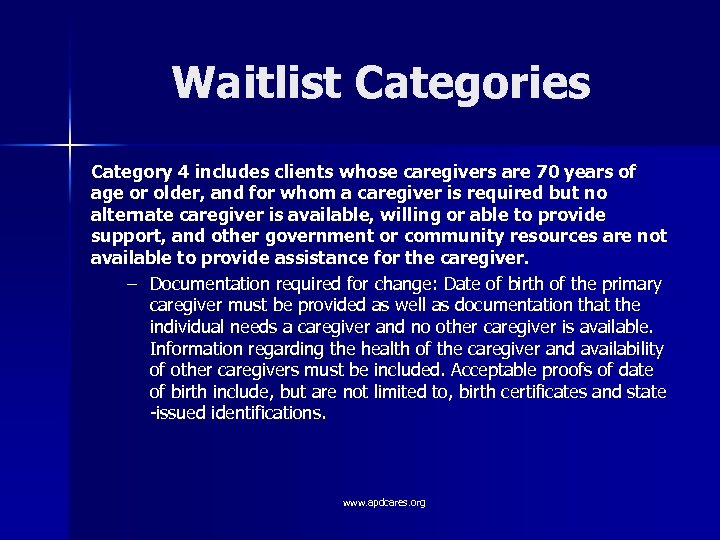
Waitlist Categories Category 4 includes clients whose caregivers are 70 years of age or older, and for whom a caregiver is required but no alternate caregiver is available, willing or able to provide support, and other government or community resources are not available to provide assistance for the caregiver. – Documentation required for change: Date of birth of the primary caregiver must be provided as well as documentation that the individual needs a caregiver and no other caregiver is available. Information regarding the health of the caregiver and availability of other caregivers must be included. Acceptable proofs of date of birth include, but are not limited to, birth certificates and state -issued identifications. www. apdcares. org
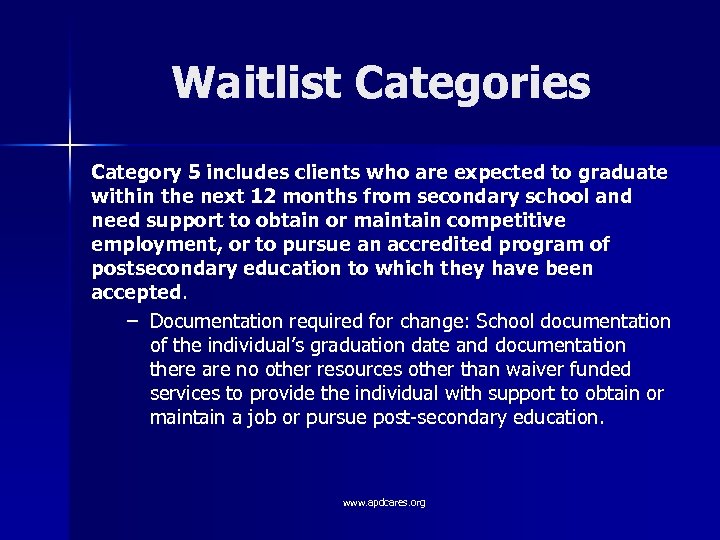
Waitlist Categories Category 5 includes clients who are expected to graduate within the next 12 months from secondary school and need support to obtain or maintain competitive employment, or to pursue an accredited program of postsecondary education to which they have been accepted. – Documentation required for change: School documentation of the individual’s graduation date and documentation there are no other resources other than waiver funded services to provide the individual with support to obtain or maintain a job or pursue post-secondary education. www. apdcares. org
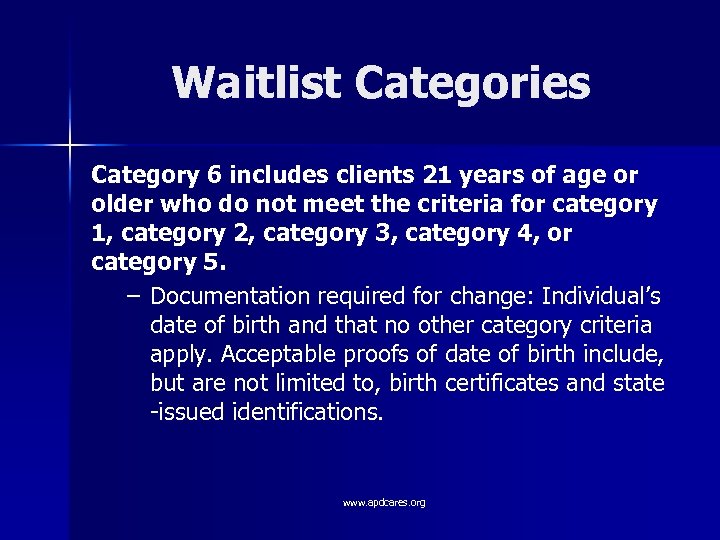
Waitlist Categories Category 6 includes clients 21 years of age or older who do not meet the criteria for category 1, category 2, category 3, category 4, or category 5. – Documentation required for change: Individual’s date of birth and that no other category criteria apply. Acceptable proofs of date of birth include, but are not limited to, birth certificates and state -issued identifications. www. apdcares. org
Waitlist Categories Category 7 includes clients younger than 21 years of age who do not meet the criteria for category 1, category 2, category 3, or category 4. – Documentation required for change: Individual’s date of birth and that no other category criteria apply. Acceptable proofs of date of birth include, but are not limited to, birth certificates and state -issued identifications. www. apdcares. org
Transition from Waitlist to APD Waiver Crisis Enrollment n Waitlist Priority Enrollment n Community Based Care n Intermediate Care Facility n www. apdcares. org
Home & Community Based Waiver n The Agency for Persons with Disabilities Home and Community Based Waiver provides necessary supports and services to people who have a developmental disability so that they may remain in the community and avoid placement in an institution. The HCBS Waiver program is funded by federal and matching state dollars. www. apdcares. org
Home and Community Based Waiver (continued) APD annually serves more than 50, 000 Floridians with developmental disabilities of Autism, Cerebral Palsy, Intellectual Disabilities, Down Syndrome, Spina Bifida and Prader-Willi Syndrome. www. apdcares. org
Home and Community Based Waiver (continued) The Medicaid Waiver Program helps to Support: n n 30, 000 Floridians with developmental disabilities so they may live and participate in their local community. These 30, 000 individuals have been transitioned to i. Budget Florida. i. Budget gives individuals and their families more control over day to day expenditures for necessary services. www. apdcares. org
Support Employment Program (EEP) n Employment Enhancement Project (EEP) – When aging out of school n College/university n Vocation Rehabilitation (VR) n Stays in public school until age 22. www. apdcares. org
Support Employment Program (EEP) (continued) n APD has funding once the student leaves the schools system with support employment services. n Purpose of the supported employment is to: n n n connect and build relationships Mentorship Resume builder www. apdcares. org
APD Field Units Supervisor - Rebeca Garcia-Sotelo (305) 377 -7101 Wait List/General Revenue Supervisor - Niurka Romero (305) 377 -5593 www. apdcares. org

Thank you www. apdcares. org
Скачать презентацию Rick Scott Governor Barbara Palmer Director www apdcares
0d49f3b01b13fd199c293844811bea85.ppt