


 Скачать презентацию Richard Woods Georgia s School Superintendent Educating Georgia s Future
e006453675dd72ad55b6300075f3ae77.ppt
- Количество слайдов: 72
 Richard Woods, Georgia’s School Superintendent “Educating Georgia’s Future” gadoe. org Disproportionality in Special Education: Current Data and Recommendations Georgia Association for Positive Behavior Support Conference Atlanta, Georgia Dr. Jasolyn Henderson and Dr. Paula Freer, Presenters
 What is Disproportionality in Special Education? Richard Woods, Georgia’s School Superintendent “Educating Georgia’s Future” gadoe. org Disproportionality refers to the “overrepresentation” and “underrepresentation” of a particular demographic group in special education programs relative to the presence of this group in the overall student population.
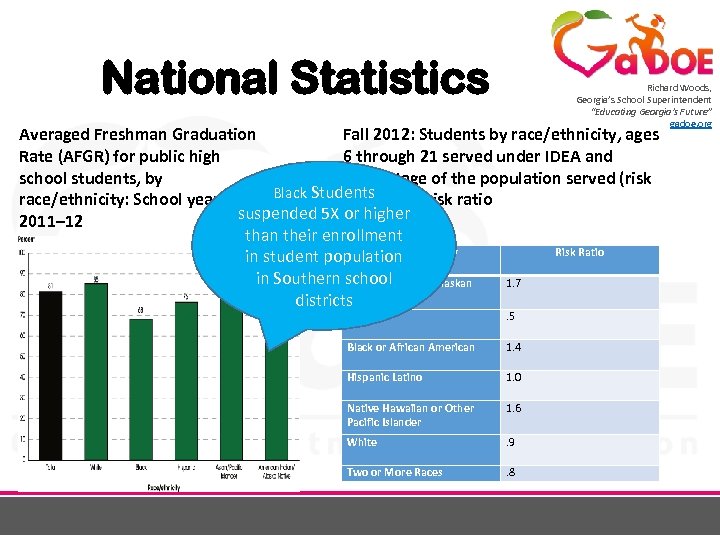 National Statistics Richard Woods, Georgia’s School Superintendent “Educating Georgia’s Future” gadoe. org Averaged Freshman Graduation Fall 2012: Students by race/ethnicity, ages Rate (AFGR) for public high 6 through 21 served under IDEA and school students, by percentage of the population served (risk Black Students and risk ratio race/ethnicity: School year index) suspended 5 X or higher 2011– 12 than their enrollment Race/ethnicity Risk Ratio in student population in Southern school Indian/Alaskan American 1. 7 Native districts Asian . 5 Black or African American 1. 4 Hispanic Latino 1. 0 Native Hawaiian or Other Pacific Islander 1. 6 White . 9 Two or More Races . 8
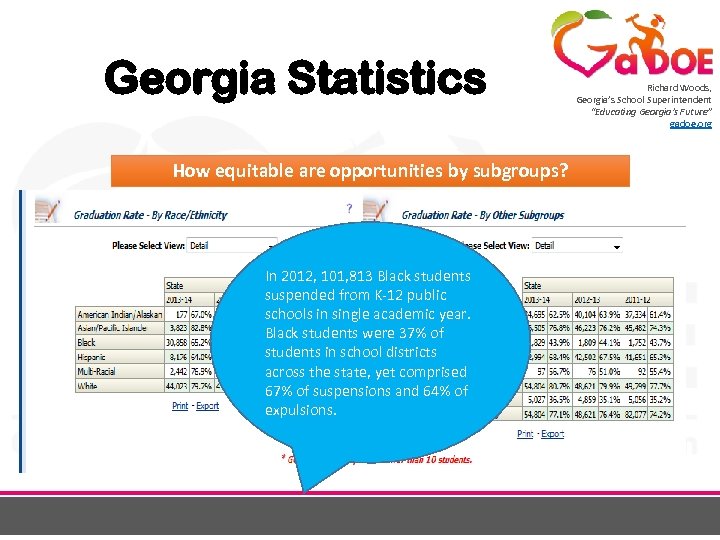 Georgia Statistics How equitable are opportunities by subgroups? In 2012, 101, 813 Black students suspended from K-12 public schools in single academic year. Black students were 37% of students in school districts across the state, yet comprised 67% of suspensions and 64% of expulsions. Richard Woods, Georgia’s School Superintendent “Educating Georgia’s Future” gadoe. org
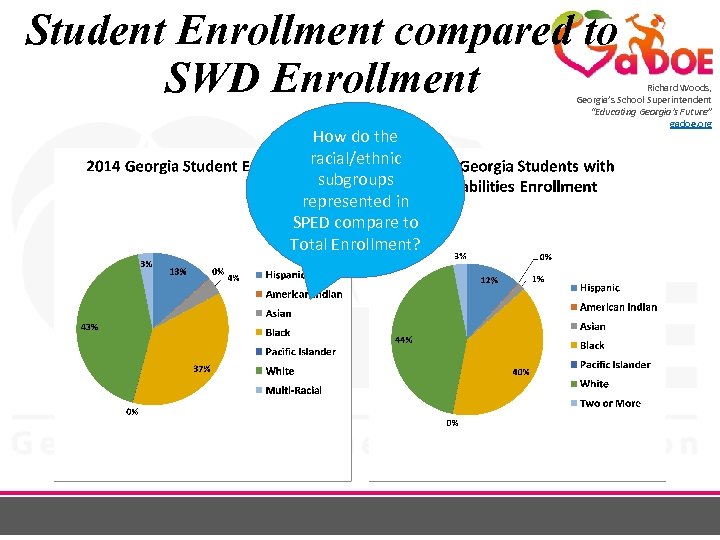 Student Enrollment compared to SWD Enrollment How do the racial/ethnic subgroups represented in SPED compare to Total Enrollment? Richard Woods, Georgia’s School Superintendent “Educating Georgia’s Future” gadoe. org
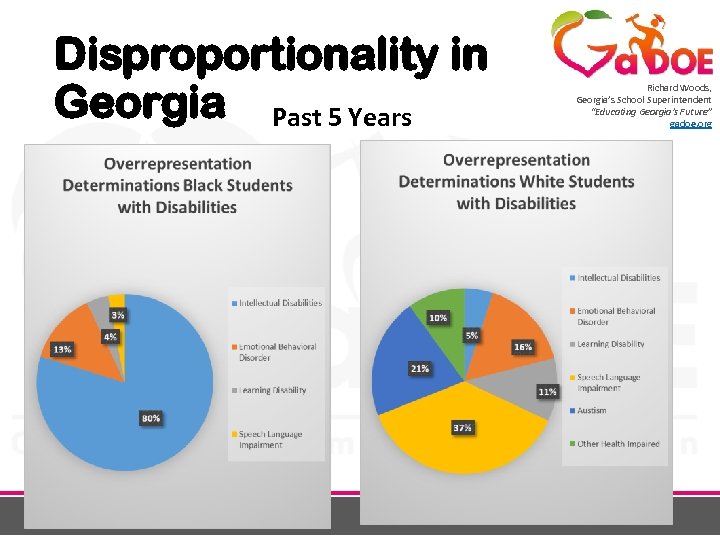 Disproportionality in Georgia Past 5 Years Richard Woods, Georgia’s School Superintendent “Educating Georgia’s Future” gadoe. org
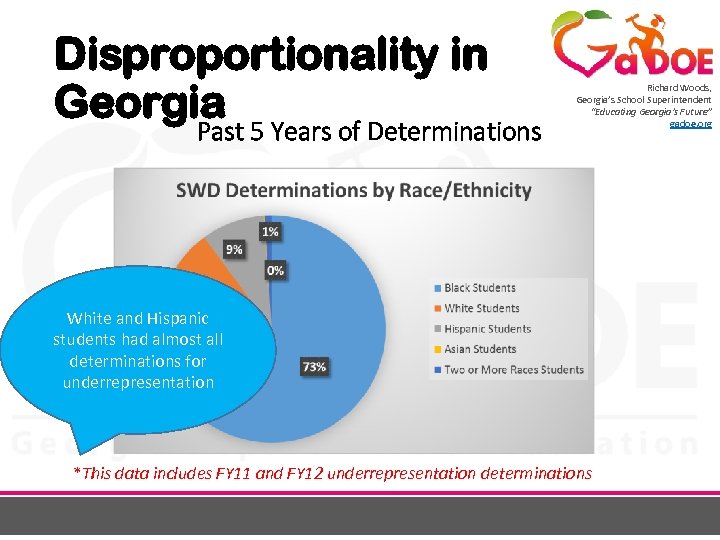 Disproportionality in Georgia Past 5 Years of Determinations Richard Woods, Georgia’s School Superintendent “Educating Georgia’s Future” gadoe. org White and Hispanic students had almost all determinations for underrepresentation *This data includes FY 11 and FY 12 underrepresentation determinations
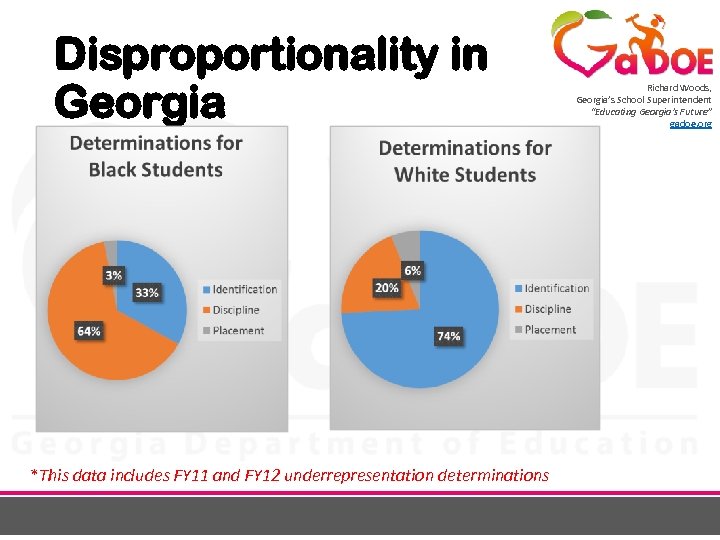 Disproportionality in Georgia *This data includes FY 11 and FY 12 underrepresentation determinations Richard Woods, Georgia’s School Superintendent “Educating Georgia’s Future” gadoe. org
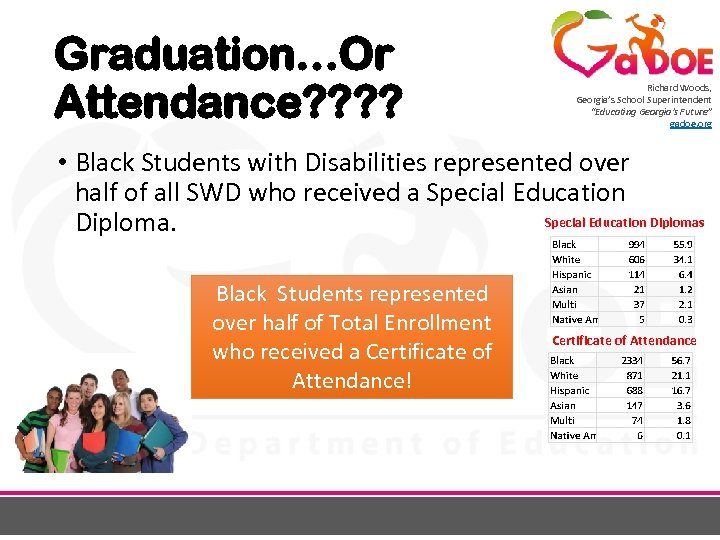 Graduation…Or Attendance? ? Richard Woods, Georgia’s School Superintendent “Educating Georgia’s Future” gadoe. org • Black Students with Disabilities represented over half of all SWD who received a Special Education Diplomas Diploma. Black Students represented over half of Total Enrollment who received a Certificate of Attendance! Certificate of Attendance
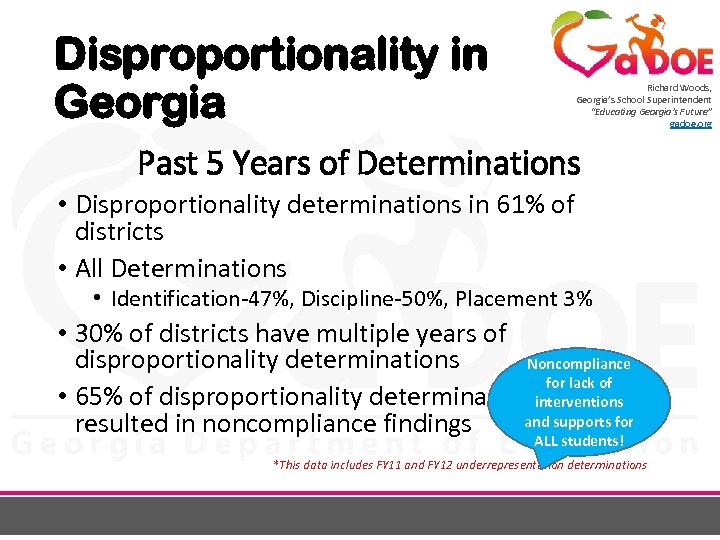 Disproportionality in Georgia Richard Woods, Georgia’s School Superintendent “Educating Georgia’s Future” gadoe. org Past 5 Years of Determinations • Disproportionality determinations in 61% of districts • All Determinations • Identification-47%, Discipline-50%, Placement 3% • 30% of districts have multiple years of disproportionality determinations Noncompliance for lack of • 65% of disproportionality determinations have interventions resulted in noncompliance findings and supports for ALL students! *This data includes FY 11 and FY 12 underrepresentation determinations
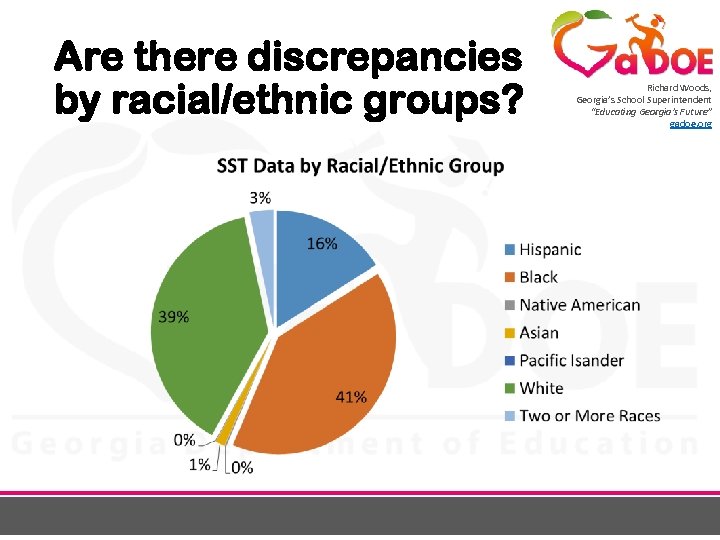 Are there discrepancies by racial/ethnic groups? Richard Woods, Georgia’s School Superintendent “Educating Georgia’s Future” gadoe. org
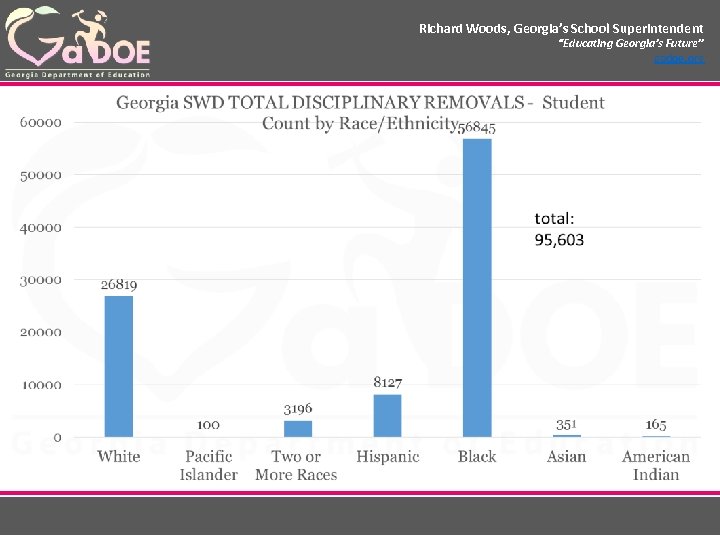 Richard Woods, Georgia’s School Superintendent “Educating Georgia’s Future” gadoe. org
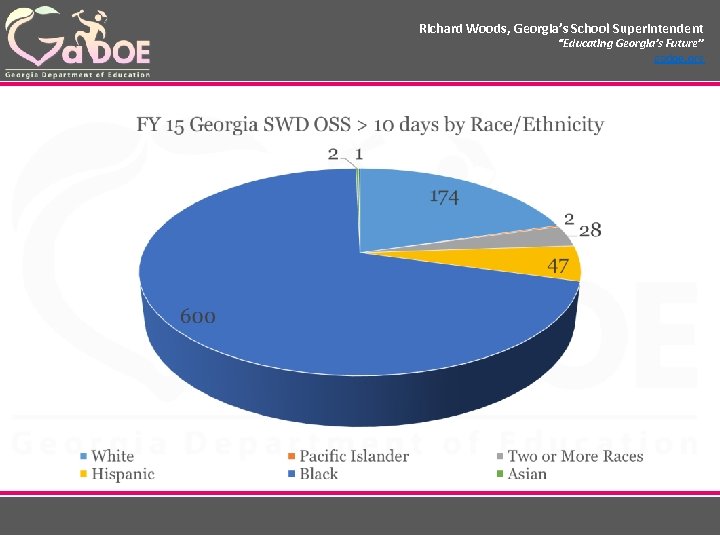 Richard Woods, Georgia’s School Superintendent “Educating Georgia’s Future” gadoe. org
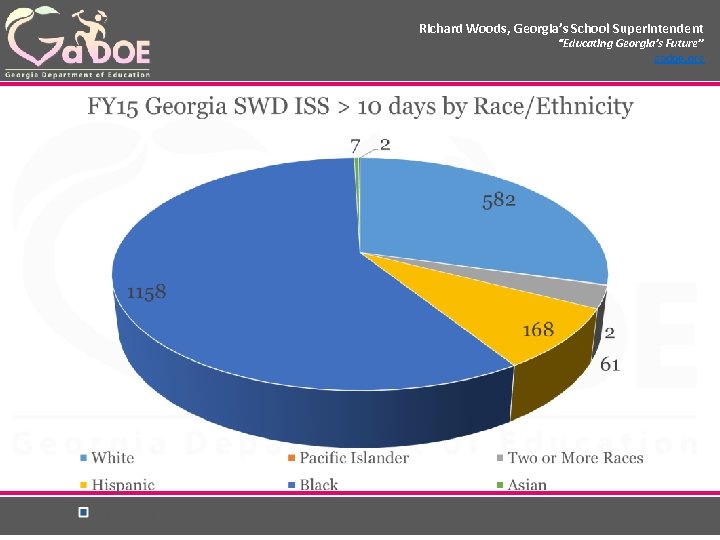 Richard Woods, Georgia’s School Superintendent “Educating Georgia’s Future” gadoe. org
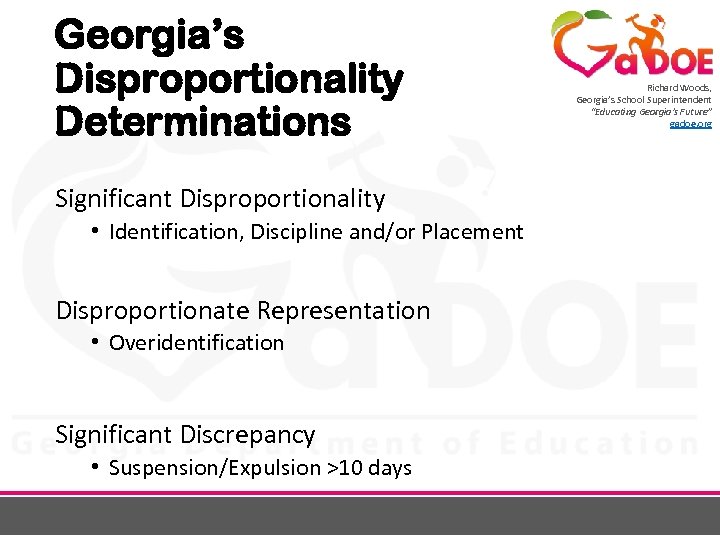 Georgia’s Disproportionality Determinations Significant Disproportionality • Identification, Discipline and/or Placement Disproportionate Representation • Overidentification Significant Discrepancy • Suspension/Expulsion >10 days Richard Woods, Georgia’s School Superintendent “Educating Georgia’s Future” gadoe. org
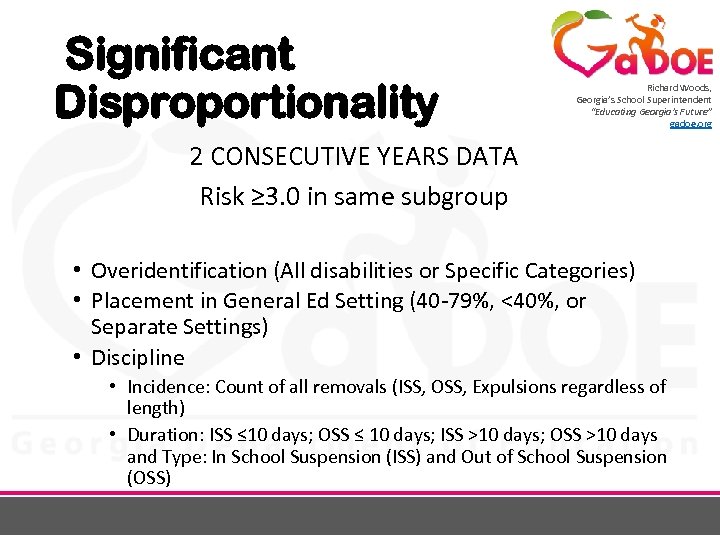 Significant Disproportionality Richard Woods, Georgia’s School Superintendent “Educating Georgia’s Future” gadoe. org 2 CONSECUTIVE YEARS DATA Risk ≥ 3. 0 in same subgroup • Overidentification (All disabilities or Specific Categories) • Placement in General Ed Setting (40 -79%, <40%, or Separate Settings) • Discipline • Incidence: Count of all removals (ISS, OSS, Expulsions regardless of length) • Duration: ISS ≤ 10 days; OSS ≤ 10 days; ISS >10 days; OSS >10 days and Type: In School Suspension (ISS) and Out of School Suspension (OSS)
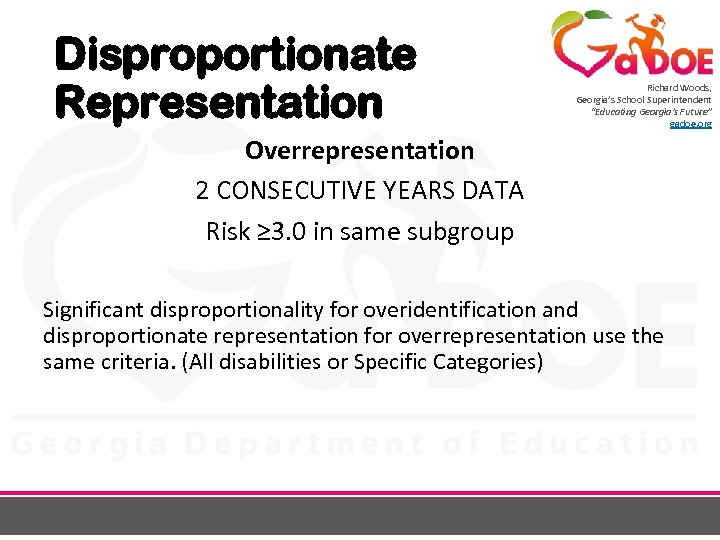 Disproportionate Representation Richard Woods, Georgia’s School Superintendent “Educating Georgia’s Future” gadoe. org Overrepresentation 2 CONSECUTIVE YEARS DATA Risk ≥ 3. 0 in same subgroup Significant disproportionality for overidentification and disproportionate representation for overrepresentation use the same criteria. (All disabilities or Specific Categories)
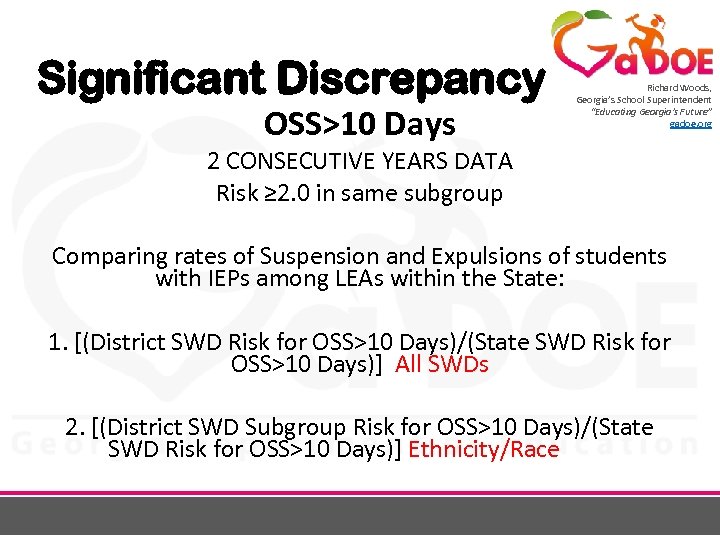 Significant Discrepancy OSS>10 Days Richard Woods, Georgia’s School Superintendent “Educating Georgia’s Future” gadoe. org 2 CONSECUTIVE YEARS DATA Risk ≥ 2. 0 in same subgroup Comparing rates of Suspension and Expulsions of students with IEPs among LEAs within the State: 1. [(District SWD Risk for OSS>10 Days)/(State SWD Risk for OSS>10 Days)] All SWDs 2. [(District SWD Subgroup Risk for OSS>10 Days)/(State SWD Risk for OSS>10 Days)] Ethnicity/Race
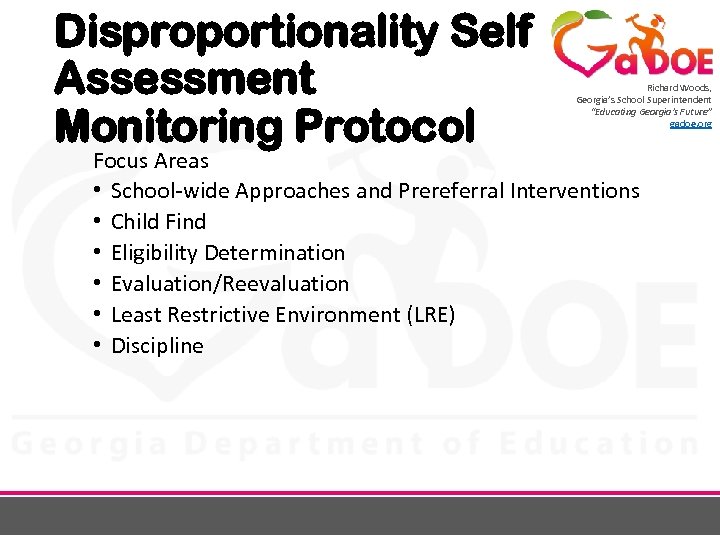 Disproportionality Self Assessment Monitoring Protocol Richard Woods, Georgia’s School Superintendent “Educating Georgia’s Future” gadoe. org Focus Areas • School-wide Approaches and Prereferral Interventions • Child Find • Eligibility Determination • Evaluation/Reevaluation • Least Restrictive Environment (LRE) • Discipline
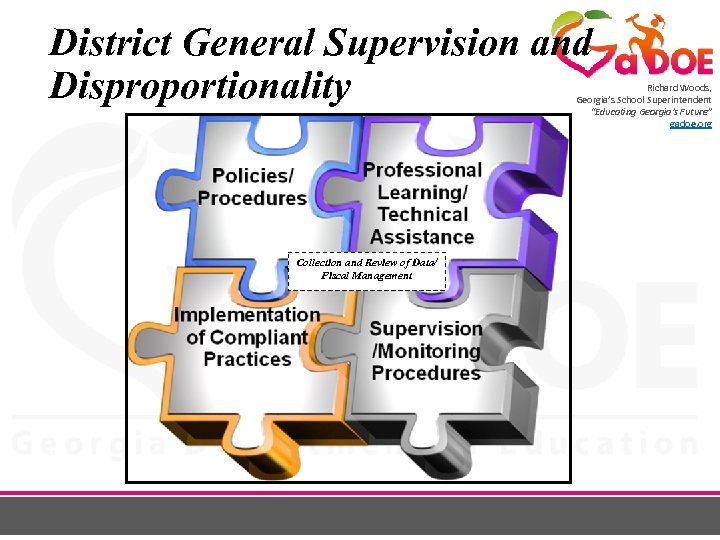 District General Supervision and Disproportionality Richard Woods, Georgia’s School Superintendent “Educating Georgia’s Future” gadoe. org Collection and Review of Data/ Fiscal Management
 Examination of Practices Richard Woods, Georgia’s School Superintendent “Educating Georgia’s Future” gadoe. org SST and Child Find Rule • Child Find Activities • SST meeting participants • Parent/guardian invitation • Steps of SST are clear in documentation • Documentation of scientific, research, or evidence based interventions • Progress monitoring data
 Contributing Factors to Disproportionality in Special Education Richard Woods, Georgia’s School Superintendent “Educating Georgia’s Future” gadoe. org SST/Child Find • Failure to provide research or evidence-based academic and behavioral supports and interventions • Lack of SST documentation which is REQUIRED and necessary to assess effectiveness and fidelity of implementation • Staff not being knowledgeable/proficient at implementation of targeted, evidence-based interventions • Inconsistent implementation of SST process
 Examination of Practices Richard Woods, Georgia’s School Superintendent “Educating Georgia’s Future” gadoe. org IDEA Discipline • Parents’ Rights • Timely Manifestation Determination Meetings • Continuation of Services after removals exceeding 10 days • Parent Notification of change in placement • Reviewing or conducting/implementing FBAs/BIPs
 Contributing Factors to Disproportionality in Special Education Richard Woods, Georgia’s School Superintendent “Educating Georgia’s Future” gadoe. org Individuals with Disabilities Education Act (IDEA) Discipline • Lack of monitoring days of removals • Lack of implementation of FBA/BIPs • Lack of access to/implementation of positive behavioral supports and interventions • Zero tolerance philosophy • Ineffective code of conduct
 Supervision and Monitoring Tips for SST and IDEA • District Richard Woods, Georgia’s School Superintendent “Educating Georgia’s Future” gadoe. org q. Ensure compliant policies and procedures are in place q. Provide professional learning on the policies and procedures to all relevant personnel q Keep an accurate log to document Child Find activities, SST, Initial eligibility and reevaluation q Assign a specific person or persons to work on Child Find activities, SST, initial eligibility, and reevaluation log at the district level and at the school level q Review monitoring data monthly q. Randomly select 3 -5 SST, initial eligibility, reevaluation folders from each school to review and ensure compliance q. If non-compliance is found provide technical assistance and require corrective action
 Supervision and Monitoring Tips for SST and IDEA Richard Woods, Georgia’s School Superintendent “Educating Georgia’s Future” gadoe. org School-level q. Participate in professional learning on the policies and procedures q. Review district’s compliant policies and procedures and ensure implementation q Keep an accurate log to document Child Find activities, SST, Initial eligibility and reevaluation at the building level q. Meet with the district personnel as needed to review log q. If non-compliant procedures had been followed during the meetings, take corrective action. This may include reconvening the meeting and participating in additional professional learning q. Building administrator: assign a specific person or persons to log information on Child Find activities, SST, initial eligibility, and reevaluation
 Recommendations for Solutions • PBIS • MTSS • Effective, High Quality Instruction • Broadening SEA and LEA disproportionality monitoring requirements • Public reporting of disproportionality data • Increase focus on cultural issues • Quality early childhood opportunities Richard Woods, Georgia’s School Superintendent “Educating Georgia’s Future” gadoe. org
 Ga. DOE Initiatives • Equity Summit • PBIS • MTSS Steering Committee • Monitoring • State Systemic Improvement Plan (SSIP) Richard Woods, Georgia’s School Superintendent “Educating Georgia’s Future” gadoe. org
 Resources Richard Woods, Georgia’s School Superintendent “Educating Georgia’s Future” gadoe. org Georgia’s Disproportionality Self Assessment Monitoring Protocol http: //www. gadoe. org/Curriculum-Instruction-and. Assessment/Special-Education. Services/Pages/Disproportionality-Self. Assessment. aspx RTI Essential Components Integrity Rubric http: //www. rti 4 success. org/sites/default/files/RTI_F ramework_Integrity_Rubric. pdf
 Resources Richard Woods, Georgia’s School Superintendent “Educating Georgia’s Future” gadoe. org MTSS Implementation Components http: //www. floridarti. org/educator. Resources/MTSS_Book_Impl. Comp_0126 12. pdf Intervention Fidelity Checklists http: //www. iup. edu/page. aspx? id=134567 National Center on Intensive Intervention- Monitoring Fidelity http: //www. intensiveintervention. org/implementationplanning-and-evaluation/monitoring-fidelity
 Resources Richard Woods, Georgia’s School Superintendent “Educating Georgia’s Future” gadoe. org Addressing the Root Causes of Disparities in School Discipline: An Educator’s Action Planning Guide http: //safesupportivelearning. ed. gov/sites/default/fi les/151547%20 NCSSLE%20 Root%20 Causes%20 Guide%20 FI NAL 02%20 mb. pdf School Climate and Discipline http: //www 2. ed. gov/policy/gen/guid/schooldiscipline/index. html
 References Richard Woods, Georgia’s School Superintendent “Educating Georgia’s Future” gadoe. org NEA. (2007). Truth in labeling: Disproportionality in Special Education. http: //www. nea. org/assets/docs/HE/EWTruth. In. Labeling. pdf Council for Children with Behavioral Disorders. (2012). CCBD’s Position Summary on Federal Policy on Disproportionality in Special Education. http: //www. indiana. edu/~equity/docs/CCBD_Policy_ Disproportionality. pdf
 References Richard Woods, Georgia’s School Superintendent “Educating Georgia’s Future” gadoe. org Mc. Intosh et al. (2014). Recommendations for addressing discipline disproportionality in education. PBIS Technical Assistance Center. https: //www. pbis. org/Common/Cms/files/pbisresou rces/Recommendations. For. Addressing. Discipline. Dispr oportionality. pdf Skiba et al. (2008). Achieving equity in special education: History, status, and current challenges. Council for Exceptional Children, 74, 3, 264 -288.
 References Richard Woods, Georgia’s School Superintendent “Educating Georgia’s Future” gadoe. org Carter et al. (March 2014). Discipline disparities: A research-to-practice collaborative. http: //www. indiana. edu/~atlantic/wpcontent/uploads/2015/01/Disparity_Overview_0109 15. pdf
 Building a Pyramid of Successful Behavior Supports Tier 1 is CRITICAL D Richard Woods, a Georgia’s School Superintendent t “Educating Georgia’s Future” gadoe. org a Building upon a weak Tier 1 framework results in: §Continued behavioral problems which have little impact on achievement and drop-out/graduation rates §Limited to…. at best, short-term gains with intervention outcomes Tiers 2, 3, 4
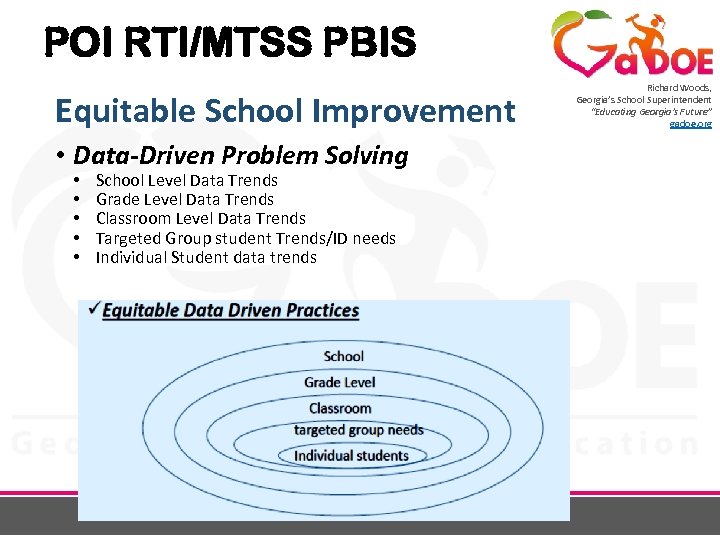 POI RTI/MTSS PBIS Equitable School Improvement • Data-Driven Problem Solving • • • School Level Data Trends Grade Level Data Trends Classroom Level Data Trends Targeted Group student Trends/ID needs Individual Student data trends Richard Woods, Georgia’s School Superintendent “Educating Georgia’s Future” gadoe. org
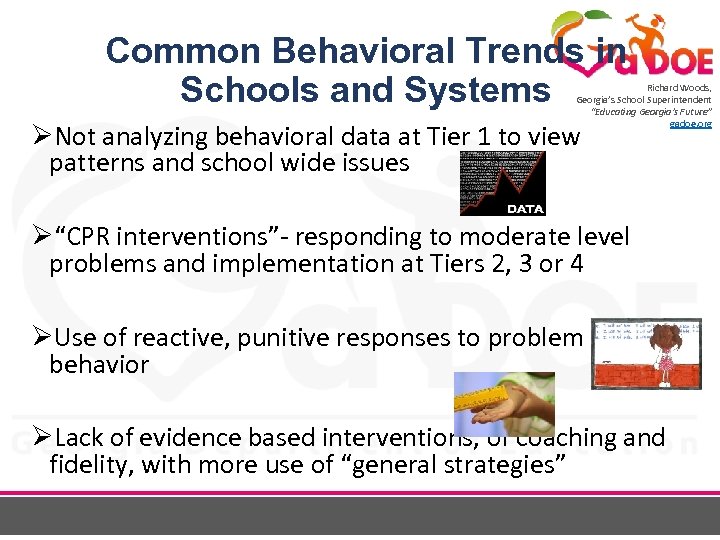 Common Behavioral Trends in Schools and Systems Richard Woods, Georgia’s School Superintendent “Educating Georgia’s Future” gadoe. org ØNot analyzing behavioral data at Tier 1 to view patterns and school wide issues Ø“CPR interventions”- responding to moderate level problems and implementation at Tiers 2, 3 or 4 ØUse of reactive, punitive responses to problem behavior ØLack of evidence based interventions, of coaching and fidelity, with more use of “general strategies”
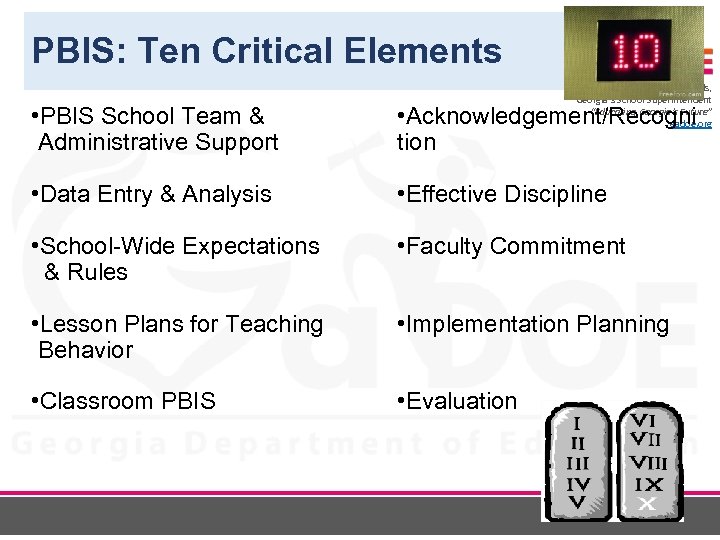 PBIS: Ten Critical Elements • PBIS School Team & Administrative Support • Data Entry & Analysis Richard Woods, Georgia’s School Superintendent “Educating Georgia’s Future” gadoe. org • Acknowledgement/Recogni tion • Effective Discipline • School-Wide Expectations & Rules • Faculty Commitment • Lesson Plans for Teaching Behavior • Implementation Planning • Classroom PBIS • Evaluation
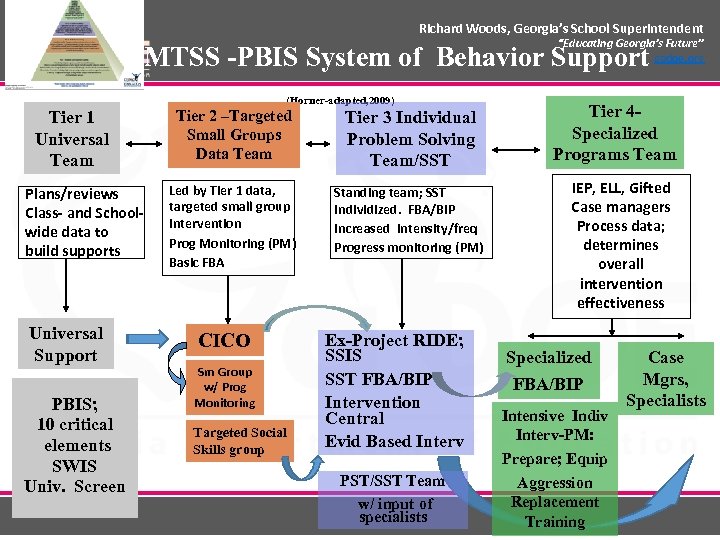 Richard Woods, Georgia’s School Superintendent “Educating Georgia’s Future” gadoe. org MTSS -PBIS System of Behavior Support (Horner-adapted, 2009) Tier 1 Universal Team Plans/reviews Class- and Schoolwide data to build supports Universal Support PBIS; 10 critical elements SWIS Univ. Screen Tier 2 –Targeted Small Groups Data Team Tier 3 Individual Problem Solving Team/SST Led by Tier 1 data, targeted small group intervention Prog Monitoring (PM) Basic FBA Standing team; SST Individized. FBA/BIP Increased intensity/freq Progress monitoring (PM) CICO Sm Group w/ Prog Monitoring Targeted Social Skills group Ex-Project RIDE; SSIS SST FBA/BIP Intervention Central Evid Based Interv PST/SST Team w/ input of specialists Richard Woods, Georgia’s School Superintendent “Educating Georgia’s Future” gadoe. org Tier 4 Specialized Programs Team IEP, ELL, Gifted Case managers Process data; determines overall intervention effectiveness Specialized FBA/BIP Intensive Indiv Interv-PM: Prepare; Equip Aggression Replacement Training Case Mgrs, Specialists
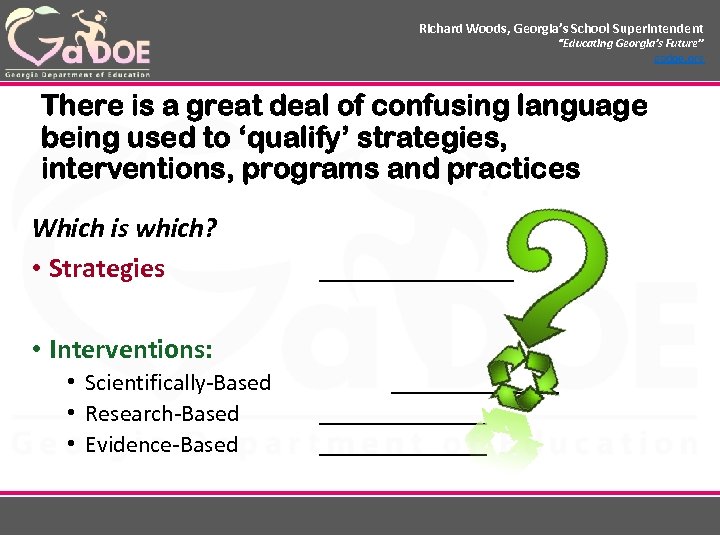 Richard Woods, Georgia’s School Superintendent “Educating Georgia’s Future” gadoe. org There is a great deal of confusing language being used to ‘qualify’ strategies, interventions, programs and practices Which is which? • Strategies _______ • Interventions: • Scientifically-Based • Research-Based • Evidence-Based ______________
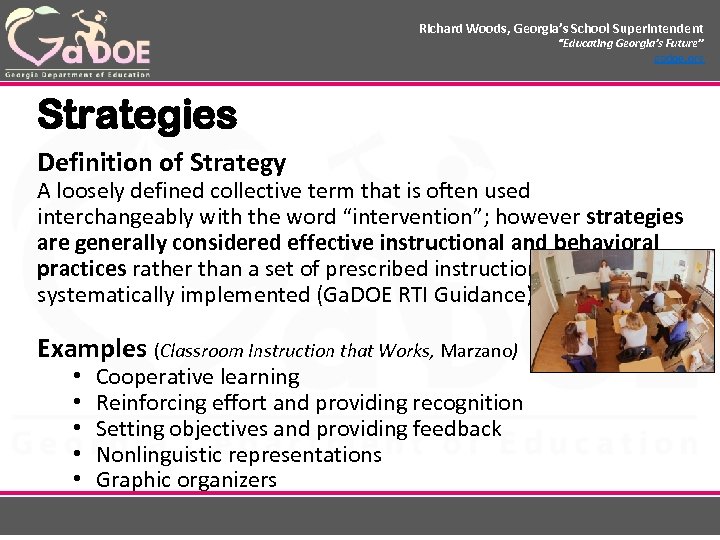 Richard Woods, Georgia’s School Superintendent “Educating Georgia’s Future” gadoe. org Strategies Definition of Strategy Richard Woods, Georgia’s School Superintendent “Educating Georgia’s Future” gadoe. org A loosely defined collective term that is often used interchangeably with the word “intervention”; however strategies are generally considered effective instructional and behavioral practices rather than a set of prescribed instructional procedures, systematically implemented (Ga. DOE RTI Guidance). Examples (Classroom Instruction that Works, Marzano) • • • Cooperative learning Reinforcing effort and providing recognition Setting objectives and providing feedback Nonlinguistic representations Graphic organizers
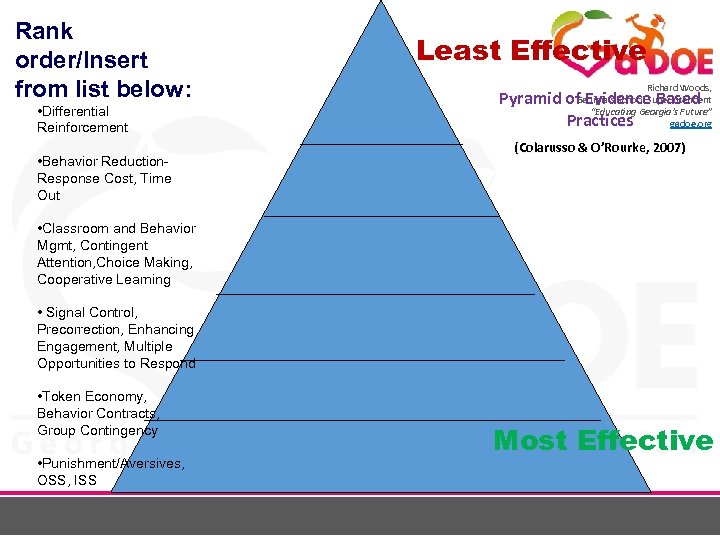 Rank order/Insert from list below: • Differential Reinforcement • Behavior Reduction. Response Cost, Time Out Least Effective Richard Woods, Georgia’s School Superintendent “Educating Georgia’s Future” gadoe. org Pyramid of Evidence Based Practices (Colarusso & O’Rourke, 2007) • Classroom and Behavior Mgmt, Contingent Attention, Choice Making, Cooperative Learning • Signal Control, Precorrection, Enhancing Engagement, Multiple Opportunities to Respond • Token Economy, Behavior Contracts, Group Contingency • Punishment/Aversives, OSS, ISS Most Effective
 Utah State Office of Education: LRBI Resources Richard Woods, Georgia’s School Superintendent “Educating Georgia’s Future” gadoe. org Least Restrictive Behavioral Practices (LRBI) • “Behavioral refresher" on specific evidenced based strategies such as how to do, step by step recommendations and video examples: • Precision commands • Differential reinforcement • Behavioral momentum • Other effective proven behavioral practices http: //www. iseesam. com/teachall/text/behavior/LRBI. htm
 Richard Woods, Georgia’s School Superintendent “Educating Georgia’s Future” gadoe. org Interventions are NOT… 2006) • Preferential seating • Shortened assignments • Parent contacts • Classroom observations • Suspension • Doing MORE of the same • Retention • Peer helpers (informal) Richard Woods, Georgia’s School Superintendent “Educating Georgia’s Future” gadoe. org (John Mc. Cook,
 Intervention Research & Fidelity? Richard Woods, Georgia’s School Superintendent “Educating Georgia’s Future” gadoe. org • Degree to which interventions are empirically supported (evidence and/or research-based) • Fidelity of intervention implementation (at the interventionist and teacher levelclassroom level) (Barringer, 2011)
 Richard Woods, Georgia’s School Superintendent “Educating Georgia’s Future” gadoe. org Understanding Scientifically-Based Interventions (NASP-Harn, 2007) Richard Woods, Georgia’s School Superintendent “Educating Georgia’s Future” gadoe. org ESEA Defines Scientifically Based Reading Research as: • (A) applies rigorous, systematic, and objective procedures to obtain valid knowledge relevant to reading development, reading instruction, and reading difficulties; and • (B) includes research that: • (i) employs systematic, empirical methods that draw on observation or experiment; • (ii) involves rigorous data analyses that are adequate to test the stated hypotheses and justify the general conclusions drawn; • (iii) relies on measurements or observational methods that provide valid data across evaluators and observers and across multiple measurements and observations; and • (iv) has been accepted by a peer-reviewed journal or approved by a panel of independent experts through a comparably rigorous, objective, and scientific review. . (20 U. S. C. § 6368(6))
 Richard Woods, Georgia’s School Superintendent Intervention Science “Educating Georgia’s Future” gadoe. org Scientists have produced programs and practices that can help students, communities, and education systems Richard Woods, Georgia’s School Superintendent “Educating Georgia’s Future” gadoe. org • SAMHSA NREPP http: //www. nrepp. samhsa. gov/ • Colorado Blueprints http: //www. colorado. edu/cspv/index. html http: //www. colorado. edu/cspv/blueprints/ • RTI Guidance Manual 2011 • http: //public. doe. k 12. ga. us/Curriculum-Instruction-and. Assessment/Curriculum-and. Instruction/Documents/RTI%20 document%20 Full%20 Text. pdf • Ga. DOE/SERVE RTI Guidance Series: Using Research to Select Interventions http: //public. doe. k 12. ga. us/Curriculum-Instruction-and -Assessment/Curriculum-and-Instruction/Pages/Response-to. Intervention. aspx
 Intervention Science Richard Woods, Georgia’s School Superintendent “Educating Georgia’s Future” gadoe. org Scientists/researchers have produced programs and practices that can help students, communities & education systems • National Center on Intensive Intervention http: //www. intensiveintervention. org/ • Evidence Based Intervention Network http: //ebi. missouri. edu/ • What Works Clearinghouse http: //ies. ed. gov/ncee/wwc/ • Best Evidence Encyclopedia www. bestevidence. org • Promising Practices Network promisingpractices. net
 Interventions Richard Woods, Georgia’s School Superintendent “Educating Georgia’s Future” gadoe. org • Definition of an intervention • Targeted instruction that is based on student needs. Interventions supplement the general education curriculum. Interventions are a systematic compilation of well researched or evidence-based specific instructional strategies and techniques (Ga. DOE RTI Guidance).
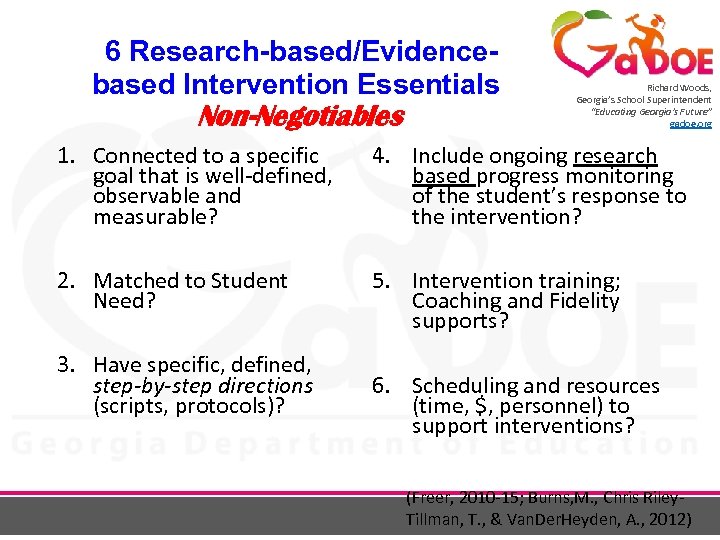 6 Research-based/Evidencebased Intervention Essentials Non-Negotiables Richard Woods, Georgia’s School Superintendent “Educating Georgia’s Future” gadoe. org 1. Connected to a specific goal that is well-defined, observable and measurable? 4. Include ongoing research based progress monitoring of the student’s response to the intervention? 2. Matched to Student Need? 5. Intervention training; Coaching and Fidelity supports? 3. Have specific, defined, step-by-step directions (scripts, protocols)? 6. Scheduling and resources (time, $, personnel) to support interventions? (Freer, 2010 -15; Burns, M. , Chris Riley. Tillman, T. , & Van. Der. Heyden, A. , 2012)
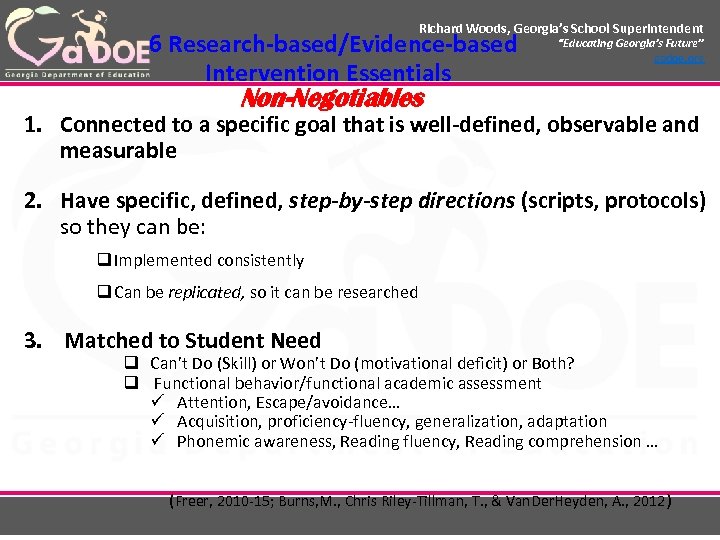 Richard Woods, Georgia’s School Superintendent 6 Research-based/Evidence-based Intervention Essentials Non-Negotiables “Educating Georgia’s Future” gadoe. org Richard Woods, Georgia’s School Superintendent “Educating Georgia’s Future” gadoe. org 1. Connected to a specific goal that is well-defined, observable and measurable 2. Have specific, defined, step-by-step directions (scripts, protocols) so they can be: q Implemented consistently q Can be replicated, so it can be researched 3. Matched to Student Need q Can’t Do (Skill) or Won’t Do (motivational deficit) or Both? q Functional behavior/functional academic assessment ü Attention, Escape/avoidance… ü Acquisition, proficiency-fluency, generalization, adaptation ü Phonemic awareness, Reading fluency, Reading comprehension … (Freer, 2010 -15; Burns, M. , Chris Riley-Tillman, T. , & Van. Der. Heyden, A. , 2012 )
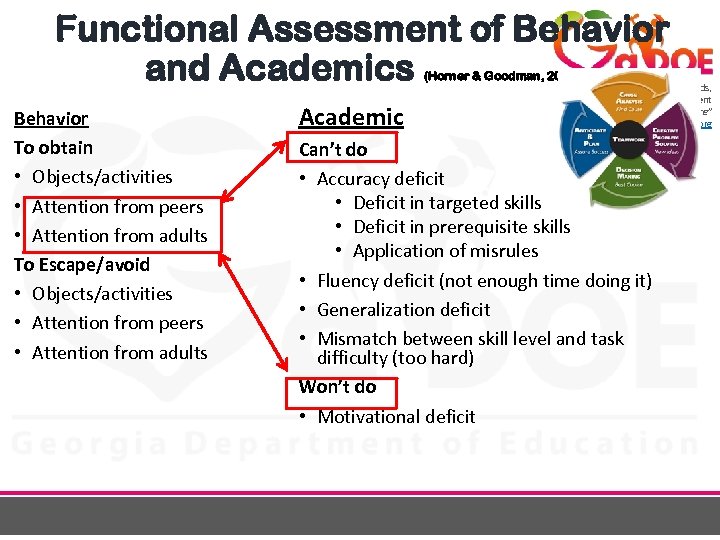 Functional Assessment of Behavior and Academics (Horner & Goodman, 2010) Behavior To obtain • Objects/activities • Attention from peers • Attention from adults To Escape/avoid • Objects/activities • Attention from peers • Attention from adults Academic Richard Woods, Georgia’s School Superintendent “Educating Georgia’s Future” gadoe. org Can’t do • Accuracy deficit • Deficit in targeted skills • Deficit in prerequisite skills • Application of misrules • Fluency deficit (not enough time doing it) • Generalization deficit • Mismatch between skill level and task difficulty (too hard) Won’t do • Motivational deficit
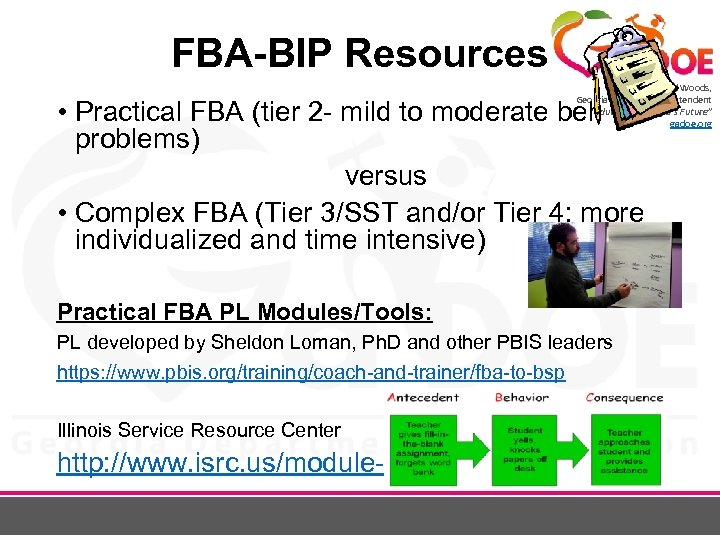 FBA-BIP Resources Richard Woods, Georgia’s School Superintendent “Educating Georgia’s Future” gadoe. org • Practical FBA (tier 2 - mild to moderate beh problems) versus • Complex FBA (Tier 3/SST and/or Tier 4; more individualized and time intensive) Practical FBA PL Modules/Tools: PL developed by Sheldon Loman, Ph. D and other PBIS leaders https: //www. pbis. org/training/coach-and-trainer/fba-to-bsp Illinois Service Resource Center http: //www. isrc. us/module-22
 Intervention Tools Richard Woods, Georgia’s School Superintendent “Educating Georgia’s Future” gadoe. org Evidence Based Intervention Network Dr. T. Chris Riley-Tillman, School Psych-Univ. of Missouri • Evidence Briefs • Intervention Scripts • Videos http: //ebi. missouri. edu/
 Richard Woods, Georgia’s School Superintendent “Educating Georgia’s Future” gadoe. org 6 Research-based/Evidence-based Intervention Essentials Non-Negotiables Richard Woods, Georgia’s School Superintendent “Educating Georgia’s Future” gadoe. org 4. Include ongoing research based progress monitoring of the student’s response to the intervention (research/normed reading, math, written language) q. Goal, aim line & trend line (based on norms/research)? q. Weekly expected rate of progress or growth (based on norms/research)? q. Training and Fidelity of administration, scoring, interpretation and data decision-making rules of PM (based on research)? (Freer 2010 -13; Burns, M. , Chris Riley-Tillman, T. , & Van. Der. Heyden, A. , 2012)
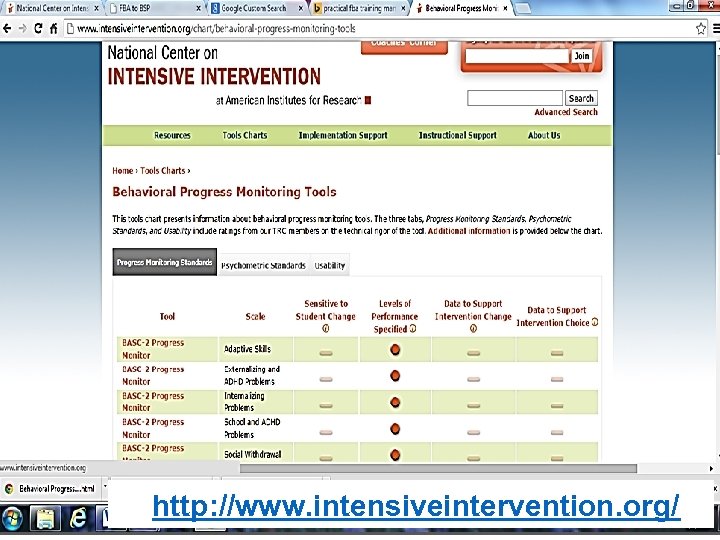 Richard Woods, Georgia’s School Superintendent “Educating Georgia’s Future” gadoe. org http: //www. intensiveintervention. org/
 Do you or others at your school experience TCS? Tier Confusion Symptoms? What Tier? What’s on 1 st? What’s on 2 nd? Where’s SST? Does it still exist (legally-YES!) and is it on 3 rd? (Yes) Who’s on and where’s 4? Richard Woods, Georgia’s School Superintendent “Educating Georgia’s Future” gadoe. org
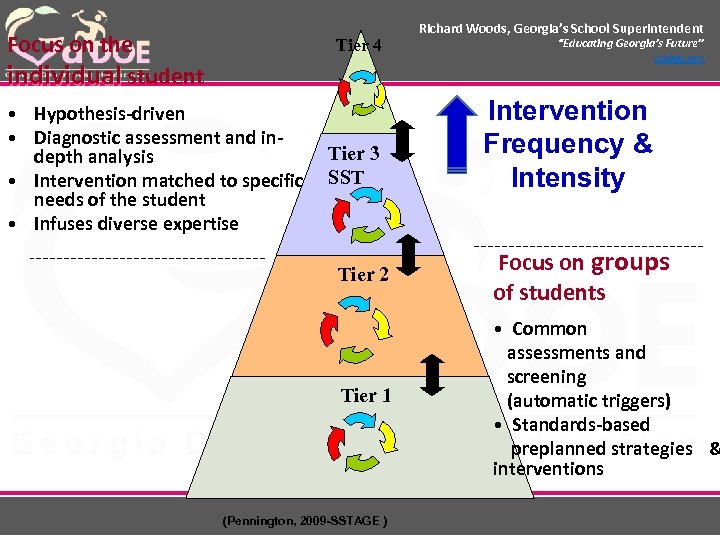 Focus on the individual student Tier 4 • Hypothesis-driven • Diagnostic assessment and indepth analysis • Intervention matched to specific needs of the student • Infuses diverse expertise Richard Woods, Georgia’s School Superintendent “Educating Georgia’s Future” gadoe. org Tier 3 SST Intervention Frequency & Intensity Tier 2 Focus on groups of students Tier 1 • Common assessments and screening (automatic triggers) • Standards-based preplanned strategies & interventions (Pennington, 2009 -SSTAGE )
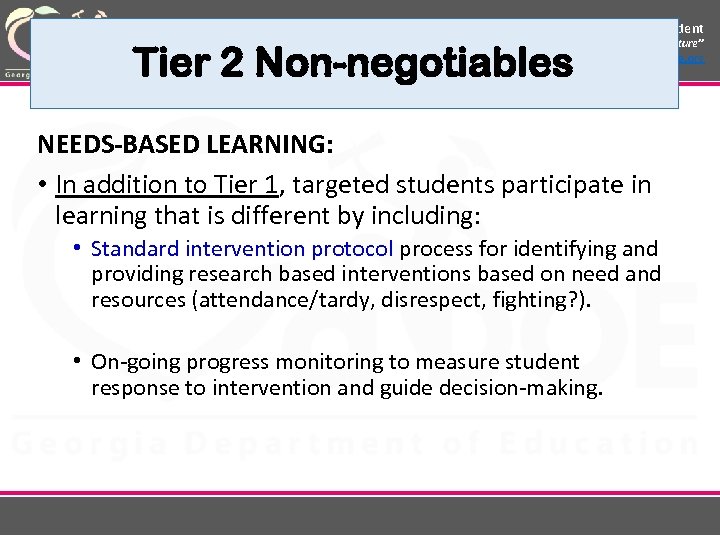 Richard Woods, Georgia’s School Superintendent “Educating Georgia’s Future” gadoe. org Tier 2 Non-negotiables Richard Woods, Georgia’s School Superintendent “Educating Georgia’s Future” gadoe. org NEEDS-BASED LEARNING: • In addition to Tier 1, targeted students participate in learning that is different by including: • Standard intervention protocol process for identifying and providing research based interventions based on need and resources (attendance/tardy, disrespect, fighting? ). • On-going progress monitoring to measure student response to intervention and guide decision-making.
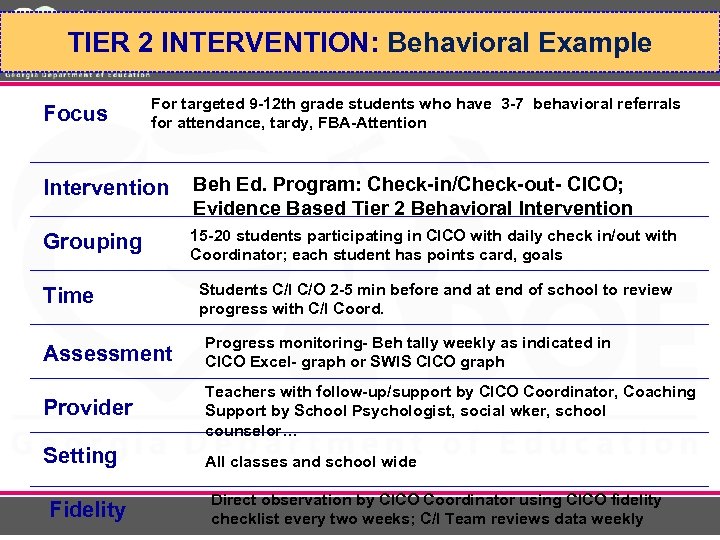 Richard Woods, Georgia’s School Superintendent “Educating Georgia’s Future” TIER 2 INTERVENTION: Behavioral Example gadoe. org Focus Richard Woods, Georgia’s School Superintendent “Educating Georgia’s Future” gadoe. org For targeted 9 -12 th grade students who have 3 -7 behavioral referrals for attendance, tardy, FBA-Attention Intervention Beh Ed. Program: Check-in/Check-out- CICO; Evidence Based Tier 2 Behavioral Intervention Grouping 15 -20 students participating in CICO with daily check in/out with Coordinator; each student has points card, goals Time Students C/I C/O 2 -5 min before and at end of school to review progress with C/I Coord. Assessment Progress monitoring- Beh tally weekly as indicated in CICO Excel- graph or SWIS CICO graph Provider Teachers with follow-up/support by CICO Coordinator, Coaching Support by School Psychologist, social wker, school counselor… Setting All classes and school wide Fidelity Direct observation by CICO Coordinator using CICO fidelity checklist every two weeks; C/I Team reviews data weekly
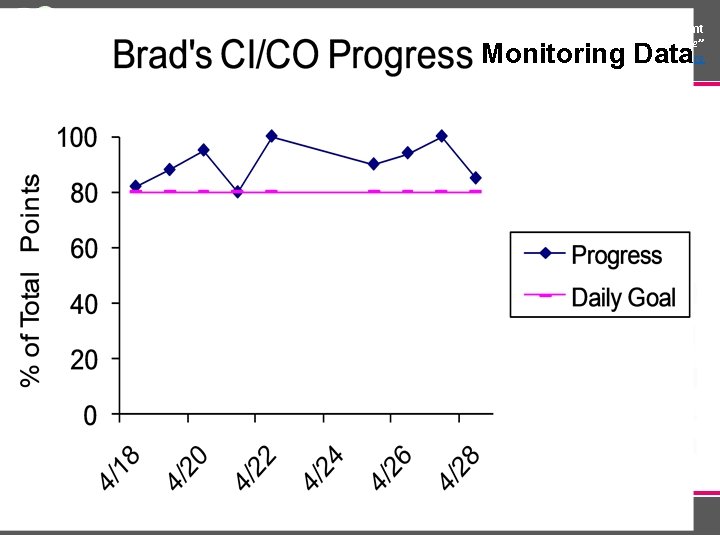 Richard Woods, Georgia’s School Superintendent “Educating Georgia’s Future” gadoe. org Monitoring Data Richard Woods, Georgia’s School Superintendent “Educating Georgia’s Future” gadoe. org © 2005 by The Guilford Press
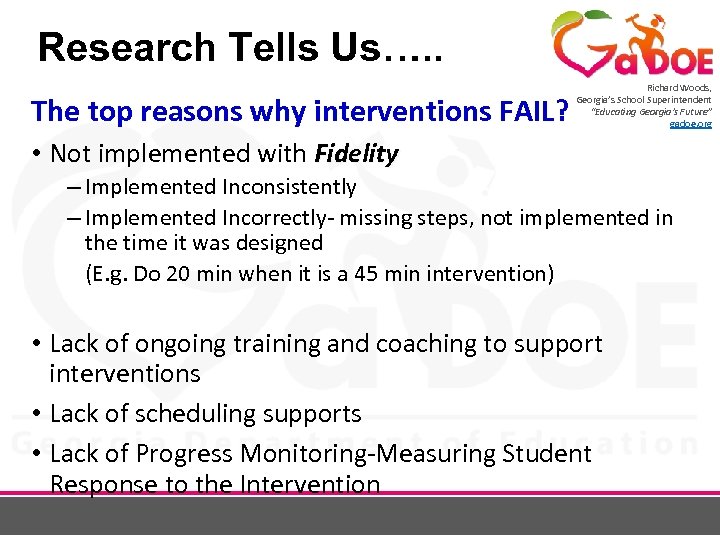 Research Tells Us…. . The top reasons why interventions FAIL? Richard Woods, Georgia’s School Superintendent “Educating Georgia’s Future” gadoe. org • Not implemented with Fidelity – Implemented Inconsistently – Implemented Incorrectly- missing steps, not implemented in the time it was designed (E. g. Do 20 min when it is a 45 min intervention) • Lack of ongoing training and coaching to support interventions • Lack of scheduling supports • Lack of Progress Monitoring-Measuring Student Response to the Intervention
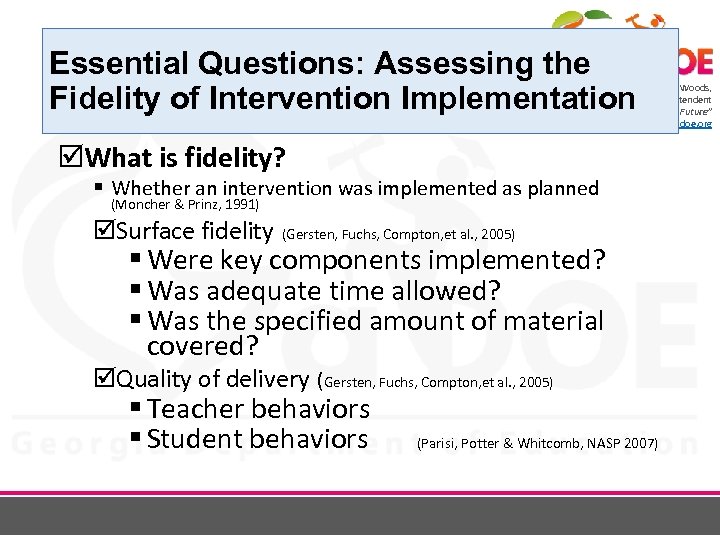 Essential Questions: Assessing the Fidelity of Intervention Implementation Richard Woods, Georgia’s School Superintendent “Educating Georgia’s Future” gadoe. org þWhat is fidelity? § Whether an intervention was implemented as planned (Moncher & Prinz, 1991) þSurface fidelity (Gersten, Fuchs, Compton, et al. , 2005) § Were key components implemented? § Was adequate time allowed? § Was the specified amount of material covered? þQuality of delivery (Gersten, Fuchs, Compton, et al. , 2005) § Teacher behaviors § Student behaviors (Parisi, Potter & Whitcomb, NASP 2007)
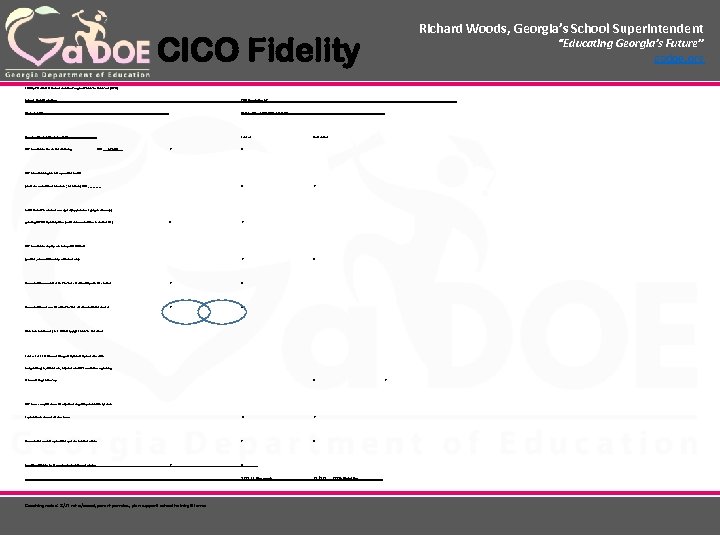 Richard Woods, Georgia’s School Superintendent CICO Fidelity “Educating Georgia’s Future” gadoe. org Richard Woods, Georgia’s School Superintendent “Educating Georgia’s Future” gadoe. org Fidelity Checklist: Behavior Education Program/Check-In, Check-out (CICO) School: Park Elementary CICO Coordinator L. . P Observer: G. H Date and Day of Week: Wed; 8/17/10 Program Elements/Non-negotiables BEP Coordinator has received training. Evident Date ___7/27/10___ X Not Evident BEP School training has been provided to staff (circle documentation: handouts; list trainer) Date _____ X Initial Parent Permission Form signed (by parent or legal guardian only) granting BEP/CICO participation (written-documentation in student file). X BEP Coordinator displays necessary skills/attitude (positive, warm relationships with students). X Documentation consistent face-to-face check-in daily with the student X Documentation of consistent face-to-face check-out with the student X Direct observation of (circle all that apply): Check-in Check-out Evidence of CICO Team meeting weekly/biweekly to review data and goal targets, data trends, adjustments. BEP Coordinator organizing team meetings/follow-up. BEP forms completed consistently. If missing data points/dates/periods explanation is documented on form. X Documented consistency in delivery of rewards/incentives. X Inputting data into excel program and printing out graphs. X _____ TOTAL Present Coaching notes: 8/17 mt w/coord, parent permiss. , plan support: school training& forms 6 /10 60% Fidelity_ X
 Evidence Based Tier 2, 3, 4 Behavioral Interventions Richard Woods, Georgia’s School Superintendent “Educating Georgia’s Future” gadoe. org • Skillstreaming-Pre. K-12 , typically 30 -50 min 1 or more times per wk, varies according to need of student(s); small or large group. Can be used at tiers 1 -4. Skillstreaming the Adolescent employs a four-part training approach—modeling, role-playing, performance feedback, and generalization—to teach essential prosocial skills. Ex- Skillsteaming the Adolescent provides a complete description of the program, with instructions for teaching 50 prosocial skills. https: //www. researchpress. com/books/all/all/skillstreaming • Social Decision Mkg/Social Prob Solving (SDM/SPS) K-8; Selfcontrol skills, social awareness and decision-mkg/prob-solving skills; 1 -2 sessions per wk with a range of flexibility to fit student needs. Helps reduce school violence, foster social and emotional intelligence, improve academic effort and attention, and prevent at-risk students from giving up. Includes assessment tools for tracking progress. An accompanying CD of all the reproducible forms and student handouts is included with the book. https: //www. researchpress. com/books/702/social-decision-makingsocial-problem-solving -sdmsps
 Evidence Based Tier 2, 3, 4 Behavioral Interventions • Social Skills Improvement System- (SSIS) Richard Woods, Georgia’s School Superintendent “Educating Georgia’s Future” gadoe. org • Classwide Intervention Program- 10 social skills , Three 20 -30 min lessons per unit; Pre. K- Middle School • Intervention Guide- small group and individual intervention Pre-K- Gr 2, Upper Elem- Secondary Gr 3 -12; 2 x wk- 45 min sessions but can be modified according to student needs http: //www. pearsonclinical. com/therapy/Related. Info/ssis-overview. html • RIDE Behavior Intervention Bank: Responding to Individual Differences in Education (RIDE) Behavior Intervention Bank (BIB) is a multimedia web-based program consisting of 104 research-based interventions across six critical areas of behavior: aggression, disruptive behavior, noncompliance, off task/non-participation, social skills, and unprepared. Videos, track and graph progress monitoring. Grades K-12. http: //www. voyagersopris. com/curriculum/subject/school-climate/ride-online -behavior-intervention-bank
 Evidence-Based Tier 2, 3, 4 Behavioral Interventions Richard Woods, Georgia’s School Superintendent “Educating Georgia’s Future” gadoe. org • EQUIP Middle-high school-10 wk intervention, 3 x week for 45 min (social skills, decision-mkg, anger mgmt). EQUIP consists of 30 sessions—ten each of anger management, social skills, and social decision making. Each session includes facilitator notes, objectives, and activities such as roleplays, worksheets, and analysis of realistic problem scenarios. https: //www. researchpress. com/search-1/EQUIP • PREPARE Curriculum series of 10 course-length interventions, 2 -3 times per wk, 30 -60 min: reducing aggression, stress, and prejudice. Use with middle school and high school students and can also be adapted for use with younger students; The 93 supplementary exercises involve games, role plays, reading and writing, drawing, brainstorming, group discussion, relaxation, tape recordings, photography, and other hands-on activities https: //www. researchpress. com/books/818/preparecurriculum
 Evidence-Based Tier 2, 3, 4 Behavioral Interventions Richard Woods, • Anger Coping Program- Larson & Lochman, Gr 3 -8; 18 sessions, 1 Georgia’s School Superintendent “Educating Georgia’s Future” or more times wk/45 min. Practitioners are taken step by step through setting gadoe. org up treatment groups, teaching vital skills for reducing aggression and disruptive behavior, and building strong partnerships with teachers and parents. Many practical suggestions are provided for adapting the program to different settings and optimizing student outcomes. Includes reproducible handouts, forms, and parent letters (in English and Spanish). http: //www. guilford. com/books/Helping-Schoolchildren-Cope-with. Anger/Larson-Lochman/9781606239735 • Aggression Replacement Training, Dev by Glick, Gibbs, Goldstein; M/H; ages 12 -18, 3 sessions per week- 60 min, 10 wks: revised and updated to reflect over 30 years of use in schools, community agencies, juvenile institutions, and other settings. The new edition of Aggression Replacement Training offers step-by-step session plans for teaching ART's three coordinated components: Social Skills, Anger Control training and Social Decision Making; training recommended https: //www. researchpress. com/books/409/aggression-replacement-training
 Richard Woods, Georgia’s School Superintendent 6 Research-based/Evidence-based Intervention Non-Negotiables “Educating Georgia’s Future” gadoe. org Richard Woods, Georgia’s School Superintendent “Educating Georgia’s Future” gadoe. org 5. ABC’s of Effective Intervention Success • A- Intervention training • B- Coaching to support the intervention training • C- Fidelity data on intervention implementation 6. Scheduling and Resources Time, $, and Personnel to support interventions (Freer 2010 -13; Burns, M. , Chris Riley-Tillman, T. , & Van. Der. Heyden, A. , 2012)
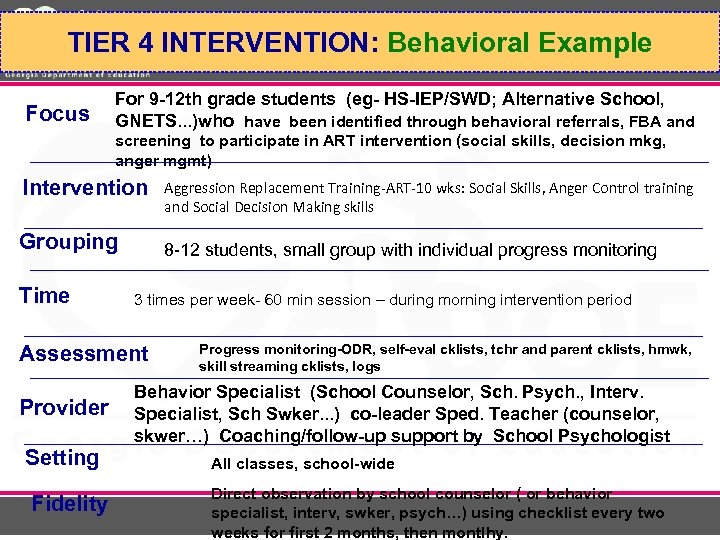 Richard Woods, Georgia’s School Superintendent “Educating Georgia’s Future” TIER 4 INTERVENTION: Behavioral Example gadoe. org Focus Richard Woods, Georgia’s School Superintendent “Educating Georgia’s Future” gadoe. org For 9 -12 th grade students (eg- HS-IEP/SWD; Alternative School, GNETS. . . )who have been identified through behavioral referrals, FBA and screening to participate in ART intervention (social skills, decision mkg, anger mgmt) Intervention Grouping Time 8 -12 students, small group with individual progress monitoring 3 times per week- 60 min session – during morning intervention period Assessment Provider Setting Fidelity Aggression Replacement Training-ART-10 wks: Social Skills, Anger Control training and Social Decision Making skills Progress monitoring-ODR, self-eval cklists, tchr and parent cklists, hmwk, skill streaming cklists, logs Behavior Specialist (School Counselor, Sch. Psych. , Interv. Specialist, Sch Swker. . . ) co-leader Sped. Teacher (counselor, skwer…) Coaching/follow-up support by School Psychologist All classes, school-wide Direct observation by school counselor ( or behavior specialist, interv, swker, psych…) using checklist every two weeks for first 2 months, then montlhy.
 Intervention Implementers, Coaches, Leaders &Trainers Richard Woods, Georgia’s School Superintendent “Educating Georgia’s Future” gadoe. org • Should have specialized expertise, behavioral training, and successful intervention implementation experience (Behavior Specialist, Interventionist, School Psychologist, School Counselor, Social Worker…) • Should have experience with successful training and implementation of interventions and skill in teaching the 6 Intervention Essentials* • Should have some training in assessment and progress monitoring: administering, scoring and interpretation • Work in teams and Intervention PLC’s, Coaching
 • Many interventions shared in this presentation do not require specialized intervention training but do recommend prior behavioral expertise and level of certification (school psychologist, counselors, behavior specialists…). Richard Woods, Georgia’s School Superintendent “Educating Georgia’s Future” gadoe. org • Best practices would recommend that you seek training if available and send team, to form a PLC of colleagues with expertise and pilot on a small scale and work together in planning and implementation. This results in more successful outcomes and builds capacity within your system/school. • Following intervention manual/protocols/fidelity tools, collecting multiple forms of progress monitoring and using the 6 intervention essentials framework to guide your PLC will help increase success.