


 Скачать презентацию Richard W Hamming Learning to Learn The Art
fc526ed013adcffb49a6f499303caef3.ppt
- Количество слайдов: 15
 Richard W. Hamming Learning to Learn The Art of Doing Science and Engineering Session 28: You Get What You Measure
 Measurements & Organizations The way you measure things has an effect on your organization & drawn conclusions • Example: using nets to determine minimum size of fish in the sea Example: Rating Systems • Rating systems that rewards conservatism will remove risk-takers from the organization • But risk-taking may be a trait that is needed later on
 What You Choose to Measure Hard to measure intelligence or morale Confusion between what is reliably measured and what is relevant • Tendency is to choose a thing that can be easily and accurately measured, versus hard-to-measure thing, without regard to relevance • Adding reproducibility makes this choice harder still
 Intelligence Quotient (IQ) Testing Create a list of questions • Test a small sample Correlate question relevance to intelligence and drop “irrelevant” questions • Calibrate with a larger sample size Forced IQs to be normally distributed through the calibration of the scores • irrespective of reality
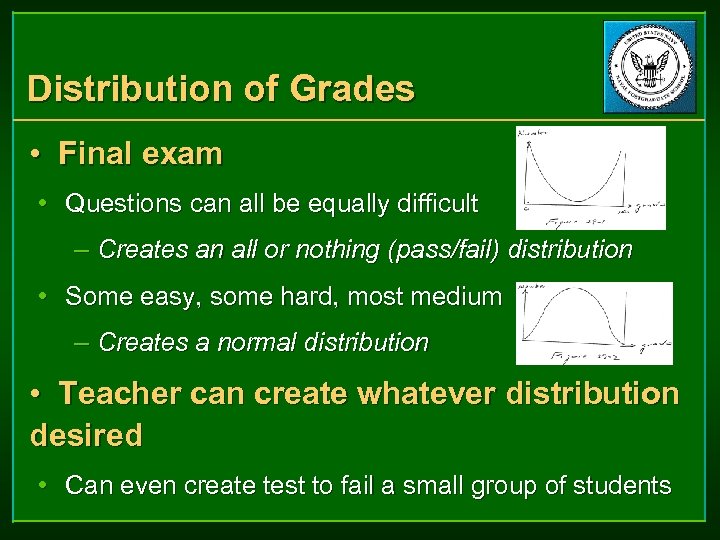 Distribution of Grades • Final exam • Questions can all be equally difficult – Creates an all or nothing (pass/fail) distribution • Some easy, some hard, most medium – Creates a normal distribution • Teacher can create whatever distribution desired • Can even create test to fail a small group of students
 Scoring Systems Dynamic range (1 -9 with 5 being the average) • Most people will choose 4 s and 6 s • One person can use 1 s and 9 s to dominate ratings • Most people fail to use entire dynamic range Scoring systems communicating information have maximum entropy when all symbols used equally • Grading is a communication medium • Giving all As and Bs provides little information • Can adopt class rank to add info (but how good are peers? )
 Rating People • Example: Bell Labs promotion and salary • Rating people from different fields/departments • People do not like to rate people • Judge not lest ye be judged; Cast not the first stone • Easier to determine relevant rank without giving the reason – the reason is where intuitive judgments are put into words
 Initially Perceived Features The people you initially attract are the people you will later have • Example: mixed up psychology students and faculty • Example: Comp. Sci – people obsessed with sea of detail Causes inbreeding within field or company • Strengthening most dominant perceived traits of organization/field (whether good or bad) • Can weaken more subtle, “big picture” traits
 Personnel Employment • Promote from within or go outside field • Research needs people with original ideas • These people may be “too original” for Human Resources (HR) recruiters • Company may need to get researchers to recruit other researchers (since like recognizes like)
 Leadership & Promotions • Board of Directors self-selects leaders • People they like and who were once like them, rather than people who will be good for the future • Great homogeneity leads to low innovation • High heterogeneity leads to no decisions being made • How to avoid inbreeding • Don’t always choose someone from your own organization/field – once very common at universities • Think about how you are shaping the company and what would this all look like to an outsider
 Judgements • Human vs. automated judgments • “It’s not that your answers are better than what we can do by hand, it is that they are consistent. ” • Systematic approach allowed study of subtle effects • Humans are better in taking the complexities of people and assigning them a scalar value (ranking) • Good human judgment requires maturity • Example: to fail (or not fail) a failing student
 Inspections Random vs. scheduled • People/organizations will prepare for inspections • How does a scheduled evaluation relate to readiness at any given instant in time? • While most “random” inspections are known in advance, it is usually not by as much as a scheduled inspection, thus providing a somewhat better opportunity to measure typical readiness
 Scaling More scales are available than just linear/additive. Earthquakes measured on the logarithmic Richter scale (multiple of log of released energy). • 2 s & 3 s common; 6 s and 7 s extremely rare • Convenient to humans; Nature likely doesn’t use logarithmic units to decide earthquake distribution Logarithmic scale is good for many sensory tests. Percentage change can be a good scale. • Example: additional cattle into a herd (3 to 5 vs. 3 to 1000)
 Decisions and Scaling Scale is an important factor in making decisions and measuring/displaying data • Equations will frequently do scaling Lower mgt will bend figures for top mgt through creative scaling & measurement • “How to Lie With Statistics” & “How to Lie with Charts” • Use due prudence to check figures/claims • Necessary for company health & your legal protection
 Final Thoughts Just because a measurement is popular, it does not make it reliable or accurate. Capability does not equal probability. • Underlings may bend those definitions • Life testing measurements and tricks Ask questions before creating a rating system • What are the long term global effects? • Who will we attract into our company?