


 Скачать презентацию Rhode Island s Ports Opportunities for Growth April 28
1ded58af79434471f3bb88f60193947f.ppt
- Количество слайдов: 182
 Rhode Island’s Ports: Opportunities for Growth April 28, 2011 Conducted by: Martin Associates Lancaster, PA 17603 www. martinassoc. net Sponsored and Funded by: RI Bays, Rivers, and Watersheds Coordination Team
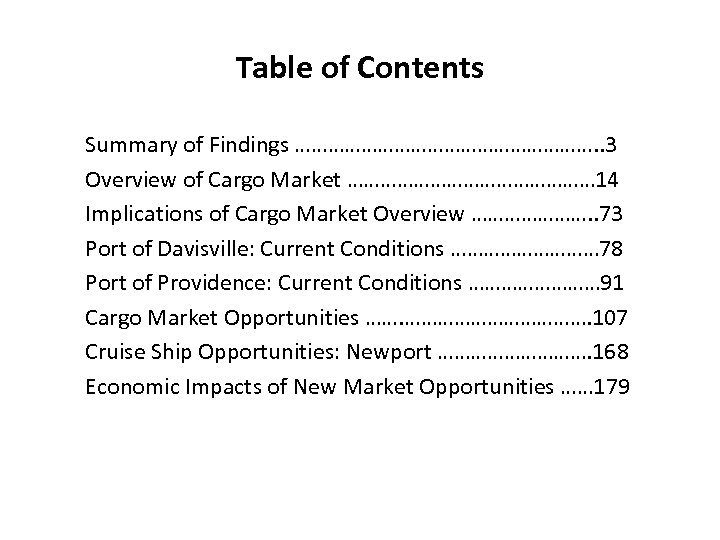 Table of Contents Summary of Findings ………………………. . 3 Overview of Cargo Market …………………… 14 Implications of Cargo Market Overview …………………. . 73 Port of Davisville: Current Conditions …………… 78 Port of Providence: Current Conditions ………… 91 Cargo Market Opportunities ……. ………………. 107 Cruise Ship Opportunities: Newport ……………. 168 Economic Impacts of New Market Opportunities …… 179
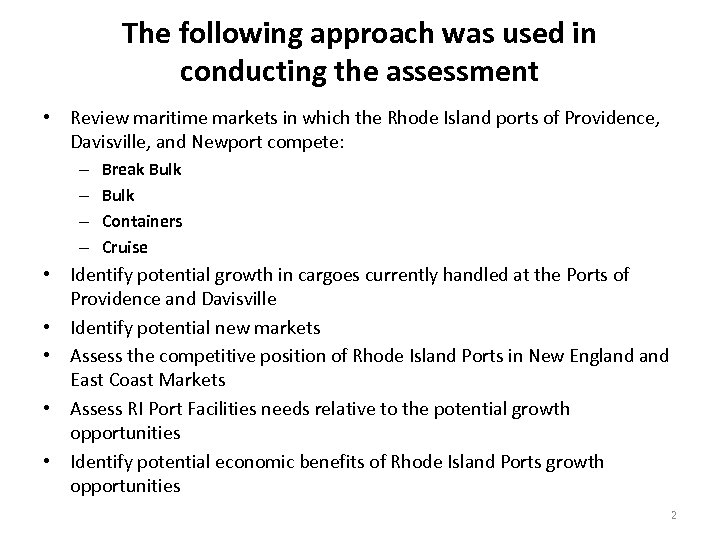 The following approach was used in conducting the assessment • Review maritime markets in which the Rhode Island ports of Providence, Davisville, and Newport compete: – – Break Bulk Containers Cruise • Identify potential growth in cargoes currently handled at the Ports of Providence and Davisville • Identify potential new markets • Assess the competitive position of Rhode Island Ports in New England East Coast Markets • Assess RI Port Facilities needs relative to the potential growth opportunities • Identify potential economic benefits of Rhode Island Ports growth opportunities 2
 SUMMARY OF FINDINGS 3
 The New England Ports have a small share of the East Coast break bulk and dry bulk markets • East Coast dry bulk imports are driven by coal and salt/stone • Coal is the key dry bulk import at Bridgeport, while salt is the major import at Boston and Providence • Coal is the major export from the East Coast ports • Scrap is the leading dry bulk export from New England ports, and Providence 4
 Several break bulk commodities have grown over time and represent potential opportunities for Rhode Island ports • Overall, break bulk imports have not shown growth over the past decade • However, specific break bulk cargoes that have shown growth over time are : – Break bulk fruit imports – Auto imports and exports • Davisville handles imports and exports of new vehicles • Prov. Port handles exported Previously owned vehicles • • – Pulp imports – Scrap paper exports Autos are the major break bulk imports and exports through the Providence Customs District Paper scrap exports are a key break bulk export from Boston Pulp is the major break bulk export from Eastport Steel is the major import via New Haven 5
 Growth opportunities for RI’s Ports • Base market opportunities - Automobile market shows potential growth market: – Davisville currently pursuing new auto export market as well as imports and domestic distribution – Exemption from Harbor Maintenance Tax is a key competitive advantage for RI’s Ports – Water depth could become an issue, and if the harbor deepening were to be undertaken by the federal government, then the competitive advantage of Davisville as an auto port would be eroded due to the imposition of the Harbor Maintenance Tax. – Previously Owned Vehicles – (POV) have been a growing export market from Prov. Port 6
 Growth opportunities for RI’s Ports • New market opportunities - The break bulk fruit and perishables import market: – Stable growth market – Currently concentrated in the Delaware River area – Providence ports located in proximity to key perishable goods distribution centers in New England – Break bulk banana business has moved from Bridgeport to the Delaware River, however, the return of break bulk operations to New England is underscored by the new break bulk fruit service between Mexico and New Bedford 7
 Growth opportunities for RI’s Ports • New Market Opportunities – Container Feeder Service – There has been an increase in all-water service for Asian container operations since 2002, due to several factors: • West Coast Port Shutdown in 2002 • Tuck and rail capacity issues in 2002 -2004 at West Coast ports • Infrastructure and environmental fees at West Coast ports • Expansion of the Panama Canal in 2014 • Increased usage of the Suez Canal as production centers increase in Vietnam and India, and further commitment of $210 billion in infrastructure development in India • The growth in Suez Canal usage will favor North Atlantic ports of container growth – Imported Asian container service has increased at East Cost ports, including New York, Boston, and Baltimore, and potentially at Halifax in the future – Previously, barge feeder services moved containerized cargo between Halifax, Boston and New York, but was discontinued – With aggressive marketing, there may be the potential to develop a barge feeder operation between New York and Providence, which would provide an alternative to the trucking of containerized cargo between the Port of New York/New Jersey and Providence ports. • This is compatible with the development of the Marine Highway, moving truck traffic from congested highways 8
 Growth opportunities for RI’s Ports • New Market Opportunities – Offshore wind energy – Development of support base for offshore wind energy operations: • Potential development of a land side operations • Deepwater is looking to develop a landside operations base in Davisville to support offshore wind turbine farms – The wind power market is uncertain, and investment in wind energy support and facilities should be placed on the private sector, not the State • Price of offshore generated electricity is projected to be significantly higher than alternative price onshore – Deepwater estimates the wholesale price of its electricity to be in the mid-teens – Wholesale prices from conventional electricity generation are significantly less • Offshore projects appear to be in jeopardy until commitments can be made as to purchases of electricity • Furthermore, delivery infrastructure (grids) will be required, and investment in this infrastructure is uncertain • Rhode Island Ports should only invest in facilities after commitments have been established. Furthermore, private sector investment and partnership should be a pre-requisite for any terminal development in support of the wind energy programs 9
 Potential state investments to support future terminal operations should they develop • RO/RO Ramp – $1. 75 million – To support potential container feeder operations • If RO/RO feeder operation were to develop • Traditional RO/RO vessels have ramps incorporated in their design and do not require use of a ramp • Chill Facility – $2 million – To support potential fresh fruit import market • Public and/or private sector investment • Estimated $100 per sq ft investment for facility • Reefer Plugs – $5, 000 per unit – To support chill facility operations – optional – To support container feeder operations if refrigerated containers are handled • Cruise Ship Dock – $12. 5 million – “T” dock for passenger embarking/debarking – Two mooring dolphins – Assumes location is in relative proximity to deep water to accommodate ships (i. e. off of Goat Island)
 Leading Port Growth Opportunities • Base Cargo: – Auto units could grow from 200, 000 (import and domestic) units to 300, 000 units (good possibility) • Potential Opportunities: – Develop of a break bulk fruit operation (will require aggressive marketing) – Possible container barge feeder operations – 24, 000 TEUs (will require significant reduction in barge rate/stevedoring charges and a RO/RO operation) – Wind energy 130 units – uncertainty, and should include significant infrastructure investment by private sector • State should not invest until private sector commitment. 11
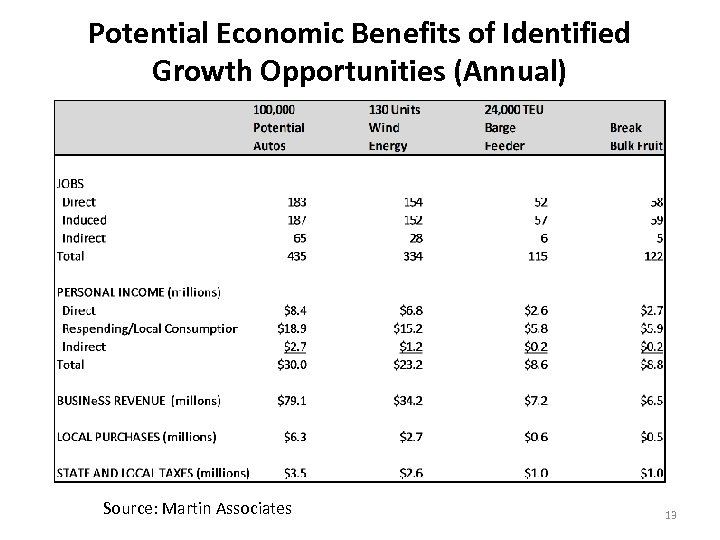
 Potential economic benefits of identified market opportunities: Model Projections Martin Associates’ Prov. Port Economic Impact Model was adjusted to reflect the potential annual economic impact of the identified opportunities. This study was conducted for Prov. Port in 2006, and included the development of local models to estimate induced and indirect economic impacts of the direct operations at marine terminals in Providence. Specific terminal models were developed for Prov. Port operations. In addition, Martin Associates has developed more than 300 economic impact studies for most ports in the United States and we were able to use direct impact models to estimate the types of impacts that could be anticipated from the growth in new automobile exports and imports, the development of fruit import operation similar to the size of operations of a terminal in the Delaware River, and the development of a barge feeder operation. Our wind energy models for Gulf Coast and Pacific Northwest ports were used to estimate the impacts of the potential wind energy imports, but not manufacturing/assembly. 12
 Potential Economic Benefits of Identified Growth Opportunities (Annual) Source: Martin Associates 13
 OVERVIEW OF CARGO MARKET 14
 National and regional cargo markets were reviewed to assess the position of Rhode Island ports as basis for identifying potential opportunities for future RI Port development and their economic benefits • Break bulk: Includes cargoes that are typically palletized, bagged or handled in individual pieces such as steel, fresh fruit, forest products, automobiles, and wind turbines: – Imports – Exports • Bulk: Liquid and dry products that are not packaged but move in large, fungible lot sizes and include petroleum, liquid bulk, cement, limestone, coal, scrap: – Imports – Exports • Containerized cargo: General cargo that is moved via a 20 ft. , 40 ft. or 45 ft. ocean container, and is typically higher value cargo including apparel, electronics, furniture, machine parts, etc. 15
 Historical Trade Data • Historical commodity specific data (all reported in tons) was developed by Port, handling type and commodity • US Bureau of the Census Foreign Trade Division, Import and Export Merchandise, trade statistics: – This does not include domestic waterborne data – Providence data includes cargo activity at: • • Prov. Port Melville Newport Davisville • Historical data is provided, as are the compound annual growth rates (CAGR) 16
 Break Bulk Imports 17
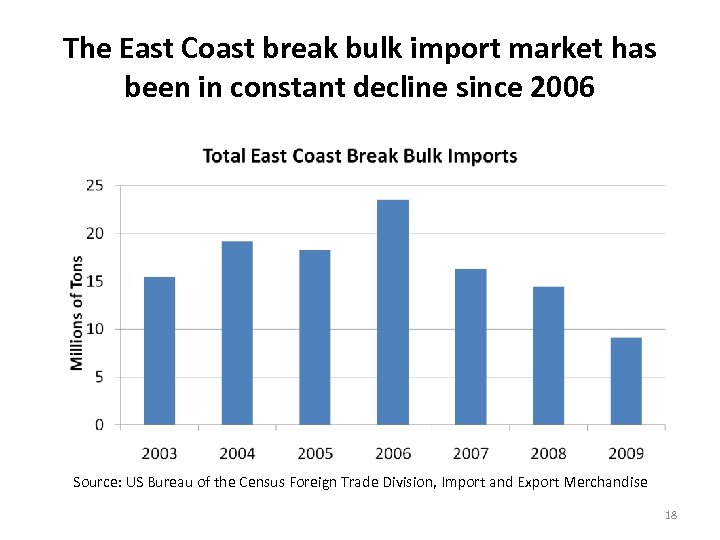 The East Coast break bulk import market has been in constant decline since 2006 Source: US Bureau of the Census Foreign Trade Division, Import and Export Merchandise 18
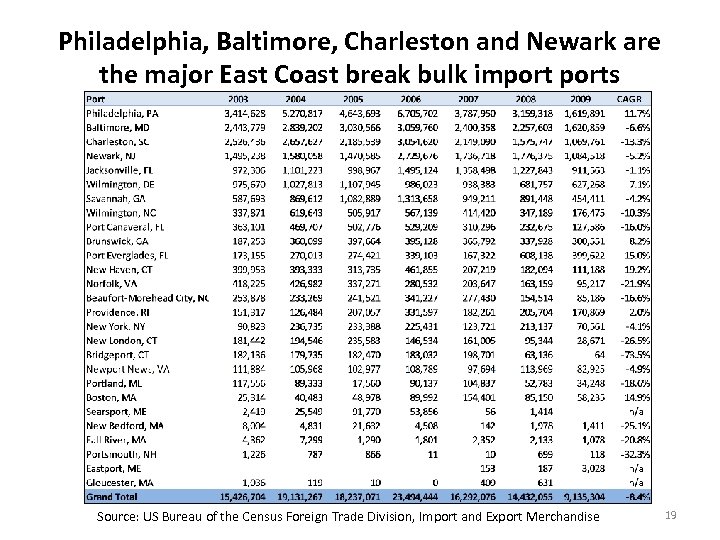 Philadelphia, Baltimore, Charleston and Newark are the major East Coast break bulk imports Source: US Bureau of the Census Foreign Trade Division, Import and Export Merchandise 19
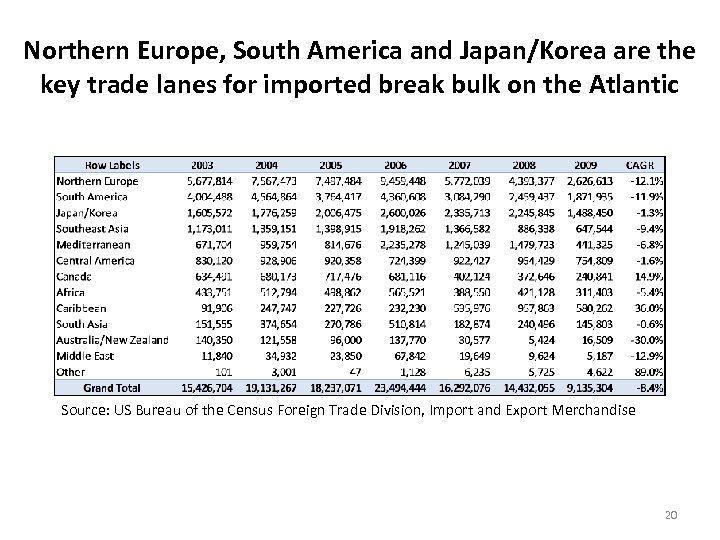 Northern Europe, South America and Japan/Korea are the key trade lanes for imported break bulk on the Atlantic Source: US Bureau of the Census Foreign Trade Division, Import and Export Merchandise 20
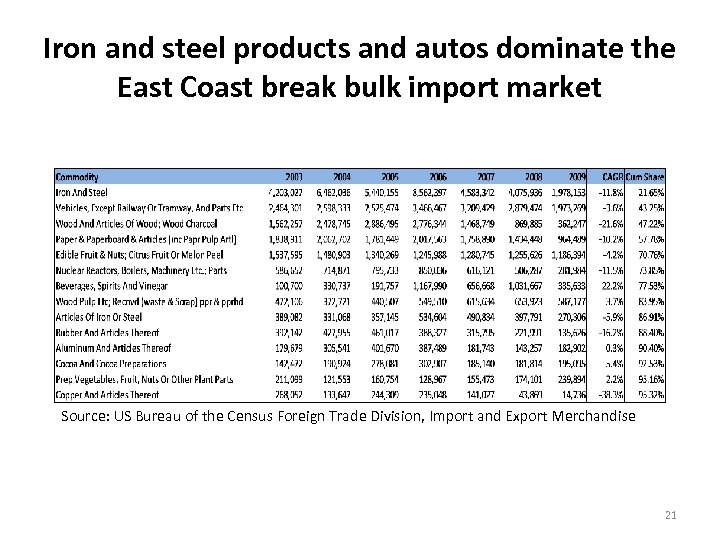 Iron and steel products and autos dominate the East Coast break bulk import market Source: US Bureau of the Census Foreign Trade Division, Import and Export Merchandise 21
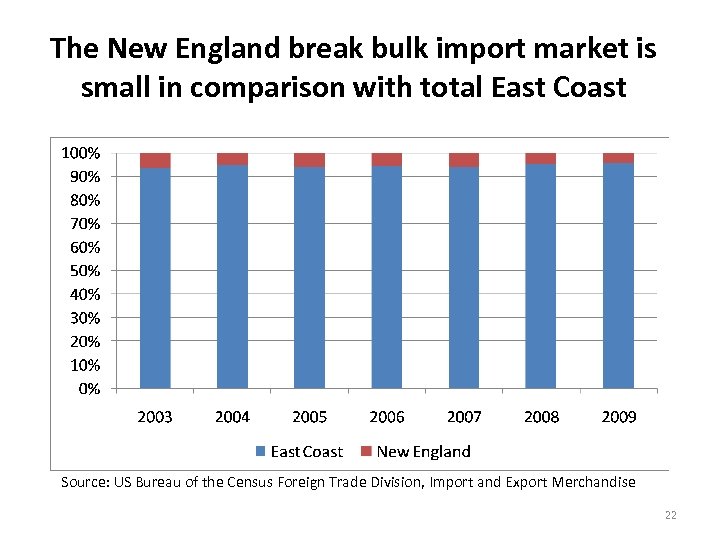 The New England break bulk import market is small in comparison with total East Coast Source: US Bureau of the Census Foreign Trade Division, Import and Export Merchandise 22
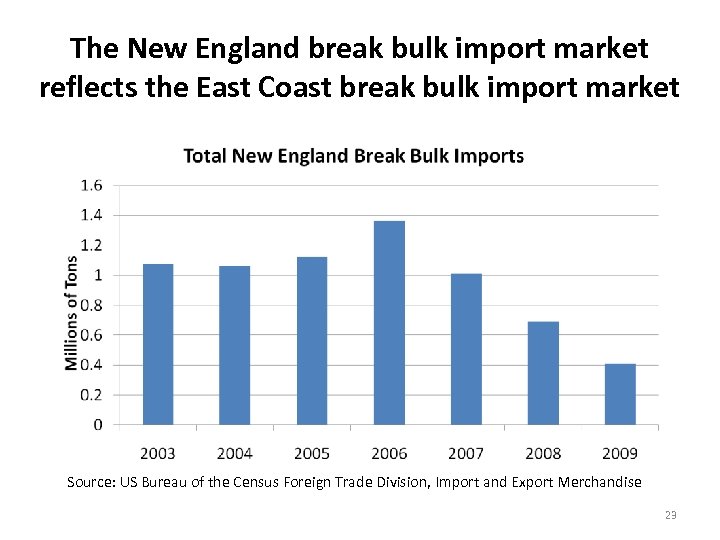 The New England break bulk import market reflects the East Coast break bulk import market Source: US Bureau of the Census Foreign Trade Division, Import and Export Merchandise 23
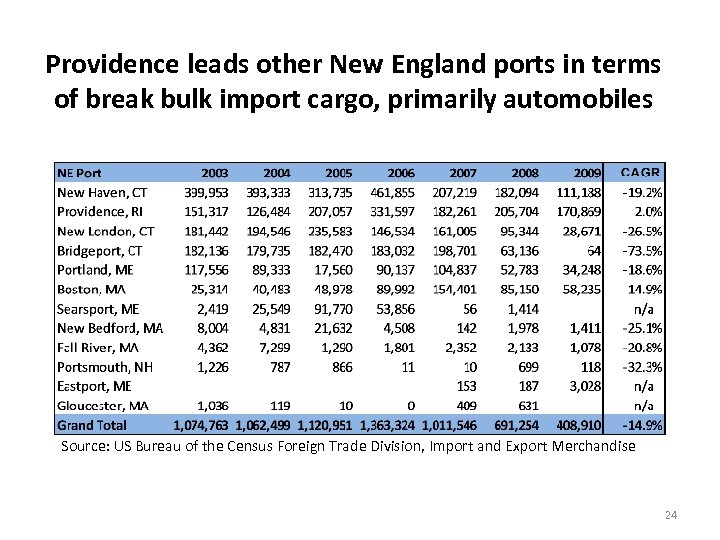 Providence leads other New England ports in terms of break bulk import cargo, primarily automobiles Source: US Bureau of the Census Foreign Trade Division, Import and Export Merchandise 24
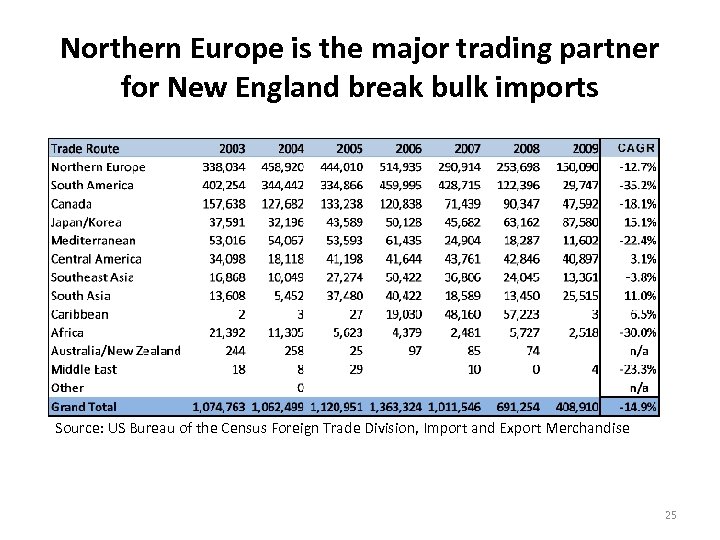 Northern Europe is the major trading partner for New England break bulk imports Source: US Bureau of the Census Foreign Trade Division, Import and Export Merchandise 25
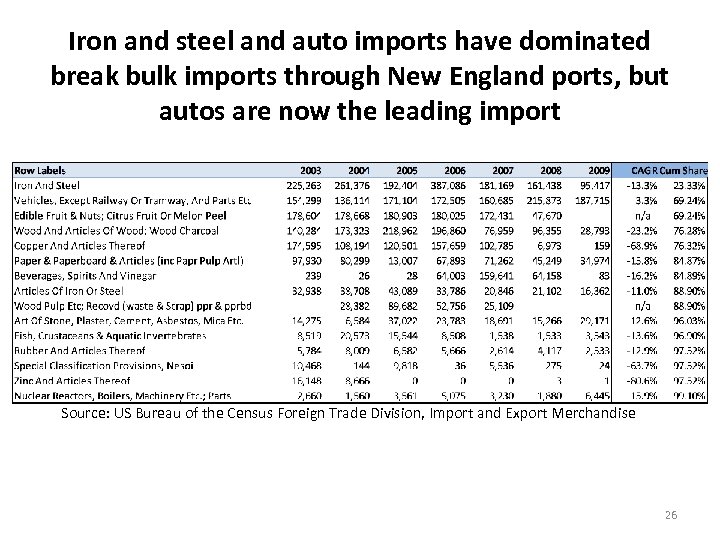 Iron and steel and auto imports have dominated break bulk imports through New England ports, but autos are now the leading import Source: US Bureau of the Census Foreign Trade Division, Import and Export Merchandise 26
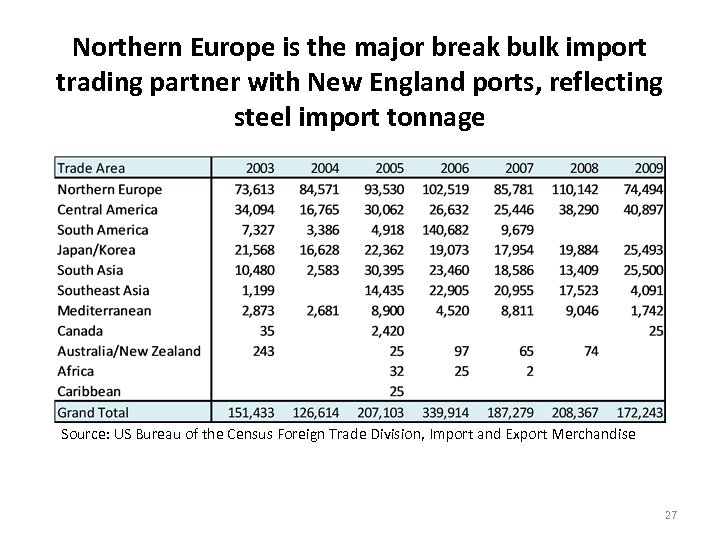 Northern Europe is the major break bulk import trading partner with New England ports, reflecting steel import tonnage Source: US Bureau of the Census Foreign Trade Division, Import and Export Merchandise 27
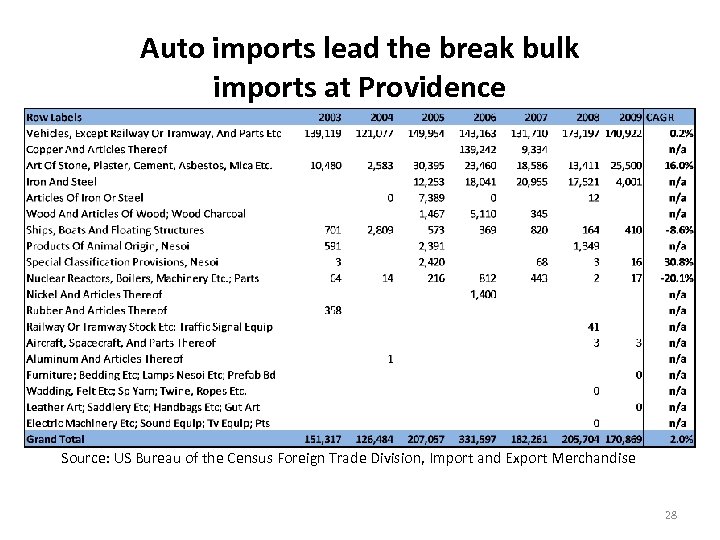 Auto imports lead the break bulk imports at Providence Source: US Bureau of the Census Foreign Trade Division, Import and Export Merchandise 28
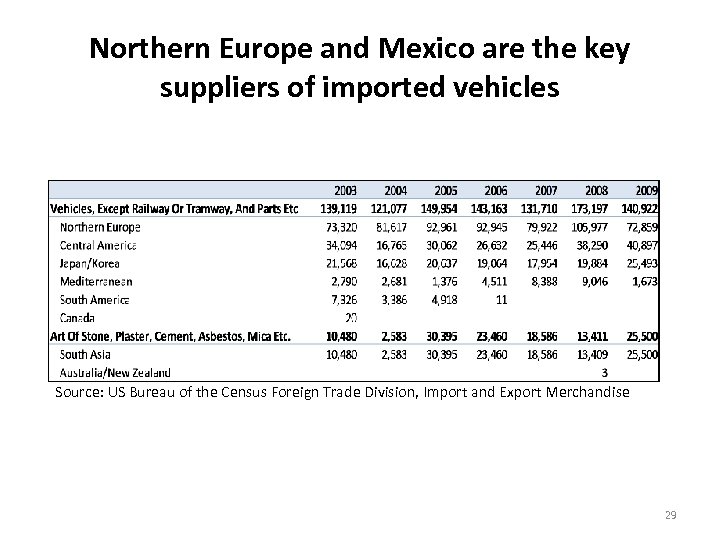 Northern Europe and Mexico are the key suppliers of imported vehicles Source: US Bureau of the Census Foreign Trade Division, Import and Export Merchandise 29
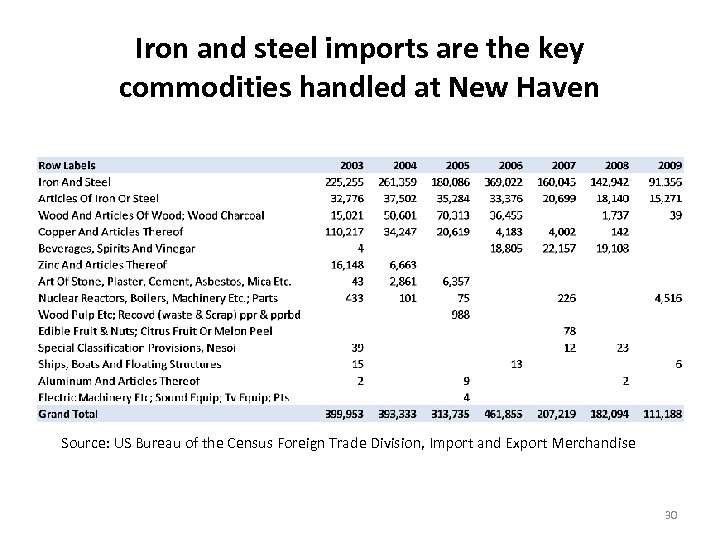 Iron and steel imports are the key commodities handled at New Haven Source: US Bureau of the Census Foreign Trade Division, Import and Export Merchandise 30
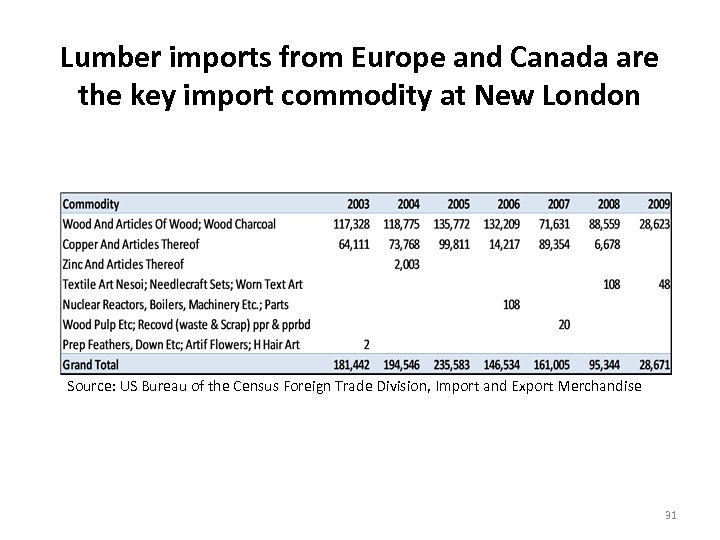 Lumber imports from Europe and Canada are the key import commodity at New London Source: US Bureau of the Census Foreign Trade Division, Import and Export Merchandise 31
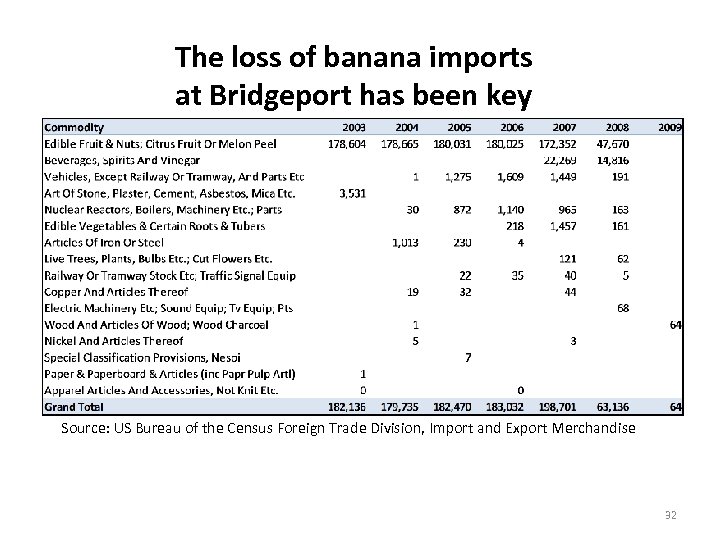 The loss of banana imports at Bridgeport has been key Source: US Bureau of the Census Foreign Trade Division, Import and Export Merchandise 32
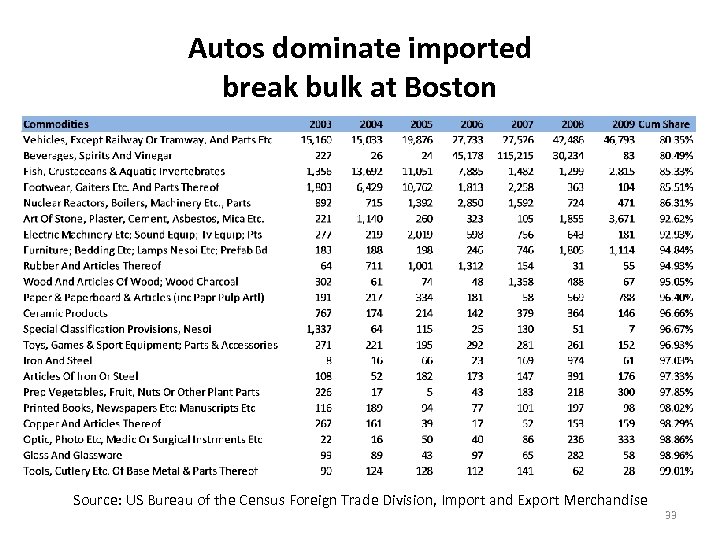 Autos dominate imported break bulk at Boston Source: US Bureau of the Census Foreign Trade Division, Import and Export Merchandise 33
 Break Bulk Exports 34
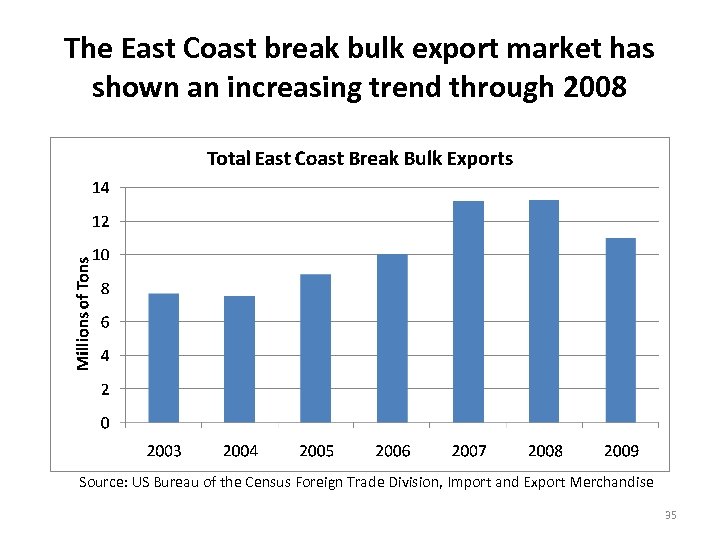 The East Coast break bulk export market has shown an increasing trend through 2008 Source: US Bureau of the Census Foreign Trade Division, Import and Export Merchandise 35
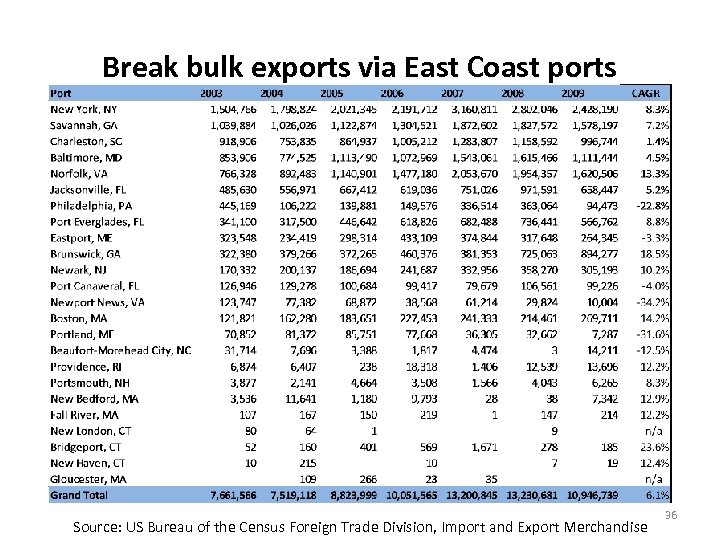 Break bulk exports via East Coast ports Source: US Bureau of the Census Foreign Trade Division, Import and Export Merchandise 36
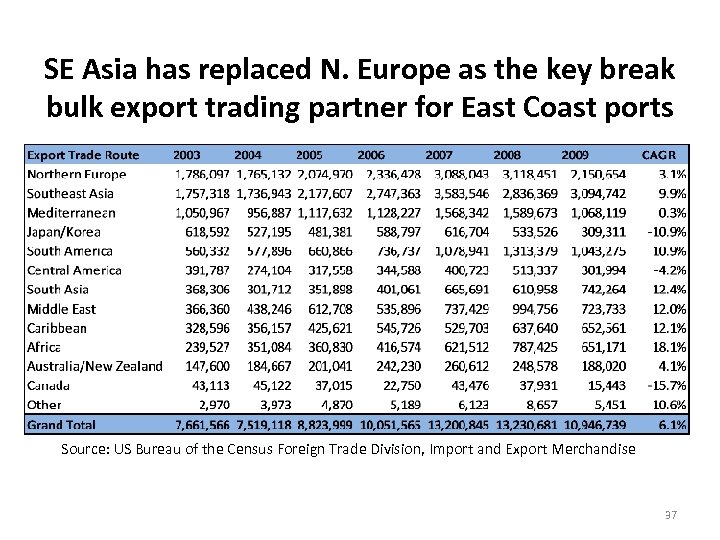 SE Asia has replaced N. Europe as the key break bulk export trading partner for East Coast ports Source: US Bureau of the Census Foreign Trade Division, Import and Export Merchandise 37
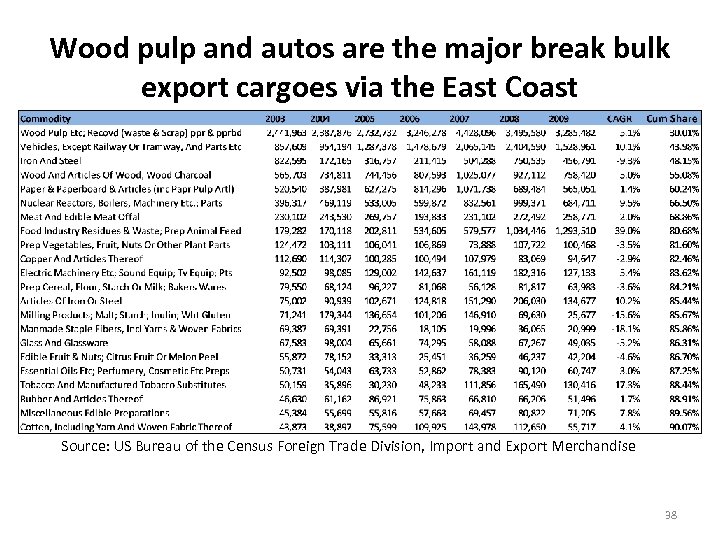 Wood pulp and autos are the major break bulk export cargoes via the East Coast Source: US Bureau of the Census Foreign Trade Division, Import and Export Merchandise 38
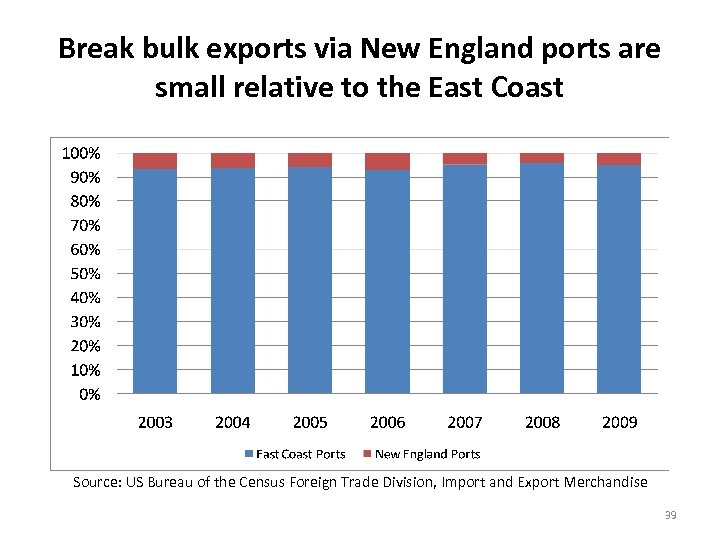 Break bulk exports via New England ports are small relative to the East Coast Source: US Bureau of the Census Foreign Trade Division, Import and Export Merchandise 39
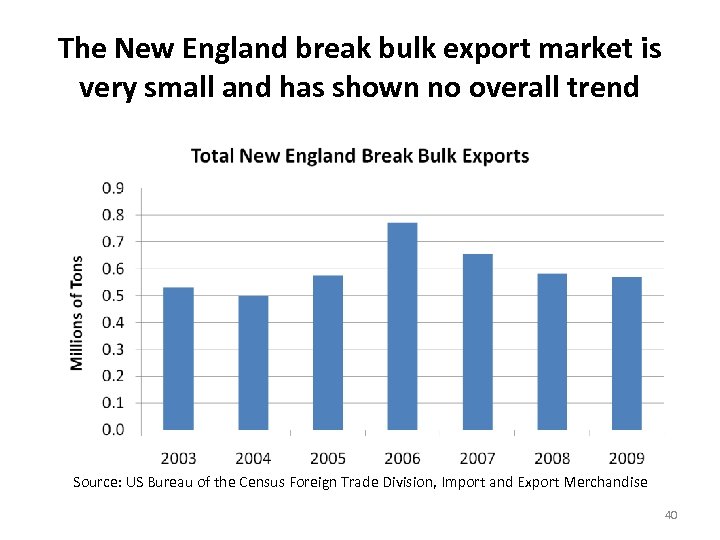 The New England break bulk export market is very small and has shown no overall trend Source: US Bureau of the Census Foreign Trade Division, Import and Export Merchandise 40
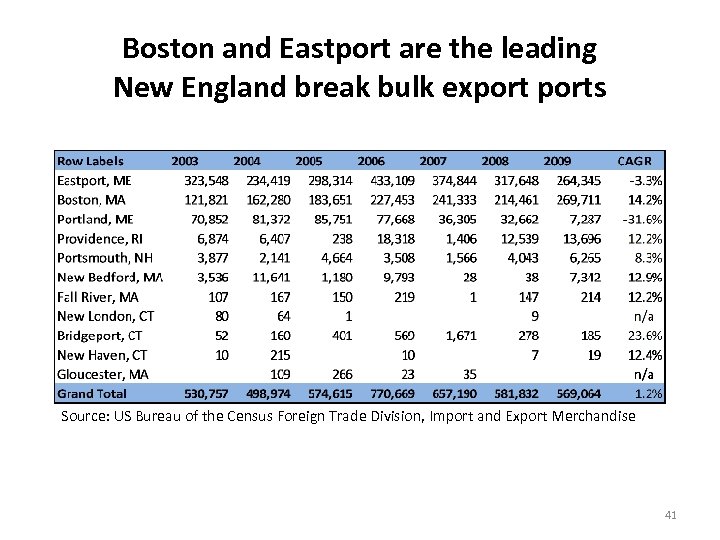 Boston and Eastport are the leading New England break bulk exports Source: US Bureau of the Census Foreign Trade Division, Import and Export Merchandise 41
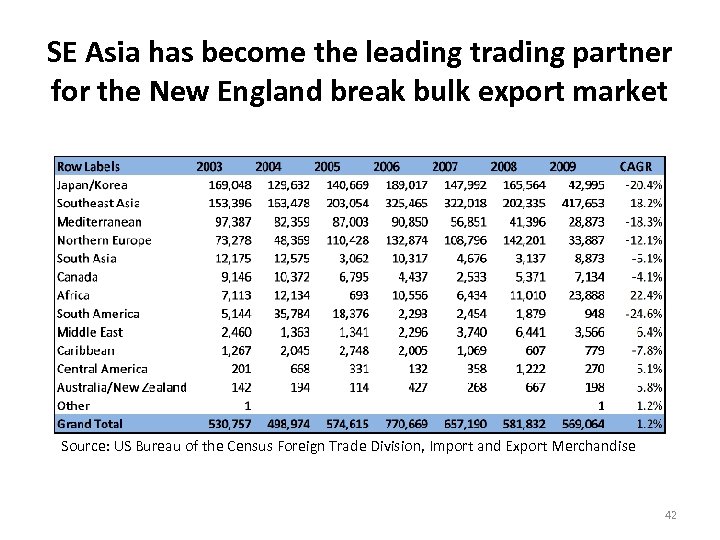 SE Asia has become the leading trading partner for the New England break bulk export market Source: US Bureau of the Census Foreign Trade Division, Import and Export Merchandise 42
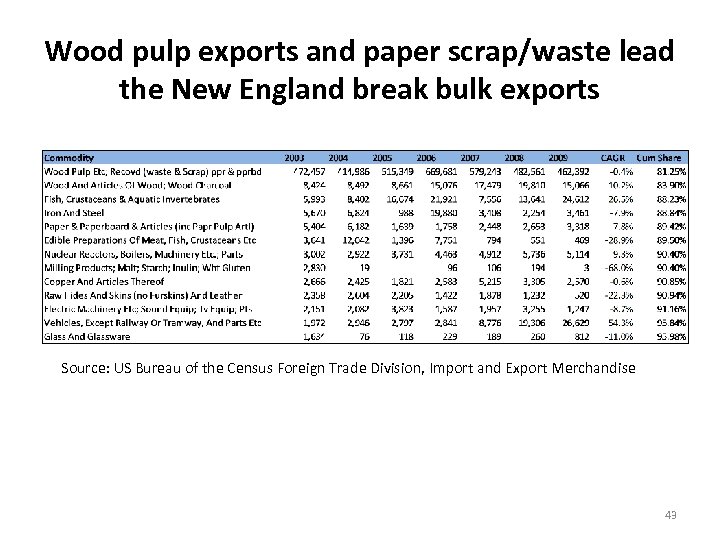 Wood pulp exports and paper scrap/waste lead the New England break bulk exports Source: US Bureau of the Census Foreign Trade Division, Import and Export Merchandise 43
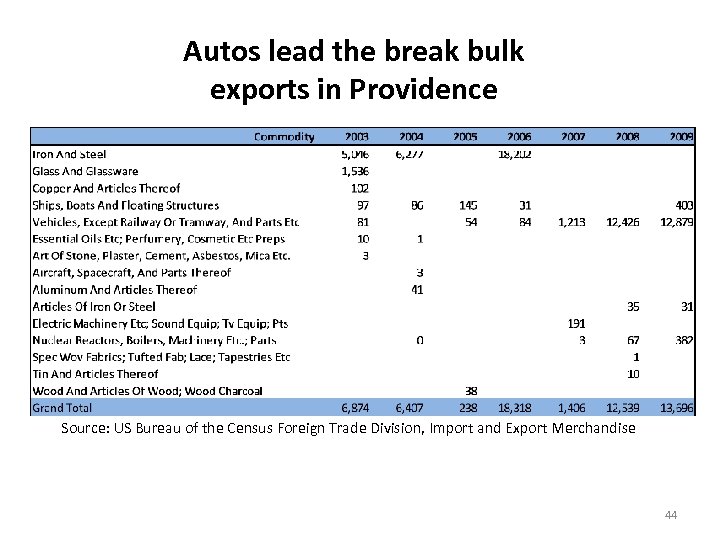 Autos lead the break bulk exports in Providence Source: US Bureau of the Census Foreign Trade Division, Import and Export Merchandise 44
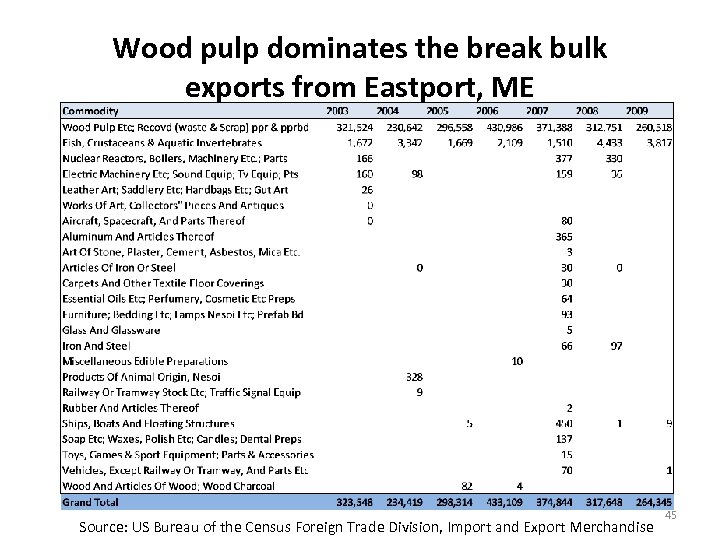 Wood pulp dominates the break bulk exports from Eastport, ME Source: US Bureau of the Census Foreign Trade Division, Import and Export Merchandise 45
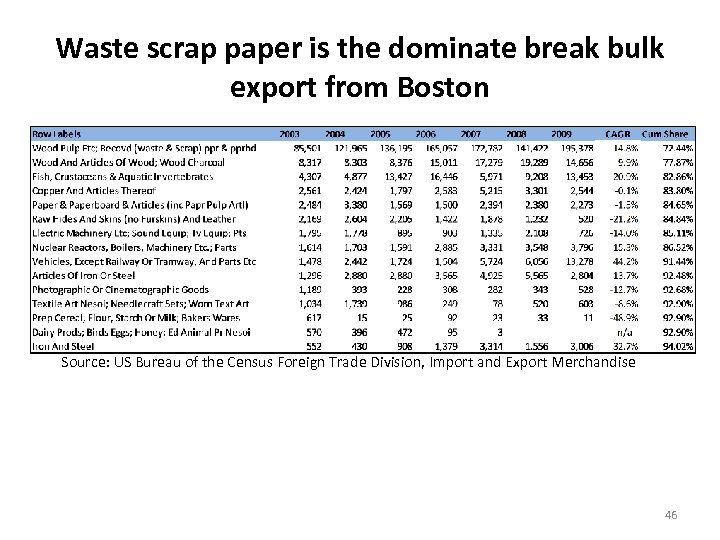 Waste scrap paper is the dominate break bulk export from Boston Source: US Bureau of the Census Foreign Trade Division, Import and Export Merchandise 46
 Dry Bulk Import Market 47
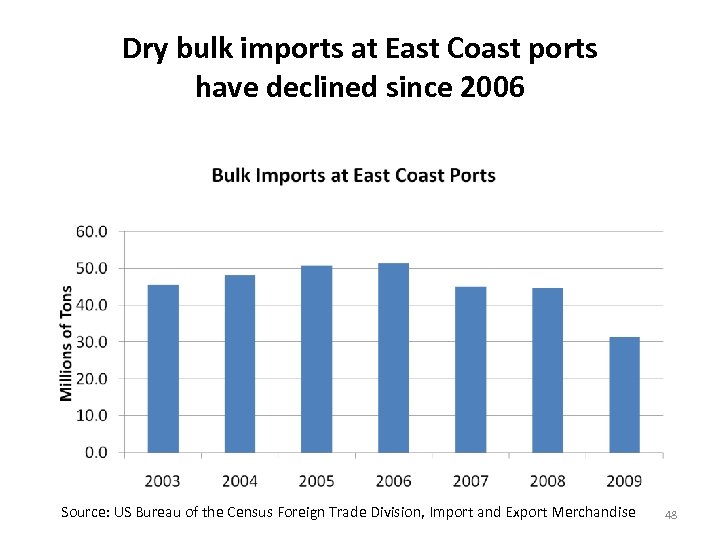 Dry bulk imports at East Coast ports have declined since 2006 Source: US Bureau of the Census Foreign Trade Division, Import and Export Merchandise 48
 Baltimore leads the East Coast in dry bulk imports 49
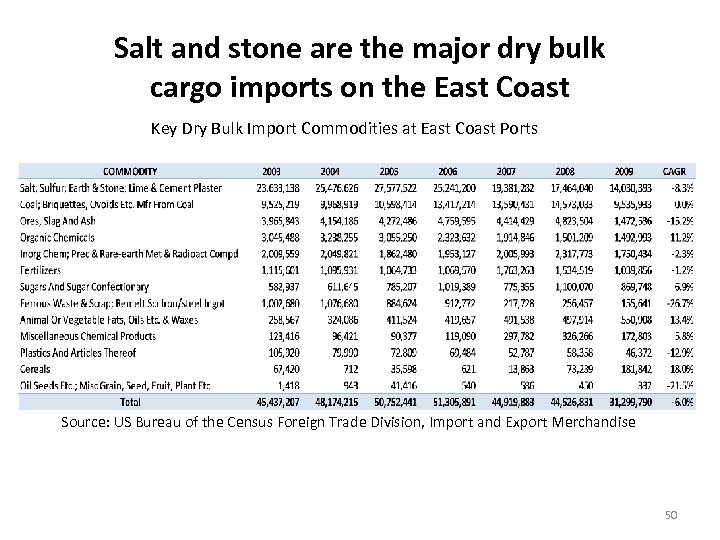 Salt and stone are the major dry bulk cargo imports on the East Coast Key Dry Bulk Import Commodities at East Coast Ports Source: US Bureau of the Census Foreign Trade Division, Import and Export Merchandise 50
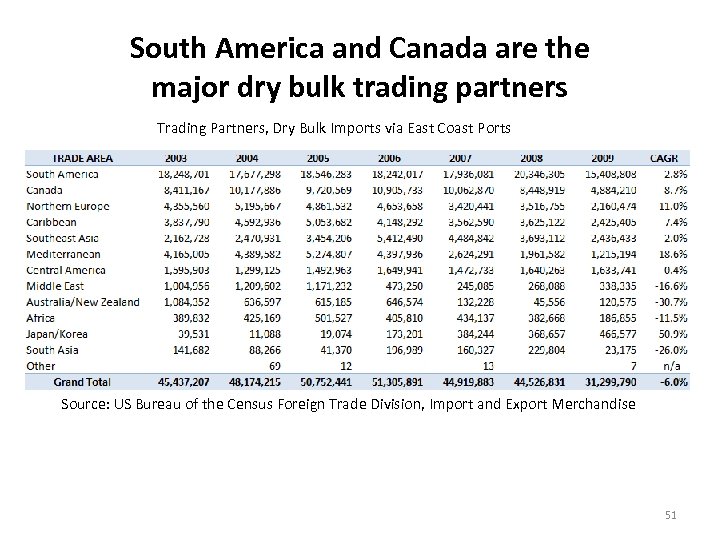 South America and Canada are the major dry bulk trading partners Trading Partners, Dry Bulk Imports via East Coast Ports Source: US Bureau of the Census Foreign Trade Division, Import and Export Merchandise 51
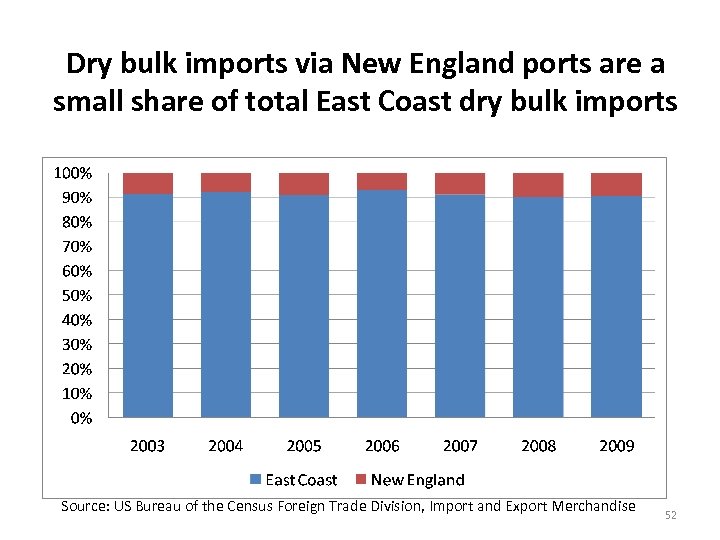 Dry bulk imports via New England ports are a small share of total East Coast dry bulk imports Source: US Bureau of the Census Foreign Trade Division, Import and Export Merchandise 52
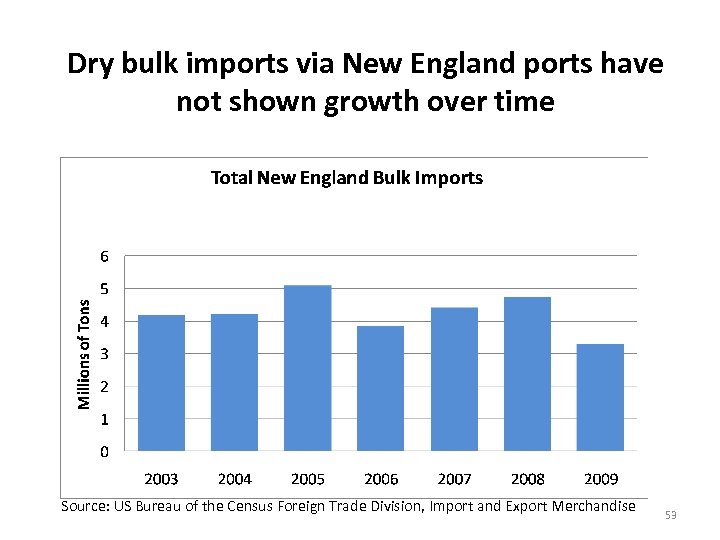 Dry bulk imports via New England ports have not shown growth over time Source: US Bureau of the Census Foreign Trade Division, Import and Export Merchandise 53
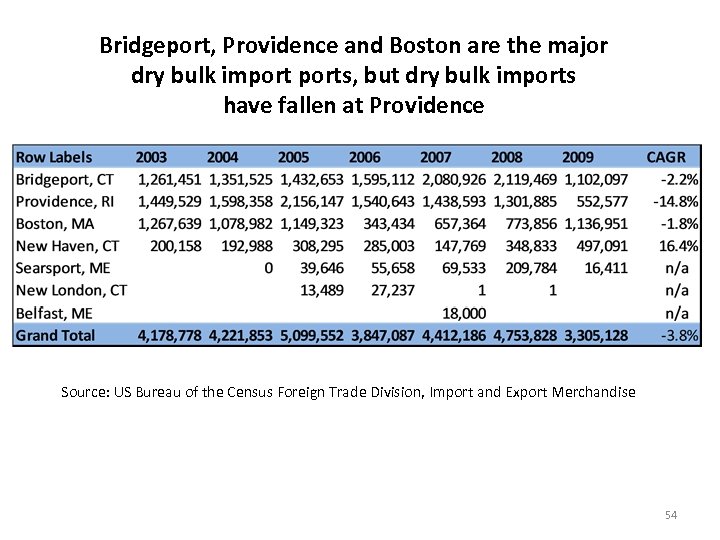 Bridgeport, Providence and Boston are the major dry bulk imports, but dry bulk imports have fallen at Providence Source: US Bureau of the Census Foreign Trade Division, Import and Export Merchandise 54
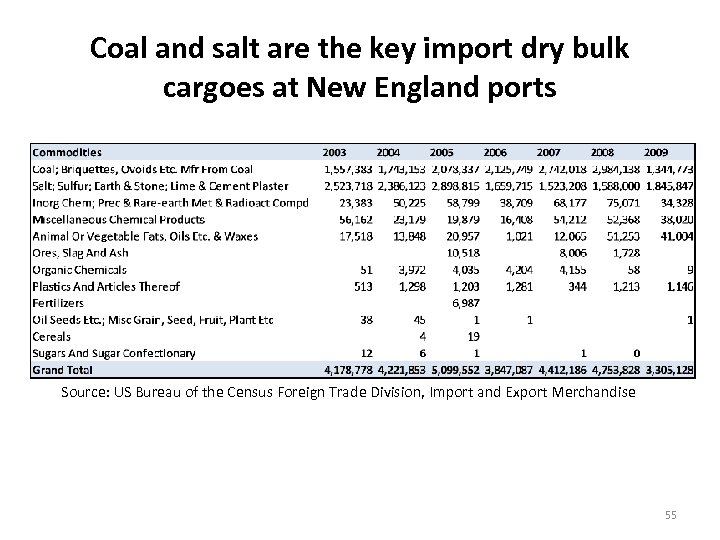 Coal and salt are the key import dry bulk cargoes at New England ports Source: US Bureau of the Census Foreign Trade Division, Import and Export Merchandise 55
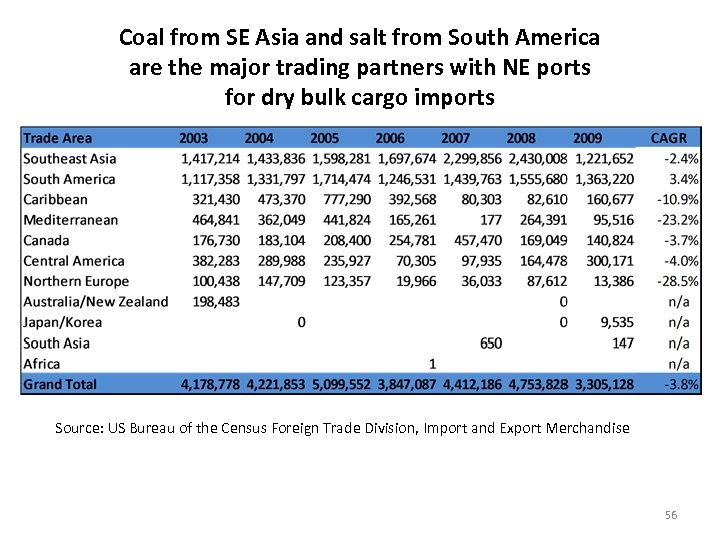 Coal from SE Asia and salt from South America are the major trading partners with NE ports for dry bulk cargo imports Source: US Bureau of the Census Foreign Trade Division, Import and Export Merchandise 56
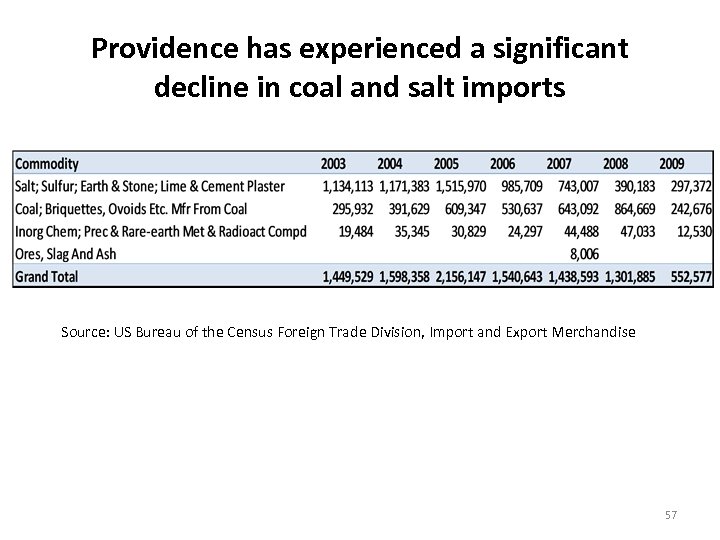 Providence has experienced a significant decline in coal and salt imports Source: US Bureau of the Census Foreign Trade Division, Import and Export Merchandise 57
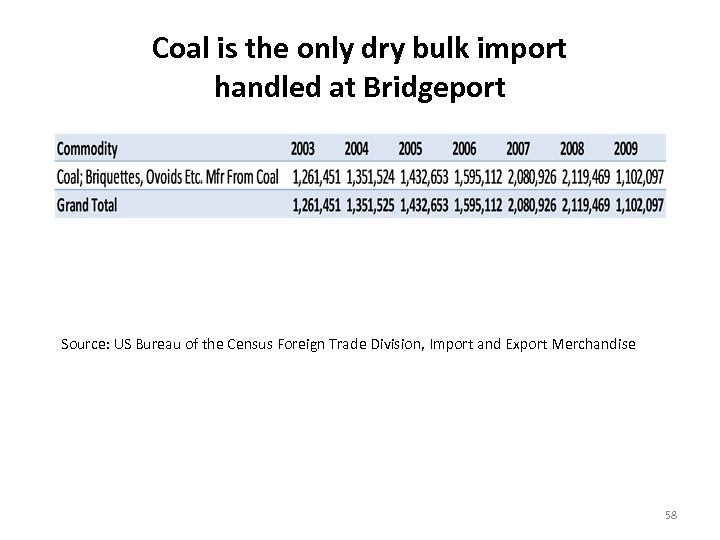 Coal is the only dry bulk import handled at Bridgeport Source: US Bureau of the Census Foreign Trade Division, Import and Export Merchandise 58
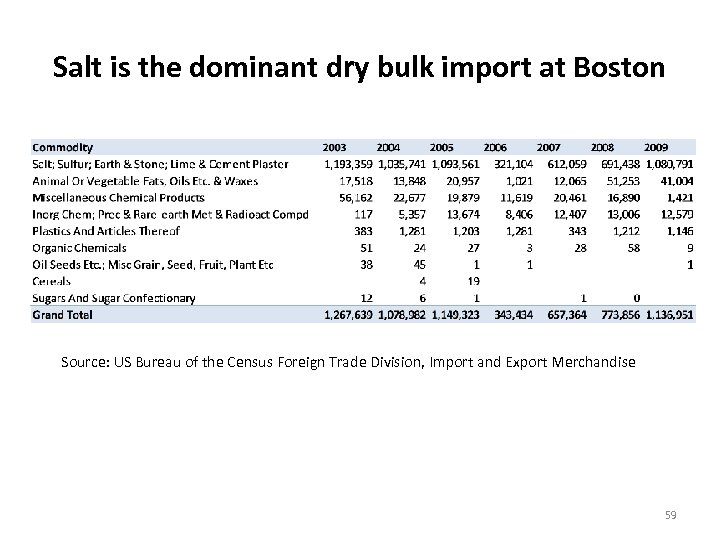 Salt is the dominant dry bulk import at Boston Source: US Bureau of the Census Foreign Trade Division, Import and Export Merchandise 59
 Dry Bulk Export Market 60
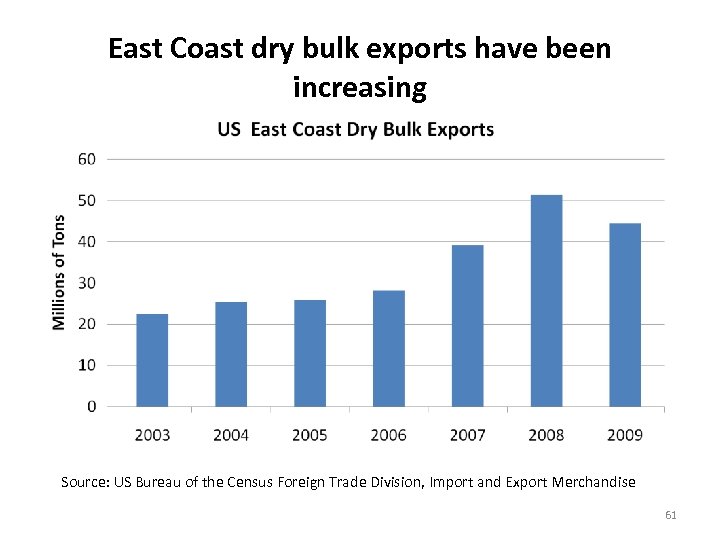 East Coast dry bulk exports have been increasing Source: US Bureau of the Census Foreign Trade Division, Import and Export Merchandise 61
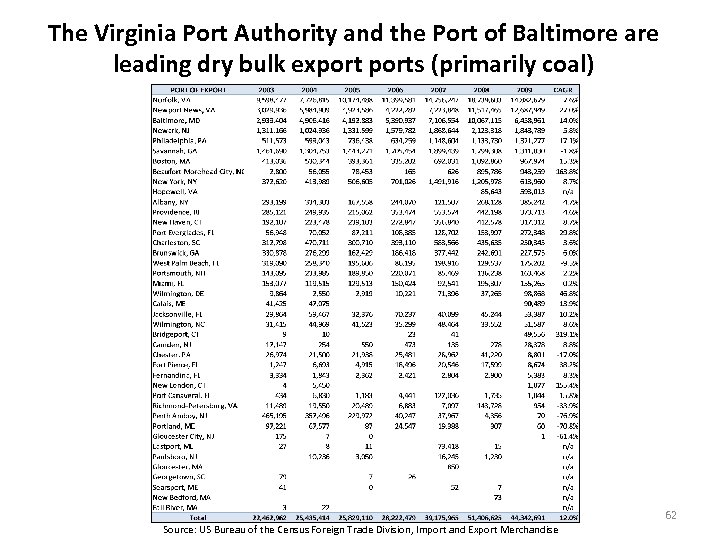 The Virginia Port Authority and the Port of Baltimore are leading dry bulk exports (primarily coal) 62 Source: US Bureau of the Census Foreign Trade Division, Import and Export Merchandise
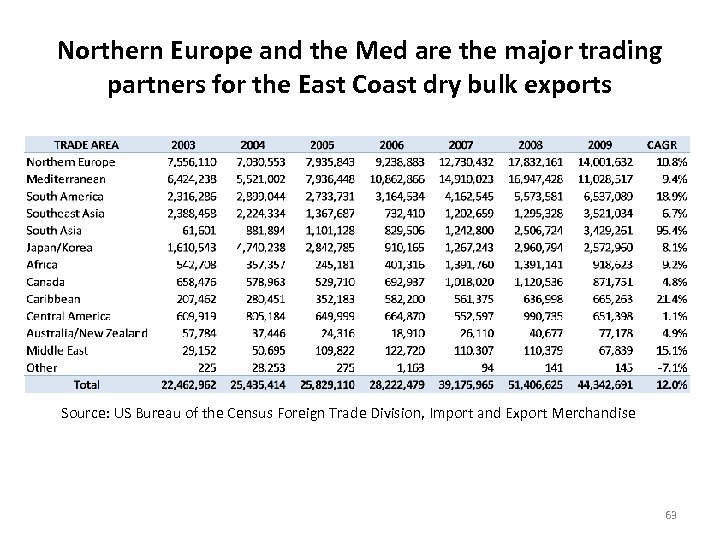 Northern Europe and the Med are the major trading partners for the East Coast dry bulk exports Source: US Bureau of the Census Foreign Trade Division, Import and Export Merchandise 63
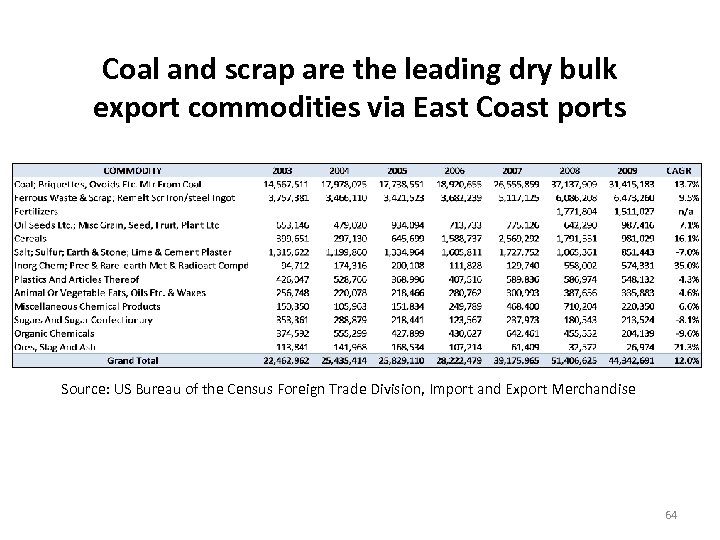 Coal and scrap are the leading dry bulk export commodities via East Coast ports Source: US Bureau of the Census Foreign Trade Division, Import and Export Merchandise 64
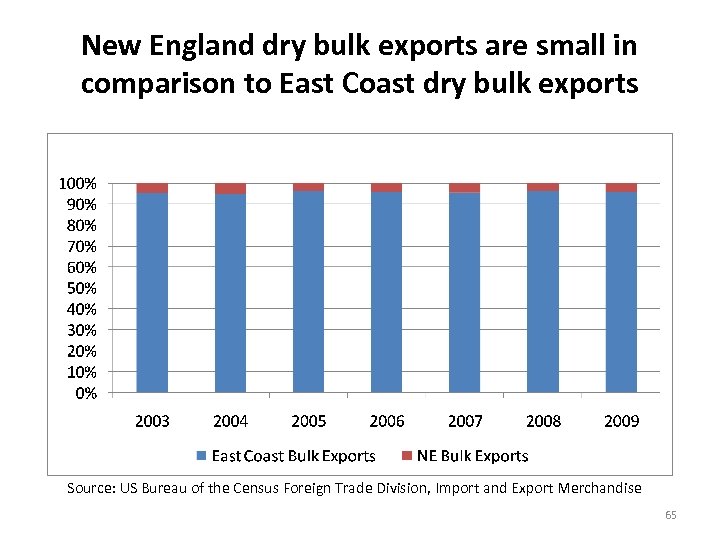 New England dry bulk exports are small in comparison to East Coast dry bulk exports Source: US Bureau of the Census Foreign Trade Division, Import and Export Merchandise 65
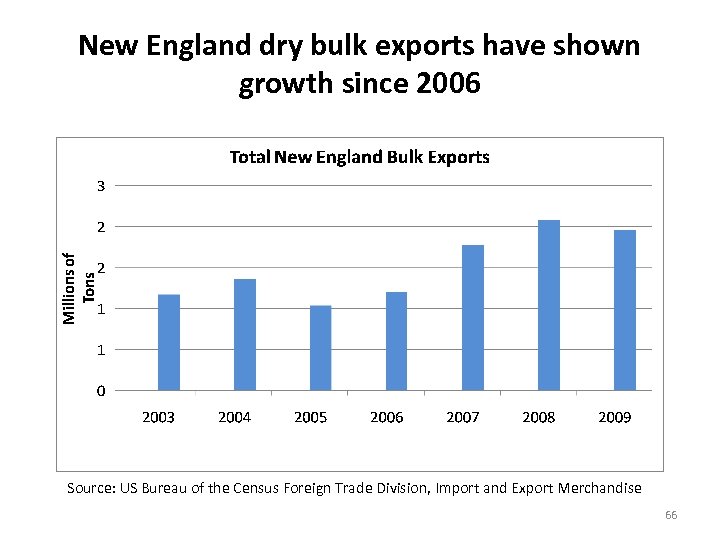 New England dry bulk exports have shown growth since 2006 Source: US Bureau of the Census Foreign Trade Division, Import and Export Merchandise 66
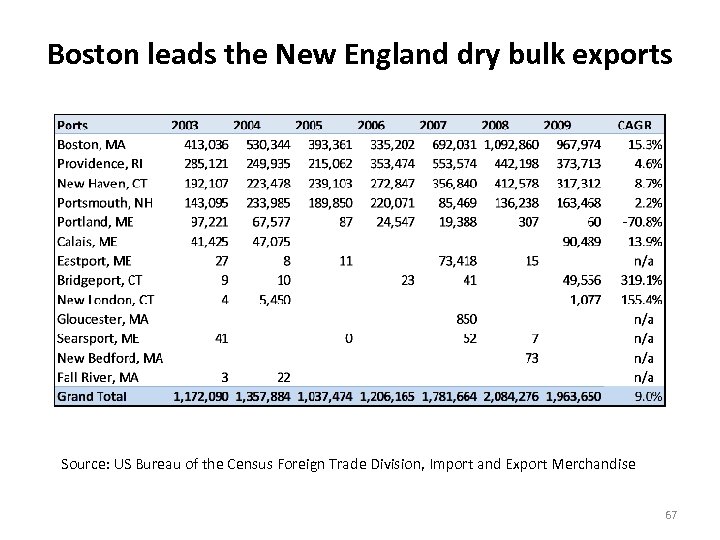 Boston leads the New England dry bulk exports Source: US Bureau of the Census Foreign Trade Division, Import and Export Merchandise 67
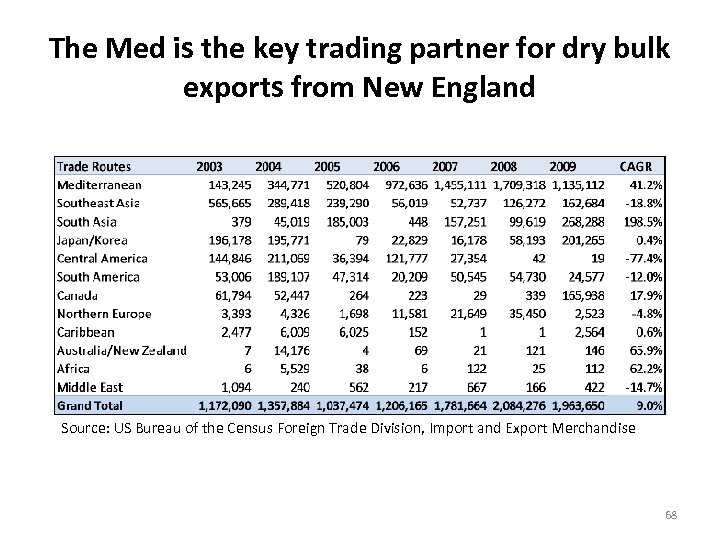 The Med is the key trading partner for dry bulk exports from New England Source: US Bureau of the Census Foreign Trade Division, Import and Export Merchandise 68
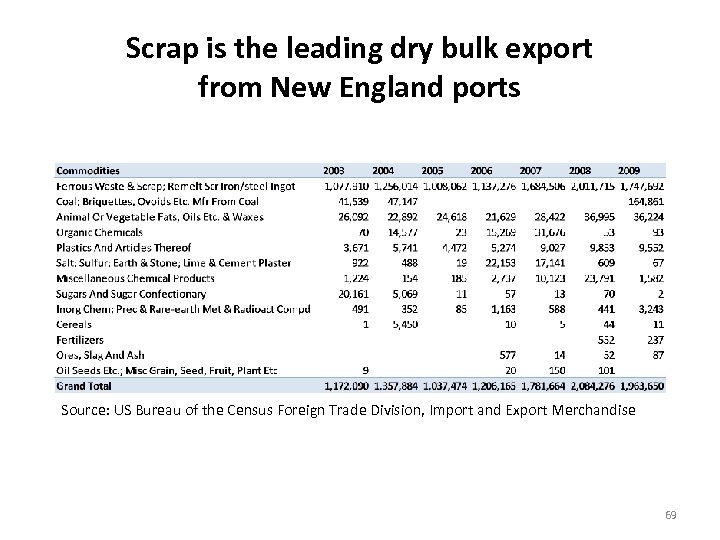 Scrap is the leading dry bulk export from New England ports Source: US Bureau of the Census Foreign Trade Division, Import and Export Merchandise 69
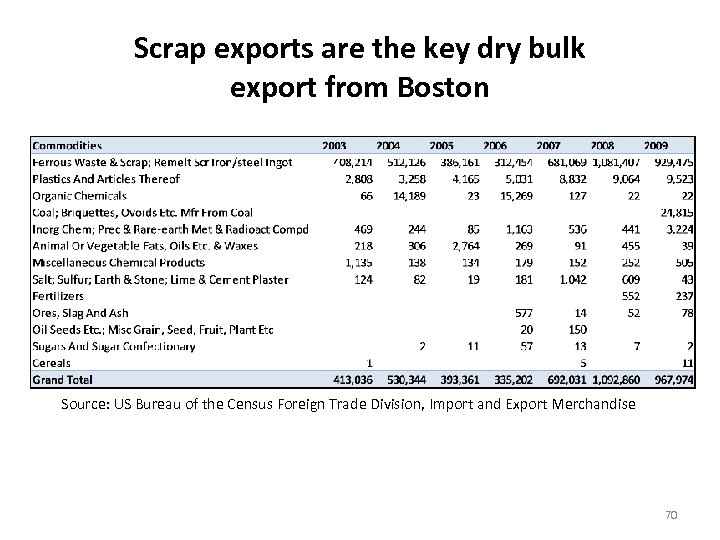 Scrap exports are the key dry bulk export from Boston Source: US Bureau of the Census Foreign Trade Division, Import and Export Merchandise 70
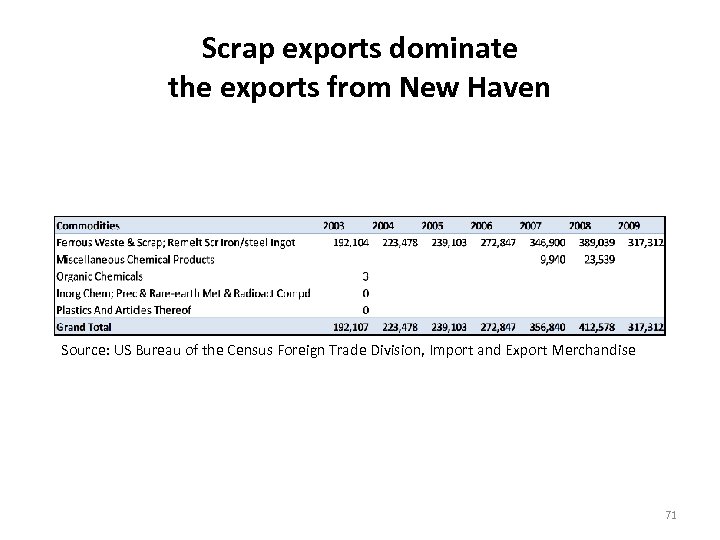 Scrap exports dominate the exports from New Haven Source: US Bureau of the Census Foreign Trade Division, Import and Export Merchandise 71
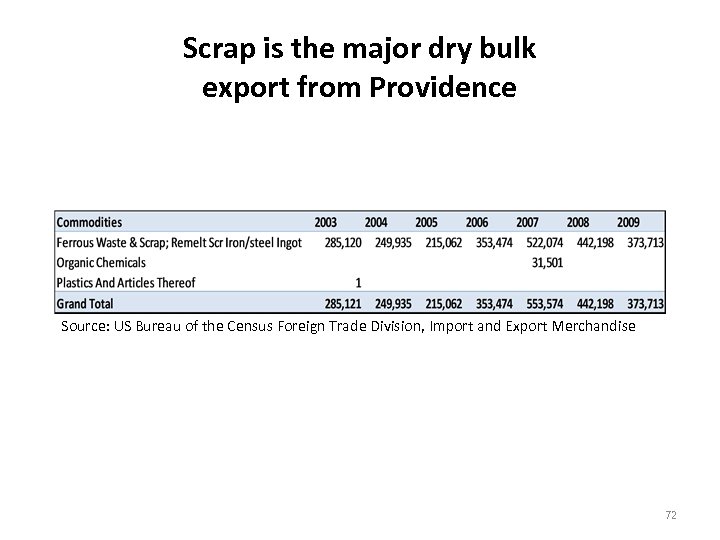 Scrap is the major dry bulk export from Providence Source: US Bureau of the Census Foreign Trade Division, Import and Export Merchandise 72
 IMPLICATIONS OF CARGO MARKET OVERVIEW 73
 The New England Ports have a small share of the East Coast break bulk and dry bulk markets • East Coast dry bulk imports are driven by coal and salt/stone • Coal is the key dry bulk import at Bridgeport, while salt is the major import at Boston and Providence • Coal is the major export from the East Coast ports • Scrap is the leading dry bulk export from New England ports, and Providence 74
 Several break bulk commodities have grown over time and represent potential opportunities for Rhode Island ports • Overall, break bulk imports have not shown growth over the past decade • Key break bulk cargoes that have shown growth over time are: – Break bulk fruit imports – Auto imports and exports • Davisville handles imports of new vehicles • Prov. Port handles exported Previously Owned Vehicles – Pulp imports – Scrap paper exports • Autos are the major break bulk imports and exports through Providence – Census Foreign Trade data reports “Providence” – includes Davisville and Prov. Port • Paper scrap exports are a key break bulk export from Boston • Pulp is the major break bulk export from Eastport • Steel is the major import via New Haven 75
 THE CURRENT SITUATION AT RHODE ISLAND PORTS 76
 Interviews were conducted to assess markets, facility descriptions, outlook of current cargoes handled at the Port of Davisville and Providence and to identify terminal constraints at Rhode Island ports • Terminal operators in Rhode Island were interviewed: – Port of Davisville: • Port of Davisville, managed by the Quonset Development Corporation • Port tenants – Prov. Port: • Tenants • Prov. Port management – Future market opportunities/tenants for RI ports assessed • To assess cruise market potential, Martin Associates interviewed the Newport & Bristol County Convention & Visitors Bureau regarding Newport cruise operations 77
 Port of Davisville Current Conditions This section provides and overview of the current facilities in the State of Rhode Island as well as the outlook for the base cargoes handled at these port facilities. 78
 Port of Davisville – Current Operations • Davisville Waterfront District is comprised of 289. 5 acres: – 239. 1 acres are developed or developable – 50. 4 acres are undevelopable • Port of Davisville is served by two piers: – – Pier 1 – built with load capacity of 500 lbs/sq ft Pier 2 – filled cofferdam structure with load capacity of 1, 000 lbs/sq ft 29 ft channel – controlling depth 31 ft alongside • Port of Davisville currently has two tenants: – North Atlantic Distribution (NORAD) – automobiles: • Leases 160 acres – 50 -year lease: – Last 35 acres currently being developed – Seafreeze – cold storage/seafood: • 15, 000 ton freezer • 3 -acre lease 79
 Port of Davisville received $22. 3 million TIGER Grant for port development and improvements Planned Grant Expenditures: – $4 million – rehabilitate Piers 1 & 2 – $10. 4 million – purchase and install mobile crane and crane platform – $4 million – pave Terminals 4 & 5 – $1 million – rail projects – $3 million – road projects As of spring 2011, all projects other than upgrades to Terminal 4 & 5 completed or scheduled for completion 80
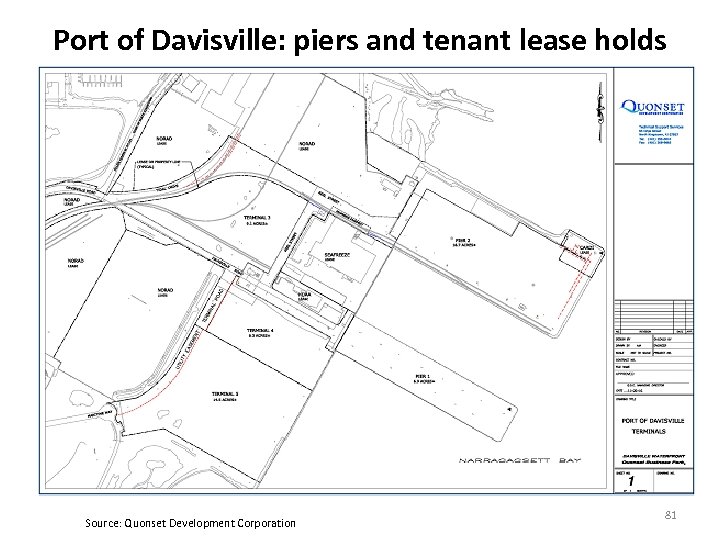 Port of Davisville: piers and tenant lease holds Source: Quonset Development Corporation 81
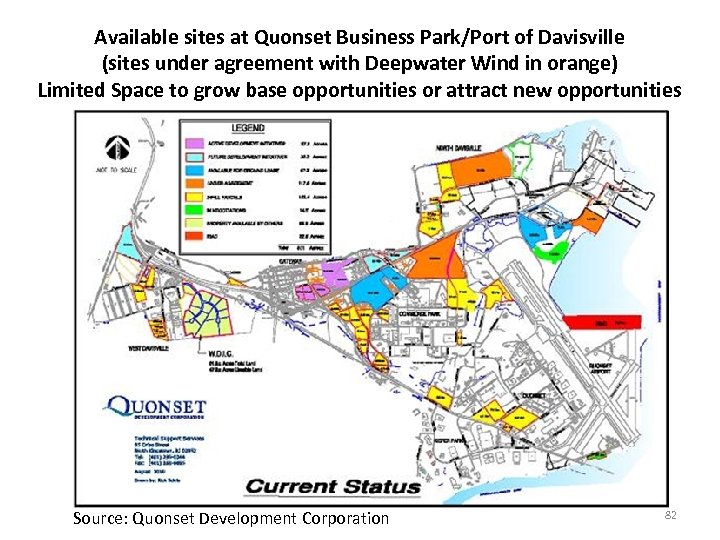 Available sites at Quonset Business Park/Port of Davisville (sites under agreement with Deepwater Wind in orange) Limited Space to grow base opportunities or attract new opportunities Source: Quonset Development Corporation 82
 Automobiles • Davisville is 3 rd largest auto port in the Northeast (8 th in North America): – 135, 575 import units in 2010 • Excludes domestics – Handles VW, Audi, Porsche, Subaru, Bentley and Ford • By comparison: – New York handled 330, 767 import autos – Baltimore handles 275, 000 import autos – Boston handled 16, 146 import autos 83
 Automobiles (cont’d) • Auto markets served via Davisville: – VW/Audi: • Market stretches from Maine to North Carolina and reaches into the Midwest – Porsche: • Market is New England to North Carolina to Midwest – Subaru: • New England market • ½ imported from Japan – ½ manufactured in Lafayette, IN and railed to Quonset/Davisville – Bentley: • 1, 500 -2, 000 cars per year destined for eastern half of US • Requires inside storage – Ford: • Produced domestically and railed to Quonset/Davisville • New England market • Ocean Carriers serving Davisville include: – NYK, K Line, Mitsui and VAG (VW leased ships) – 2, 000 -3, 000 cars discharged daily 84
 Automobiles (cont’d) • Infrastructure is in place and expanding to handle high volume throughput at Davisville. North Atlantic Distribution, Inc. (NORAD) is actively marketing new accounts to expand business at Davisville: – 3 NORAD processing facilities are in operation totaling 180, 000 ft 2 with a fourth building under construction. – Rail market accounts for 22% of the inbound automobile market: • • 100% of Ford inbound (domestic) – 35, 000 Units 50% of Subaru inbound (domestic) – 20, 000 Units 5% stock transfers – i. e. cars to San Diego if needed Can accommodate 30 rail cars at a time (50 autos/car) – Nearly all imported and domestic automobiles are distributed by truck to markets in New England the eastern United States: • 18, 000 -19, 000 trucks per month: – 8 -9 autos per truck – 5 autos per truck if enclosed 85
 Challenges for future growth of Auto imports in Davisville • Tenant actively marketing new accounts to expand business at Davisville: – Targeting accounts from other competing ports • There are issues facing the future of automobiles in Davisville: – Ability to fund dredging projects with non-Federal funds is key, since the use of Federal Funds will require US Army Corps of Engineers involvement, which will further impact the exemption from the harbor maintenance tax: • Deeper water will allow larger ships to call the port and increase throughput: – This would require in an estimated $7 million investment by the state • Currently the port is exempt from the Harbor Maintenance Tax, which equates to a savings of $12. 50 per $10, 000 of cargo value • The savings are important in the port choice of auto processors and importers/exporters • If the channel is deepened with Federal Funds, then the cargo will be subject to the Harbor Maintenance Tax, reducing the competitive advantage of Davisville • State funding of the deepening would preserve the exemption from the Harbor Maintenance Tax • Appropriations from the Legislature • Proceeds from Municipal or State bonds • Private sector financing 86
 • Port of Davisville plans to deepen to 32’ portions of channel accessing the turning basin. It will propose financing via a FY 2013 revenue bond a modest increase in tariff fees • It plans to conduct proposed dredging during the October 2012 to January 2013 “dredging window”
 Frozen Seafood • Seafreeze owns and operates an on-dock freezer at Davisville: – It is the largest frozen-at-sea fish producer on the East Coast: • 15, 000 ton capacity • The only competition is Cape May, NJ – It sells sea- and land-frozen fish and seafood to US and world markets: – 80 employees: • 45 on three boats 88
 Frozen Seafood (cont’d) • Frozen seafood is received in Davisville over the dock as well as by truck and rail from US and world markets: – Between 60 -70% of the inbound products are delivered by water: • Over the dock on own boats (3) plus two other supplying boats: – Seafood frozen aboard ships • Containerized imports discharged at other US ports and trucked to Davisville – About 20 -30 truck loads are shipped in and out of the freezer per day: • 40, 000 lbs/load, some LTL – Rail cars are used for shipments to/from the West Coast: • 150, 000 lbs/load – Typical dwell time for products in the freezer is 5 -6 months 89
 Frozen Seafood (cont’d) • Outbound markets are primarily international: – 95% of the exports are containerized: • 70 -80% export containers via NY or Boston – The single largest market is Alaska: • Outbound – squid used as bait for cod • Inbound – cod • Business is growing 15 -20% annually, which could result in capacity constraints under existing operating practices: – To increase capacity, the dwell time of the cargo could be reduced or the composition of the cargo now occupying space in the freezer can be changed to focus on import operations, rather than domestic storage • Could the cold storage facility provide a potential site for import of perishable fruit and meats? 90
 Prov. Port/Port of Providence Current Conditions 91
 Prov. Port is a privately operated marine terminal in Providence • Prov. Port occupies about 105 acres: – On-dock rail with 3 rail spurs – 20 acres of open lay down area – 300, 000+ ft 2 of enclosed warehouse space: • Includes indoor rail spur • Adjacent to pier face and on-dock rail lines • Potential expansion possibilities exist at the site at southern end of terminal: – adjacent to Ports America – (see Port Tenants map) 92
 Prov. Port has over 1 mile of berthing, capable of working 6 ships at one time • Berth #1: – 29 ft @ 7 ft off dock wall – 30 ft with fixed fendering (11 ft) – 31 ft @ 20 ft off dock wall • Berth #2: – 29 ft @ 7 ft off dock wall – 32 ft @ 13 ft off dock wall – 33 ft @ 20 ft off dock wall • Berth #3: • Berth #4: – 35 ft @ 7 ft off dock wall – 38 ft @ 13 ft off dock wall – 40 ft when 20 ft off dock wall • Berth #5: – 35 ft @ 7 ft off dock wall – 38 ft @ 13 ft off dock wall – 40 ft when 20 ft off dock wall • Berth #6: – 35 ft @ 7 ft off dock wall – 37. 5 ft @ 13 ft off dock wall – 40 ft when 20 ft off dock wall – 26 ft @ 7 ft off dock wall – 31 ft @ 13 ft off dock wall – 35 ft @ 20 ft off dock wall 93
 Prov. Port received $10. 5 million TIGER Grant to enhance cargo handling capability • Grant will contribute towards the purchase of 2 cranes (about $11 million each): – Cranes will be mounted on barges for movement throughout the Bay: • Cranes will be purchased in Europe • Barges will be purchased in the US • Cranes will support existing cargoes and expand capabilities for new markets 94
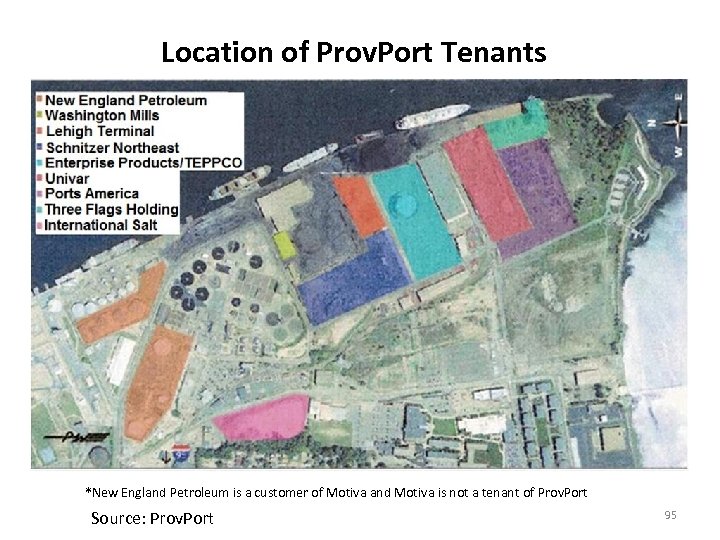 Location of Prov. Port Tenants *New England Petroleum is a customer of Motiva and Motiva is not a tenant of Prov. Port Source: Prov. Port 95
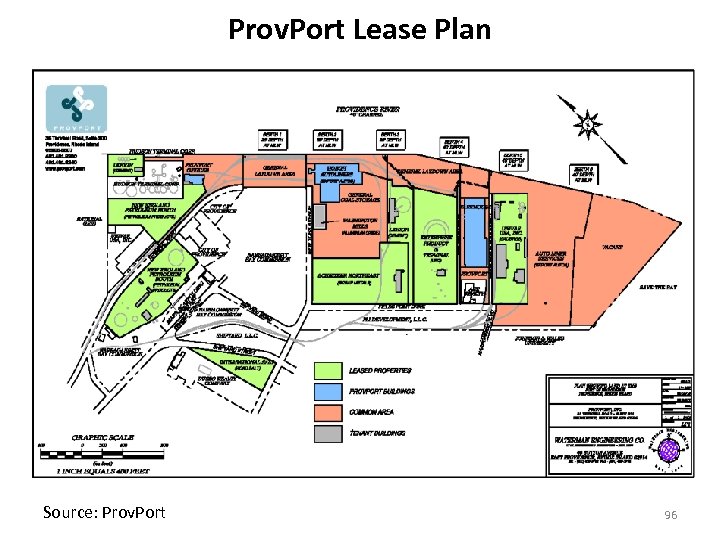 Prov. Port Lease Plan Source: Prov. Port 96
 Washington Mills imports aluminum oxide and ferrosilicon for manufacturing of abrasive materials • Leases a 26, 000 ft 2 warehouse with a storage capacity of 28, 000 tons • Annual imports average 50, 000 tons per year • Products are discharged from ships, stored on-dock until needed: – Maintains inventory at all times at Prov. Port • Products are trucked to North Grafton, MA for manufacturing: – 85 -90% of finished products destined for US markets – 10 -15% exported in containers, primarily through New York and Boston (West Coast ports have been used) • No change in market is seen in the near-term • There are no terminal/facility constraints for the aluminum oxide operations in the near future 97
 Lehigh Cement receives and stores cement at Prov. Port for regional distribution • Leases a 45, 000 ton capacity storage dome • Prov. Port reports an average of 67, 000 tons of cement were handled between 2007 and 2010 – dependent on market conditions, specifically construction activity in Rhode Island Southern Massachusetts • Theoretically, annual throughput capacity is estimated at 1 million tons. • This operation is not water dependent: – Cement arrives by rail from plants in PA, MD and Upstate NY – Cement moves out by truck to customers in a 60 -75 mile radius • No facility constraints at this time for cement operations • The following chart shows the projected level of construction activity in Rhode Island – This suggests that recovery in the local construction industry will be slow 98
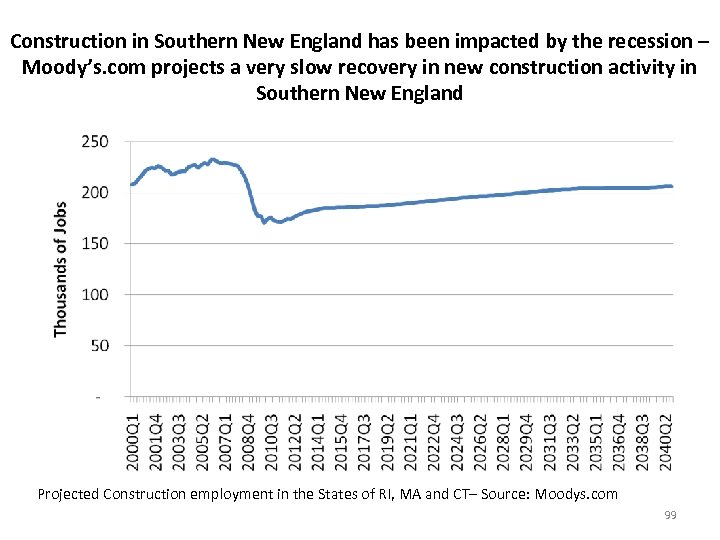 Construction in Southern New England has been impacted by the recession – Moody’s. com projects a very slow recovery in new construction activity in Southern New England Projected Construction employment in the States of RI, MA and CT– Source: Moodys. com 99
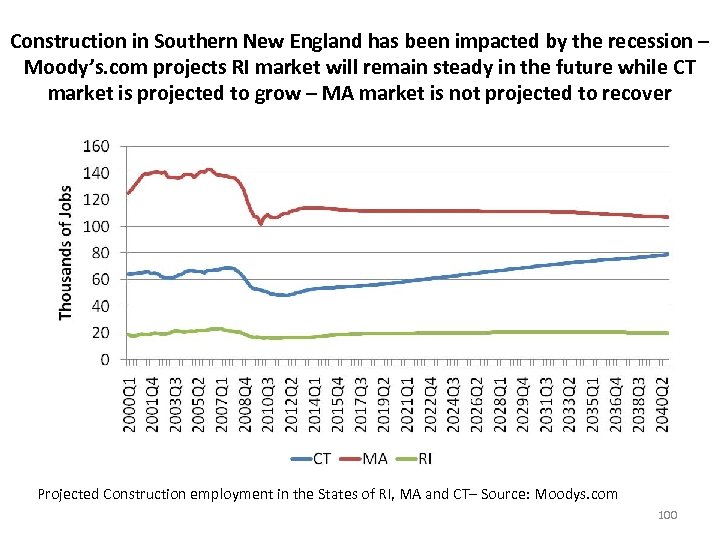 Construction in Southern New England has been impacted by the recession – Moody’s. com projects RI market will remain steady in the future while CT market is projected to grow – MA market is not projected to recover Projected Construction employment in the States of RI, MA and CT– Source: Moodys. com 100
 Schnitzer Northeast – scrap metal • 7 acres of open storage area are leased by Schnitzer • 500, 000 -600, 000 tons of scrap handled annually: – Prov. Port reports an average of 572, 000 tons were handled in the last 4 years • Theoretical capacity estimated at 1½-2 million tons • Scrap is delivered to Prov. Port by truck, rail and barge and is shipped out on ships • 5% annual growth is anticipated in the near-term • Sufficient capacity as terminal is operating at less than 50% of capacity: – However, this has been a dominant export cargo from New England ports historically 101
 Enterprise Products (formerly TEPPCO) receives imported LPG from Algeria • Enterprise operates a 420, 000 barrel (bbl) storage tank at Prov. Port: – Inventory turns every 5 weeks in winter – Inventory turns every 2 months in summer • 196, 000 tons of LPG are imported annually on average: – Sole customer controls the markets: • Source, destinations and costs • Has the market insight • No growth in throughput anticipated in mid term • Capacity adequate to handle future growth potential 102
 Univar – caustic soda 50% • An average of 47, 000 tons are imported annually • Univar key markets are: – Food industry – Personal care – Pharmaceuticals • Projecting 9 -10% growth in 2011: – Committed to aggressive growth in New England: • General growth • acquisitions • Terminal capacity adequate to handle future anticipated growth 103
 Ports America handles used cars for export • Leases 12 acres for automobile storage and handling • 20, 000 previously owned vehicles (POV’s) exported in 2009: – New England is the primary originating market – Automobiles also originate from as far as Ohio and Canada • 40 ship calls at Prov. Port in 2009: – Hoegh Autoliners provides vessel service – 75% of export market is to Africa – 25% of export market is to the Mediterranean • Market is growing • Ports America has experienced constraints at Prov. Port: – Only 4 of the 6 berths can handle auto ships (due to water depth restrictions alongside) – Land constrained to expand POV business 104
 International Salt imports salt for roads • Leases storage area at Prov. Port and also has an off-port facility • An average of 236, 000 tons were handled between 2007 and 2010 – Prov. Port reported 339, 000 tons in 2010 • Market area is Southeastern New England: – Rhode Island portions of Massachusetts – Most customers are located within a 50 -mile radius • Morton reported salt storage pile height restrictions is the capacity constraint: – Salt pile height is restricted to prevent blocking views by neighbors – Demand driven by weather conditions 105
 Implications for Current Base Cargo at Rhode Island Ports • Auto business at Davisville represents a significant potential growth opportunity • Can Port of Davisville or Prov. Port compete in the perishable fruits and meat market? • Capacity exists at Prov. Port to support the future projected growth of the base commodities 106
 CARGO MARKET OPPORTUNITIES In this section, potential market opportunities are analyzed to determine the ability of Rhode Island Ports to capture a share of these markets. These markets include increasing the Rhode Island participation in the Atlantic automobile import and export market, the participation in the wind energy markets, particularly the off shore markets, and the potential to develop short sea shipping opportunities through the development of a container feeder operation. 107
 Potential Auto Markets – The Competitive Environment 108
 Potential opportunities for Davisville – Automobiles • Auto import, export and domestic mixing operations for new autos at Davisville have been growing • Major competition is: – – New York/Newark Boston Baltimore Philadelphia 109
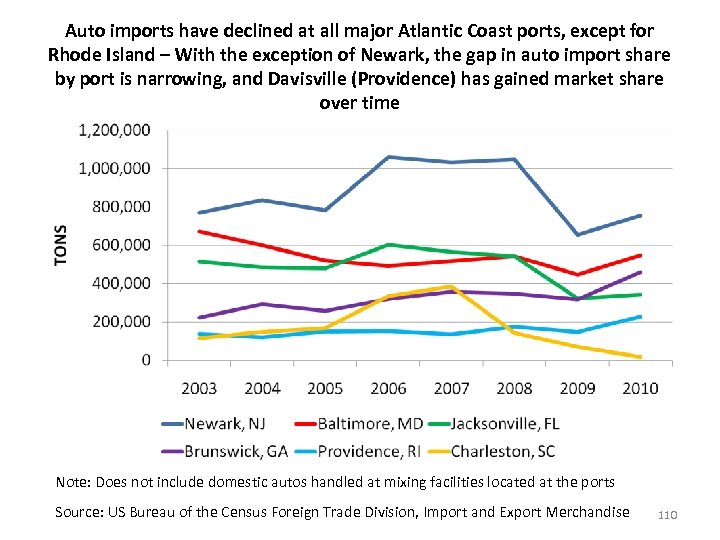 Auto imports have declined at all major Atlantic Coast ports, except for Rhode Island – With the exception of Newark, the gap in auto import share by port is narrowing, and Davisville (Providence) has gained market share over time Note: Does not include domestic autos handled at mixing facilities located at the ports Source: US Bureau of the Census Foreign Trade Division, Import and Export Merchandise 110
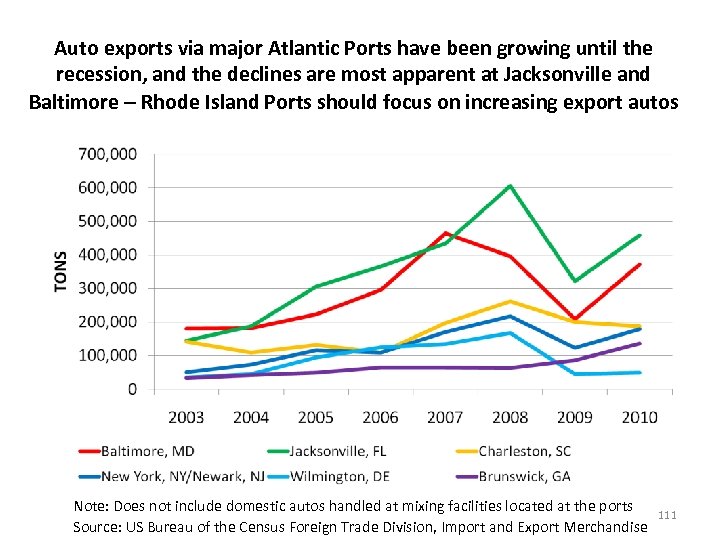 Auto exports via major Atlantic Ports have been growing until the recession, and the declines are most apparent at Jacksonville and Baltimore – Rhode Island Ports should focus on increasing export autos Note: Does not include domestic autos handled at mixing facilities located at the ports Source: US Bureau of the Census Foreign Trade Division, Import and Export Merchandise 111
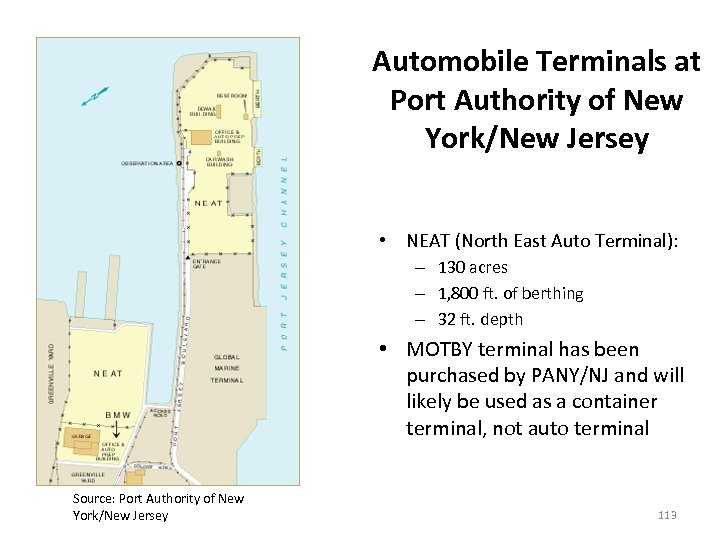 Automobile Terminals at Port Authority of New York/New Jersey • NEAT (North East Auto Terminal): – 130 acres – 1, 800 ft. of berthing – 32 ft. depth • MOTBY terminal has been purchased by PANY/NJ and will likely be used as a container terminal, not auto terminal Source: Port Authority of New York/New Jersey 113
 Auto Facilities at the Port of Philadelphia • Pier 98 is operated by Philly RO/RO Partners • Glovis imports and processes 150, 000 Hyundai’s and Kia’s • PRPA invested $1 million and Philly RO/RO partners invested $3. 7 million • Holt Logistics’ subsidiary, Greenwich Terminals, leases the terminal, and Holt Logistics negotiated the deal with Glovis • “Word on the street” is that PRPA receives less than $10. 00 per car: – Most ports receive $20 -30/auto in revenue – Philadelphia essentially bought the business from Baltimore 114
 South Jersey Port Corporation – Paulsboro Site offers a potential for auto import terminal development • Targeting off shore wind energy support, RO/RO and break bulk • Phase I of Facility upgrade (Being developed through bond issued by SJPC): – 2 berth facility – Rail loop – 75 acres of open storage • Phase II: – Third berth and barge berth – 125 additional acres of outside storage • Conrail connecting to NS and CSX • 40 ft. of water, possible 45 ft. • Looking for private sector investor for Phase II 115
 Auto facilities at the Rhode Island Ports • Port of Davisville: – 4, 500 linear feet of berthing space – Two piers (each 1, 200 feet in length) – 29 ft controlling depth - mean low water (MLW) – On-dock rail – 31. 3 acres for auto storage – 120+ acres for processing – No Harbor Maintenance Tax – Volkswagen/Audi, Porsche, Subaru, Bentley accounts – Ford uses Davisville for domestic distribution: • 25, 000 cars will be railed by Norfolk Southern initially • Volume projected to 75, 000 cars per year – The absence of the Harbor Maintenance tax is a key competitive advantage for the Port of Davisville. If federal dredging were required, the Port may be subject to the Harbor Maintenance Tax. – Therefore, deepening should focus on state or private sector funding • Port of Providence: – 12 acres for auto storage – 4 of 6 berths capable of docking RO/RO vessels 116
 Auto throughput potential • The import market has been in decline, but opportunities should focus on: – Discussion with Glovis, the logistics company handling the Hyundai Kia imports throughout the United States: • Philadelphia is the current port now used by Glovis, and the PRPR has “a very low” throughput charge, and as a result this could be a difficult account to attract • Auto business at Boston and New York/New Jersey is a also a potential target, given the growth in containerized cargo at New York/New Jersey and the recent purchases of the Port Authority of the MOTB terminal for future container operations • Further focus by Davisville on exports as well as the continued development of the domestic distribution business • It is essential to remain free of the Harbor Maintenance Tax (HMT), and focus should also be on higher value autos to maximize the absence of the Harbor Maintenance Tax 117
 Perishable Cargo Market – Atlantic Coast Overview 118
 Potential opportunities for Providence – Fresh Fruit • Historically, Bridgeport handled imported break bulk bananas for Turbana • This market has demonstrated a stable growth over time, and is a labor-intensive port cargo activity, as shown in the table on the following page • Turbana left Bridgeport for Philadelphia in 2008, and had been identified as a potential customer for Davisville previously by Martin Associates • Interviews were conducted with several break bulk fruit importers and cold chain logistics providers to identify potential market for Providence and Davisville 119
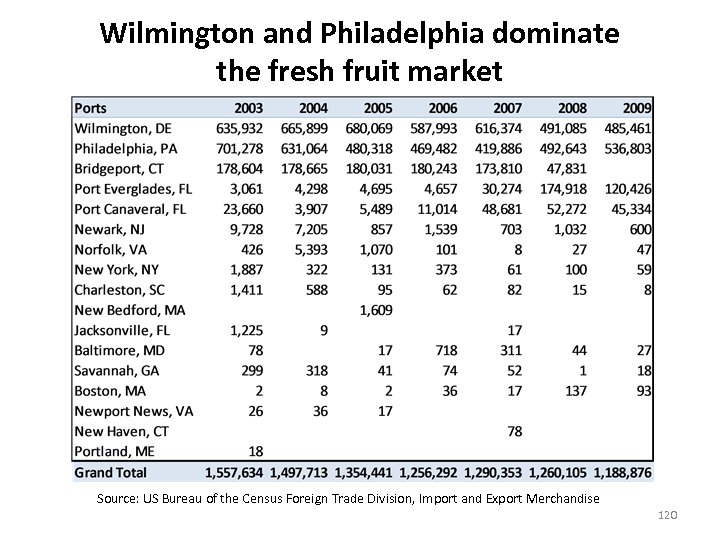 Wilmington and Philadelphia dominate the fresh fruit market Source: US Bureau of the Census Foreign Trade Division, Import and Export Merchandise 120
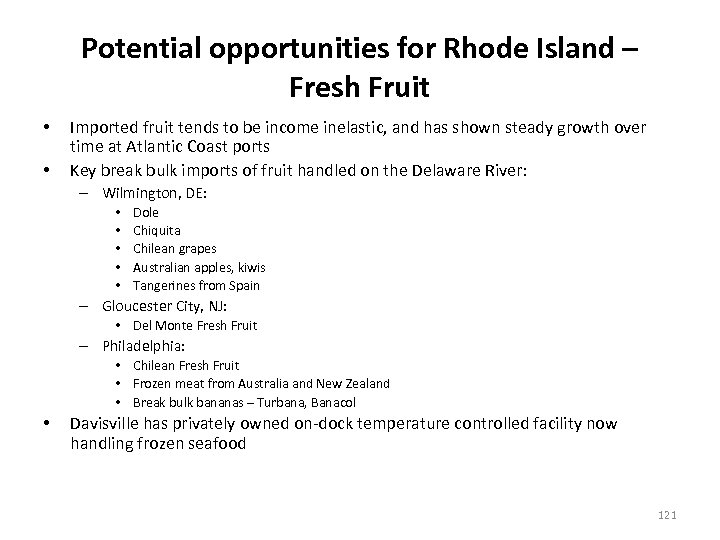 Potential opportunities for Rhode Island – Fresh Fruit • • Imported fruit tends to be income inelastic, and has shown steady growth over time at Atlantic Coast ports Key break bulk imports of fruit handled on the Delaware River: – Wilmington, DE: • • • Dole Chiquita Chilean grapes Australian apples, kiwis Tangerines from Spain – Gloucester City, NJ: • Del Monte Fresh Fruit – Philadelphia: • Chilean Fresh Fruit • Frozen meat from Australia and New Zealand • Break bulk bananas – Turbana, Banacol • Davisville has privately owned on-dock temperature controlled facility now handling frozen seafood 121
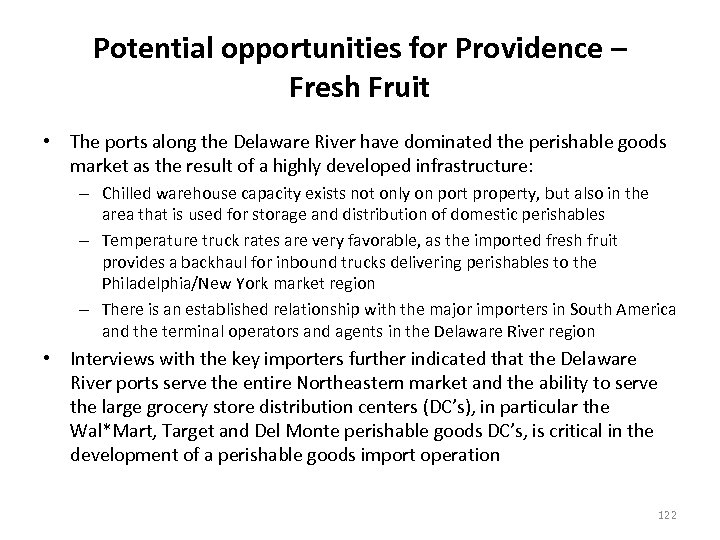 Potential opportunities for Providence – Fresh Fruit • The ports along the Delaware River have dominated the perishable goods market as the result of a highly developed infrastructure: – Chilled warehouse capacity exists not only on port property, but also in the area that is used for storage and distribution of domestic perishables – Temperature truck rates are very favorable, as the imported fresh fruit provides a backhaul for inbound trucks delivering perishables to the Philadelphia/New York market region – There is an established relationship with the major importers in South America and the terminal operators and agents in the Delaware River region • Interviews with the key importers further indicated that the Delaware River ports serve the entire Northeastern market and the ability to serve the large grocery store distribution centers (DC’s), in particular the Wal*Mart, Target and Del Monte perishable goods DC’s, is critical in the development of a perishable goods import operation 122
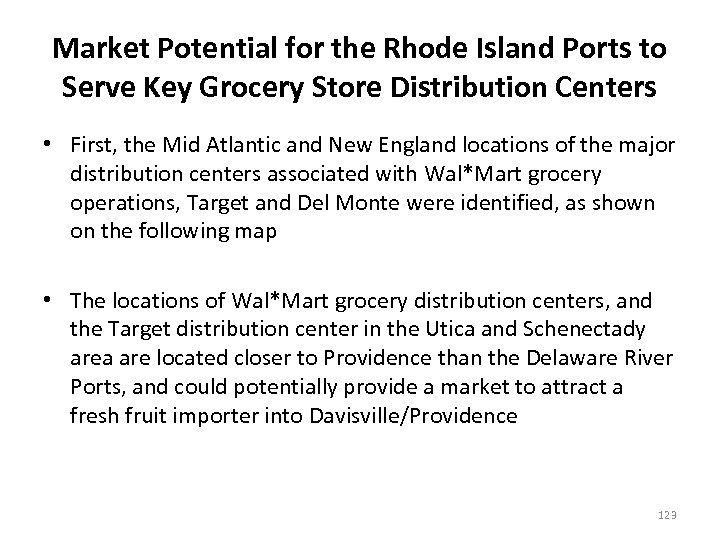 Market Potential for the Rhode Island Ports to Serve Key Grocery Store Distribution Centers • First, the Mid Atlantic and New England locations of the major distribution centers associated with Wal*Mart grocery operations, Target and Del Monte were identified, as shown on the following map • The locations of Wal*Mart grocery distribution centers, and the Target distribution center in the Utica and Schenectady area are located closer to Providence than the Delaware River Ports, and could potentially provide a market to attract a fresh fruit importer into Davisville/Providence 123
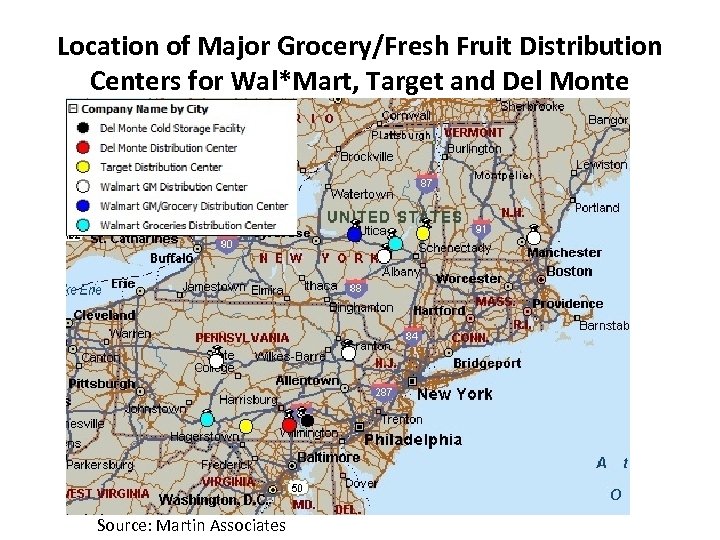 Location of Major Grocery/Fresh Fruit Distribution Centers for Wal*Mart, Target and Del Monte Source: Martin Associates
 Market Potential for the Rhode Island Ports to Serve Key Grocery Store Distribution Centers • In addition to proximity to the “Big Box” Grocery distribution centers, the proximity to other chain store grocery store distribution centers is also important in marketing to an import fruit/perishable goods operator for a Rhode Island Port location • The map on the following page also identifies the location of the chain grocery store distribution centers in New England, as well as the non-chain independent single store distribution centers 125
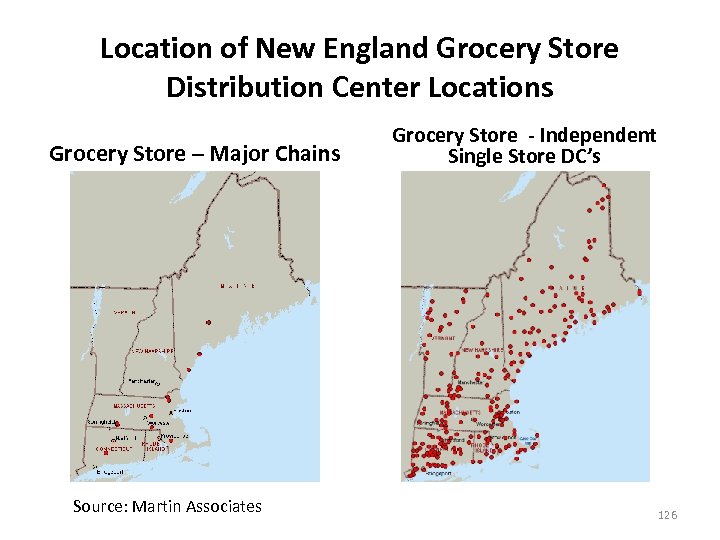 Location of New England Grocery Store Distribution Center Locations Grocery Store – Major Chains Source: Martin Associates Grocery Store - Independent Single Store DC’s 126
 Implications for the development of Fruit Import Terminal Operations in Rhode Island • The market analysis regarding the development of an import perishable operations appears to present potential for the Rhode Island Ports • Further analysis is necessary to develop detailed logistics costs, as well as to target potential tenants and terminal operators • Initially, market efforts should focus on: – – – Dole Del Monte Chiquita Banacol Holt Logistics - the key terminal operator on the Delaware River 127
 Break Bulk Steel Market 128
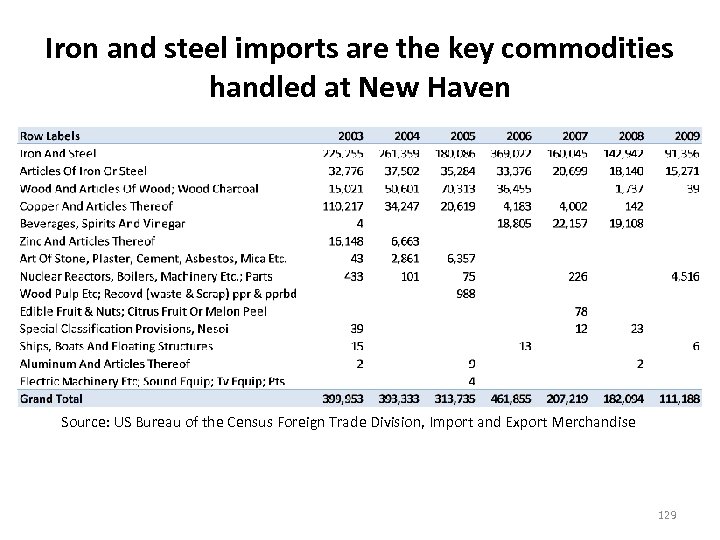 Iron and steel imports are the key commodities handled at New Haven Source: US Bureau of the Census Foreign Trade Division, Import and Export Merchandise 129
 Potential opportunities for Providence – Imported Iron and Steel • Despite the volume of steel handled at New Haven, steel imports are highly cyclical, and driven by regional construction activity and the proximity to steel mills • Steel mill production is concentrated in Eastern Ohio and Western Pennsylvania, and these markets are served via: – The Delaware River Ports – Mississippi River System – Great Lakes ports of Cleveland Burns Harbor 130
 Implications of market potential for imported steel • The overall steel market in New England is dominated by New Haven • The US and the New England Steel market is very cyclical, and is dependent upon economic conditions as well as US Trade policies, such as the Section 201 steel import quotas imposed in March 2002 and removed at the end of December 2003 • In New England, construction drives the imported steel tonnage, and long term projections for new construction in Rhode Island are not robust • It is not recommended that the imported steel market be given high priority for port development at Rhode Island Ports 131
 Wind Energy Market 132
 Potential opportunities for Providence – wind energy/offshore support • There is a potential for the development of a support base for offshore wind energy farms • Rhode Island Ports could potentially serve as: – – Import for blades, nacelles and towers Laydown area for assembly Location for manufacturing facility Provide support base for the offshore wind farms • Two wind farm operators have interest in Davisville: – Deepwater Wind • In discussions with Port • Have 3 sites under agreement – Cape Wind • Has looked at Davisville • Considering Davisville as secondary support base in addition to New Bedford • Prov. Port also in discussions to handle materials for wind turbines 133
 Offshore wind farms – potential for support base • In April, 2009, the Department of the interior finalized the framework for renewable energy production of the US Outer Continental Shelf: – Bureau of Ocean Energy Management, Regulation and Enforcement (BOEMRE) is the federal agency responsible for overseeing the safe, environmentally responsible development of energy and mineral resources on the Outer Continental Shelf and contends with all aspects of offshore federal leasing and renewable energy projects – FERC is an independent agency regulating interstate transmission of electricity, natural gas and oil. Regarding electricity: • Regulates transmission and wholesales of electricity in interstate commerce • Reviews siting applications for electric transmission projects under limited circumstances • There is a strong interest throughout the country for developing offshore wind farms 134
 Offshore wind farms (cont’d) • No offshore wind farms are currently in operation in the United States: – More than 2, 000 megawatts of offshore wind projects have been proposed around the country • The National Renewable Energy Lab estimates the potential wind energy off the Atlantic coast alone totals more than 1, 000 gigawatts: – Represents 25% of total US electricity demand – US total wind energy potential is greater than the country’s entire current electricity demand 134
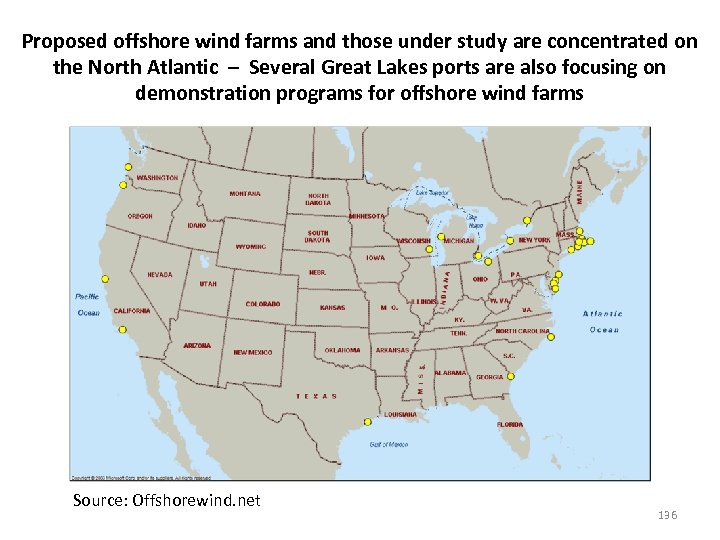 Proposed offshore wind farms and those under study are concentrated on the North Atlantic – Several Great Lakes ports are also focusing on demonstration programs for offshore wind farms Source: Offshorewind. net 136
 Proposed offshore wind farms • Deepwater Wind: – Proposing two offshore wind farms off of the coast of Rhode Island: • 200 5 -6 mw wind turbines 20 miles off RI • Smaller 30 mw (max) farm off Block Island • Cape Wind Associates: – Proposed constructing an offshore wind farm in Nantucket Sound – Consist of 130 wind turbines over 24 square miles – Would power about 200, 000 homes 137
 Proposed offshore wind farms (cont’d) • Bluewater Wind: – Proposed constructing an offshore wind farm about 11 miles east of Rehoboth Beach, Delaware – Consist of 60 large wind turbines – Signed into law in June, 2008: • Approves a 25 -year power purchase agreement to allow Delmarva Power to buy up to 200 megawatts of electricity – Could begin delivering energy to Delaware customers by 2012 • Other offshore wind farms are proposed off the coasts of New Jersey, New York, Maryland, Texas, as well as Lake Erie and Lake Ontario 138
 Wind turbine fabrication in the US • The share of US – made parts in wind turbines increased from 30 percent in 2005 to nearly 50% in 2008 • The companies assembling nacelles in the US grew from 1 in 2004 to 5 in 2008; 5 additional foreign plants plan to build US plants • There are 11 blade manufacturers and 16 tower manufacturers that either have plants or plan to build plants in the US • Wind turbine imports grew from $60 million in 2004 to $2. 5 billion in 2008: – 2007 was $2. 4 billion indicating more US production • The goal of the major wind energy manufacturers, however, is to produce all wind energy products in the US in the next five years, thereby reducing the need for wind energy imports via US ports • Ports will become the staging area for offshore farms, reducing the role as an import facility 139
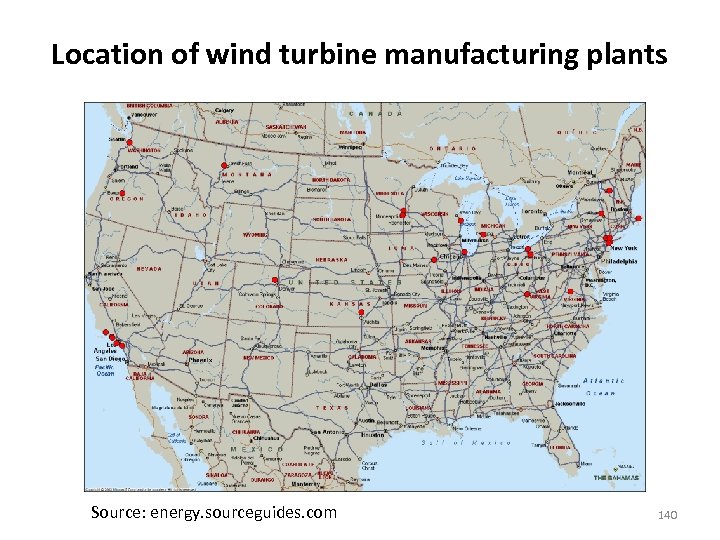 Location of wind turbine manufacturing plants Source: energy. sourceguides. com 140
 Deepwater Wind – offshore wind farms • Deepwater is looking to develop a landside operations base in Davisville to support offshore wind turbine farms: – – 200 5 -6 mw wind turbines 20 miles off RI – 5 yr build out starting 2014 Smaller 30 mw (max) farm off Block Island – 1 yr build out in 2012/2013 350 mw farm 20 miles off Ocean City/Avalon, NJ – later time frame Off Long Island – no details • 117 acres in 3 noncontiguous parcels under agreement: – 80 acres are usable – Assembly and/or manufacturing operations are being considered – decision will be based in part on what can be accommodated on the 80 acres • Pier 2 dock can handle inbound cargo weight and vessel calls: – Significant upgrades will be made to Pier 2 as a result of TIGER Grant – Use of Pier 2 will impact automobile market: • Which is growth market 141
 Deepwater Wind – offshore wind farms (cont’d) • Deepwater could receive turbines and components for assembly: – Turbines (400 -450 tons each) – Turbine housing (nacelles) – Jackets – 4 -leg structures (350 -400 tons) supporting windmills: • • 120 ft legs tapered to maximum 20 ft diameter Would require a 90 ft x 120 ft laydown area Final assembly done at sea Platform or transition piece: – A deck connecting the lower portion of the legs for stabilization and reducing vibrations 142
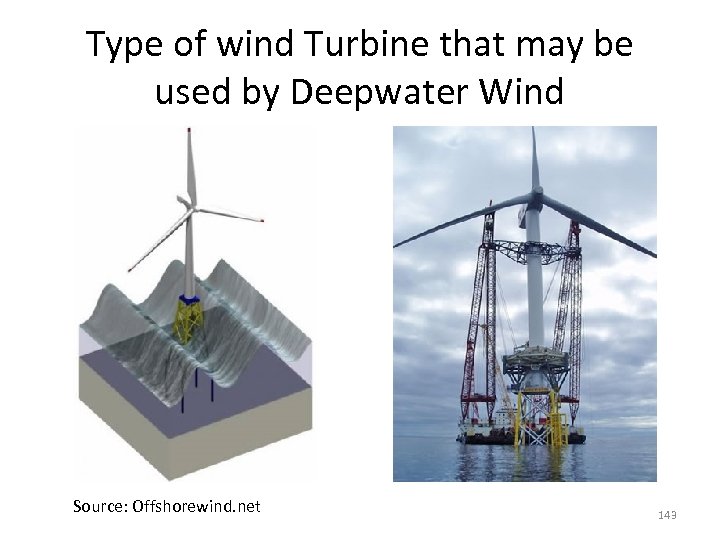 Type of wind Turbine that may be used by Deepwater Wind Source: Offshorewind. net 143
 Deepwater Wind – offshore wind farms (cont’d) • Steel coil could be imported if limited manufacturing is established on-site: – Coil would be barged from Providence and/or railed into Davisville – Currently evaluating trade-off between wind energy assembly vs. manufacturing • Current plan is to move components outbound over a barge dock at Terminal 5: – Components will be rolled/wheeled from land to barge: • This process would consider a NASA type rocket mover/transporter • Several development scenarios in the Moffatt and Nichol master plan report include windmills – the development projects associated with the wind turbine market include: – Improvements for berth at Terminal 5: • QDC/Port considering vessel dock at T 5 for inbound moves • Cost of full build-out of pier similar to Pier 2 up to $60 million – $7 million for dredging at Terminal 5 144
 Cape Wind – offshore wind farms • Maximum 420 mw farm off Cape Cod – 130 turbines • Cape Wind operation linked to Port of New Bedford: – Developing/expanding 20 acre South Terminal for wind turbines: • A multi-purpose terminal: – May be used to store containers – May be used for other market as they develop – Cape Wind not sure if 20 acres will be enough for its needs • Looking at Quonset as a supplemental operation if needed: – Will be at New Bedford regardless • Future farms off the East Coast could use this/these operation(s) 145
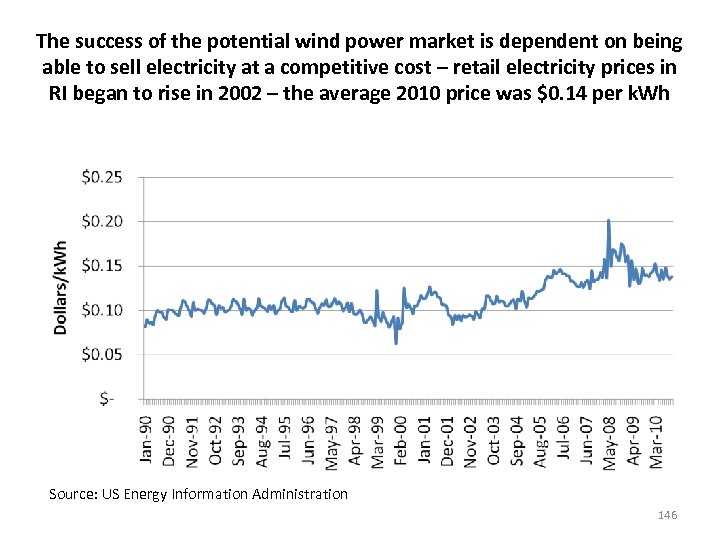 The success of the potential wind power market is dependent on being able to sell electricity at a competitive cost – retail electricity prices in RI began to rise in 2002 – the average 2010 price was $0. 14 per k. Wh Source: US Energy Information Administration 146
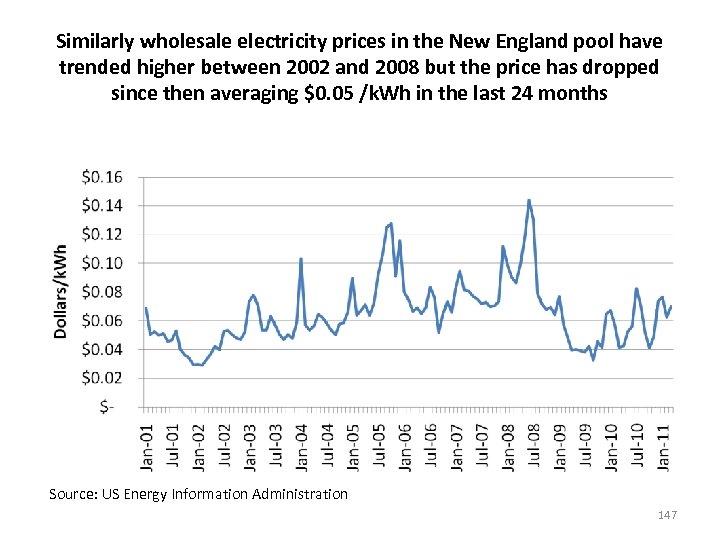 Similarly wholesale electricity prices in the New England pool have trended higher between 2002 and 2008 but the price has dropped since then averaging $0. 05 /k. Wh in the last 24 months Source: US Energy Information Administration 147
 The wind power market is uncertain, and investment in wind energy support and facilities should be placed on the private sector, not the State • • Price of offshore generated electricity is projected to be significantly higher than alternative price onshore: – Deepwater estimates the wholesale price of its electricity to be in the mid-teens – Wholesale prices from conventional electricity generation, as indicated on the previous charts, are significantly less Offshore projects appear to be in jeopardy until commitments can be made as to purchases of electricity Furthermore, delivery infrastructure (grids) will be required, and investment in this infrastructure is uncertain Future development is uncertain at this time due to current electricity prices Rhode Island Ports should only invest in facilities after commitments have been established. Furthermore, private sector investment and partnership should be a pre-requisite for any terminal development in support of the wind energy programs Martin Associates suggests due diligence by the State on the wind energy potential and cautions on the potential impact on the import/export auto market New technologies are under investigation that may replace wind energy attraction: – – Wave energy Thermal-gradient energy production focusing on under temperature gradients 148
 Container Feeder Operations Potential For Rhode Island Ports 149
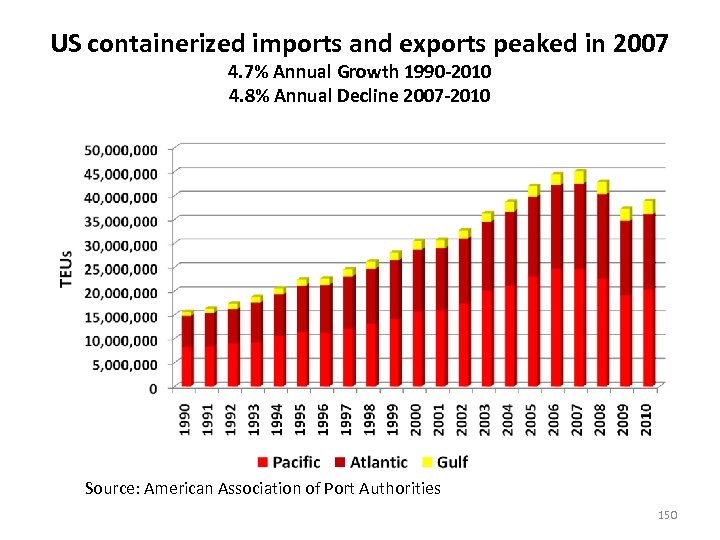 US containerized imports and exports peaked in 2007 4. 7% Annual Growth 1990 -2010 4. 8% Annual Decline 2007 -2010 Source: American Association of Port Authorities 150
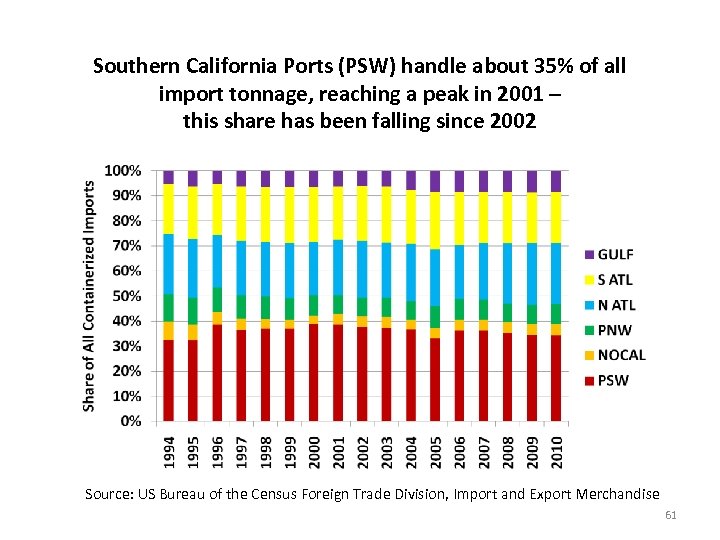 Southern California Ports (PSW) handle about 35% of all import tonnage, reaching a peak in 2001 – this share has been falling since 2002 Source: US Bureau of the Census Foreign Trade Division, Import and Export Merchandise 61
 Changes In Logistics Patterns As demonstrated, within the West Coast Ports, the San Pedro Bay Ports of Los Angeles and Long Beach handle about 35% of the imported Asian containerized cargo. This dominance of the Asian trade by the West Coast Ports, and in particular the Ports of Los Angeles and Long Beach, particularly in the late 1990’s through 2002, was driven by the fact that importers viewed theses ports as the major port linkage in the supply chain of imported cargo. Prior to the mid to late 1990’s, the steamship lines determined the port routings and importers were essentially “port blind” as they selected an ocean carrier, and the carrier decided which port the cargo would be discharged and how the cargo would be delivered to the customer. However, as the concentration of large importers such as Wal*Mart, Target, Cost Plus, etc. increased in the late 1990’s, these importers invested in large distribution centers in the Los Angeles/Long Beach area to serve as points in the importers’ logistic supply chains. As these importers gained bargaining power in terms of contract negotiations with the ocean carriers, they were able to “demand” a San Pedro Bay port routing from the carriers. Hence, with the development of the distribution centers and cross dock operations in the San Pedro Bay region, the concentration of imported Asian containers at the Ports of Los Angeles and Long Beach increased. Furthermore, the railroads providing intermodal services at the San Pedro Bay Ports further increased investment in rail trackage and intermodal yards to facilitate the flow of containers from the Los Angeles area to the key Midwestern and Eastern consumption centers such as Chicago, Memphis, St. Louis, New York, Atlanta, Columbus, etc. This concentration of containerized cargo import activity continued to increase until several events occurred.
 Changes In Logistics Patterns (continued) These events are the impact of 9/11 on the distribution supply chain, the 2002 West Coast Port shutdown, and major congestion issues that arose in 2004 due to rail meltdowns at the San Pedro Bay ports. As a result of these events, there has been an increased focus on diversification of containerized cargo via various US Ports. This is evident by the growth in container volume at the North Atlantic, South Atlantic and Gulf Coast ports. The growth of all water service from Asia to the East Coast and Gulf Coast ports has been increasing significantly since 2002. There are two all water routings that are available for all water services – the use of the Panama Canal and the use of the Suez Canal. Each of the routings provides advantages and disadvantages to the use of the intermodal cargo (railed from the West Coast ports). For example, the current dimensions of the Panama Canal limit the size (width and depth) of the vessels that can transit the Canal, and also the transit time using an all water service to an East Coast port and then a rail move to a Midwestern consumption point is longer than using an intermodal move via a West Coast Port. This longer transit time from Asia results in increased inventory carrying costs, and is more pronounced for higher value cargo than for lower value cargo. In addition, ocean carriers prefer to internalize the revenue for the entire trip from Asia to the East Coast rather than sharing the revenue with a rail carrier from the West Coast to an East Coast consumption point.
 Implications for the State of Rhode Island However, changes are in play to improve the current negatives of using the Panama Canal. The Canal will be enlarged by 2014, allowing for the transit of much larger container vessels, which in turn tend to have a lower per unit operating cost than smaller container vessels. In addition, the ocean carriers are introducing more direct all-water services that are improving the transit times using all water routings from Asia. With respect to the Suez Canal, the dimensions of this canal do not limit the size of the container ships that can transit, but there is some concern over political instability in the region. The Suez routing from Asia to the East Coast is longer than via the Panama Canal, but as production centers shift to South Asia and India, this routing can in some cases provide very competitive transit times to the use of the trans-pacific routings and the use of intermodal moves from the West Coast to the East Coast. In addition, ocean carriers are increasing India-Europe express services, with the use of Mediterranean ports for transshipment centers for cargo destined further to the US and Europe. The Suez routing is becoming particularly attractive as the production centers are shifting into India and Vietnam. Supporting this growth in production centers in India is the fact that the Indian Government, along with private sector interests, are investing heavily in port infrastructure to accommodate the growth in Indian Government investment is estimated at $110 billion and private sector investment is estimated at another $8. 5 billion.
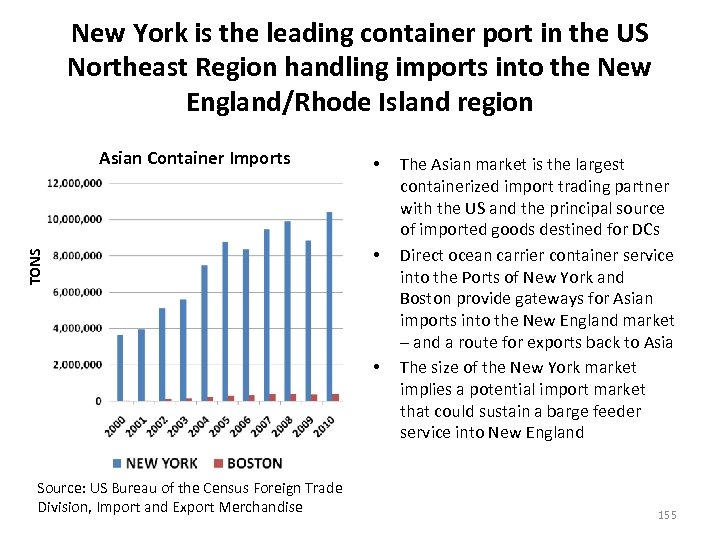 New York is the leading container port in the US Northeast Region handling imports into the New England/Rhode Island region Asian Container Imports TONS T o ns • • • Source: US Bureau of the Census Foreign Trade Division, Import and Export Merchandise The Asian market is the largest containerized import trading partner with the US and the principal source of imported goods destined for DCs Direct ocean carrier container service into the Ports of New York and Boston provide gateways for Asian imports into the New England market – and a route for exports back to Asia The size of the New York market implies a potential import market that could sustain a barge feeder service into New England 155
 The marine terminals located at the Port Authority of New York and New Jersey are the terminals supplying New England with imports, particularly Asian imports Martin Associates used data provided by the Port of Davisville. This data provides an estimate of the location of importers/exporters by city within New England, and the Ports serving those importers. As the following map shows, the green shaded areas on the map indicate the location of importers/exporters at the county level. The circles on the map indicate the size of the import/export market by city, while the color shades in the circles indicate the ports now used to serve the import/export markets in New England. As this chart shows, New York is the key port used to serve the New England market. This market is currently served by truck. The market is quantified in terms of TEUs which is a standard measure of container volume, representing twenty foot equivalent units. The question now becomes, could a barge feeder service between New York marine terminals and a terminal located at the Rhode Island Ports be competitive to the current truck routing, and provide a lower carbon footprint? 156
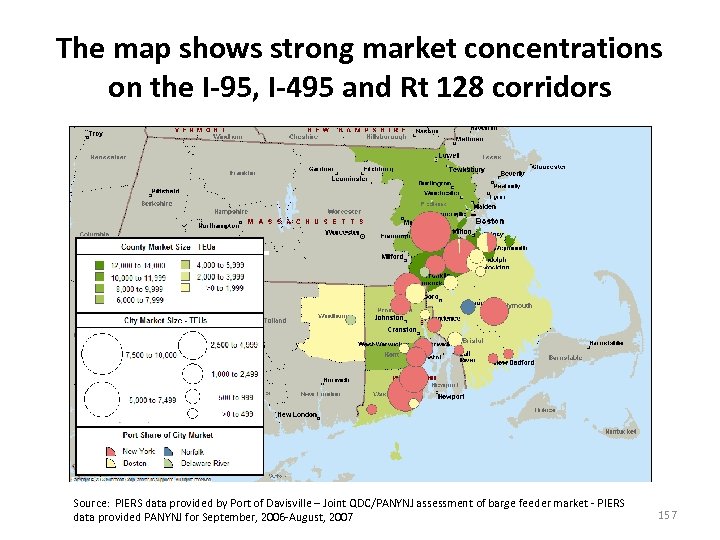 The map shows strong market concentrations on the I-95, I-495 and Rt 128 corridors Source: PIERS data provided by Port of Davisville – Joint QDC/PANYNJ assessment of barge feeder market - PIERS data provided PANYNJ for September, 2006 -August, 2007 157
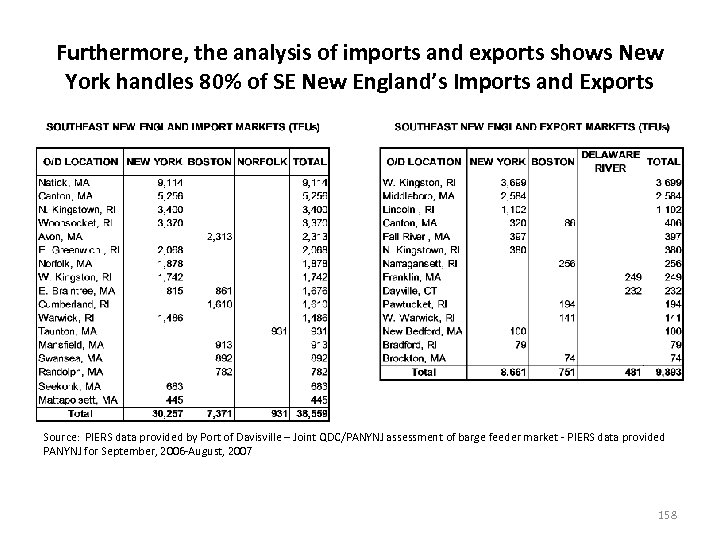 Furthermore, the analysis of imports and exports shows New York handles 80% of SE New England’s Imports and Exports Source: PIERS data provided by Port of Davisville – Joint QDC/PANYNJ assessment of barge feeder market - PIERS data provided PANYNJ for September, 2006 -August, 2007 158
 Feeder/short sea services are designed to serve smaller port markets where no direct carrier service exists • The feeder/short sea concept consists of smaller vessels that connect load center ports such as New York with secondary ports • The feeder operation is designed to compete with rail and truck services from the load center ports to the smaller markets 159
 The barge feeder concept is not new! • Feeder services between Halifax and New England developed in the 1980’s to take advantage of constraints at US North Atlantic ports • Carriers discharged New England-bound import containers in Halifax rather than in New York and returned export containers to Halifax • The feeder/short sea operations changed hands several times during this period: – Hapag-Lloyd began a weekly ship feeder service between Halifax and the Ports of Portsmouth, NH (later replaced with Portland, ME) and Boston – Halship took over this service between August, 2005 ending one year later – Columbia Coastal Transit replaced Halship with a barge feeder service – Eimskip was the last operator on this service providing a ship feeder service from April, 2007 through December, 2007 160
 The barge feeder concept is not new! (cont’d) • Columbia Coastal operated a weekly container-on-barge feeder service between the Ports of New York and Boston However, the service was discontinued in August, 2010: • Volumes declined sharply in the last three years due to lower truck rates • New all water services were introduced into Boston , which eliminated need for the feeder operations • The feeder service was operating at a 50% utilization rate: – 100 -150 containers per week – The cargo consisted mostly of heavy weight refrigerated containers, which could not move over the road 161
 Renewed interest exists for a barge feeder operation between New York and Rhode Island Ports • Columbia Coastal has been working with Port of Davisville to develop NY-RI barge feeder • Columbia Coastal has been targeting potential customers – Lowe’s – DC in Plainfield, CT – Ocean State Job Lot – DC in Quonset Business Park – Wal*Mart – DC in New Hampshire – Bostitch – Connecticut Fibers – W Kingston, RI – Rand-Whitney/Kraft Group – Pawtucket, Worcester 162
 Over 48, 000 TEUs of cargo have been identified to be destined or originate in South Eastern New England. These importers/exporters currently use the Port of New York /New Jersey • If one-half of the 48, 000 TEU market could be captured by a barge feeder operation, this would equate to a 24, 000 TEUs annually that could move via barge/feeder operations • Assuming a weekly service, this suggests a weekly service moving about 400 -450 TEUs per call • The next step in the analysis is to evaluate the competitive costs of using the barge feeder vs. the current truck routing to and from the terminals at the Port of New York/New Jersey 163
 The transportation cost analysis for the barge/feeder operation consisted of the following steps • • The locations of the import and export volume to and from the Southeastern New England cities were identified from PIERS data provided by the Quonset Point Development Corp The Martin Associates’ Trucking Cost Model was used to estimate the trucking costs between origins and destinations and the marine terminals at the Port Authority of New York/New Jersey: – Based on actual trucking rates provided to Martin Associates, and converted to per mile basis – Between the Port of New York and SE New England cities for the direct truck routing – For the barge feeder operation, the truck cost model was used to estimate the inland cost between the Port of Davisville/Providence and the key New England cities – Google Maps was used to identify the respective mileages • Two scenarios were developed to reflect head haul and backhaul truck flows: – Headhaul truck is the primary routing, where the truck originates in New York/New Jersey and moves to the import destinations (New England cities) – Backhaul traffic represents the return truck movement from the New England region to New York/New Jersey. This rate is discounted from the head haul rate to attract return cargo • • The barge cost between New York and a Rhode Island site cost was provided by Columbia Coastal. The cost includes the barge loading and unloading charges at New York/New Jersey marine terminals and at a site in Rhode Island The results are presented in the following two tables 164
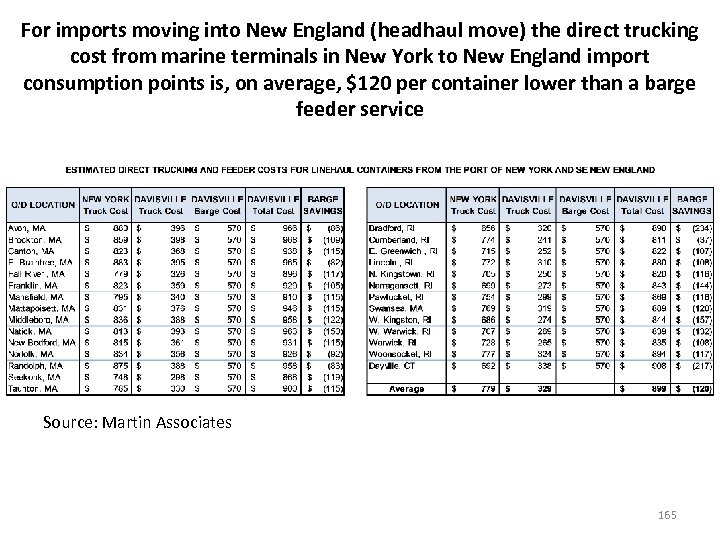 For imports moving into New England (headhaul move) the direct trucking cost from marine terminals in New York to New England import consumption points is, on average, $120 per container lower than a barge feeder service Source: Martin Associates 165
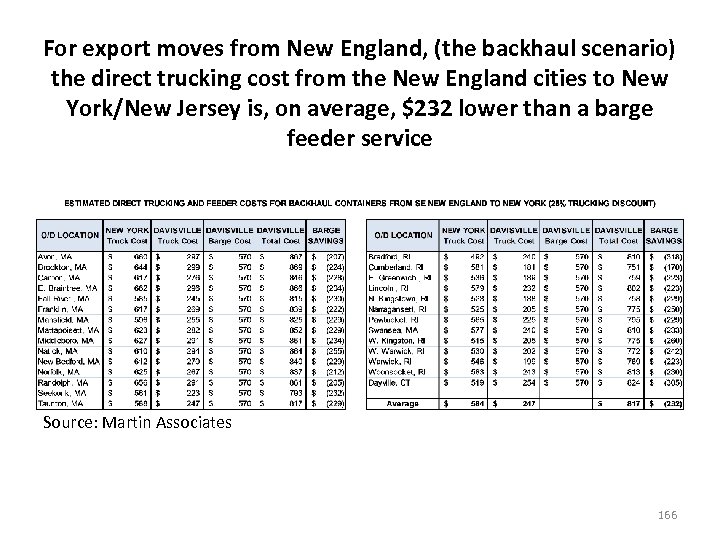 For export moves from New England, (the backhaul scenario) the direct trucking cost from the New England cities to New York/New Jersey is, on average, $232 lower than a barge feeder service Source: Martin Associates 166
 Implications of the competitive analysis of the development of a barge feeder operation Under the current pricing structure, including feeder rate, stevedoring/terminal handling and inland drayage from a Rhode Island port to and from the key New England consumption and production markets for export cargo, the feeder operation is more costly, averaging about $175 -200 per container more than direct trucking to and from New York. In addition, the feeder operation would add days to the current delivery time via truck to and from New York/New Jersey, as the barge feeder would operate weekly given the estimated volumes. Given the longer transit times via barge, the barge rates would have to be reduced significantly to provide a cost incentive to the beneficial cargo owners to utilize the feeder service. The focus on heavy weight containers is needed. These types of cargo include alcoholic beverages and machinery. In order for this type of operation to have a potential to succeed, the barge rate must be reduced by about $200 -250 per container. This would require a significant reduction in stevedoring charges, and perhaps the use of a roll-on/roll-off operation (RO/RO), rather than lift- on/lift-off operations. (LO/LO) This RO/RO operation would require a RO/RO ramp, but would eliminate the need for shore side cranes, and reduce the stevedoring and terminal charges. A detailed market study is needed to understand the logistics of the New England beneficial cargo owners, as well as the composition of the containerized cargo moving to and from the New England regions. Similarly, an engineering study would be required to develop costs to service either a RO/RO or LO/LO. The volumes identified indicate that a terminal space would be required to handle up to 24, 000 TEUs annually. Assuming a low dwell time, and 3, 000 TEUs per acre per year throughput, about 8 acres would be required to handle such a service. 167
 CRUISE SHIP OPPORTUNITIES: NEWPORT 168
 The Newport cruise market is served by international and domestic Lines • • Aida American Canadian Car. Celebrity Costa Cruise West Crystal Great Lakes Holland America • • MCS Norwegian Caribbean P & O Phoenix Princess Regent Seven Seas Silver Sea The World 169
 Newport has an active cruise market as described by the Newport & Bristol County Convention & Visitors Bureau • 71 cruises made a Newport-of-call in 2010 – 70% between Sep 1 -Nov 1 • American Canadian Caribbean is the only cruise line that docks in Newport: – Operates 184 ft vessels with a capacity of 96 passengers – With a draft of 6’ 6” it is able to dock at Ft. Adams – The vessel is home ported in Warren, RI • All other lines anchor off Newport and tender passenger between ship and Perotti Park in downtown Newport – a 15 minute transit: – Passengers queue up on ship up to 2 hrs to disembark on a tender – Passengers queue up onshore up to 1 hr for the return 170
 Newport has an active cruise market • Newport is the only destination for passengers: – 10% stay aboard ship – 30% take package tours – 60% wander around Newport on their own • A new dock would eliminate tendering making city access easier perhaps enticing the remaining 10% ashore: – Improve movement of passengers on to and off of the ships – Reduce tendering costs 171
 Docking options are limited in Newport • The Newport waterfront and downtown area are fully developed with no waterfront land available to develop a cruise terminal: – No berthing capacity available other than for potential docking dolphins offshore connecting passengers to the shore via a “T” dock • There is strong community opposition for expanding cruise capabilities in Newport: – No new development on the waterfront: • “Not in my back yard” • Impeding views – Yachting crowd most vocal group opposing cruise activity altogether: • Cruise ships anchor in regatta waters 172
 There are limited alternative locations for potential cruise berthing to serve the Newport tourist market • Quonset/Davisville is a less attractive port-of-call: – It is not a tourist destination – It is an industrial area – And is not pedestrian friendly • Ft. Adams is a possible location, but not possible because…. – It is a historic landmark – It cannot accommodate large cruise ships at this time – length and draft issues – And there is community opposition • The only option may be using Navy land on Aquidneck Island in Middletown – north of Newport and south of Portsmouth – if made available: – Currently the Navy is opening Burma Road along west side of Aquidneck Island from northern Newport through Middletown into southern Portsmouth through Navy property – At this time no land is being released: • The Navy may consider what to do with surplus land in the future: – Two piers – in great disrepair – Land west of Burma Road – Community would oppose any development “across the street” 173
 Cruise implications • The cruise market is limited: – Newport is the only cruise destination/market – Limited berthing capability exists at Newport – Community opposition exists for expansion of cruise business • Additional traffic from existing cruise business could be enhanced with the construction of mooring dolphins and a “T” berth in Newport to eliminate tendering 174
 Summary of growth opportunities • Base market opportunities: – Automobile market shows potential growth – Water depth could become an issue, and if the harbor deepening were to be undertaken by the federal government, then the competitive advantage of Davisville as an auto port would be eroded due to the imposition of the Harbor Maintenance Tax. • Aggressively market perishable import market • Investigate more fully the development of container feeder service: – About 24, 000 TEU container market potential 175
 Potential state investments to support existing marine cargo terminals • Maintenance dredging of Davisville docks - $7 million for 250, 000 cubic yards • Developing dock at Terminal 5 (for wind turbines) requires state-funded dredging : – 60, 000 ft 3 along berth – 240, 000 ft 3 in the basin – $40 -60 million project • Corps of Engineers-funded dredging of the channel would require partial funding by the State: – This would also result in the imposition of the federal Harbor Maintenance Tax which will increase the costs to users of RI ports, and removes the competitive advantage of Davisville in the auto market 176
 Potential state investments to support future terminal operations should they develop • RO/RO Ramp – $1. 75 million – To support potential container feeder operations • If RO/RO feeder operation were to develop • Traditional RO/RO vessels have ramps incorporated in their design and do not require use of a ramp • Chill Facility – $2 million – To support potential fresh fruit import market • Public and/or private sector investment • Estimated $100 per sq ft investment for facility • Reefer Plugs – $5, 000 per unit – To support chill facility operations – optional – To support container feeder operations if refrigerated containers are handled • Cruise Ship Dock – $12. 5 million – “T” dock for passenger embarking/debarking – Two mooring dolphins – Assumes location is in relative proximity to deep water to accommodate ships (i. e. off of Goat Island)
 Potential sites to consider for future development using public/private partnerships should Davisville and Prov. Port become constrained • P & W quay – East Providence: – 35 acres on 40 ft of water – Waterfront would have to be bulkheaded • Cumberland Farms – Providence: – – 10 -acre site Pier could be built out to 38 -40 ft. Building on-site can not be demolished due to historical designation Additional adjacent sites could be merged to make 24 -acre terminal: • Rhode Island Recycling – 5 acres • Verizon Maintenance Depot – 6 acres • Tow truck operation – 3 acres • Former Chevron site – East Providence: – Has been on the market for 20 years for commercial or residential development • Expansion of Prov. Port • Cruise dock/terminal on Aquidneck Island 178
 ECONOMIC IMPACTS OF NEW MARKET OPPORTUNITIES 179
 Potential Market Opportunities • Base Cargo: – Auto units could grow from 200, 000 units to 300, 000 units (good possibility) • Potential Opportunities: – Develop of a break bulk fruit operation (will require aggressive marketing) – Possible container barge feeder operations – 24, 000 TEUs (will require significant reduction in barge rate/stevedoring charges and a Ro/Ro operation) – Wind energy 130 units – uncertainty, and should include significant infrastructure investment by private sector. State should not invest until private sector commitment. 180
 Potential economic impacts to Providence were developed for each of the opportunities Martin Associates’ Prov. Port Economic Impact Model was adjusted to reflect the potential annual economic impact of the identified opportunities. This study was conducted for Prov. Port in 2006, and included the development of local models to estimate induced and indirect economic impacts of the direct operations at marine terminals in Providence. Specific terminal models were developed for Prov. Port operations. In addition, Martin Associates has developed more than 300 economic impact studies for most ports in the United States and we were able to use direct impact models to estimate the types of impacts that could be anticipated from the growth in new automobile exports and imports, the development of fruit import operation similar to the size of operations of a terminal in the Delaware River, and the development of a barge feeder operation. Our wind energy models for Gulf Coast and Pacific Northwest ports were used to estimate the impacts of the potential wind energy imports, but not manufacturing/assembly. 181
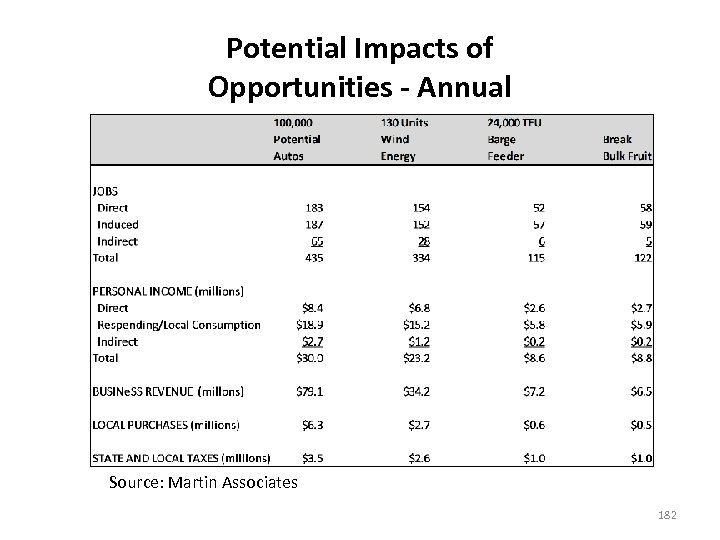 Potential Impacts of Opportunities - Annual Source: Martin Associates 182