 Скачать презентацию RHIC-PHENIX実験における荷電ハドロン 楕円フローの系統的研究 下村 真弥 for the PHENIX Collaborations University
f61d839ad650b530524c8d998884bb4e.ppt
- Количество слайдов: 52



RHIC-PHENIX実験における荷電ハドロン 楕円フローの系統的研究 下村 真弥 for the PHENIX Collaborations University of Tsukuba 2008/09/20 September. JPS meeting 20, JPS 2008 1
Universidade de São Paulo, Instituto de Física, Caixa Postal 66318, São Paulo CEP 05315 -970, Brazil Institute of Physics, Academia Sinica, Taipei 11529, Taiwan China Institute of Atomic Energy (CIAE), Beijing, People's Republic of China Peking University, Beijing, People's Republic of China Charles University, Ovocnytrh 5, Praha 1, 116 36, Prague, Czech Republic Czech Technical University, Zikova 4, 166 36 Prague 6, Czech Republic Institute of Physics, Academy of Sciences of the Czech Republic, Na Slovance 2, 182 21 Prague 8, Czech Republic Helsinki Institute of Physics and University of Jyväskylä, P. O. Box 35, FI-40014 Jyväskylä, Finland Dapnia, CEA Saclay, F-91191, Gif-sur-Yvette, France Laboratoire Leprince-Ringuet, Ecole Polytechnique, CNRS-IN 2 P 3, Route de Saclay, F-91128, Palaiseau, France Laboratoire de Physique Corpusculaire (LPC), Université Blaise Pascal, CNRS-IN 2 P 3, Clermont-Fd, 63177 Aubiere Cedex, France IPN-Orsay, Universite Paris Sud, CNRS-IN 2 P 3, BP 1, F-91406, Orsay, France SUBATECH (Ecole des Mines de Nantes, CNRS-IN 2 P 3, Université de Nantes) BP 20722 - 44307, Nantes, France Institut für Kernphysik, University of Münster, D-48149 Münster, Germany Debrecen University, H-4010 Debrecen, Egyetem tér 1, Hungary ELTE, Eötvös Loránd University, H - 1117 Budapest, Pázmány P. s. 1/A, Hungary KFKI Research Institute for Particle and Nuclear Physics of the Hungarian Academy of Sciences (MTA KFKI RMKI), H-1525 Budapest 114, POBox 49, Budapest, Hungary Department of Physics, Banaras Hindu University, Varanasi 221005, India Bhabha Atomic Research Centre, Bombay 400 085, India Weizmann Institute, Rehovot 76100, Israel Center for Nuclear Study, Graduate School of Science, University of Tokyo, 7 -3 -1 Hongo, Bunkyo, Tokyo 113 -0033, Japan Hiroshima University, Kagamiyama, Higashi-Hiroshima 739 -8526, Japan KEK, High Energy Accelerator Research Organization, Tsukuba, Ibaraki 305 -0801, Japan Kyoto University, Kyoto 606 -8502, Japan Nagasaki Institute of Applied Science, Nagasaki-shi, Nagasaki 851 -0193, Japan RIKEN, The Institute of Physical and Chemical Research, Wako, Saitama 351 -0198, Japan Physics Department, Rikkyo University, 3 -34 -1 Nishi-Ikebukuro, Toshima, Tokyo 171 -8501, Japan Department of Physics, Tokyo Institute of Technology, Oh- okayama, Meguro, Tokyo 152 -8551, Japan Institute of Physics, University of Tsukuba, Ibaraki 305, Japan Waseda University, Advanced Research Institute for Science and Engineering, 17 Kikui-cho, Shinjuku-ku, Tokyo 162 -0044, Japan Chonbuk National University, Jeonju, Korea Ewha Womans University, Seoul 120 -750, Korea KAERI, Cyclotron Application Laboratory, Seoul, South Korea Kangnung National University, Kangnung 210 -702, South Korea University, Seoul, 136 -701, Korea Myongji University, Yongin, Kyonggido 449 -728, Korea System Electronics Laboratory, Seoul National University, Seoul, South Korea Yonsei University, IPAP, Seoul 120 -749, Korea IHEP Protvino, State Research Center of Russian Federation, Institute for High Energy Physics, Protvino, 142281, Russia Joint Institute for Nuclear Research, 141980 Dubna, Moscow Region, Russian Research Center "Kurchatov Institute", Moscow, Russia PNPI, Petersburg Nuclear Physics Institute, Gatchina, Leningrad region, 188300, Russia Saint Petersburg State Polytechnic University, St. Petersburg, Russia Skobeltsyn Institute of Nuclear Physics, Lomonosov Moscow State University, Vorob'evy Gory, Moscow 119992, Russia Department of Physics, Lund University, Box 118, SE-221 00 Lund, Sweden 14 Countries; 69 Institutions July 2007 Abilene Christian University, Abilene, TX 79699, U. S. Collider-Accelerator Department, Brookhaven National Laboratory, Upton, NY 11973 -5000, U. S. Physics Department, Brookhaven National Laboratory, Upton, NY 11973 -5000, U. S. University of California - Riverside, CA 92521, U. S. University of Colorado, Boulder, CO 80309, U. S. Columbia University, New York, NY 10027 and Nevis Laboratories, Irvington, NY 10533, U. S. Florida Institute of Technology, Melbourne, FL 32901, U. S. Florida State University, Tallahassee, FL 32306, U. S. Georgia State University, Atlanta, GA 30303, U. S. University of Illinois at Urbana-Champaign, Urbana, IL 61801, U. S. Iowa State University, Ames, IA 50011, U. S. Lawrence Livermore National Laboratory, Livermore, CA 94550, U. S. Los Alamos National Laboratory, Los Alamos, NM 87545, U. S. University of Maryland, College Park, MD 20742, U. S. Department of Physics, University of Massachusetts, Amherst, MA 01003 -9337, U. S. Muhlenberg College, Allentown, PA 18104 -5586, U. S. University of New Mexico, Albuquerque, NM 87131, U. S. New Mexico State University, Las Cruces, NM 88003, U. S. Oak Ridge National Laboratory, Oak Ridge, TN 37831, U. S. RIKEN BNL Research Center, Brookhaven National Laboratory, Upton, NY 11973 -5000, U. S. Chemistry Department, Stony Brook University, Stony Brook, SUNY, NY 11794 -3400, U. S. Department of Physics and Astronomy, Stony Brook University, SUNY, Stony Brook, NY 11794, U. S. University of Tennessee, Knoxville, TN 37996, U. S. Vanderbilt University, Nashville, TN 37235, U. S. 2
Contents • Introduction – QGP – RHIC-PHENIX – Elliptic Flow (v 2) – Motivation • Results – Energy dependence – System size dependence – Universal v 2 • Conclusion 2008/09/20 JPS meeting 3
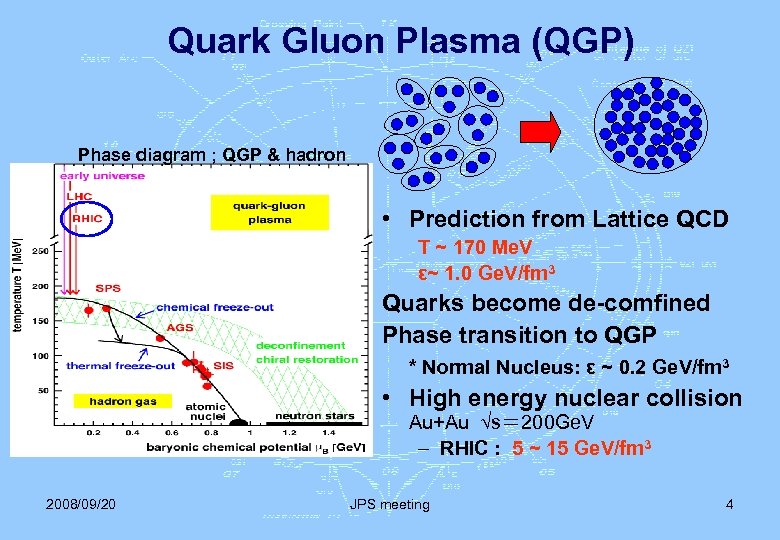
Quark Gluon Plasma (QGP) Phase diagram ; QGP & hadron • Prediction from Lattice QCD T ~ 170 Me. V ε~ 1. 0 Ge. V/fm 3 Quarks become de-comfined Phase transition to QGP * Normal Nucleus: ε ~ 0. 2 Ge. V/fm 3 • High energy nuclear collision Au+Au √s= 200 Ge. V – RHIC : 5 ~ 15 Ge. V/fm 3 2008/09/20 JPS meeting 4
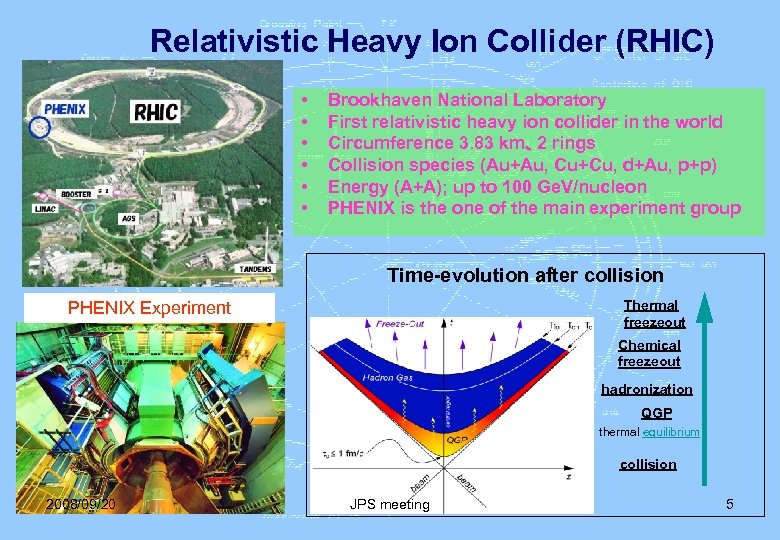
Relativistic Heavy Ion Collider (RHIC) • • • Brookhaven National Laboratory First relativistic heavy ion collider in the world Circumference 3. 83 km、2 rings Collision species (Au+Au, Cu+Cu, d+Au, p+p) Energy (A+A); up to 100 Ge. V/nucleon PHENIX is the one of the main experiment group Time-evolution after collision Thermal freezeout PHENIX Experiment Chemical freezeout hadronization QGP thermal equilibrium collision 2008/09/20 JPS meeting 5
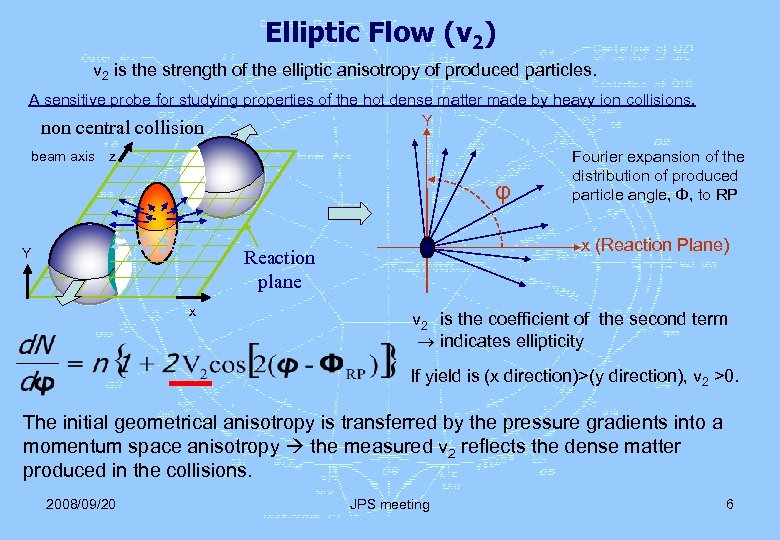
Elliptic Flow (v 2) v 2 is the strength of the elliptic anisotropy of produced particles. A sensitive probe for studying properties of the hot dense matter made by heavy ion collisions. Y non central collision beam axis z φ x (Reaction Plane) Reaction plane Y x Fourier expansion of the distribution of produced particle angle, Φ, to RP v 2 is the coefficient of the second term indicates ellipticity If yield is (x direction)>(y direction), v 2 >0. The initial geometrical anisotropy is transferred by the pressure gradients into a momentum space anisotropy the measured v 2 reflects the dense matter produced in the collisions. 2008/09/20 JPS meeting 6
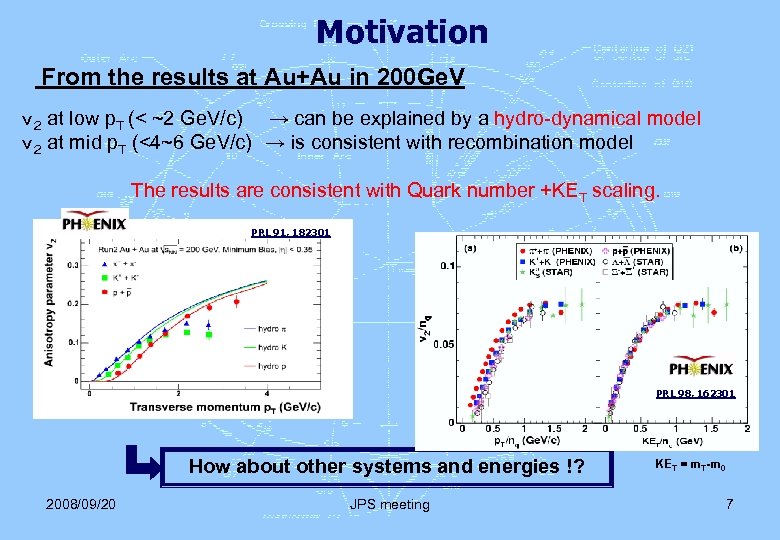
Motivation From the results at Au+Au in 200 Ge. V v2 at low p. T (< ~2 Ge. V/c) → can be explained by a hydro-dynamical model v2 at mid p. T (<4~6 Ge. V/c) → is consistent with recombination model The results are consistent with Quark number +KET scaling. PRL 91, 182301 PRL 98, 162301 How about other systems and energies !? 2008/09/20 JPS meeting KET = m. T-m 0 7
Results • Energy dependence • System size dependence – Eccentricity scaling • Universal v 2 – Quark number + KET scaling – Universal scaling 2008/09/20 JPS meeting 8
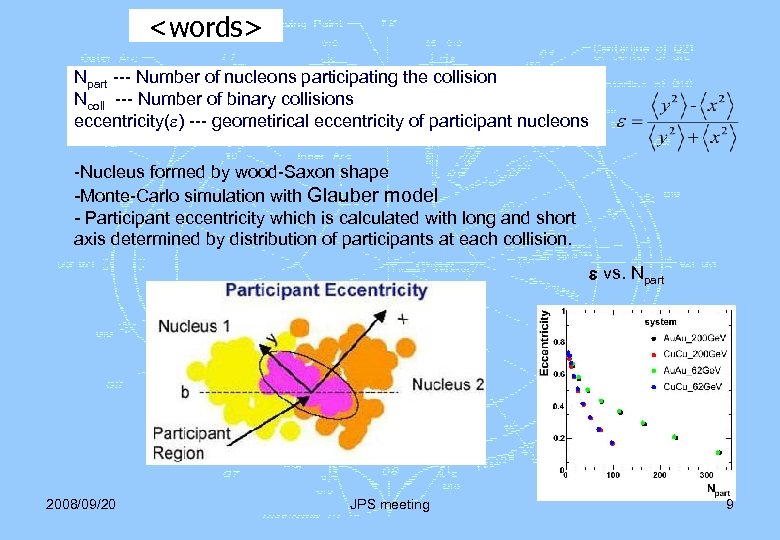
<words> Npart --- Number of nucleons participating the collision Ncoll --- Number of binary collisions eccentricity( ) --- geometirical eccentricity of participant nucleons -Nucleus formed by wood-Saxon shape -Monte-Carlo simulation with Glauber model - Participant eccentricity which is calculated with long and short axis determined by distribution of participants at each collision. vs. Npart 2008/09/20 JPS meeting 9
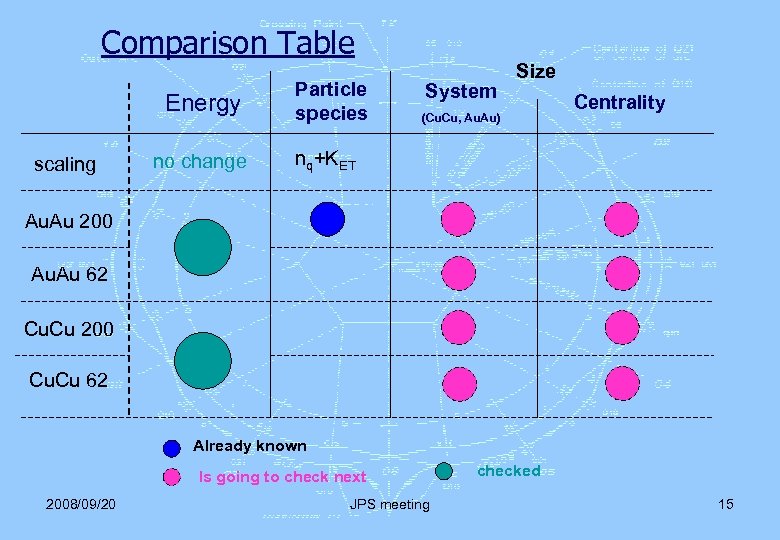
Comparison Table Energy scaling Particle species System (Cu. Cu, Au. Au) Size Centrality nq+KET Au. Au 200 Au. Au 62 Cu. Cu 200 Cu. Cu 62 Already known Is going to check next 2008/09/20 JPS meeting 10
Comparison Table Energy scaling Particle species System (Cu. Cu, Au. Au) Size Centrality nq+KET Au. Au 200 Au. Au 62 Cu. Cu 200 Cu. Cu 62 Already known Is going to check next 2008/09/20 JPS meeting 11
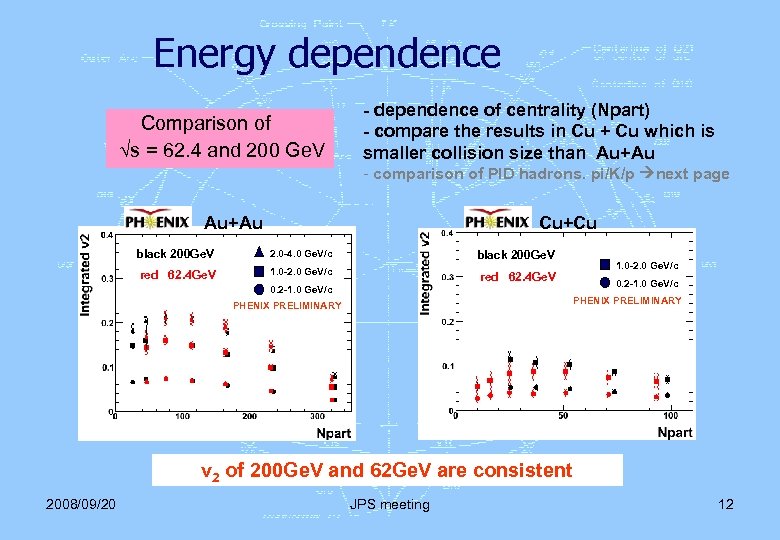
Energy dependence Comparison of s = 62. 4 and 200 Ge. V - dependence of centrality (Npart) - compare the results in Cu + Cu which is smaller collision size than Au+Au - comparison of PID hadrons. pi/K/p next page Cu+Cu Au+Au black 200 Ge. V 2. 0 -4. 0 Ge. V/c black 200 Ge. V red 62. 4 Ge. V 1. 0 -2. 0 Ge. V/c red 62. 4 Ge. V 0. 2 -1. 0 Ge. V/c 1. 0 -2. 0 Ge. V/c 0. 2 -1. 0 Ge. V/c PHENIX PRELIMINARY v 2 of 200 Ge. V and 62 Ge. V are consistent 2008/09/20 JPS meeting 12
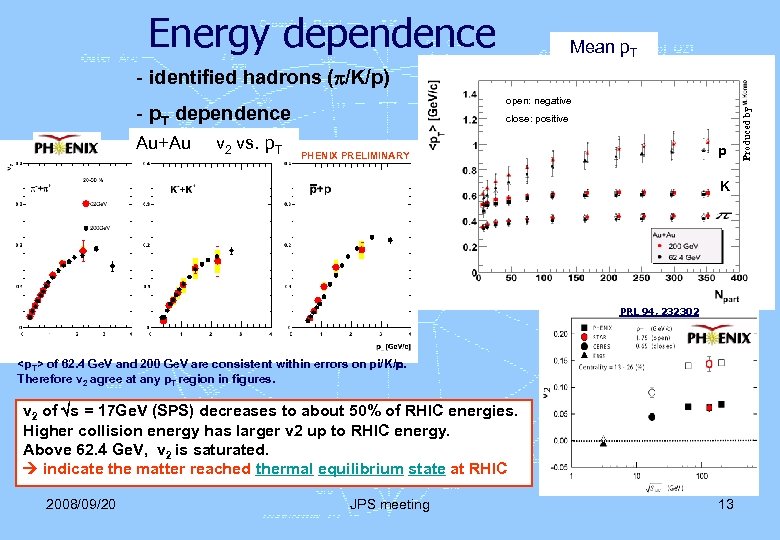
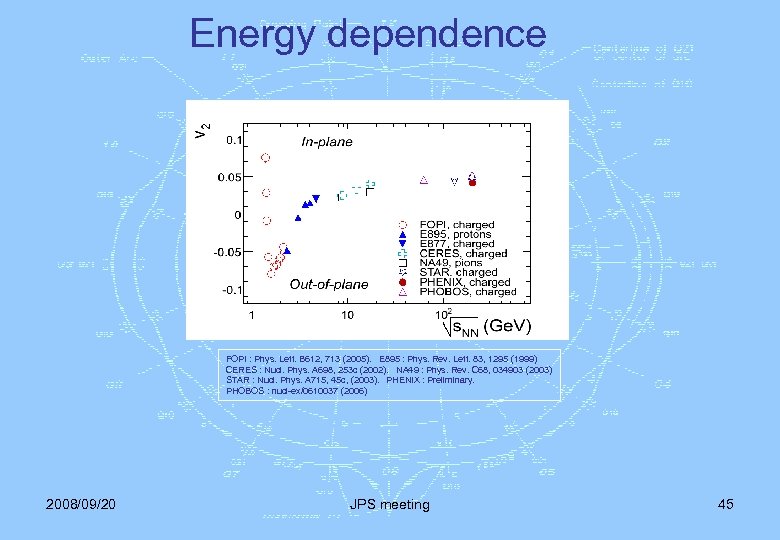
Energy dependence Mean p. T - identified hadrons ( /K/p) - p. T dependence Au+Au v 2 vs. p. T close: positive p PHENIX PRELIMINARY K PRL 94, 232302 <p. T> of 62. 4 Ge. V and 200 Ge. V are consistent within errors on pi/K/p. Therefore v 2 agree at any p. T region in figures. v 2 of s = 17 Ge. V (SPS) decreases to about 50% of RHIC energies. Higher collision energy has larger v 2 up to RHIC energy. Above 62. 4 Ge. V, v 2 is saturated. indicate the matter reached thermal equilibrium state at RHIC 2008/09/20 JPS meeting 13 Produced by open: negative
System Size Dependence • Eccentricity Scaling What can change the size of collision system. • Species of collision nucleus (Au+Au , Cu+Cu) • Centrality 2008/09/20 JPS meeting 14
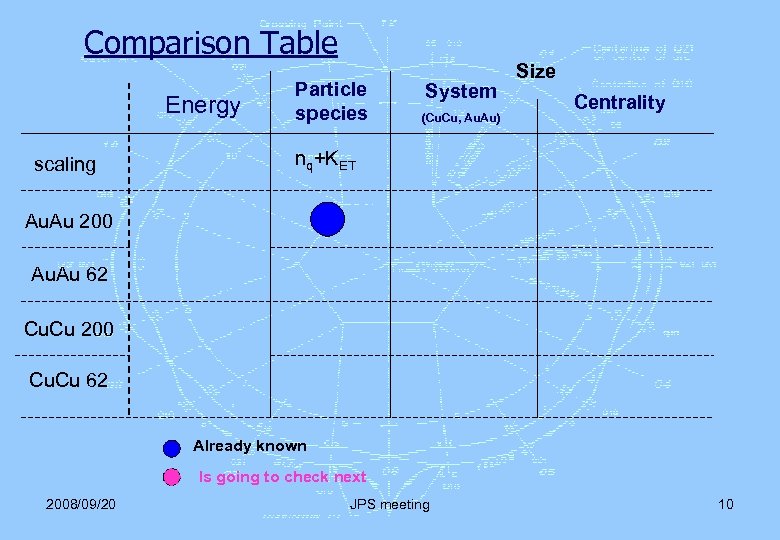
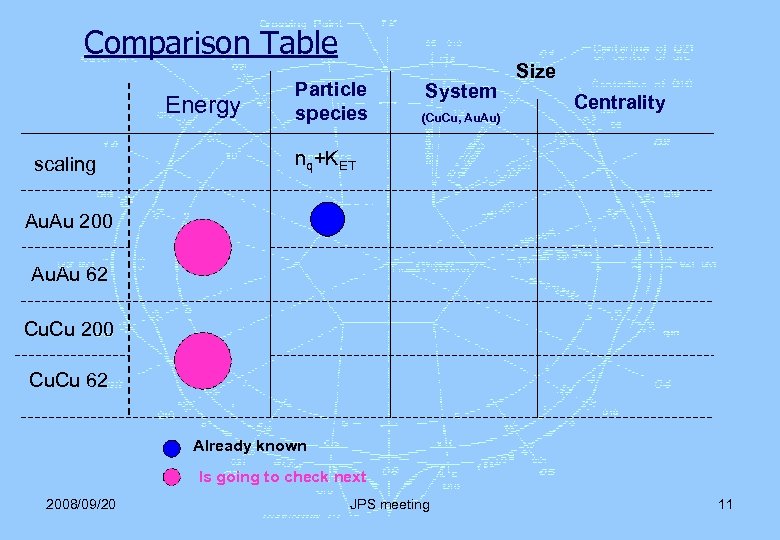
Comparison Table Energy scaling no change Particle species System Size (Cu. Cu, Au. Au) Centrality nq+KET Au. Au 200 Au. Au 62 Cu. Cu 200 Cu. Cu 62 Already known Is going to check next 2008/09/20 JPS meeting checked 15
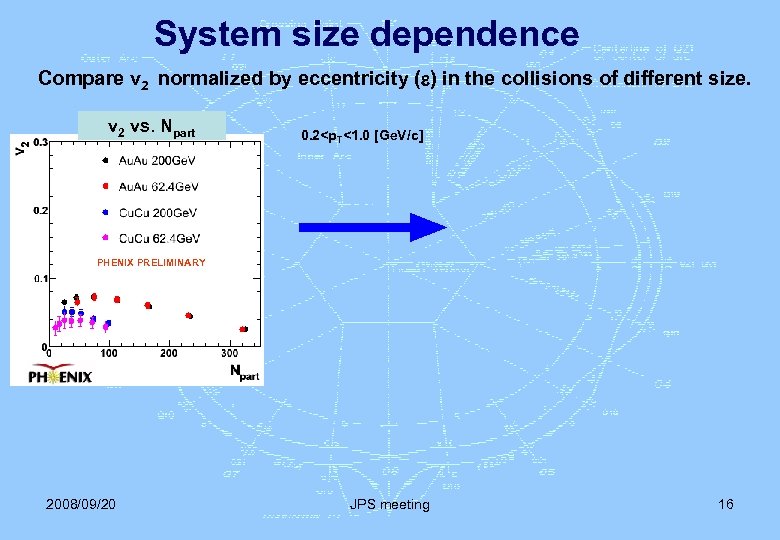
System size dependence Compare v 2 normalized by eccentricity ( ) in the collisions of different size. v 2 vs. Npart 0. 2<p. T<1. 0 [Ge. V/c] PHENIX PRELIMINARY 2008/09/20 JPS meeting 16
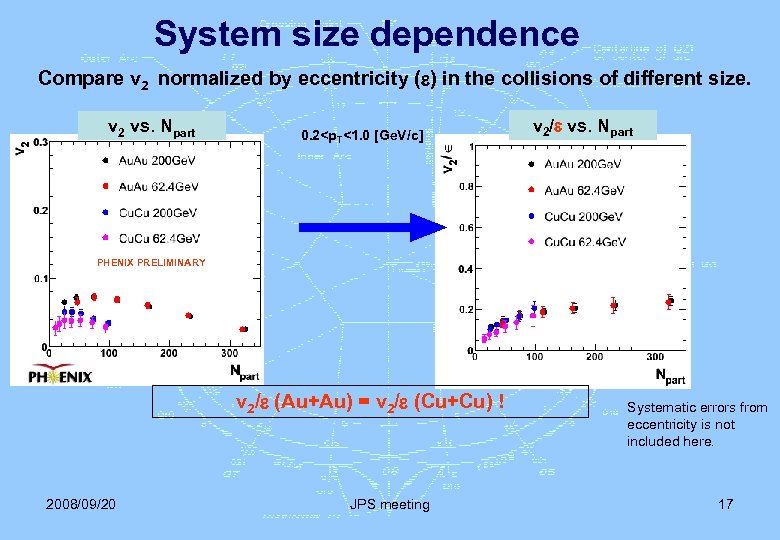
System size dependence Compare v 2 normalized by eccentricity ( ) in the collisions of different size. v 2 vs. Npart 0. 2<p. T<1. 0 [Ge. V/c] v 2/ vs. Npart PHENIX PRELIMINARY v 2/ (Au+Au) = v 2/ (Cu+Cu) ! 2008/09/20 JPS meeting Systematic errors from eccentricity is not included here. 17
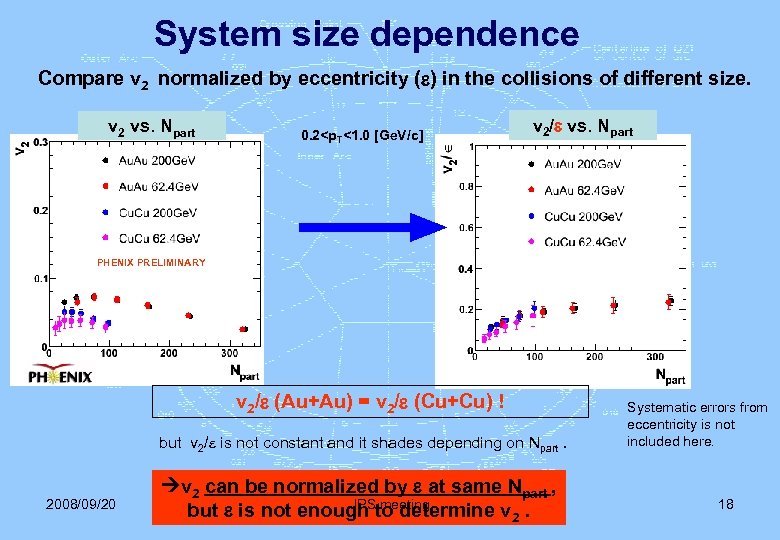
System size dependence Compare v 2 normalized by eccentricity ( ) in the collisions of different size. v 2 vs. Npart 0. 2<p. T<1. 0 [Ge. V/c] v 2/ vs. Npart PHENIX PRELIMINARY v 2/ (Au+Au) = v 2/ (Cu+Cu) ! but v 2/ is not constant and it shades depending on Npart. 2008/09/20 v 2 can be normalized by at same Npart , JPS meeting but is not enough to determine v 2. Systematic errors from eccentricity is not included here. 18
![System size dependence 0. 2<p. T<1. 0 [Ge. V/c] v 2 vs. Npart Dividing](https://present5.com/presentation/f61d839ad650b530524c8d998884bb4e/image-19.jpg "System size dependence 0. 2<p. T<1. 0 [Ge. V/c] v 2 vs. Npart Dividing")
System size dependence 0. 2<p. T<1. 0 [Ge. V/c] v 2 vs. Npart Dividing by Npart 1/3 v 2/ vs. Npart V 2/ /Npart 1/3 vs. Npart PHENIX PRELIMINARY Systematic errors from eccentricity is not included here. v 2/ (Au+Au) = v 2/ (Cu+Cu) v 2/eccentricity is scaled by Npart 1/3 and not dependent on the collision system. 2008/09/20 JPS meeting 19
![System size dependence Dividing by Npart 1/3 1. 0<p. T<2. 0 [Ge. V/c] v](https://present5.com/presentation/f61d839ad650b530524c8d998884bb4e/image-20.jpg "System size dependence Dividing by Npart 1/3 1. 0<p. T<2. 0 [Ge. V/c] v")
System size dependence Dividing by Npart 1/3 1. 0<p. T<2. 0 [Ge. V/c] v 2 vs. Npart v 2/ vs. Npart V 2/ /Npart 1/3 vs. Npart PHENIX PRELIMINARY Systematic errors from eccentricity is not included here. v 2/eccentricity is scaled by Npart 1/3 and not dependent on the collision system. 2008/09/20 JPS meeting 20
![System size dependence Dividing by Npart 1/3 2. 0<p. T<4. 0 [Ge. V/c] v](https://present5.com/presentation/f61d839ad650b530524c8d998884bb4e/image-21.jpg "System size dependence Dividing by Npart 1/3 2. 0<p. T<4. 0 [Ge. V/c] v")
System size dependence Dividing by Npart 1/3 2. 0<p. T<4. 0 [Ge. V/c] v 2 vs. Npart v 2/ vs. Npart V 2/ /Npart 1/3 vs. Npart PHENIX PRELIMINARY Systematic errors from eccentricity is not included here. v 2/eccentricity is scaled by Npart 1/3 and not dependent on the collision system. 2008/09/20 JPS meeting 21
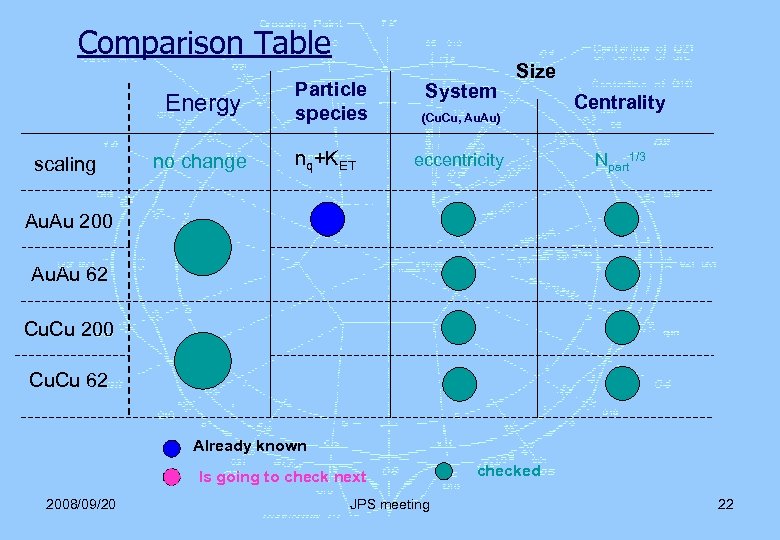
Comparison Table Energy scaling no change Particle species nq+KET System Size (Cu. Cu, Au. Au) eccentricity Centrality Npart 1/3 Au. Au 200 Au. Au 62 Cu. Cu 200 Cu. Cu 62 Already known Is going to check next 2008/09/20 JPS meeting checked 22
Universal v 2 • Quark number + KET scaling • Universal Scaling 2008/09/20 JPS meeting 23
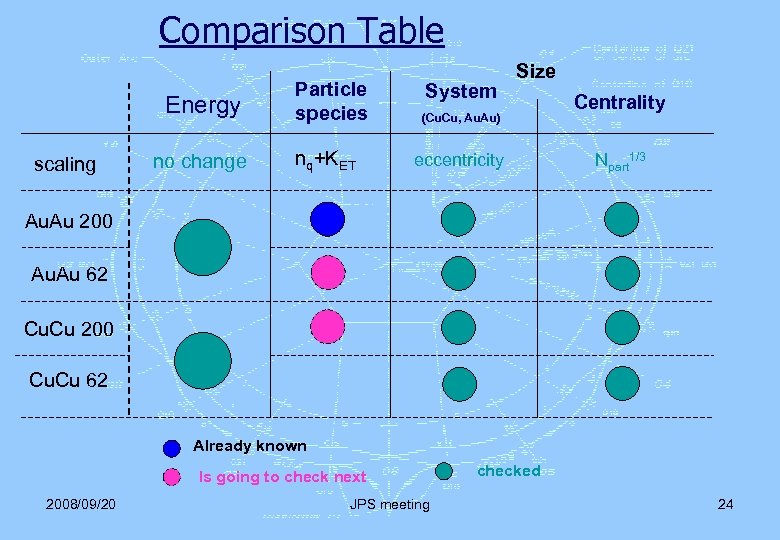
Comparison Table Energy scaling no change Particle species nq+KET System Size (Cu. Cu, Au. Au) eccentricity Centrality Npart 1/3 Au. Au 200 Au. Au 62 Cu. Cu 200 Cu. Cu 62 Already known Is going to check next 2008/09/20 JPS meeting checked 24
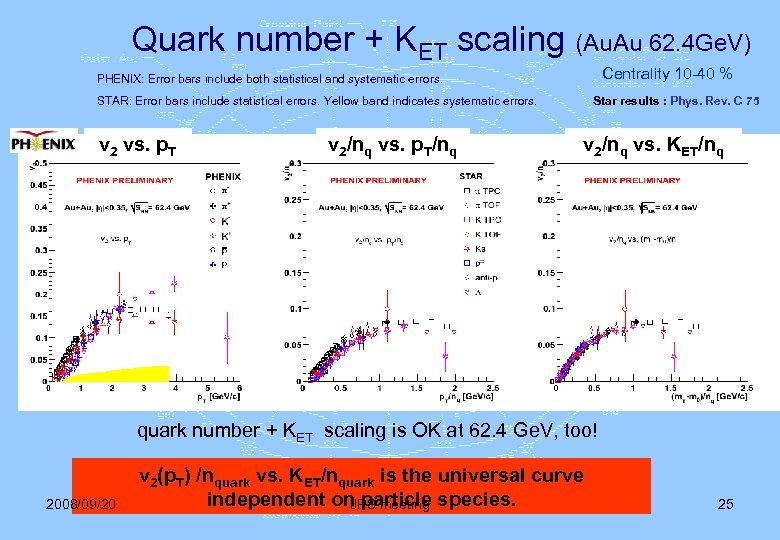
Quark number + KET scaling (Au. Au 62. 4 Ge. V) Centrality 10 -40 % PHENIX: Error bars include both statistical and systematic errors. STAR: Error bars include statistical errors. Yellow band indicates systematic errors. v 2 vs. p. T v 2/nq vs. p. T/nq Star results : Phys. Rev. C 75 v 2/nq vs. KET/nq quark number + KET scaling is OK at 62. 4 Ge. V, too! 2008/09/20 v 2(p. T) /nquark vs. KET/nquark is the universal curve independent on particle species. JPS meeting 25
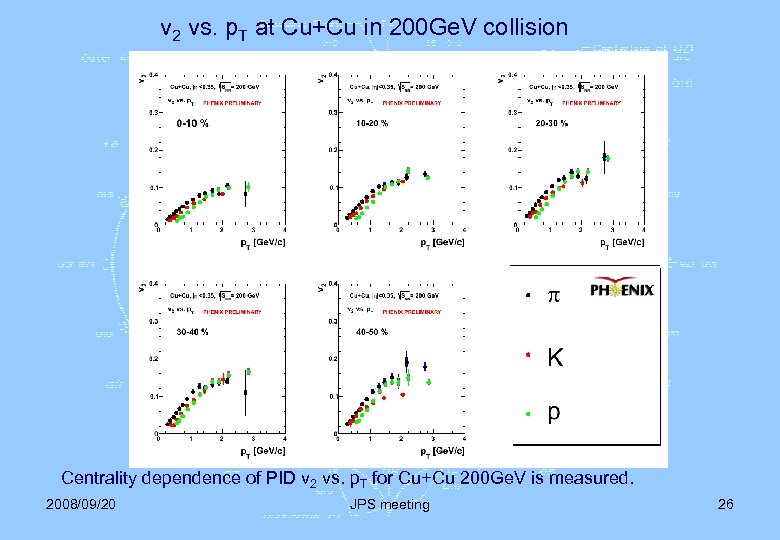
v 2 vs. p. T at Cu+Cu in 200 Ge. V collision Centrality dependence of PID v 2 vs. p. T for Cu+Cu 200 Ge. V is measured. 2008/09/20 JPS meeting 26
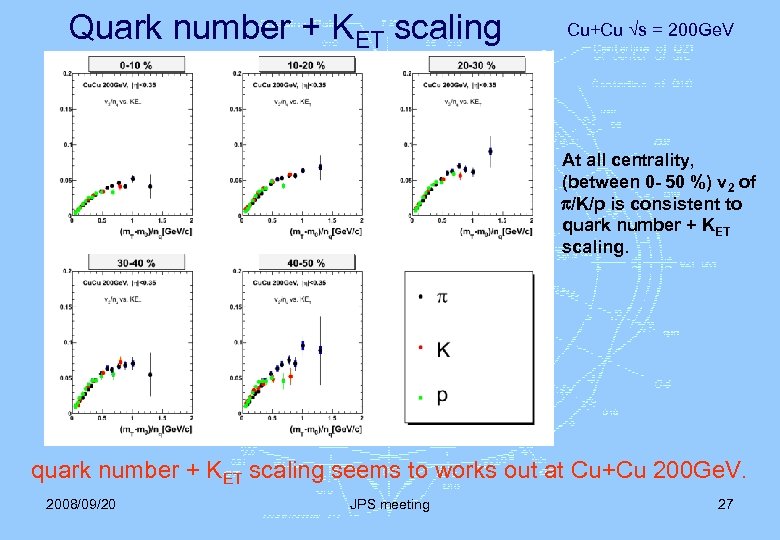
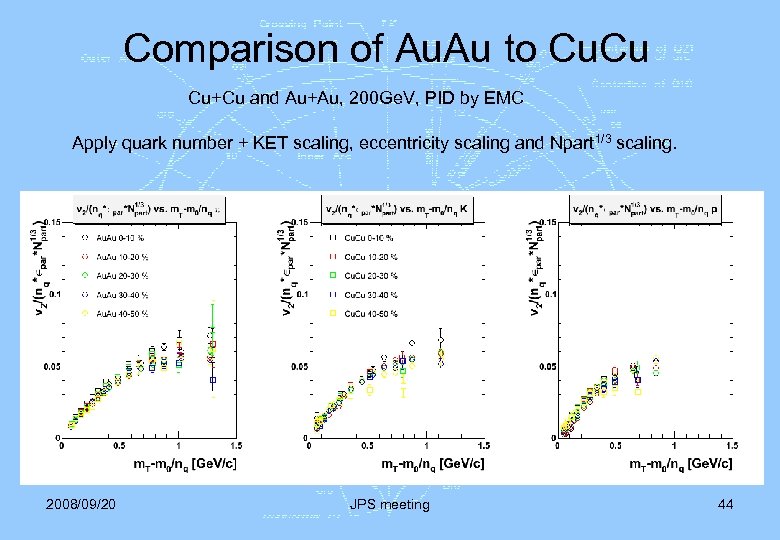
Quark number + KET scaling Cu+Cu s = 200 Ge. V At all centrality, (between 0 - 50 %) v 2 of /K/p is consistent to quark number + KET scaling seems to works out at Cu+Cu 200 Ge. V. 2008/09/20 JPS meeting 27
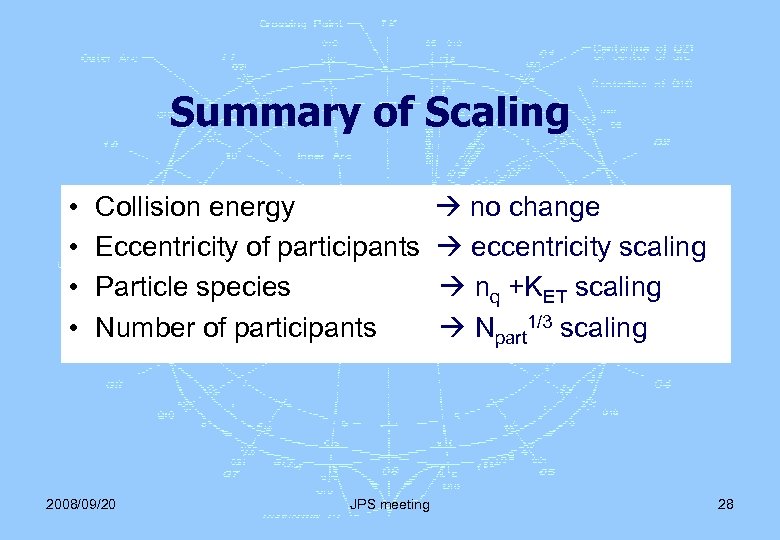
Summary of Scaling • • Collision energy Eccentricity of participants Particle species Number of participants 2008/09/20 JPS meeting no change eccentricity scaling nq +KET scaling Npart 1/3 scaling 28
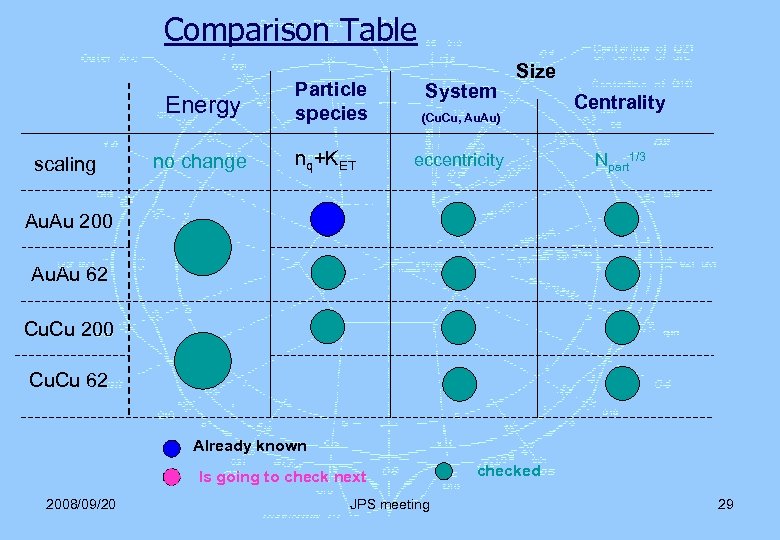
Comparison Table Energy scaling no change Particle species nq+KET System Size (Cu. Cu, Au. Au) eccentricity Centrality Npart 1/3 Au. Au 200 Au. Au 62 Cu. Cu 200 Cu. Cu 62 Already known Is going to check next 2008/09/20 JPS meeting checked 29
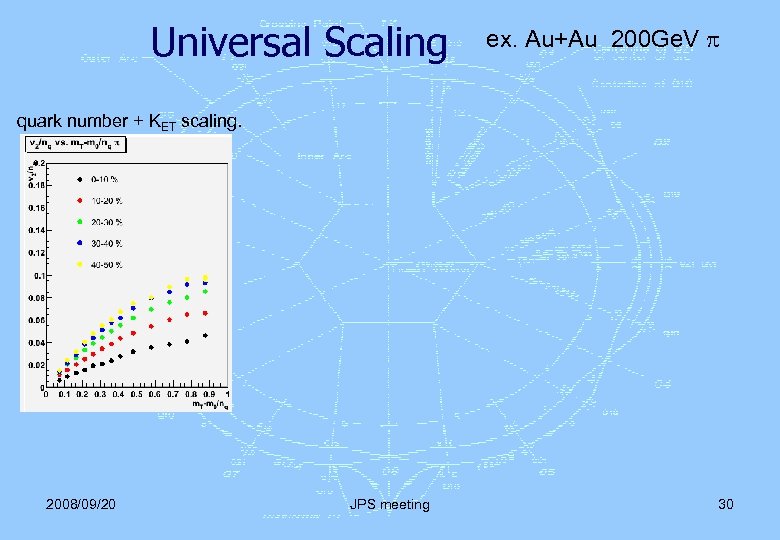
Universal Scaling ex. Au+Au 200 Ge. V quark number + KET scaling. 2008/09/20 JPS meeting 30
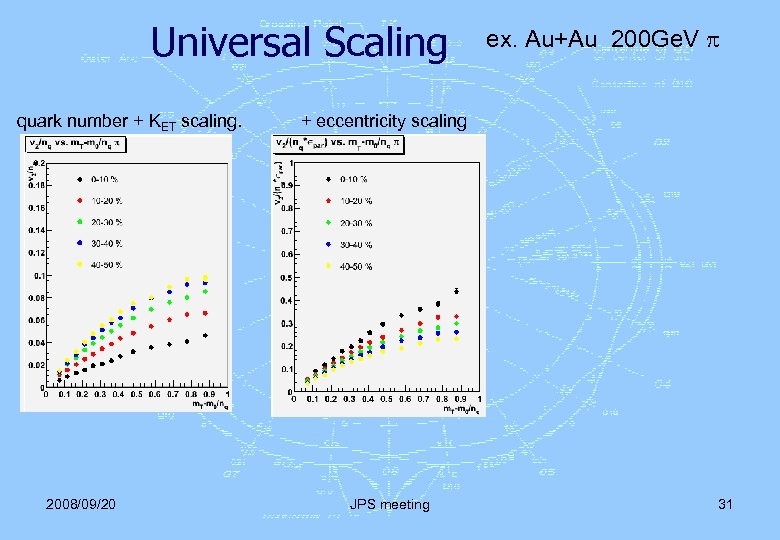
Universal Scaling quark number + KET scaling. 2008/09/20 ex. Au+Au 200 Ge. V + eccentricity scaling JPS meeting 31
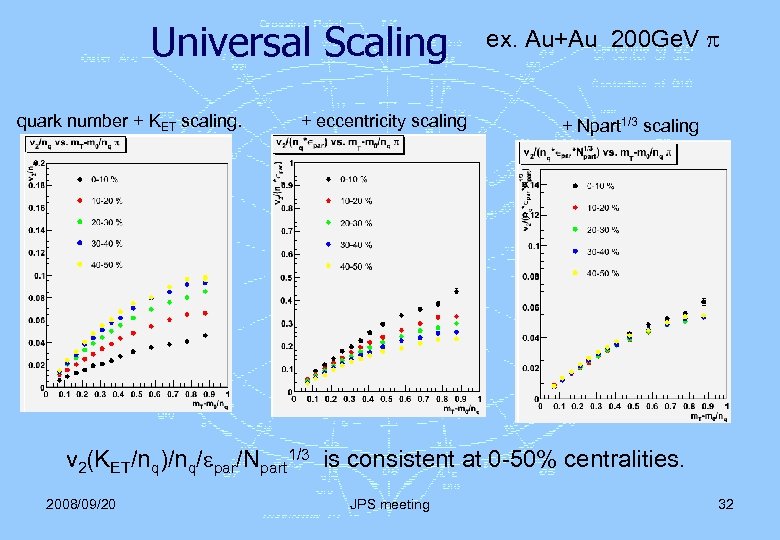
Universal Scaling quark number + KET scaling. + eccentricity scaling ex. Au+Au 200 Ge. V + Npart 1/3 scaling v 2(KET/nq)/nq/ par/Npart 1/3 is consistent at 0 -50% centralities. 2008/09/20 JPS meeting 32
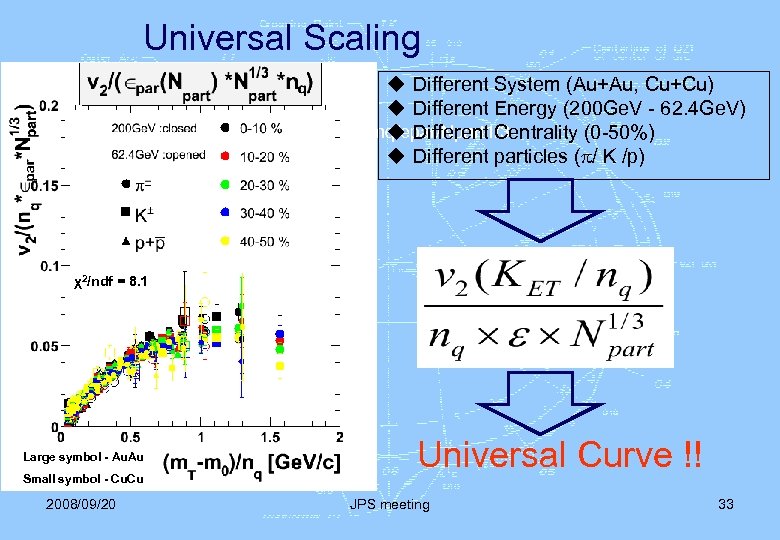
Universal Scaling u Different System (Au+Au, Cu+Cu) u Different Energy (200 Ge. V - 62. 4 Ge. V) v 2(KET/nq)/nq/epar/Npart 1/3 u Different Centrality (0 -50%) u Different particles ( / K /p) χ2/ndf = 8. 1 Large symbol - Au. Au Small symbol - Cu. Cu 2008/09/20 Universal Curve !! JPS meeting 33
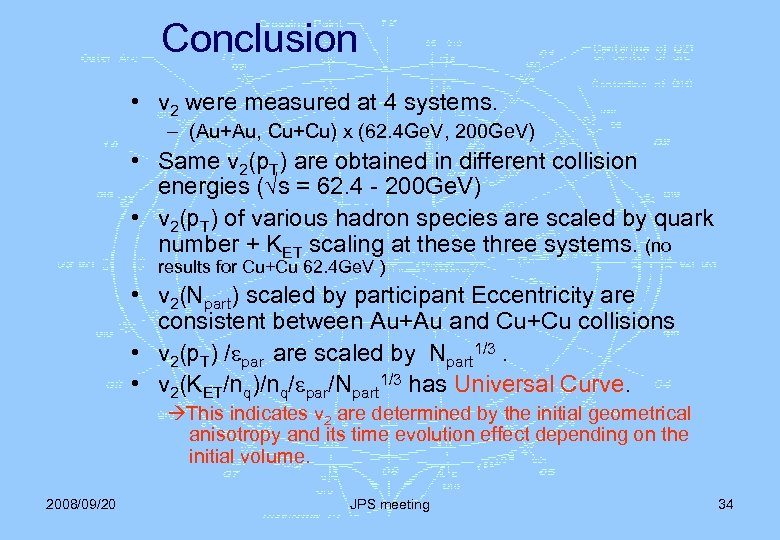
Conclusion • v 2 were measured at 4 systems. – (Au+Au, Cu+Cu) x (62. 4 Ge. V, 200 Ge. V) • Same v 2(p. T) are obtained in different collision energies ( s = 62. 4 - 200 Ge. V) • v 2(p. T) of various hadron species are scaled by quark number + KET scaling at these three systems. (no results for Cu+Cu 62. 4 Ge. V ) • v 2(Npart) scaled by participant Eccentricity are consistent between Au+Au and Cu+Cu collisions • v 2(p. T) / par are scaled by Npart 1/3. • v 2(KET/nq)/nq/ par/Npart 1/3 has Universal Curve. This indicates v 2 are determined by the initial geometrical anisotropy and its time evolution effect depending on the initial volume. 2008/09/20 JPS meeting 34
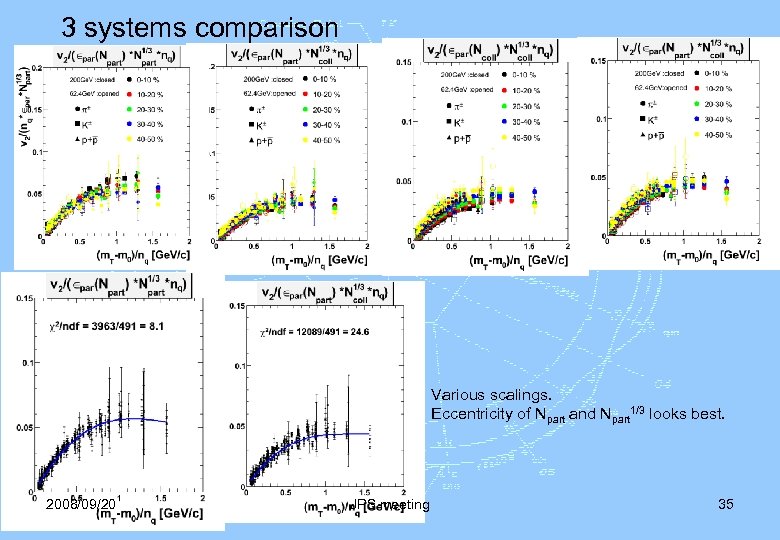
3 systems comparison Various scalings. Eccentricity of Npart and Npart 1/3 looks best. 2008/09/20 JPS meeting 35
Back Up 2008/09/20 JPS meeting 36
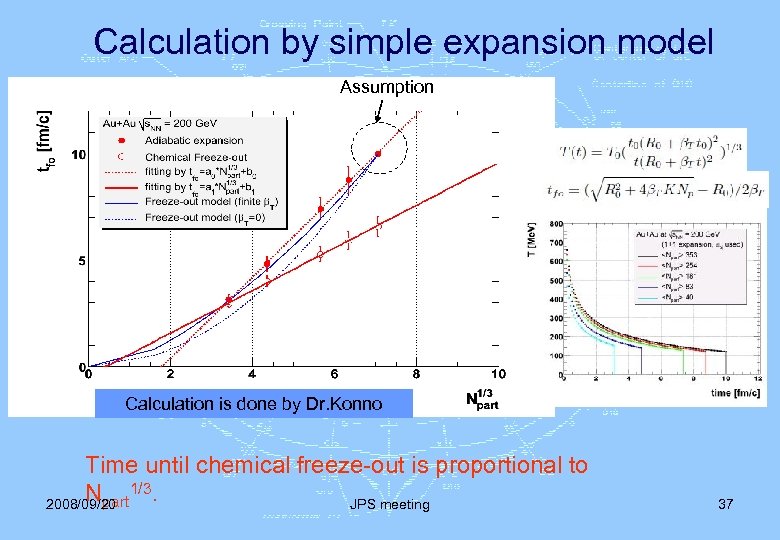
Calculation by simple expansion model Assumption Calculation is done by Dr. Konno Time until chemical freeze-out is proportional to Npart 1/3. 2008/09/20 JPS meeting 37
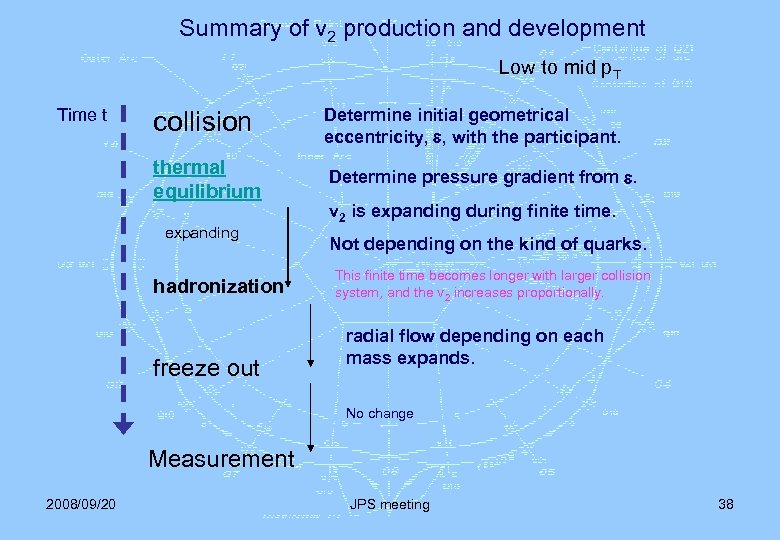
Summary of v 2 production and development Low to mid p. T Time t collision thermal equilibrium expanding hadronization freeze out Determine initial geometrical eccentricity, , with the participant. Determine pressure gradient from . v 2 is expanding during finite time. Not depending on the kind of quarks. This finite time becomes longer with larger collision system, and the v 2 increases proportionally. radial flow depending on each mass expands. No change Measurement 2008/09/20 JPS meeting 38
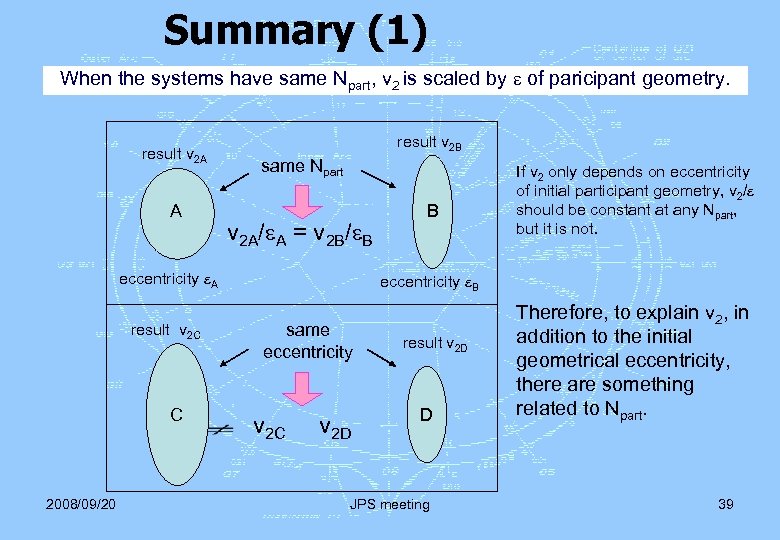
Summary (1) When the systems have same Npart, v 2 is scaled by of paricipant geometry. result v 2 A A result v 2 B same Npart v 2 A/ A = v 2 B/ B eccentricity A result v 2 C C 2008/09/20 B If v 2 only depends on eccentricity of initial participant geometry, v 2/ should be constant at any Npart, but it is not. eccentricity B same eccentricity v 2 C v 2 D result v 2 D D JPS meeting Therefore, to explain v 2, in addition to the initial geometrical eccentricity, there are something related to Npart. 39
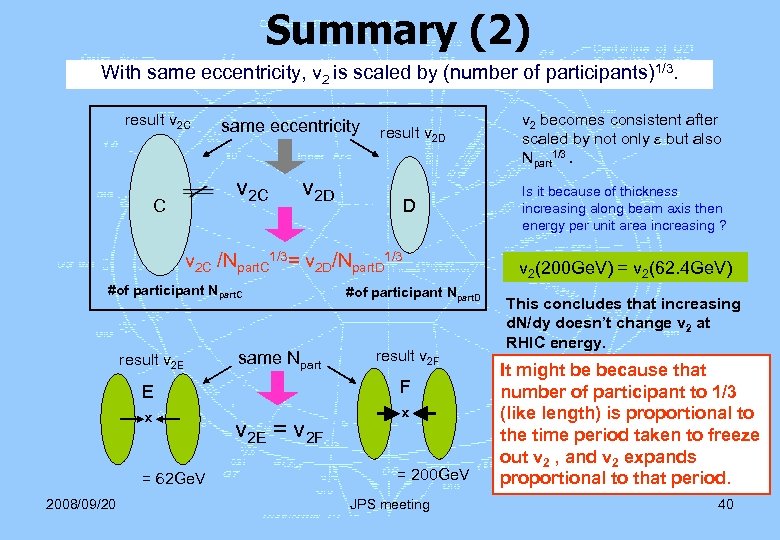
Summary (2) With same eccentricity, v 2 is scaled by (number of participants)1/3. result v 2 C C result v 2 D v 2 becomes consistent after scaled by not only but also Npart 1/3. D same eccentricity Is it because of thickness increasing along beam axis then energy per unit area increasing ? v 2 D v 2 C /Npart. C 1/3= v 2 D/Npart. D 1/3 #of participant Npart. C result v 2 E same Npart = 62 Ge. V 2008/09/20 result v 2 F F E X #of participant Npart. D v 2 E = v 2 F X = 200 Ge. V JPS meeting v 2(200 Ge. V) = v 2(62. 4 Ge. V) This concludes that increasing d. N/dy doesn’t change v 2 at RHIC energy. It might be because that number of participant to 1/3 (like length) is proportional to the time period taken to freeze out v 2 , and v 2 expands proportional to that period. 40
Comparison of experimental results to hydro calculation. Hydro calculations are done by Dr. Hirano. ref: ar. Xiv: 0710. 5795 [nucl-th] and Phys. Lett. B 636, 299 (2006) QGP fluid+hadron gas with Glauber I. C. 2008/09/20 JPS meeting 41
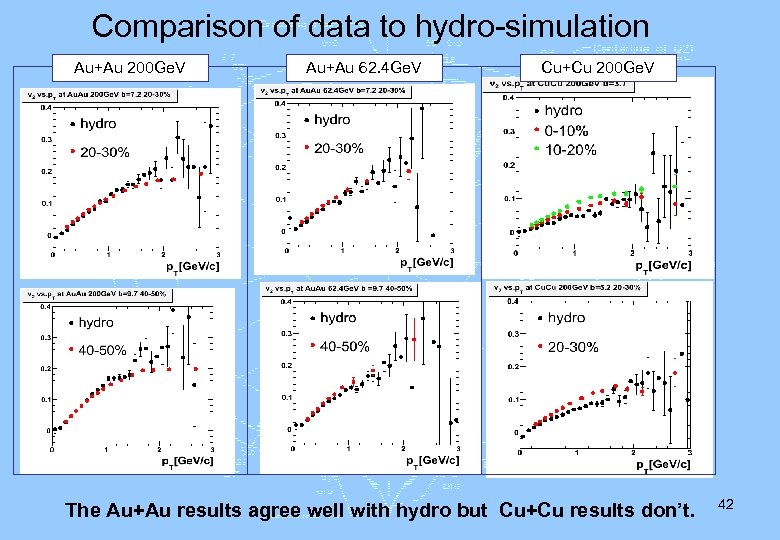
Comparison of data to hydro-simulation Au+Au 200 Ge. V Au+Au 62. 4 Ge. V Cu+Cu 200 Ge. V The Au+Au results agree well with hydro but Cu+Cu results don’t. 42
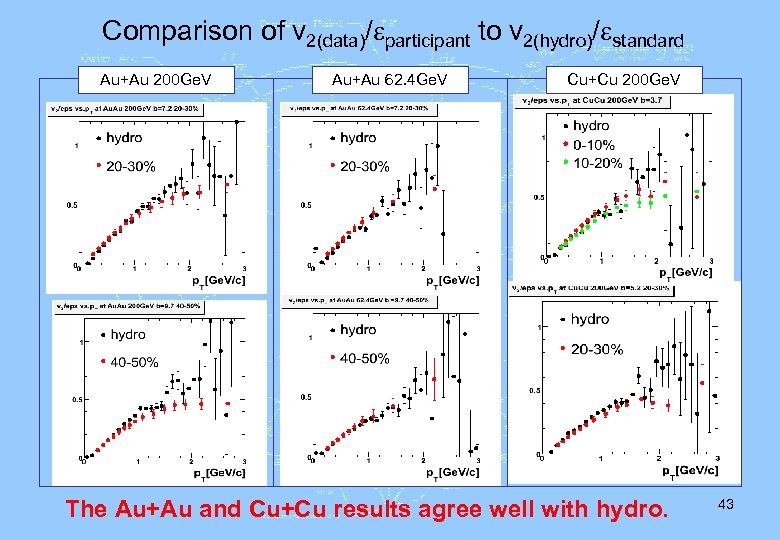
Comparison of v 2(data)/ participant to v 2(hydro)/ standard Au+Au 200 Ge. V Au+Au 62. 4 Ge. V Cu+Cu 200 Ge. V The Au+Au and Cu+Cu results agree well with hydro. 43
Comparison of Au. Au to Cu. Cu Cu+Cu and Au+Au, 200 Ge. V, PID by EMC Apply quark number + KET scaling, eccentricity scaling and Npart 1/3 scaling. 2008/09/20 JPS meeting 44
Energy dependence FOPI : Phys. Lett. B 612, 713 (2005). E 895 : Phys. Rev. Lett. 83, 1295 (1999) CERES : Nucl. Phys. A 698, 253 c (2002). NA 49 : Phys. Rev. C 68, 034903 (2003) STAR : Nucl. Phys. A 715, 45 c, (2003). PHENIX : Preliminary. PHOBOS : nucl-ex/0610037 (2006) 2008/09/20 JPS meeting 45
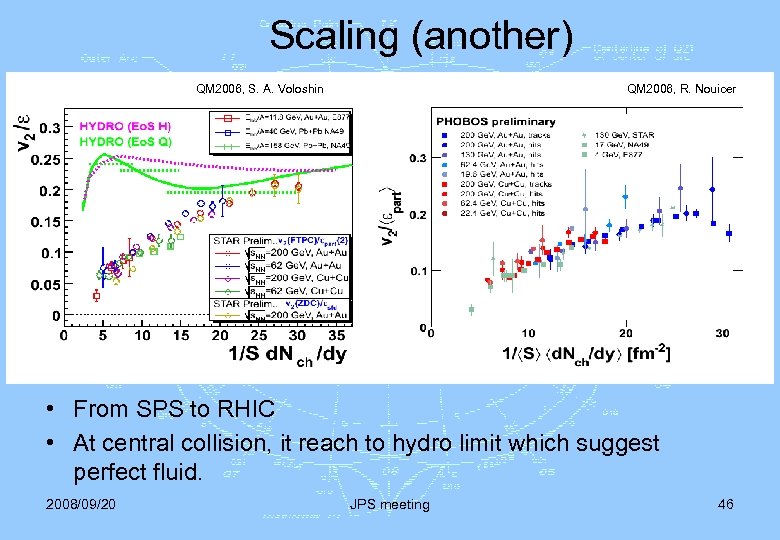
Scaling (another) QM 2006, S. A. Voloshin QM 2006, R. Nouicer • From SPS to RHIC • At central collision, it reach to hydro limit which suggest perfect fluid. 2008/09/20 JPS meeting 46
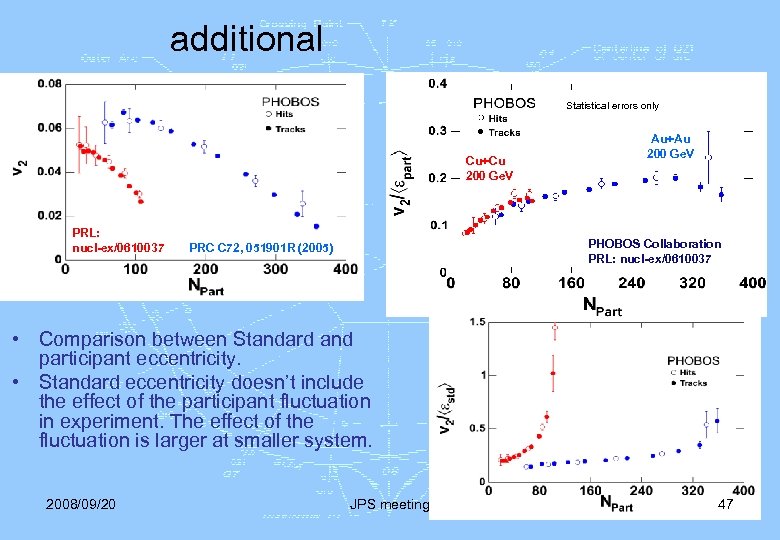
additional Statistical errors only Cu+Cu 200 Ge. V PRL: nucl-ex/0610037 Au+Au 200 Ge. V PHOBOS Collaboration PRL: nucl-ex/0610037 PRC C 72, 051901 R (2005) • Comparison between Standard and participant eccentricity. • Standard eccentricity doesn’t include the effect of the participant fluctuation in experiment. The effect of the fluctuation is larger at smaller system. 2008/09/20 JPS meeting 47
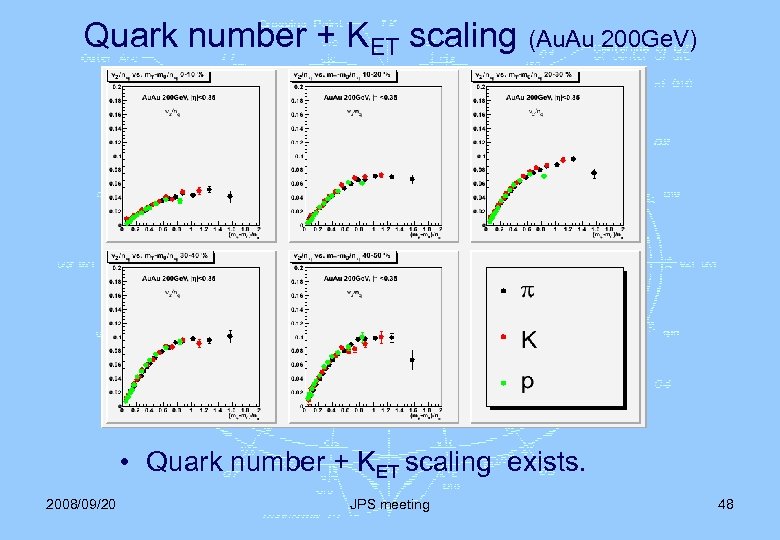
Quark number + KET scaling (Au. Au 200 Ge. V) • Quark number + KET scaling exists. 2008/09/20 JPS meeting 48
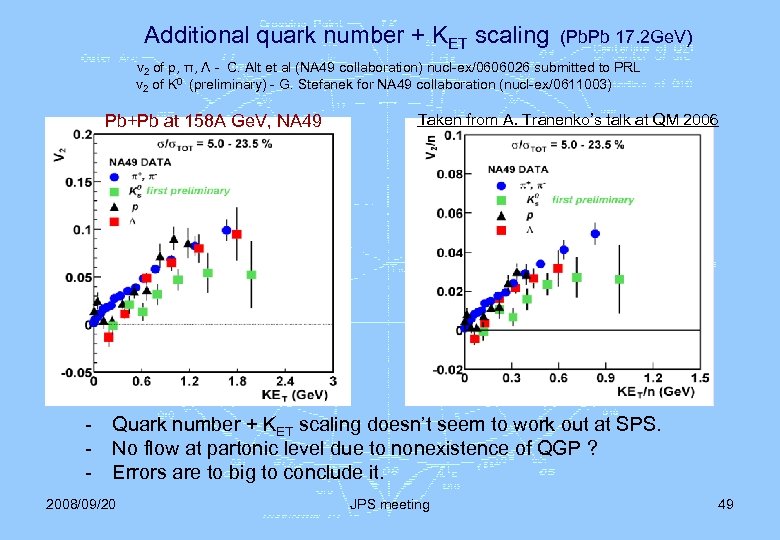
Additional quark number + KET scaling (Pb. Pb 17. 2 Ge. V) v 2 of p, π, Λ - C. Alt et al (NA 49 collaboration) nucl-ex/0606026 submitted to PRL v 2 of K 0 (preliminary) - G. Stefanek for NA 49 collaboration (nucl-ex/0611003) Pb+Pb at 158 A Ge. V, NA 49 Taken from A. Tranenko’s talk at QM 2006 - Quark number + KET scaling doesn’t seem to work out at SPS. - No flow at partonic level due to nonexistence of QGP ? - Errors are to big to conclude it. 2008/09/20 JPS meeting 49
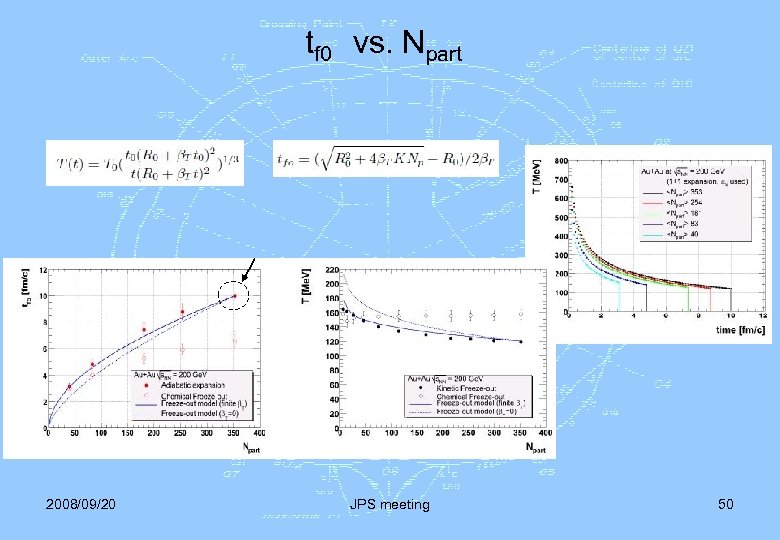
tf 0 vs. Npart 2008/09/20 JPS meeting 50
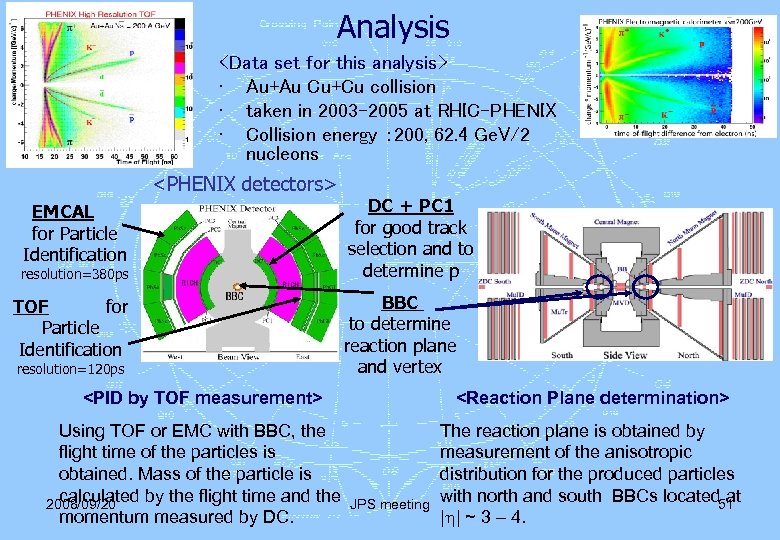
Analysis <Data set for this analysis> • Au+Au Cu+Cu collision • taken in 2003 -2005 at RHIC-PHENIX • Collision energy : 200, 62. 4 Ge. V/2 nucleons <PHENIX detectors> EMCAL for Particle Identification resolution=380 ps TOF for Particle Identification resolution=120 ps DC + PC 1 for good track selection and to determine p BBC to determine reaction plane and vertex <PID by TOF measurement> Using TOF or EMC with BBC, the flight time of the particles is obtained. Mass of the particle is calculated by the flight time and the 2008/09/20 momentum measured by DC. <Reaction Plane determination> JPS meeting The reaction plane is obtained by measurement of the anisotropic distribution for the produced particles with north and south BBCs located 51 at | | ~ 3 – 4.
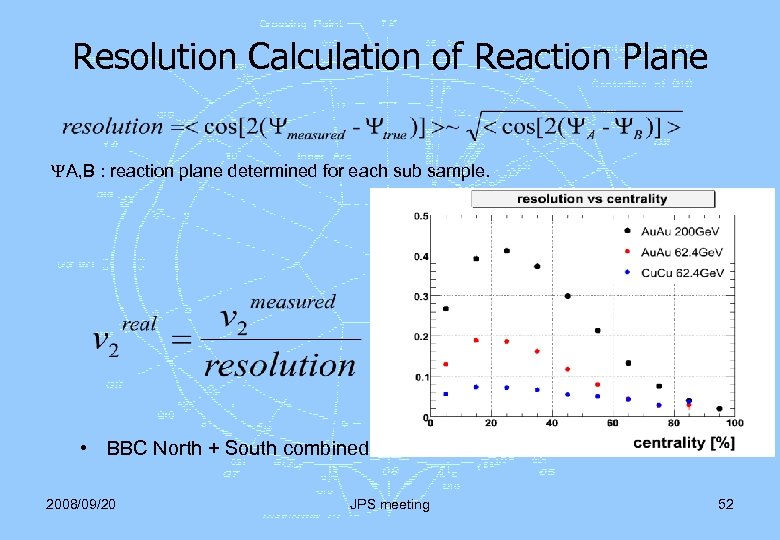
Resolution Calculation of Reaction Plane A, B : reaction plane determined for each sub sample. • BBC North + South combined 2008/09/20 JPS meeting 52
Скачать презентацию RHIC-PHENIX実験における荷電ハドロン 楕円フローの系統的研究 下村 真弥 for the PHENIX Collaborations University
f61d839ad650b530524c8d998884bb4e.ppt